Rare Decays at LHCb
Sam Hall1,aon behalf of the LHCb collaboration
1Imperial College London
Abstract. Rare decays of beauty and charm hadrons provide an effective method of testing the Standard Model and probing possible new physics scenarios. The LHCb experiment has published a variety of interesting results in this field, some of which are presented here. In particular the measurements of the branching fractions ofB0
(s)→μ+μ−which, in combination with CMS, resulted in the first observation of theB0
s →μ+μ−decay. Other topics include searches for the rare decayD0→μ+μ−, the lepton flavour violating decays B0
(s)→e±μ∓, and the observation of theψ(4160) resonance in the region of low recoil in B+→K+μ+μ−decay. New results on the angular analysis of the decayB0→
K∗0μ+μ− with form factor independent observables are also shown.
1 Introduction
Flavour changing neutral currents (FCNCs) are forbidden at tree level in the Standard Model (SM) and thus are mediated by loop processes. At leading order these loops are either penguin or box type diagrams, Fig. 1a. Virtual particles can enter these loops, probing mass scales much higher than those
accessible via direct production. In the SMb → stransition thet-quark dominates in the loop, but
in a New Physics (NP) model such as Supersymmetry (SUSY) other heavy particles, see Fig. 1b, can contribute and significantly alter the observed physics. These indirect probes are complementary approaches to those taken by general purpose detectors.
The rare nature of the aforementioned transitions is exploited as a tool for hunting NP since contributions could be of the same order to those from the SM. A FCNC decay’s suppression is dependent on a number of factors, particularly the mass of the quark mediating the loop, the GIM mechanism and helicity suppression.
Measurements of rare decays strongly constrain possible new physics scenarios in a model independent
way using the Operator Product Expansion (OPE). The OPE uses an effective Hamiltonian with all
heavy fields, such as the top andW, integrated out, it includes a set of generic operators,Oi, and
coefficients,Ci, which are known as Wilson coefficients. The operators and Wilson coefficients describe
ae-mail: [email protected] DOI: 10.1051/
C
Owned by the authors, published by EDP Sciences, 2014
/2 01
b
s
W
−t
Z/γ
μ
+μ
−b
s
t
W
−W
+ν
μμ
+μ
−(a)
b
s
H
−˜
d
H
0μ
+μ
−b
s
t
H
−H
+ν
μμ
+μ
−(b)
Figure 1: Feynman diagrams showing examples of theb→ sFCNC in the (a) SM and (b) SUSY particles
mediating the (top) penguin, (bottom) box loops.
long and short distance interactions respectively, for ab→ s(d) transition the effective Hamiltonian is:
Heff≈ −
4√GF
2VtbV
∗
ts(d) e2
16π2
i=7,9,10,S,P
CiOi+CiOi +
h.c.. (1)
In the SM the process is sensitive to the Wilson coefficientsC7, the photonic penguin,C9, the vector
mediated dilepton-penguin, andC10which is the axial-vector mediated dilepton-penguin. The scalar,
CS, and pseudoscalar,CP, transitions are also included but are suppressed bymmb/m2W. The helicity
state disfavoured by the SM is denoted byOiandCi, these are vanishingly small.
Wilson coefficients are accessible both by measuring branching fractions and angular observables of
decaying mesons. Since each Wilson coefficient describes a particular interaction, placing limits on
them constrains NP contributions in that process.
Branching fraction measurements and angular distributions of decaying mesons (with interesting helicity structures) lead to direct constraints on all the involved coefficients, and thus potential NP models.
1.1 The LHCb detector
The LHCb experiment is located on the LHC accelerator at CERN and is supplied withppcollisions
at √s=7(8) TeV in 2011(2012). A largebbcross-section at these energies in the LHCb acceptance
decays to be analysed. On the other hand, understanding the complex event structure inppcollisions is challenging.
The LHCb detector is a single-arm forward spectrometer covering the pseudorapidity range 2< η <5 designed for the study of particles containingborcquarks. In order to do this effectively the detector is equipped with two Ring Imaging CHerenkov (RICH) detectors. The RICH detectors together with tracking stations, calorimeters and muon chambers gives LHCb excellent particle identification capabilities over the momentum range 1 to 100 GeV/c. For example, the muon identification efficiency is 97% for only a 1 to 3% misidentification rate, and the kaon identification is 95% for only a 5% pion misidentification probability. A silicon-strip VErtex LOcator, VELO, provides high precision track measurements close to the interaction point, giving an impact parameter resolution of 20μm for tracks with large transverse momentum. A full description of the LHCb detector is given in Ref. [2].
2 Searches for very rare and forbidden decays
Comparable strategies are employed in all rare decay analyses. Signal and normalization candidates are selected by a hardware trigger and subsequent software triggers [3]. Triggers require that there are highpTtracks in an event, and a well defined displaced secondary vertex with reference to the primary
vertex defined by theppcollision. Muons in the decay are must register hits in the muon systems.
The complex event structure ofppcollisions and the rarity of these events leads to the use of advanced analytical techniques such as multivariate selections. Boosted Decision Trees (BDTs) are the type of favoured multivariate classifier used in these analyses, they are trained to differentiate between signal and background candidates. Input variables are a variety of geometric and kinematic variables. Most background removal is done by placing a cut on the output of the BDT discriminant.
2.1 Analysis of the very rare decayB0(s) →μ+μ−
The decaysB0
s→μ+μ−andB0→μ+μ−are well motivated by theory and LHCb offers an excellent
arena to search for them. The decayB0
s→μ+μ−is heavily suppressed in the SM because it is an FCNC,
Fig. 1a, and helicity suppressed decays. TheB0 → μ+μ−decay is further disfavoured because the
FCNC is ab→dtransition, and is therefore rarer by approximately a factor of|Vtd/Vts|2in the SM.
There are precise predictions for the branching fraction of these decays in the SM [4]:
B(B0s→μ+μ−)=(3.23±0.27)×10−9,
B(B0→μ+μ−)=(1.07±0.10)×10−10. (2)
Here, branching fraction uncertainties are dominated by theBsdecay constant and the relevant CKM
matrix elements.
New scalar, pseudoscalar, and axial-vector particles can all contribute to the loop amplitude; although the axial-vector is helicity suppressed. This would be observed as a deviation in the branching fraction from the SM predictions in Eq. 2. These decays are particularly sensitive to supersymmetry for two main reasons: firstly a neutral Higgs lifts the helicity supression; and secondly the branching fraction is proportional to tan6β, where tanβis the ratio of vacuum expectations values of the up and down
BDT
0 0.2 0.4 0.6 0.8 1
-4
10
-3
10
-2
10
-1
10 1
Signal
Background LHCb
Figure 2:Distributions in bins of the BDT classifier for signal-proxyB0
(s)−>hh(h
()=π±,K±) candidates and for events in the mass sidebands [7]. The signal response is linear whereas the background sample response drops as the BDT value increases.
The ratio of the branching fractions of the decays B0
s → μ+μ− and B0 → μ+μ− leads to some
uncertainties being cancelled:
B(B0
s→μ+μ−)
B(B0→μ+μ−) = 30.35 (1±0.06±2σfs/d), (3)
hereσfs/d is the relative error of fBs/fBd [4]. This is also a very precise test of the Minimal Flavour
Violation, MFV, scenario which assumes that the flavour structure BSM is the same as in the SM, and would therefore be an interesting future measurement for the LHCb upgrade.
Dominant backgrounds forB0
(s)→μ+μ−are of the formbb→Xμμ, caused when abbpair hadronizes
separately and decays into final states containing muons appearing to point to a common secondary vertex. Analysis of the decaysB0
(s)→μ+μ−features two multivariate classifiers. The first, described
in Ref. [5], efficiently removes background contamination frombb→Xμμleaving signal efficiency
high. Remaining candidates are binned according to the result of the second discriminant thus allowing access to signal candidates that would be removed by a simple cut. The second BDT includes the input variables:Bcandidate decay time,IPandpT; the minimumχ2IPof the two muons with respect to any
PV; the distance of closest approach between the two muons; and the cosine of the angle between the muon momentum in the dimuon rest frame and the vector perpendicular to both the B candidate
momentum and the beam axis. Moreover two different measures for the isolation of signal candidates
are included: the number of good two-track vertices a muon can make with other tracks in the event; and theBcandidate isolation, introduced in Ref. [6]. The signal efficiency is linear with the value of
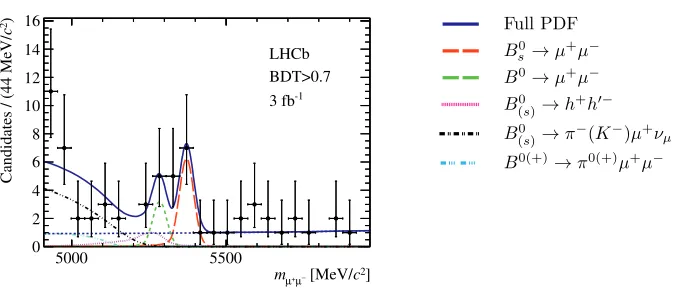
the BDT cut but the background efficiency drops, Fig. 2. A simultaneous fit is then performed to all
bins and the total signal yield extracted.
In the final selection combinatorial background dominates around theB0
smass, but peaking background
fromB0
(s)−>hh, where both hadrons are misidentified as muons. A wrong mass hypothesis here
induces a displacement to lower mass and hence only theB0mass window is affected. This adds to the
] 2 c [MeV/ − μ + μ m
5000 5500
)
2c
Candidates / (44 MeV/
0 2 4 6 8 10 12 14 16
LHCb BDT>0.7
-1 3 fb
Full PDF
B0
s→μ+μ−
B0→μ+μ−
B0
(s)→h+h−
B0
(s)→π−(K−)μ+νμ
B0(+)→π0(+)μ+μ−
Figure 3:(left) The three most signal like BDT bins are plotted and fitted functions are overlayed.
The normalization is achieved using two decays channels chosen for their similarity to the signal. The
decayB0 → K+π−is chosen because it has similar kinematics, and the decayB+ → J/ψK+where
J/ψ →μ+μ−is also used because the muon triggering is similar. Signal yield of the normalization and signal channels is used to calculate the branching fractions ofB0
(s) →μ+μ−using:
B(B0q →μ+μ−)=Bnorm· norm B0
q→μ+μ−
· fnorm fBq
·NB0q→μ+μ−
Nnorm .
(4)
In this equation is the total efficiency of the given decay, this includes the trigger, geometric acceptance and selection. Lastly, fX denotes a fragmentation function, which is the probability for abto hadronize
into a given hadronX. The values of the fragmentation fractions, fX, used were measured by LHCb
[8].
After normalization, the calculated branching fractions are:
B(B0
s →μ+μ−)=
2.9+−11..10(stat)−+00..31(syst)×10−9,
B(B0→μ+μ−)=3.7−+22..41(stat)−+00..64(syst)×10−10, (5)
with statistical significances of 4.0σand 2.0σrespectively [7]. Low significance of the latter motivates calculating a limit:
B(B0d→μ+μ−)<7.4×10⁻¹⁰ (6)
to 95% confidence level using the CLsmethod[9].
The CMS collaboration also published measurements of the branching fractions of these decays [10]. An average of the results from LHCb and CMS has been performed [11], the resulting branching fractions are:
B(B0
s →μ+μ−)=(2.9±0.7)×10−9, B(B0 →μ+μ−)=3.6+1.6
−1.4
×10−10. (7)
The statistical significance of the measurement ofB(B0
s→μ+μ−) is over 5σ, and thus an observation
]
9 −
) [10
−
μ
+
μ →
s 0 B
B(
0 1 2 3 4 5 6 7
preliminary CMS+LHCb
1 −
CMS 25fb
1 −
LHCb 3fb
SM
]
10 −
) [10
−
μ
+
μ →
0 B
B(
0 1 2 3 4 5 6 7
preliminary CMS+LHCb
1 −
CMS 25fb
1 −
LHCb 3fb
SM
Figure 4:Comparisons of the SM expected branching fraction (green band) forB0
s→μ+μ−andB0→μ+μ−with the measurements from CMS, LHCb and the combination of these results (1σuncertainties are shown). While B(B0
s→μ+μ−) is very consistent with the SM, for theB0channel the results are still statistically consistent but also slightly enhanced.
The two branching fractions measurements ofB0
s →μ+μ−andB0 →μ+μ−are powerful constraints
on NP, particularly SUSY. Considering them alone is enough to remove a large amount of available parameter space for SUSY, which continues to shrink around SM expectations. It also sets constraints
on Wilson coefficients, which remain in good agreement with SM predictions as shown in Ref. [12],
and for 2012 results Ref. [13].
Although the significance of the measurements ofB(B0→μ+μ−) from LHCb and CMS are low, they
are both above SM predictions, Fig. 4; consequently there has been much interest in the possibility of an enhancement here [14, 15].
2.2 Search for the very rare decayD0→μ+μ−
The decayD0 → μ+μ−is ac → uFCNC transition, and therefore more suppressed than ab → s
current because the decay amplitude is proportional to the mass of the quark running in the loop, andm2
t m2b. When there are down-type quarks running in the loops, the GIM mechanism is more
effective because they are more degenerate in mass thanu-type quarks.
Theoretical predictions are less accurate for theD0decay than for theB0because long distance effects
are dominant. However, there are theoretical predictions of the order [16]
B(D0→μ+μ−) 3×10⁻¹³, (8)
while the previous limit from Belle [17] is:
B(D0→μ+μ−)<1.4×10⁻⁷at 90% CL. (9)
So, there are approximately six orders of magnitude to explore for possible NP contributions.
The decayD0→μ+μ−is not sensitive to SUSY theories unless they permitR-parity violation. Many
]
2 c
[MeV/ −
μ + μ
m
1800 1850 1900 1950 2000
)
2c
Candidates / (10 MeV/
0 5 10 15 20 25 30 35 40 45 50
]
2 c
[MeV/ −
μ + μ
m
Δ
140 145 150
)
2c
Candidates / (0.5 MeV/
0 20 40 60 80 100 120
Figure 5: (a) Invariant mass distribution,mμμ, with 144< Δmμμ <147 MeV/c2 (b) Delta mass distribution where 1820<mμμ<1885 MeV/c2. The fitted pdfs are overlaid, these are: (solid black) the full pdf, (dashed red) D0→π+π−, (dashed yellow) combinatorial background, (dash-dotted blue)D0 →
K−π+, (dash-dotted purple) D0→π−μ+ν
μ.
This analysis uses 1 fb−1 of data collected by LHCb in 2011. TheD0 candidates were selected
from reconstructedD∗+→ D0π+requiring a well defined primary and secondary vertices. Again a
multivariate selection is applied, optimized to achieve the best possible limit by assuming that no signal will be observed. Yields are extracted from a fit to data in two dimensions, the dimuon mass spectrum
mμμ, and the difference in mass between theD∗+and theD0,Δmμμ[19], the resulting fits are shown
in Fig. 5. Normalization is done in relation to the decayD0 →π+π−in the same way as shown in
Eq. 4. The branching fraction of the normalization mode isO(10−4) and this channel also constitutes
the main peaking background because of similarity in mass between pions and muons. Studies were done regarding this peaking background, its shape is fixed in the fit. Another background, that appears at lower mass, is fromD0→π−μ+ν
μwhere the neutrino is not reconstructed. These backgrounds can
all be seen in Fig. 5.
2.3 Search for the forbidden decayB0(s) →e±μ∓
The analysis of the decayB0
(s)→e±μ∓is a direct search for a Lepton Flavour Violation (LFV). Many
models permit these kind of interactions, for example heavy singlet Dirac neutrinos [20] can mediate these currents, as could various SUSY models [21]. There are also models which contain leptoquark objects that carry both colour and lepton flavour but many of these conflict with the lifetime of the proton, which is known to be greater thanO(1034) years, unless the leptoquark is high enough [22].
However, the Pati-Salam model [23] treats lepton number as a fourth colour and predictsτp ∼1035
years and is therefore attractive among these models. Previous limits of lepto-quark masses are set by ATLAS [24–26] and CMS [27–29].
The analysis strategy is very similar to that forB0
s→μ+μ−andB0→μ+μ−in that there are two BDTs
of which a loose cut is applied to one and the remaining candidates are binned in the other. There is then a simultaneous fit to eight BDT bins, each of which contributes equally to the total signal yield. ForB0
(s) →e±μ∓only the normalization channelB+→K+π−is required and corrections are made for
No evidence for the decayB0
s →e±μ∓orB0→e±μ∓is seen, and limits on the branching fractions are
set:
B(B0
s→e±μ∓)<1.1(1.4)×10−8,
B(B0→e±μ∓)<2.8(3.7)×10−9 (10)
at a 90 (95)% confidence level [30]. Model-independant limits on the branching fractions can be interpreted in the context of Pati-Salam lepto-quarks and limits computed on their mass:
MLQ(B0s→e±μ∓)>107(101) TeV/c2,
MLQ(B0→e±μ∓)>135(126) TeV/c2 (11)
at a 90(95)% confidence level [30]. The magnitude of the masses of these particles testifies as to how effective indirect searches for NP are.
3 Electroweak penguin decays
3.1 Observation of a new resonance inB+→K+μ+μ−decay at low recoil
There has been significant interest in measurements of the decayB+→ K+μ+μ−andB0 →K0μ+μ−
because of the large deviation from SM expectation observed in the Isospin Asymmetry,AI, of this
decay [31]. TheAI is defined as the ratio of the differences in the branching fraction of the neutral and
charged modes ofB→Kμμto the sum of them (corrected for lifetime differences):
AI =
B(B0→K0μ+μ−)−τ0
τ+B(B
+→K+μ+μ−)
B(B0→K0μ+μ−)+τ0
τ+B(B+→K+μ+μ−)
. (12)
In the spectator model this should be zero [32], however a deviation is measured to 4.4σfrom the SM,
which is most significant in low and highq2regions. Even more intriguinglyA
I for the excitedK∗
mode is consistent with zero, as expected in the SM.
A resonance at∼4190 MeV was observed in the invariant dimuon mass at low kaon recoil, or highq2,
in the decayB+→K+μ+μ−[33], whereq2is the invariant mass of the dimuon system squared,m2 μμ.
Resonances in thisq2region are not very well understood, what is known experimentally comes from
the BES collaboration [34] where interferences between resonances are accounted for.
The selection is made withmKμμconstrained to the nominal mass of theBin order to increase the
resolution of the resonance. A free fit was performed beginning around theψ(3770) resonance to
include a Breit-Wigner resonance which interferes with the non-resonant component ofB+→K+μ+μ−
with a strong phase. Properties of the observed resonance resemble closely those of theψ(4160) as
measured by BES. Therefore another fit was performed with the addition of theψ(4160) and the
ψ(4040) where parameters were allowed to float within their Gaussian uncertainties. The two fit results
can be compared in Table 1. [34] To ensure that this resonance is not theY(4260) [35] a likelihood
Table 1: Results from the fit to the resonance observed in the low recoil region ofB+ → K+μ+μ−, where the Unconstrained column is a free fit and that labelledψ(4160) has parameters allowed to float
within the Gaussian uncertainties of measurements by BES [34]. The latter also includes theψ(4040)
state.
Unconstrained ψ(4160)
B [×10−9] 3.9+0.7
−0.6 3.5+−00..98
Mass [ MeV/c2] 4191+9
−8 4190±5
Width [ MeV/c2] 65+22
−16 66±12
Phase [rad] −1.7±0.3 −1.8±0.3
]
2
c [MeV/ − μ
+
μ m
3800 4000 4200 4400 4600
)
2c
Candidates / (25 MeV/ 0 50 100 150 (a)
data total nonresonant interference resonances background LHCb
]
2
c [MeV/ − μ
+
μ m
3800 4000 4200 4400 4600
)
2c
Candidates / (25 MeV/ 0 50 100 150
data total nonresonant interference resonances background LHCb
Figure 6:Fits to the dimuon invariant mass spectra where the resonance in the fit is (left) unconstrained, (right) constrained to the BES measurements
]
2
c Mass [MeV/ 4180 4200 4220 4240 4260
]
2c
Width [MeV/
60 80 100
/L)
best
2log(L
5 10 15 20 25 30
LHCb LHCb best fit ψ(4160) Y(4260)
3.2 Angular analysis of the decayB0→K∗0μ+μ−
The angular analysis of theB0 →K∗0μ+μ−, whereK∗0 →K+π−decay provides information on the
helicity structure of the involved amplitudes, which are sensitive to NP contributions.
Three angles describe the decay, they are:φ, the angle between the planes formed by the dimuon pair and the daughters of theK∗0;θ
, the angle formed by the flight of theμ+(μm) and theB0(B0) meson in
the dimuon rest frame; andθK, the angle between the flight direction of the kaon andB0(B0) in the K∗0(K∗0) rest frame.
The angular distribution can be written:
1
dΓ/dq2
d4Γ dcosθKdφdq2
= 9
32π
3
4(1−FL) sin 2θ
K+FLcos2θK−FLcos2θKcos 2θ +1
4(1−FL) sin 2θ
Kcos 2θ+S3sin2θKsin2θcos 2φ +S4sin 2θKsin 2θcosφ+S5sin 2θKsinθcosφ +S6sin2θKcosθ+S7sin 2θKsinθsinφ +S8sin 2θKsin 2θsinφ+S9sin2θKsin2θsin 2φ
, (13)
whereFL is the longitudinal component of theK∗0 meson and theSi parameters are functions of
Wilson coefficients. It has recently been shown that Eq. 13 can be rewritten withPjcoefficients [36–40] which have reduced theory uncertainties, where:
Pj=4,5,6,8=
Si=4,5,7,8 √
FL(1−FL)
. (14)
EachPvariable is calculated in 6 bins ofq2and compare to the SM predictions from Ref. [41]. In all
of theq2regions forP
4.P6andP8the experimental results are consistent with theory, Fig 8. However
the measurement ofP5deviates by 3.7σfrom SM predctions in the region 4.3<q2<8.68 GeV2/c4,
and deviates by 2.5σin the the theoretically favoured region (1<q2<6 GeV2/c4), Fig 8 [42].
4 Summary
Beyond SM physics scenarios often predict observable effects in the flavour sector, particularly in the decays of beauty and charmed mesons. Thus far, new physics has not been observed in the flavour sector despite the higher energies accessible in loop level diagrams through which many of these decays are mediated. Although no observations of NP in the flavour sector have been made many stringent limits have been set which serve to constrain possible NP scenarios.
Sensitive probes for NP are the purely leptonic modes ofB0,B0
sandD0to a dimuon pair, all of which
have been analysed by the LHCb collaboration. The first observation of theB0
s→μ+μ−decay has been
made and the best limit to date has been set onB0 →μ+μ−in cobination with CMS. A confidence
limit has also been set on the branching fraction of the decayD0→μ+μ−.
It is possible that NP could be observed at LHCb directly via lepton flavour violating decays, such as
B0
] 4 c / 2 [GeV 2 q
0 5 10 15 20
'4 P -1 -0.8 -0.6 -0.4 -0.2 0 0.2 0.4 0.6 0.8 1 SM Predictions Data LHCb ] 4 c / 2 [GeV 2 q
0 5 10 15 20
'5 P -1 -0.8 -0.6 -0.4 -0.2 0 0.2 0.4 0.6 0.8 1 SM Predictions Data LHCb ] 4 c / 2 [GeV 2 q
0 5 10 15 20
'6 P -1 -0.8 -0.6 -0.4 -0.2 0 0.2 0.4 0.6 0.8 1 SM Predictions Data LHCb ] 4 c / 2 [GeV 2 q
0 5 10 15 20
'8 P -1 -0.8 -0.6 -0.4 -0.2 0 0.2 0.4 0.6 0.8 1 SM Predictions Data LHCb ] 4 c / 2 [GeV 2 q
2 4 6
'5 P -1 -0.8 -0.6 -0.4 -0.2 0 0.2 0.4 0.6 0.8 1 SM Predictions Data LHCb
Figure 8:Measurements of the angular observablesPj=4,5,6,8binned inq2, and the theoretically favoured region of 1<q2<6 GeV2/c4forP
5, which is the variable in most tension with the SM.
constrains NP models with LFV, particularly the Pati-Salam model, for which mass constraints on the mediating lepto-quarks are a factor of two higher than previous limits.
The LHCb collaboration have recently observed a new resonance in the dimuon distribution at highq2
in the decayB+→K+μ+μ−. This corresponds to the first observation of bothB+→K+ψ(4160) and
ψ(4160)→μ+μ−. Studting resonant structures in the low recoil region ofB+→
K pμ+μ−and how they effect related observables will be an important part of future measurements.
Additionally electroweak penguin decays ofb-hadrons, coupled with the large data samples from
An angular analysis of the rare electroweak penguin decayB0→K∗0μ+μ−has been performed by the
LHCb collaboration using new form factor independent observables.
While experimental results in the flavour sector remain in agreement with theoretical predictions of the SM it must be assumed that either the scale of NP is high, or it mirrors the flavour structure of the SM.
Analyses presented here use the 1 fb−1collected at √s=7 TeV and some also use the additional 2 fb−1 collected at√s=8 TeV. After the current shutdown LHCb will collect 4 fb−1, more than doubling the dataset. Updates with improved sensitivity are therefore to be expected in the near future.
References
[1] R. Aaij et al., Physics Letters B694, 209 (2010)
[2] A.A. Alves Jr. et al. (LHCb collaboration), JINST3, S08005 (2008)
[3] R. Aaij, J. Albrecht, F. Alessio, S. Amato, E. Aslanides et al. (2012),1211.3055
[4] A.J. Buras, J. Girrbach, D. Guadagnoli, G. Isidori, Eur.Phys.J.C72, 2172 (2012),1208.0934
[5] R. Aaij et al. (LHCb collaboration), Phys. Rev. Lett.108, 231801 (2012),1203.4493
[6] A. Abulencia et al. (CDF Collaboration), Phys.Rev.Lett.95, 221805 (2005),hep-ex/0508036
[7] R. Aaij et al. (LHCb collaboration), Phys. Rev. Lett.111, 101805 (2013),1307.5024
[8] R. Aaij et al. (LHCb collaboration), JHEP04, 1 (2013),1301.5286
[9] A.L. Read, Journal of Physics G: Nuclear and Particle Physics28, 2693 (2002)
[10] S. Chatrchyan et al. (CMS Collaboration) (2013),1307.5025
[11] Combination of results on the rare decays B0
(s) →μ+μ−from the CMS and LHCb experiments
(2013), CMS-PAS-BPH-13-007, LHCb-CONF-2013-012
[12] F. Beaujean, C. Bobeth, D. van Dyk (2013),1310.2478
[13] W. Altmannshofer, D.M. Straub, JHEP1208, 121 (2012),1206.0273
[14] W.S. Hou, M. Kohda, F. Xu, Phys.Rev.D87, 094005 (2013),1302.1471
[15] G.W.S. Hou (2013),1307.2448
[16] G. Burdman, E. Golowich, J. Hewett, S. Pakvasa, Phys. Rev. D66, 014009 (2002)
[17] H. Guler et al. (The Belle Collaboration), Phys. Rev. D81, 091102 (2010)
[18] E. Golowich, J. Hewett, S. Pakvasa, A.A. Petrov, Phys. Rev. D79, 114030 (2009)
[19] R. Aaij et al. (LHCb collaboration), Phys. Lett.B725, 15 (2013),1305.5059
[20] A. Ilakovac, Phys. Rev. D62, 036010 (2000)
[21] R. Diaz, R. Martinez, C. Sandoval, The European Physical Journal C - Particles and Fields46,
403 (2006)
[22] S. Kovalenko, I. Schmidt, Phys.Lett.B562, 104 (2003),hep-ph/0210187
[23] J.C. Pati, A. Salam, Phys. Rev.D10, 275 (1974), erratum-ibid.D11(1975) 703
[24] G. Aad et al. (ATLAS Collaboration), JHEP1306, 033 (2013),1303.0526
[25] G. Aad et al. (ATLAS Collaboration), Phys.Lett.B709, 158 (2012),1112.4828
[26] G. Aad et al. (ATLAS Collaboration), Eur.Phys.J.C72, 2151 (2012),1203.3172
[27] S. Chatrchyan et al. (CMS Collaboration), JHEP1212, 055 (2012),1210.5627
[28] S. Chatrchyan et al. (CMS Collaboration), Phys.Rev.D86, 052013 (2012),1207.5406
[29] S. Chatrchyan et al. (CMS Collaboration), Phys.Rev.Lett.110, 081801 (2013),1210.5629
[30] R. Aaij et al. (LHCb collaboration) (2013), to appear in Phys. Rev. Lett.,1307.4889
[32] P. Ball, R. Zwicky, Phys.Rev.D71, 014029 (2005),hep-ph/0412079
[33] R. Aaij et al. (LHCb collaboration) (2013), to appear in Phys. Rev. Lett.,1307.7595
[34] M. Ablikim et al. (The BES Collaboration), Physics Letters B660, 315 (2008)
[35] J. Beringer et al. (Particle Data Group), Phys. Rev.D86, 010001 (2012)
[36] D. Becirevic, E. Schneider, Nucl.Phys.B854, 321 (2012),1106.3283
[37] J. Matias, F. Mescia, M. Ramon, J. Virto, JHEP1204, 104 (2012),1202.4266
[38] F. Kruger, J. Matias, Phys.Rev.D71, 094009 (2005),hep-ph/0502060
[39] U. Egede, T. Hurth, J. Matias, M. Ramon, W. Reece, JHEP0811, 032 (2008),0807.2589
[40] C. Bobeth, G. Hiller, D. van Dyk, JHEP07, 067 (2011),1105.0376
[41] S. Descotes-Genon, T. Hurth, J. Matias, J. Virto, JHEP1305, 137 (2013),1303.5794

![Figure 2: Distributions in bins of the BDT classifier for signal-proxy B0( s)− > hh′(h(′) = π±, K±) candidates andfor events in the mass sidebands [7]](https://thumb-us.123doks.com/thumbv2/123dok_us/8199443.1369562/4.482.145.332.85.220/figure-distributions-classier-signal-candidates-andfor-events-sidebands.webp)