International Journal of Research (IJR)
e-ISSN: 2348-6848, p- ISSN: 2348-795X Volume 2, Issue 05, May 2015Available at http://internationaljournalofresearch.org
GSM Based Automatic License Plate Recognition System
1Bharatendu Prakash ; 2Manil Kumar & 3Ms K.Bramara Neelima
1,2
UG Scholars student potential division,3Supervisor Department Of Electronics And TeleCommunication Engineering Bharath University,Chennai,Tamilnadu, India
1
[email protected] [email protected] [email protected]
ABSTRACT
The increasing rate of traffic volume in road transportations needs automatic traffic controls system. The automatic traffic control mange the security of road side and accidental event in road transportation. Number plate recognition plays an important role in automatic traffic control system. The diversity of number plate deceases the recognition rate of automatic system. For the improvement of number plate recognition various technique are used in current research trend. Some researcher used feature based technique, some are used basic image processing technique and now days used neural network and machine learning technique for number plate recognition. in this paper presents review of number plate recognition technique based on neural network and feature based technique
License plate location is an important phase in vehicle license plate recognition for intelligent transport systems. This paper presents a robust and real time method of license plate location.
Index Terms—
Color template matching; image recognition;
license plate detection; license plate
localization; license plate number
identification; license plate recognition (LPR).
I.
INTRODUCTION
AUTOMATIC license plate recognition system (ALPR) has become a high-priority research in
recent years. Because the license plate is a unique ID for a vehicle, its automatic recognition has many uses. For example, the license plate recognition (LPR) system can be used in smart parking areas or smart toll stations to open gates for vehicles bearing authorized license plates or to calculate the average speed of a vehicle between two stations by recognizing its license plate at both stations. In addition, by installing LPR systems on roads, particularly in traffic zones and at junctions that need police patrolling, prohibited vehicles can be recognized and their movement monitored. Nowadays, speed control stations on highways take color photos of vehicles that break the speed limit. Usually, on highways in India, these control stations use local memory because they are not connected to a central database [1]. The photos are taken by speed control cameras in high resolution, which consume a lot of disk space; thus, after a while, most of the stations encounter a low-disk-space problem. This problem can be solved by the ALPR system, which converts huge data of images into a series of bits. The ALPR system installed at speed control stations uses highresolution images to recognize license plates. After recognition,
International Journal of Research (IJR)
e-ISSN: 2348-6848, p- ISSN: 2348-795X Volume 2, Issue 05, May 2015Available at http://internationaljournalofresearch.org
drivers from repeat offenses. Thus, an ALPR system based on color images from normal/high-resolution surveillance cameras is highly useful. That is why several studies have applied color features for localizing license plates.
In the developed countries and in most of the developing countries the attributes of the license plates are strictly maintained. For example, the size of the plate, color of the plate, font face/ size/ color of each character, spacing between subsequent characters, the number of lines in the license plate, script etc. are maintained very specifically.
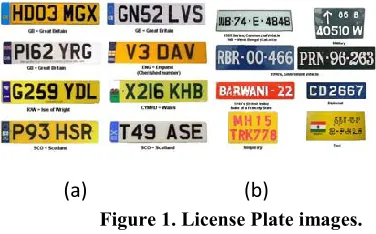
Some of the images of standard license plates, used in developed countries, are shown in Fig 1 (a). However, in India, the license plates are not yet standardized across different states, making localization and subsequent recognition of license plates extremely difficult. Moreover, in India license plates are often written in
(a) (b)
Figure 1. License Plate images.
(a) Standardized license plates of European vehicles (b) License plates of Indian vehicles
multiple scripts. Fig. 1(b) shows some of the typical Indian license plates with variety of shape, size, script etc. This large diversity in the features of the license plate makes its localization a challenging problem for the research community.
II. Principle of Number Plate Recognition
The principle of License plate Recognition system operates in three steps, the first step is the detection and capturing a vehicle image, second step is the detection and extraction of
number pate in an image and last the third step is use image segmentation technique to get the individual character and optical character recognition to identify the individual character with the help of database stored for each and
every alphanumeric character. The License
Plate recognition system is normally made up of four parts, where each of the process contains sub process.
1. LP image collection 2. LP location
3. Character segmentation 4. Character recognition
LP image Collection This is the first phase in a
License Plate Recognition system. This phase arrangement with obtained an image by an acquisition method. use a high resolution digital camera to acquire the input image. The input of the system is the picture of a motor vehicle captured by a camera. The captured image is taken from a distance of 4-5 meters away processed through the license plate extractor with giving its output to segmentation pa
sample color image
License Plate Extraction License plate
International Journal of Research (IJR)
e-ISSN: 2348-6848, p- ISSN: 2348-795X Volume 2, Issue 05, May 2015Available at http://internationaljournalofresearch.org
(a) (b)
(b) (d)
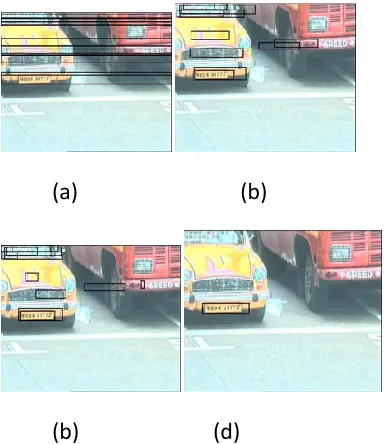
Figure 3. Different stages of license plate localization (a) Selected rows after stage 1
(b) Potential license plate regions after stage 2 (c) Refined license plate regions after stage 3 (d) Final license plate region(s) identified by stage 4
License Plate Segmentation License plate
segmentation process is also called as the Character Separation. After the license plate images are extracted from a picture, and then one has to find characters in the license plate and recognize them well [6]. In the segmentation of license plate characters, license plate is divided into segments to essential parts obtaining the characters separately
License Plate Recognition License plate
Recognition is the last step of the LPR system. This step is the main part of the recognition process which decides the accuracy and recognition rate of the system. This Step decides the efficiency of the License plate recognition system. This Recognition involves
about to recognize the characters of the license plate numbers and character. Before the recognition the license plate characters are normalized. Normalization is to improve the characters into a block containing no added white spaces (pixels) in all the four sides of the characters
III. Related work
In this section describe the related work of number plate recognition based on feature extraction on different technique. The process of recognition used neural network and also used some feature optimization technique. some method discuss here used by different authors.
[1] In this paper, innovative method is proposed for number plate recognition. It uses series of image manipulations to recognize number plates. It uses 4-6 algorithms in order to do the same. For plate localization, several traditional images processing techniques are used. Techniques such as image enhancement unsharp masking, edge detection, filtering and component analysis each plays a role in the extraction process.
[2] In this paper, author proposes a method for
automatic license plate detection and
recognition in the city of Abu Dhabi. The proposed method starts by segmenting moving
vehicles using background subtraction.
International Journal of Research (IJR)
e-ISSN: 2348-6848, p- ISSN: 2348-795X Volume 2, Issue 05, May 2015Available at http://internationaljournalofresearch.org
background subtraction technique. The detected vehicle model is calculated and used to initialize a color-based particle-filter video object tracking technique. The position of the vehicle is monitored and when detecting the vehicle as approaching, a high-resolution image is captured.
[3] In this paper author discuss different types of localization algorithms and which of them
should be used for a particular application.
Different countries have their own types of license plates for instance some use single line horizontal license plates while others use multi line non horizontal and differently located number plates. Some of the widely used localizations algorithms which are used in the neural network recognizer are global threshold scheme, NiBlack’s threshold. We have addressed the technical aspects of the license plate localization and discussed the benefits and limitations of using this methodology to be considered as part of a complete real time traffic surveillance system in future.
[4] In this paper author propose a text-line region location algorithm, which takes into account the characteristics of single character as well as the spatial relationship between successive characters. This module locates the text-line regions by using a horizontal high-pass filter and scan line analysis. To resolve non uniform illumination, a two step procedure is applied to segment container-code characters, and a projection process is adopted to isolate characters in the isolation module. The experimental results demonstrate the efficiency and effectiveness of the proposed technique for practical usage.
[5] In this paper author discuss the number plate recognition using segmentation. The non-adherence of the system to any particular country-specific standard & fonts effectively means that this system can be used in many different countries a feature which can be especially useful for trans-border traffic e.g. use
in country borders etc. We have also addressed the issue of building the databases as per user convenience so that the user has the option to train the neural network with the fonts those are more relevant and mostly used in any particular geographical location.
[6] In this paper author presents a real time and robust method of license plate detection and recognition based on the morphology and template matching. a novel method of identifying and recognizing of Iranian car license plates. we extracted the plate location, and then we separated the plate characters by segmentation and applied a correlation based template matching scheme for recognition of plate characters. This system is customized for the identification of Iranian license plates. The system is tested over a large number (more than 150) of images, where this algorithm performs well on different types of vehicles including Iranian car and motorcycle plates as well as diverse circumstances.
[7] In this paper author presents a method for Indian vehicle plate recognition and extraction using character segmentation, The proposed
algorithm consists of three major parts:
Extraction of plate region, segmentation of characters and recognition of plate characters. For extracting the Plate region, edge detection algorithm and vertical projection method are used. In segmentation part, filtering, thinning and vertical and horizontal projection are used.
Feature Extraction Feature extraction
technique is important phase of number plate recognition system [5]. In number plate image basically three types of features are color, texture and dimensions. Feature extraction can be defined as the act of mapping the image from image space to the feature space
IV. Problem Formulation:- Study of various
International Journal of Research (IJR)
e-ISSN: 2348-6848, p- ISSN: 2348-795X Volume 2, Issue 05, May 2015Available at http://internationaljournalofresearch.org
license number plate because the Indian number plates are versatile (there is no any particular standard format for number plate). But in current scenario Govt. of India issues standard number plate and standard templates of characters and number’s. In order to maintain traffic problem and controlling a crime and various agencies working in the field of Indian license plate recognition system. We found some general problem. Here we mention problem with references:
Rate of recognition low [16][11]. Creation of template [2][3][7]. Recognition time is very high [12]
Standard deviation error of most of the method nearer 5 to 10%.
V. Conclusion and Future Scope:-
In this paper discuss number plate recognition technique based on feature based technique using different transform function. The extraction of feature in number plate recognition is important phase for recognition purpose. in this paper also discuss gab our transform for feature extraction. in the process of feature optimization used various algorithm such as genetic algorithm, ant colony
optimization and particle of swarm
optimization. in this paper discuss one novel feature optimsation method such as teacher learning based optimization algorithm. the process of recognition depends on creation of template. if template of number plate is optimal the recognition rate inceases. in future used wavelet domain function for feature extraction and heuristic function for optimization and improved the performance of recognition.
ACKNOLEDGEMENT:-
We would like to offer our heartfelt gratitude to esteemed Bharath University research and
development student potential division
department of Electronics and
Telecommunications engineering research
Directors and Mentor Dr, M. Ponnavaiko and all Deans of Bharath University and my fellow students for their help and suggestion
regarding this project.
REFERENCES:-
[1] Sahil Shaikh, Bornika Lahiri, Gopi Bhatt, Nirav Raja “A novel approach for Automatic Number Plate Recognition” International Conference on Intelligent Systems and Signal Processing, 2013. Pp 375-381.
[2] Mohammad Ghazal, Hassan Hajjdiab “License Plate Automatic Detection and Recognition Using Level Sets and Neural Networks” IEEE 2013. Pp 1-5.
[3] Anurag Tyagi, Rakesh Rathi, Vinesh Jain, Abhishek Tyagi “Performance Analysis of Localization Algorithms Applied on Real Time License Plates of Different Countries” IEEE 2013. Pp 14-19.
[4] Wei Wu, Zheng Liu, Mo Chen, Xiaomin Yang, Xiaohai He “An automated vision system for container-code recognition” Expert Systems with Applications, Elsevier 2012. Pp 2842-2855.
[5] Ankush Roy, Debarshi Patanjali Ghoshal “Number Plate Recognition for Use in Different Countries Using an Improved Segmentation” IEEE 2011. Pp 1-5.
[6] S. Hamidreza Kasaei, S. Mohammadreza Kasaei, S. Alireza Kasaei “New Morphology-Based Method for Robust Iranian Car Plate Detection and Recognition” International
Journal of Computer Theory and Engineering,
Vol- 2, 2010. Pp 264-269.