University of South Carolina
Scholar Commons
Theses and Dissertations
12-15-2014
Leadership Perspectives on International Education
For Public School Students in South Carolina: Two
Case Studies
Frederick Eugene Brown
University of South Carolina - Columbia
Follow this and additional works at:https://scholarcommons.sc.edu/etd Part of theEducational Administration and Supervision Commons
This Open Access Dissertation is brought to you by Scholar Commons. It has been accepted for inclusion in Theses and Dissertations by an authorized administrator of Scholar Commons. For more information, please [email protected].
Recommended Citation
Brown, F. E.(2014).Leadership Perspectives on International Education For Public School Students in South Carolina: Two Case Studies.
Leadership Perspectives on International Education For Public School Students in South Carolina: Two Case Studies
by
Frederick Eugene Brown
Bachelor of Science College of Charleston, 1996
Master of Education Converse College, 2003
Specialist in Education
South Carolina State University, 2009
_____________________________________________
Submitted in Partial Fulfillment of the Requirements
For the Degree of Doctor of Philosophy in
Educational Administration
College of Education
University of South Carolina
2014
Accepted by:
Doyle Stevick, Major Professor
Peter Moyi, Committee Member
Kara Brown, Committee Member
Zach Kelehear, Committee Member
ii
iii
DEDICATION
I would not be here without the love and support of my family. My wife, Kristina,
and children, Gwenivere and Marko, have been very understanding. Thank you so much
for always being there for me. Kristina, you have been an inspiration to me. You are so
dedicated to your own research and have pushed me to complete mine. Gwenivere and
Marko, you are both amazing. I hope that your mom and I inspire you to dream big and
iv
ACKNOWLEDGEMENTS
I am eternally grateful to Dr. Doyle Stevick, my mentor, who allowed me to reach
my goal of receiving a doctoral degree. Dr. Stevick became my mentor long before I was
accepted into the program. If it were not for him, I would not be writing this now. I will
always be grateful to him.
I want to give my sincere thanks to my dissertation committee members for
giving their time, expertise and educational insights while serving on my committee. I
am grateful to all my interview participants who shared their time and insights into
international education. I am indebted to the two districts allowing me to conduct my
v
ABSTRACT
This study explores how two rural public school districts in South Carolina
conceptualize and implement an international education, according to the perspectives
of administrators and teachers. This comparative case study of two public school
districts spans the districts’ elementary, middle, high and career center schools and
seeks to understand how the presence of a major multinational corporation influences
school internationalization. The data on their perspectives on internationalization were
drawn from interviews. I interviewed the school principal and teachers involved in
internationalizing the curriculum, policy and practice in each of the ten schools. In
addition to school level personnel, I interviewed district level curriculum specialists and
instructor coordinators in both districts.
Participants emphasized the importance of learning to communicate in a
language other than one’s native tongue and everyone agreed that an international
curriculum is important. All of the administrators interviewed expressed their belief that
internationally educated students would have a clear advantage over traditionally
educated students and be, in their own words, “more well-rounded”. Most of the
interviewees discussed changing students’ points of view and helping them see from a
broader perspective. Tolerance was a term used by many of the interviewees. They
want students to understand that other people’s viewpoints are acceptable and that
vi
felt that internationalization would not become a school focus unless it was mandated
by the state government or department of education.
One theme of many of the interviews was preparing students to be college and
career ready. They emphasized that students need to be prepared to get a job and be
productive citizens in society. The two school districts have international corporations
within the county where their graduates want to work and live. There is an interesting
paradox taking place in these districts. The districts are appropriating
internationalization into their curriculum in order to allow their graduates to remain
local.
Data revealed a second paradoxical situation. Both districts have a large
population of Hispanic, Russian, and Ukrainian students. The paradox is the fact that the
district is preparing local students to become international in order for them to receive
better jobs but is “Americanizing” immigrant students in order to assimilate them.
Internationalization is taking place in South Carolina, but it is not always clear
why it happens at a certain location. Having a multinational company would seem to be
conducive to internationalization. In this case, its presence seemed to encourage
modest steps towards internationalization, such as expanding the presence of the
German language in the curriculum, but did not lead to broader implementation of
internationalization nor broader conceptions of internationalization. Instead, the
primary goal of the district is to promote local employment opportunities for their
vii
TABLE OF CONTENTS
DEDICATION ... iii
ACKNOWLEDGEMENTS ... iv
ABSTRACT ... v
CHAPTER IINTRODUCTION ... 1
CHAPTER II INTERNATIONALIZATION OF K12 SCHOOLING ... 22
CHAPTER III METHOLOGY ... 47
CHAPTER IV FINDINGS... 56
CHAPTER V SUMMARY, CONCLUSIONS, AND RECOMMENDATIONS ... 101
REFERENCES ... 142
APPENDIX A: INSTITUTIONAL REVIEW BOARD (IRB)... 148
APPENDIX B: CONSENT FORMS ... 149
1
CHAPTER I
INTRODUCTION
In our increasingly interconnected world, there is a growing interest in
international forms of education. What constitutes an international education, however,
is the subject of much debate. A child attending an international school may never
receive an international education, while a child attending a local public school may
receive an international education. Indeed, the “international” can mean quite different
things depending on the specific context in which it is pursued. In a public school
district, the international context begins with the district practices, policies and
leadership.
International education advocates from the National Association of State
Universities and Land-Grant Colleges (NASULGC) Task Force (2004) suggest that
students who receive an international education develop the ability to think globally and
critically and become citizens of the world (p. viii). They also suggest that because
students are a part of enriched classrooms they develop skills to comprehend, analyze,
and evaluate knowledge of the world, its peoples, politics, and cultures. In addition,
these students apply this knowledge to develop a broader global perspective (NASULGC,
2004, p. 2). An international education would seem to be particularly promising for rural
communities. These are arguments for providing an international education for
2
Most school districts in South Carolina do not articulate an international focus as
a part of their mission or vision statements. In a review of 15 randomly selected South
Carolina school district mission and vision statements, only Lexington School District
One contained an explicitly international focus. This district declares that its graduates
will be a new generation of leaders and global citizens who are “self-directed, creative,
collaborative, caring and multilingual and who flourish in a global, competitive 21st
century” (Lexington School District One, 2014). The district has a mixed rural and urban
population in a cosmopolitan area of the state, which contributed to its international
focus. Cosmopolitan areas have a greater concentration of people and a greater
diversity of cultures than rural areas, which makes them an obvious site to study
international education in public schools. It is possible to find exemplary international
programs in diverse communities. It is also important to study the less obvious areas,
like the rural South.
Rural areas in South Carolina are less concentrated and are less diverse than
cosmopolitan areas, but some are also influenced by large international corporations.
BMW, for example, is a large international corporation located in rural Duncan, South
Carolina. Many of BMW’s employees live in Duncan and their families attend the local
public school district. The luxury carmaker resides in a community where few could
afford its products. The introduction of a massive wealthy multinational corporation
would seem to be conducive to the development of an international education. This
comparative case study seeks to understand how the presence of a major multinational
3
According to the South Carolina Rural Education Grassroots Committee (2001),
“South Carolina ranks second in the United States in the number of rural students
eligible for free or reduced price lunch” (p. 7). They also report that “45% of [South
Carolina’s] population lives in rural areas and 67% of the school districts are in rural
areas” (SCREGC, 2001, p. 7). Two rural school districts were chosen because two case
studies would allow for a comparative study. Many of the rural districts are small and
the two districts were chosen due to their similar demographics and proximity to each
other. These two case studies explore how district policy related to providing an
international education is conceptualized and implemented in rural school districts of
South Carolina. This study identifies innovative efforts and practices, as well as obstacles
and challenges that can be of use to any school or district that is considering
internationalizing its education.
Research Questions
Research Questions that guided the study are as follows:
1. How do administrators and teachers conceptualize internationalization? Why
do they feel an international education is important or not?
2. How does the presence of a major multinational corporation influence school
internationalization?
Significance
This study, which based on administrators’ and teachers’ perspectives, shows
many ways by which local public school districts provide an internationalized education.
4
nationwide to aid their students in becoming members of the global community.
Research Purpose
There are three purposes of this study. The first purpose is to understand
administrators’ perspectives on the ways in which public schools in South Carolina are
able to offer an international education to its students and to determine how important
an international education is for students. The second purpose of this study is to
illuminate how and why two rural districts implement policies on international
education. Finally, the third purpose is to determine in what ways, if any, a large
international corporation affects the internationalization of a local public school district.
For ten schools in two districts, I interviewed the school principal and lead teachers
whom the principal identified as individuals involved in internationalizing the curriculum
of the school. In addition to school level personnel, I interviewed district level
coordinators for each of the districts’ international programs. Each group represents a
unique perspective on the international education experience of students in their
respective school districts.
Rationale
According to the Asia Society & Longview Foundation (2014), there is a
significant gap between the rapid globalization of America and the knowledge
and skills—the global competencies—that youth need to be successful. The
Mapping the Nation website pulls together nearly a million economic,
demographic and education data points to reveal that our nation is becoming
5
increasingly unmet by the United States’ education system (home section, para.
1).
Internationalization occurs in both public and private schools in the South.
Several metropolitan areas in the Southeastern United States are sites of international
schools. Atlanta International School (AIS) is located in Atlanta, Georgia. It has a
combination of American and international students. According to AIS’s website, the
school seeks to provide a global curriculum for future leaders (Atlanta International
School, 2014). Charlotte, North Carolina is the site for the British International School of
Charlotte. The school has an international community where they claim that difference
is embraced and diversity celebrated. The school aims to provide a global learning
experience for its student body, whose members come from eleven different countries
and speak eighteen different languages (British International School of Charlotte, 2014).
Some internationalization features cooperative efforts by government and
private or non-profit organizations. In 1989, the North Carolina Department of Public
Instruction partnered with the Visiting International Faculty (VIF). VIF brings teachers
from other countries to teach in the United States. Since 1989, VIF has brought over
1000 participants from forty-eight different countries to teach in North Carolina public
schools (VIF international education, 2014).
Many efforts for internationalization are rooted in language immersion. In South
Carolina, partial immersion programs are being implemented in a few of the larger
cities. Greenville County School District has a magnet school with a partial immersion
6
Academy is a bilingual program in English and Mandarin (East Point Academy, 2014).
Lexington School District One has a full world languages program. Their elementary
schools have both a language acquisition program and a partial immersion program. The
middle schools continue with the immersion program and begin teaching world
languages as a core subject. Lexington School District One offers centers of study at the
high school level. One center of study is the Center for World Languages and
International Business (Lexington School District One, 2014).
Thus, different forms of internationalization are found in South Carolina and
across the region, but it is not always clear why it happens at a certain location and not
at another. Having a giant multinational company in the community would seem to be
conducive to internationalization within school districts. Many rural areas in South
Carolina are sites of large multinational companies and are becoming increasingly
international. Many of the students in rural public schools in South Carolina are being
prepared to join the workforce in these international companies. Most public school
districts in South Carolina are not setting mission or vision statement with international
education goals. Despite the lack of an international component in their mission, public
school districts in South Carolina are preparing their graduates to compete in the new
global market place.
Economics.In the United States, the job growth in international trade is 100% on
a 20 year average. One in five American jobs is tied to international trade. Higher
education has the highest in history with 800,000 foreign students attending in the
7 Foundation, 2014, about section, para. 2).
Demographics. There are 40 million foreign born people in the United States
which makes it more than any time in history. There is an increase in languages other
than English being spoken in homes within the United States. The intelligence
community has also been recruiting heritage speakers – i.e., speakers who learn a
language at home that is different than the dominant language of the society – to work
on language studies (Asia Society & Longview Foundation, 2014, about section, para. 3).
Education. “Nearly every county in the United States has ties to the world
outside our borders, schools have not been able to keep pace by providing students
with the needed knowledge and skills for success in the interconnected world” (Asia
Society & Longview Foundation, 2014, about section, para. 4). Only, one in five of the
states have more than 25% of its high school students learning a foreign language. There
are also less than one percent of the students taking part in a foreign exchange (Asia
Society & Longview Foundation, 2014, about section, para. 5).
Key Indicators for South Carolina and Chosen County. “In matters of national
security, environmental sustainability, and economic development, what we do as a
nation and in our everyday lives is inextricably intertwined with what governments,
businesses, and individuals do beyond our borders”(Asia Society & Longview
Foundation, 2014, global competence section, para. 1). Each state invests in human
capital and is responsible for the education of their children. According to Asia Society &
Longview Foundation (2014), education must include the development of global
8
was created to assist policymakers, districts, and schools in creating curriculum which is
global and international in nature. The Mapping the Nation website does not offer a way
to directly compare states. Many of the indicators do not lend themselves to a direct
comparison. There are eight “key indicators” for each state and they give a snapshot for
what is considered global in each county (Asia Society & Longview Foundation, 2014,
how to use the map section, para. 4). The following chart shows the eight key indicators
for South Carolina and the county used in this study.
Table 1.1 Key Indicators
Key Indicator for Global Competence
South Carolina County used for Study
Percent of Total Population of Foreign Born
4.81% 5.91%
(Top 2 in Upstate S.C.)
Estimated Sales Value of Imports and Exports
$20.5 Billion $2.3 Billion
(Top 2 in Upstate S.C.)
Total Employees at Companies Importing
Exporting Goods
177,544 36,483
(Top 4 in Upstate S.C.)
Total Jobs Related to Services of Exports
25,386 1,627
(Top 2 in Upstate S.C)
Percent Change in K-12 Enrolled between 2004-05
school year and 2007-08 school year in All World
Language courses
5.72 % No Information
Total Number of Students in Post-Secondary Language
Enrollment
32,784 2,338
(Top 5 in Upstate S.C.)
9 International Students and
Dependents to U.S. Economy 2012-2013
(Top 3 in Upstate S.C)
Languages Other Than English Spoken at Home
285,280 22,639
(Top 2 in Upstate S.C.) (Top 2 for German) (Top 2 for Spanish) (Only one in the State for
Russian)
These statistics show that international markets are necessary to sustain the
local markets in the upstate of South Carolina. The county chosen is one of the top two
global markets in the upstate of South Carolina.
Definition of Terms
Two concepts that need definition: international education and policy. The terms
have different meanings when used colloquially and in scholarship.
This study, in part, attempts to understand how administrators and teachers
conceive international education. In this study, an international education is more than
learning about global facts and about other countries. It is also more than being
physically located in a different country than your home country. An international
education teaches students about other cultures. An internationally educated student is
able to take an issue or topic and understand a different culture’s perspective.
Therefore, a student living in his or her own country can receive an internationalized
education by learning about other cultures and different perspectives. In this study, an
internationalized education is an education that provides students with curriculum that
broadens a student’s perspective. From this point forward in this case study, an
10 education.
Policy can have different meanings. Formal policy in the traditional sense is
guidance for action. This guidance may be general or specific, and written or unwritten
(Sapru, 2010, p. 25). The two districts chosen for this study do not have a formal
international education policy. This study, therefore, uses Dye’s definition of policy as
“whatever governments choose to do or not to do” (as cited in Sapru, 2010, p. 24).
Using this definition of policy, internationalization policy is the sum total of international
activities in each of the school districts. In order to keep the two meanings separate, in
this study – unless otherwise stated – policy, or de facto policy, refers to Dye’s definition
of policy (as cited in Sapru, 2010, p. 24), and formal or traditional policy refers to a
general or specific guidance for action (Sapru, 2010, p. 25).
Subjectivity and Positionality
In the following sections, I outline the experiences, philosophies and concepts
that contribute to my worldview, and hence the ways in which I value
internationalization and conceptualize my research.
Progressive Education
“Education is not a preparation for life but is life itself” is a famous quote by John
Dewey (Gwyer & Hack, 2012, p. 3). Dewey viewed education as worthwhile by itself and
as a lifelong process. Dewey considered education as a process of growing in meaning.
Growing refers to the fact that a person’s education is continuous and developing.
Growth in this sense comprises the building blocks of knowledge. Education provides a
11
capable of grasping more complex knowledge. The term “meaning” refers to how a
person makes sense of life and the world around them. The educative process impacts a
person’s attitudes, whether toward one’s self, the world, other people, or knowledge
itself (Munoz & Munoz, 1998). There is a difference between training and education.
Training teaches people how to behave in specific circumstances; whereas, education
teaches a person how to think.
According to Dewey (1938), “All genuine education comes about through
experience” (p. 25). Dewey considered experience as doing, trying, and acting on the
environment. He also believed that all human ideals and concepts come from
experiences. Experiences are what allow people to develop their tools to understand
and transform their environment (Munoz & Munoz, 1998). People also pass these
values, means, ideals and concepts to the next generation. This transmission gives us a
history and culture (Munoz & Munoz, 1998). According to Dewey’s philosophy,
experience, communication, and education are a triad that serves to guarantee a
culture’s continuity.
Dewey’s progressive education focuses on the student’s experiences. Students
are involved in real-life tasks and challenges. Progressive education also emphasizes
life-long learning and development of social skills. A person’s culture and language would
come from their life experiences. In order to have a wider understanding, or a broader
worldview, a person would need to experience other cultures.
Third Culture Kid (TCK). “Third Culture Kid” (TCK) is a term coined by Ruth Hill
12
another culture. In the traditional definition of TCKs, the decision to live in a foreign
country is based on a parent’s career choice. David Pollock describes a TCK as an
individual who spent a significant part of their developmental years in a culture other
than their parents (Pollock & Van Reken, 2009). When I was 18, I spent a year as an
exchange student in Belgium. This experience changed me forever. I became more
confident, self-aware, and mature. I grew up in a rural town in South Carolina and my
exchange year changed my worldview. I felt that I was always accepting of people but I
learned from my exchange year how narrow my mindset and focus really were.
International Teacher. I taught middle school science and high school biology
and physical science from 2000-2004 at the American International School of Zagreb,
Croatia. This experience has provided me with a perspective on internationalization that
has sensitized me to the many ways in which it occurs. As a result, I am more aware of
the needs of ELL students and the cultural differences among students and teachers.
These sensitivities heightened my awareness of other kinds of differences as well,
including racial and gender dynamics.
CofW, or “Citizen of the World”. Third Culture Adults (TCA) are people, “whose
international mobility began only in adulthood yet whose international experiences
have wrought a profound identity change” (Schaetti, 2006, para. 1). I have lived in the
United States, Belgium, and Croatia. I have traveled to many different countries and
speak more than one language. I am an American, but I am at home in other countries
as well.
13
tutoring program across South Carolina. I am accustomed to working with teachers and
asking questions.
Transformative learning. Transformative learning provides an understanding for
how adults learn. Adults, as learners, use their life experiences to make sense of new
information and are motivated to address problems that relate directly to their lives
(Hunzicker, 2010, p. 3). Mezirow’s theory of transformative learning is defined as “a
deep and profound altering of one’s worldview, involving an epiphanic or apocalyptic
cognitive event” (Servage, 2008, p. 67). One’s worldview is the totality of one’s beliefs
about reality and is a personal view of the world and how to interpret it. A cognitive
event would be an event that impacted your way of thinking. Transformation does not
happen in isolation and requires a social context (Servage, 2008, p. 67). Transformative
learning should, however, focus on the individual because it is the individual’s
worldview which is altered. The more time I spent in different cultures, the broader my
world view became.
The Role of Experience in Research
There are three areas of research that have influenced me and are directly
related to this study: student teaching abroad; international experiences affecting
administrators in the American South; and Cross Cultural Kids.
Student teaching abroad. Cushner (2007) compares the benefits of an
international experience of teachers who have completed their student teaching
overseas to those who have completed it in a local school. International experience in
14
(Cushner, 2007, p. 28). The overseas experience provides the opportunity for students
to stretch their comfort zone, increase self-efficacy, and increase their cultural
knowledge (Cushner, 2007, p. 28). Overseas teachers are more independent, confident,
and likely to take charge of situations than teachers who have never had any
international experience. This is due to the fact that overseas teachers gain a significant
amount of self-knowledge, develop confidence and professional competence, as well as
a greater understanding of both global and domestic diversity (Cushner, 2007, p. 30).
Overseas teachers develop a sense of their own culture and how their culture
relates to others. The overseas teachers are more culturally sensitive and racially
conscious than teachers who completed their student teaching in a local school
(Cushner, 2007, p. 30). In addition, students with overseas experience tend to express
intercultural sensitivity and openness to cultural diversity. They have a sense for
addressing issues of domestic diversity and for reducing prejudice (Cushner, 2007, p.
34). This is an aspect that the international experience offers teachers which will be
directly related to their classroom in a local school in their home country. Cushner
(2007) quotes one student as saying, “The biggest change that happened to me was that
I became much more multicultural in my view of the world. I believe that multicultural
education happens every day, and that this can become a mindset for the teacher—
rather than an occasional effort. I owe this to my overseas teaching experience”
(Cushner, 2007, p. 34). Along with this student, many others expressed the importance
for multicultural education and the need to diversify the learning process to account for
15
International experiences do affect administrators in the American South. My
earlier pilot research on the international experience of administrators and whether it
influenced their approach to domestic diversity issues informs my design for this study.
In 1984, Norma McCraig coined the term global nomad. The standard definition is “a
person of any age or nationality who has lived a significant part of his or her
developmental years in one or more countries outside his or her passport country
because of a parent’s occupation” (Schaetti, 2006, para. 1). Barbara Schaetti (2006)
analyses the definition of a global nomad. A person never loses their status as a global
nomad: Schaetti (2006) writes, “Once a global nomad, always a global nomad” (para. 2).
Their experiences influence them throughout their lives; therefore, a person’s
age does not exclude them from being a global nomad. Global nomads are of all
nationalities, and there is no minimum time frame to the experience being significant
(Schaetti, 2006). Therefore, both a person living for ten months and a person living for
ten years in a foreign country can have experiences that affect them for life. How
significant the experience is depends upon one’s personal interpretation.
Developmental years refer to the years from birth through adolescence (Schaetti, 2006).
This is the time during which an individual’s sense of self is being developed. In this
dissertation, the term global nomad will be considered as interchangeable with the term
Third Culture Adult.
Third Culture Adults have their values and cultural identity developed before
they move abroad. They do not have to go through the experience of developing their
16
throughout their lives and that culture is a fluid state which can be shifted. I also believe
that people’s experiences in different cultures will change their worldview and create an
identity change in them. When teachers or administrators work in an international
school, their perceptions of the world will be changed. How do these changes affect
their teaching practices and views once their international experience is over?
I conducted pilot interviews with former teachers and administrators who have
worked in an international setting: traditional international schools, Department of
Defense schools, service programs (Peace Corps), and missionary schools. The research
question was, “how do international school teachers and administrators perceive social
issues, more specifically, their views and perceptions of race and racism, in schools in
the southeastern part of the United States?” Criteria for inclusion in the study included
experience in either an international school, Department of Defense school, through a
mission program, or through a service program. They must also have taught or
administered in the American South after their international experience. I interviewed
three participants who are working in higher education and one participant who had
retired from administering a stateside department of defense school.
According to Dewey’s belief that “All genuine education comes about through
experience” (1938, p. 25), the experience each of the participants had in an
international setting was a form of progressive education. Education comes about
through one’s experiences which is the doing, trying, and acting on the environment. All
four of the participants were in contact with the host community and made a choice to
17
organized sporting events with international schools from other countries. Jan got
involved in the local community through his wife and daughter. He also arranged field
trips for the DOD students to go into the host culture. Patrick and Steve worked in the
local schools of their respective host countries. They both made the choice to teach in a
local school. Patrick’s choice was to teach in West Africa, and Steve chose to teach in a
local public school and not the missionary school.
All four of the participants underwent a form of transformative learning.
Mezirow describes transformative learning as an altering of one’s worldview (Servage,
2008, p. 67). Each of the participants changed their interpretation of the world. Their
international experience affected each of them uniquely due to their unique situations
and unique prior experiences and abilities. Jim experienced reverse culture shock when
he returned to Kansas after his experience in Egypt in the 1960s. It was a time when
many Americans were afraid of communism, and Jim had just come back from Egypt.
Egypt had many communist followers and there were Americans who felt Jim was a
communist. Jan’s reverse culture shock was the change from living near London and
moving to Beaufort, South Carolina. It was a very different lifestyle and he needed to
accept the change in salary and the lost benefits of living so close to London’s cultural
experiences. Patrick describes his experience as de-familiarizing his own educational
system. He had to look at his system in a totally different way. Steve said that his
worldview was formed when he was living in Liberia. He describes his worldview as
being able to recognize individuals from a group. Before his experience in Liberia, he
18 people.
Cross-Cultural Kids (CCKs) Model. Due to globalization, many people are not
living in their city of origin or even their nation-state of citizenship. Migrants have the
ability to move to other parts of the world but still keep in contact with people from
their country of origin, and “migration leads to transnationalism” (Dijkstra, 2001, p. 59).
Transnationalism is the processes by which immigrants build social fields that link
together their country of origin and their country of settlement (Smart & Smart, 2003, p.
276). These relationships transcend not only geographical boundaries but also cultural
and political boundaries (Dijkstra, 2001, p. 59). “The traditional image of emigrants who
start a new life in a new country, leaving their past far behind, is thus no longer current”
(Dijkstra, 2001, p. 60). Because there are fewer and fewer of the former monocultural
communities, the two classifications of either a monocultural kid or a traditional third
cultural kid do not “fit” everyone. Ruth Van Reken (2009) took the model of a TCK and
expanded it to include children who are growing up in different kinds of multicultural
environments.
Ruth Van Reken (2009) defines “a Cross-Cultural Kid (CCK) as a person
who has lived in—or meaningfully interacted with—two or more cultural
environments for a significant period of time during developmental years (para.
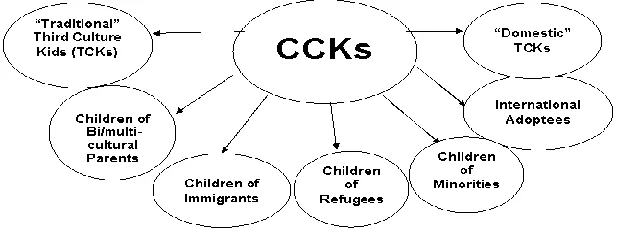
14)”. She also developed the following model to help define CCKs.
The Figure 1.1 Cross-Cultural Kid Model shows seven different groups of
CCKs. Each of the groups is influenced by different cultures due to their
19
have meaningful interaction with two or more cultural environments during their
developmental years.
Figure 1.1 Cross-Cultural Kid Model
Children are often in more than one of these circles at the same time.
(E.g., A traditional TCK who is also from a minority group, a child of
immigrants whose parents are from two different cultures, etc.) This
helps us understand the growing complexity of the issues we face in our
changing world. (Van Reken, 2009, para. 14).
Van Reken (2014) describes CCKs as the new normal (Title section). During my
teaching experience in South Carolina, I noticed that in many cases, the Hispanic
students in our classrooms are growing up in two cultures. There are many students in
our classrooms who are multiracial and or mixed cultures. Another example comes from
my personal experience: I am married to a Croatian American and our kids are raised
speaking both English and Croatian. We also spend time in Croatia as well as in South
Carolina. It appears that CCK is a more inclusive term than TCK and many of the
different groups of CCKs share similar characteristics and face similar issues as
traditional TCKs. However, most of the discourse is focused on traditional TCKs and not
20
Fail (1996) describes several traits that make up the Third Culture Kid profile. A
TCK grows up in a highly mobile lifestyle which can become a lifetime habit. TCKs tend
to be multilingual due to exposure to many different languages at an early age. Many
have psychological problems with belonging and they tend either to feel at home
everywhere or are constantly searching for it. They are usually friendly and good at
quickly making friends, but they also know how to end relationships. This does not
mean that they do not experience psychological consequences of losing friends; instead
they have a lot of experience ending relationships and are competent at doing it. Most
of the literature focuses on United States citizens; TCKs have a large global perspective
and seem very mature and worldly when compared to non-TCK United States citizens.
Finally, they grow up culturally sensitive and understand how to change their behavior
to suit the situation (Fail, 1996).
Relationship to study and implication
Insider. I have a direct relationship with one of the school districts. I do know
some of the participants personally.
Outsider. I do not have personal connections with the second school district.
Before I conducted the interviews, I had not met most of the participants in the study.
As an outsider, I am not in regular contact with the participants. I believe that this
distance could be a positive circumstance in the fact that it allows the participants to
open up to me because I am not connected with their district.
Summary
21
questions leading this study. How do two public school districts conceptualize and
implement an international education for their students? What are the administrators’
and teachers’ personal perceptions of international education?
There are three purposes of this study. The first purpose is to understand
administrators’ and teachers’ perspectives on both ways in which public schools in
South Carolina are able to offer an international education to its students and to
determine how important they feel an international education is for students. The
second purpose of this study is to illuminate how and why two rural districts implement
policies on international education, according to the perspectives of administrators and
teachers. Finally, the third purpose is to determine in what ways, if any, a large
international corporation has impact on the internationalized curriculum of a local
public school district. For ten schools in two districts, I interviewed school principals,
lead teachers and district office personnel.
I outlined the experiences, philosophies and concepts that have contributed to
my worldview, and hence the ways in which I value internationalization and think about
my research. I discussed progressive education, including Dewey and my experiences as
a third culture kid, an international teacher, citizen of the world, and administrator. I
also discussed three areas of research that have influenced me and are directly related
to this study: student teaching abroad; international experiences affecting
administrators in the American south; and Cross Cultural Kids. Finally, I outlined my
22
CHAPTER II
INTERNATIONALIZATION OF K12 SCHOOLING
International education literature focuses on students attending international
schools located in countries other than the United States. These are multinational
student bodies attending a school in Germany or France. An example of this focus is
found in Hayden and Thompson’s studies (1997, 1998) on perceptions of students and
teachers on international education. International schools are located in the United
States as well to serve the international community; however, international schools in
the United States do not often appear in the research. In addition, local public schools
are also beginning to internationalize their curriculum; however, there is not yet much
research on internationalized curriculum in local public schools in the United States.
There is great variance of international curricula within the United States. This study
attempts to fill a gap in the research of international education in rural settings - in
particular, in South Carolina.
Cross Cultural Kids seems to be a more inclusive term than Third Culture Kids;
and many of the different groups of CCKs share similar characteristics and face similar
issues as traditional TCKs. However, most of the discourse is focused on traditional TCKs
and not CCKs, and the research on Third Culture Kids (TCK) is growing. Data were
collected for these two case studies in two school districts with high population of
23 rural South.
Chapter two explores the literature that shaped the two research questions.
Chapter two is organized around the research questions.
How do administrators and teachers conceptualize internationalization?
Why do they feel that an international education is important or not?
A purpose of these research questions is to understand educators’ perspectives
on the ways in which public schools in South Carolina are able to offer an international
education to its students and to determine how important an international education is
for students.
Defining international education in Research
There are several terms used for this study that need to be defined. A National
Association of State Universities and Land-Grant Colleges (NASULGC) task force on
international education (2004) put out a report to challenge presidents and chancellors
to increase their universities’ international education. The report defines four terms:
internationalization, globalization, international education, and global competence.
Internationalization is “the process of integrating international and multicultural
perspectives and experiences into the learning, discovery and engagement mission of
higher education” (p. 2). Globalization is “the integration of countries and people as the
result of economic, technological and knowledge advances” (NASULGC, 2004, p. 2).
International education includes “the full spectrum of educational programs and
practices that facilitate internationalized learning. This includes curriculum, education
24
involvement of international students and scholars on U.S. campuses” (NASULGC, 2004,
p. 2). Finally, global competence is “the ability of faculty, staff and students not only to
contribute to knowledge, but also to comprehend, analyze, and evaluate its meaning in
the context of an increasingly globalized world” (NASULGC, 2004, p. 2). These four terms
are related and in many cases they are used interchangeably. They will not be
interchangeable in this study.
What does it mean to internationalize or globalize a public school? Do these two
terms have the same meaning? What are administrators in primary and secondary
schools doing to internationalize their schools? In this study, the term administrator
refers to administrators of primary and secondary schools and not higher education.
There are several other definitions of internationalization in the literature.
Francis (1993) explains that “internationalization is a process that prepares the
community for successful participation in an increasingly interdependent world” (p.5).
Francis’s definition relates to the communities’ need to be successful in a global market
place. This definition is very similar to the school district with a global focus in its
mission and vision statements. The school district’s mission is to create students who
are prepared to succeed in a global market.
Ebuchi (as cited by McKellin, 1995):
Internationalization is a process by which the teaching, research and
service functions of a(n)…education system become internationally and
cross-culturally compatible…The main aim of internationalization is to put
25
institutions, students, staff—to take part effectively in a world
characterized by increasing international cooperation, exchange and
interdependence. (p.44)
Ebuchi’s definition underscores the fact that an international education is related
to the experience of the students. Students are prepared for a global community
because they have shared international experiences with other internationally educated
students.
King (as cited by McKellin, 1995):
Internationalization refers to all programs, projects, studies and activities
that help an individual to learn and care more about the world beyond
his or her nation, and to transcend his or her ethnocentric perspectives,
perceptions and behavior. (p.44)
King’s definition also focuses more on the experience of the students. The key
elements include curriculum that is consciously international in content and approach
and language acquisition. In many international schools, the students and teachers have
a wide diversity of cultural backgrounds. What does internationalization mean to
administrators in public schools in South Carolina? Do the administrators believe that an
internationalized school would have any benefits, and if so, what would they be for
students, staff, and community?
As a teacher, I subscribe to King’s definition. I think that students need
experiences that foster acceptance and tolerance of other cultures. This development is
26
study is not to promote a certain concept of internationalization, but to understand how
the administrators and teachers conceive it. There are three dimensions of
internationalization, taken from Francis’s, Ebuchi’s and King’s definitions, that I look for
in the interviewees’ conception of an international education, including: preparing
students for a global market place; looking at what international experiences the
students are receiving; and how students’ worldviews are changed.
Movement away from definitions
Dilemmas. Cambridge and Thompson (2001) argue that instead of trying to
correctly define an international school, it would be more productive to describe how
the school resolves four different dilemmas. The first dilemma is between globalization
and internationalism. On one hand there is a view of international education as a
globally branded service industry, while on the other, there is a desire for peace and
understanding between nations (Conclusions section, para. 7). The globalism and
internationalism dilemma is a focus of research question two. Is the school’s
international education a product of the multinational corporation that is now located
in the community?
Second, there is a dilemma between monoculturalism and pluralism. Will the
child be educated in culturally diverse schools or in schools that replicate the home
national system (Cambridge &Thompson, 2001, Conclusions section, para. 8). The
resolution of this dilemma is a focus on what is taking place within the school district.
Again, research question two focuses on the implementation of school district policy.
27
curriculum to be centered upon cognitive aims, placing a premium upon formal
examination success? Or is it to be centered upon more affective aims, placing a
premium on existential, experiential learning? This is the contrast between views of the
school as a ‘filling station’ and as a ‘tool for social change’ (Deal & Nolan, 1978)”
(Cambridge &Thompson, 2001, Conclusions section, para. 9). The first research question
focuses on the educators’ conceptions of what they think should be taking place. It is
not necessarily a description of what is taking place in the school district.
Finally, there is a dilemma between economic privilege, access and equity. “In
many parts of the world international schools represent private islands of plenty in
contrast to an impoverished local public education system. They are places where the
children of the economic elites are brought together from many countries” (Cambridge
&Thompson, 2001, Conclusions section, para. 10). The resolution of this dilemma is a
focus of both research questions. This dilemma is both a conception of what the
educators’ think should be taking place and what the educators’ see as taking place
within the school district.
Perceptions. A second approach to building a common understanding of what an
international education is to consider the perceptions of its students, teachers, and
parents. Hayden and Thompson (1997, 1998) examined perceptions based on a large
scale survey where participants were asked to assess in terms of importance what is a
necessary part of the experience of international education. In this study, perceptions
are defined by the participants’ views of what is taking place within the district with
28
questionnaire. I chose to interview participants and discuss their perceptions of
international education. Hayden and Thompson’s survey involved over 3000 student
surveys and over 300 teacher surveys from six international schools; for my comparative
case study, I interviewed eighteen participants from ten schools in two public school
districts.
Students. I choose not to interview students in this study. I choose to interview
only administrators and teachers about their conceptions. However, the students’
perceptions are an important part of the literature. There is a lot of overlap between the
students’ and the teachers’ perceptions, so it is worth describing the major perceptions
about international schools from the students’ point of view.
Hayden and Thompson (1997) surveyed student perceptions in six European
international schools. Three perceptions appeared to be of particularly high level of
importance for only international students located within European schools: “learning
to speak more than one language fluently; being in a school environment where a
number of languages are frequently spoken; and taking examinations acceptable for
university entrance in a number of countries” (p. 464). This is an interesting perception
because many of the students in European schools observe multiple languages being
spoken around them and tend to have a utilitarian value of language. International
students located outside of Europe may perceive English as the more international
language to value (Hayden & Thompson, 1997, p. 464). Several perceptions that were
slightly less prioritized but still considered of high importance included: learning in class
29
tolerance of cultures; all cultures are equally valid; and a diversity of student cultures
within the school (Hayden & Thompson, 1997, p. 464). There were several other
important perceptions that need to be taken into consideration: “learning to speak the
local language; having teachers from a number of different cultures; and studying
subjects through more than one language” (Hayden & Thompson, 1997, pp. 465-466).
These student perspectives highlighted several interesting points; some were
anticipated by the researchers and were relatively straightforward to rationalize
(Hayden & Thompson, 1997, p. 471). Two areas that were of high importance to
students and are of significance to this study are language acquisition and cultural
differences.
Teachers. Hayden and Thompson (1998) followed their student survey by
surveying teachers about their perceptions of secondary-level international schools
throughout the world. The teachers represented a range of nationalities and teaching
experience. Five perceptions that teachers reported as what they valued the highest
included: “learning in class to be tolerant of cultures whose practices are different from
one’s own; offering examinations which will be acceptable for university entrance in a
number of countries; learning in class how to consider issues from more than one
perspective; offering a curriculum designed to be international (e.g. IB, IGCSE); and
learning in class that all cultures are equally valid” (Hayden & Thompson, 1998, p. 553).
Two perspectives were of high importance to teachers: cultural diversity and
preparation for college. Cultural diversity is a perception pertaining to both students
30
The perceptions of both students and teachers describe many of the elements
that contribute to an international education. I looked for these perceptions in the data
collected from interviews. I was also open to any other internationalized education
practices not listed. Any aspects of internationalization that emerge that were not
included in Hayden and Thompson’s (1997, 1998) findings would constitute a
contribution to the research.
Evaluating International Education
There are three international curriculums that are widely used in the field of
internationalization: International Baccalaureate (IB), Council of International Schools
(CIS), and International Schools Association (ISA). This section reveals some of the ways
in which the field indicates what is important for international education. The goal of
understanding what is important for international education, led to my interview
questions about what administrators and educators think about international
education.
International Baccalaureate (IB) Criteria. The development of a curriculum that
is appropriate for an international environment is not simply an adaptation of the
curriculum of one national system. The International Baccalaureate (IB) emerged in the
early 1960s as an appropriate curriculum for many international schools. The IB was
designed for graduating students to be accepted into universities of their choice in
different countries without having to obtain equivalence agreements (Fox, 2004, pg.
65). The IB did not include an international primary or middle school component until
31 formative years of development.
The International Baccalaureate chooses to define international education in
part according to the following criteria: developing citizens of the world; building and
reinforcing students' sense of identity and cultural awareness; recognition and
development of universal human values; providing international content while
responding to local requirements and interests; encouraging diversity and flexibility in
teaching methods; and providing appropriate forms of assessment and international
benchmarking (International Baccalaureate, 2014, Four Programmes section, para. 1).
Two advantages to these criteria are that they have a large influence and are
integrated into the authorization process. In order to become an IB World school, a
school must undergo an authorization during which the IB supports the candidate
school in building its organizational structure. However, the criteria are not a part of a
separate process focused exclusively on international education and may be missing
some parts.
Council of International Schools (CIS) Criteria. CIS’s list of standards for
accreditation, eighth edition contains many standards that are uniquely international in
nature (Council of International Schools, 2012, p. 1). There are four standards, however,
which are directly related to international education and are highlighted here. Standard
A2 states that all of the school’s “Guiding Statements shall clearly demonstrate a
commitment to internationalism/ interculturalism in education, and this shall be
reflected throughout the life of the institution” (Council of International Schools, 2012,
32
interculturalism is the promotion of differences between multicultural communities
(Oxford Dictionary, 2014). Neither of these principles should be taken for a passive act.
Both principles should promote dialogue between nations and cultures. Standard A3
states that the school’s vision must be related to internationalism and interculturalism
(Council of International Schools, 2012, p. 1). Standard B1 states that the school’s
curriculum must include fostering global citizenship (Council of International Schools,
2012, p. 2). Standard B4 states that, “students shall benefit from a curriculum and
related activities that shall be enhanced by the cultural diversity of both the host
country and the school community, hence contributing to the development of global
citizenship in students” (Council of International Schools, 2012, p. 2).
The CIS criteria have the same advantages and disadvantages as the IB program.
They have a large influence and are integrated into the authorization process. They also
do not have a separate focus exclusively on international education.
International Schools Association (ISA) Criteria. The International Schools
Association’s Internationalism in Schools –A Self-Study Guide (2006) includes five main
areas: school values, curriculum and teaching practices, school communities, school
management, and facilities (p. 2). Typical questions include: how is the school’s
character, in terms of internationalism, related to its values? How is the school’s
internationalism supported by its curriculum and teaching practices?
The advantages of these criteria include a focus exclusively on internationalism
and their flexibility. A disadvantage is the fact that they will likely be staff-focused and a
33
Conceptions of Local Public School Educators
There is some research on internationalization within higher education. Much of
this research is on how and why an institution of higher learning can bring in more
international students. The first research question focuses not on higher education but
instead on local public school districts. Specifically, it focuses on conceptions of
educators. Perceptions and conceptions can be blurred together. In this study,
perceptions and conceptions will be considered interchangeable. Concepts – in this
study – are viewed as a deep understanding of what the educator thinks international
education should be in general.
How conducive to school internationalization is the
presence of a major multinational corporation?
The purpose of this research question is to illuminate how and why two rural
districts implement policies on international education. Specifically, it is to determine
what effect, if any, a large international corporation has on the internationalized
curriculum of a local public school district.
Implementation of International Education Policy
Sapru (2010) defines “policy as a purposive course of action taken or adopted by
those in power in pursuit of certain goals or objectives.” Formal policy in the traditional
sense is guidance for action. This guidance may be general or specific, and written or
unwritten (Sapru, 2010, p. 25). The two districts chosen for this study do not have a
formal international education policy in the traditional sense. This study, therefore, is
34
to do” (as cited in Sapru, 2010, p. 24). Using this definition of the word policy,
internationalization policy is the sum total of international activities in each of the
school districts. This is of particular interest due to the fact that a large multinational
corporation arrived in this community in 1994.
Policy adoption focuses on why policies penetrate the local arena. The Globally
Structured Educational Agenda (GSES) on policy adoption describes the world capitalist
economy as the driving force of globalism and as the main causal source of international
education policies (Verger, 2014, p. 15). Global policies are not widely adopted because
they are the best choice, but rather they are perceived as the best by policy makers
(Verger, 2014, p. 20). The constructivists research the independent factors which cause
policy change. They are interested in the process by which ideas - that are initially held
by a minority - become widely adopted and institutionalized (Verger, 2014, p. 19).
Internationalizing Education in U.K. Public Schools
There is no universal international education curriculum, because paradoxically
international and local are always inextricably intertwined. International education is
international depending on where one is locally. Policy makers need to look
comparatively at different countries in different contexts in order to determine how
international activities are manifested in a local context. Part of what I am revealing is
the manifestations of the international in a rural local setting in South Carolina.
Assessing the International Dimension in Education in Schools in Wales. Phase
II. This was the second part of a research project that studied the impact of the
35
Education (IDE) is reference to all components of education and learning that focus on
or incorporate European and/or international activity” (National Foundation for
Educational Research, 2010, Executive summary, p. 3). The first part of the study
identified the extent of IDE activities in Wales. It is important for the United States to
study other countries’ educational systems in order to improve its own. Studying other
educational systems gives us a chance to take ideas and policies from other countries
and incorporate them into our own.
Value of the International Dimension.In Wales, the International Dimension is
considered an important element of school education. There are a range of factors that
contribute to its relevance including: specific opportunities that student have to interact
through global communication and media; international trade; increased awareness of
different cultures; and global challenges (National Foundation for Educational Research,
2010, Executive summary, p. 3). The Welsh Assembly Government has had Education for
Sustainable Development and Global Citizenship as a priority since 2004 (National
Foundation for Educational Research, 2010, Executive summary, p. 3). In 2010, the
Development Education Association reported that International Dimension “learning
nurtured a socially responsible and outward looking populace, which counteracted
discomfort about racial and religious differences” (National Foundation for Educational
Research, 2010, Executive summary, p. 4).
Why assess the IDE? The self-assessment tool was created in order to move
schools towards a focus on how IDE benefited the school. This would help the schools to
36
be able to assess how effective the IDE activities were in delivering the components of
the school curriculum (National Foundation for Educational Research, 2010, Executive
summary, p. 4). I chose not use the self-assessment tool from the Welsh government. It
was specific for the policies and practices taking place in Wales. I chose to interview my
participants and to create my own interview questions.
All of the schools recognized the contribution of IDE. These outcomes were
difficult to quantify. There is an increased awareness and knowledge of different
countries, and a familiarity with and respect for cultural differences. Schools should
analyze their existing activities and develop a systematic approach to include initiatives
to increase the use of IDE in its curriculum (National Foundation for Educational
Research, 2010, Executive summary, p. 8).
Internationalizing Education in U.S. Public Schools
It is important to look at different local practices in the United States to
understand that international education varies depending on the local context. The
following discourse on international education in U.S. public schools provides a rationale
for why schools are beginning to provide an international education and why it is
important. In South Carolina, the state does not mandate a curriculum which provides
an international education. During their interviews, participants were asked about their
perspectives on the importance of an international education. In situations where
interviewees felt that an international education was not a district priority, participants
were asked if and when an international education would become one.
37
teachers who are teaching internationalized courses. These case studies add to the
discourse about international education in classrooms. Published on National Council for
the Social Studies, McJimsey, Ross, and Young (2013) describe global and international
education as containing strategies for:
gaining knowledge of world cultures; understanding the historical,
geographic, economic, political, cultural, and environment relationships
among world regions and peoples; examining the nature of cultural
differences and national or regional conflicts and problems; and acting to
influence public policy and private behavior on behalf of international
understanding, tolerance and empathy (p. 1).
As a focus for social studies, McJimsey et al. (2013) argue that global education
focuses on the interrelation between issues and trends while international education
focuses on specific areas, problems, and cultures (p.1). In the social studies classroom,
international education follows an in-depth study of a specific religion, language,
literature, or current issue.
Development. The comparative approach allows students to develop an
understanding of similarities between two different cultures. Both global and
international studies are integrated in specific disciplines at the high school level. The
interdisciplinary approach is used in a foreign language classroom. Language becomes
the primary objective to understanding culture and identity. In addition to language
development, the foreign language classroom integrates culture into the curriculum