Towards Optimally Efficient Secret-Key Authentication from PRG
Ivan Damg˚ard1 and Sunoo Park2
1Aarhus University 2MIT
Abstract
We propose a new approach to the construction of secret-key authentication protocols making black-box use of any pseudorandom generator (PRG). Our authentication protocols require only two messages, have perfect completeness, and achieve concurrent man-in-the-middle security. Finally, when based on a sufficiently efficient PRG, our protocol has (amortised) complexity O(n) bit operations where n is the security parameter. To the best of our knowledge, this construction is the first with linear complexity. We achieve this at the cost of having the prover (but not the verifier) keep a small amount of state. A variant of our construction, based on a stronger security notion for the PRG, is secure even if the adversary is able to reset the prover an unbounded number of times. A practical analysis of our protocol shows our prover computation time compares favorably against a simple AES-based protocol.
1
Introduction
Secret-key authentication is one of most basic cryptographic tasks: a prover and a verifier share a secret keyK, and the aim is to design a protocol that will allow the prover (and the prover alone) to convince the verifier that he indeed knows the key K. We call this one-sided authentication, to distinguish from mutual authentication where both parties must be convinced of each other’s identity.
The strongest security notion in the authentication literature for one-sided authentication con-siders an adversary who may first interact (concurrently) as many times as he wants with the honest prover and verifier; after this, he is on his own and must attempt to falsely convince the verifier that he knows the secret key.1 If no efficient adversary can win this game, we say the protocol is concurrent man-in-the-middle (MIM) secure.
Let us consider what resources we need, in terms of communication and computation, to realise (one-sided) authentication. It is easy to see that we need at least two messages, where the verifier sends the first messages. Furthermore, both messages must be long enough to not be easily guessed. Informally, if the prover’s message is short, the adversary can guess what to say in the final phase; on the other hand, if the verifier’s message is short, the adversary can guess what the verifier will say in the final phase and query the prover for the right answer in the first phase. Finally, we assume that both parties accessnkey bits, where nis the security parameter, so it follows that the computational complexity must be Ω(n) bit-operations.
It is therefore a natural theoretical goal to build two-message authentication protocols of com-plexity O(n), where n is the bit length of the shared key. Also, from a practical point of view, efficient “lightweight” authentication protocols are becoming ever more relevant as application sce-narios proliferate where, for instance, the prover may be a low-cost RFID tag or smartcard.
1
1.1 Background and motivation
The first solution to the authentication problem is from Goldreich, Goldwasser, and Micali [GGM86], as follows. Suppose we are given a pseudorandom function family (PRF)F whose functionsfK have
a keyK and input/output sizenbits. The crucial property of a PRF is that even an adversary who chooses the input (but does not know the key) cannot distinguish the output offK from random. Given a PRF, we can simply let the verifier send a random input x, and have the prover respond withfK(x). This simple two-round protocol already achieves concurrent MIM security2.
Asymptotic efficiency. From the perspective of efficiency, this simple solution is problematic in general. The standard construction of a PRF (from [GGM86]) is based on a pseudorandom generator (PRG), which is a much simpler primitive that expands a short key into a random-looking longer output. However, the GGM construction does not yield a particularly efficient PRF: even assuming a very efficient PRG that only requires a constant number of operations per output bit, the PRF will have complexity Ω(n2).
There are in fact several very efficient and low-depth constructions of PRGs from specific prob-lems, such as Learning Parity with Noise (LPN); and furthermore, even linear-time computable PRGs with linear stretch are known to follow from general and plausible assumptions3. Hence, it is compelling to try to design authentication directly based on weaker pseudorandom primitives such as PRGs, in such a way that the protocol inherits the efficiency. More specifically, we direct our attention to the open question of designing a two-round protocol to achieve (optimal) linear computational complexity.
Practical efficiency. In practice, a natural way to implement the simple PRF-based authenti-cation protocol described above would be to use a block cipher such as AES in place of the PRF. While widely-used block ciphers such as AES are highly streamlined, we observe that (synchronous) stream ciphers can be used as PRGs and are often much faster than block ciphers. Thus, a natural question arises: can we design authentication directly based on stream ciphers, in such a way that the protocol inherits the efficiency? Efficiency gains at this scale could be particularly significant in settings where the prover is a lightweight hardware device. Indeed, building authentication based on stream ciphers has been recognised as a promising topic in the RFID authentication literature, for exactly this reason [FW08]; however, to the best of our knowledge, concrete proposals so far have required three or more rounds and have security which is (if proved at all) based upon non-standard assumptions that are stronger than assuming the stream cipher is a PRG (e.g. [LY08; BEG10]).
Prover-stateful protocols. In this work, we consider these questions in theprover-stateful setting where the prover (but not the verifier) keeps a small amount4 of state. We remark that in the fully stateful model where both prover and verifier keep state and are in sync with each other, the authentication problem is straightforwardly resolvable – however, this model is much stronger than the prover-stateful model, and may require the guarantee that state is always synchronised between the prover and verifier, as well as raises questions of how to account for possible attacks where the adversary causes them to go out of sync. In contrast, the prover-stateful model requires no synchrony assumptions, and indeed amounts to the premise that the prover has a small amount of
2Note that for authentication, it is actually sufficient to have an unpredictable function, a computationally secure
“MAC”, rather than a PRF. However, we do not know of more efficient constructions of MACs either, so this does not help in terms of efficiency. In [IKOS08], Ishai et al. construct constant-overhead PRFs and MACs, but in their work the output size is much smaller than the input: in our context, this would make the prover’s answer much easier to guess than the verifier’s challenge, making the protocol insecure.
3A number of different sufficient conditions for such PRGs are known. In [IKOS08] it is observed that such PRGs
follow from Alekhnovich’s variant of the Learning Parity with Noise assumption. Applebaum [App13] shows that such PRGs can be obtained from the assumption that a natural variant of Goldreich’s candidate for a one-way function in NC0 is indeed one-way. The improved HILL-style result of Vadhan and Zheng [VZ12] implies that such PRGs can be obtained from any exponentially strong one-way function that can be computed by a linear-size circuit.
updatable memory in addition to the space required for key storage – practically speaking, this is often true even when the prover is a small hardware device.5
The problem of optimally efficient two-round authentication has been long open in the (standard) stateless model. In this paper we ask the following question: can we leverage a small amount of state on the prover side to build far more efficient protocols?
1.2 Related work
Authentication from weak pseudorandom primitives. This direction has been explored in a work of Dodis et al. [DKPW12], which constructs a three-round protocol based on any weak PRF. A weak PRF is a relaxed notion of PRF in which function outputs are only required to look random for uniformly random (rather than adversarially chosen) inputs. The protocol of [DKPW12] achieves active security (a weaker notion than MIM security). Subsequently, Lyubashevsky and Masny [LM13] proposed a three-message protocol based on any weak PRF, which is secure against sequential MIM attacks6. In addition, they give a variant three-message protocol that can be built from any randomised weak PRF, a yet slightly weaker primitive. However, these protocols are not concurrent MIM secure (in fact, [LM13] outlines an attack), and all require three messages.
Authentication from concrete hardness assumptions. An obvious alternative approach to authentication is to build protocols directly from a concrete problem. Much work in this direction has been based on the LPN problem, which can be briefly stated as follows: given polynomially many samples of the form (a,ha,si+e), whereais a random n-bit vector, sis a secretn-bit vector fixed across all samples, andeis a bit which is 1 with probabilityτ <1/2, can we discover the secret s(or at least, distinguish the samples from random)? Authentication from LPN has been studied in a series of papers, including [HB01; JW05; KSS10; Hey+12]. The latest in this line of work [Kil+11; DKPW12] have proposed two-message MIM secure protocols. Even based on a compact version of LPN (namely, the ring-LPN problem [Hey+12]), these protocols have computational complexity Ω(nlogn); and moreover, they are not perfectly complete: the verifier may reject the honest prover with non-zero probability. In order to keep this error probability low, the protocol’s communication (and hence also computational) complexity must depend on the LPN noise parameterτ, and in fact the complexity grows quite dramatically as τ approaches 1/2. Thus, these protocols incur a rather high price if we want to use a weaker variant of the LPN assumption where τ is close to 1/2.
The well-known LWE problem is syntactically similar to LPN, but is defined over a larger field, and the noise parameter e is chosen with a discrete Gaussian distribution. In [BPR12], Banerjee, Peikert and Rosen suggest a construction of a PRF directly from LWE problem. Whereas this is indeed more efficient than applying the [GGM86] construction on the PRG that follows naturally from LWE, the complexity of the resulting PRF is still Ω(nlogn).
Other related work. Recent work by Cash, Kiltz, and Tessaro [CKT16] (which is subsequent to but independent of our work) proposes MIM secure two-round authentication by a generic trans-formation from actively-secure protocols which satisfy certain requirements. Their construction can be instantiated from a number of existing protocols, including ones based on concrete assumptions such as LPN or the decision Diffie-Hellman assumption, and also based on weak PRFs. However, the constructions of [CKT16] only achieve sequential MIM security.
5
Interestingly, in the RFID authentication literature mentioned above, a stateful prover (i.e. RFID tag) seems to be a standard assumption: non-volatile memory is assumed to be present (after all, it is required to store the secret key information), and is assumed also to be used for storing state.
6Sequential MIM security is stronger than active security, but weaker than concurrent MIM security. In a sequential
1.3 Our contribution
In order to describe the security our protocol achieves, the standard security notions for authenti-cation protocols must be extended to the prover-stateful setting. We formalise a natural extension of standard concurrent man-in-the-middle security that makes sense for the prover-stateful setting, and also define a yet stronger security notion calledmulti-instance concurrent MIM security which additionally captures the possibility of the adversary resetting the prover’s state. In the latter def-inition, the adversary may, in the first phase, have several concurrent sessions with many different incarnations (or “clones”) of the prover and the verifier, where each incarnation will start from a fresh initial state. Note that for a stateless protocol, the concurrent and multi-instance concurrent security notions coincide.
We then propose a new two-message authentication protocol that can be based on black-box access to any PRG. The prover (but not the verifier) keeps a state that grows logarithmically with the number of executions. The protocol has perfect completeness and is concurrent MIM secure (but not multi-instance). When based on a linear-time PRG, the amortised complexity7 of the protocol isO(n). To the best of our knowledge, our protocol is the first to have all these properties simultaneously.
A variant of the protocol is multi-instance concurrent MIM secure for any polynomial number of instances, as long as this polynomial ` is fixed when the system is set up. If the number of instances` is constant, we can maintain the linear complexity of the protocol – in order to achieve this, we propose a construction of linear-time computable `-wise independent hash functions for any constant `. A recent work of Ishai et al. [IKOS08] achieved linear time but only for ` = 2 (i.e. pairwise independent hash functions), and we extend their construction to any constant ` by invoking very efficient error-correcting codes.
Finally, we define a new, stronger variant of PRG security, under which it is possible to achieve yet better multi-instance security. Consider a PRG G as a mapping from n-bit seeds to n-bit outputs. Then clearly, the stringG(s1), . . . , G(st) is pseudorandom for any polynomialt, if thesi’s
are independent and random. We say that Gis (H, `)-wise secure if this still holds, even if the si
are not independent, but are chosen from an `-wise independent distribution generated by a hash function from an`-wise independent family H.
Now, given a PRG G and an `-wise independent hash function family, a small modification of our authentication protocol is multi-instance concurrent MIM secure for up to`instances assuming only thatGis a PRG (just as before); and moreover, the same protocol isunbounded multi-instance concurrent MIM secure if G is (H, `)-wise secure. In other words, the protocol is secure against
` resets of the prover if the PRG is secure; and if the adversary can do more then ` resets, the protocol “degrades gracefully” and is still secure, but under a stronger assumption. Note that one may instantiate bothG andH to be linear-time.
On the practical side, we analyse the efficiency of the prover in our protocol when instantiated with the Grain stream cipher [HJM07] (from the eSTREAM portfolio), and find that the prover’s computation time compares favorably against the simple AES-based protocol. We consider our anal-ysis to be preliminary in the sense that while AES is one natural benchmark candidate, realistically speaking, lightweight authentication protocols use a variety of techniques based on other (hardware-oriented) block ciphers or even hash functions such as SHA: thus, a more comprehensive analysis would be necessary to draw conclusions about real practicality. Nonetheless, with our preliminary analysis, we put forth the first two-round protocol with provable security based on standard security of any stream cipher, which is certainly efficient enough to be implemented on lightweight (RFID) hardware.
Comparison to previous work. Let us first consider previous authentication protocols based on general assumptions, where the best known results are [LM13] and [CKT16] (these works both
7It should be noted that this refers to the time spent in normal operation between the honest prover and verifier.
base their constructions on any weak PRF). In comparison to these works, we can use any PRG (which seems like a simpler and easier to build primitive than weak PRF) and we have bounded concurrent MIM security, where [LM13] has no concurrent security. Moreover, our protocol (and [CKT16]) achieves minimal round complexity (2 rounds) whereas [LM13] requires 3 rounds. On the other hand, we need the prover to keep state and we can tolerate only an a priori bounded number of reset attacks (which is a non-issue for a stateless protocol). However, under a stronger but still general type of assumption ((H, `)-wise secure PRG) we get unbounded instance concurrent MIM security which is a strictly stronger notion than what [LM13] and [CKT16] achieve.
As for previous work on authentication from specific assumptions such as hardness of (ring-)LWE it is less clear how to compare, because our construction is based on a general assumption that can be supported by several different specific problems. But we can at least say that all previous protocols based on specific problems such as ring-LPN or ring-LWE, have complexity Ω(nlogn). On the other hand, we can exhibit an assumption under which our protocol will have (amortised) complexity
O(n), while obtaining the same number of messages and same security notion as previous works. The assumption is that there exists linear time PRG G, a constant `and a linear time computable hash function familyHsuch thatGis (H, `)-wise secure. Concrete candidates forGare known and we propose a candidate for Hand any `in this paper.
Moreover, we note our protocol can be based on the PRG that follows naturally from LPN. Since our construction achieves perfect completeness, we avoid the bad dependence on the noise parameter τ which was mentioned in the previous section, which has been a common property of other LPN-based authentication protocols proposed thus far.
Ideas and techniques. The basic idea of our protocol is that the verifier sends ann-bit random challenge ato the prover, who responds with an unconditionally secure MAC on acomputed from a secret key that he shares with the verifier.
The good news is that unconditionally secure MACs (in contrast to computationally secure ones) can give us the efficiency we are after. In particular we will use a MAC of the formC(a)∗s⊕ewhere (s, e) is the key, and whereC is a linear-time encodable linear code that is good in the sense that both its length and minimum distance are Θ(n). Then C(a) is the encoding of a and the product
C(a)∗sis the component-wise (Schur) product. This one-time MAC is linear-time computable and was proven secure in a work of Damg˚ard and Zakarias [DZ13].
However, the bad news is that while s can be reused over several executions, ecannot: it must be a fresh random value every time, or the key will be revealed. An obvious solution is to choosee
pseudorandomly using another shared keyK. Computing it ase=fK(a) wheref is PRF may seem
natural, but this would be pointless, because then the simpler PRF-based protocol mentioned above might as well be used, and we will again face the efficiency issues associated with using a PRF in this way. To get around this, we propose to have the prover keep a counterithat is incremented for each execution, and computeease=fK(i). The point is that now the prover does not need to compute
the PRF on arbitrary unpredictable inputs, but only on values that arrive in a particular order
i= 1,2, . . .. To see why this is an advantage, note that the GGM construction forms a tree with exponentially many leaves, one for each possible input. Computing an output requires computing the path to the relevant leaf, calling the PRG once for each vertex. Now the idea is to save the last path we computed and only recompute the part that changes for the next input. If the inputs indeed arrive in order, it turns out that on average we will only need to call the PRG twice per call to the PRF.
the protocol is executed. The worst case for our approach isO(nlogt).
The construction we just sketched achieves concurrent MIM security: the strongest security notion in the case where the adversary cannot clone or reset the prover. If the adversary can clone or reset, then we need multi-instance concurrent MIM security. We achieve this by modifying our protocol using an additional technique based on universal hashing. In particular, we extend a result of [IKOS08] to get a linear time computable `-wise independent hash function family H for any constant`(rather than pairwise independence as in [IKOS08]). If there exists a linear time PRGG
that is (H, `)-secure, then we get a protocol that is multi-instance concurrent MIM secure and has amortised complexity O(n).
Interestingly, the proof of security is not so straightforward as it may seem at first sight. One naturally expects a simple two-step argument: first use the security of the PRF to replace the pseudorandom e in the prover’s responseC(a)∗s⊕e by a really random value, and then use the unconditional security of the MAC to conclude that the protocol is secure. However, while the first step is fine, the second fails because an adversary against the protocol is more powerful than an adversary against the MAC: he can arbitrarily schedule interactions with the verifier and with the prover, so we need first to argue that access to the verifier is useless for the adversary. This requires an argument that is completely different from the standard security proof for the MAC.
2
Preliminaries
Notation. For a finite set B, we will write b← B to denote thatb is drawn uniformly randomly from B. For n∈N, [n] denotes the set {1,2, . . . , n}. The relation ≈s between distributions denotes statistical indistinguishability, and≈c denotes computational indistinguishability. negl(n) denotes a negligible function in parametern, andpoly(n) denotes a polynomial function. Anefficientalgorithm is one which runs in probabilistic polynomial time (ppt).
The definitions of pseudorandom generators (PRGs) and pseudorandom function families (PRFs) are given in Appendix A.
2.1 Authentication protocols
A authentication protocol is an interactive two-party protocol (P,V) between a prover P and a verifierV: these may be respectively thought of as a (lightweight)tag, and areader to which the tag is identifying itself. Both parties are ppt, and hold a shared secret s generated according to some
generation algorithm Gen(1κ) (where κ denotes the security parameter) in an initial phase. After an execution of the protocol, the verifier V outputs either accept or reject – this is also called the output of the protocol execution.
In this work we consider prover-stateful protocols where the prover also maintains some (small amount of) state between protocol executions.
Definition 2.1 (Completeness). The completeness errorof a protocol is: Pr
s←Gen(1κ)[(P(s),V(s)) = reject].
A protocol is complete if its completeness error is negligible in a security parameter. It is perfectly completeif its completeness error is zero.
Common definitions of security for authentication protocols are given below. Note that these definitions are adapted for the prover-stateful setting; they have natural analogues in the stateless setting which is more common in the literature.
(now, without access to P) interacts once with an honest verifier V, it holds that
Pr[(A,V(s)) = accept]≤negl(κ).
Definition 2.3(Concurrent man-in-the-middle (MIM) security). An authentication protocol(P,V) is secure against concurrent man-in-the-middle attacks if for any ppt adversary A which first can
interact arbitrarily polynomially many times with an honest prover P and/or an honest verifier V (the interactions may be concurrent, but the adversary cannot reset the prover’s state), and then afterward (now, without access to P,V) interacts once with an honest verifier V0, it holds that
Pr[(A,V0(s)) = accept]≤negl(κ).
In this setting, the adversary learns the accept/rejectdecisions of the verifier.
Definition 2.4 (Multi-instance concurrent MIM security). An authentication protocol (P,V) is secure against multi-instance concurrent man-in-the-middle attacks if for any ppt adversary A
which first can interact arbitrarily polynomially many times with polynomially many honest provers P1, . . . ,Pk and/or honest verifiersV1, . . . ,Vk, and then afterward (now, without access to the Pi,Vi)
interacts once with an honest verifierV0, it holds that
Pr[(A,V0(s)) = accept]≤negl(κ).
As above, the adversary learns the accept/reject decisions of the verifier(s).
A natural relaxation of multi-instance concurrent MIM security addresses the case when the adversary has access to only a`provers and verifiers, where`=poly(n) is bounded in advance. We write`-instance concurrent MIM securityto denote security against an adversary who has concurrent access to up to `honest provers (and verifiers), but no more. This definition allows a construction to take advantage of the fact that`is chosen and fixed initially. Furthermore, we define `-instance active security to be the corresponding notion for active security: that is, where the adversary has access to up to`honest provers.
Note that for stateful protocols, the multi-instance definition covers the case of an adversary who can reset, e.g., the prover’s state: clearly, an adversary who can do this`times can be emulated by an adversary having access to`copies of the prover.
3
Authentication via “one-time” MACs
In this section, our approach is to build authentication protocols from very efficient MACs. It was observed in earlier sections that known MAC constructions are not very efficient as they are based on PRFs – however, this is only true of computationally secure MACs. In contrast, there are unconditionally secure MACs that are very efficient – but these are only secure for one-time use, so have not thus far been considered suitable for authentication protocols.
Notation. For vectorsv, w∈ {0,1}n,v∗wdenotes the component-wise (Schur) product, and v·w
is the field product (inF2n). For an error-correcting codeC,C.Enc and C.Decdenote the encoding
and decoding functions, respectively.
Consider the following simple and unconditionally secure MAC: for a message a ∈ {0,1}n, the
MAC on the message is a·s+e, where (s, e) ∈ {0,1}n× {0,1}n is the secret key (which is chosen
uniformly at random). MACs of this form are well known, and it is also known that although a key for an unconditionally secure MAC can usually be used only once, in this case the multiplier (s) can be reused provided thateis freshly chosen for each message (see e.g. [BDOZ11]).
whereC is an error-correcting code (with constant-fraction distance) with expansionc, and (s, e)∈ {0,1}cn× {0,1}cn is the secret key. The security of this variant MAC is shown in [DZ13].
In our protocols, we considersto be the secret key, and generateepseudorandomly per execution. The man-in-the-middle security of our protocol does not follow from MAC security, however: the standard security notion for MACs simply requires that an adversary who observes a message and a valid MAC cannot produce a different message and valid MAC. We consider a more complicated game where the adversary interacts with prover and verifier concurrently.
Finally, we remark that although our protocols are presented in terms of the variant MAC, the proofs of correctness and security all go through (with almost no changes) also when using the “a·s+e” MAC. Which version is better in a concrete application would be determined by the encoding efficiency of the error-correcting code for the relevant parameters.
3.1 Pseudorandom look-up function
As a building block for our authentication protocols, we construct a logarithmic-depth “look-up function” for efficient retrieval of pseudorandom values using the PRG, and show that the look-up function is a PRF. Note that this technique may be of independent interest towards generic constructions of low-depth PRFs.
Notation. Since a PRG Gcan be used to build a PRG of any stretch, we write Gn→m to denote the PRG based on G which mapsn bits to m bits. We write Gn→m(r)[i,j] to denote the substring of the PRG outputGn→m(r)∈ {0,1}m ranging from theith bit to the jth bit, inclusive.
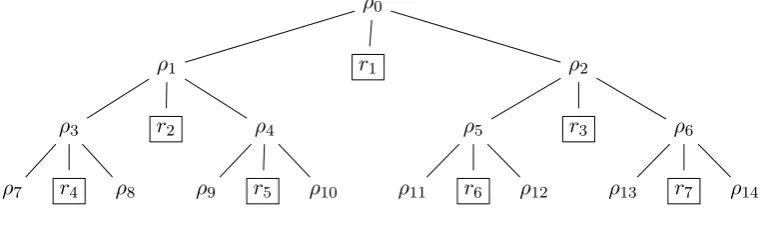
Given a PRG G taking an n-bit input, our goal is to generate a series of polynomially many pseudorandom valuesr1, r2, r3, . . ., such that eachri can be looked up in time (poly-)logarithmic in i. This is achieved using the tree structure below.
Note that while the PRF construction of [GGM86] also performs lookups in logarithmic time (and can be easily adapted to support an unlimited input domain{0,1}∗, as pointed out in [Gol01]), their construction does not satisfy our required property: in their case, the lookup time for any outputri is poly-logarithmic in the total number of queries that will ever be made to the PRF.
ρ0
ρ1
ρ3
ρ7 r4 ρ8
r2 ρ4
ρ9 r5 ρ10
r1 ρ2
ρ5
ρ11 r6 ρ12
r3 ρ6
ρ13 r7 ρ14
Figure 1: Tree illustrating efficient look-up of pseudorandom values (first 4 levels)
In Figure 1,ρ0∈ {0,1}nis the original (random) input to the PRG Gn→m+2n. Theρi∈ {0,1}n
are values which are subsequently pseudorandomly generated, which are used again as input to the PRG to produce more pseudorandom values: in particular, if ρi is a child of ρj in the tree, then ρi =Gn→m+2n(ρj)[m+1,m+n]if iis even, andρi =Gn→m+2n(ρj)[m+n+1,m+2n] ifiis odd. The boxed
nodesri∈ {0,1}m are leaves that represent the output pseudorandom values which we want to look
up, and they are generated byri=Gn(ρj)[1,m] whereρj is the parent node ofri.
LetlookupGn,m(ρ0, i)∈ {0,1}m denote theithoutput value,ri ∈ {0,1}m, obtained using the above
tree method. It is clear that for any iof polynomial size, the number of PRG evaluations required to look up ri is logarithmic. This gives rise to a PRF family with logarithmic-depth evaluations, as
Lemma 3.1. Let G:{0,1}n→ {0,1}m be a PRG. Then for any polynomialq =q(n), it holds that
there is no efficient distinguisherD for which it holds that
|Pr [D((r1, . . . , rq)) = 1]−Pr [D((G(s1), . . . , G(sq))) = 1]| ≥negl(n)
for all negligible functions negl, where r1, . . . , rq← {0,1}m(n) ands1, . . . , sq ← {0,1}n.
Proof. Suppose, for contradiction, that there is a distinguisher Db for which
Pr
h
b
D((r1, . . . , rq)) = 1 i
−PrhD((b G(s1), . . . , G(sq))) = 1 i
≥1/P(n)
whereP is a polynomial. Fori∈[q], definetupito be the distribution of tuples whose firstielements are uniformly random in {0,1}m and whose remaining elements are sampled as G(si
+1), . . . , G(sq)
for si+1, . . . , sq ← {0,1}n. Let pi = Pr[D(tupb i) = 1] denote the probability that Db outputs 1 on
input fromtupi.
By our supposition, we know|p0−pq| ≥P(n). Then, sincep0−pq= P
i∈[q](pi−1−pi), there must
existi∗∈[q] such that|pi∗−1−pi∗| ≥ 1
q·P(n), which is non-negligible. Then there exists a distinguisher
b
D0 which can distinguish asingle output of the PRG from random, as follows: on input r∈ {0,1}m, b
D0 generates a tuple twhose first i∗−1 elements are random in {0,1}m, whose (i∗)th element is r,
and whose remaining elements are generated as G(si∗+1), . . . , G(sq) for si+1, . . . , sq ← {0,1}n. Ifr
is truly random thent←tupi∗; otherwise,t←tupi∗−1. Hence, runningDb on inputtwill distinguish
with non-negligible probability between these cases. This contradicts thatGis a PRG.
Theorem 3.2. Let G be a PRG and n, m ∈ N be positive integers with m = poly(n). Then the family of functions F(n,m) def= {lookupG
n,m(ρ,·)}ρ∈{0,1}n is a PRF with input size n0 bits and output
size nbits, for any n0 =poly(n).
Proof. The statement to prove is that for any PRGGand randomρ0← {0,1}n, there is no efficient
distinguisherD that satisfies
Pr
h
DlookupGn,m(ρ0,·)() = 1
i
−PrhDR(·)() = 1i
>negl(κ)
for all negligible functions negl and all sufficiently large values of the security parameter κ. In the above, R is a random oracle, and DO may make any polynomial number of “polynomial-depth”8 queries to the oracleO.
Suppose, for contradiction, that there exists such a distinguisherD, for which the above inequalityb
does not hold: that is, there is a polynomialq for which
Pr
h
DlookupGn,m(ρ0,·)() = 1
i
−Pr
h
DR(·)() = 1
i
>1/q(κ).
Let T = T(κ) be the run-time of distinguisher D, and letb Hj be a stateful algorithm which is
defined as follows. (Note that when referring to tree structure, the root node is considered to be at depth 0.) On inputi, the algorithm Hj does the following:
• ifihas already been queried previously, look up the stored tuple (leaf, i, ρi), and output ρi;
• else if i < 2j+1 (that is, the ith output node is at depth less than or equal to j in the tree), then choose some ρi ← Z2n uniformly at random, store the tuple (leaf, i, ρi) in memory, and
outputρi;
• otherwise (that is, the ith output node is at depth greater than j in the tree):
– if there is no stored tuple of the form (root, α, ρ), then choose someρ←Z2
n uniformly at
random, store the tuple (root, α, ρ) in memory, and outputlookupGn,m(ρ, γ);
8 More precisely, the distinguisher cannot make queries that would require a super-polynomial depth look-up in
the tree structure oflookupGn,m. This is because in this case,lookup G
– otherwise, look up the stored tuple (root, α, ρ) and outputlookupGn,m(ρ, γ); whereα=α(i,j), γ=γ(i,j) are defined by the following:
α(i,j) =b(i−2blog2(i)c)/2jc
β(i,j) =i−2blog2(i)c mod 2blog2(i)c−j
γ(i,j) = 2(2
blog2(i)c−j)
+β(i,j).
When considering the tree representation of lookupGn,m, the algorithms Hj can be explained in
more intuitive terms as follows. For each j, the outputs of Hj behave as a random oracle up to and including depthj of the tree. Below depth j, the outputs are obtained deterministically by the lookupGn,m(ρ,·) function, with the appropriate depth-j value ρ(which is randomly chosen) acting as the “root node” of the subtree in which the lookup is performed.
Observe that H0 behaves exactly as lookupGn,m(ρ,·) for random ρ ← {0,1}n. Moreover, Hk
behaves exactly like a random oracle in the distinguishing experiment, provided that all of D’sb
queries can be retrieved from depth at mostk. Since the input size isn0 =poly(n) bits, there exists such a maximum depthk from which queries can be retrieved, withk=poly(n).
Let pi = Pr[DbHi() = 1] denote the probability that the distinguisher outputs 1 given Hi as an
oracle. By our earlier supposition, |p0−pk| > 1/q(κ). It follows that for some k∗ ∈ [k], we have
|pk∗−1−pk∗|> 1
k·q(κ). Such ak
∗ can be found in polynomial time with non-negligible probability9.
We now construct a new distinguisher DbPRG attacking the PRG Gn→m+2n: specifically, we will
show that the following expression is non-negligible:
Pr
h
b
DPRG((r1, . . . , rT)) = 1 i
−PrhDbPRG((Gn→m+2n(s1), . . . , Gn→m+2n(sT))) = 1 i
,
wherer1, . . . , rT ← {0,1}m+2n and s1, . . . , sT ← {0,1}n.
b
DPRG operates as follows. Given input (er1, . . . ,erT),DbPRG first determines ak
∗ ∈[k] as described
above, then runs Db and responds to the oracle queries of Db in the following way: when Db makes
query i, DbPRG responds with Hke ∗(er1, . . . ,erT), whereHke ∗ is a variant algorithm based on Hk∗. Hke ∗
takes as input (re1, . . . ,rTe ), and then behaves exactly like Hk∗, except that the values associated
with nodes at depthk∗ of the tree are obtained as substrings of the input values er1, . . . ,reT. (For a
detailed formal description ofHke ∗, refer to Appendix B.)
By construction, it holds that if the inputs eri are truly random, then Hek∗ and Hk∗ behave
identically; on the other hand, if the inputs rei are generated by Gn→m+2n, then Hek∗ and Hk∗−1
behave identically. By the choice of k∗, we know that Db distinguishes Hk∗ and Hk∗−1 with
non-negligible probability. Hence,DbPRGdistinguishes with (the same) non-negligible probability between
the case where there1, . . . ,erT are random and the case where they are generated by Gn→m+2n. By
Lemma 3.1, this contradicts that Gn→m+2n is a PRG. Therefore, our initial supposition was false:
that is, there cannot exist aDbwhich distinguishes betweenlookupGn,m(ρ0,·) andRwith non-negligible
probability. The result follows.
3.1.1 Looking up random values in order.
We would like to look up the random valueslookupGn,m(ρ0,·) in order, that is, first r1, then r2, and
so on. This can be done more efficiently than by traversing the tree starting at the root for each new value, essentially by storing the path to the most recently retrieved leaf, and implementing a “next leaf” function which takes the stored path as an input. Naturally, this incurs additional (logarithmic) storage cost, compared to looking up each leaf starting afresh from the root.
An algorithm to find the next leaf in a binary tree given the path to the “current” leaf is given in Algorithm 1. The description given in Algorithm 1 is recursive, for clarity of exposition. Note
9
This can be done by runningDbpolynomially many times on the oraclesH0, . . . , Hk, and taking the adjacent pair
that in practice, there is a more efficient implementation that avoids recursion. The method returns the entire path to the next leaf, rather than just the leaf node, because the path must be passed into the next invocation of the method to obtain the following leaf.
1 P a t h p a t h T o N e x t L e a f ( int depth ,
2 P a t h c u r r e n t P a t h , int c u r r e n t L e a f N u m ) {
3 if ( d e p t h = 1) {
4 L e a f n e x t L e a f = c u r r e n t P a t h . r o o t . r i g h t C h i l d ();
5 r e t u r n c u r r e n t P a t h . r e m o v e E n d N o d e (). a p p e n d ( n e x t L e a f );
6 } e l s e if ( d e p t h > 1) {
7 if ( c u r r e n t L e a f N u m is e v e n ) {
8 L e a f n e x t L e a f = c u r r e n t P a t h . e n d N o d e . r i g h t C h i l d ();
9 r e t u r n c u r r e n t P a t h . r e m o v e E n d N o d e (). a p p e n d ( n e x t L e a f );
10 } e l s e {
11 P a t h p a t h T o P a r e n t = c u r r e n t P a t h . r e m o v e E n d N o d e ();
12 int p a r e n t L e a f N u m = f l o o r ( c u r r e n t L e a f N u m / 2 ) ;
13 P a t h p a t h T o N e x t P a r e n t =
14 p a t h T o N e x t L e a f ( depth -1 , p a t h T o P a r e n t , p a r e n t L e a f N u m );
15 r e t u r n p a t h T o N e x t P a r e n t . a p p e n d (
16 p a t h T o N e x t P a r e n t . e n d N o d e . l e f t C h i l d ( ) ) ;
17 }
18 }
19 }
Algorithm 1: Recursive method to find next leaf from path to current leaf
Lemma 3.3. For any given depthd, when Algorithm 1 is used to compute all the leaves of a complete binary tree (of depth d) in order, the leftChild() and rightChild() methods are called exactly once for each non-leaf node in the tree. More precisely, the method employed is the following: in order to obtain the first leaf, the standard method traversing the tree downwards from the root is used; and then subsequent leaves are obtained in order by callingpathToLeaf1 = nextLeafPath(d, pathToLeaf0, 0), then pathToLeaf2 = nextLeafPath(d, pathToLeaf1, 1), etc.
Proof. Given in Appendix C.
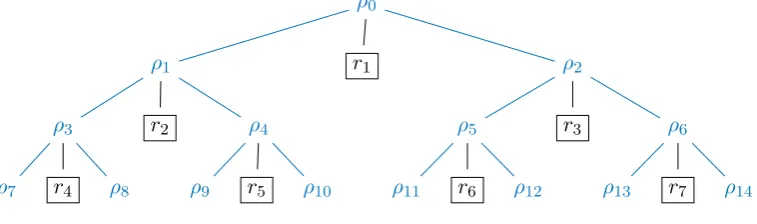
In order to apply this method to our lookup tree, we observe that the non-leaf nodes of the lookup tree constitute a binary tree (shown in blue in Figure 2). We show that applying Algorithm 1 to this binary tree allows in-order retrieval of the first k leaf values in the look-up tree in time O(k), for any k∈N. The storage requirement is log(k)·log(n) wherenis the number of input bits to G.
ρ0
ρ1
ρ3
ρ7 r4 ρ8
r2 ρ4
ρ9 r5 ρ10
r1 ρ2
ρ5
ρ11 r6 ρ12
r3 ρ6
ρ13 r7 ρ14
Figure 2: A binary tree within the lookup tree
Lemma 3.4. For any given depthd≥1, when all the output values (boxed nodes) at depthdof the lookup tree are computed in order (from left to right) by:
• then, computing each subsequent output value by applying Algorithm 1 to the binary tree of non-leaf nodes up to and including depthd−1, and calling the underlying PRG to obtain each actual (leaf ) output value,
the total numberC of calls to the underlying PRGGthat is required to computeall the output values at depth d is exactly 2d+ 2d−1−2. (Note that in order to use Algorithm 1, the path to the most recently retrieved output node must be stored at all times: this incurs logarithmic storage space.)
Proof. By the construction of the lookup tree, leftChild()andrightChild() can each be imple-mented by a single invocation of the PRG G. By Lemma 3.3, when Algorithm 1 is used to look up all nodes at a particular depthd−1 in a binary tree (in order), theleftChild()andrightChild()
methods will each be called exactly once for every node at depth less thand−1 in the tree. Thus,
Gwill be called twice for every node at depth less thand−1 in the binary tree. There are 2d−1−1 such nodes, soG will be called a total of 2d−2 times while traversing the tree. In addition, there is one invocation of Gper output value, which we have not counted in the above analysis, because it is not within thebinary tree. There are 2d−1 output values at depthdof the lookup tree, so this adds 2d−1 invocations to our total. Hence, the total number of calls of G required to compute all the output values at depth d(in order) is 2d+ 2d−1−2.
Corollary 3.5. When computing the valueslookupGn,m(ρ0, i)fori= 1,2, . . . (in order) by the method
described in Lemma 3.4, the amortised number of calls to G per output value looked up is constant. To be precise, it is less than1.5.
Proof. For any given depth d >1, there are 2d−1 output values at that depth. By Lemma 3.4, all of these values can be looked up with a total of 2d+ 2d−1−2 calls toG. Hence, the number of calls toGper output value (at depthd) is 2d+22dd−1−2 <1.5.
3.2 Concurrent man-in-the-middle secure protocol
The protocol construction which follows can be realised with black-box access to any PRG, and achieves concurrent man-in-the-middle security.
Public parameters. PRGG, security parametern∈Z, error-correcting codeCwith constant-fraction distance.
Key generation. Gen(1n) sampless, s0 ← {0,1}n and outputs secret key (s, s0).
Initial state. The prover’s state consists ofi∈Ninitialised to 1.
P(s, s0;i) V(s, s0)
a
←−−−−−−−− a←R
e:=lookupGn,n(s0, i) z:=C.Enc(a)∗s+e i:=i+ 1
z, i −−−−−−−−−→
accept iff
z+C.Enc(a)∗s=lookupGn,n(s0, i)
Protocol 1: Concurrent MIM secure protocol
The magenta colorin the protocol indicates (updating of) the prover’s state.
Lemma 3.6. Protocol 1 is perfectly complete. Proof. This is clear sincelookupGn,n is deterministic.
Lemma 3.7. Protocol 1 is secure against active attacks.
Proof. Letej denote the noise string for index j. Consider the following games:
Game 1. P,V and the adversary Aplay the active security game.
Game 2. P,V and A play the active security game as before, except that P,V no longer know
s0, but instead have oracle access to lookupGn,n(s0,·).
Game 3. Like Game 2, butlookupGn,n(s0,·) is replaced by a random oracle.
Games 1 and 2 are perfectly indistinguishable for the adversary, since the messages sent by are distributed identically in the two games. Suppose, for contradiction, that there exists an adversary A which can efficiently distinguish between Games 2 and 3. Then, this adversary could be used to efficiently distinguish between (oracle access to)lookupGn,n(s0,·) and a random oracle – this contradicts Theorem 3.2. Therefore, Games 1, 2, and 3 are computationally indistinguishable, and so theej are
indistinguishable from uniformly random noise.
We have established that the prover’s message z = C.Enc(a)∗s+ej is indistinguishable from
C.Enc(a)∗s+r for random r. Hence,z is indistinguishable from random to any active adversary, regardless of the choice ofa. It remains only to consider the interaction ofAwith the honest verifier V. Given a challenge afrom V, A can have at most negligible advantage at guessing the (unique) value of zthat V will accept, as shown by considering the following two cases:
1. Asends an indexithat was not used when talking to the honest prover. In this case, we could give the adversary theevalues for thisifor free (as it is independent of the what happens for the other indices). Now the adversary’s task is equivalent to guessing C.Enc(a)∗s, which he cannot do since he has no information abouts.
2. Asends an indexithat was previously used in a query to the prover. Letz, i be the response (toa) from the honest prover. Say the honest verifier sends a0 and let z0, i be the adversary’s response. If there is a non-negligible probability that z0 is accepted, then it follows that
z−z0 = (C.Enc(a) −C.Enc(a0))∗ s. This happens with negligible probability since all of
a, a0, z, z0 were chosen independently of s.
Theorem 3.8. Protocol 1 is secure against concurrent MIM attacks.
Proof. We show that if there is an adversaryAwhich achieves a certain advantage when conducting a concurrent MIM attack, then there is another adversaryA0thatonly talks to the prover in Protocol 1 and achieves essentially the same advantage. First, we replace the honest verifier by a fake verifier V0 who has no access to sor the e
j but still gives essentially the same answers as V. Then we argue
that for any concurrent MIM attack, there is an equally successfulactive attack, and finally refer to Lemma 3.7 for the active security of the protocol.
V0 works as follows: when queried by A, it chooses a random challenge a (just like V does).
When Areturns an answer z, j, there are two cases to consider:
1. Apreviously received answerz0, j fromP, wherez0=C.Enc(a0)∗s+ej anda0 isA’s query to P. Here we have two possibilities:
(a) a= a0 (which could be the case if A queried P during the current protocol execution): in this case, ifz=z0,V0 accepts; else, it rejects.
(b) a6=a0: V0 always rejects.
2. Anever previously received an answer of the formz0, j fromP. In this caseV0 always rejects.
Consider the first time A queries the verifier. V’s challenge is distributed identically to that of V0. In case 1a, V will accept if and only if z has the correct value C.Enc(a)∗s+e
j: so V0
z0 = C.Enc(a0)∗s+ej it must be that (z−z0) = (C.Enc(a)−C.Enc(a0))∗s. This happens with negligible probability because s is random and z, z0, a, a0 are all independent of s: P’s responses, includingz0, are independent ofs; and since this is the first query,V has not seensyet, soa, a0 and
zmust be independent ofstoo. Thus, V rejects with overwhelming probability, soV0 is statistically close to the right behavior. Finally, in case 2, no one sees ej before A produces z, j. If V accepts,
we havez =C.Enc(a)∗s+ej, so ej =z−C.Enc(a)∗s, which happens with negligible probability sincez, a ands are independent ofej.
Therefore, we can replace V with V0 for the first query, and A’s advantage changes at most
negligibly as a result. Repeating this argument for all the queries, we reach the game where V is entirely replaced by V0, and A’s advantage is still at most negligibly different from in the original game. SinceV0does not possess any secret information, an adversary can runV0“in his head”. So for
any adversaryAwhich has non-negligible advantage in a man-in-the-middle attack, we can construct an adversaryA0 that emulates both A and V0 “in his head” and achieves the same advantage, but conducting an active attack (since he need not interact with the real verifier V). The result then follows from Lemma 3.7.
3.2.1 Linear-time implementation.
The prover in Protocol 1 can run in timeO(n) and spaceO(log(n)·log(k)), wherekis the number of protocol executions run so far10: this is possible by using Algorithm 1 to compute lookupGn,n(·,·) as described in Lemma 3.4. This follows from Corollary 3.5, and the fact that there exist linear-time, linear-stretch PRGs and linear-time encodable codes with constant-factor expansion and large constant-fraction distance (such as those of Guruswami and Indyk [GI05]).
The verifier can also be implemented to run in linear time for honest executions, by using the same method as the prover to computelookupGn,n(·,·). Clearly, if the prover is honest, the verifier will run in linear time. If the prover cheats and breaks the sequence, then the verifier can retrieve the requiredlookupGn,n(·,·) value by the “backup method” of traversing the lookup tree downwards from the root, which takesO(n·log(k)) time instead. This implementation requiresN·O(log(n)·log(k)) space, whereN is the number of different provers with which the verifier interacts. Note that since the multiplication can be done in depthO(log(n)), if the PRGGis of poly-logarithmic depth, then the verifier does only poly-logarithmic depth computation (even when the prover cheats).
3.3 `-instance concurrent MIM secure protocol
Building upon the ideas of Protocol 1, our next protocol achieves`-instance concurrent MIM security for any polynomial `. Moreover, if`is constant, we can still get (amortised) linear time. The next protocol makes use of`-wise independent hashing, which is defined below.
Definition 3.9 (`-wise independent hash function family). A function family H of functions that mapnbits tombits is a`-wise independent hash function familyif for ally1, . . . , y`∈ {0,1}mand for
all distinct x1, . . . , x` ∈ {0,1}n, it holds that Prh←H[h(x1) =y1∧h(x2) =y2∧ · · · ∧h(x`) =y`] =
2−`m.
Lemma 3.10. Protocol 2 is perfectly complete.
Proof. This is clear sincelookupGn,(`+1)·n+β is deterministic.
Our security proofs follow a similar structure to those of Protocol 1: we first prove `-instance active security, then use this to prove `-instance concurrent MIM security. The proofs of Lemma 3.11 and Theorem 3.12 are given in Appendix D, due to space constraints. We remark that the proof of Theorem 3.12 is very similar to that of Theorem 3.8
10In other words, k is the number of leaf values in the lookup tree that have been retrieved so far. Note that if
desired, the value ofkcan be upper-bounded by some polynomial-sizeK, by “starting a new tree” afterKvalues have been retrieved from the initial tree: the (K+ 1)thleaf value in the first tree serves as the root of a new tree in which
Public parameters. ` = poly(n), PRG G, security parameter n ∈ Z, error-correcting code C with constant-fraction distance, function family H = {hr}r∈{0,1}β of 2`-wise independent hash functions mapping (`+ 1)·nbits to nbits. Key generation. Gen(1n) sampless←R, s0← {0,1}n and outputs (s, s0).
Initial state. The prover’s state consists ofi∈Ninitialised to 1.
P(s, s0;i) V(s, s0)
a
←−−−−−−−− a←R
ri :=lookupGn,(`+1)·n+β(s0, i)
e:=hr[1,β]
i
a+ri[β+1,(`+1)·n+β]
z:=C.Enc(a)∗s+e i:=i+ 1
z, i −−−−−−−−−→
ri:=lookupGn,(`+1)·n+β(s0, i) accept iffz+C.Enc(a)∗s=
hr[1,β]
i
a+ri[β+1,(`+1)·n+β]
Protocol 2: `-instance concurrent MIM secure protocol
Lemma 3.11. Protocol 2 is secure against `-instance active attacks.
Theorem 3.12. Protocol 2 is secure against `-instance concurrent MIM attacks.
3.3.1 Linear-time implementation.
If`is constant, then the prover in Protocol 2 can run in (amortised) timeO(n) and spaceO(log(n)· log(k)), where k is the number of protocol executions run so far: as with Protocol 1, this requires the use of Algorithm 1 to compute lookupGn,n(·,·), and the use of a linear-time PRG and linear-time encodable code. In addition, we require an`-wise independent hash function family whose functions can be sampled and computed in linear time. A construction of a hash function family satisfying these properties for constant ` is given in Section E. As in the case of Protocol 1, the verifier in Protocol 2 can also be implemented to run in linear time when the prover is honest.
3.3.2 On achieving unbounded multi-instance MIM security.
Consider the PRG G as a mapping from n-bit seeds to n-bit outputs. Then clearly the string
G(s1), ..., G(st) is pseudorandom for any polynomialt, if thesi’s are independent and random. We
say thatGis (H, `)-wise secure if this still holds, even if thesi are not independent, but are chosen
from an`-wise independent distribution generated by a hash function from`-wise independent family H – more precisely, any subset of ` seeds are uniformly random and independent, and si = h(xi) forh chosen at random from H and distinct xi. We can now define a small change to Protocol 2:
namely, in Step 2 of the Prover’s computation,eis computed as
e:=Gh ri[1,β]
a+ri[β+1,(`+1)·n+β].
(That is, we do the same as before, but apply G at the end.) Now, assuming Gis strongly (H, ` )-wise secure, where H is the hash function family used in the protocol, we will get pseudorandom output after applyingG, no matter how (polynomially) many outputs we generate, As a result this variant of the protocol is Multi-instance MIM secure (with an unbounded number of instances), if
Gis (H, `)-wise secure. If Ghas this property even for a constant `, the protocol can run in linear time, by using the`-wise independent hash functions described in Appendix E.
seeds. Therefore the protocol has “graceful degradation”: it is bounded instance MIM secure for at most`instances assuming only thatGis a PRG, and the same protocol is also unbounded instance secure under the stronger security notion.
We emphasise that the (H, `) security notion for a PRG is new and its plausibility depends very much on how the concrete PRG and hash function family relate to each other. It should therefore not be used without a careful analysis of the building blocks.
4
Comparison with AES-based protocol
Returning to a more practical perspective, we consider how our protocol would perform when in-stantiated with a stream cipher acting as the PRG. Since fine-tuning the efficiency of one-sided authentication is particularly relevant for lightweight hardware devices, we focus on a hardware-oriented cipher and compare performance at the relatively low 100kHz clock frequency which is common in low-end devices. By the same reasoning, we analyse theprover’s performance which is the bottleneck in such applications.
Our analysis considers our protocol instantiated with the Grain-128 stream cipher as the PRG. We selected Grain-128 from the eSTREAM (Profile 2)11 portfolio because it is highly optimised for hardware implementation with high throughput, and it has a mode with 128 bits of security which is good for comparison to AES with 128-bit keys. Moreover, Grain has the advantage of a relatively fast initialization time compared to other Profile 2 candidates such as Trivium [FW08]. Specifi-cally, our benchmarks are based on the performance of Grain128x32 and a comparable hardware implementation of AES (by [SMTM01]), as documented in [GB08, Table 4].
An interesting initial observation is that if one uses Grain128x32 in the GGM construction of a PRF, then the speed of a Grain-based PRF evaluation is “only” about 20 times slower than an AES evaluation. This highlights that the efficiency advantage of stream ciphers over block ciphers is a major factor that counterbalances the relative inefficiency of the GGM-style construction that is inherent in our protocols.
Indeed, as shown in Table 1, our protocol outperforms the simple AES-based protocol)in terms of prover computation time by a factor of three when instantiated with 2048 bits of prover state. Our figures do not account for write time to update state, in order to have a fairer comparison of the computation times, since write times vary greatly across different chips / types of memory.12
Simple PRF-based protocol Our protocol
AES Grain (+GGM) Grain (32-bit state) Grain (2048-bit state)
0.54 10.24 3.84 0.18
Table 1: Amortised provercomputation time (in ms) in two-round authentication
Size of the prover’s state. In Table 1, “32-bit state” refers to the scenario when the prover stores only a (32-bit) counter value, whereas “2048-bit state” refers to the variant when the prover stores partial paths in the modified GGM tree.
Remarks on protocol implementation. Note that in software, using a more standard MAC of form a·s+e, where the product is in the field with 2n elements, may be an advantage (even if it is not preferable asymptotically). For instance, forn= 64, we can multiply by a fixed elements
using 8 table look-ups in 16 KB of precomputed tables. However, if the prover is a small hardware device, whereas the verifier has more power, then using the MAC C(a)∗s+ethat we suggest may
11Profile 2 ciphers are described as “Stream ciphers for hardware applications with restricted resources such as
limited storage, gate count, or power consumption.”
12To give a very rough estimate: based on the specifications of common RFID manufacturers, the write time to
be even better, since we can ask the verifier to send the encoding C(a) rather than a. Our proof of security still applies if the prover checks that he receives a codeword, and this can be extremely fast in hardware if we use an LDPC (low-density parity check) code: the codeword check consists of computing parity functions of a small constant (say, 3 or 4) number of bits, and all the parity functions could be computed in parallel. This reduces the prover’s computation essentially to the cost of running the stream cipher (and we have assumed that this is the case, in computing the figures in Table 1).
Remark on counter mode. The use of a counter in our protocol may prompt the question: if we use a stream cipher with a nonce in counter mode, then could we run the stream cipher on consecutive counter values instead of evaluating the lookup function? The answer is that such a scheme would only be secure if the stream cipher were secure against adversarially chosen nonces. The standard assumption about stream ciphers is that nonces need not be kept secret, but are chosen honestly (rather than adversarially) by the party in possession of the key [Sch95]. The use of the lookupfunction allows us to base our protocol onany PRG, or any stream cipher.
The behaviour of stream ciphers under adversarially chosen nonces seems to be little studied/un-derstood: for example, the eSTREAM cipher candidates do not discuss the possibility of adversarial nonces. Assuming security under adversarial nonces is equivalent to assuming PRF security of a stream cipher, rather than PRG security. The only instance of such an assumption being used in the literature, of which we are aware, is [BEG10] which proposes a (three-round) authentication protocol based on “PRF security of a stream cipher”, but gives no discussion of why such an assumption may be reasonable. If, somehow, one has a stream cipher satisfying this strong assumption, then our protocol would yield prover computation time of 0.12 ms with a 32-bit state. We mention this topic as an academic point, and we stress that we do not consider this to be a safe option for use with arbitrary (or perhaps any) stream ciphers.
5
Conclusion
We have proposed several variants of a two-round authentication protocol that can be instantiated using any pseudorandom generator, and have (optimal) linear time complexity with a logarithmic space requirement. We defined and proved full concurrent man-in-the-middle security in the prover-stateful model, and also showed that our variant protocols satisfy stronger multi-instance security. A key tool in our construction is the design of PRF-like function based on a black-box PRG, which has very efficient lookups when inputs are queried in sequential order, which may be useful in other settings. Finally, a preliminary analysis shows that the protocol is efficient enough that it is possible to implement on lightweight hardware devices.
6
Acknowledgements
We would like to thank Ron Rivest, Srini Devadas, and Chiraag Juvekar for illuminating conver-sations about lightweight authentication. We thank an anonymous reviewer for bringing to our attention the topic of stream ciphers in counter mode.
References
[BPR12] Abhishek Banerjee, Chris Peikert, and Alon Rosen. “Pseudorandom Functions and Lat-tices”. In:EUROCRYPT. Ed. by David Pointcheval and Thomas Johansson. Vol. 7237. Lecture Notes in Computer Science. Springer, 2012, pp. 719–737. isbn: 978-3-642-29010-7. doi: 10.1007/978- 3- 642- 29011- 4.url: http://dx.doi.org/10.1007/ 978-3-642-29011-4.
[BR93] Mihir Bellare and Phillip Rogaway. “Entity Authentication and Key Distribution”. In: Advances in Cryptology - CRYPTO ’93, 13th Annual International Cryptology Con-ference, Santa Barbara, California, USA, August 22-26, 1993, Proceedings. Ed. by Douglas R. Stinson. Vol. 773. Lecture Notes in Computer Science. Springer, 1993, pp. 232–249. isbn: 3-540-57766-1. doi: 10 . 1007 / 3 - 540 - 48329 - 2 _ 21. url: http : //dx.doi.org/10.1007/3-540-48329-2_21.
[BDOZ11] Rikke Bendlin, Ivan Damg˚ard, Claudio Orlandi, and Sarah Zakarias. “Semi-homomorphic Encryption and Multiparty Computation”. In:EUROCRYPT. Ed. by Kenneth G. Pa-terson. Vol. 6632. Lecture Notes in Computer Science. Springer, 2011, pp. 169–188.
isbn: 978-3-642-20464-7.
[BEG10] Olivier Billet, Jonathan Etrog, and Henri Gilbert. “Fast Software Encryption: 17th In-ternational Workshop, FSE 2010, Seoul, Korea, February 7-10, 2010, Revised Selected Papers”. In: ed. by Seokhie Hong and Tetsu Iwata. Berlin, Heidelberg: Springer Berlin Heidelberg, 2010. Chap. Lightweight Privacy Preserving Authentication for RFID Us-ing a Stream Cipher, pp. 55–74. isbn: 978-3-642-13858-4. doi: 10.1007/978-3-642-13858-4_4.url:http://dx.doi.org/10.1007/978-3-642-13858-4_4.
[Can+00] Ran Canetti, Yevgeniy Dodis, Shai Halevi, Eyal Kushilevitz, and Amit Sahai. “Exposure-Resilient Functions and All-or-Nothing Transforms”. In:Advances in Cryptology - EU-ROCRYPT 2000, International Conference on the Theory and Application of Cryp-tographic Techniques, Bruges, Belgium, May 14-18, 2000, Proceeding. Ed. by Bart Preneel. Vol. 1807. Lecture Notes in Computer Science. Springer, 2000, pp. 453–469.
isbn: 3-540-67517-5. doi: 10.1007/3- 540- 45539- 6_33. url: http://dx.doi.org/ 10.1007/3-540-45539-6_33.
[CKT16] David Cash, Eike Kiltz, and Stefano Tessaro. “Two-Round Man-in-the-Middle Security from LPN”. In:TCC. 2016.
[Cho+85] Benny Chor, Oded Goldreich, Johan H˚astad, Joel Friedman, Steven Rudich, and Ro-man Smolensky. “The Bit Extraction Problem of t-Resilient Functions (Preliminary Version)”. In: 26th Annual Symposium on Foundations of Computer Science, Port-land, Oregon, USA, 21-23 October 1985. IEEE Computer Society, 1985, pp. 396–407.
isbn: 0-8186-0644-4. doi: 10.1109/SFCS.1985.55. url: http://dx.doi.org/10. 1109/SFCS.1985.55.
[DFMV13] Ivan Damg˚ard, Sebastian Faust, Pratyay Mukherjee, and Daniele Venturi. “Tamper Resilient Cryptography Without Self-Destruct”. In: IACR Cryptology ePrint Archive 2013 (2013), p. 124.
[DZ13] Ivan Damgrd and Sarah Zakarias. “Constant-Overhead Secure Computation of Boolean Circuits using Preprocessing”. English. In: Theory of Cryptography. Ed. by Amit Sa-hai. Vol. 7785. Lecture Notes in Computer Science. Springer Berlin Heidelberg, 2013, pp. 621–641. isbn: 978-3-642-36593-5. doi: 10.1007/978- 3- 642- 36594- 2_35. url: http://dx.doi.org/10.1007/978-3-642-36594-2_35.
[DKPW12] Yevgeniy Dodis, Eike Kiltz, Krzysztof Pietrzak, and Daniel Wichs. “Message Authenti-cation, Revisited”. In:EUROCRYPT. Ed. by David Pointcheval and Thomas Johans-son. Vol. 7237. Lecture Notes in Computer Science. Springer, 2012, pp. 355–374.isbn:
[FW08] Martin Feldhofer and Johannes Wolkerstorfer. “RFID Security: Techniques, Proto-cols and System-on-Chip Design”. In: ed. by Paris Kitsos and Yan Zhang. Boston, MA: Springer US, 2008. Chap. Hardware Implementation of Symmetric Algorithms for RFID Security, pp. 373–415. isbn: 978-0-387-76481-8. doi: 10.1007/978-0-387-76481-8_15.url:http://dx.doi.org/10.1007/978-0-387-76481-8_15.
[Gol01] Oded Goldreich. Foundations of Cryptography: Basic Techniques. Cambridge Univer-sity Press, 2001.isbn: 0-521-79172-3.
[GGM86] Oded Goldreich, Shafi Goldwasser, and Silvio Micali. “How to construct random func-tions”. In: J. ACM 33.4 (1986), pp. 792–807.
[GB08] T. Good and M. Benaissa. “Hardware performance of eSTREAM phase-III stream cipher candidates”. In: In SASC. 2008.
[GI05] Venkatesan Guruswami and Piotr Indyk. “Linear-time encodable/decodable codes with near-optimal rate”. In:IEEE Transactions on Information Theory51.10 (2005), pp. 3393– 3400. doi: 10.1109/TIT.2005.855587. url: http://dx.doi.org/10.1109/TIT. 2005.855587.
[HJM07] Martin Hell, Thomas Johansson, and Willi Meier. “Grain: a Stream Cipher for Constrained Environments”. In: Int. J. Wire. Mob. Comput.2.1 (May 2007), pp. 86– 93. issn: 1741-1084. doi: 10.1504/IJWMC.2007.013798.url: http://dx.doi.org/ 10.1504/IJWMC.2007.013798.
[Hey+12] Stefan Heyse, Eike Kiltz, Vadim Lyubashevsky, Christof Paar, and Krzysztof Pietrzak. “Lapin: An Efficient Authentication Protocol Based on Ring-LPN”. In: FSE. Ed. by Anne Canteaut. Vol. 7549. Lecture Notes in Computer Science. Springer, 2012, pp. 346– 365.isbn: 978-3-642-34046-8.
[HB01] NicholasJ. Hopper and Manuel Blum. “Secure Human Identification Protocols”. En-glish. In: Advances in Cryptology ASIACRYPT 2001. Ed. by Colin Boyd. Vol. 2248. Lecture Notes in Computer Science. Springer Berlin Heidelberg, 2001, pp. 52–66.isbn:
978-3-540-42987-6.doi:10.1007/3-540-45682-1_4.url: http://dx.doi.org/10. 1007/3-540-45682-1_4.
[IKOS08] Yuval Ishai, Eyal Kushilevitz, Rafail Ostrovsky, and Amit Sahai. “Cryptography with constant computational overhead”. In: Proceedings of the 40th Annual ACM Sym-posium on Theory of Computing, Victoria, British Columbia, Canada, May 17-20, 2008. Ed. by Cynthia Dwork. ACM, 2008, pp. 433–442. isbn: 978-1-60558-047-0.doi: 10.1145/1374376.1374438.url:http://doi.acm.org/10.1145/1374376.1374438.
[JW05] Ari Juels and Stephen A. Weis. “Authenticating Pervasive Devices with Human Pro-tocols”. In: CRYPTO. Ed. by Victor Shoup. Vol. 3621. Lecture Notes in Computer Science. Springer, 2005, pp. 293–308.isbn: 3-540-28114-2.
[KSS10] Jonathan Katz, Ji Sun Shin, and Adam Smith. “Parallel and Concurrent Security of the HB and HB+ Protocols”. In:J. Cryptology 23.3 (2010), pp. 402–421.
[Kil+11] Eike Kiltz, Krzysztof Pietrzak, David Cash, Abhishek Jain, and Daniele Venturi. “Ef-ficient Authentication from Hard Learning Problems”. In:EUROCRYPT. Ed. by Ken-neth G. Paterson. Vol. 6632. Lecture Notes in Computer Science. Springer, 2011, pp. 7– 26.isbn: 978-3-642-20464-7.
[LM13] Vadim Lyubashevsky and Daniel Masny. “Man-in-the-Middle Secure Authentication Schemes from LPN and Weak PRFs”. English. In:Advances in Cryptology CRYPTO 2013. Ed. by Ran Canetti and JuanA. Garay. Vol. 8043. Lecture Notes in Computer Science. Springer Berlin Heidelberg, 2013, pp. 308–325.isbn: 978-3-642-40083-4. doi: 10.1007/978-3-642-40084-1_18.url: http://dx.doi.org/10.1007/978-3-642-40084-1_18.
[MNT90] Y. Mansour, N. Nisan, and P. Tiwari. “The Computational Complexity of Universal Hashing”. In: Proceedings of the Twenty-second Annual ACM Symposium on Theory of Computing. STOC ’90. Baltimore, Maryland, USA: ACM, 1990, pp. 235–243.isbn:
0-89791-361-2.doi:10.1145/100216.100246. url: http://doi.acm.org/10.1145/ 100216.100246.
[Pat11] Kenneth G. Paterson, ed.Advances in Cryptology - EUROCRYPT 2011 - 30th Annual International Conference on the Theory and Applications of Cryptographic Techniques, Tallinn, Estonia, May 15-19, 2011. Proceedings. Vol. 6632. Lecture Notes in Computer Science. Springer, 2011.isbn: 978-3-642-20464-7.
[PJ12] David Pointcheval and Thomas Johansson, eds. Advances in Cryptology - EURO-CRYPT 2012 - 31st Annual International Conference on the Theory and Applica-tions of Cryptographic Techniques, Cambridge, UK, April 15-19, 2012. Proceedings. Vol. 7237. Lecture Notes in Computer Science. Springer, 2012.isbn:
978-3-642-29010-7. doi: 10.1007/978-3-642-29011-4. url: http://dx.doi.org/10.1007/978-3-642-29011-4.
[SMTM01] Akashi Satoh, Sumio Morioka, Kohji Takano, and Seiji Munetoh. “Advances in Cryp-tology — ASIACRYPT 2001: 7th International Conference on the Theory and Ap-plication of Cryptology and Information Security Gold Coast, Australia, December 9–13, 2001 Proceedings”. In: ed. by Colin Boyd. Berlin, Heidelberg: Springer Berlin Heidelberg, 2001. Chap. A Compact Rijndael Hardware Architecture with S-Box Op-timization, pp. 239–254.isbn: 978-3-540-45682-7. doi:10.1007/3-540-45682-1_15.
url:http://dx.doi.org/10.1007/3-540-45682-1_15.
[Sch95] Bruce Schneier. Applied Cryptography (2Nd Ed.): Protocols, Algorithms, and Source Code in C. New York, NY, USA: John Wiley & Sons, Inc., 1995.isbn: 0-471-11709-9.
[VZ12] Salil Vadhan and Colin Jia Zheng. “Characterizing pseudoentropy and simplifying pseu-dorandom generator constructions”. In:Proceedings of the 44th symposium on Theory of Computing. ACM. 2012, pp. 817–836.
A
Pseudorandom primitives
We give the standard definitions of pseudorandom generators (PRGs) and pseudorandom function families (PRFs).
Definition A.1(Pseudorandom generator). LetG:{0,1}n→ {0,1}m(n)be a deterministic
polynomial-time algorithm. G is a pseudorandom generator (PRG) if m(n) > n and for any efficient distin-guisher D that outputs a single bit, it holds that |Pr[D(r) = 1]−Pr[D(G(s)) = 1]| ≤negl(n), where
r← {0,1}m(n), s← {0,1}n are chosen uniformly at random, and the probabilities are taken over r, s, and the random coins of D.
It is well known that any pseudorandom generator implies pseudorandom generation with any polynomial expansion factorm(n), by applying the PRG to its own output repeatedly.
Definition A.2(Pseudorandom function family (PRF)). Let F ={FK}be family of deterministic
polynomial-time keyed algorithms mapping n bits to m bits. F is a pseudorandom function family (PRF), if for any efficient distinguisher D that outputs a single bit, it holds that |P r[DFK = 1]−
Pr[DRn→m = 1]| ≤ negl(n), where R
n→m is a random oracle mapping n bits to m bits, and the