ISSN 2286-4822
www.euacademic.org DRJI Value: 5.9 (B+)
The Impact of Solid Waste on the Ecosystem of
Quetta
AFIFA NOOR
M.Phil. Scholar, Institute of Biochemistry University of Balochistan, Quetta, Pakistan
MUHAMMAD ANWAR PANEZAI
Professor, Institute of Biochemistry University of Balochistan, Quetta, Pakistan
JAHANGIR KHAN ACHAKZAI
Ph.D. Scholar, Institute of Biochemistry University of Balochistan, Quetta, Pakistan
SAMINA GUL
M.Phil. Scholar, Institute of Biochemistry University of Balochistan, Quetta, Pakistan
ABDUL MANAN KAKAR
Ph.D. Scholar, Institute of Biochemistry University of Balochistan, Quetta, Pakistan
NAZIMA YOUSAF KHAN Ph.D. Scholar, Institute of Biochemistry University of Balochistan, Quetta, Pakistan
AJAB KHAN TAREEN
Ph.D. Scholar, Institute of Biochemistry University of Balochistan, Quetta, Pakistan
MUHAMMAD IMRAN
M.Phil. Scholar, Institute of Biochemistry University of Balochistan, Quetta, Pakistan
Abstract:
the paper explain that the filthy and dump areas with solid waste is depicting our poor planning, poor education and poor capacity of the government and private organization. These filthy areas are not only injurious for the health of the local dwellers but also to the visitors coming from across the border and from other provinces. The mounting garbage is an eyesore. But it has even more harmful effect on environment and ecosystem. The piles of the garbage collected by the private garbage workers and throw it to the various open spaces and vacant plots. The same garbage rises in the air with the wind and makes the environment polluted. We breathe in this polluted air, which ultimately has a health hazard risk for the people of the population. The aim of this paper is to present the facts of municipal waste management and its impact on ecosystem relevant to Quetta city.
Key words: Municipal solid waste (MSW), Municipal waste management (MWM)
INTRODUCTION:
and other environmental considerations [3]. The municipalities in developing countries typically lack the financial resources and skills needed to cope with this crisis. Several countries have realized that the way they manage their solid wastes does not satisfy the objectives of sustainable development [4]. This raises the important issue of how to deliver quality service in the face of the financial and skill constraints of the public sector [5].
Moreover, the least mitigating measures have also never been reported from any municipality. Treatment and disposal technologies such as sanitary land filling, composting and incineration are comparatively new in Pakistan [6]. Crude open dumping is the most common practice throughout Pakistan and dump sites are commonly set to fire to reduce the volume of accumulating waste, hence adding to the air pollution caused by the uncovered dumped waste itself [7]. At present, there are no landfill regulations or standards that provide a basis for compliance and monitoring, but national guidelines for these standards are being prepared by the Consultant under National Environmental Action Plan Support Program (NEAP SP). Review and Analysis of Current Solid Waste Management Situation in Urban Areas of Pakistan. Hazardous Waste Industrial and medical wastes constitute a larger part on what is known as ‘hazardous wastes [8].
is the body to care for and reduce the risks of waste by managing it as per rules and that of Pakistan EPA.
Quetta as a city of the province of Balochistan does lack many facilities inclusive of waste collection and management. Therefore the present paper is detailed to have an idea of the population with their waste generation in the city and its impacts on the ecosystem.
RESEARCH METHODOLOGY:
The data was collected through Questionnaire. Twenty-Five union councils Halqas / areas out of 68 union councils were selected. After getting primary data through survey and other secondary data, the data was tabulated and presented in graphs as well. Microsoft Excel was used for getting the percentage and averages of the data. Office of the Municipal Committee was visited as well as Metropolitan Quetta for getting information regarding solid waste management.
The scope of study ranging from collecting of primary data through survey and secondary data from concerned departments. Research articles from internet for references and research work of the previous researchers available in University of Balochistan. Further, that I am residing in Quetta city and it is the capital of Balochistan province and it is a better choice to work in provincial headquarters. Sample data comprises over the 36.8% which is good scope for portraying the impact of the solid waste on the ecosystem of the Quetta City.
RESULTS AND DISCUSSION:
contributes about 0.33 kg of the solid waste daily. 100% solid waste is being disposed-off by the people through private waste collectors, it was also concluded that 61% private solid waste collector used gloves while collecting the waste whereas 51% also use protective dress.
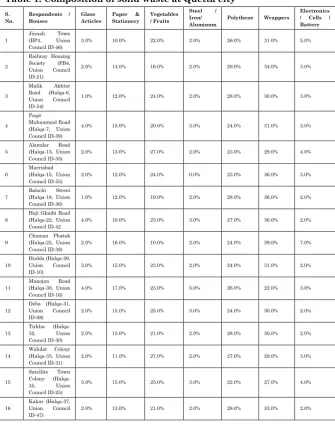
Table 1: Composition of solid waste at Quetta city
S. No.
Respondents / Houses
Glass Articles
Paper & Stationery
Vegetables / Fruits
Steel / Iron/ Aluminum
Polythene Wrappers
Electronics / Cells / Battery
1
Jinnah Town (BP4, Union Council ID-46)
3.0% 10.0% 22.0% 2.0% 26.0% 31.0% 5.0%
2
Railway Housing Society (PB4, Union Council ID-21)
2.0% 14.0% 16.0% 2.0% 29.0% 34.0% 3.0%
3
Malik Akhter Road (Halqa-6, Union Council ID-54)
1.0% 12.0% 24.0% 2.0% 28.0% 30.0% 3.0%
4 Faqir Muhammad Road (Halqa-7, Union Council ID-39)
4.0% 15.0% 20.0% 3.0% 24.0% 31.0% 3.0%
5
Alamdar Road (Halqa-13, Union Council ID-35)
2.0% 13.0% 27.0% 2.0% 23.0% 29.0% 4.0%
6
Marriabad (Halqa-15, Union Council ID-55)
2.0% 12.0% 24.0% 0.0% 23.0% 36.0% 3.0%
7
Balochi Street (Halqa-18, Union Council ID-36)
1.0% 12.0% 19.0% 2.0% 28.0% 36.0% 2.0%
8
Haji Ghaibi Road (Halqa-22, Union Council ID-42
4.0% 10.0% 23.0% 3.0% 27.0% 30.0% 2.0%
9
Chaman Phatak (Halqa-25, Union Council ID-38)
2.0% 16.0% 10.0% 2.0% 24.0% 39.0% 7.0%
10
Hudda (Halqa-29, Union Council ID-10)
3.0% 15.0% 23.0% 2.0% 24.0% 31.0% 2.0%
11
Manojan Road (Halqa-30, Union Council ID-16)
4.0% 17.0% 23.0% 5.0% 26.0% 22.0% 3.0%
12
Deba (Halqa-31, Union Council ID-08)
2.0% 15.0% 25.0% 3.0% 24.0% 30.0% 2.0%
13
Tirkha (Halqa-32, Union Council ID-30)
2.0% 15.0% 21.0% 2.0% 28.0% 30.0% 2.0%
14
Wahdat Colony (Halqa-33, Union Council ID-31)
2.0% 11.0% 27.0% 2.0% 27.0% 29.0% 3.0%
15
Satellite Town Colony (Halqa-35, Union Council ID-25)
3.0% 15.0% 25.0% 3.0% 22.0% 27.0% 4.0%
16
Kakar (Halqa-37, Union Council ID-47)
17
Gol Masjid (Halqa-39, Union Council ID-41)
2.0% 15.0% 23.0% 2.0% 25.0% 29.0% 3.0%
18
Industrial (Halqa-48, Union Council ID-45)
3.0% 11.0% 29.0% 3.0% 24.0% 27.0% 4.0%
19
Nawa Killi (Halqa-50, Union Council ID-57)
4.0% 10.0% 23.0% 3.0% 27.0% 30.0% 2.0%
20
Sheikhmanda (Halqa-51, Union Council ID-28)
1.0% 16.0% 25.0% 2.0% 24.0% 30.0% 3.0%
21
Sabzal (Halqa-52, Union Council ID-23)
2.0% 18.0% 27.0% 1.0% 19.0% 29.0% 4.0%
22
Pashtoonabad (Halqa-53, Union Council ID-18)
2.0% 8.0% 29.0% 2.0% 29.0% 26.0% 2.0%
23
Poodgali (Halqa-54, Union Council ID-19)
3.0% 15.0% 25.0% 3.0% 22.0% 27.0% 4.0%
24
Qambrani (Halqa-57, Union Council ID-20)
4.0% 14.0% 27.0% 2.0% 24.0% 26.0% 4.0%
25
Baleli (Halqa-62, Union Council ID-05)
4.0% 17.0% 23.0% 5.0% 26.0% 22.0% 3.0%
Total 64% 339% 581% 60% 631% 744% 79%
Average 2.6% 13.6% 23.2% 2.4% 25.2% 29.8% 3.2%
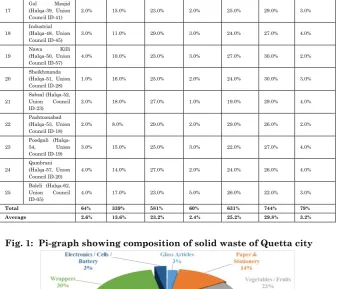
Fig. 1: Pi-graph showing composition of solid waste of Quetta city
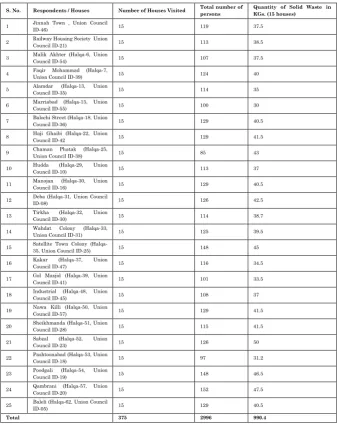
Table 2: Volume of solid waste at Quetta city
S. No. Respondents / Houses Number of Houses Visited Total number of persons
Quantity of Solid Waste in KGs. (15 houses)
1 Jinnah Town , Union Council ID-46) 15 119 37.5
2 Railway Housing Society Union Council ID-21) 15 113 38.5
3 Malik Akhter (Halqa-6, Union Council ID-54) 15 107 37.5
4 Faqir Mohammad (Halqa-7, Union Council ID-39) 15 124 40
5 Alamdar Council ID-35) (Halqa-13, Union 15 114 35
6 Marriabad (Halqa-15, Union Council ID-55) 15 100 30
7 Balochi Street (Halqa-18, Union Council ID-36) 15 129 40.5
8 Haji Ghaibi (Halqa-22, Union
Council ID-42 15 129 41.5
9 Chaman Phatak (Halqa-25, Union Council ID-38) 15 85 43
10 Hudda Council ID-10) (Halqa-29, Union 15 113 37
11 Manojan Council ID-16) (Halqa-30, Union 15 129 40.5
12 Deba (Halqa-31, Union Council ID-08) 15 126 42.5
13 Tirkha Council ID-30) (Halqa-32, Union 15 114 38.7
14 Wahdat Union Council ID-31) Colony (Halqa-33, 15 125 39.5
15 Satellite Town Colony
(Halqa-35, Union Council ID-25) 15 148 45
16 Kakar Council ID-47) (Halqa-37, Union 15 116 34.5
17 Gol Masjid (Halqa-39, Union Council ID-41) 15 101 33.5
18 Industrial (Halqa-48, Union Council ID-45) 15 108 37
19 Nawa Killi (Halqa-50, Union Council ID-57) 15 129 41.5
20 Sheikhmanda (Halqa-51, Union Council ID-28) 15 115 41.5
21 Sabzal Council ID-23) (Halqa-52, Union 15 126 50
22 Pashtoonabad (Halqa-53, Union Council ID-18) 15 97 31.2
23 Poodgali (Halqa-54, Union
Council ID-19) 15 148 46.5
24 Qambrani (Halqa-57, Union Council ID-20) 15 152 47.5
25 Baleli (Halqa-62, Union Council ID-05) 15 129 40.5
Total 375 2996 990.4
waste due to the shortage of machinery in out skirts which is creating worse to worst situation of solid waste in the city day by day (10).
Table 3: Average family size, SW produced per house and per person
Average Family Size (Persons) 7.99
Average SW Produced by a House
(Kg) 2.64
Average SW Produced by a
Person(Kg) 0.33
Table 4: Methods of solid waste collection S. No. Respondents /
Houses
Daily Basis
Weekly Basis Gloves
Protective Dress
Naked Hands
SW Picked Privately
SW picked by Municipality
1
Jinnah Town (PP4, Union Council ID-46)
100% 0% 87% 47% 33% 100% 0%
2
Railway Housing Society (PB4, Union Council ID-21)
100% 0% 73% 73% 27% 100% 0%
3
Malik Akhter (Halqa-6, Union Council ID-54)
100% 0% 80% 40% 20% 100% 0%
4
Faqir Mohammad (Halqa-7, Union Council ID-39)
100% 0% 60% 47% 40% 100% 0%
5
Alamdar (Halqa-13, Union Council ID-35)
100% 0% 100% 100% 0% 100% 0%
6
Marriabad (Halqa-15, Union Council ID-55)
100% 0% 100% 100% 0% 100% 0%
7
Balochi Street (Halqa-18, Union Council ID-36)
100% 0% 67% 53% 33% 100% 0%
8
Haji Ghaibi (Halqa-22, Union Council ID-42
100% 0% 53% 33% 47% 100% 0%
9
Chaman Phatak (Halqa-25, Union Council ID-38)
100% 0% 60% 60% 27% 100% 0%
10
Hudda (Halqa-29, Union Council ID-10)
100% 0% 80% 60% 20% 100% 0%
11
Manojan (Halqa-30, Union Council ID-16)
100% 0% 67% 67% 33% 100% 0%
12
Deba (Halqa-31, Union Council ID-08)
100% 0% 40% 40% 60% 100% 0%
13
Tirkha (Halqa-32, Union Council ID-30)
100% 0% 60% 60% 47% 100% 0%
14
Wahdat Colony (Halqa-33, Union Council ID-31)
100% 0% 73% 73% 27% 100% 0%
15
Satellite Town Colony (Halqa-35, Union Council ID-25)
16
Kakar (Halqa-37, Union Council ID-47)
100% 0% 67% 67% 33% 100% 0%
17
Gol Masjid (Halqa-39, Union Council ID-41)
100% 0% 80% 53% 20% 100% 0%
18
Industrial (Halqa-48, Union Council ID-45)
100% 0% 47% 27% 53% 100% 0%
19
Nawa Killi (Halqa-50, Union Council ID-57)
100% 0% 53% 33% 47% 100% 0%
20
Sheikhmanda (Halqa-51, Union Council ID-28)
100% 0% 27% 27% 73% 100% 0%
21
Sabzal (Halqa-52, Union Council ID-23)
100% 0% 47% 47% 53% 100% 0%
22
Pashtoonabad (Halqa-53, Union Council ID-18)
100% 0% 67% 67% 33% 100% 0%
23
Poodgali (Halqa-54, Union Council ID-19)
100% 0% 27% 13% 73% 100% 0%
24
Qambrani (Halqa-57, Union Council ID-20)
100% 0% 20% 13% 80% 100% 0%
25
Baleli (Halqa-62, Union Council ID-05)
100% 0% 67% 67% 33% 100% 0%
Average 100% 0% 61% 51% 39% 100% 0%
CONCLUSIONS
i. That solid waste has been increasing due to the
international marketing trend. This has been proved that from our survey that 30% of the solid waste is comprises over the wrappers.
ii. Quetta City is becoming an international city with the
arrival of the CPEC; the people use to come from across the border, further people from the other district of the province and from other provinces used to come here for visiting and for buying their needs. This will certainly give rise in the solid waste.
iii. Metropolitan Corporation Quetta, Metropolitan
out skirts which is creating worse to worst situation of solid waste in the city day by day (10).
iv. The existing fleet life is more than 30 years’ old and it is
on 88 No’s out of which 37 No’s were giving by Government of Balochistan in 1983, 1988 and 1994 remaining 51 No’s were in shape of in kind by JICA in 1996 and 1997. The existing strength of drivers are 65 which is insufficient for 88 Machinery/Vehicles (10).
v. The secondary data which was acquired from the
Metropolitan Quetta illustrated that Dumper of 4.5 metric ton capacity are 16 in numbers, while of 7 metric ton are 11 in numbers. Containers of 4.5 metric ton are 37 in numbers, Tractor trolleys are only 3 in numbers. Excavator is only one, loaders heavy duty 2 numbers, and light loaders are 7 in numbers. This shows that the capacity of the Metropolitan of Quetta City is far low then the required.
vi. To develop an environment friendly solid waste disposal
system, sanitary land fill site should be developed to reduce the impact of the solid waste on ecosystem i.e. on ground water, air and environment. The Methane gas produced as a result of decaying of the solid waste. To stop the contamination of ground water by the seepage of leachate, layers of liners are laid down. Clay layer of particular nature work as impermeable membrane to stop ground water adulteration. Two more layers of plastic and fabric liner will be introduced for effective results. (Engineer, Abdul Haq, Metropolitan Corporation Quetta).
vii. It was also observed while survey, that newly built
the streets and in open plots. The scattered solid waste at various places giving and ill environment impact and disturbing the ecosystem of the Quetta City. The air and landmass is being polluted by this scattered solid waste at many places.
viii. From thirty-three 33 dumping sites the solid waste is collected and unloaded at Eastern bypass. However, there is no solid waste management is existing for the Quetta City (10).
ix. The filthy and dump areas with solid waste is depicting
our poor planning, poor education and poor capacity of the government and private organization. These filthy areas are not only injurious for the health of the local dwellers but also to the visitors coming from across the border and from other provinces. This pile of the solid waste showing our negligence of the institutions. Billions of rupees have been expended on the sewerage system but end of the day, the streets are flooded with water after an hour of rain untreated solid waste overflowed to streets which creates worst and dirtiest condition.
x. The Municipal Committee of the Quetta City is not as
operative in disposing off the solid waste as it should be or as it is the requirement of the Metropolitan. That is why the solid waste has become a major problem of the Quetta City and its adjacent areas. Hundreds of the people who are living in the rural areas of the provinces often visited the Quetta City for their personnel chores, like Education, Jobs and shopping. This all makes the solid waste; however, the Government has still not addressed this issue at large.
xi. The mounting garbage is an eyesore. But it has even
worker and throw it to the various open spaces and vacant plots. This portrays a filthy and unhealthy environment. The same garbage rises in the air with the wind and makes the environment polluted. We breathe in this polluted air, which ultimately has a health hazard risk for the people of the Quetta City.
xii. It was also observed from survey that a lot of materials
in every day waste are recyclable. When waste is not isolated to various categories, it would have been difficult for recycling which further leads to a lot of wastage of valuable resources.
xiii. Solid waste also contributes to pollution and has negative impact on public health. This solid waste is certainly needs to be addressed on top priority to prevent the drastic effects that can result in improper disposal of garbage.
xiv. Proper solid waste management is most essential. The
aim of waste reduction is to eliminate waste before it is produced. The next most cost-effective means of minimizing waste is to reuse waste material.
xv. Solid waste is not as big issue of the Quetta city but
efficient management of solid waste is the biggest issue. The population of Quetta is increasing. The major thing, needs to be addressed is to manage the solid waste so efficiently that it may not put an ill effect on our ecosystem. The piles of the garbage may not be seen at various places while walking in the city areas, markets, driving etc.
xvi. In the above-mentioned discussions bases over the
xvii. Recycling of the solid waste is recommended. Recycling is the best way of solid waste management. It helps in reducing pollution, saving resources and conserving the matter. Recycling newspapers, plastics, glass and aluminum also helps in saving money. Recycling other materials such as tires, batteries, motor oil, etc. reduces pollution. To reduce garbage, it is necessary to encourage and implement recycling at all levels of society.
xviii. Awareness can be given for proper solid waste disposal to our community through mass media that how to classify the solid waste into various categories. Peeling of the vegetable and fruit can be used to feed the animals if it is not mixed with other waste. Similarly, tin and metals can be collected separately, plastics, papers, card boards can also be separately collected and sold on minimum prices for their reuse and recycling at recycling plants.
xix. Metropolitan Quetta reported that a waste disposal
plant was constructed; however this plant is not functional as a result of civil suit. Metropolitan also reported that the budget is insufficient to meet the expenses.
xx. Overall it is very difficult to assess everything as the
finances and good management to help us out of this filthy environment.
ACKNOWLEDGEMENT:
We are thankful to the Institute of Biochemistry, University of Balochistan, Quetta, for providing lab facilities and special thanks to Livestock Department, Spinney Road, Quetta, in statistical work and Metropolitan staff for getting access to the data and provision of details of the municipality whenever required.
REFERENCES:
1. Beede, D. N., Bloom, D.E., The economics of municipal
solid waste. World Bank Research Observer, 10(2) (1995).
2. Hoornweg, D., Thomas, L., What a waste: Solid waste
management in Asia. Washington, DC, USA: World Bank Urban waste management working paper series no.1 (1999).
3. Daskalopoulos E., Badr O., Probert S.D., Economic and
Environmental Evaluations of Waste Treatment and Disposal Technologies for Municipal Solid Waste. Applied Ecology 58, pp.2009-255 (1999).
4. Abu Qdais H.A., Techno-economic assessment of
municipal solid waste management in Jordan. Waste Management (article in press) (2006)
5. Mansoor A.S. and Azam S. A., People as partners:
Facilitating people's participation in public–private partnerships for solid waste management. Habitat International 30, pp.781-796 (2006)
6. Veenstra S., Sanitation and Solid Waste Technology
(1997)
7. Rehan Ahmed, Shahana Kaukab and Roland
urban areas in Pakistan, presented at 24th WEDC Conference on Sanitation and Water for all. Islamabad, Pakistan (1998).
8. Mato R.R.A.M., and Kaseva, Critical review of industrial
and medical waste practices in Dar es Salaam City.
9. Francos H., and Bituro M., Innovative Ways for Solid