A New Approach to Partial Face Recognition
Amit V. Manapure1, Nitin Mishra2 1
M.Tech Student(4th Sem),
Department of IT, RGPV University, NRI Institute of Information Science & Technology ,Bhopal , MP, India
2
Associate Professor,
Department of IT, NRI Institute of Information Science & Technology ,Bhopal , MP, India
Abstract— Face Recognition is the technique to verify whether the entered image or input is exactly similar to the available images present in the databases. The technique comes under the Artificial Intelligence. Updation to the existing technique and also new technique is introduced day by day. Different types of facial recognition techniques are Finding faces in images with controlled background, Finding faces by color, Finding faces by motion, Finding faces in unconstrained scenes etc. Each and every approach has its different techniques. Subsequently various algorithms are also exist which gives us result based as per our expectation. We are implementing face recognition approach by using MKD-SRC Algorithm. The advantage of this algorithm is that we can apply it on partial or incomplete faces also, even if the given input is partial, then also we can use this method. Also we can compare the left part of the given image with the available right one to determine whether they belongs to same object or not. Compare with the FaceVACS and PittPatt, our algorithm provides the solution on general face recognition problem. Our technique will also do the object categorization, to determine whether the object belongs to the same category or different.
Key Words: MKD-SRC Algorithm, FaceVACS, PittPatt, and object categorization.
I. INTRODUCTION
Over the decades the Face Recognition technology has received a great demand due to which many researchers has focus on this area. Physical Science shows that there are some part of body of human being which has its unique identity like Nose Structure, Eyes, Facial Parts etc. Considering these parameters, we can easily determine whether these objects are the part of given Human Body or not.Thus, Face Recognition approach by using MKD-SRC Algorithm; provide an approach through which we can compare partial face images with the available database images to verify whether the input images are the part of available images. The advantage of this method is that, we can compare partial input with the available ones. Partial Face Recognition, provide a solution to the following questions: (i) Whether is it possible to recognize a person from a partial image of his face? , (ii) Which portion of the face? and What size of the partial face are critical for exact recognition?
Face recognition has its applications in information security and access control, law enforce, surveillance and more generally image understanding. A general approach of partial face recognition method based on Multi-Key point Descriptors (MKD) which is the
method that does not require face alignment by eye coordinates or any other fiducial points. The invariant shape adaptation makes image matching more robust to viewpoint changes which are desired in face recognition with pose variations. In Multi-Key Point Descriptor (MKD), the descriptor size of a image is determine based on actual content of the image. The MKD-SRC (Sparse Representation-based Classification) framework that works for both holistic faces and partial faces can be sparsely represented by a large dictionary of gallery descriptors. Multitask sparse representation is learned for an each probe face and the Sparse Representation-based Classification (SRC) approach is applied for face recognition a fast atom filtering strategy for MKD-SRC to address large-scale face recognition (with 10,000 gallery images).
II. PROPOSED WORK
In this paper, we present a general formulation of the partial face recognition problem. It do not require the presence of the eyes, face alignment or any other facial component within the image. In this case, we are not aware of a priori whether the input face is partial or holistic. By using this information, our aim is to give a general matching solution to acclimatize all types of partial faces listed in Table 1. Briefly, this approach is based on a Multi-Keypoint Descriptor (MKD) representation which can be used for the probe image as well as the gallery dictionary. For each probe face, a Multitask sparse representation is to be learned, and thus for face detection, Sparse Representation-based Classification (SRC) approach [7] is implemented. This method, we used to call is MKD-SRC. Fig. 2. shows the flowchart of the proposed method :
The uniqueness of the proposed approach includes: 1. A general partial face recognition approach without
requiring face alignment, the MKD-SRC framework that works for both holistic faces as well as partial faces, and surpass SRC[7] for addressing the one-sample-per-class problem.
2. A new keypoint descriptor, called the Gabor Ternary Pattern (GTP), which outperforms the Scale Invariant Feature Transform (SIFT) [8] descriptor,
Table 1: A categorization of Partial Face Image
This paper is built upon the preliminary work reported in [9]. The main differences are summarized as follows: 1) While the method in [9] uses the SIFT descriptor, instead of it, a new keypoint descriptor (GTP) which outper-forms SIFT is proposed by us. 2) We address the one-sample-per-class problem in large-scale open-set identification setting for PFR, and it shows that as compare to the FaceVACS and PittPatt, the proposed MKD-SRC method performs better, on the FRGCv2.0, AR, and PubFig databases. 3) Here, for the purpose of partial face verification, we have extended the MKD-SRC method, which gives better results on the LFW database.
III.LITERATURE REVIEW
Some various popular face alignment methods include the Active Shape Model (ASM) [10] and the Active detect the two eyes and Appearance Model (AAM) [11], which depend on localizing a certain fixed number (typically 68) of landmarks on holistic face. In [12], a sparse representation-based alignment method under controlled scenarios, was proposed
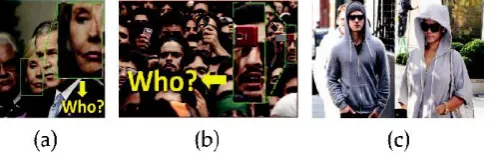
Fig. 1. Partial face examples. (a) Partial faces in the LFW database [2]. (b) Partial faces in a crowd (http://www.textually.org/picturephoning/ archives/2008/09/021247.htm). (c) Occluded faces by hooded sweat-shirt and sunglasses (http://www.howtovanish.com/2010/01/avoid-nosy-surveillance-cameras/).
Nonfrontal face recognition has also attracted significant attention by multiview [19], [20] and cross-view [21], [22], [23],[24], [25], [26] face recognition. In case of cross-view FR, most approaches apply 2D or 3D appearance models to synthesize face images in specific views. Multiview face recognition requires that the gallery contain a large number of poses for the corresponding subject, that is not practically possible to satisfy in practice. In these approaches, a critical step is to localize a certain fixed number of representative facial landmarks and establish correspondences between two images in different views accordingly. Due to this, the images are expected to have visible anchor points irrespective of the view.
Yang et al. [27] and Yi et al. [28] proposed an automatic partial face alignment and matching approach, for partial
faces resulting from a limited field of view. But, their approach requires high-resolution images (with an interpupil distance of more than 128 pixels) with good skin texture, but it is not applied to pose variations.
Some FR approaches only require face subimages as input, such as eye [29], nose [29], one half (left or right portion) of the face [30], or the periocular region. Again, these methods require the presence of certain facial components and prealignment.
Fig. 2. Proposed partial face recognition approach
In contrast with the above SRC-based approaches, the proposed MKD-SRC approach uses a different feature representation. To represent a face, since both SRC and LBP-SRC require aligned faces and use a single fixed-size feature vector (e.g., concatenated image pixels or LBP histograms), each column of their corresponding dictionary is related to one gallery image. On the other hand, a partial face might be difficult to align and represent due to unknown missing facial regions, in such a scheme. On the contrary, MKD-SRC uses a variable-size description intendly, in ordet to represent each face by a set of descriptors. As a whole, the MKD dictionary is comprised of a large number of gallery descriptors, making it possible, for a probe image to sparsely represent descriptors, irre-spective of whether it represents a holistic or partial face.
Furthermore, SRC requires a sufficient number of training samples covering all possible illumination variations for each subject, which limits its applicability in each area. On the other hand, MKD-SRC performs satisfactorily in scenarios where only one training sample per class is available.
view. Because of this reason, the BoW representation is not suitable for PFR.
A number of papers have been published on SIFT-based face recognition[1]. However, all of them were applied on prealigned face images. But the most significant feature of SIFT matching is that, it is fast and it treats each image pair independently and that is the reason, in the gallery set, it does not utilize collaborative representation of different subjects. A many local facial patches may look similar like others, it can be possible that, for an impostor pair, apparently SIFT matching would find more matches than a genuine pair [9]. To palliate this and to get more perfect result, the proposed MKD-SRC approach performs keypoint matching via sparse representation of all gallery images to select the best match automatically.
Characteristics of MKD-SRC in comparison with various existing approaches are encapsulated in Table 2. The rest of this paper of this paper is formulated as follows: If we see closer into the Section 2, it shows a well described and proposed alignment-free partial face representation method. For Section 3, an MKD-SRC algorithm introduced by us is depicted. Extensive experiments are demonstrated in Section 4, shown in the table, and ultimately this work has been concluded by us in Section 5.
IV.MKD-SRC ALGORITHM
Wright et al. [7] showed that a sparse linear combination of gallery images represents a probe image very effectively. Thus the resulting algorithm is been called as SRC. In this paper, by using a large dictionary of keypoint descriptors, we have planned to apply SRC instead of applying it directly to raw face image pixels; this is the key to the proposed alignment-free partial face recognition approach.
4.1 Gallery Dictionary Construction
The gallery dictionary is constructed as follows: First, an MKD representation (as introduced above) is constructed for each image. Suppose kc keypoints, say, pc1 ;
pc2 ; . . . ; pckc , are detected for class (subject) c in the
gallery. Suppose if we assume that class c has multiple face images in the gallery, now we just incorporate the keypoints which are obtained from all of them. The corresponding kc
GTP descriptors are denoted by dc1 ; dc2 ; . . . ; dckc , where
each descriptor is an M-dimensional vector (in our case, M ¼ 128). Let
Dc ¼ ðdc1 ; dc2 ; . . . ; dckc Þ: ð5Þ
This way the descriptors from the same class form a subdictionary of size M kc representing class c. A gallery
dictionary for all the C classes is built as
D ¼ ðD1; D2; . . . ; DC Þ: ð6Þ
Note that D has a total of K C k descriptors, resulting
in an M K dictionary. ¼ Pc¼1 c
Typically, K is very large (e.g., over 1 million), which makes D an overcomplete description space of the C classes. Therefore, any descriptor from the C classes can be linearly represented in terms of the dictionary D. According to the theory of compressed sensing (CS), a sparse solution is
possible for an overcomplete dictionary; therefore, we can express any descriptor from a probe image by a sparse linear combination of the dictionary D.
4.2 Multitask Sparse Representation
For a probe face image with n descriptors in the given scenario:
Y ¼ ðy1; y2; . . . ; ynÞ; ð7Þ
Subsequently, sparse representation problem is formulated as
^
n
¼
arg min k
x ik
0
; s:t:Y ¼
DX;
ð8Þ X
X
i¼1
X
where X ¼ ðx1; x2; . . . ; xnÞ 2 RK n is the sparse coefficient
matrix,
and k k0 is denoted
as the ‘0 norm of a vector,
which is kxk0 ¼ i Iðxi ¼6 0Þ
where IðsÞ ¼ 1 if the statatement s is true; P
NP-hard. Based on the results from compressed sensing [61], sparse signals can be recovered with a high probability via the ‘1-minimization. Therefore, we solve the following
‘1-minimization problem3 instead of (8):
^
n
¼arg min x ik1 ; s:t: Y ¼ DX; 9
X i¼1 k ð Þ
X
where k k1 denotes the ‘1 norm defined as kxk1 ¼ Pi jxij.
Since both X and Y have multiple columns, it can be seen that this is a multitask problem Similarly, the following set of n ‘1-minimization problems can also be solved, one for
each probe descriptor yi:
x ^
i ¼
arg min x
ik1
; s:t: y
i ¼
Dx ; i
¼
1; 2; . . . ; n: 10
x
i k i ð Þ
TABLE 3 Parameter Values Parameter t a M L
Value 0.03 20 128 100
A number of efficient fast ‘1 minimization algorithms
can be used to solve (10), including the ‘1 Homotopy
method. Since the n ‘1-minimization problems in (10) are
indepen-dent, it is straightforward to accelerate the algorithm via parallel computation.
Inspired by Wright et al. [7], we adopt the following multitask SRC to determine the identity of the probe image:
min r Y
1 n
y D x ^
2
; 11 k i iÞk2
c n i¼1 c cð ð Þ
X
corresponding to class c. Equation (11) applies a sum fusion among reconstruction residuals of the n descriptors with respect to each class efficiently, apparently the identity based on the least residual is also analysed by it. For this reason, an unknown partial face in the probe can be recognized by computing (10) and (11). The resulting algorithm is called as the MKD-SRC, and the most significant feature of it is that , it is independent of the face alignment. Fig. 2 depicts the flowchart of the MKD-SRC algorithm.
4.3 Fast Filtering
In practice, the size (K) of the dictionary D can be of the order of millions, making it difficult to solve (10). Therefore, we adopt a fast approximate solution. For each probe descriptor yi, we first compute the following linear
correlation coefficients between yi and all the descriptors in
the dictionary D:
ci ¼ DT yi; i ¼ 1; 2; . . . ; n: ð12Þ
Then, for each yi, we keep only L ðL KÞ descriptors
according to the top L largest values of ci, resulting in a
small subdictionary DðMiÞL. Next, D is replaced by DðiÞ in
(10), and (11) is adjusted accordingly.
We set L ¼ 100 in our algorithm. According to our previous finding [9], this approximate sol ution speeds up the computation, due to this, a significant degradation in recognition performance is not observed. According to (12) and the selec-tion of the top L elements (note that this can be done in OðK Þ by the Introselect algorithm), the computation time of the filtering step scales linearly with respect to K. Therefore, the algorithm scales almost linearly with respect to the gallery size for each probe image (considering an average number of keypoints per image). MKD-SRC algorithm, alongwith its complete method is explained in the following Algorithm. Finally, all the parameter values which are used in this paper are encapsulated in Table 3 shown above. They were fixed for all the experiments reported in the paper.
ALGORITHM
Algorithm 1. The MKD-SRC Algorithm Input : As gallery images of C classes; probe
image I; parameter L
Output: We get Identity C of the probe image I.
1: Enrollment: Initially, Extract multi-keypoint descriptors (MKD)
from every gallery image then after this, build the Dictionary
D ¼ ðD1; D2; ; DC Þ 2 RM K .
2: Recognition:
3: Extract MKDs from the probe image: Y ¼ ðy1; y2; . . . ; ynÞ 2 RM n;
4: For i ¼ 1 To n do
5: Compute top L descriptors from (12), resulting in a subdictionary DðMiÞL;
6: Solve (10) with DðMiÞL;
7: end
8: Solve (11) to determine the identity c;
4.4 MKD-SRC for Partial Face Verification
Given a gallery set, the residual defined in (11) can be used as the dissimilarity score for face identification. However, the SRC algorithm was originally proposed for face identification purpose, the work which has been done so far for SRC-based face verification, is not sufficient. Here, we propose a simple extension of the MKD-SRC algorithm for face verification. The face verification task is to judge whether a given pair of face images, say M and N, whether belong to the same subject or it has been belongs to another pair. Therefore, here we have used a normal set of background face images along with the image I as a virtual gallery set, and the other input face image J as the probe which gives a brief idea. It should be noted that even though the set of background face images does not contain the same subject as either of the two input face images, we will get the result. Finally, the MKD-SRC algorithm is applied to he set , for which the verification score is defined as 1 rc, where rc is defined in (11) and c is the class for
image I. To make the verification score a symmetric function of I and J, we also put J in the gallery set and use I as the probe, and the average score is computed as the final score.
REFERENCES
1. Shi, Yishu; Xu, Feng ; Ge, Feng-Xiang ;“SIFT-type descriptors for sparse-representation-based classification”, International Conference on Natural Computation (ICNC), Vol. 10, Aug-2014. 2. Shengcai Liao, Anil K. Jain, Fellow, IEEE, and Stan Z. Li “Partial
Face Recognition:Alignment Free Approach” IEEE Transactions On Pattern Analysis And Machine Intelligence, Vol. 35, No. 5, May 2013
3. Renliang Weng, Jiwen Lu, Junlin Hu, Gao Yang, Yap-Peng Tan, Robust Feature Set Matching forPartial Face Recognition, IEEE International Conference on Computer Vision (ICCV), 2013. 4. G. Hua, M.-H. Yang, E. Learned-Miller, Y. Ma, M. Turk, D.J.
Kriegman, and T.S. Huang, “Introduction to the Special Section on Real-World Face Recognition,” IEEE Trans. Pattern Analysis and Machine Intelligence, vol. 33, no. 10, pp. 1921-1924, Oct. 2011. 5. G.B. Huang, M. Ramesh, T. Berg, and E. Learned-Miller, “Labeled
Faces in the Wild: A Database for Studying Face Recognition in Unconstrained Environments,” Technical Report 07-49, Univ. of Massachusetts, Amherst, http://vis-www.cs.umass.edu/lfw/, Oct. 2007.
6. FaceVACS Software Developer Kit, Cognitec Systems GmbH, http://www.cognitec-systems.de, 2012.
7. PittPatt Software Developer Kit, Pittsburgh Pattern Recognition, Inc., http://www.pittpatt.com, 2012.
8. “Police Use Facial Recognition Technology to Nab Rioters,” http://www.msnbc.msn.com/id/44110353/ns/technology_and_scienc e-tech_and_gadgets/#.TkR_lnO4KsJ, 2012.
9. “Face Recognition Technology Fails to Find UK Rioters,” http:// www.newscientist.com/article/mg21128266.000-face-recognition-technology-fails-to-find-uk-rioters.html, 2012.
10. J. Wright, A.Y. Yang, A. Ganesh, S.S. Sastry, and Y. Ma, “Robust Face Recognition via Sparse Representation,” IEEE Trans. Pattern Analysis and Machine Intelligence, vol. 31, no. 2, pp. 210-227, Feb. 2009.
11. D.G. Lowe, “Distinctive Image Features from Scale-Invariant Keypoints,” Int’l J. Computer Vision, vol. 60, pp. 91-110, 2004. 12. S. Liao and A.K. Jain, “Partial Face Recognition: An Alignment Free
Approach,” Proc. IAPR/IEEE Int’l Joint Conf. Biometrics, Oct., 2011.
13. T.F. Cootes, C.J. Taylor, D. Cooper, and J. Graham, “Active Shape Models—Their Training and Application,” Computer Vision and Image Understanding, vol. 61, no. 1, pp. 38-59, Jan. 1995.
15. A.Wagner, J. Wright, A. Ganesh, Z. Zhou, H. Mobahi, and Y. Ma, “Toward a Practical Face Recognition System: Robust Alignment and Illumination by Sparse Representation,” IEEE Trans. Pattern Analysis and Machine Intelligence, vol. 34, no. 2, pp. 372-386, Feb. 2012
16. K. Hotta, “Robust Face Recognition under Partial Occlusion Based on Support Vector Machine with Local Gaussian Summation Kernel,” Image and Vision Computing, vol. 26, no. 11, pp. 1490-1498, 2008.
17. H. Jia and A. Martı´nez, “Support Vector Machines in Face Recognition with Occlusions,” Proc. IEEE Conf. Computer Vision and Pattern Recognition, June 2009.
18. H. Ekenel and R. Stiefelhagen, “Why Is Facial Occlusion a Challenging Problem?” Proc. IAPR/IEEE Int’l Conf. Bio-metrics, vol-3, 2009.
19. D. Beymer, “Face Recognition under Varying Pose,” Proc. IEEE Conf. Computer Vision and Pattern Recognition, pp. 756-761, June 1994.
20. A.Pentland, B. Moghaddam, and T. Starner, “View-Based and Modular Eigenspaces for Face Recognition,” Proc. IEEE Conf. Computer Vision and Pattern Recognition, pp. 84-91, 1994. 21. T. Vetter and T. Poggio, “Linear Object Classes and Image Synthesis
from a Single Example Image,” IEEE Trans. Pattern Analysis and Machine Intelligence, vol. 19, no. 7, pp. 733-741, July 1997. 22. D. Graham and N. Allison, “Face Recognition from Unfamiliar
Views: Subspace Methods and Pose Dependency,” Proc. Int’l Conf. Automatic Face and Gesture Recognition, vol. 3, pp. 348-353, 1998. 23. Recognition by Elastic Bunch Graph Matching,” IEEE Trans. Pattern
Analysis and Machine Intelligence, vol. 19, no. 7, pp. 775-779, July 1997.
24. V. Blanz, S. Romdhani, and T. Vetter, “Face Identification across Different Poses and Illumination with a 3D Morphable Model,” Proc. Int’l Conf. Face and Gesture Recognition, vol. 3, 202-207, 2002. 25. R. Gross, I. Matthews, and S. Baker, “Fisher Light-Fields for Face
Recognition across Pose and Illumination,” Proc. German Symp. Pattern Recognition, pp. 481-489, 2002.
26. B.Heisele, P. Ho, J. Wu, and T. Poggio, “Face Recognition: Component-Based versus Global Approaches,” Computer Vision and Image Understanding, vol. 91, nos. 1/2, pp. 6-21, 2003
27. J. Yang, S. Liao, and S.Z. Li, “Automatic Partial Face Alignment in NIR Video Sequences,” Proc. IAPR/IEEE Int’l Conf. Bio-metrics, vol. 3, 2009.
28. D.Yi, S. Liao, Z. Lei, J. Sang, and S. Li, “Partial Face Matching between Near Infrared and Visual Images in MBGC Portal Challenge,” Proc. IAPR/IEEE Int’l Conf. Biometrics, vol.3, 2009 29. K. Sato, S. Shah, and J. Aggarwal, “Partial Face Recognition Using
Radial Basis Function Networks,” Proc. IEEE Int’l Conf. Automatic Face and Gesture Recognition, vol.3, pp. 288-293, 1998.