
Robust selective image
encryption and decryption
based on key controlled
matrix
.
Pooja shekar c c 1, Mrs. Prabavathi2
,
1
P.G Student, Department of ECE,
BGSIT-Mandya, Karnataka
2
Asst.Professor, Department of ECE,
BGSIT-Mandya, Karnataka
Abstract- A proficient but a simple image compression selective encryption hybrid algorithm to realize compression and encryption simultaneously, where the key is easily circulated, stored or memorized. In this method, DWT is adopted as the fundamental base and combined with Dabuaeshies technique for image encryption.
The main essence of the suggested scheme is here the given input image is decomposed into 4 blocks to compress and encrypt, then by using random matrices the pixels of the two adjacent blocks are randomly interchanged. This decomposition is done upto the third level to ensure high level of security of image, which becomes serious problem for hackers to get the secret data. By using the circulant matrices, compressive sensing measurement matrices are constructed and with the help of logistic map the original row vectors of the circulant matrices can be controlled. The random pixel generator is used for exchanging of adjacent pixels. And the resulting image increases the key space. At last, a suitable decryption method is suggested to form original image from the encrypted image. Analysis and experimental results indicates that the suggested method can succeed many goal of selective encryption and is reckoning safe with good compression performance.
Keywords – Selective encryption, Image compression, Random pixel generator, Discrete wavelet transform, Dabuaeshies technique.
I. INTRODUCTION
Security of images in data transmission plays a major role in global proportions. Image data
are extremely sensitive and easily possible to minor decoding by hackers. Important modes such as: network and communication technology, digital techniques, are widely spread to transfer image data securely over the nations. Images are used in multiple areas for instance: distance education and training, research and laboratories, commercial fields, military services, etc; in all these areas maintaining the security, and confidentiality, accuracy of original image data is a vital issue.
Due to the advance in network technology, image security is becoming a important crisis. Familiar application of multimedia technology and progressively more transmission ability of network gradually leads to occupy information directly and undoubtedly through images. Even more, exceptional and reliable security in storage and transmission of digital images is needed in various applications, such as, confidential video conferences, military image communications, medical imaging systems, pay TV, etc. Hence, securing of image has become most vital issue. Image encryption techniques tries to renovate an image to another image that is difficult to understand; to keep the image confidential between users, in other word, it is fundamental that no one could get to know the contents without a key for decryption. In order to achieve such a job, so many image encryption methods have been introduced, but some of them have been known to be unconfident, so always we want to build up more and more secure image encryption techniques. Habitual data encryption techniques can be fall into two classifications which are used in combination or individually in every cryptographic algorithm: substitution and transposition. According to some algorithm, In the substitution technique, , we symmetrically exchanges one symbol in the data with another symbol; in a transposition technique, according to some rule we reorganize the position of symbols in the data.
Digital Encryptioning is becoming accepted, especially for adding undetectable identifying marks, such as patent or information. Encryptioning is a technique of identifying information or hiding data within digital multimedia. Encryptedding a digital signal (even text or image) with information which can’t be deleted easily is called digital Encryptioning.
Because of this use, Encryptioning techniques are often evaluated based on their robustness, recoverability and invisibility.
Image encryption techniques tries to convert an image to another image that is difficult to understand; to keep the image confidential between users, in other word, it is essential that no one could get to know the contents without a key for decryption. In order to accomplish such a job, so many image encryption methods have been introduced, but some of them have been known to be unconfident, so always we want to build up more and more secure image encryption techniques. Habitual data encryption techniques can be fall into two classifications which are used in combination or individually in every cryptographic algorithm: substitution and transposition. In substitution technique, according to some algorithm, we symmetrically exchanges one symbol in the data with another symbol; in a transposition technique, according to some rule we rearrange the position of symbols in the data.
The main aim is to performing a selective image encryption of the data upto the third level decomposed host image and appraise their vulnerability to attack by various image processing techniques, here host image is alters to random signal form i.e Encryption image and Encryptedded with decomposed image i.e Encryptioning image. Now the embedded image is known as Encryptioned image. In addition, GUI is used so that would allow users unfamiliar with Matlab to add and take out Encryptions, on the basis of morphological image attacks like blurring and cropping assess their significant Robustness.
Design process is the demonstration of the system which will be used to build up the system. The input for the design process is the SRS and the output is Design of proposed system, while the input SRS is completely in problem domain, design is the preliminary step in moving from the problem domain to solution domain. Design act as a bridge between the requirement specification and the final solution for fulfilling the requirements. Thus it is essential for blue print of the solution of the system. In the software engineering context, design focuses on four areas of interest: components, data, interfaces and architecture. The designing process is very important form a practical point of view as a laborer one would not attempt to build a house
without an approved blueprint thereby risking the structural integrity and customer satisfaction in the same manner.
The design process for the software system has two levels. At first level the focus is decides on modules interconnection. This is what we called “top level design” and the name token for this top level design is “system design”.System architecture is the process of defining a structured solution that meets all of the technical and operational requirements. System Architecture is a response to the conceptual and practical difficulties of the description and the design of the complex systems.
Firstly, the host image is decomposed at level 3 using discrete wavelet transform. The Encryptioned image and host image is Encryptedded with singular values of the Encryption image into the specific values of singular values of the transformed host image. At the receiver end, we apply inverse discrete wavelet transform to extract the host and host image.
Figure [1]: Flow chart for proposed algorithm.
Many experiments are performed in sequence to see the achieving results and robustness of suggested encryption technique. The basics of embedding data rely on three different facts i.e. capacity, security, and robustness. Capacity means the media on which the data is to be hidden should hold the data, so that the complexity of the medium should not be disturbed. Security means the embedding algorithm is said to be secure if the embedded information cannot be removed beyond reliable detection by targeted
attacks. Finally, robustness means the amount of manipulation a cover image (original image) can handle without drawing any attention that a change has taken place.
II. METHODOLOGY
In this chapter some of the driving factors in the design of our attempt to selective image encryption are discussed. The suggested technique uses a color image and provides an encrypted image which can be decrypted later for so many goals. Without loss of generality, assuming G
represents the initial color image of size M × N. The suggested technique consist of three phases. In the first phase, the given input image is decomposed into smaller blocks, this is done upto third level. In second phase, each secret data is encrypted. For encryption, DWT algorithm is used. . In third phase, each secret data is decrypted. For encryption, IDWT algorithm is used.
A. Image decomposition:
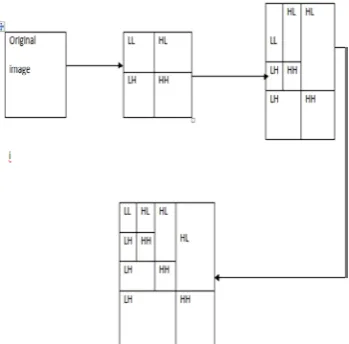
Here, the original image of 256*256 pixel size is divided into four blocks of horizontal, vertical, diagonal and approximation. This figure shows decomposition upto third levels to enhance image security.
Figure [2]: 3 Levels of image decomposition. Discrete Wavelet Transform (DWT) is a multi resolution analytical approach of time domain, frequency domain and can describe partial characteristics of time and frequency domains. The basic thought is to decompose the image to sub images with different frequency and space. Then, the coefficient is processed.
The DWT can be implemented as a multistage transformation. An image is decomposed into four sub bands denoted LL, LH, HL, and HH at level 1 in the DWT domain, where finest scale wavelet coefficients are LH, HL, HH and LL stands for the coarse level coefficients. An image is decomposed into four sub bands denoted LH, HL, HH and LH2
HH2 HL2 LL2 at level 2 in the DWT domain.
Also an image is decomposed into further four sub bands denoted LH, HL,HH and LH2 HH2 HL2
,LL3 HL3 LH3 HH3 at level 3 in the DWT
domain.
B. Encryption and decryption process: Input image to the encryption process is the image to be screen and results the encrypted image whose size is same as that of original input image. The main goal of the decryption process is to get the image as precisely as feasible from the encrypted image.Image encryption approaches fall into two wide categories: spatial domain methods and frequency domain methods. The term spatial domain refers to the image plane itself, In this category approaches are based on direct manipulation of pixels in an image. From this algorithms, the general encryption usually destroys the correlation among pixels and thus makes the encrypted images incompressible. Frequency domain processing techniques are based on modifying the Fourier transforms of an image . The Fourier transform can be recovered completely through an inverse process is insecure, so we always need to develop more and more secure image encryption techniques.
The proposed algorithm is Fit for the image whose width equals to height. Suppose the size of input image is N*N. Steps are as follows:
Step 1: Divide the input host image into 4 blocks, block1, block2, block 3 and block 4, as shown in Figure above, thus each block is should be of the size (N/2 *N/2).
Step 2: Construct two M*N/2 measurement matrices Φ1 and Φ2 along with keys x01 and x02,
measure the block 1 and the block 3 with Φ1 matrix
and measure the block 2 and block 4 with Φ2. C1,
C2, C3 and C4 are the measurements equivalent to
block 1, block 2, block 3 and block 4. Then apply random pixel scrambling to get encrypted image c.
Figure [4]: The block diagram of the proposed encryption and decryption
algorithm.
Step 3 :In the decryption and decompression process, the inverse scrambling operation should be performed firstly. Notice that the inverse scrambling order is the inverse order of scrambling order, From inverted measurements D1 D2 D3 D4
block 1 and 3 measured by Φ1 , block 2 and 4
measured by Φ2. Then one can obtain the decrypted
and decompressed blocks. The decrypted image is the combination of these blocks.
Chaos theory is exists in many research areas have many benefits in the area of image encryption. chaotic signals is having any advantages as sensitivity to initial condition, deterministic work, apparently accidental feature. Chaotic signals is having unpredictable, random behavior because of these advantages many researchers believe that this signal is having great advantages in the area of image encryption.
This phase affects the testing and maintenance phase profound fully , here the clear goal of this phase should be not to reduce the design implementation phase, but the goal should reduce the cost of later stages. The criteria for a good program include reliability, size of program, execution time and required memory, the entire project is developed using MATLAB.The basic implementation has been done in prototype development style. where at each stage, a prototype for the required problem is build and tested for the sample inputs if the prototype is giving the correct
output then this is Encryptedded with the system with proper interfaces built to it.
C. Random pixel exchanging
The random pixel swapping process is shown in Figure 3, here I1 and I2 are 2 matrices.
The m and n variables are the indices of the matrices. Random matrix is ‘R’ whose elements are limited to the interval [0,1] . where M and N are the sizes of the random matrix R. The matrices I1
and I2 have M*N pixels. The round function is
toward nearest integer of input number. The mean R value of random matrix R. The symbol ↔ is defined to swap the pixels at the right side and the left one. I1′ and I2′ are the outputs of the pixel
swapping operation. The new position (m’ , n’) is computed as
m’=f
1(m,n)=1+round{(M-1)}sin[πR(m,n)}
n’=f
2(m,n)=1+round{(N-1)R(m,n)}
1≤m≤M, 1≤n≤N.
Figure [3]: The random pixel swapping. Where, M and N are the sizes of the random matrix R. The matrices I1 and I2 have
M*N pixels. The round function is toward nearest
integer of input number. The mean value of random matrix R is
~R=1/(M*N)∑
m,nR(m,n).
If R(m,n)> ~R, the pixels at the positions (m,n) and (m′, n′) are exchanged with each other for the two matrices I1 and I2. If R(m,n) < ~R, the
pixel exchanging is made in the inner pixels of every matrix. In order to justify the decrypted images, The most two common attacks were used: Blurring and cropping attack.
111. IMPLEMENTATION RESULTS:
A. Image encryption with random signal Without attack:
Figure[5]:3level decomposition of image. Figure[6]:Encryption signal waveform
Figure[7]:3 level retrieval of an encryption embedded image. Figure[8]:Extracted Encryption signal
B.
Image encryption with random
signal
with blurring attack:Figure[9]:Original image after attack. Figure[10]:error image after attack.
Figure[11]:Plot of PSNR v/s Gaussian Noise. Figure[12]:Plot of Correlation v/s Noise
Table[1]: Analyzed result.
IV CONCLUSION
This paper suggests a simple yet efficient image compression selective encryption hybrid algorithm encrypts a selected image based on the DWT, random pixel exchanging, logistic map, where the compression and the encryption are completed simultaneously. The DWT technique is used here for image decomposition. The image is divided into 4 blocks to compress and encrypt. Compared with the methods adopting the whole measurement matrix as key, the proposed algorithm shortens the key greatly, which is of importance for a practical encryption algorithm. Then random pixel exchanging is introduced to scramble the compressed and encrypted blocks. The chaotic system generates chaotic sequence by the help of chaos mathematical equations; the generated sequence is of fractioned and non repeated values ranges from [0,1]. In order to justify the decrypted images, The most two common attacks were used: Blurring and cropping attack. If the encrypted images are contaminated by white Gaussian noise
with different noise strengths, we observed the corresponding decrypted images in blurring and cropping attacks, but the quality of these decrypted image doesn’t degrade too much and the decrypted images from the contaminated encrypted image with different noise strength is still acceptable. Hence the proposed algorithm is secure. By binding the random matrices with the measurement matrices, the security is enhanced further.
A few security analysis is also explained that the right fusion of keys is necessary reveal the original image. In addition , suggested technique has advantage of convenient realization, less computational complexity, nice compression performance. and a good security. Suggested algorithm is appropriate for a color images and in future it can be expanded for video also. This extension can be easily done by adopting suggested algorithm separately to each frame..
REFERENCES
[1]. Invisible digital Encryptioning in the spatial and dct domains for color images Heather Wood Adams State College, Alamosa, Colorado;
[2]. A Robust Image Encryptioning Scheme using Singular Value Decomposition B.Chandra Mohan JNTU College of Engineering, ECE Department, Kakinada, India;
[3]. Digital Image Encryptioning Technique Based on Different Attacks Dr. Sandeep Kumar Sood Department of Computer Science and Engineering G.N.D.U.R.C, Gurdaspur, India;
[4]. A New Robust Encryption Encryptedding into Wavelet DC Components Sanghyun Joo, Youngho Suh, Jaeho Shin;
[5]. Discrete Wavelet Transforms: Theory and Implementation.
[6]. Aloha Sinha, Kehar Singh, “A technique for image encryption using digital signature”, Optics Communications, Vol-2 I 8 (2203),229-234.
[7]. Jiun-In Guo, Jui-Cheng Yen, “A new mirror-like image Encryption algorithm and its VLSI architecture”, Pattern Recognition and Image Analysis, vol.IO, no.2, pp.236-247, 2000.
[8] Chang-Mok Shin, Dong-Hoan Seo, Kyu-Bo Chol, Ha-Wmn Lee, and SmJmng Kim, “ Multilevel Image Encryption by Binary Phase XOR Operations”, IEEE Proceeding in the year 2003.
Ms. POOJA SHEKAR C
C Received her B.E (electronics and
communication) degree from KVG college of
Engineering, Sullia in 2013 and currently pursuing
M.Tech in VLSI and Embedded System from
BGSIT, Mandya. She has interest in the field of
image processing. She had presented her paper in
National conference on Emerging trends in
Electronics and Communication (NCETEC-15).
Mrs. PRABHAVATHI K, she has completed her M.tech in JC College of engineering, Mysore.her area of specialization is Computer Networking. she has 12 years of experience.
![Figure [1]: Flow chart for proposed algorithm.](https://thumb-us.123doks.com/thumbv2/123dok_us/7834641.1298292/2.595.352.562.417.591/figure-flow-chart-for-proposed-algorithm.webp)
![Figure [3]: The random pixel swapping.](https://thumb-us.123doks.com/thumbv2/123dok_us/7834641.1298292/4.595.312.555.362.591/figure-the-random-pixel-swapping.webp)
