Evaluating User Privacy in Bitcoin
Elli Androulaki1, Ghassan O. Karame2, Marc Roeschlin1, Tobias Scherer1, and Srdjan Capkun1
1
ETH Zurich, 8092 Zuerich, Switzerland
[email protected], [email protected], [email protected], [email protected]
2 NEC Laboratories Europe, 69115 Heidelberg, Germany [email protected]
Abstract. Bitcoin is quickly emerging as a popular digital payment system. How-ever, in spite of its reliance on pseudonyms, Bitcoin raises a number of privacy concerns due to the fact that all of the transactions that take place are publicly announced in the system.
In this paper, we investigate the privacy provisions in Bitcoin when it is used as a primary currency to support the daily transactions of individuals in a university setting. More specifically, we evaluate the privacy that is provided by Bitcoin(i) by analyzing the genuine Bitcoin system and(ii)through a simulator that faith-fully mimics the use of Bitcoin within a university. In this setting, our results show that the profiles of almost 40% of the users can be, to a large extent, recov-ered even when users adopt privacy measures recommended by Bitcoin. To the best of our knowledge, this is the first work that comprehensively analyzes, and evaluates the privacy implications of Bitcoin.
1
Introduction
Bitcoin [6] is an emerging digital currency that is currently being integrated across a number of businesses [1] and exchange markets.
Bitcoin is a Proof-of-Work (PoW) based currency that allows users to generate dig-ital coins by performing computations. Bitcoin users execute payments by digdig-itally signing their transactions and are prevented from double-spending their coins (i.e., signing-over the same coin to two different users) through a distributed time-stamping service [6]. This service operates on top of the Bitcoin Peer-to-Peer (P2P) network and ensures that all transactions and their order of execution are available to the public. To strengthen the privacy of its users, Bitcoin users participate in transactions using pseudonyms—referred to asBitcoin addresses. Generally, each user has hundreds of different Bitcoin addresses that are all stored and transparently managed by its client.
In spite of the reliance on pseudonyms, the public timestamping mechanism of Bit-coin raises serious concerns with respect to the privacy of users. In fact, given that Bitcoin transactions basically consist of a chain of digital signatures, the expenditure of individual coins can be publicly tracked [16].
(i)by investigating the behavior of Bitcoin client and exploiting its properties, and(ii) through a novel simulator that mimics the use of Bitcoin as the primary currency within a university setting. Finally, we discuss possible measures that can be used to enhance the privacy of users in Bitcoin. To the best of our knowledge, this is the first work that analyzes, and evaluates the privacy provisions in Bitcoin. More specifically, our contributions in this paper can be summarized as follows:
- We adapt existing privacy notions to the Bitcoin context and we investigate the privacy-enhancing measures that are used in current Bitcoin implementations.
- We design and implement a simulator that faithfully emulates the functionality of Bit-coin. Our simulator also provides us with “ground truth” information that corresponds to the use of Bitcoin in a university setting.
- We investigate the privacy provisions of Bitcoin in a realistic university setting through our simulator. Our results show that the profiles of 40% of the university users can be constructed using behavior-based clustering techniques with 80% accuracy, even in the case when users manually transfer their Bitcoins among their addresses in an at-tempt to enhance their privacy.
- We discuss possible measures that can be used by Bitcoin developers to enhance the privacy of users in Bitcoin.
The remainder of this paper is organized as follows. In Section 2, we present a back-ground on Bitcoin. In Section 3, we introduce metrics that we use to measure privacy in Bitcoin. In Section 4, we present our Bitcoin simulator and our evaluation results. In Section 5, we discuss the implications of our findings and we explore possible counter-measures for enhancing privacy in Bitcoin. In Section 6, we overview the related work and we conclude the paper in Section 7.
2
Background on Bitcoin
Bitcoin is a decentralized P2P payment system [6] that relies on PoW. Payments are performed by generatingtransactionsthat transfer Bitcoin coins (BTCs) between Bit-coin users. Users participate in transactions using pseudonyms—referred to asBitcoin addresses. Generally, each user has hundreds of different Bitcoin addresses that are all stored and managed by its (digital)wallet. Each address is mapped through a transfor-mation function to a unique public/private key pair. These keys are used to authorize the transfer of the ownership of BTCs among addresses.
Transactions:Users transfer coins (BTCs) to each other by issuing a transaction. A transaction is formed by digitally signing a hash of the transaction through which a BTC was acquired. Given that in Bitcoin there is one-to-one correspondence between signa-ture public keys and addresses, a transaction taking place between two addressesaSand aR has the following form:τ(aS→aR) = {source, B, aR, SIGskaS(source, B, aR)}.
Here,SIGskaS is the signature using the private keyskaS that corresponds to the
isconfirmed(as described later in this section),aRcan subsequently use this transaction as a reference to spend the acquired BTCs. Consequently, Bitcoin transactions form a public record and any user can verify the authenticity of a BTC by checking the chain of signatures of the transactions in which the BTC was involved.
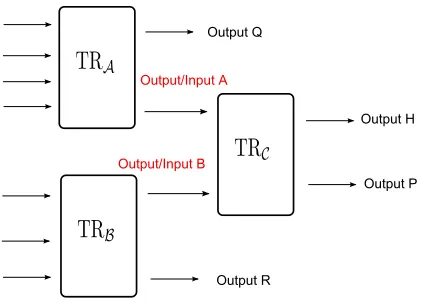
In the case whereaSneeds to spend a value that exceeds the maximum value of a BTC that it possesses, then its Bitcoin client will automatically combine a number of its BTCs as multiple inputs of the same outgoing transaction. We analyze the impact of “multi-input” transactions on the privacy of users in Bitcoin in Section 4.1. Figure 4 in Appendix A depicts an example of multiple-input transactions.
Shadow Addresses: In the current implementation of Bitcoin, a new address—the “shadow” address [1]—is automatically created and used to collect back the “change” that results from any transaction issued by the user. Besides the reliance on pseudonyms, shadow addresses constitute the only mechanism adopted by Bitcoin to strengthen the privacy of its users.
Confirmation of Transactions:As mentioned before, transactions are broadcasted in the Bitcoin network and are subject to validity checks by users in the system. Valid transactions are included by a special type of users, theminers, in Bitcoinblocksthat are also broadcasted in the network. More specifically, to generate a new block, miners must find a nonce value that, when hashed with additional fields (i.e., the Merkle hash of all valid and received transactions, the hash of the previous block, and a timestamp), results in a value below a given threshold. If such a nonce is found, miners then include it in a block thus allowing any entity to verify the PoW. Upon successful block generation, a miner is granted a number of new BTCs. This provides an incentive for miners to continuously support Bitcoin. Table 2 in Appendix B shows the information included in Bitcoin block number 80,000 as reported in the Bitcoin block explorer [2]. The resulting block is forwarded to all users in the network, who can then check its correctness by verifying the hash computation. If the block is deemed to be “valid”3, then the users append it to their previously accepted blocks, thus growing the Bitcoin blockchain. Bitcoin relies on this mechanism to resist double-spending attacks; for malicious users to double-spend a BTC without being detected, they would not only have to redo all the work required to compute the block where that BTC was spent, but also they need to recompute all the subsequent blocks in the chain.
3
Modelling Privacy in Bitcoin
In this section, we introduce our adversarial model and we define a number of metrics that can be used to quantify privacy in Bitcoin.
3.1 Adversarial Model
We observe the public log of Bitcoin, denoted bypubLog, within a period of time∆t. During this period,nUusers,U ={u1, u2, . . . , unU}, participate inpubLogthrough a
3
set ofnA addresses:A = {a1, a2, . . . , anA}.We assume that within∆t,nT transac-tions have taken place as follows:T ={τ1(S1→R1), . . . , τnT(SnT →RnT)}, where τi(Si→Ri)denotes a transaction with (unique) ID numberiandSiandRidenote the
sets of senders’ addresses and recipients’ addresses, respectively.
We assume that the adversaryAis motivated to acquire information about the ad-dresses/transactions pertaining to all or a subset of Bitcoin users. As such,Adoes not only have access topubLog, but is alsopart of the Bitcoin systemand can also incur one or more transactions through Bitcoin. Furthermore, we assume thatAcan have access to the (public) addresses of some vendors along with (statistical) information such as the pricing of items or the number of their clients within a specified amount of time. We, however, assume thatAis computationally bounded and as such cannot construct ill-formed Bitcoin blocks, double-spend confirmed transactions, or forge signatures, etc. Throughout this paper, we consider the “privacy” measures adopted by existing Bitcoin clients. Namely, we assume that(i)new shadow addresses are used to collect change that results from issued transactions,(ii)users own many Bitcoin addresses, and (iii) users are encouraged to frequently change their addresses (by transferring some of their BTCs to newly created addresses); this conforms with the current practices adopted in Bitcoin.
3.2 Quantifying Privacy in Bitcoin
In this section, we introduce two different notions of Bitcoin privacy, activity unlinka-bility and profile indistinguishaunlinka-bility and we provide metrics to appropriately quantify these notions.
Activity unlinkabilityrefers to the fact that an adversaryAshould not be able to link two different addresses (address unlinkability) or transactions (transaction unlinkabil-ity) pertaining to a user ofher choice. By design, ifAcan link two Bitcoin addresses to the same user, then she can also link all the transactions that these addresses participate in. Therefore, we focus our analysis on address unlinkability. On the other hand,profile indistinguishabilityrefers to the (in-)ability of Ato reconstruct the profiles ofall the usersthat participate inpubLog. Profiles, here, consist of the set of addresses (address-based profiles) or set of transactions (transaction-(address-based profiles) of Bitcoin users. As such, profile indistinguishability property is a stronger privacy notion than the activity unlinkability as it assesses the concealment of the profiles ofall usersin Bitcoin. Unlike the activity unlinkability case, here we also account for transaction-based profiles. This is due to the fact that address-based and transaction-based profiles are not equivalent when it comes to modeling user profiles in Bitcoin4.
In the following, we provide definitions on both privacy notions, and we rely on these definitions to provide metrics for them. In particular, we define address unlink-ability and profiling indistinguishunlink-ability through theAddUnland theProfIndgames, respectively. We quantify these notions by assessing the advantage of an adversaryA
in winning these games over an adversary who responds to all game challenges with
4An adversary can perform well in address-based profiling but not in transaction-based
random guesses,AR. We assume thatAhas access topubLogand that bothAandAR
have gathered (the same) a-priori knowledgeKAwith respect to correlations of a subset
of addresses (i.e., whether these addresses belong to the same user or not).
Activity Unlinkability (Address Unlinkability):We construct the address unlinkabil-ity game in Bitcoin,AddUnl, as follows.Achooses an addressa0∈pubLogchosen
among the addresses that appear inpubLogand sends it to the challengerC. If the owner ofa0does not have any other Bitcoin address, thenAwins. Otherwise, the challenger
C randomly chooses a bitb. Ifb = 1, thenC randomly chooses another addressa1
∈pubLogsuch thata0, a1belong to the same user; otherwise,Crandomly choosesa1
such that the two addresses are owned by different users. The challenger sendsha0, a1i
toA, who responds with her estimateb0 on whether the two addresses belong to the same user.Awins the game if she answers correctly, i.e.,b =b0. We say that Bitcoin satisfies address unlinkability if for all p.p.t. adversariesAand∀ha0, a1i,Ahas only a
negligible advantage overARin winning, i.e., if:
Prob[b0 ← A(pubLog,KA) :b=b0]−Prob[b0← AR(KA) :b =b0]≤ε,
whereεis negligible.
Quantifying Address Unlinkability:In Section 4.1, we show that due to inherent prop-erties of the Bitcoin protocol and client,Acan succeed with a considerable probability in winning the aboveAddUnlgame. In what follows, we measure thedegreeto which Bitcoin addresses can belinkedto the same user.
To do so, we express the estimate ofAthrough annA×nAmatrix,Elink, where
Elink[i, j] ={pi,j}i,j∈[1,nA]. That is, that for every addressai,Aassesses the
probabil-itypi,jwith whichaiis owned by the same user as every other addressajinpubLog.
Note thatElinkincorporatesKA, and any additional information thatAcould extract
frompubLog(e.g., by means of clustering, statistical analysis, etc.). Similar to [15], we quantify the success ofAin theAddUnlgame as follows. LetGTlinkdenote the
gen-uine address association matrix, i.e.,GTlink[i, j] = 1, ifaiandajare of the same user
andGTlink[i, j] = 0otherwise for alli, j∈[1,nA]. For each addressaiwe compute the
error inA’s estimate, i.e., the distance ofElink[i,∗]from the genuine association ofai
with the rest of the addresses inpubLog,||Elink[i,∗]−GTlink[i,∗]||,where||·||denotes
norm-L1 of the corresponding row-matrix. Thus, the success ofAinAddUnl,SuccA, can then be assessed throughA’s maximum error: max
∀ai∈KA/
(||Elink[i,∗]−GTlink[i,∗]||).
Similarly, we represent the estimate of AR in the AddUnl game for all
possi-ble pairs of addresses by thenA×nAmatrix ERlinkwhich is constructed as follows.
ER[i, j] =πi,jifhai, aji ∈ KA, andERlink[i, j] =ρ+ (1−ρ) 1
2 otherwise. Here,πi,j
represents the probability that addressesai aj correspond to the same user according
toKA, andρrefers to the fraction of addresses in{pubLog-KA}that cannot be
asso-ciated to other addresses (i.e., when their owners have only one address)5. For pairs of addresses that are not included inKA, this probability equals toρ+ (1−ρ)12.
5
Given this, we measure the degree of address unlinkability in Bitcoin againstA
by measuring address linkability, i.e., by evaluating the additional success thatAcan achieve frompubLog, when compared toAR. We call this advantageLinkabs
A :LinkabsA =
SuccA−SuccAR, and its normalized versionLinkA:LinkA=
SuccA−SuccAR
SuccAR .6
User Profile Indistinguishability: The profile indistinguishability property is a stronger privacy notion than the activity unlinkability as it refers to the concealment of all Bit-coin user profiles. Here, we require that an adversary is not able to group addresses or transactions corresponding to Bitcoin users correctly. As mentioned before, we ac-count for the indistinguishability of the profiles of users, assuming address-based and transaction-based profiles.
We construct theProfIndgame as follows. Here, the challengerCsends toAthe number of usersnUinpubLog-KA.Aresponds withnU(non-overlapping) sets of
ad-dresses (or transactions) and with Eprof = {gi}ni=1U representing the estimate on the
profile of all users in the system. LetGTprof ={gti}
nU
i=1represent the genuine
group-ing of addresses (or transactions) to users. That is,GTprof = {aui}
nU
i=1 for
address-based profiles, andGTprof ={τui}
nU
i=1, for transaction-based profiles, whereaui and
τui represent the sets of addresses and transactions respectively of userui. Clearly,A
wins if she guesses correctly, i.e., ifEprof ≡GTprof.
We say that a system satisfies the profile indistinguishability property if there is no p.p.t. adversaryAwho wins theProfIndgame with better probability thanAR, i.e.: ∀p.p.t.A: Prob[Eprof ← A(pubLog,nU) : Eprof ≡GTprof]−
Prob[ERprof ← AR(nU) : ERprof ≡GTprof]≤ε.
Quantifying User Profile Indistinguishability:We now proceed to quantifyA’s advan-tage in winning theProfIndgame by measuring the similarity ofA’s estimateEprof
from the genuine grouping of profilesGTprof, Sim(Eprof,GTprof), where the
simi-larity function Sim ranges in [0,1]. As in address unlinkability, we measure profile indistinguishability againstAby measuring the degree of profile distinguishability that
Acan achieve, i.e., we assess the advantage ofAin approximatingGTprofoverARby
ProfA= Sim(Eprof,GTprof)−Sim(ERprof,GTprof).7
We quantifySim(Eprof,GTprof)andProfAby relying on two commonly used
en-tropy based distance metrics, namely: theNormalized Mutual Information(NMI) and the Adjusted Mutual Information, (AMI).NMIassesses the similarity of two group-ings of the same items (in our case,Eprof andGTprof), and takes higher values (1) the
more identical the groupings are [19, 20]. On the other hand,AMIassesses the advan-tage ofAin winning the ProfIndgame. More specifically, given the two groupings Eprof andGTprof AMIapproaches0whenEprof is close to random assignment of
ad-dresses/transactions to groups, i.e.,ER
prof, and is1whenEprofmatchesGTprof[19,20].
6
We say that Bitcoin satisfiesµ-address unlinkability if∀p.p.t. algorithmsAand the corre-spondingAR
: Prob[Elink← A(pubLog,KA),ERlink← A R(K
A) : LinkA≥1−µ]≤ε. 7
We say that a system offersµ-profile indistinguishability, and we writeµ-ProfInd, if∀p.p.t.
Assuming address-based profiles,NMIandAMIare computed as follows:
NMI = I(Eprof,GTprof) max(H(Eprof),H(GTprof))
, AMI = I(Eprof,GTprof)− E max(H(Eprof),H(GTprof))− E
,
where:
I(Eprof,GTprof) =
nU P i=1 nU P j=1
n(i,j)
nA log(
n(i,j)·nA
n(i,∗)n(∗,j)),
H(Eprof) =− nU
P
i=1
n(i,∗)
nA log(
n(i,∗)
nA ), H(GTprof) =−
nU
P
j=1
n(∗,j)
nA log(
n(∗,j)
nA ),
E = nU P i=1 nU P j=1 P n∈M n
nAlog(
nAn
n(i,∗)n(∗,j))
n(i,∗)!n(∗,j)!(nA−n(i,∗))!(nA−n(∗,j))!
nA!(n(i,∗)−n)!(n(∗,j)−n)!(nA−n(i,∗)−n(∗,j)−n)!.
Here,nA is the number of Bitcoin addresses,n(i,j) is the number ofui’s addresses,
which are assigned to groupgj,n(i,∗) andn(∗,j) are the number of addresses ofui
andgj respectively. E reflects theexpectedmutual information between GTprof and
a random grouping of addresses (ERprof). Also, M = [max(n(i,∗)+n(∗,j)−nA,0),
min(n(i,∗), n∗,j)]. Similar calculations can be derived to computeNMIandAMIfor
transaction-based profiles.
Remark 1. Although NMI andAMI represent sufficiently well the success of A in profiling all the users in the system, they do not measure the success of the adversary on the profiling of a particular userui. In Section 4.4, we measure the success ofAin
profilinguiby assessing the maximum similarity of the addresses (or transactions) of
each useruiwith each adversarial clustergji.e.,max
∀j (Sim(aui,gj)).
4
Evaluating Privacy in Bitcoin
In what follows, we show how the adversary, givenpubLog, can gather some knowledge about Bitcoin users by exploiting the properties of existing Bitcoin client implementa-tions. We then evaluate, by means of our Bitcoin simulator, the success of the adversary in the aforementioned privacy games given this knowledge.
4.1 Exploiting Existing Bitcoin Client Implementations
Current Bitcoin client implementations enableAto link a fraction of Bitcoin addresses that belong to the same user.
modify the Bitcoin client implementation themselves.
Heuristic II—“Shadow” Addresses: As mentioned earlier, Bitcoin generates a new address, the “shadow” address [1], on which each sender can collect back the “change”. This mechanism suggests a distinguisher for shadow addresses. Namely, in the case when a Bitcoin transaction has two output addresses,aRn,aRo, such thataRnis a new address (i.e., an address that has never appeared inpubLogbefore), andaRocorresponds to an old address (an address that has appeared previously inpubLog), we can safely assume thataRnconstitutes a shadow address forai. Note that, in the current Bitcoin
implementation, users rarely issue transactions to two different users.
Evaluating Heuristics I and II: In what follows, we evaluate the implications of these heuristics on the user-privacy in Bitcoin. Given the absence of recent statistical data on the number of Bitcoin users, we rely on an estimate of the number of Bitcoin users performed in September 2011; at that time, Bitcoin users amounted to 60,000 users [1]. We then created a C++ parser that parses the first 140,000 blocks (till August 2011) in the Bitcoin block explorer [2].
Our C++ parser extracts all the addresses in each block and categorizes them in clus-ters of Generic Addresses,GAs, given the two aforementioned heuristics. The parser then outputs a list of addresses organized in differentGAs. Our results show that there were 1,632,648 unique addresses in the first 140,000 blocks. Given Heuristic I, we could classify these addresses into 1,069,699 distinctGAs. Given Heuristic II, this number decreases to 693,051GAs; this corresponds to grouping approximately 58% of Bit-coin addresses with an average of 11.55 addresses perGA. This clearly shows thatA’s advantage in theAddUnlgame is considerable given Heuristics I and II.
4.2 Behavior-Based Analysis
Besides exploiting current Bitcoin implementations,Acould also make use of behavior-based clustering techniques, such as K-Means (KMC), and the Hierarchical Agglom-erative Clustering (HAC) algorithms. LetUbe the set of users populating Bitcoin and (GA1, . . . ,GAnGA)denote theGAs thatAhas obtained by applying the two aforemen-tioned heuristics onpubLog, respectively. Given this, the goal ofAis to output a group of clusters of addressesEprof = {g1, . . . ,gnU}such thatEprof best approximatesU.
Since eachGA is owned by exactly one user, the estimate on the assignment of each GAican be modeled by a variablezisuch thatzi=k, if and only if,GAibelongs togk.
In fact, HAC assumes that initially eachGA represents a separate cluster ({zi =
i}nGA
i=1) and computes similarity values for each pair of clusters. Clusters with higher
similarity value are combined into a single cluster and cluster-to-cluster similarity val-ues are re-computed. The process continval-ues until the number of created clusters equals the number of usersnU. KMC is then initialized using the output of HAC and assumes
In our implementation (cf. Section 4.3), we represent each transaction that appears within aGAusing:(i)the time at which the transaction took place,(ii)the indexes of the differentGAs that appear within the transaction (as senders or recipients), and(iii) the values of the BTCs spent by the transaction. Letτxdenote the set of transactions of
GAx. The degree of similarity betweenGAi andGAj, denoted bySimhac(GAi,GAj),
is then represented by the cosine similarity of listsτiandτj, i.e.,Simhac(GAi,GAj) =
P
∀τ∈τi∩τj(f(τ,i)·f(τ,j))
kτik·kτjk ,wheref(τ,i),f(τ,j)are the occurrences of itemτ in listsτiand
τj respectively, and kXk denotes the norm II of vectorX. Given this, the resulting
distance metric in KMC isDistkmc(GA
i,gk) = 1+Simhac2(GAi,gk)−1.
Our implementation also accounts for constraints that are posed by real-world set-tings. Namely, since users cannot be physically located in two different places at the same time, they cannot participate in two different (physical) exchanges of goods at the same time. To account for this case (cf. Section 4.4), we apply different weighting for similarity ofGAs who participate in transactions concurrently.
4.3 Simulating the use of Bitcoin in a University
To evaluate the success ofA in theAddUnl and theProfInd games, we simulate a realistic case of using Bitcoin in the Department of Computer Science in ETH Zurich. Here, we assume that the shops located around the university also accept BTCs as a currency. Given the lack of details and statistics about the current use of Bitcoin, this was one of the few “workable” uses of Bitcoin that we could try to accurately model and through which we could evaluate the advantage ofAin the system.
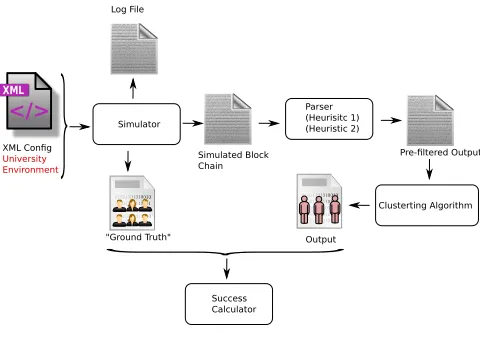
Experimental Setup:To evaluate the privacy implications of using Bitcoin in a univer-sity environment, we devised the setup shown in Figure 1. Our Bitcoin simulator takes an XML configurations file as input and outputs:(i)a log that details the events that were simulated, the “ground truth”, as well as(ii)the resulting simulated public Bitcoin log,pubLog. The XML configurations file contains all the necessary parameters to run the simulator. These include the number of users, the number of miners, the simulation time, the difficulty in block generation, as well as usage configurations for creating user profiles and Bitcoin sellers/buyers. Further details about our simulator can be found in Appendix D. As shown in Figure 1, the outputs of our simulator are used to evaluateA’s success. In fact, once the simulations terminate, a Perl-based parser uses the simulated Bitcoin block as input and pre-classifies the simulated addresses intoGAs according to Heuristics I and II. The resulting “pre-filtered output” is then fed into our clustering algorithms, the HAC and the KMC algorithms (both implemented in C). The output of these algorithms is then compared using another Perl-based script with the “ground truth” generated by the simulator in order to compute the success ofAin theAddUnl and theProfIndgames.
XML Config University Environment
Simulator
"Ground Truth"
Parser (Heurisitc 1) (Heuristic 2)
Clusterting Algorithm
Success Calculator
Output XML
</>
Log File
Simulated Block Chain
Pre-filtered Output
Fig. 1.Experimental setup used throughout our simulations. The outputs of our Bitcoin simulator are pre-filtered according to Heuristics I and II and then fed as input to our clustering algorithm. The clustering result is then compared with the “ground truth” that is emulated by our simulator.
(12 options), buying groceries (2 options), buying from vending machines (4 options), online shopping (5 options), purchasing books (2 options), and performing barters with other users, totalling 25 different Bitcoin vendors present in our system. For each user, we assign a probability that the user undergoes each of the possible options of each event. These probabilities are assigned according to the “category” of the user; that is, if the user is a “Professor”, then it is more likely that he/she would eat lunches at more expensive restaurants, when compared to the case where the user falls in the “Student” category. For each event, we specify in the XML configuration the following parame-ters: the frequency of the event, and the price range per option of the event. Note that each option is assigned a rating that would reflect its popularity. The probability of per-forming an option is interpolated from the frequency of occurrence of the event per week, and from the rating of the option. To ensure a large variety of profiles in our user base, we specify in the XML configuration a minimum and maximum value for the frequency, rating and price fields. These bounds depend on the category of the user, the event and option in question (c.f. Appendix C). At the start of our experiments, users originally have few (< 10) Bitcoin addresses; as they issue new transactions, new (shadow) addresses are created in their wallets. In the XML file, we also model the behavior of “privacy-aware” users. We assume that these users create new Bitcoin addresses in their wallets and send some of their BTCs from their old to their new addresses.
4.4 Experimental Results
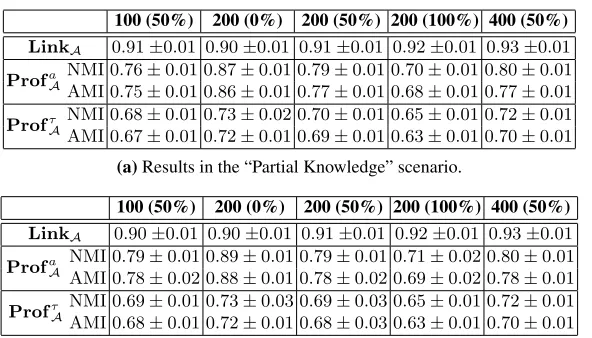
100 (50%) 200 (0%) 200 (50%) 200 (100%) 400 (50%)
LinkA 0.91±0.01 0.90±0.01 0.91±0.01 0.92±0.01 0.93±0.01
ProfaA
NMI 0.76±0.01 0.87±0.01 0.79±0.01 0.70±0.01 0.80±0.01 AMI 0.75±0.01 0.86±0.01 0.77±0.01 0.68±0.01 0.77±0.01
Profτ A
NMI 0.68±0.01 0.73±0.02 0.70±0.01 0.65±0.01 0.72±0.01 AMI 0.67±0.01 0.72±0.01 0.69±0.01 0.63±0.01 0.70±0.01
(a)Results in the “Partial Knowledge” scenario.
100 (50%) 200 (0%) 200 (50%) 200 (100%) 400 (50%)
LinkA 0.90±0.01 0.90±0.01 0.91±0.01 0.92±0.01 0.93±0.01
ProfaA
NMI 0.79±0.01 0.89±0.01 0.79±0.01 0.71±0.02 0.80±0.01 AMI 0.78±0.02 0.88±0.01 0.78±0.02 0.69±0.02 0.78±0.01
Profτ A
NMI 0.69±0.01 0.73±0.03 0.69±0.03 0.65±0.01 0.72±0.01 AMI 0.68±0.01 0.72±0.01 0.68±0.03 0.63±0.01 0.70±0.01
(b)Results in the “No Knowledge” scenario.
Table 1.Behavior-based clustering results in the “Partial Knowledge” and “No Knowledge” sce-narios. A column entitled X (Y%) denotes an experiment featuring X users among whichY%
are privacy-aware. Each data point in our plots is averaged over five rounds of experiments; we also present the corresponding95%confidence intervals (shown after the “±” sign).
transaction was performed in exchange of a physical good. In this case, we include the vendors’s addresses in the prior knowledge ofAwhen computingAdvunl; we also
assume thatAcan tune the clustering algorithm to take into account that the same user performing this transaction cannot appear in other transactions that takes place at the same time. This case emulates the realistic setting whereAcan extract a subset of the addresses owned by geographically co-located Bitcoin users/vendors from the overall public Bitcoin log; for example,Acan extract from the Bitcoin log all the addresses that interact with a known address of a vendor located within the university environment. In the second scenario denoted by “No Knowledge”, we consider the case whereAdoes not know the location or service of the vendors, and as such does not have any prior knowledge, but assumes that up to 10% of the transactions are performed in exchange of goods delivered over the Internet.
Given this setup, we evaluate the metricsLinkA,ProfaA(for address-based profiles),
andProfτA(for transaction-based profiles) with respect to(i)the fraction of “privacy-aware” users and(ii)the number of usersnU. By privacy-aware users, we refer to users
that manually generate new Bitcoin addresses (following a configuration in the XML file) to enhance their privacy in the system. Table 1 depicts our findings. Our results show that both the “Partial Knowledge” and the “No Knowledge” configurations exhib-ited comparable results.
In the first round of experiments, we evaluate the success ofAwith respect to the fraction of “privacy-aware” users. More specifically, we run our clustering and privacy evaluation algorithm in a setting featuring200users, among which0%,50%, and100% of the users are privacy-aware. Table 1 showsLinkA,ProfaA, andProfτAwith respect
20 40 60 80 100 0 20 40 60 80 100
Fraction of Transactions Captured (%)
Fr
action of Users (%)
● ● ● ● ● ● ● ●
0% Privacy Awareness 50% Privacy Awareness 100% Privacy Awareness
Fig. 2. Fraction of transactions captured by our clustering algorithms in the “No Knowledge” case.
100 150 200 250 300 350
0.6
0.7
0.8
0.9
1.0
Estimate of the Number of Users
P ro fA NMI (Addresses) AMI (Addresses) NMI (Transactions) AMI (Transactions)
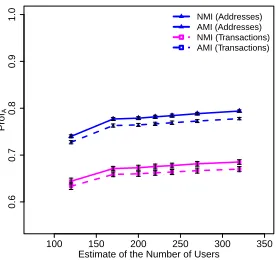
Fig. 3. The case where A cannot accu-rately estimatenU. We assume the ‘Partial Knowledge” case wherenU= 200.
In both configurations, the advantage ofAinAddUnlgame is only negligible af-fected by the fraction of the privacy aware users in the system. More specifically, we can see that our clustering algorithms outperformARby almost90%. On the contrary,
ProfaA andProfτA show a better dependency on the fraction of privacy aware users. When none of users in the system are privacy-aware, the performance of our clustering algorithms is high. In particular, in both configurationsProfAa(NMIandAMIfor
ad-dresses) range within0.87−0.89, whileProfτA(NMIandAMIfor transactions) are 0.73. However, as the fraction of the privacy aware users increases, the performance of
Adrops and results inProfτAandProfaAof0.70and0.63respectively. This mischief can be explained by the fact that privacy aware users add noise to the Bitcoin log. How-ever, the fact thatAMIvalues remain consistently far from0and close to1indicates thatAperforms much better thanARand that the estimate chosen byAis close to the genuine assignment of users to clusters.
Figure 2 depicts the overall fraction of user profiles (measured by means of the similarity of transactions appearing in a user’s wallet and the corresponding cluster as discussed in Section 3.2) that are captured by A. Our results show that in the case whennU = 200users with 0% privacy awareness, almost42%of the users have their
preferences captured with 80% accuracy. In the case featuring 100% privacy-aware users, this fraction drops to 35% of the users whose profile was correctly clustered with an accuracy of at least80%. We therefore conclude that the privacy of users in Bitcoin can be compromised, even if users manually create new addresses in order to enhance their privacy in the system.
Furthermore, our results show thatA’s advantage overAR is not significantly
if A’s estimate of the number of users is not accurate, the privacy of a considerable fraction of users is still compromised.
5
Discussion
So far, our analysis focused on the current implementation of Bitcoin when used in a university setting. Note that our results provide rather an upper bound to privacy in the studied university setting than an accurate assessment of privacy in Bitcoin in generic settings. In what follows, we analyze the implications of our findings in generic implementations/uses of Bitcoin.
Evading Heuristic I:We start by showing that Heuristic I cannot be easily evaded in any future implementation of Bitcoin without compromising the basic operation of Bit-coin. Indeed, the combination of multiple inputs ensures that coins with “large” values can be recreated from existing smaller BTCs; this prevents the value of coins from be-ing continuously deprecated followbe-ing every issued transaction until the value of these coins reaches the minimum amount. At that point in time, the only way for Bitcoin users to issue transactions without combining their previous coins is to perform mul-tiple transactions with single-input, one coin at a time. This clearly does not solve the problem since this process can still be tracked by the adversary (transactions will be linked by time). Another alternative would be for Bitcoin developers to provide sup-port for different users to transparently participate in a single transaction. While this would increase the use-cases where Bitcoin finds applicability (e.g., performing con-tracts [1]), the collaborative construction of transactions by different users is unlikely to be predominately used in the network.
Evading Heuristic II: Similarly, it is easy to see that evading Heuristic II can only decrease the privacy of Bitcoin users. That is, if “shadow” addresses were not utilized, and the change of coins is simply put back in the sender’s address then users’ activities can be traced in an easier way. We point out that Heuristic II results in the dispersion of the coins among several addresses of the users. This makes the privacy leakage due to Heuristic I even more considerable. One possible way to “evade” Heuristic II would be for Bitcoin users to(i)first divide the coins according to the required payment in one transaction and(ii)then make the payment with zero change at a random point later in time. Another possible solution to “harden” the reliance on Heuristic II would be for Bitcoin to support Mutli-Input Multi-Output (MIMO) transactions.
ven-dors that the adversary knows, the more complete is the view of the adversary of the geographic sub-network.
The reliance on third-party trusted entities (e.g., Bitcoin banks, Bitcoin Anonymiz-ers, FlexCoin [3]) emerges as one of the few workable solutions to increase the privacy of Bitcoin clients. These entities can hide the direct relationship between the inputs and outputs of a transaction within a sufficiently large anonymity set. However, this solution comes at odds with the main intuition behind the complete decentralization in Bitcoin.
6
Related Work
In [5], Elias investigates the legal aspects of privacy in Bitcoin. In [7], Babaioffet al. address the lack of incentives for Bitcoin users to include recently announced transac-tions in a block, while in [4], Syedet al.propose a user-friendly technique for managing Bitcoin wallets. In [14], Karameet al.thoroughly investigate double-spending attacks in Bitcoin and show that double-spending fast payments in Bitcoin can be performed in spite of the measures recommended by Bitcoin developers. Clarket al. [11] pro-pose the use of the Bitcoin PoW to construct verifiable commitment schemes. Reid and Harrigan [16] analyze the flow Bitcoin transactions in a small part of Bitcoin log, and show that external information, i.e., publicly announced addresses, can be used to link identities and organizations to some transactions.
ECash [8–10] and anonymous credit cards were the first attempts to define privacy-preserving transactions. Privacy in ECash consists of user anonymity and transaction unlinkability; by relying on a set of cryptographic primitives ECash ensures that pay-ments pertaining to the same user cannot be linked to each other or to the payer, pro-vided that the latter does not misbehave. In [15], Pfitzmannet al.define unlinkability and privacy in pseudonymous systems. Dwork [13] defined differential privacy and quantified the information leakage from the query access of individuals. In Section 3.2, we adapt Dwork’s generic differential privacy notion to our Bitcoin privacy notions. Finally, in [18], Shokriet al. quantify location privacy by assessing the error of the adversarial estimate from the ground truth. In [12, 17] the authors further introduce entropy-based metrics to assess the communication privacy in anonymous networks.
7
Conclusion
In this paper, we evaluated the privacy provisions in Bitcoin when it is used as a primary currency to support the daily transactions of individuals in a university setting.
Acknowledgements
The authors would like to acknowledge the reviewers for their valuable comments and feedback.
References
1. Bitcoin – Wikipedia, Available fromhttps://en.bitcoin.it/wiki. 2. Bitcoin Block Explorer, Available fromhttp://blockexplorer.com/. 3. Flexcoin –The Bitcoin Bank, Available fromhttp://www.flexcoin.com/.
4. Bitcoin Gateway, A Peer-to-peer Bitcoin Vault and Payment Network, 2011. Available from http://arimaa.com/bitcoin/.
5. Bitcoin: Tempering the Digital Ring of Gyges or Implausible Pecuniary Privacy, 2011. Available fromhttp://ssrn.com/abstract=1937769ordoi:10.2139/ssrn. 1937769.
6. Satoshi Nakamoto. Bitcoin: A Peer-to-Peer Electronic Cash System.
7. M. Babaioff, S. Dobzinski, S. Oren, and A. Zohar. On Bitcoin and Red Balloons. CoRR, 2011.
8. S. Brands. Electronic Cash on the Internet. InProceedings of the Symposium on the Network and Distributed System Security, 1995.
9. J. Camenisch, S. Hohenberger, and A. Lysyanskaya. Compact E-Cash. InProceedings of Advances in Cryptology - EUROCRYPT, 2005.
10. D. Chaum, A. Fiat, and M. Naor. Untraceable electronic cash. InProceedings on Advances in Cryptology - CRYPTO, 1990. http://dl.acm.org/citation.cfm?id=88314. 88969.
11. J. Clark and A. Essex. (Short Paper) CommitCoin: Carbon Dating Commitments with Bit-coin. InProceedings of Financial Cryptography and Data Security, 2012.
12. C. Diaz, S. Seys, J. Claessens, and B. Preneel. Towards measuring anonymity. In R. Din-gledine and P. Syverson, editors,Proceedings of Privacy Enhancing Technologies Workshop (PET 2002), April 2002.
13. C. Dwork. Differential privacy: a survey of results. InProceedings of the 5th international conference on Theory and applications of models of computation, TAMC’08, 2008. 14. G. Karame, E. Androulaki, and S. Capkun. Double-Spending Fast Payments in Bitcoin. In
Proceedings of ACM CCS, 2012.
15. A. Pfitzmann and M. Hansen. Anonymity, Unlinkability, Undetectability, Unobservabil-ity, PseudonymUnobservabil-ity, and Identity Management  A Consolidated Proposal for Terminology. Fachterminologie Datenschutz und Datensicherheit, pages 111–144, 2008.
16. F. Reid and M. Harrigan. An Analysis of Anonymity in the Bitcoin
System. CoRR, 2011. http://www.bibsonomy.org/bibtex/
257d6640d03ae4a5668ef8b32656461eb/dblp.
17. A. Serjantov and G. Danezis. Towards an information theoretic metric for anonymity. In R. Dingledine and P. Syverson, editors,Proceedings of Privacy Enhancing Technologies Workshop (PET 2002). Springer-Verlag, LNCS 2482, April 2002.
18. R. Shokri, G. Theodorakopoulos, J. L. Boudec, and J. P. Hubaux. Quantifying location privacy. InProceedings of the IEEE Symposium on Security and Privacy, 2011.
19. N. X. Vinh, J. Epps, and J. Bailey. Information theoretic measures for clusterings com-parison: is a correction for chance necessary? In26th Annual International Conference on Machine Learning (ICML), 2009.
A
Multi-Input Transactions
Output H
Output P Output Q
Output R
Output/Input A
Output/Input B
Fig. 4.Example of referencing input/output in transactions.
B
Bitcoin Block Explorer
Hash:000000000043a8c0fd1d6f726790caa2a406010d19efd2780db27bdbbd93baf6
Previous block:00000000001937917bd2caba204bb1aa530ec1de9d0f6736e5d85d96da9c8bba
Next block:00000000000036312a44ab7711afa46f475913fbd9727cf508ed4af3bc933d16
Time:2010-09-16 05:03:47
Difficulty:712.884864
Transactions:2
textbfMerkle root: 8fb300e3fdb6f30a4c67233b997f99fdd518b968b9a3fd65857bfe78b2600719
Nonce:1462756097
Input/Previous Output Source & Amount Recipient & Amount
N/A Generation: 50 + 0 total fees Generation: 50 + 0 total fees f5d8ee39a430...:0 1JBSCVF6VM6QjFZyTnbpLjoCJ...: 50 16ro3Jptwo4asSevZnsRX6vf..: 50
Table 2.Example Block of Bitcoin. The block contains 2 transactions, one of which awards the miner with 50 BTCs.
Listing 1Example of XML configuration parameters for a “lunch” event with 12 op-tions corresponding to the profile of a “Professor”.
<!– lunch, eventid="0" refers to event with id="0" from above –> <ProfileEvent eventid="0" minFreqPerWeek="5" maxFreqPerWeek="5" > <Store storeid="0" maxPref="1" minPref="0" maxPrice="10.0" minPrice="8.0" /> <Store storeid="1" maxPref="1" minPref="0" maxPrice="13.0" minPrice="10.0" /> <Store storeid="2" maxPref="1" minPref="0" maxPrice="15.0" minPrice="13.0" /> <Store storeid="3" maxPref="4" minPref="2" maxPrice="25.0" minPrice="15" /> <Store storeid="4" maxPref="2" minPref="0" maxPrice="20.0" minPrice="15.0" /> <Store storeid="5" maxPref="2" minPref="0" maxPrice="17.0" minPrice="12.0" /> <Store storeid="6" maxPref="0.5" minPref="0" maxPrice="20.0" minPrice="8.0" /> <Store storeid="7" maxPref="0.5" minPref="0" maxPrice="10.0" minPrice="7.5" /> <Store storeid="8" maxPref="4" minPref="2" maxPrice="25.0" minPrice="15" /> <Store storeid="9" maxPref="0.5" minPref="0" maxPrice="25.0" minPrice="10" /> <Store storeid="10" maxPref="0.5" minPref="0" maxPrice="10.0" minPrice="5.0" /> <Store storeid="11" maxPref="3" minPref="1" maxPrice="12.0" minPrice="9.0" /> </ProfileEvent>
D
Bitcoin Simulator
Our simulator is round-based; in each simulation round (defined as a “weekly timestep-ping” interval), events are added to a priority queue with a probability dictated by the configuration file. These events correspond to one of the following operations:
– Issue a new transaction:Users might issue new Bitcoin transactions whose time, value, beneficiary and purpose stem from the XML configurations file. The process of transaction issuance in our simulator fully mimics its counterpart in the genuine Bitcoin system.
– Generate a new Bitcoin address:Here, in addition to the automatically generated addresses in Bitcoin (cf. Section 3), “privacy-aware” users might decide to generate a number of new addresses to further “obfuscate” their usage of Bitcoin.
Conforming with the current use of Bitcoin, only few users in our setting were miners (i.e., mining is currently mostly performed by dedicated mining pools).
Our Bitcoin simulator abstracts away network delays, congestion, jitter, etc.. We also assume that all transactions in the system are well-formed and we do not model transaction fees that are incurred in the network. While malformed transactions and double-spending attempts [14] can be indeed witnessed in the genuine Bitcoin system, we believe that malicious behavior in Bitcoin is orthogonal to our privacy investigation— which explains the reason why we did not model such a misbehavior in our simulator. Moreover, our simulator relies on a variant greedy algorithm that closely approximates the genuine algorithm used in Bitcoin. Note that while the distribution of generated blocks in our simulator matches that in Bitcoin [14]8, we increased the average time be-tween the generation of successive blocks in the simulator to better cope with simulated network dynamics9.
8
It was shown in [14] that the block generation in Bitcoin follows a shifted geometric distribu-tion with parameter 0.19.
9
E
Captured Transactions w.r.t.
n
UFigure 5 shows the impact of the number of usersnUon the performance of our profiling
algorithms.
20 40 60 80 100
0
20
40
60
80
100
Fraction of Transactions Captured (%)
Fr
action of Users (%)
● ●
●
●
●
● ●
●
100 Users 200 Users 400 Users
Fig. 5.Fraction of captured transactions with respect tonU. Here, we consider the “No Knowl-edge” case where 50%of the users are privacy-aware.
Our results show that the fraction of users whose transactions are correctly captured by our algorithms is not considerably affected by the number of users in the system. For instance, the fraction of users whose profiles were captured with an accuracy of at least 80%is approximately40%whennU= 100,200,400.