Contents lists available atScienceDirect
Physics
Letters
B
www.elsevier.com/locate/physletb
Search
for
flavour-changing
neutral
currents
in
processes
with
one
top
quark
and
a
photon
using
81 fb
−
1of
pp
collisions
at
√
s
=
13 TeV with
the
ATLAS
experiment
.TheATLASCollaboration
a r t i c l e i n f o a b s t ra c t
Articlehistory:
Received22August2019
Receivedinrevisedform16October2019 Accepted29October2019
Availableonline13November2019 Editor:M.Doser
Asearchforflavour-changingneutralcurrent(FCNC)eventsviathecouplingofatopquark,aphoton,and anuporcharmquarkispresentedusing81 fb−1ofproton–protoncollisiondata takenata
centre-of-massenergyof13 TeV withtheATLASdetectorattheLHC.Eventswithaphoton,anelectronormuon, ab-taggedjet,and missing transversemomentumare selected.Aneuralnetwork basedonkinematic variables differentiatesbetweeneventsfromsignal andbackground processes.The dataare consistent with the background-only hypothesis, and limits are set on the strength of the tqγ coupling in an effectivefieldtheory.Theseare alsointerpretedas 95%CLupperlimits onthecrosssectionforFCNC
tγ productionviaaleft-handed(right-handed)tuγ couplingof36 fb(78 fb)andonthebranchingratio fort→γuof2.8×10−5(6.1×10⁻⁵).Inaddition,theyareinterpretedas95%CLupperlimitsonthe
crosssectionforFCNCtγ productionviaaleft-handed(right-handed)tcγ couplingof40 fb(33 fb)and onthebranchingratiofort→γcof22×10−5(18×10−5).
©2019TheAuthor(s).PublishedbyElsevierB.V.ThisisanopenaccessarticleundertheCCBYlicense (http://creativecommons.org/licenses/by/4.0/).FundedbySCOAP3.
1. Introduction
Flavour-changingneutralcurrents(FCNCs)areforbiddenattree levelintheStandardModel(SM)andstronglysuppressedathigher ordersvia the GIM mechanism [1].Several extensionsto the SM predict processes involving FCNCs. In particular, some of these modelspredictthebranchingratiosoftop-quarkdecaysvia FCNC tobesignificantlylarger [2] thanthosepredictedbytheSM,which areoftheorder of10−14 [2]. Examplesare R-parity-violating su-persymmetricmodels [3] andmodelswithtwoHiggsdoublets [4]. SuchmodelswouldallowtheproductionoftopquarksviaFCNCs atameasurablerate.
ThisLetterpresentsasearchforFCNCsinprocesseswithatop quark(t)andaphoton(γ)basedondatacollectedwiththeATLAS experimentat√s =13 TeV. Thisanalysisismostsensitive tothe productionofasingletopquarkplusaphoton,butalsoconsiders thedecayofapair-producedtopquarkintoanuporcharmquark (q)plusaphoton.Tree-levelFeynmandiagramsfortheseprocesses are shownin Fig. 1, where inboth cases,exactly one top quark decays via the SM-favoured t W b coupling. Comparedto the SM productionofatopquarkandaphoton,theFCNCprocessesresult inhigherphotontransversemomentaonaverage.
E-mailaddress:atlas.publications@cern.ch.
FCNC contributionsto the decaymode (t→qγ) and the pro-duction mode (q→tγ) can be expressed in terms of effective coupling parameters but also in terms of branching ratios and cross sections [5,6]. In the former case and following the nota-tion in Ref. [7], the corresponding operators are OuB(i j) and O(uWi j), where i=j areindices forthequark generation.Ingeneral, left-handed (LH) andright-handed (RH) couplings could exist, which result in different kinematic properties of the top-quark decay products, such asthe transverse momentum of the charged lep-toninsemileptonictop-quarkdecays.Themoststringentlimitsto datearelimitsonbranchingratiosofB(t→uγ)<1.3·10−4 and B(t→cγ)<1.7·10−3 set by the CMS Collaboration, assuming equalleft- andright-handedcouplings [8].
2. ATLASdetector
The ATLAS experiment [9] atthe LHCis a multi-purpose par-ticledetector witha forward-backwardsymmetric cylindrical ge-ometry anda near4π coverage in solidangle.1 It consistsofan inner tracking detector (ID) surrounded by a thin
superconduct-1 ATLASuses aright-handedcoordinatesystemwith itsoriginat thenominal
interactionpoint(IP)inthecentreofthedetectorandthez-axisalongthebeam pipe.Thex-axispointsfromtheIPtothecentreoftheLHCring,andthe y-axis pointsupwards.Cylindricalcoordinates(r,φ)areusedinthetransverseplane,φ beingtheazimuthalanglearoundthez-axis.Thepseudorapidityisdefinedinterms
https://doi.org/10.1016/j.physletb.2019.135082
Fig. 1.Tree-level Feynman diagrams for top-quark production (left) and decay (right) via FCNCs. Thetqγvertex, which is not present in the SM, is highlighted.
ingsolenoidprovidinga 2 Taxialmagneticfield, electromagnetic andhadron calorimeters,and amuon spectrometer (MS). The ID covers the pseudorapidity range |η|<2.5. It consists of silicon pixel,siliconmicrostrip,andtransitionradiationtrackingdetectors. Lead/liquid-argon(LAr)samplingcalorimetersprovide electromag-netic(EM) energymeasurementswithhighgranularity. Ahadron (steel/scintillator-tile)calorimeter coversthe central pseudorapid-ityrange(|η|<1.7). Theend-capandforwardregions are instru-mented with LAr calorimeters for both EM and hadronic energy measurementsupto|η|=4.9.TheMSsurroundsthecalorimeters andisbasedonthreelargeair-coretoroidalsuperconducting mag-netswitheightcoilseach.Thefield integralofthetoroidsranges between2.0and6.0 T m acrossmostofthedetector.The MS in-cludesasystemofprecisiontrackingchambersandfastdetectors fortriggering.Atwo-leveltrigger systemis usedtoselectevents. Thefirst-leveltriggerisimplementedinhardwareandusesa sub-setof thedetector informationto reduce the acceptedrateto at mostnearly 100 kHz.Thisisfollowedbyasoftware-basedtrigger thatreducestheacceptedeventrateto1 kHzonaverage depend-ingonthedata-takingconditions.
3. Analysisstrategy
Thesearchstrategy selectseventswithafinalstate containing onepromptphotonandthedecayproductsofatopquark,namely anelectronoramuon,ab-taggedjet,andmissingtransverse mo-mentum,andestimatescontributionsfromFCNCprocessesinthis background-dominated dataset.Asignalregion (SR)isdefinedby looserequirements on thekinematic propertiesof thefinal-state objects,giving rise to alarge acceptance forsignal events inthe production mode. With this selection, the search is most sensi-tivetoFCNCsinthismode,butthedecaymodeisincludedinthe analysis. The mainbackground contributionstems fromelectrons misidentified as photons, primarily in top-quark–anti-top-quark events (tt¯). These contributions and contributions from hadrons misidentified as photons (both labelled “fakes” in the following) aremodelledbyMonteCarlo(MC)simulationsandscaledto data-drivenestimates.Photons producedinassociationwitha leptoni-callydecayingW orZ bosonareestimatedincontrolregions(CRs) whichdonotoverlapwiththeSRbutarekinematicallysimilarto it.Thepredictionsforothersmallprompt-photonbackground pro-cessesare takenfromMC simulationandincludet¯tγ production, single-topquarkproductioninassociation withaphoton andthe production of two massive gauge bosons with a photon. As the lattertwoprocessesresultinasmallcontributiontothetotal back-groundprediction, it issufficient that in theseprocesses prompt photonsaregenerated bythe parton-showerprogram.Signal and backgroundeventsaredistinguishedusinganeuralnetwork(NN).
ofthepolarangleθas η= − ln tan(θ/2).Angulardistanceismeasuredinunitsof R ≡(η)2+(φ)2.
Finally,thesignal contributionisestimatedinaprofile likelihood fittotheNNoutputdistributionsintheSRandtheCRs,inwhich each source of systematicuncertainty is modelled as a nuisance parameter.
4. Dataandsimulation
The proton–proton(pp) collision dataanalysed were recorded with the ATLAS detector from2015 to 2017 ata centre-of-mass energy of √s=13 TeV. The average number of interactions per bunchcrossingwas13.4,25.1,and37.8in2015,2016and2017, re-spectively.Events wereselectedbysingle-leptontriggers [10] and required to haveat least one reconstructed primary vertexwith at least three assignedtracks that havea transverse momentum greaterthan400 MeV.Aftertheapplicationofdata-quality require-ments,thedatasamplecorrespondstoanintegratedluminosityof 81 fb−1.ItisobtainedusingtheLUCID-2detector [11] forthe pri-maryluminositymeasurements.
The data were modelled by MC simulations ofthe signal and backgroundprocesses.Aftereventgeneration,theresponseofthe ATLAS detectorwas simulatedusingGeant4 [12] with afull
de-tectormodel [13] ormodelledbyafastsimulation [14].Toaccount foradditionalppcollisions(pile-up),inelasticppinteractionswere superimposedonthehard-scatteringeventsandweighted accord-ing to theobserved pile-updistribution.The pile-upevents were simulated usingPythia8.186 [15],withthe A3 [16] setof tuned
parameters(A3tune).
The simulated signal samples were generated using Mad-Graph5_aMC@NLO 2.4.3 [17] with the TopFCNC model [6,18] at
next-to-leading order (NLO) in QCD and the NNPDF3.0NLO [19] set ofpartondistribution functions(PDFs).The partonshowering was done with Pythia 8.212 with the A14 tune set [20].
Simu-latedsamplesofSMtt¯andsingle-top-quarkeventsweregenerated using Powheg-Box [21–27] with the NNPDF3.0NLO PDF set. The
parton showering, hadronisation, andthe underlying event were modelledusingPythia8.230.Thetop-quarkmassmtop wassetto
172.5 GeV inthesesamples,andthehdampparameterthatcontrols thetransversemomentumofthefirstgluonemittedwassetto1.5 timesmtop. Samplesoftt¯γ eventswere generatedas2→7 pro-cess atleading order usingMadGraph5_aMC@NLO 2.3.3and the
For the study of systematic uncertainties in the modelling of processes involving top quarks, simulated t¯t samples were produced with Powheg-Box + Herwig 7.0.4 [35,36] and Mad-Graph5_aMC@NLO 2.6.0plusPythia8.212.TheMMHT2014LO [37]
PDFsetisusedtogetherwiththeH7-UE-MMHT [36] tune.An ad-ditional tt¯ sample was produced with hdamp set to three times mtop andthe factorisation and renormalisation scales set to half their nominal values using the A14tune. For the t W process, a samplewasproducedwithanalternativeschemeforremovingthe overlapwitht¯t production [38]. Moreover, single-top-quark sam-ples were produced withPowheg-Box +Herwig 7.0.4 and Mad-Graph5_aMC@NLO 2.6.2 plusPythia 8.212. The NNPDF2.3LO PDF
setisusedaswellastheA14tune.
Processes with one or two heavy gauge bosons, in particu-larthe processes W+γ+jets and Z+γ+jets, were simulatedusing
Sherpa2.2.1 and 2.2.2 [39] with the matrix elements calculated
usingComix [40] and OpenLoops [41]. All matrixelements were mergedwith theSherpa partonshowering [42] accordingto the
ME+PS@NLO [43] prescription. The NNPDF3.0NNLO PDF set was used.
An overlap removal scheme was applied to remove double-countingofeventsstemmingfromphotonradiationinsamplesin whichaphotonwasnot explicitlyrequiredinthefinalstate [29]. Thisappliestotheprocessestt¯,W+jetsand Z+jetsinorderto re-movetheoverlapwiththett¯γ,W+γ+jetsandZ+γ+jetssamples.
Mismodellingofthephoton pT distributionis observedinthe W+γ+jetandZ+γ CRs,whicharedefinedinSection5.Thephoton pT spectrum in the W+γ+jets and Z+γ+jets processes was cor-rectedby adjustingthe MCpredictionto thedatainfive pT bins usingalinear functionthat onlychanges theshape ofthe distri-butionandnotitsnormalisation.Thiscorrectiontothephoton pT improvesthemodellingoftheNNoutputdistributionintheCRs.
As discussed in Sections 6 and 7, the contribution of events withelectrons andhadronsmisidentified asphotonsis corrected usingdata.Thecontributionfromprocesseswithhadrons misiden-tifiedasleptonsisestimatedtobenegligible.
5. Objectandeventselection
Electronsare reconstructedfromclustersofenergydepositsin theelectromagneticcalorimetercellswithamatchedIDtrack [44]. Theyarerequiredtomeetthetightidentificationcriteria [44],and their tracksmust point to theprimary vertex. Theymust havea transversemomentum pT largerthan27 GeV and|ηcluster|<2.47, excluding1.37<|ηcluster|<1.52,where|ηcluster|isthe pseudora-pidityoftheelectron’senergycluster.Muonsarereconstructedby combining a track in the MS with a track in the ID [45]. They are required to meet the medium identification criteria [45] and must point to the primary vertex. They must have pT>27 GeV and |η|<2.5. Isolated electrons and muons are selected by re-quiring the amount of energy in nearby energy deposits in the calorimeters and the scalar sum of the transverse momenta of nearbytracksintheIDtobesmall.
Photons are reconstructed fromclustersof energydeposits in the electromagnetic calorimeter cells with no matched ID track (unconvertedphotons)orwithoneortwomatchedIDtracksthat arecompatiblewiththetracksfromanelectronorpositronfroma photonconversion(convertedphotons) [44].TheymusthavepT> 20 GeV and|ηcluster|<2.37,excluding1.37<|ηcluster|<1.52.They arerequiredtomeetthetight identificationcriteriafortheshape ofthe shower inthe electromagneticcalorimeter(shower shape) andfortheenergydepositedinthehadroniccalorimeter [44]. Pho-tonsmustbeisolatedfromnearbyenergydepositsinthe calorime-terandnearbytracksintheID: thesumoftheenergydeposited (pT of the tracks) within R=0.4 (R=0.2) of the photon
direction is required to be smaller than 0.022×pT+2.45 GeV (0.065×pT), excluding thephoton energydeposition (tracks as-sociatedwiththephoton).
Jets are reconstructed fromtopological clusters [46,47] in the calorimeterswiththeanti-kt algorithm [48] usingFastJet [49] and aradiusparameterof0.4.Theirenergyiscalibrated [50],andthey mustfulfilpT>25 GeV and|η|<2.5.Jetswith pT<120 GeV and
|η|<2.4 are required to pass a requirement on the jet-vertex-tagger (JVT) [51] to suppress pile-upjets. Jetsare b-tagged with the MV2c10 algorithm [52], which uses a boosted decision tree withseveralb-taggingalgorithmsasinput.Theb-taggingefficiency forjetsthatoriginatefromthehadronisationofb-quarksis60%in simulatedt¯tevents.Theb-taggingrejection2 forjetsthatoriginate fromthehadronisation ofc-quarks(u-,d-, s-quarksorgluons)is 23(1200).
The magnitude ofthe missing transverse momentum EmissT is reconstructed fromthe vector sumof the pT of leptons,photons, andjets, aswellasIDtracksthatpointtotheprimaryvertexbut arenotassociatedwithareconstructedobject(softterm) [53].
Toavoiddouble-counting,objectsareremovedinthefollowing order: electrons sharing a trackwith a muon; jets within R= 0.2 ofan electron;electronswithin R=0.4 ofa jet;jetswithin R=0.4 of a muon ifthey haveat mosttwo associatedtracks; muonswithin R=0.4 ofa jet; photonswithin R=0.4 ofan electronormuon;jetswithinR=0.4 ofaphoton.
Scalefactors(SFs)are usedtocorrecttheefficiencies in simu-lationinordertomatchtheefficienciesmeasured indataforthe electron [44] andmuon [45] trigger,reconstruction,identification, andisolationcriteria, aswell asforthephotonidentification [44] and isolation requirements. SFs are also applied for the JVT re-quirementandfortheb-taggingefficienciesforjetsthatoriginate fromthehadronisationofb-quarks [54],c-quarks [52],andu-,d-, s-quarksorgluons [55].
The selected events have exactly one electron or muon, ex-actly one photon, exactly one b-tagged jet and no further jets, and Emiss
T >30 GeV.This selection definesthe SRwithsignal ef-ficiencies3 for the production mode of 3.03% (2.45%) for the LH (RH)tuγ couplingandof3.79%(3.14%)fortheLH(RH)tcγ cou-pling.These efficienciesare definedwithrespect tosignal events that include a leptonic decay of the W boson,i.e. a decay with anelectron,muonortaulepton.Theefficienciesforthecouplings thatinvolveac-quarkarelargerthanthosethatinvolveau-quark becauseofthedifferenceinthekinematicsthatarisesfromthe dif-ferencebetweentheu- andc-quarkPDFs.Thedifferencebetween theefficienciesfortheLHandtheRHcouplingsisduetothe kine-maticdistributionsoftheW boson’sdecayproducts,whichdiffer dependingonthehandednessofthetopquark.Theefficienciesfor thedecaymodeare0.45%and0.51%forthetuγ andthetcγ cou-pling, respectively, and are lower dueto the requirement ofnot morethanone jetinthefinal state,i.e.thisanalysisisoptimised forthe productionmode. The absolutestatisticaluncertainties in the efficiencies are0.03% orsmaller. Inthe SR, 9557data events are selected. The ratioof production-mode to decay-mode event yieldsis4.2(5.3)fortheLH(RH)tuγ couplinganditis0.86(0.68) fortheLH(RH)tcγ coupling,i.e.inthecaseoftuγ coupling,the dominantsignalprocessisindeedtheproductionmode.However, inthecaseofthetcγ coupling,thedecaymodealsoplaysan im-portant role, because the production mode is suppressed by the c-quarkPDF.
2 Therejectionisdefinedastheinverseoftheefficiency.
3 Here,thesignalefficiencyincludesthesignallossduetothelimitedacceptance
TwoCRsaredefinedfortheW+γ+jetsandZ+γ+jetsprocesses, which are dominated by the respective background process and kinematically closetothe SR. The W+γ+jetCRis definedbythe samecriteriaasthe SRwithtwomodifications: the jet mustnot beb-taggedandthelepton–photoninvariantmassmustbeoutside the range 60–100 GeV to suppress the contribution from Z+jets events with one electron that is misidentified as a photon. The Z+γ CR is defined by requiring exactly one photon andexactly twoleptonswiththesameflavourbutoppositeelectriccharge.No requirementismadeintheZ+γ CRonthenumberofjetsorEmiss
T . IntheW+γ+jetCR,atotalnumberof127 864eventsareobserved, andinthe Z+γ CR,thetotalnumberis85 347.
6. Data-drivenestimateofelectronsmisidentifiedasphotons
Electronscan be misidentified asphotons, forexample, ifthe trackoftheelectronisnotreconstructedorifthematchingcriteria betweenthetrackandclusterarenotmet.Inparticular,dileptonic tt¯ events with at least one electron in the final state can enter theSRifan electronismisidentifiedasaphoton.The probability foranelectrontobemisidentifiedasaphoton, fe→γ,ismeasured fromdataandsimulation following themethodology used previ-ously [56],andaSFisderivedthatisappliedtothesimulation.
Two regions are defined to measure fe→γ, called “electron fake regions” (EFR) in the following. The Z→eγ (Z→ee) EFR isdefinedby requiring exactlyone electron andonephoton (ex-actlytwoelectrons withopposite electriccharge andnophotons) withan electron–photon (dielectron)invariant mass intherange 60–120 GeV, a vetoon the presence ofjets, and Emiss
T <30 GeV. NeitherEFRoverlapswiththeSRnortheCRs.The Z→eγ EFRis richinZ→eeeventswithoneelectronmisidentifiedasaphoton, andthe Z→eeEFRisrichin Z→eeevents.
Inthe Z→ee andthe Z →eγ EFRs, the dielectroninvariant massortheelectron–photoninvariant mass,respectively, isfitted withanalyticsignal(forZ→eewithbothelectronscorrectly iden-tifiedorwithoneelectronmisidentifiedasaphoton,respectively) and background functions. The signal function is a double-sided CrystalBallfunction,andthebackgroundfunctionisafourth-order Bernstein polynomial. The integrals of the aforementioned fitted signalfunctionsaredividedinordertoestimate2fe→γ,wherethe factoroftwoaccountsforthetwoelectronsinZ→eeeventsthat may be misidentified as a photon. In the Z →eγ EFR, the ex-pected contribution from Z →eeγ events,relative to the signal, is8.8%anditissubtractedfromtheintegral,becausethisprocess mainly contributesto events withprompt photonsand inwhich oneelectronwasnot reconstructedordidnotpassthe identifica-tionorisolationcriteria.
Systematicuncertaintiesfromseveralsourcesareevaluated:the range of the invariant-mass fit is changed from 60–120 GeV to 65–115 GeV;the parameters ofthesignal function, exceptforits normalisation,aresettothevaluesextractedfromsimulationand a Gaussian function is used for the background; instead of sub-tractingtheexpectedrelativecontributionfromZ→eeγ eventsin the Z→eγ EFR,theexpectedabsolutecontributionissubtracted. Foreachofthesevariations,a systematicuncertaintyfor fe→γ is estimatedasthedeviationfromthenominalvalue.Thelargest ef-fectisduetothevariationofthesignalandbackgroundfunctions. Thevalue of fe→γ is3.11%±0.01%(stat.)±0.13%(syst.).TheSF forthesimulationis0.978±0.004(stat.)±0.040(syst.).
Themodellingofkinematicvariablesischeckedinavalidation region.The eventselectionforthisvalidation regionis similarto theSRselection,butafewchangesaremadeinordertoenhance the contributions from Z →ee events and dileptonic tt¯ events withamisidentifiedelectron,whileensuring nooverlapwiththe SR,theCRs,ortheEFRs.Thevalidationregionisdefinedby
requir-ingexactlyonephotonandoneelectronwithaninvariantmassin therange70–110 GeV,atleastonejet,and EmissT <30 GeV. Satis-factory modelling ofthe kinematicvariables is observed,but the relativeuncertaintyin fe→γ isincreasedto10% inordertocover thedifferenceinthenormalisationobservedbetweendataandthe prediction.
7. Data-drivenestimateofhadronsmisidentifiedasphotons
Insomecases,hadronscanbemisidentifiedasphotons.For ex-ample, this can happen when a meson decays into two photons that are reconstructed asa single cluster in the electromagnetic calorimeter.Processessuch ast¯t productioncan entertheSRifa high-energy hadron ismisidentified asa photon. The number of eventswithmisidentifiedhadronsisestimatedfromdata,andaSF is appliedto the simulation,definedasthe estimatednumberof eventsindatadividedbythepredictednumberinsimulation.The SF is only usedto correctthe overall normalisationof this back-ground, andtheshapesofkinematicdistributions aretakenfrom simulationswiththeassociatedsystematicuncertainties.
Three hadron fakeregions (HFR) are definedby thesame cri-teria as the SR but with modified photon criteria: HFRpass|fail, HFRfail|pass, andHFRfail|fail. If the first indexis “pass”, the photon hasmettheidentificationcriteriadefinedinSection 5.Ifthefirst index is“fail”, thephoton has failedto meet at leastone of the criteriaontheshower shapesthat arecalculatedfromthe finely-segmentedfirstlayeroftheelectromagneticcalorimeter;however, itisrequiredtomeetalltightphoton-identificationcriteriaforthe other shower variables.The second indexrepresentswhetherthe photonmeetsorfailstomeettheisolationcriterion.
Only thefirst-layer shower shapesareconsidered forthe first indexbecausethesearemostlysensitivetothecoreoftheshower and are expected to be only weakly correlated with the isola-tion variables, whichare sensitive tothe energysurrounding the photon.ThenumberofSReventswithmisidentifiedhadronsis es-timatedasN(HFRpass|fail)×N(HFRfail|pass)/N(HFRfail|fail),whereNis thenumberofobservedeventsaftersubtractingboththeexpected number of events with misidentified electrons and the expected fraction of events with prompt photons (leakage). This estimate isadditionallycorrectedforthenon-zerocorrelationbetweenthe criteria for the first-layer shower shapes andthe isolation crite-rion.ThecorrectionfactorisdeterminedusingMCsimulationsand amountsto0.85withastatisticaluncertaintyof0.14.
Systematicuncertaintiesfromseveralsourcesareevaluated:the correctionfactorforthenon-zerocorrelationisconservatively var-iedby ±50%;theSF formisidentifiedelectrons,usedforthe sub-traction discussed above, is varied by one standard deviationup anddown (±1σ), andthelarger ofthetwo deviationsis consid-ered as a systematic uncertainty; and instead of subtracting the expected fraction of events with prompt photons, the expected prompt-photon contribution is subtracted in each HFR. For each of these variations, a systematic uncertainty is estimated as the resulting deviationfrom the nominal value. The largest effect is thevariationofthecorrectionfactor.TheSFforthesimulationsis 1.7±0.3(stat.)±1.0(syst.).
8. Neuralnetworkfordiscriminationbetweensignaland background
The signal is distinguished from the sum of the background processes by a fully connected feed-forward neural network (NN) withbackpropagation, implemented in Keras [57] with the TensorFlow [58] backend.SeparateNNsaretrainedforFCNC
kinematicdifferencesbetweentheproductionmodeandthe back-groundare more pronounced than forthe decaymode and thus leadtobetterdiscriminationbetweensignalandbackground.
Ten variablesare inputsto theNN: the pT ofthe photon,the lepton and the jet; the charge of the lepton; Emiss
T ; the lepton– photonandlepton–jetinvariantmasses;theR betweenthe lep-tonandthephoton,betweentheleptonandthejet,andbetween thejetandthephoton.Additionalkinematicvariablesweretested anddidnotimprovethediscrimination betweensignal and back-ground.All variablesare transformedusingscikit-learn’s [59]
Ro-bustScaler.
TheNNistrainedwiththeAdamoptimiser [60].TheMC
sam-plesaredivided into80%fortrainingand20%fortesting,so that approximately 63 000 background MC events and approximately 10 000-13 000 signal MC events are available for the training— dependingonthecoupling.Twohiddenlayerswith11nodeseach areusedandthehyperparametersoftheNNarechosenfroma se-riesoftestedvaluesinaprocedurewiththreefoldcrossvalidation.
9. Systematicuncertainties
Systematiceffectsmaychangetheexpectednumbersofevents fromthesignalandbackgroundprocessesandtheshapeofthe fit-teddiscriminantsintheSRandintheCRs.Theseeffectsare evalu-atedbyvaryingeachsourceofsystematicuncertaintyby±1σ and consideringtheresultingdifferencefromthenominalexpectation astheuncertainty. For some sources, onlyone variation is avail-able andthe difference is symmetrised usingthe full difference. Forsourceswithtwovariations,their effectsaresymmetrised us-ingtheaveragedifferencefromthenominalprediction.
Uncertaintiesduetothetheoreticalcrosssectionsareevaluated byvaryingthemby±5.6% fort¯tproduction [28,30,61–63],by±8% fort¯t+γ production [34], by −+43..04% (+−54..05%) fort-channel single-t (single-t)¯ production [31], by +−33..16% (+−44..83%) for s-channel single-t (single-t)¯ production [32], by ±5.3% for t W production [33], by
±5% forW+jetsand Z+jetsproduction [64],andby±6% for dibo-sonproduction [65].Nocross-sectionuncertaintyisconsideredfor W+γ+jetsand Z+γ+jets production,becausetheir normalisations aredeterminedinthefit.
Uncertaintiesduetothemodellingofthesignal areestimated byconsidering variations ofthe renormalisationandfactorisation scales by factors of 2 and 0.5, butnormalising the signal to the nominal cross section. In each bin of a distribution, the largest deviationamongallvariationsisconsideredasanuncertainty (en-velope).In addition,uncertainties dueto the PDFsare estimated byfollowingthePDF4LHCprescriptionforRun 2 [66].
Uncertainties due to the renormalisation and factorisation scales and from the PDFs of the background processes are esti-mated separately for each process following the same procedure as for the signal. For the t¯t and single-top processes, however, thescale variations arealreadyincluded inthe estimationofthe uncertaintyinthemodellingoftheinitial-stateradiation(see be-low).Forthe W+γ+jetsandthe Z+γ+jetsprocesses,a correction isapplied to the photon pT spectrum,as described inSection 4. Toaccount fortheuncertaintyduetothephoton pT correction,a conservativeuncertaintyisapplied,forwhichthepredictionwith the correction applied is compared with the prediction without thecorrection.
Forallbackground processes—exceptfor W+γ+jets and Z+γ+ jets production, for which the normalisation is estimated by a free parameter in the fit—an uncertainty of2% in theintegrated luminosityisincluded [67].Theuncertaintydueto pile-upis de-terminedbyvarying theaveragenumberofinteractions by 9%in thesimulation.The uncertaintiesduetotheSFsforelectrons and
Table 1
ExpectednumberofeventsforthedifferentbackgroundcontributionsintheSRand thetwoCRsafterthefitincludingalluncertainties,aswellastheobservednumber ofevents.
SR W+γ+jet CR Z+γCR
e→γfake 4 500±400 8 200±1 300 236±32 j→γfake 260±200 2 900±2 000 1 300±1 000 Z+γ+jets 780±100 13 400±1 300 81 400±1 900 W+γ+jets 2 200±400 101 200±2 800 6±2 Other promptγ 1 800±400 1 900±500 2 140±200
Total background 9 500±220 127 700±3 000 85 100±1 600
Data 9 557 127 864 85 347
hadronsthat aremisidentified as photonsare determined as de-scribedinSections6and7.
ToestimatetheuncertaintyduetotheproductionofW and Z bosonstogetherwithb-quarks,theshapeoftheSRdistributionin eventswithjetsthatoriginatefromthehadronisationofab-quark isusedforeventswithjetsthatoriginatefromotherquarksor glu-ons (andviceversa) forthe W+jets, W+γ+jets, Z+jets, Z+γ+jets, and diboson processes. Differences betweenthe shapes of these backgrounds inassociationwithb-quarksorwithother quarksor gluons are small, however. An additional uncertainty inthe nor-malisationofW+γ productioninassociationwithb-quarksof50% is assigned,covering observed differencesbetweendataand pre-dictionsinmeasurementsofW and Z bosonsinassociationwith b-quarks [68–71].
To estimate the uncertainty due to the modelling of initial-and final-state radiation in tt¯ and single-top-quark production, the effects of varying the A14 tune’s parameter values is eval-uated. In addition, fort¯t production, the sample generated with hdamp=3mtop, thefactorisation andrenormalisationscales setto halftheirnominalvalues,andavariationoftheA14tune’s param-eter valuesis used to estimate theuncertainty due to the mod-ellingofinitial-stateradiation.Toestimatetheuncertaintydueto our choice of generator and shower programs fortt¯ and single-top-quark production, the nominal MC samples, generated with
Powheg-Box+Pythia8,arereplacedwithsamplesgeneratedwith MadGraph5_aMC@NLO +Pythia 8andwith Powheg-Box+ Her-wig7.Toevaluatetheuncertaintyduetotheschemeforremoving
the overlap with tt¯ productionfor the t W process, the nominal sample is compared witha sample produced withan alternative scheme [38].
Forthetriggering,reconstruction,identification,andcalibration of the objects, the following systematic uncertainties are eval-uated: electron and muon triggers, reconstruction, identification andisolation SFs [44,45];photon identification [44] and isolation SFs; electron- and photon-energy and muon-momentum calibra-tion and resolution [44,45]; jet energy scale (JES) [50] and jet energyresolution(JER) [72];JVTSF;b-taggingSFs [52,55,73];EmissT softterm [53].
10. Results
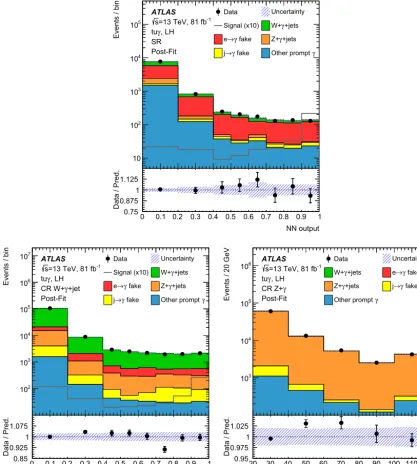
cor-Fig. 2.Post-fitdistributionsofabackground-onlyfittotheSRandtheCRsoftheNNoutputintheSR(top)andtheW+γ+jetCR(bottomleft)andofthe pT-distribution
oftheZ+γ CR(bottomright).Thelastbinofthedistributioninthe Z+γCRcontainstheoverflow.Inaddition,intheSRandintheW+γ+jetCR,theexpectedsignalis overlaidforaneffectivecouplingstrengthcorrespondingtotheobservedlimitmultipliedbyafactoroften.IntheZ+γCR,theexpectedsignalisnotshown,becauseitis negligible.
respondingpost-fit distributions. Thequalitative features ofthese distributionsaresimilarfortheothercouplingsstudied.
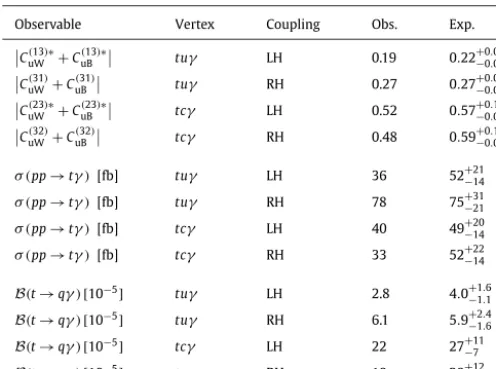
ThedataandSMpredictionsagreewithinuncertaintiesandno significant FCNC contributions are observed.From the 95% confi-dence level (CL) limits on the signal contribution, derived using the C Ls method [74], the corresponding limits on the effective couplingparameters are calculated,andfromthese thelimitson the production crosssection andbranching ratios are calculated. The background contributions from photons produced in associ-ation with a leptonically decaying W or Z boson are scaled by normalisationfactorsestimatedtobe1.25±0.09 and1.12±0.12, respectively, from the fit for the LH tuγ coupling. The normali-sation values determined in the fits for the other couplings are similar.The observedandexpected95% CLlimitson theeffective couplingstrengths,theproductioncrosssectionandthebranching
ratio are summarised in Table 2 for different vertices and cou-plings. Thesourcesofsystematicuncertaintywiththelargest im-pactontheestimatedsignalcontributiondependonthecoupling studied.Among themare thejetenergyresolution,the reweight-ingofthephoton pT,thefactorisationandrenormalisationscales, the choice of generator for the simulation of the t¯t and single-topprocesses,andtheuncertaintiesduetothelimitednumberof MonteCarloevents.Theresultinglimitsonthestrengthofthe ef-fectiveoperatorsarecomplementarytocurrentlimitsonthesingle operatorsfromasearchforanFCNCtq Z coupling [75].
11. Conclusion
Table 2
Observed(expected)95%CLlimitsontheeffectivecouplingstrengthsfordifferent verticesand couplings,theproductioncrosssection,andthebranchingratio.For theformer,theenergyscaleisassumedtobe=1 TeV.
Observable Vertex Coupling Obs. Exp. CuW(13)∗+C
(13)∗
uB tuγ LH 0.19 0.22
+0.04
−0.03 CuW(31)+C
(31)
uB tuγ RH 0.27 0.27+
0.05
−0.04 CuW(23)∗+C
(23)∗
uB tcγ LH 0.52 0.57+
0.11
−0.09 CuW(32)+C(uB32) tcγ RH 0.48 0.59+−00..1209
σ(pp→tγ)[fb] tuγ LH 36 52+−2114
σ(pp→tγ)[fb] tuγ RH 78 75+−3121
σ(pp→tγ)[fb] tcγ LH 40 49+−2014
σ(pp→tγ)[fb] tcγ RH 33 52+−2214
B(t→qγ)[10−5] tuγ LH 2.8 4.0+1.6
−1.1
B(t→qγ)[10−5] tuγ RH 6.1 5.9+2.4
−1.6
B(t→qγ)[10−5] tcγ LH 22 27+11
−7
B(t→qγ)[10−5] tcγ RH 18 28+12
−8
√
s=13 TeV pp data collected with the ATLAS detector at the LHC.Events with a photon, an electron ormuon, a b-tagged jet, andmissingtransverse momentumare selected.Thecontribution from events with electrons or hadrons that are misidentified as photons is estimated using data, and the two main background processeswitha promptphotonare estimatedincontrol regions. Aneuralnetworkisusedtodistinguishthesignalandbackground events,andthedataare consistentwiththebackground-only hy-pothesis.Limitsare setonthestrengthofeffectiveoperators that introduce a left- or right-handed flavour-changing tqγ coupling withanup-typequarkq,ontheproductioncrosssectionforFCNC tγ production,andon thebranching ratiot→γq. Thelimitson the branching ratio and on the tγ production cross section are themoststringenttodate.Theresultinglimitsonthestrengthof the effective operators are the most stringent limitsobtained in searchesforeventswithatqγ vertex.
Acknowledgements
We thankCERN for thevery successful operation ofthe LHC, aswell asthe support stafffromour institutions without whom ATLAScouldnotbeoperatedefficiently.
WeacknowledgethesupportofANPCyT,Argentina;YerPhI, Ar-menia; ARC, Australia; BMWFW and FWF, Austria; ANAS, Azer-baijan;SSTC, Belarus; CNPq and FAPESP, Brazil; NSERC, NRC and CFI,Canada; CERN; CONICYT,Chile; CAS, MOSTandNSFC, China; COLCIENCIAS, Colombia; MSMT CR, MPO CR and VSC CR, Czech Republic;DNRFandDNSRC,Denmark;IN2P3-CNRS,CEA-DRF/IRFU, France; SRNSFG, Georgia; BMBF, HGF, andMPG, Germany; GSRT, Greece;RGC,HongKong SAR,China;ISFandBenoziyo Center, Is-rael; INFN, Italy; MEXT and JSPS, Japan; CNRST, Morocco; NWO, Netherlands;RCN, Norway;MNiSW andNCN, Poland;FCT, Portu-gal; MNE/IFA, Romania; MES of Russiaand NRC KI, Russian Fed-eration; JINR; MESTD, Serbia; MSSR, Slovakia; ARRS and MIZŠ, Slovenia;DST/NRF,SouthAfrica;MINECO,Spain;SRCand Wallen-berg Foundation, Sweden; SERI, SNSF and Cantons of Bern and Geneva, Switzerland; MOST, Taiwan; TAEK, Turkey; STFC, United Kingdom;DOEandNSF, UnitedStatesofAmerica. Inaddition, in-dividualgroupsandmembershavereceivedsupportfromBCKDF, Canarie,CRCandComputeCanada,Canada;COST,ERC,ERDF, Hori-zon2020, andMarie Skłodowska-Curie Actions, European Union; Investissementsd’ Avenir Labex andIdex, ANR,France; DFG and
AvH Foundation, Germany; Herakleitos, Thales and Aristeia pro-grammesco-financedbyEU-ESFandtheGreekNSRF,Greece; BSF-NSF and GIF, Israel; CERCA Programme Generalitat de Catalunya, Spain;TheRoyalSocietyandLeverhulmeTrust,UnitedKingdom.
The crucial computingsupport from all WLCG partnersis ac-knowledged gratefully, in particular from CERN, the ATLAS Tier-1 facilities at TRIUMF (Canada), NDGF (Denmark, Norway, Swe-den),CC-IN2P3(France),KIT/GridKA(Germany),INFN-CNAF(Italy), NL-T1(Netherlands),PIC(Spain),ASGC(Taiwan),RAL(UK)andBNL (USA),theTier-2facilitiesworldwideandlargenon-WLCGresource providers.Majorcontributorsofcomputingresourcesare listedin Ref. [76].
References
[1]S.L. Glashow,J. Iliopoulos,L. Maiani,Weakinteractions with lepton-hadron symmetry,Phys.Rev.D2(1970)1285.
[2]J.A.Aguilar-Saavedra,Topflavor-changingneutralinteractions:theoretical ex-pectationsandexperimentaldetection,ActaPhys.Pol.B35(2004)2695,arXiv: hep-ph/0409342.
[3]J.M.Yang,B.-L.Young,X.Zhang,Flavor-changingtopquarkdecaysin R-parity-violatingsupersymmetricmodels,Phys.Rev.D58(1998)055001,arXiv:hep -ph/9705341.
[4]D.Atwood,L.Reina,A.Soni,PhenomenologyoftwoHiggsdoubletmodelswith flavor-changingneutralcurrents,Phys.Rev.D55(1997)3156,arXiv:hep-ph/ 9609279.
[5]J.A.Aguilar-Saavedra,Aminimalsetoftopanomalouscouplings,Nucl.Phys.B 812(2009)181,arXiv:0811.3842 [hep-ph].
[6]G.Durieux,F.Maltoni,C.Zhang,Globalapproachtotop-quarkflavor-changing interactions,Phys.Rev.D91(2015)074017,arXiv:1412.7166 [hep-ph].
[7]B.Grzadkowski,M.Iskrzynski,M.Misiak,J.Rosiek,Dimension-sixtermsinthe StandardModelLagrangian,J.HighEnergyPhys. 10(2010)085,arXiv:1008. 4884 [hep-ph].
[8]CMSCollaboration,Searchforanomaloussingletopquarkproductionin asso-ciationwithaphotoninppcollisionsat√s=8 TeV,J.HighEnergyPhys.04 (2016)035,arXiv:1511.03951 [hep-ex].
[9]ATLASCollaboration,TheATLASexperimentattheCERNlargehadroncollider, J.Instrum.3(2008)S08003.
[10]ATLAS Collaboration,Performanceofthe ATLAStriggersystemin2015,Eur. Phys.J.C77(2017)317,arXiv:1611.09661 [hep-ex].
[11]G.Avoni,etal., ThenewLUCID-2detector forluminositymeasurementand monitoringinATLAS,J.Instrum.13(2018)P07017.
[12]S. Agostinelli,etal.,GEANT4- asimulationtoolkit,Nucl.Instrum.Methods, Sect.A506(2003)250.
[13]ATLAS Collaboration,The ATLASsimulationinfrastructure,Eur.Phys. J.C70 (2010)823,arXiv:1005.4568 [physics.ins-det].
[14] ATLASCollaboration,ThesimulationprincipleandperformanceoftheATLAS fastcalorimetersimulationFastCaloSim,ATL-PHYS-PUB-2010-013,https://cds. cern.ch/record/1300517,2010.
[15]T.Sjöstrand,etal.,AnintroductiontoPYTHIA8.2,Comput.Phys.Commun.191 (2015)159,arXiv:1410.3012 [hep-ph].
[16] ATLASCollaboration,ThePythia8A3tunedescriptionofATLASminimumbias andinelasticmeasurementsincorporatingtheDonnachie–Landshoffdiffractive model,ATL-PHYS-PUB-2016-017,https://cds.cern.ch/record/2206965,2016. [17]J.Alwall,etal.,Theautomatedcomputationoftree-levelandnext-to-leading
orderdifferentialcrosssections,andtheirmatchingtopartonshower simula-tions,J.HighEnergyPhys.07(2014)079,arXiv:1405.0301 [hep-ph].
[18]C.Degrande,F.Maltoni,J.Wang,C.Zhang,Automaticcomputationsat next-to-leadingorderinQCDfortop-quarkflavor-changingneutralprocesses,Phys. Rev.D91(2015)034024,arXiv:1412.5594 [hep-ph].
[19]R.D.Ball,etal.,PartondistributionsfortheLHCrunII,J.HighEnergyPhys.04 (2015)040,arXiv:1410.8849 [hep-ph].
[20] ATLAS Collaboration, ATLAS Pythia8 tunes to 7 TeV data, ATL-PHYS-PUB-2014-021,https://cds.cern.ch/record/1966419,2014.
[21]S.Frixione,P.Nason,G.Ridolfi,Apositive-weightnext-to-leading-orderMonte Carloforheavyflavourhadroproduction,J.HighEnergyPhys.09(2007)126, arXiv:0707.3088 [hep-ph].
[22]P.Nason,AnewmethodforcombiningNLOQCD withshowerMonteCarlo algorithms,J.HighEnergyPhys.11(2004)040,arXiv:hep-ph/0409146.
[23]S.Frixione,P.Nason,C.Oleari,MatchingNLOQCDcomputationswithparton showersimulations:thePOWHEGmethod,J.HighEnergyPhys.11(2007)070, arXiv:0709.2092 [hep-ph].
[24]S.Alioli,P.Nason,C.Oleari,E.Re,AgeneralframeworkforimplementingNLO calculationsinshowerMonteCarloprograms:thePOWHEGBOX,J.High En-ergyPhys.06(2010)043,arXiv:1002.2581 [hep-ph].
[26]R.Frederix,E.Re,P.Torrielli,Single-topt-channelhadroproductioninthe four-flavourschemewithPOWHEGandaMC@NLO,J.HighEnergyPhys.09(2012) 130,arXiv:1207.5391 [hep-ph].
[27]S.Alioli, P.Nason,C.Oleari,E.Re,NLOsingle-topproductionmatchedwith showerinPOWHEG: s- andt-channelcontributions,J.HighEnergyPhys.09 (2009)111,Erratum:J.HighEnergyPhys.02(2010)011,arXiv:0907.4076 [hep -ph].
[28]R.D.Ball,etal.,PartondistributionswithLHCdata,Nucl.Phys.B867(2013) 244,arXiv:1207.1303 [hep-ph].
[29]ATLASCollaboration,Measurementsofinclusiveanddifferentialfiducial cross-sectionsoftt¯γ productioninleptonicfinalstatesat√s=13 TeVinATLAS, Eur.Phys.J.C79(2018)382,arXiv:1812.01697 [hep-ex].
[30]M. Czakon, A.Mitov, Top++:a programfor the calculation ofthe top-pair cross-sectionathadron colliders,Comput. Phys.Commun.185(2014)2930, arXiv:1112.5675 [hep-ph].
[31]N. Kidonakis, Next-to-next-to-leading-order collinear and soft gluon correc-tionsfort-channelsingletopquarkproduction,Phys.Rev.D83(2011)091503, arXiv:1103.2792 [hep-ph].
[32]N. Kidonakis, Next-to-next-to-leading logarithm resummation for s-channel singletopquarkproduction,Phys.Rev.D81(2010)054028,arXiv:1001.5034 [hep-ph].
[33]N.Kidonakis,Two-loopsoftanomalousdimensionsforsingletopquark asso-ciatedproductionwithaW−or H−,Phys.Rev.D82(2010)054018,arXiv: 1005.4451 [hep-ph].
[34]K.Melnikov,M.Schulze,A.Scharf,QCDcorrectionstotopquarkpair produc-tioninassociationwithaphotonathadroncolliders,Phys.Rev.D83(2011) 074013,arXiv:1102.1967 [hep-ph].
[35]M.Bahr,etal.,Herwig++physicsandmanual,Eur.Phys.J.C58(2008)639, arXiv:0803.0883 [hep-ph].
[36]J.Bellm,etal.,Herwig7.0/Herwig++3.0releasenote,Eur.Phys.J.C76(2016) 196,arXiv:1512.01178 [hep-ph].
[37]L.A.Harland-Lang,A.D.Martin,P.Motylinski,R.S.Thorne,Partondistributions intheLHCera:MMHT 2014PDFs,Eur.Phys.J.C75(2015)204,arXiv:1412. 3989 [hep-ph].
[38]S. Frixione, E. Laenen, P. Motylinski, B.R. Webber, C.D. White, Single-top hadroproductioninassociationwithaW boson,J.HighEnergyPhys.07(2008) 029,arXiv:0805.3067 [hep-ph].
[39]T.Gleisberg,etal.,EventgenerationwithSHERPA1.1,J.HighEnergyPhys.02 (2009)007,arXiv:0811.4622 [hep-ph].
[40]T.Gleisberg,S.Höche,Comix,anewmatrixelementgenerator,J.HighEnergy Phys.12(2008)039,arXiv:0808.3674 [hep-ph].
[41]F.Cascioli,P.Maierhofer,S.Pozzorini,Scatteringamplitudeswithopenloops, Phys.Rev.Lett.108(2012)111601,arXiv:1111.5206 [hep-ph].
[42]S.Schumann,F.Krauss,ApartonshoweralgorithmbasedonCatani-Seymour dipolefactorisation,J.HighEnergyPhys.03(2008)038,arXiv:0709.1027 [hep -ph].
[43]S.Höche,F.Krauss,S.Schumann,F.Siegert,QCDmatrixelementsand trun-catedshowers,J.HighEnergyPhys.05(2009)053,arXiv:0903.1219 [hep-ph].
[44]ATLASCollaboration,Electronandphotonperformancemeasurementswiththe ATLASdetectorusingthe2015-2017LHCproton-protoncollisiondata,arXiv: 1908.00005 [hep-ex],2019.
[45]ATLASCollaboration,MuonreconstructionperformanceoftheATLASdetector inproton-protoncollisiondataat√s=13 TeV,Eur.Phys.J.C76(2016)292, arXiv:1603.05598 [hep-ex].
[46] ATLASCollaboration,Propertiesofjetsand inputstojet reconstructionand calibrationwith the ATLASdetector usingproton–protoncollisionsat √s= 13 TeV,ATL-PHYS-PUB-2015-036,2015,https://cds.cern.ch/record/2044564. [47]ATLASCollaboration,TopologicalcellclusteringintheATLAScalorimetersand
itsperformanceinLHCRun1,Eur.Phys.J.C77(2017)490,arXiv:1603.02934 [hep-ex].
[48]M.Cacciari,G.P.Salam,G.Soyez,Theanti-ktjetclusteringalgorithm,J.High
EnergyPhys.04(2008)063,arXiv:0802.1189 [hep-ph].
[49]M.Cacciari,G.P.Salam,G.Soyez,FastJetusermanual,Eur.Phys.J.C72(2012) 1896,arXiv:1111.6097 [hep-ph].
[50]ATLASCollaboration,Jetenergyscalemeasurementsandtheirsystematic un-certaintiesinproton–protoncollisionsat√s=13TeV withtheATLASdetector, Phys.Rev.D96(2017)072002,arXiv:1703.09665 [hep-ex].
[51]ATLASCollaboration,Performanceofpile-upmitigationtechniquesforjetsin
ppcollisionsat√s=8TeV usingtheATLASdetector,Eur.Phys.J.C76(2016) 581,arXiv:1510.03823 [hep-ex].
[52]ATLAS Collaboration, ATLAS b-jet identification performance and efficiency measurementwithtt¯eventsinppcollisionsat√s=13 TeV,arXiv:1907.05120 [hep-ex],2019.
[53]ATLAS Collaboration, Performance ofmissing transverse momentum recon-structionwith the ATLAS detector usingproton–proton collisions at √s=
13TeV,Eur.Phys.J.C78(2018)903,arXiv:1802.08168 [hep-ex].
[54]ATLASCollaboration,Measurementsofb-jettaggingefficiencywiththeATLAS detectorusingtt¯eventsat√s=13TeV,J.HighEnergyPhys.08(2018)089, arXiv:1805.01845 [hep-ex].
[55] ATLASCollaboration,Calibration oflight-flavourb-jet mistaggingratesusing ATLASproton–proton collisiondataat √s=13 TeV,ATLAS-CONF-2018-006,
https://cds.cern.ch/record/2314418,2018.
[56]ATLAS Collaboration, Measurement ofthe photon identification efficiencies withtheATLASdetectorusingLHCRun2datacollectedin2015and2016, Eur.Phys.J.C79(2019)205,arXiv:1810.05087 [hep-ex].
[57] F.Chollet,etal.,Keras,https://keras.io,2015.
[58] M.Abadi,et al.,TensorFlow:large-scalemachinelearningonheterogeneous distributed systems, Software available from tensorflow.org, 2015, https:// www.tensorflow.org/.
[59]F.Pedregosa,et al.,Scikit-learn:machinelearninginPython,J.Mach.Learn. Res.12(2011)2825,arXiv:1201.0490 [cs.LG].
[60]D.P.Kingma,J.Ba,Adam:amethod forstochastic optimization,arXiv:1412. 6980,2014.
[61]M. Botjeet, et al., The PDF4LHC working group interim recommendations, arXiv:1101.0538 [hep-ph],2011.
[62]A.D.Martin,W.J.Stirling,R.S.Thorne,G.Watt,Uncertaintieson αSinglobal PDFanalysesandimplicationsforpredictedhadroniccrosssections,Eur.Phys. J.C64(2009)653,arXiv:0905.3531 [hep-ph].
[63]J.Gao,etal.,CT10next-to-next-to-leadingorderglobalanalysisofQCD,Phys. Rev.D89(2014)033009,arXiv:1302.6246 [hep-ph].
[64] ATLASCollaboration, MonteCarlogeneratorsforthe production ofaW or Z/γ∗ boson in association with jets at ATLAS in Run 2, ATL-PHYS-PUB-2016-003,2016,https://cds.cern.ch/record/2120133.
[65] ATLASCollaboration,Multi-bosonsimulationfor13TeVATLASanalyses, ATL-PHYS-PUB-2016-002,2016,https://cds.cern.ch/record/2119986.
[66]J.Butterworth,etal.,PDF4LHCrecommendationsforLHCRunII,J.Phys.G43 (2016)023001,arXiv:1510.03865 [hep-ph].
[67] ATLASCollaboration,Luminositydeterminationinppcollisionsat√s=13 TeV usingtheATLASdetectorattheLHC,ATLAS-CONF-2019-021,2019,https://cds. cern.ch/record/2677054.
[68]CMSCollaboration,MeasurementoftheproductioncrosssectionofaW boson inassociationwithtwobjetsinppcollisionsat√s=8 TeV,Eur.Phys.J.C77 (2017)92,arXiv:1608.07561 [hep-ex].
[69]CMSCollaboration,MeasurementsoftheassociatedproductionofaZ boson andbjetsinppcollisionsat√s=8 TeV,Eur.Phys.J.C77(2017)751,arXiv: 1611.06507 [hep-ex].
[70]ATLASCollaboration,Measurementofthecross-sectionforW boson produc-tioninassociationwithb-jetsinppcollisionsat√s=7TeV withtheATLAS detector,J.HighEnergyPhys.06(2013)084,arXiv:1302.2929 [hep-ex].
[71]ATLASCollaboration,Measurementofdifferentialproductioncross-sectionsfor aZbosoninassociationwithb-jetsin7TeVproton-protoncollisionswiththe ATLASdetector,J.HighEnergyPhys.10(2014)141,arXiv:1407.3643 [hep-ex].
[72] ATLASCollaboration,Jetcalibrationandsystematicuncertaintiesforjets recon-structedintheATLASdetectorat√s=13 TeV,ATL-PHYS-PUB-2015-015,2015,
https://cds.cern.ch/record/2037613.
[73] ATLASCollaboration,Measurementofb-taggingefficiencyofc-jetsint¯tevents usingalikelihoodapproachwiththeATLASdetector,ATLAS-CONF-2018-001,
https://cds.cern.ch/record/2306649.
[74]A.L.Read,Presentation ofsearch results:the C LS technique,J. Phys. G28
(2002)2693.
[75]ATLASCollaboration,Searchforflavour-changingneutralcurrenttop-quark de-cayst→q Zinproton–protoncollisionsat√s=13TeV withtheATLAS detec-tor,J.HighEnergyPhys.07(2018)176,arXiv: 1803.09923 [hep-ex].
[76] ATLAS Collaboration, ATLAS computing acknowledgements, ATL-GEN-PUB-2016-002,https://cds.cern.ch/record/2202407.
TheATLASCollaboration
A.A. Affolder146, Y. Afik160, C. Agapopoulou132, M.N. Agaras38, A. Aggarwal119, C. Agheorghiesei27c, J.A. Aguilar-Saavedra140f,140a,ag, F. Ahmadov79, W.S. Ahmed103, X. Ai18, G. Aielli73a,73b, S. Akatsuka85, T.P.A. Åkesson96, E. Akilli54, A.V. Akimov110, K. Al Khoury132, G.L. Alberghi23b,23a, J. Albert176,
M.J. Alconada Verzini161, S. Alderweireldt36, M. Aleksa36, I.N. Aleksandrov79, C. Alexa27b, D. Alexandre19, T. Alexopoulos10, A. Alfonsi120, F. Alfonsi23b,23a, M. Alhroob128, B. Ali142, G. Alimonti68a, J. Alison37, S.P. Alkire148, C. Allaire132, B.M.M. Allbrooke156, B.W. Allen131, P.P. Allport21, A. Aloisio69a,69b, A. Alonso40, F. Alonso88, C. Alpigiani148, A.A. Alshehri57,
M. Alvarez Estevez98, D. Álvarez Piqueras174, M.G. Alviggi69a,69b, Y. Amaral Coutinho80b, A. Ambler103, L. Ambroz135, C. Amelung26, D. Amidei105, S.P. Amor Dos Santos140a, S. Amoroso46, C.S. Amrouche54, F. An78, C. Anastopoulos149, N. Andari145, T. Andeen11, C.F. Anders61b, J.K. Anders20,
A. Andreazza68a,68b, V. Andrei61a, C.R. Anelli176, S. Angelidakis38, A. Angerami39,
A.V. Anisenkov122b,122a, A. Annovi71a, C. Antel61a, M.T. Anthony149, M. Antonelli51, D.J.A. Antrim171, F. Anulli72a, M. Aoki81, J.A. Aparisi Pozo174, L. Aperio Bella15a, G. Arabidze106, J.P. Araque140a,
V. Araujo Ferraz80b, R. Araujo Pereira80b, C. Arcangeletti51, A.T.H. Arce49, F.A. Arduh88, J-F. Arguin109, S. Argyropoulos77, J.-H. Arling46, A.J. Armbruster36, A. Armstrong171, O. Arnaez167, H. Arnold120, Z.P. Arrubarrena Tame114, A. Artamonov111,∗, G. Artoni135, S. Artz99, S. Asai163, N. Asbah59, E.M. Asimakopoulou172, L. Asquith156, J. Assahsah35d, K. Assamagan29, R. Astalos28a, R.J. Atkin33a, M. Atkinson173, N.B. Atlay19, H. Atmani132, K. Augsten142, G. Avolio36, R. Avramidou60a, M.K. Ayoub15a, A.M. Azoulay168b, G. Azuelos109,av, H. Bachacou145, K. Bachas67a,67b, M. Backes135, F. Backman45a,45b, P. Bagnaia72a,72b, M. Bahmani84, H. Bahrasemani152, A.J. Bailey174, V.R. Bailey173, J.T. Baines144, M. Bajic40, C. Bakalis10, O.K. Baker183, P.J. Bakker120, D. Bakshi Gupta8, S. Balaji157,
E.M. Baldin122b,122a, P. Balek180, F. Balli145, W.K. Balunas135, J. Balz99, E. Banas84, A. Bandyopadhyay24, Sw. Banerjee181,i, A.A.E. Bannoura182, L. Barak161, W.M. Barbe38, E.L. Barberio104, D. Barberis55b,55a, M. Barbero101, G. Barbour94, T. Barillari115, M-S. Barisits36, J. Barkeloo131, T. Barklow153, R. Barnea160, S.L. Barnes60c, B.M. Barnett144, R.M. Barnett18, Z. Barnovska-Blenessy60a, A. Baroncelli60a, G. Barone29, A.J. Barr135, L. Barranco Navarro45a,45b, F. Barreiro98, J. Barreiro Guimarães da Costa15a, S. Barsov138, R. Bartoldus153, G. Bartolini101, A.E. Barton89, P. Bartos28a, A. Basalaev46, A. Bassalat132,ao,
M.J. Basso167, R.L. Bates57, S. Batlamous35e, J.R. Batley32, B. Batool151, M. Battaglia146, M. Bauce72a,72b, F. Bauer145, K.T. Bauer171, H.S. Bawa31,k, J.B. Beacham49, T. Beau136, P.H. Beauchemin170, F. Becherer52, P. Bechtle24, H.C. Beck53, H.P. Beck20,q, K. Becker52, M. Becker99, C. Becot46, A. Beddall12d,
A.J. Beddall12a, V.A. Bednyakov79, M. Bedognetti120, C.P. Bee155, T.A. Beermann76, M. Begalli80b, M. Begel29, A. Behera155, J.K. Behr46, F. Beisiegel24, A.S. Bell94, G. Bella161, L. Bellagamba23b,
N. Bruscino139, P. Bryant37, L. Bryngemark96, T. Buanes17, Q. Buat36, P. Buchholz151, A.G. Buckley57, I.A. Budagov79, M.K. Bugge134, F. Bührer52, O. Bulekov112, T.J. Burch121, S. Burdin90, C.D. Burgard120, A.M. Burger129, B. Burghgrave8, K. Burka83a, J.T.P. Burr46, C.D. Burton11, J.C. Burzynski102, V. Büscher99, E. Buschmann53, P.J. Bussey57, J.M. Butler25, C.M. Buttar57, J.M. Butterworth94, P. Butti36,
W. Buttinger36, C.J. Buxo Vazquez106, A. Buzatu158, A.R. Buzykaev122b,122a, G. Cabras23b,23a,
S. Cabrera Urbán174, D. Caforio56, H. Cai173, V.M.M. Cairo153, O. Cakir4a, N. Calace36, P. Calafiura18, A. Calandri101, G. Calderini136, P. Calfayan65, G. Callea57, L.P. Caloba80b, S. Calvente Lopez98,
D. Calvet38, S. Calvet38, T.P. Calvet155, M. Calvetti71a,71b, R. Camacho Toro136, S. Camarda36,
D. Camarero Munoz98, P. Camarri73a,73b, D. Cameron134, R. Caminal Armadans102, C. Camincher36, S. Campana36, M. Campanelli94, A. Camplani40, A. Campoverde151, V. Canale69a,69b, A. Canesse103, M. Cano Bret60c, J. Cantero129, T. Cao161, Y. Cao173, M.D.M. Capeans Garrido36, M. Capua41b,41a, R. Cardarelli73a, F. Cardillo149, G. Carducci41b,41a, I. Carli143, T. Carli36, G. Carlino69a, B.T. Carlson139, L. Carminati68a,68b, R.M.D. Carney45a,45b, S. Caron119, E. Carquin147b, S. Carrá46, J.W.S. Carter167, M.P. Casado14,d, A.F. Casha167, D.W. Casper171, R. Castelijn120, F.L. Castillo174, V. Castillo Gimenez174, N.F. Castro140a,140e, A. Catinaccio36, J.R. Catmore134, A. Cattai36, J. Caudron24, V. Cavaliere29,
E. Cavallaro14, M. Cavalli-Sforza14, V. Cavasinni71a,71b, E. Celebi12b, F. Ceradini74a,74b,
L. Cerda Alberich174, K. Cerny130, A.S. Cerqueira80a, A. Cerri156, L. Cerrito73a,73b, F. Cerutti18,
A. Cervelli23b,23a, S.A. Cetin12b, Z. Chadi35a, D. Chakraborty121, S.K. Chan59, W.S. Chan120, W.Y. Chan90, J.D. Chapman32, B. Chargeishvili159b, D.G. Charlton21, T.P. Charman92, C.C. Chau34, S. Che126,
S. Chekanov6, S.V. Chekulaev168a, G.A. Chelkov79,au, M.A. Chelstowska36, B. Chen78, C. Chen60a, C.H. Chen78, H. Chen29, J. Chen60a, J. Chen39, S. Chen137, S.J. Chen15c, X. Chen15b,at, Y. Chen82, Y-H. Chen46, H.C. Cheng63a, H.J. Cheng15a,15d, A. Cheplakov79, E. Cheremushkina123,
R. Cherkaoui El Moursli35e, E. Cheu7, K. Cheung64, T.J.A. Chevalérias145, L. Chevalier145, V. Chiarella51, G. Chiarelli71a, G. Chiodini67a, A.S. Chisholm21, A. Chitan27b, I. Chiu163, Y.H. Chiu176, M.V. Chizhov79, K. Choi65, A.R. Chomont72a,72b, S. Chouridou162, Y.S. Chow120, M.C. Chu63a, X. Chu15a, J. Chudoba141, A.J. Chuinard103, J.J. Chwastowski84, L. Chytka130, D. Cieri115, K.M. Ciesla84, D. Cinca47, V. Cindro91, I.A. Cioar˘a27b, A. Ciocio18, F. Cirotto69a,69b, Z.H. Citron180, M. Citterio68a, D.A. Ciubotaru27b,
B.M. Ciungu167, A. Clark54, M.R. Clark39, P.J. Clark50, C. Clement45a,45b, Y. Coadou101, M. Cobal66a,66c, A. Coccaro55b, J. Cochran78, H. Cohen161, A.E.C. Coimbra36, L. Colasurdo119, B. Cole39, A.P. Colijn120, J. Collot58, P. Conde Muiño140a,e, E. Coniavitis52, S.H. Connell33b, I.A. Connelly57, S. Constantinescu27b, F. Conventi69a,aw, A.M. Cooper-Sarkar135, F. Cormier175, K.J.R. Cormier167, L.D. Corpe94,
M. Corradi72a,72b, E.E. Corrigan96, F. Corriveau103,ac, A. Cortes-Gonzalez36, M.J. Costa174, F. Costanza5, D. Costanzo149, G. Cowan93, J.W. Cowley32, J. Crane100, K. Cranmer124, S.J. Crawley57, R.A. Creager137, S. Crépé-Renaudin58, F. Crescioli136, M. Cristinziani24, V. Croft120, G. Crosetti41b,41a, A. Cueto5,
T. Cuhadar Donszelmann149, A.R. Cukierman153, S. Czekierda84, P. Czodrowski36,
M.J. Da Cunha Sargedas De Sousa60b, J.V. Da Fonseca Pinto80b, C. Da Via100, W. Dabrowski83a, T. Dado28a, S. Dahbi35e, T. Dai105, C. Dallapiccola102, M. Dam40, G. D’amen29, V. D’Amico74a,74b, J. Damp99, J.R. Dandoy137, M.F. Daneri30, N.P. Dang181, N.D Dann100, M. Danninger175, V. Dao36, G. Darbo55b, O. Dartsi5, A. Dattagupta131, T. Daubney46, S. D’Auria68a,68b, W. Davey24, C. David46, T. Davidek143, D.R. Davis49, I. Dawson149, K. De8, R. De Asmundis69a, M. De Beurs120,
S. De Castro23b,23a, S. De Cecco72a,72b, N. De Groot119, P. de Jong120, H. De la Torre106, A. De Maria15c, D. De Pedis72a, A. De Salvo72a, U. De Sanctis73a,73b, M. De Santis73a,73b, A. De Santo156,
K. De Vasconcelos Corga101, J.B. De Vivie De Regie132, C. Debenedetti146, D.V. Dedovich79,
A.M. Deiana42, M. Del Gaudio41b,41a, J. Del Peso98, Y. Delabat Diaz46, D. Delgove132, F. Deliot145,p, C.M. Delitzsch7, M. Della Pietra69a,69b, D. Della Volpe54, A. Dell’Acqua36, L. Dell’Asta73a,73b,
M. Delmastro5, C. Delporte132, P.A. Delsart58, D.A. DeMarco167, S. Demers183, M. Demichev79, G. Demontigny109, S.P. Denisov123, D. Denysiuk120, L. D’Eramo136, D. Derendarz84, J.E. Derkaoui35d, F. Derue136, P. Dervan90, K. Desch24, C. Deterre46, K. Dette167, C. Deutsch24, M.R. Devesa30,
P.O. Deviveiros36, A. Dewhurst144, F.A. Di Bello54, A. Di Ciaccio73a,73b, L. Di Ciaccio5,
W.K. Di Clemente137, C. Di Donato69a,69b, A. Di Girolamo36, G. Di Gregorio71a,71b, B. Di Micco74a,74b, R. Di Nardo102, K.F. Di Petrillo59, R. Di Sipio167, D. Di Valentino34, C. Diaconu101, F.A. Dias40,
A. Dimitrievska18, W. Ding15b, J. Dingfelder24, F. Dittus36, F. Djama101, T. Djobava159b, J.I. Djuvsland17, M.A.B. Do Vale80c, M. Dobre27b, D. Dodsworth26, C. Doglioni96, J. Dolejsi143, Z. Dolezal143,
M. Donadelli80d, B. Dong60c, J. Donini38, A. D’onofrio92, M. D’Onofrio90, J. Dopke144, A. Doria69a, M.T. Dova88, A.T. Doyle57, E. Drechsler152, E. Dreyer152, T. Dreyer53, A.S. Drobac170, D. Du60b, Y. Duan60b, F. Dubinin110, M. Dubovsky28a, A. Dubreuil54, E. Duchovni180, G. Duckeck114,
A. Ducourthial136, O.A. Ducu109, D. Duda115, A. Dudarev36, A.C. Dudder99, E.M. Duffield18, L. Duflot132, M. Dührssen36, C. Dülsen182, M. Dumancic180, A.E. Dumitriu27b, A.K. Duncan57, M. Dunford61a,
A. Duperrin101, H. Duran Yildiz4a, M. Düren56, A. Durglishvili159b, D. Duschinger48, B. Dutta46, D. Duvnjak1, G.I. Dyckes137, M. Dyndal36, S. Dysch100, B.S. Dziedzic84, K.M. Ecker115, R.C. Edgar105, M.G. Eggleston49, T. Eifert36, G. Eigen17, K. Einsweiler18, T. Ekelof172, H. El Jarrari35e, M. El Kacimi35c, R. El Kosseifi101, V. Ellajosyula172, M. Ellert172, F. Ellinghaus182, A.A. Elliot92, N. Ellis36,
J. Elmsheuser29, M. Elsing36, D. Emeliyanov144, A. Emerman39, Y. Enari163, M.B. Epland49, J. Erdmann47, A. Ereditato20, M. Errenst36, M. Escalier132, C. Escobar174, O. Estrada Pastor174, E. Etzion161, H. Evans65, A. Ezhilov138, F. Fabbri57, L. Fabbri23b,23a, V. Fabiani119, G. Facini94, R.M. Faisca Rodrigues Pereira140a, R.M. Fakhrutdinov123, S. Falciano72a, P.J. Falke5, S. Falke5, J. Faltova143, Y. Fang15a, Y. Fang15a, G. Fanourakis44, M. Fanti68a,68b, M. Faraj66a,66c, A. Farbin8,
A. Farilla74a, E.M. Farina70a,70b, T. Farooque106, S. Farrell18, S.M. Farrington50, P. Farthouat36, F. Fassi35e, P. Fassnacht36, D. Fassouliotis9, M. Faucci Giannelli50, W.J. Fawcett32, L. Fayard132, O.L. Fedin138,n, W. Fedorko175, M. Feickert42, L. Feligioni101, A. Fell149, C. Feng60b, E.J. Feng36, M. Feng49,
M.J. Fenton57, A.B. Fenyuk123, J. Ferrando46, A. Ferrante173, A. Ferrari172, P. Ferrari120, R. Ferrari70a, D.E. Ferreira de Lima61b, A. Ferrer174, D. Ferrere54, C. Ferretti105, F. Fiedler99, A. Filipˇciˇc91,
F. Filthaut119, K.D. Finelli25, M.C.N. Fiolhais140a, L. Fiorini174, F. Fischer114, W.C. Fisher106, I. Fleck151, P. Fleischmann105, R.R.M. Fletcher137, T. Flick182, B.M. Flierl114, L.F. Flores137, L.R. Flores Castillo63a, F.M. Follega75a,75b, N. Fomin17, J.H. Foo167, G.T. Forcolin75a,75b, A. Formica145, F.A. Förster14,
A.C. Forti100, A.G. Foster21, M.G. Foti135, D. Fournier132, H. Fox89, P. Francavilla71a,71b,
S. Francescato72a,72b, M. Franchini23b,23a, S. Franchino61a, D. Francis36, L. Franconi20, M. Franklin59, A.N. Fray92, P.M. Freeman21, B. Freund109, W.S. Freund80b, E.M. Freundlich47, D.C. Frizzell128, D. Froidevaux36, J.A. Frost135, C. Fukunaga164, E. Fullana Torregrosa174, E. Fumagalli55b,55a,
T. Fusayasu116, J. Fuster174, A. Gabrielli23b,23a, A. Gabrielli18, G.P. Gach83a, S. Gadatsch54, P. Gadow115, G. Gagliardi55b,55a, L.G. Gagnon109, C. Galea27b, B. Galhardo140a, G.E. Gallardo135, E.J. Gallas135,
B.J. Gallop144, G. Galster40, R. Gamboa Goni92, K.K. Gan126, S. Ganguly180, J. Gao60a, Y. Gao50, Y.S. Gao31,k, C. García174, J.E. García Navarro174, J.A. García Pascual15a, C. Garcia-Argos52,
M. Garcia-Sciveres18, R.W. Gardner37, N. Garelli153, S. Gargiulo52, V. Garonne134, A. Gaudiello55b,55a, G. Gaudio70a, I.L. Gavrilenko110, A. Gavrilyuk111, C. Gay175, G. Gaycken46, E.N. Gazis10, A.A. Geanta27b, C.M. Gee146, C.N.P. Gee144, J. Geisen53, M. Geisen99, M.P. Geisler61a, C. Gemme55b, M.H. Genest58, C. Geng105, S. Gentile72a,72b, S. George93, T. Geralis44, L.O. Gerlach53, P. Gessinger-Befurt99,
G. Gessner47, S. Ghasemi151, M. Ghasemi Bostanabad176, M. Ghneimat24, A. Ghosh132, A. Ghosh77, B. Giacobbe23b, S. Giagu72a,72b, N. Giangiacomi23b,23a, P. Giannetti71a, A. Giannini69a,69b, G. Giannini14, S.M. Gibson93, M. Gignac146, D. Gillberg34, G. Gilles182, D.M. Gingrich3,av, M.P. Giordani66a,66c,
F.M. Giorgi23b, P.F. Giraud145, G. Giugliarelli66a,66c, D. Giugni68a, F. Giuli73a,73b, S. Gkaitatzis162, I. Gkialas9,g, E.L. Gkougkousis14, P. Gkountoumis10, L.K. Gladilin113, C. Glasman98, J. Glatzer14, P.C.F. Glaysher46, A. Glazov46, G.R. Gledhill131, M. Goblirsch-Kolb26, D. Godin109, S. Goldfarb104,
T. Golling54, D. Golubkov123, A. Gomes140a,140b, R. Goncalves Gama53, R. Gonçalo140a,140b, G. Gonella52, L. Gonella21, A. Gongadze79, F. Gonnella21, J.L. Gonski59, S. González de la Hoz174,
S. Gonzalez-Sevilla54, G.R. Gonzalvo Rodriguez174, L. Goossens36, P.A. Gorbounov111, H.A. Gordon29, B. Gorini36, E. Gorini67a,67b, A. Gorišek91, A.T. Goshaw49, M.I. Gostkin79, C.A. Gottardo119,
M. Gouighri35b, D. Goujdami35c, A.G. Goussiou148, N. Govender33b, C. Goy5, E. Gozani160,
J.G.R. Guerrero Rojas174, F. Guescini115, D. Guest171, R. Gugel52, T. Guillemin5, S. Guindon36, U. Gul57, J. Guo60c, W. Guo105, Y. Guo60a,r, Z. Guo101, R. Gupta46, S. Gurbuz12c, G. Gustavino128, M. Guth52, P. Gutierrez128, C. Gutschow94, C. Guyot145, C. Gwenlan135, C.B. Gwilliam90, A. Haas124, C. Haber18, H.K. Hadavand8, N. Haddad35e, A. Hadef60a, S. Hageböck36, M. Haleem177, J. Haley129, G. Halladjian106, G.D. Hallewell101, K. Hamacher182, P. Hamal130, K. Hamano176, H. Hamdaoui35e, G.N. Hamity149, K. Han60a,ai, L. Han60a, S. Han15a,15d, Y.F. Han167, K. Hanagaki81,v, M. Hance146, D.M. Handl114,
B. Haney137, R. Hankache136, E. Hansen96, J.B. Hansen40, J.D. Hansen40, M.C. Hansen24, P.H. Hansen40, E.C. Hanson100, K. Hara169, T. Harenberg182, S. Harkusha107, P.F. Harrison178, N.M. Hartmann114, Y. Hasegawa150, A. Hasib50, S. Hassani145, S. Haug20, R. Hauser106, L.B. Havener39, M. Havranek142, C.M. Hawkes21, R.J. Hawkings36, D. Hayden106, C. Hayes155, R.L. Hayes175, C.P. Hays135, J.M. Hays92, H.S. Hayward90, S.J. Haywood144, F. He60a, M.P. Heath50, V. Hedberg96, L. Heelan8, S. Heer24, K.K. Heidegger52, W.D. Heidorn78, J. Heilman34, S. Heim46, T. Heim18, B. Heinemann46,aq, J.J. Heinrich131, L. Heinrich36, C. Heinz56, J. Hejbal141, L. Helary61b, A. Held175, S. Hellesund134, C.M. Helling146, S. Hellman45a,45b, C. Helsens36, R.C.W. Henderson89, Y. Heng181, S. Henkelmann175, A.M. Henriques Correia36, G.H. Herbert19, H. Herde26, V. Herget177, Y. Hernández Jiménez33c, H. Herr99, M.G. Herrmann114, T. Herrmann48, G. Herten52, R. Hertenberger114, L. Hervas36,
T.C. Herwig137, G.G. Hesketh94, N.P. Hessey168a, A. Higashida163, S. Higashino81, E. Higón-Rodriguez174, K. Hildebrand37, E. Hill176, J.C. Hill32, K.K. Hill29, K.H. Hiller46, S.J. Hillier21, M. Hils48, I. Hinchliffe18, F. Hinterkeuser24, M. Hirose133, S. Hirose52, D. Hirschbuehl182, B. Hiti91, O. Hladik141, D.R. Hlaluku33c, X. Hoad50, J. Hobbs155, N. Hod180, M.C. Hodgkinson149, A. Hoecker36, F. Hoenig114, D. Hohn52,
D. Hohov132, T.R. Holmes37, M. Holzbock114, L.B.A.H Hommels32, S. Honda169, T.M. Hong139, A. Hönle115, B.H. Hooberman173, W.H. Hopkins6, Y. Horii117, P. Horn48, L.A. Horyn37, S. Hou158, A. Hoummada35a, J. Howarth100, J. Hoya88, M. Hrabovsky130, J. Hrdinka76, I. Hristova19, J. Hrivnac132, A. Hrynevich108, T. Hryn’ova5, P.J. Hsu64, S.-C. Hsu148, Q. Hu29, S. Hu60c, Y.F. Hu15a, D.P. Huang94, Y. Huang60a, Y. Huang15a, Z. Hubacek142, F. Hubaut101, M. Huebner24, F. Huegging24, T.B. Huffman135, M. Huhtinen36, R.F.H. Hunter34, P. Huo155, A.M. Hupe34, N. Huseynov79,ae, J. Huston106, J. Huth59, R. Hyneman105, S. Hyrych28a, G. Iacobucci54, G. Iakovidis29, I. Ibragimov151, L. Iconomidou-Fayard132, Z. Idrissi35e, P.I. Iengo36, R. Ignazzi40, O. Igonkina120,z,∗, R. Iguchi163, T. Iizawa54, Y. Ikegami81,
M. Ikeno81, D. Iliadis162, N. Ilic119,s, F. Iltzsche48, G. Introzzi70a,70b, M. Iodice74a, K. Iordanidou168a, V. Ippolito72a,72b, M.F. Isacson172, M. Ishino163, W. Islam129, C. Issever135, S. Istin160, F. Ito169, J.M. Iturbe Ponce63a, R. Iuppa75a,75b, A. Ivina180, H. Iwasaki81, J.M. Izen43, V. Izzo69a, P. Jacka141, P. Jackson1, R.M. Jacobs24, B.P. Jaeger152, V. Jain2, G. Jäkel182, K.B. Jakobi99, K. Jakobs52, S. Jakobsen76, T. Jakoubek141, J. Jamieson57, K.W. Janas83a, R. Jansky54, J. Janssen24, M. Janus53, P.A. Janus83a,
G. Jarlskog96, N. Javadov79,ae, T. Jav ˚urek36, M. Javurkova52, F. Jeanneau145, L. Jeanty131, J. Jejelava159a,af, A. Jelinskas178, P. Jenni52,a, J. Jeong46, N. Jeong46, S. Jézéquel5, H. Ji181, J. Jia155, H. Jiang78, Y. Jiang60a, Z. Jiang153,o, S. Jiggins52, F.A. Jimenez Morales38, J. Jimenez Pena115, S. Jin15c, A. Jinaru27b,
O. Jinnouchi165, H. Jivan33c, P. Johansson149, K.A. Johns7, C.A. Johnson65, K. Jon-And45a,45b, R.W.L. Jones89, S.D. Jones156, S. Jones7, T.J. Jones90, J. Jongmanns61a, P.M. Jorge140a, J. Jovicevic36, X. Ju18, J.J. Junggeburth115, A. Juste Rozas14,x, A. Kaczmarska84, M. Kado72a,72b, H. Kagan126, M. Kagan153, C. Kahra99, T. Kaji179, E. Kajomovitz160, C.W. Kalderon96, A. Kaluza99,
A. Kamenshchikov123, M. Kaneda163, L. Kanjir91, Y. Kano163, V.A. Kantserov112, J. Kanzaki81, L.S. Kaplan181, D. Kar33c, K. Karava135, M.J. Kareem168b, S.N. Karpov79, Z.M. Karpova79,
V. Kartvelishvili89, A.N. Karyukhin123, L. Kashif181, R.D. Kass126, A. Kastanas45a,45b, C. Kato60d,60c, J. Katzy46, K. Kawade150, K. Kawagoe87, T. Kawaguchi117, T. Kawamoto163, G. Kawamura53, E.F. Kay176, V.F. Kazanin122b,122a, R. Keeler176, R. Kehoe42, J.S. Keller34, E. Kellermann96, D. Kelsey156,
J.J. Kempster21, J. Kendrick21, O. Kepka141, S. Kersten182, B.P. Kerševan91, S. Ketabchi Haghighat167, M. Khader173, F. Khalil-Zada13, M. Khandoga145, A. Khanov129, A.G. Kharlamov122b,122a,
T. Kharlamova122b,122a, E.E. Khoda175, A. Khodinov166, T.J. Khoo54, E. Khramov79, J. Khubua159b, S. Kido82, M. Kiehn54, C.R. Kilby93, Y.K. Kim37, N. Kimura94, O.M. Kind19, B.T. King90,∗,