Private aggregation on untrusted servers with
customizable thresholds
Constantinos Patsakis, Michael Clear, Paul Laird
Distributed Systems Group, School of Computer Science and Statistics, Trinity College, Dublin, Ireland
email:{patsakik,clearm,lairdp}@scss.tcd.ie
Abstract. While multiparty computations are becoming more and more efficient, their performance has not yet reached the level needed to be widely deployed for many applications. Nevertheless, the heterogeneous environment of modern computing needs this functionality in order to provide users their right to privacy. For a wide range of applications there is no need for complex computations; operations such as multiplication or addition might be sufficient. In this work we introduce a new mul-tiparty computation protocol (MPC) for multi-round summation whose security is based on DDH in the semihonest model. We also introduce the concept of ananonymous aggregation system that combines MPC with “blinded” aggregation so that the aggregate values may remain hidden from the aggregator, and show how to achieve this with our MPC pro-tocol. We give results on the performance of our solution and discuss suitable applications.
Keywords: cryptographic protocols, privacy, anonymity, multiparty com-putation, aggregation
1
Introduction
In this work, we introduce the notion of ananonymous aggregation system. In such a system, a set of users wish to allow a specific entity, which we call a consumer, access to certain aggregates (say, sums or products) of their inputs, while keeping their inputs private from each other and the consumer. Further-more, the users need to communicate with an intermediate that acts as a proxy between the users and the consumer. To reduce bandwidth, it is desirable for this intermediate to perform aggregation. However, such an aggregator may not be trusted to learn the aggregate values, and therefore it is necessary to allow “blinded” aggregation.
A motivating factor for this architecture stems from a limitation with current solutions, namely they do not scale efficiently without the use of trusted third parties. This means that if someone wants to provide anonymous summation with many users, the resultant sum is significantly large. There are two solu-tions to this. Either he has to increase the key size, imposing a computational overhead, mainly to the users, or alternatively more aggregators have to be de-ployed. The latter means that due to the current nature of aggregators, sub-sums are disclosed to them. Depending on the nature of the aggregated data, this as-sumption might not be tolerated. To protect users from localized attacks and blind the result of the aggregation from the aggregator, we separate the entities of aggregator and consumer.
1.1 Main contributions
We introduce the notion of ananonymous aggregation system, and provide a con-crete construction. The main technical contribution of this work is an extension of the MPC protocol from [21]. Our extension offers a trade-off between collusion tolerance and the number of rounds of aggregation that can be performed from the same public information. We establish precise bounds and prove the proto-col secure under the DDH assumption. In contrast, the multi-round protoproto-col in [21] relies on bilinear pairings. In addition, we show how our protocol can be adapted to allow an aggregator to perform aggregation “blindly”, thus meeting our requirements of an anonymous aggregation system.
1.2 Organization of this work
2
Related work
The concept of secure multiparty computation was introduced by Yao in [32] with the introduction of the famous millionaires problem. In this problem, two millionaires want to compare their assets in order to verify which one is the richest, but without revealing the actual value of their assets. Some important foundational advances were made soon after such as [33, 17, 11, 3], however it took almost two decades for real-world implementations to became practical [26, 2, 5].
Secure multiparty computation can be broadly divided into schemes which allow arbitrary computations to be performed without leaking information, and specialised protocols for the evaluation of one particular function, such as sum-mation, while keeping individual inputs private.
General-purpose schemes include approaches based on Garbled Circuits (ef-ficient implementations include [24, 25, 23]), Nielsen’s protocol using Oblivious Transfer [29] and Oblivious RAM [16, 19]. Other protocols use arithmetic cir-cuits such as those based on the BGW protocol e.g: VIFF [14] and SPDZ which employs fully homomorphic encryption [15].
2.1 Specialised arithmetic multi-party computations
Schemes for specific arithmetic operations trade generality for greater efficiency in calculating their particular operation. Many also allow further trade-offs, such as collusion-resistance against efficiency.
Clifton et al. in [12] proposed a very efficient and elegant scheme for summing the shares ofnentities anonymously. Let’s assume thatnusers want to compute the sum of their sharessi, without disclosing the value of their shares. Starting from user 1, each user adds a random value ri to the current sum and passes that to the next user. The last user add his value and returns the resulting value to the first one. The first user now subtracts a value r10 from the value he is given, so that r1−r01 = s1. The next users do the same, so at the end,
when user nsubtracts r0n the resulting value is the sum. The scheme provides an anonymous sum under the assumption that users do not collude. It is clear that if the previous and the next user of userk collude, then the share sk can be trivially exposed, however, replacing the ring with an k-pass permuted path without duplicate neighbours increases the number of corrupt parties required to reveal an input to 2k. In this manner the communicational overhead is traded off against the collusion-tolerance of the scheme.
A significant disadvantage of the share-based anonymous sum protocol is that to achieve collusion tolerance of n−2, a total of nbn
2cmessages must be sent
serially, with each node sending and receivingbn
2cmessages. This is not practical
single round of comunication [30], however the protocol relies upon the existence of a secret share of zero, which must be supplied in advance by a trusted dealer or created using another protocol.
2.2 One bit multi-party computations
A famous problem in cryptography is the dining cryptographers problem, in-troduced by Chaum in [10]. According to the statement of the problem, three cryptographers dine and the cryptographers are notified by the waiter that their bill has been payed. The payment has been made by one of the cryptographers or by the NSA. The problem is to find anonymously whether the payment has been made by one of them, without disclosing his identity, or by the NSA. While the provided solution manages to anonymously calculate one bit of information (0 if it was paid by the NSA or 1 if it was paid by a cryptographer), one of the main limitations of the proposed protocol, usually named as DC-net is that if two cryptographers have paid for the dinner, then they cancel each other out, so the end result is wrong. The protocol has been revised in [18] to allow detection and identification of “cryptographers” that try to cheat.
Trying to extend this result so that one bit of information can be securely calculated without cancellations, Hao and Zieli´nski introduced another protocol, AV-net, in [20] which is discussed in the next section.
2.3 The Anonymous veto protocol of Hao and Zieli´nski
Hao and Zieli´nski introduced a very elegant protocol which manages to patch several vulnerabilities of the dining cryptographers network [20]. The following scenario illustrates the concept underlying their protocol. Due to extreme cir-cumstances,ngenerals from several countries have to decide whether or not they will invade a certain country. The invasion can only be decided unanimously; thus if a general decides to veto, the invasion is halted. Obviously the pressure is very high and in order to avoid pressure to individuals that decide to veto, the voting has to be made anonymously. Additionally, each party has to be able to compute and verify the result, even if some entities decide to manipulate the result.
The protocol that provides a solution to this problem has two rounds, where the involved parties broadcast their results. Initially, all users decide on a finite cyclic group of prime orderqin which the Decision Diffie-Hellman (DDH) prob-lem is known to be intractable, and choose one of its generatorsg[6]. Every user Ui selects a random secret valuexi∈Zq and in the first round every user broad-castsgxi as well as a proof of knowledge ofx
i. Knowing these values, everyone can calculate the following:
gyi = i−1
Y
j=1
gxj n Y
j=i+1
g−xj
valuegciyi along with a knowledge proof forc
i , where:
gciyi = (
griyi if U
i vetoes. gxiyi if U
i does not veto.
whereri∈Zq is random andxi6=ri.
If no one vetoes then result would be:Qn i=1g
ciyi = 1 since: Pn
i=1xiyi = 0.
Otherwise, in case of veto: Qn i=1g
ciyi 6= 1. In either case, the result can be computed by everyone and cannot be tampered by anyone. Finally, the identity of those who have vetoed cannot be deduced.
Kursawe et al. extended the Anonymous veto protocol enabling the aggre-gation of smart meter values [21]. The concept that they used is quite easy to follow. Since xiyi cancel each other out when summed, the authors saw that they could embed a value that cannot be traced, due to the intractability of the DDH problem. Therefore, the exponent of each user becomes xiyi+mi. This way, if one multiplies the published values, he will compute:
n Y
i=1
gxiyi+mi ≡ n Y
i=1
gxiyigmi≡ n Y
i=1
gPxiyi+gPmi ≡gPmi
This means that if the value Pm
i is quite small, then it could be easily brute forced, recovering the true value of the sum, without though disclosing the valuesmi that each user submitted.
3
High-Level Architecture for Anonymous Aggregation
In what follows, we will first introduce the main actors and desiderata. After-wards, we will gradually start extending the current protocols, discussing the features that each abstraction introduces.
3.1 Main actors and desiderata
In our model we assume the following entities:
The Users: We have a set of n users U1, U2, ..., Un which have already
ex-changed their public keys and want to evaluate a functionf(x1, x2, ..., xn),
so that each userUi provides input xi and his input is not disclosed to any other user. Moreover, we assume that we do not have malicious users, yet they are honest but curious. Hence, each user follows the protocol, however, he may try to find more information about others’ users input. During the protocol initialization, the users will have to send their privacy preferences, the number of people that have to collude in order to recover their submitted value.
The Aggregator: The aggregator can collect all the data from Users in order to help in the evaluation of the function and then forward it to the Consumer. The aggregator has a registry which can be read and written only by the Users and read by the Consumer. We assume that the Aggregator does not behave maliciously and that he is honest but curious.
While the entities are considered distinct, depending on the application scenario some of them can be the same real entity, for instance, the Consumer and the Aggregator can be the same real entity. Next we present a formal definition.
3.2 Formal Definition
An anonymous aggregation scheme consists of a secure multi-party computation (MPC) protocol for a deterministic functionalityf :Mn → Mover some mes-sage space Mtogether with a means to “blind” the result from an aggregator (and indeed the participants) such that only a designated party can recover the result. We formalize these requirements in the following definition.
Definition 1. An anonymous aggregation system for n parties with collusion
tolerancetand supportingζ(n, t)aggregation rounds of a functionalityf :Mn→
M is a tuple of algorithms AAn = (ParamGen,KeyGen,Init,Pub,Aggr,Recover) for public parameter generation, key generation, initialization of a protocol “ses-sion”, publication of a value, aggregation (potentially blind aggregation by an aggregator) and a recovery of the result (potentially by a designated consumer). More precisely:
– ParamGentakes as input a security parameter, and outputs public parame-tersPP, which all entities receive.
– KeyGentakes as input public parametersPPand outputs a public and private key.
– Inittakes as input public parametersPP, a number of partiesnand a list of npublic keyspk1, . . . ,pkn, and the public key of a consumerpkc. It outputs informationπdescribing a “session” or execution of the protocol.
– Pub takes as input protocol “session” π, a party number i ∈ {1, . . . , n}, a round numberρ and an input value m∈ M. It outputs a protocol message Pρ,i.
– Aggrtakes as input public parametersPP and a list of nprotocol messages Pρ,1, . . . , Pρ,n. It outputs an element P0.
– Recovertakes as input public parameters PP, an elementP0, and a private keyskc (private key of the consumer). It outputs a result m0∈ M.
In order to use the system, it is first necessary to generate the public pa-rameters which are made known to all entities. Let PP ← ParamGen(κ) for some security parameter κ. In a given “session” or execution of the proto-col, every party will have to be aware of each other’s public key. Such pub-lic keys are freshly generated for each protocol session. Therefore, all parties Ui will run (pki,ski) ← KeyGen(PP) to generate a key pair, and then broad-cast pki. Furthermore, a consumer may also generate a key pair i.e. it may run (pkc,skc) ← KeyGen(PP). To begin a protocol session, each party runs π←Init(PP, n,pk1, . . . ,pkn,pkc). Note that the consumer’s public key may also be pki for some 1≤i≤n, or alternatively, it may be a “null” public key such that everyone ca n recover the results. For a given roundρ, partyUiwhose input value in that round ismρ,i∈ M, computesPρ,i ←Pub(π, i, ρ, mρ,i) and broad-casts it. The aggregator simply needs to runP0←Aggr(PP, Pρ,1, . . . , Pρ,n) and
handP0
ρ to the consumer, who can then computem0ρ←Recover(PP, Pρ0,skc). It should hold thatm0ρ=f(mρ,1, . . . , mρ,n).
In this paper, we deal with operations such as summation and multiplication and therefore, the resultm0ρ leaks nothing about the ordering ofmρ,1, . . . , mρ,n.
Hence, the system allows anonymity. If we abstract away the notion of blind aggregation (ignore the consumer’s keyspkc andskc), we are left with an MPC protocol. Assuming all parties have pre-agreed a set of parameters generated withParamGen, the first phase of an MPC protocol can be seen as the generation and broadcasting of public keys (generated withKeyGen) followed by each party runningInitand broadcasting the protocol messages obtained fromPub. In the final phase, each party can simply runAggrfollowed by Recoverto produce the MPC protocol’s output. In the next section, we give an introductory overview of the particular MPC protocol at the heart of the anonymous aggregation system proposed in th is paper. We explore this MPC protocol in more detail in Section 4 where we prove its security.
3.3 Overview of our MPC protocol
Recall the protocol of kursawe et al. [21] described in Section 2.3, which allows nparties to privately compute the sum of their inputs. To extend this protocol, the first step is to generalize the yi coefficients. Their main property is that they allow Px
iyi≡0, nevertheless, there are many other choices fulfilling this property. One could map theyis used in the protocols of Hao and Zieli´nski and Kursawe et al. to the following matrixA:
A=
0−1−1−1−1 1 0 −1−1−1
1 1 0 · · · ... ..
. ... ... . .. ... 1 1 1 · · · 0
where the rowirepresents the coefficients that ofxjs that have to be added in order to be multiplied withxi1. The matrixAis a skew-symmetric matrix, that is −A =AT, but clearly any such matrix can be used instead of the proposed one. So far this does not give us any advantages over the standard protocol of Kursawe et al.
Enabling reuse of published information As previously discussed, users
could agree upon a skew-symmetric matrix to generate theyicoefficients. How-ever, if they would like to compute one more summary, then they could not use the previous values. The reason is that an adversary could deduce important information from that. For instance, if they had originally published gxiyi+mi1 and then gxiyi+mi2, given that m
1 andm2 are small, the valuem1−m2 could
easily be calculated. It becomes apparent that a new matrix should be generated to protect users’ privacy.
It becomes apparent that users could co-operate in the generation of the skew-symmetric matrix, defining their collusion thresholds. Definitely, by lowering the threshold users are making some compromises in their privacy. Nevertheless, this is speeding up the calculations and decreasing the communication overhead. The compromise, depending on the nature of the network, the trust of the users and the importance of protected information can imply a good balance in the user’s benefit.
Thus, we argue that in order to minimize the bandwidth overhead and com-munication between users, instead of agreeing on a matrix A, users on the ini-tialization of the scheme agree on a random seed that is used to generate a series of matrices Aρ. However, we must allow each Aρ’s independent entries to be uniformly random over Zp instead of over{−1,1}in order to avoid a straight-forward linear algebra attack. Instead of using the public keys of the parties (i.e. thegxi) for a single aggregation, we observe that we can re-use them for multiple aggregation “rounds” provided we use a different skew-symmetric matrixA in each round, where the independent entries of eachA is uniformly random over
Zp. We use a hash function to derive the matrixAfor each round. in each round.
Nevertheless, since the reuse ofgxi in many rounds, might enable collusion attacks, the amount of matrices that can be generated is bounded by n−2t, where t is the minimum threshold. More details on the latter bound are given in the Section 4. The advantage of allowing users to reuse their published values is that it decreases the computational and communication cost. Rather than going through the first step of the algorithm again, generating, publishing gxi and downloading the output of the other users, users recompute locally the new instance of matrix A and compute the new values of gyi. It turns out that Kursawe et al. propose a variant of their protocol that similarly supports multiple rounds, but they rely on bilinear pairings to achieve this. Our protocol instead relies only on DDH, but the number of rounds we can support is at most n−2
2 .
An extension, beyond the scope of this paper, sees the matrix take on an additional role, in which users can use it to indicate which entities, or at least
1
how many, must collude in order to recover their input. This information is then used to insert zero or non-zero values in the appropriate cells of the matrix, reducing the computational load per user, at the cost of a diminished number of rounds. To understand how this achieved, it has to be noted that the more zeros one introduces to his rows, the fewer published values he has to multiply in order to calculate his base value for each round of the protocol.
3.4 Blind Aggregation
Recall that in Section 3.2, we decomposed an anonymous aggregation system into two parts: MPC and blind aggregation. In this section, we describe how our MPC protocol can be combined with a means to provide the latter. Given the public keygc of a consumerC, we show how each party can “blind” his protocol messages using gc. Moreover, an aggregator is still able to compress theblinded protocol messages of all parties into a blinded element, from which onlyC can recover the result using her private keyc.
In our definition of an anonymous aggregation system in Section 3.2, theInit
algorithm accepted the public key of a consumer as input. For our system, let this be gc where cis the consumer’s private key. In each round, a user U
i who runs our MPC protocol produces a protocol messageMi. For more details on the structure ofMi, see the discussion in the next section. For our purposes here it is sufficient to say that aggregation is performed by computingQn
i=1Mi. In each
aggregation round the users do not just send Mi as they would in the “bare” MPC protocol, but:
ci,1=Migri ci,2=gcri
whereri is uniformly random inZp. The aggregator will therefore calculate:
C1=
Y ci,1=
Y
Migri =g Pr
iYM i
C2=
Y ci,2=
Y
gari =gcPri
Thus the value Q
Mi remains secret to the aggregator. The consumer can then recoverQM
i by computing
Y
Mi =C1·C−c −1
2
wherec−1 denotes the inverse ofc inZ∗p. Therefore, the consumer has the same view as a party in standard MPC.
4
Multiparty Computation Protocol for Aggregation
4.1 Notation
Letk be an integer. We denote the contiguous set of integers{1, . . . , k} by [k]. LetX andY be distributions. The notationX ≈
C Y denotes the fact that both distributions are computationally indistinguishable to any probabilistic polyno-mial time (PPT) algorithm.
4.2 Protocol Description
Our protocol builds on the work in [21] to add support for multiple “rounds” of aggregation using the same public keys generated by all parties in the initial stage. Moreover, instead of relying on additional assumptions to achieve this (as is the case in [21] where bilinear groups are employed), our construction provides security in the semihonest model for max(1,bn−t
2 c) rounds where t is
the collusion tolerance. This is optimal for our techniques.
LetA ∈ Zkp×k be a skew-symmetric matrix with uniformly random entries inZp. Each row ofArepresents a quadratic polynomial overZp inkunknowns. There are k(k−1)/2 possible monomials. Thus, A can be transformed into a coefficient matrix B ∈ Zpk×k(k−1)/2. We write this as B =coeff(A). It follows thatrank(B) =k−1. Therefore, no linear combination ofk−1 equations yields 0.
LetH :{0,1}∗→
Zp be a hash function. We define a functionχ:Zp×Z→ Znp×n that takes a random seed and a round number, and outputs a pseudo-random skew-symmetric matrix over Zp. Let s ∈ {0,1}∗ be a seed. The skew-symmetric matrix A(i)for roundiis generated as follows:
– setA(j,ki) ←H(skikjkk).
– setA(k,ji) ← −A(j,ki)
for everyj, ksatisfying 1≤j < k≤n. The remaining entries ofA(i) are set to
zero. By construction,A(i)is skew-symmetric. Furthermore,rank(coeff(A(i))) =
n−1.
Suppose there arenparties and the desired collusion tolerance isT ≤n−2. Then the protocol can accommodate `≤ bn−2Tc independent aggregations. We call each aggregation a “round”. We use the term stage to describe what is commonly referred to as around in the multiparty computation literature. Let β >0 denote the size of the message space i.e. every party chooses her input for a given round from the set {0, . . . , β}. Therefore, the sums are bounded from above bynβ.
A public seedsis deterministically derived from the users’ public keys gen-erated in the first stage of the protocol. Alternatively, s may be pre-agreed or collaboratively generated. In the security proof, it is assumed to be unique for a given protocol execution.
the Decisional Diffie-Hellman (DDH) problem is intractable in G. These public parameters PP= (G, g, p) are known to all parties Pi.
The protocol proceeds in the following stages:
1. Setup: Party Pi generates a secret key xi ∈ Zp and computes her public
keyui=gxi ∈G. She broadcastsui.
2. For every r∈ {1, . . . , `}:
Round r:
– PartyPi chooses her inputm
(r)
i ∈ {0, . . . , β}.
– ComputeA(r)←χ(s, i).
– Computew←Qn j∈1u
A(r)i,j j ∈G.
– Computev(ir)←wxi·gm(r)i ∈G.
– Broadcastv(ir).
3. Output:The protocol produces an output of ` elements, namely the sum
of the inputs in each round. To compute the sumσr for roundr:
– Computez←Qn j=1v
(r)
j .
– Use Pollard’s Lambda algorithm to compute the discrete logσr∈ {0, . . . , nβ} of z with respect to g in G. The time complexity of Pollard’s lambda algorithm is√nβ.
– The final output is (σ1, . . . , σ`).
It can be easily observed that for any 1≤r≤`,
n Y
j=1
vj(r)=gPnj=1m (r)
j (1)
4.3 Security
In order to show that the proposed protocol provides the necessary privacy to the participants, we have to show that it provides privacy against collusions of up tot users when executed with at mostmax(1,bn−t
2 c) rounds. Intuitively,
supposen−2 users collude, then it should not be possible for the colluding users to learn anything about the 2 honest users’ inputs beyond their sum. If n−1 users collude, then we expect them to learn the honest party’s input. So for the case of n−1 ≤t ≤ n, there is no privacy requirement, and thus these trivial cases are easily handled in meeting our security definition below.
We adopt the standard simulation-based definition of security in the semi-honest model with static adversaries where secure channels are assumed to exist between all pairs of parties along with a secure broadcast channel. We base our definition below on Definition 2.1 in [1]. Here we consider only computational security, and relax the more standard definition to deterministic functionalities with a single output, since this paper is concerned with aggregation. Note that this definition is general enough to accommodate multi-round aggregation as provided by our protocol.
computed with protocolπfrom the input vectorm. Furthermore, we define the view of a partyPi in the execution of protocolπwith input vectormas
VIEWπi(x) = (mi, ri, µ
(1)
i , . . . , µ
(`)
i )
where mi is party Pi0s input, ri is its random coins and µ
(1)
i , . . . , µ
(`)
i are the ` protocol messages it received during the protocol execution. Similarly, the combined view of a set ofI⊆ {1, . . . , n}parties is denoted by VIEWπI(x).
Definition 2 (t-privacy ofn-party protocols for deterministic
aggrega-tion funcaggrega-tionalities). Let f : ({0,1}∗)n →({0,1}∗) be a deterministicn-ary
functionality and letπbe a protocol. We say thatπ t-privately computesf if for every m∈({0,1}∗)n where|m
1|=. . .=|mn|,
OUTPUTπ(m1, . . . , mn) =f(m1, . . . , mn) (2)
and there exists a PPT algorithmS such that for everyI⊂[n]with|I| ≤t, and every m∈({0,1})n where|m
1|=. . .=|mn|, it holds that:
{VIEWπI(m)} ≈
C {S(I,mI, fI(m))}. (3)
The correctness condition given in 2 above holds for our protocol from Equation 1.
Lemma 1. Let m = bk/2c. Let A(1), . . . , A(m) be skew-symmetric k×k
ma-trices with uniformly random entries in Zp. Let B(1) = coeff(A(1))[1, . . . , k− 1], . . . , B(m)=coeff(A(m))[1, . . . , k−1]where the notation[1, . . . , k−1]signifies
the firstk−1rows of the matrix. LetM = (B(1);. . .;B(m))∈
Zmp(k−1)×m(k−1)be the joint matrix consisting ofk−1rows from each of themcoefficient matrices. ThenPr[rank(M)6=m(k−1)]≤ polyp(k).
Proof. We can rearrange the rows ofM such that the t-th block M(t) consists
of the t-th rows of the coefficient matrices. In each such row, there are only k−1 nonzero entries. Eliminating the zero columns results in an m×(k−1) matrixM(t)0 with independent and uniformly random elements from
Zp. Since
m < k −1, the probability that M(t)0 is linearly independent is at least the
probability that its leftm×msubmatrix is linearly independent.It is mentioned in [4] (the result is due to Cooper [13]) that the probability that an m×m random matrix over Zpis linearly independent is at least
m Y
i=1
(1− 1
pi).
Now the probability that this does not hold is bounded by mp. Observe that if
M(t)is linearly independent for all 1≤k−1 then so isM, since each submatrix
M(t) contains a unique column that is zero in all other submatrices, provided
holding is k−1
pm . Therefore, an upper bound on the probability ofM not being linearly independent is
k−1 pm +
m(k−1)
p =
poly(k) p .
u t
.
Theorem 1. Under the DDH assumption, our multi-round protocol is
compu-tationally t-private for allt≤n with at mostmax(1,b(n−t)/2c)rounds in the random oracle model.
Proof. Let` ≤max(1,b(n−t)/2c) be the number of rounds. Leth=n−t be the number of honest users. Ifh≤1, it is trivial to construct a simulatorSsince
S can fully learn m and then simulate all parties. Therefore, we assume that h≥2. Letw=h(h−1)/2. Consider the following series of Hybrids.
Hybrid 0:This is the same as the real distribution i.e. the LHS of Equation 3
with the exception that we “simulate” each honest partyPk using inputm
(ρ)
k ; therefore we have access toxk.
For 1≤q≤w: Hybridq involves two honest parties which we denote byPi and Pj. Their equations share the monomial xixj. There are w = h(h−1)/2 such monomials and the goal of each Hybridq is to replace theq-th monomial with a uniformly random element.
Hybrid q: The changes between Hybrid q and Hybrid q−1 involve changing
the protocol messages of the honest parties Pi and Pj in all `rounds. Letm
(ρ)
i andm(jρ)be the inputs of these honest parties in roundρ. Generate a uniformly random integerr ∈ {0, . . . , p−1}and replace all occurrences of gxixj by gr in the computation of the second messages in all rounds.
Hybridq−1 and Hybridqare computationally indistinguishable under the DDH assumption. Hybrid q−1 involves the DDH instance (g, gxi, gxj, gxixj) and Hybrid qinvolves the DDH instance (g, gxi, gxj, gr) where x
i, xj andr are uniformly distributed in{0, . . . , p−1}. A non-negligible advantage distinguishing between Hybrid 0 and Hybrid 1 implies a non-negligible advantage against DDH.
Hybrid w + 1: (where w = h(h−1)/2) H is modelled as a random oracle
and as such the skew-symmetric matrices contain uniformly random elements in Zp. In this Hybrid, we program H such that the joint coefficient matrix
M ∈Zp`(n−t−1)×(n−t)(n−t−1)/2formed from the coefficient matrix in every round is linearly independent. By Lemma 1, the probability of M not being linearly independent when generated as in the real world is at most poly(pn−t). Because p is superpolynomial in the security parameter, an adversary has a negligible chance between distinguishing Hybridw+ 1 and Hybridw.
Hybrid w + 2:Without loss of generality, assume that parties P1, . . . , Ph are the honest parties. For all 1 ≤ i < h and 1 ≤ ρ ≤ `, replace the protocol message vi(ρ) of party Pi in round ρ with gr
(ρ) i ·gm
(ρ)
withg−Phj=1−1r (ρ) j +m
(ρ)
h . Due to the linear independence of the coefficient matrix M ∈Zp`(n−t−1)×(n−t)(n−t−1)/2, distinguishing between Hybridw+ 2 and Hybrid w+ 1 is impossible.
Hybrid w + 3Finally, in this Hybrid, the inputs m(1ρ), . . . , m(hρ)are replaced
by a random partition of Ph k=1m
(ρ)
k , namely the values s
(ρ) 1 , . . . , s
(ρ)
h for every ρ∈ {1, . . . , `}.
An adversary has a zero advantage distinguishing Hybridw+ 3 and Hybrid w+ 2. To see this, suppose the adversary could distinguish the hybrids. Then it can determine that some party’s input (say Pi) in some roundρis not s
(ρ)
i . But v(iρ) = gr0 for some uniformly random r0, which provides no information about the message (whether it ism(iρ)orsi(ρ)). Note thatv(hρ)gives no additional information since it can be derived from the information known to the adversary (recall that the sum of each round is known).
Since Hybridw+ 3 no longer relies on the honest parties’ messages, and all other information needed to construct the distribution can be derived from the simulators’ inputs in Equation 3, it follows that there exists an algorithmSthat
can simulate the real distribution. ut
5
Performance
The proposed system is very efficient. In the initial stage, each user has to make one modular exponentiation to generate her public key. Then for each round, she has to performn−1 hash function evaluations in addition tonexponentiations andnmultiplications in the groupG. If blind aggregation is also employed, two more exponentiations and a single multiplication are required. Note that the cost for each individual user is linear in the number of users. Similarly, the aggregator has to performnmultiplications to recover the value and probably a brute force attack on the size ofP
mi. So the time complexity of participation is linear in the number of users, while the time complexity of disclosure is O(pPmi) if Pollard’s lambda algorithm is used for recovery of the sum. The complexity is dominated by one or other of these factors depending on the system parameters.
5.1 Experimental results
aggregation and extraction of the aggregate value. We evaluate the protocol for both private sum and private product. For the former, result recovery entails Pollard’s lambda algorithm. For key generation, /dev/urandom was used.
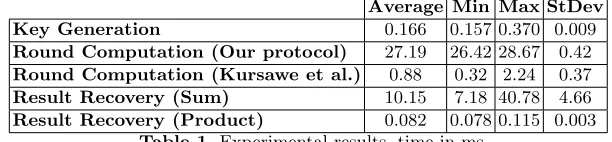
Each experiment was run 1000 times for n = 100 users. Each user’s input value in all cases was randomly sampled in the range{0, . . . ,10,000} (i.e.β = 10,000). For all stages, we measure the cost of the computation on one user’s side. The results are illustrated in Table 5.1. ’ Suppose a satisfactory collusion
Average Min Max StDev Key Generation 0.166 0.157 0.370 0.009 Round Computation (Our protocol) 27.19 26.42 28.67 0.42 Round Computation (Kursawe et al.) 0.88 0.32 2.24 0.37 Result Recovery (Sum) 10.15 7.18 40.78 4.66 Result Recovery (Product) 0.082 0.078 0.115 0.003
Table 1.Experimental results, time in ms
tolerance is 1/3; that is, t = 33 for n = 100, then we can securely evaluate
bn−t
2 c= 33 rounds. Although each round is more expensive than that of Kursawe
et al., we amortize key generation (which is comparitively not too expensive from the table), potential key verification and bandwidth for key broadcasts over a large number of rounds.
6
Applications
If we assume that the users are fair and follow the protocol without trying to maliciously manipulate their messages, then many applications can be achieved with the proposed schemes.
6.1 Collective Decision-making
A typical example is the case of collective decision-making, essentially e-voting where no party has a vested interest in any outcome, on an untrusted server. Typical e-voting schemes depend on a trusted third party for performing the elections. However, using anonymous aggregation, the election can be made on an untrusted server. The case of a Yes/No decision is quite straightforward and an evaluation in terms of time requirements is provided in the previous section. Additionally, users can select fromκoptions. To achieve this, if the prime mod-ulus ispand we havenusers, we needprime[κ−1]n < p, whereprime[i] denotes theithprime and prime[0] = 1. In this case, we map each of theκcandidates to one of the first κvalues of prime[x]. To cast the vote for optionj, user ion the second round broadcasts:
Thus the aggregator will easily retrieve the number v = Qprimekj, where Pk
j =n. Sinceprime[κ−1]n< p⇒v < p. In order to recover the votes, we have to factorvwhich is a smooth number, divided only byprime[x], x∈ {0, ...κ−1}, which can be done efficiently.
Only non-contentious decisions can be made with this protocol, as in any contentious election or decision, there is no way to prevent ballot-stuffing, and some vote rigging may even be undetectable. It is not reasonable to assume non-malicious behaviour for contentious issues or elections. There are many instances where it is in the interests of all parties to a decision to determine the honest answer to a question. Examples include when the appropriate action for a system to take is based on sensed data, which may contain errors, so it is important to determine whether a state being reported by some nodes in a wireless sensor network is the most prevalent state.
6.2 Anonymous Statistics
It is frequently of value to gather aggregate information from a population who do not wish to disclose the relevant information regarding themselves. It may be in everyone’s interests to make the information available to all parties, including themselves, but the desire to avoid revealing sensitive information may override the benefit derived from having the accurate information available to everyone. Examples may include determining the prevalence of threats, those affected by which would not like to publicize their vulnerability. This could include phys-ical preparedness of homes, business premises or military installations against invasion or intrusion, or the patch state of critical nodes following discovery of a vulnerability in their software. Knowledge of how many systems are potentially vulnerable is highly valuable to the organization in planning contingency mea-sures or allocating resources to resolution, however the possibility that a node may have been corrupted an d leaking information makes it unacceptable to have nodes directly provide this kind of information directly, as it could be used to direct attacks exploiting the vulnerability.
6.3 Privacy Preserving Collaborative Filtering
Due to the wide growth of e-commerce, automatic recommender systems and more specially Collaborative Filtering have become standard components in many services. In order to enable more private solutions, Privacy Preserving Collaborative Filtering has been introduced [9, 8]. The proposed protocol can allow users to send their preferences preserving their privacy, without the use of a trusted third party.
6.4 Urban-scale sensor aggregation
performance cost, mainly on the user side. The other solution is to install more aggregators. While this will keep the size of the key short enough, it will demand the introduction of many trusted third parties (the local aggregators). However, in smart cities the environment is very heterogeneous[7, 22, 27, 28] this translates to many installations from many parties. The proposed solution though man-ages to minimize this cost by hiding the local summaries from the aggregators, therefore many services can use them without needing to install separate ones.
7
Conclusions
In this work we introduced the notion of an anonymous aggregation system and presented a practical realization. As a building block of the latter, we presented an MPC protocol that allows multiple rounds of aggregation to be performed by lowering the collusion threshold. We showed this to be secure in the semihonest model assuming the hardness of DDH. Coupled with a method of blind aggre-gation, our proposed system offers scalability and input privacy without the use of trusted third parties.
References
1. Gilad Asharov and Yehuda Lindell. A full proof of the bgw protocol for perfectly-secure multiparty computation. Electronic Colloquium on Computational Com-plexity (ECCC), 18:36, 2011.
2. Assaf Ben-David, Noam Nisan, and Benny Pinkas. Fairplaymp: a system for secure multi-party computation. InProceedings of the 15th ACM conference on Computer and communications security, pages 257–266. ACM, 2008.
3. Michael Ben-Or, Shafi Goldwasser, and Avi Wigderson. Completeness theorems for non-cryptographic fault-tolerant distributed computation. In Proceedings of the twentieth annual ACM symposium on Theory of computing, pages 1–10. ACM, 1988.
4. I. F. Blake and C. Studholme. Properties of random matrices and applications. Unpublished report available athttp://www.cs.toronto.edu/~cvs/coding, 2006. 5. Peter Bogetoft, Dan Lund Christensen, Ivan Damg˚ard, Martin Geisler, Thomas P Jakobsen, Mikkel Krøigaard, Janus Dam Nielsen, Jesper Buus Nielsen, Kurt Nielsen, Jakob Pagter, et al. Multiparty computation goes live. IACR Cryptology ePrint Archive, 2008:68, 2008.
6. Dan Boneh. The decision diffie-hellman problem. In Algorithmic number theory, pages 48–63. Springer, 1998.
7. Francesco Calabrese, Massimo Colonna, Piero Lovisolo, Dario Parata, and Carlo Ratti. Real-time urban monitoring using cell phones: A case study in rome. Intel-ligent Transportation Systems, IEEE Transactions on, 12(1):141–151, 2011. 8. Fran Casino, Josep Domingo-Ferrer, Constantinos Patsakis, Domenec Puig, and
Agusti Solanas. Privacy preserving collaborative filtering with k-anonymity through microaggregation. Ine-Business Engineering (ICEBE), 2013 IEEE 10th International Conference on, pages 490–497. IEEE, 2013.
10. David Chaum. The dining cryptographers problem: Unconditional sender and recipient untraceability. Journal of Cryptology, 1:65–75, 1988.
11. David Chaum, Claude Cr´epeau, and Ivan Damgard. Multiparty unconditionally secure protocols. InProceedings of the twentieth annual ACM symposium on The-ory of computing, pages 11–19. ACM, 1988.
12. Chris Clifton, Murat Kantarcioglu, Jaideep Vaidya, Xiaodong Lin, and Michael Y Zhu. Tools for privacy preserving distributed data mining. ACM SIGKDD Explo-rations Newsletter, 4(2):28–34, 2002.
13. C. Cooper. On the rank of random matrices.Random Struct. Algorithms, 16:2000, 2000.
14. I. Damg˚ard, M. Geisler, M. Krøigaard, and J. Nielsen. Asynchronous Multiparty Computation: Theory and Implementation. Public Key Cryptography, pages 160– 179, 2009.
15. I. Damgard, V. Pastro, N.P. Smart, and S. Zakarias. Multiparty computation from somewhat homomorphic encryption. Cryptology ePrint Archive, Report 2011/535, 2011. http://eprint.iacr.org/.
16. O. Goldreich. Towards a Theory of Software Protection and Simulation by Obliv-ious RAMs. InProceedings of the nineteenth annual ACM symposium on Theory of computing, pages 182–194, 1987.
17. Oded Goldreich, Silvio Micali, and Avi Wigderson. How to play any mental game. InProceedings of the nineteenth annual ACM symposium on Theory of computing, pages 218–229. ACM, 1987.
18. Philippe Golle and Ari Juels. Dining cryptographers revisited. In Advances in Cryptology-Eurocrypt 2004, pages 456–473. Springer, 2004.
19. S. Dov Gordon, Jonathan Katz, Vladimir Kolesnikov, Fernando Krell, Tal Malkin, Mariana Raykova, and Yevgeniy Vahlis. Secure two-party computation in sublinear (amortized) time. InProceedings of the 2012 ACM Conference on Computer and Communications Security, CCS ’12, pages 513–524, New York, NY, USA, 2012. ACM.
20. Feng Hao and Piotr Zieli´nski. A 2-round anonymous veto protocol. InSecurity Protocols, pages 202–211. Springer, 2009.
21. Klaus Kursawe, George Danezis, and Markulf Kohlweiss. Privacy-friendly aggre-gation for the smart-grid. In Privacy Enhancing Technologies, pages 175–191. Springer, 2011.
22. Nicholas D Lane, Shane B Eisenman, Mirco Musolesi, Emiliano Miluzzo, and An-drew T Campbell. Urban sensing systems: opportunistic or participatory? In
Proceedings of the 9th workshop on Mobile computing systems and applications, pages 11–16. ACM, 2008.
23. Yehuda Lindell. Fast cut-and-choose based protocols for malicious and covert adversaries. IACR Cryptology ePrint Archive, 2013:79, 2013.
24. Yehuda Lindell and Benny Pinkas. An efficient protocol for secure two-party com-putation in the presence of malicious adversaries. In Advances in Cryptology-EUROCRYPT 2007, pages 52–78. Springer, 2007.
25. Yehuda Lindell and Benny Pinkas. Secure two-party computation via cut-and-choose oblivious transfer. Journal of cryptology, 25(4):680–722, 2012.
28. A. Manzoor, C. Patsakis, A Morris, J. McCarthy, G. Mullarkey, H. Pham, S. Clarke, V. Cahill, and M. Bouroche. CityWatch: Exploiting Sensing Data to Manage Cities Better.Transactions on Emerging Telecommunication Technologies, 2014.
29. Jesper Buus Nielsen, Peter Sebastian Nordholt, Claudio Orlandi, and Sai Sheshank Burra. A new approach to practical active-secure two-party computation. In
Advances in Cryptology–CRYPTO 2012, pages 681–700. Springer, 2012.
30. E. Shi, R. Chow, T. H. H. Chan, Dawn Song, and Eleanor Rieffel. Privacy-Preserving Aggregation of Time-Series Data. Technical report, UC Berkeley, 2011. 31. Z. Yang, S. Zhong, and R. N. Wright. Privacy-Preserving Classification of Cus-tomer Data Without Loss of Accuracy. InSIAM International Conference on Data Mining, pages 1–11, 2005.
32. Andrew Chi-Chih Yao. Protocols for secure computations. InFOCS, volume 82, pages 160–164, 1982.