The second-order nonlinearity of a class of Boolean
functions
Manish Garg
Department of Mathematics
The LNM Institute of Information Technology
Deemed University
Jaipur, Rajasthan-302031, IndiaAbstract— In this paper we find a lower bound of
second-order nonlinearity of Boolean function
),
(
)
(
1p n
x
Tr
x
f
wherep
2
2r
2
r
1
,
F
2*r,
and
n
5
r
.
It is also demonstrated that the lower bound obtained in this paper is much better than the lower bound obtained by Iwata-Kurosawa [17] and Gangopadhyay, Sarkar and Telang (Theorem 1, [12]).Keywords— Boolean function, Second-order nonlinearity,
Derivatives
INTRODUCTION
Let
F
2 be the prime field of characteristic 2. LetF
2n be an n-dimensional vector space overF
2 . The finite fieldn
F
2 is also an n-dimensional vector space overF
2 . Let
b
1,...,
b
n
be a basis ofF
2n overF
2 . Thus, for anyn
F
x
2 there exists a vector
x
1,...,
x
n
F
2n such thatn n
b
x
b
x
x
1 1
...
. This establishes a naturalF
2-vectorspace isomorphism between
F
2n andn
F
2 , both consideredas vector spaces over the prime field
F
2. We shall frequentlyidentify
x
F
2n with the vector
n
n
F
x
x
1,...,
2 assuminga fixed basis
b
1,...,
b
n
. Therefore,F
2n can be viewedas
F
2n.
Boolean function on n-variables is a mapping fromn
F
2 toF
2 (equivalently fromF
2n toF
2). The set of allBoolean functions on n-variables is denoted
B
n.
TheHamming weight number of
x
(
x
1,
x
2,...,
x
n)
F
2n isdefined as
ni i
x
x
wt
1
)
(
. The Hamming distance betweentwo Boolean functions f and g is defined as
:
(
)
(
)
,
)
,
(
f
g
x
F
2f
x
g
x
d
n
where thecardinality of a set
S
is denoted bys
.
The AlgebraicNormal Form (ANF) of a Boolean function
f
B
n is defined as),
(
)
(
1 )
,...,
(1 2
ni a i a F a a a
i n
n
x
x
f
where
a
F
2 for all 2.
n
F
a
The maximum value of)
(
a
wt
such that
a
0
is called the algebraic degree off
denoted by
deg(
f
).
The rth-order Reed-Muller code)
,
(
r
n
R
of length2
n and of order r is the set of all Boolean functions on n-variables with algebraic degree at most r.Definition 1: The nonlinearity of Boolean function
f
F
2n isdefined as the minimum Hamming distance of
f
from all affine Boolean functions (affine Boolean functions are those Boolean functions whose algebraic degree is at most 1). More over
(
,
)
|
,
min
)
(
f
d
Hf
l
l
A
nnl
where
A
n is the set of all affine Boolean function on n-variables.Definition 2: Let
f
B
n. For every non-negative integern
r
0
, the rth-order nonlinearity of f is the minimum Hamming distance of f from all n-variableBoolean functionsof degree at most r
(
r
1
)
and denoted bynl
r(
f
)
. In other words, the rth-order nonlinearity off
is equal to theminimum Hamming distance of
f
from the rth-orderWhen Boolean functions are used in stream or block ciphers their nonlinearities play an important role with respect to the security of the considered ciphers. The relationship between explicit attack and nonlinearity on symmetric ciphers was found by Matsui [22]. The best known upper bound [5]
on
nl
r(
f
)
has following asymptotic version)
(
2
)
2
1
(
2
15
2
)
(
1
2
2
r2n r n
r
f
O
n
nl
.There is a lot of research on first-order nonlinearity. Unlike nonlinearity very little is known about higher-order nonlinearity. There are no efficient algorithm to compute the rth-order nonlinearity of Boolean function
f
for(
r
1
)
. However, in [10, 11, 18] list decoding algorithms for higher order Reed-Muller codes are used to compute second-order nonlinearities. Carlet [3] provides a technique of computing lower bounds of higher-order nonlinearities recursively. In the same paper Carlet provides general lower bounds on the nonlinearity profiles of Boolean functions belonging to several important classes including Welch, Kasami and multiplicative inverse functions. Gangopadhyay, Sarkar and Telang [12] have found the second order-nonlinearity of),
(
)
(
1p n
x
Tr
x
f
wherep
2
2r
2
r
1
,
F
2*n,
and
n
6
r
.
Sun and Wu [29], Deep Singh [27] have foundthe second order-nonlinearity of
(
)
1(
),
p n
x
Tr
x
f
where,
1
2
2
2
r rp
F
2*r,
andn
4
r
andn
3
r
respectively. For more results in this direction we refer to [13-15, 20, 28]
The lower bound of rth-order nonlinearity of Boolean function
f
from a given algebraic immunity has been studied in [4]. It was improved in [2]. It gives better results than the results obtained by Iwata-Kurosawa [17]. In this paper we use the technique developed by Carlet to find out the lower bound of second-order nonlinearities of Boolean function),
(
)
(
x
Tr
1nx
pf
wherep
2
2r
2
r
1
,
F
2*r,
and
n
5
r
.
It is also found that the lower bound obtained in this paper is much better than the lower bound obtained by Iwata-Kurosawa [17], and Gangopadhyay, Sarkar and Telang [12]..
PRELIMINARIES
Definition 3: The Walsh transform of
f
B
nat
F
2n is defined as
n
F x
x x f f
W
2
) (
)
1
(
)
(
The multiset
[
W
f(
)
:
F
2n]
is called the Walsh spectrum of the Boolean function f. The relation between nonlinearity and Walsh spectrum is given as follows.
)
(
2
1
2
)
(
max
2
1
F f n
W
f
nl
n
Using Parseval's equality it can be proved that for any
positive integer n, their exist a
F
2n such that2
2
)
(
n f
W
, which implies(
)
2
2
.
1 2
1
n n
f
nl
The derivative of a Boolean function
f
B
n with respectto
a
F
2n is defined as a Boolean function)
(
)
(
)
(
x
f
x
a
f
x
D
a
for allx
F
2n.Definition 4: Suppose
a
1,
a
2,...,
a
l is a basis of k-dimensional subspace Vkof
F
2n. The kth derivative of f withrespect to Vk is defined as a Boolean function
)
(
...
)
(
1
1
D
f
x
D
D
x
f
D
Vk
ak ak a for allx
F
2n.The kth derivative of f is independent of the choice of the basis of Vk.
Remark 1: It is to be noted that the
D
(
f
)
k
V is
independent of the choice of the basis of Vk.
The trace function from
L
F
2n intoc
F
S
2 (wherec
|
n
) is defined as
10 2
)
(
c n
i L S
ci
x
x
Tr
, for allx
F
2n.
If
c
1
, we called absolute trace function and denotedas
Tr
1n(
x
)
orTr
(
x
).
Tr
1n(
xy
)
is called an inner productof x and y for any
x
,
y
F
2n.
The trace functionL S
Tr
satisfies the following properties [21].
1.
Tr
(
x
y
)
Tr
(
x
)
Tr
SL(
y
)
L S L
S
for allS
,
andx
,
y
L
.2.
Tr
SL(
x
s)
Tr
SL(
x
)
for allx
L
ands
2
c.
3. (Transitivity property) Let
R
be a finite field. LetF
be a finite extension ofR
andL
be a finite extension ofF
, that isL
F
R
.
Then
(
)
)
(
x
Tr
Tr
x
Tr
RL
RF FL for allx
L
.
2.1Quadratic Boolean functions
In this subsection, we give some lemmas which are used in this paper.
Let q be a power of 2 and let V be an n-dimensional vector
space over
F
q. A function Q from V toF
q is said to be a quadratic function on V, if it satisfies following:1.
(
)
2(
)
x
Q
c
cx
Q
for anyc
F
qandx
V
,
2.
B
(
x
,
y
)
Q
(
x
)
Q
(
y
)
Q
(
x
y
)
is bilinear on V.The kernel [1, 25] of
Q
is the subspace ofV
defined by
x
F
2n:
B
(
x
,
y
)
0
,
for
all
y
F
2n
.
f
Lemma 1. ([1], Propoition1): Let V be a vector space over a field
F
q of characteristic 2 andQ
:
V
F
q be a quadratic form. Then the dimension of V and the dimension of the kernel of Q have the same parity.Lemma 2. ([1], Lemma1): Let
f
be a quadratic Booleanfunction. The kernel of
f
is the subspace ofF
2n havingthose b such that
D
b(
f
)
is constant.
b
F
D
bf
Cons
t
f
2n:
(
)
tan
.Lemma 3. [1, 25] If 2
2
:
F
F
f
n
is a quadratic Booleanfunction and
B
(
x
,
y
)
is the bilinear form associated to it. Then the Walsh spectrum of f depends only on the dimension,k, of the kernel,
f ofB
(
x
,
y
)
. The weight distribution of the Walsh spectrum of f is:)
(
f
W
Number of
0 n
nk2
2
2
2
k n
2 2 ) 0 ( 2
1
2
)
1
(
2
k n f k
n
2
2
k n
2 2 ) 0 ( 2
1
2
)
1
(
2
k n f k
n
Carlet [3] proved the following results.
Proposition 1. ([3], Proposition 2) Let f be a n-variable Boolean function and r be a positive integer less than n, we have
))
(
(
max
2
1
)
(
12
f
D
nl
f
nl
r aF a r
n
.Corollary 1. ([3], Corollary 2) Let
f
be an n-variable Boolean function andr
be a positive integer smaller thenn
Assume that, for some non-negative integers
M
andm
, we havem n
a
r
D
f
M
nl
1(
)
2
1
2
(1)
for every non-zero
a
F
2n. Then we haven m n
n
r
f
M
nl
(
2
1
)
2
2
2
1
2
)
(
1
1
2 1 1
2
2
1
2
)
(
m n n
r
f
M
nl
. (2)Definition 5: ([21], Page 99): A polynomial of the form
ni q i
i
x
x
L
0
)
(
with the coefficients
i in an extension fieldF
qn ofF
qiscalled a Linearized polynomial (q-polynomial) over
F
qn .MAIN RESULTS
Lemma 4. Consider the Boolean function
),
(
)
(
x
Tr
1nx
pf
wherep
2
2r
2
r
1
,
F
2*r,
and
n
5
r
.
Then the dimension of the kernel of the bilinearform associated to
D
a(
f
(
x
))
is eitherr
or3
r
.Proof: The algebraic degree of Boolean function
)
(
x
f
is3
. The derivative off
(
x
)
with respect to* 2n
F
a
is)
(
)
(
))
(
(
f
x
f
x
a
f
x
D
a
)
)
(
(
)
)
(
(
))
(
(
f
x
Tr
1x
a
22r2r1
Tr
1x
22r2r1D
a n
n
1 2 2 1 2 2 2 2 1
2 2
2
(
(
))
(
(
f
x
Tr
ax
r r
a
rx
r
a
rx
rD
a n
a2r1x22r a22r1x2r a22r2rxa22r2r1))
The Walsh spectrum of Boolean function
D
a(
f
(
x
))
isequal to the Walsh spectrum of the function
G
(
x
)
, where)
(
x
G
is obtained by removing all affine monomialsfrom
D
a(
f
(
x
))
.))
(
(
)
(
2 2 2 2 1 2 2 11
2 2
2
r r r r r rx
a
x
a
ax
Tr
x
G
n
.
)
(
x
G
can also be written as)
)
(
(
)
(
2 2 1 2 2 2 2 11
2 4 4
2
r r r r r rx
a
a
x
a
Tr
x
G
n
Because
2
2r
1
and2
r
1
are not lie in the same cyclotomic coset. Therefore,G
(
x
)
is not equal to zero for* 2n
F
a
. ThereforeG
(
x
)
is a quadratic Boolean function.By Lemma 2, 3, the Walsh spectrum of
G
(
x
)
depends onthe dimension
k
of the kernel ofG
(
x
)
which is thesubspace of those
b
such thatD
b(
G
(
x
))
is constant. Thederivative
D
b(
G
(
x
))
is)
(
)
(
))
(
(
G
x
G
x
b
G
x
D
b
r r r
x
b
a
ab
Tr
x
G
D
b(
(
))
1n(
((
2
2)
22
(
2 2)
2)
(
2 2 22 2)
)
2 2 2 2
x
b
a
b
a
x
b
a
ab
r rr r r r r
(
(
2 2 2 2 1 2 2 1))
1
2 2
2
r r r r r rb
a
b
a
ab
Tr
n
.Since
x
,
a
,
b
F
2n and.
* 2r
F
Therefore,x
2n
x
,a
a
2n
,b
2n
b
,
r
2
. We get
))
)
((
(
))
(
(
23 2 24 24 23 2 221 r r r r r r r
b
a
b
a
b
a
a
x
Tr
x
G
D
nb
(
a
24r
a
22r)
b
2r))
+ Constant terms. Clearly,D
b(
G
(
x
))
is equal to the constant if and only if.
0
)
(
)
(
a
23r
a
2rb
24
a
24rb
23r
a
2rb
22r
a
24r
a
22rb
2r
Or it is equivalent to the following
.
0
)
)
(
)
(
a
22r
a
b
23r
a
23rb
22r
ab
2r
a
23r
a
2rb
(3)It is to be noted that equation 3 is a
2
r-polynomial. Sincea polynomial of the form
n i q i ix
x
L
0)
(
with thecoefficients
i in an extension fieldF
qm is called q-Polynomial over
F
qm. Let.
)
)
(
)
(
)
(
b
a
22a
b
23a
23b
22ab
2a
23a
2b
M
r
r
r r
r
r
rAs a consequence, the dimension of the kernel of
M
(
x
)
equals to
sr
, fors
0
,
1
,
2
,
or3
.
Now quadratic form from
F
q5 toF
q(
2
)
rq
)),
(
(
)
(
x
Tr
ax
22r2r
a
2rx
22r1
a
22rx
2r1N
EL
Where
L
F
25r andE
F
2r.
The set of roots of
M
(
x
)
is also the kernel ofN
(
x
)
.Indeed, the kernel of
N
(
x
)
is the set of thoseb
such that0
)
(
x
B
for allx
whereB
(
x
)
is given as)
(
)
(
)
(
)
(
x
N
x
N
b
N
x
b
B
Because
(
(
))
(
(
)),
2
B
x
Tr
x
G
D
b
FE we get)).
(
(
)
(
x
Tr
xM
b
B
ELTherefore, the kernel of
N
(
x
)
is equal to the kernelof
M
(
x
)
. By Lemma 1, the dimension of the kernel of)
(
x
N
must have the same parity as5
. Hence this is odd. Therefore, the dimension of the kernel ofN
(
x
)
is either1
or3
which imply that the one ofM
(
x
)
is eitherr
or3
r
, that is, the dimension of the kernel of the bilinear form associatedto
D
a(
f
(
x
))
is eitherr
or3
r
(k = r or k= 3r).Theorem 1. Consider the Boolean function
),
(
)
(
1 p nx
Tr
x
f
wherep
2
2r
2
r
1
,
F
2*r,
and
n
5
r
.
Then.
2
2
))
(
(
4 4 3 3 1 2
r n nx
f
nl
Proof : From Lemma 4, the dimension of the kernel of the
bilinear form associated to
D
a(
f
(
x
))
is either eitherr
orr
3
(k = r or k= 3r). From Corollary 1, nonlinearity of))
(
(
f
x
D
a that is,nl
(
D
a(
f
(
x
)))
is either2 1
2
2
1
2
r n n
or
2
.
2
1
2
2 3 1 r n n
Therefore, we have
.
2
2
1
2
))))
(
(
(
(
max
1 22 r n n a F a
x
f
D
nl
n
Therefore, by Proposition 1, we have
.
2
2
))
(
(
4 4 1 2
r n nx
f
nl
(4)* 2n
F
a
, we also have.
2
2
1
2
)))
(
(
(
2 3 1 r n na
f
x
D
nl
(5)
1
M
and.
2
2
3
n
r
m
. Therefore, using the value ofM
andm
in equation 2, we get.
2
2
))
(
(
44 3 3 1 2
r n n
x
f
nl
(6)From the above it is clear, the lower bound obtained by equation 6 is better than the lower bound obtained by equation 4 for
r
1
. So, we have.
2
2
))
(
(
44 3 3 1 2
r n n
x
f
nl
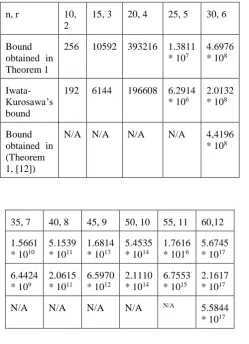
COMPARISON
We compare the lower bound obtained in Theorem 1 with the lower bound obtained by Iwata-Kurosawa [17] and the
lower bound obtained by Gangopadhyay, Sarkar and Telang (Theorem 1, [12]) in
following Table .
n, r 10,
2
15, 3 20, 4 25, 5 30, 6
Bound obtained in Theorem 1
256 10592 393216 1.3811 * 107
4.6976 * 108
Iwata-Kurosawa’s bound
192 6144 196608 6.2914 * 106
2.0132 * 108
Bound obtained in (Theorem 1, [12])
N/A N/A N/A N/A 4,4196
* 108
35, 7 40, 8 45, 9 50, 10 55, 11 60,12
1.5661 * 1010
5.1539 * 1011
1.6814 * 1013
5.4535 * 1014
1.7616 * 1016
5.6745 * 1017
6.4424 * 109
2.0615 * 1011
6.5970 * 1012
2.1110 * 1014
6.7553 * 1015
2.1617 * 1017
N/A N/A N/A N/A N/A 5.5844
* 1017
Table. Comparison of the Lower bounds of higher-order nonlinearities.
It is clear from the above table that our lower bound is much better than lower bounds obtained by Iwata-Kurosawa and Gangopadhyay et al.
CONCLUSION
In this paper, we find a lower bound of second-order nonlinearity of a class of Boolean functions
),
(
)
(
x
Tr
1nx
pf
wherep
2
2r
2
r
1
,
F
2*r,
and
n
5
r
.
The algebraic immunity off
(
x
)
is at most 3because the algebraic degree of
f
(
x
)
is 3).
(
)
(
(
AI
f
d
0f
Therefore, the lower bound ofsecond-order nonlinearity of
f
(
x
)
can not be obtained from therelation between rth-order nonlinearity and the algebraic immunity as given in [2, 4]. The lower bound of second-order nonlinearity of
f
(
x
)
is much better than lower boundobtained in [17] and (Theorem 1, [12]). Carlet [3] has obtained a way of finding out lower bounds of
rth-order nonlinearities of Boolean functions. A natural question is whether the bounds obtained by Carlet can be improved for special classes of functions. It is observed that of second-order nonlinearities of cubic functions more refined bounds can be obtained by using the technique developed by Carlet and results related of dimensions of solutions spaces of linearized polynomials which was done by Gangopadhyay et al. [12, 15] and subsequently by several other authors [28, 29]. These bounds are also related to covering radius of second-order Reed-Muller codes. From the cryptographic and coding theoretic perspectives we feel that it is important to consider
specific classes of functions and to obtain more information about their second-order nonlinearities. This
has motivated our research.
REFERENCES
[1] A. Canteaut, P. Charpin and G. M. Kyureghyan, “A new class of monomial bent functions,” Finite Fields and their Applications. Vol. 14, pp. 221-241, 2008.
[2] C. Carlet, “On the higher order-nonlinearities of algebraic immune functions,” Advances in Cryptology-CRYPTO 2006, LNCS 4117, Springer-Verlag, pp. 584-601, 2006.
[3] C. Carlet, “Recursive lower bounds on the nonlinearity profile of Boolean functions and their Applications,” IEEE Trans. Inf. Theory, 54(3), pp. 1262-1272, 2008.
[4] C. Carlet, D. Dalai, K. Gupta and S. Maitra, “Algebraic immunity for cryptographyically significant boolean functions: analysis and construction,” IEEE Trans. Inform. Theory, 52(7), pp. 3105-3121, 2006. [5] C. Carlet and S. Mesnager, “Improving the upper bounds on the
covering radii of binary Reed–Muller codes,” IEEE Trans. Inf. Theory, Vol.53, no. 1, pp.162—173, 2007.
[6] G. Cohen, I. Honkala, S. Litsyn and A. Lobstein, “Covering Codes,” Amsterdam, The Netherlands: North-Holland, 1997.
Computer Science), Berlin, Germany: Springer-Verlag, Vol. 2587, pp. 182-199 , 2002.
[8] C. Ding, G.Xiao and W. Shan, “The stability theory of stream ciphers,”
LNCS, Springer, Heidelberg, Vol. 561, 1991.
[9] H. Dobbertin et al., “Construction of bent functions via Niho power functions,” Journal of Combinatorial Theory, Series A 113, pp. 779-798, 2006.
[10] I. Dumer, G. Kabatiansky and C. Tavernier, “ List decoding of second order Reed-Muller codes up to the johnson bound with almost linear complexity,” In: Proceedings of the IEEE International Symposium on Information Theory, Seattle, WA 2006, pp. 138-142, 2006.
[11] R. Fourquet and C. Tavernier, “An improved list decoding algorithm for the second-order Reed-Muller codes and its applications,” Designs Codes Cryptogr.,” Vol, 49, pp. 323-340, 2008.
[12] S. Gangopadhyay, S. Sarkar and R. Telang, “On the lower bounds of the second-order nonlinearity of some Boolean functions,” Inf. Sci. 180(2), pp. 266-273 , 2010.
[13] M. Garg,, “Good second-order nonlinearity of a subclass of Kasami function on five, seven and nine variables,” In proceeding of IEEE, International Conference on Communication Systems and Network Technologies (CSNT-2011), 3rd to5th June, 2011, SMVDU, Katra, Jammu(India), pp. 624-628, 2011.
[14] M. Garg and S. Gangopadhyay, “A lower bound of the second-order nonlinearities of Boolean bent functions,” Fundamenta Informaticae, European Association for Theoretical Computer Science (EATCS), Vol. 111(4), pp. 413-422, 2011.
[15] R. Gode and S. Gangopadhyay, “Third-order nonlinearities of a subclass of kasami functions,” Cryptography. Commun, Vol. 2, pp. 69-83, 2010.
[16] J. Golic, “Fast low order approximation of cryptographic functions,” In Proc. EUROCRYPT'96 (Lecture Notes in ComputerScience), Berlin, Germany: Springer-Verlag, Vol.1070, pp. 268-282, 1996.
[17] T. Iwata and K. Kurosawa, “Probabilistic higher order differential attack and higher-order bent functions,” In Proc. ASIACRYPT'99 (Lecture Notes in Computer Science), Berlin, Germany: Springer,-Verlag, Vol.1716, pp. 62-74, 1999.
[18] G. Kabatiansky and C. Tavernier, “List decoding of second order Reed-Muller codes,” In : Proceedings of the Eighteen International Symposium of Communication Theory and Applications, Ambleside, UK, 2005.
[19] L. R. Knudsen and M. J. B. Robshaw, “Non-linear approximations in linear cryptanalysis. In Proc. EUROCRYPT'96 (Lecture Notes in Computer Science. Berlin, Germany: Springer-Verlag, Vol.1070, pp. 224-236, 1996.
[20] N. Kolokotronis, K. Limniotis and N. Kalouptsidis, “Best affine and quadratic approximations of partcular classes of Boolean functions,” IEEE Trans. Inform. Theory, Vol. 55, no. 11, pp. 5211-5222, 2009. [21] R. Lidl and H. Niederreiter, “Title of a Book, Introduction to finite
fields and their applications,” North-Holland, Amsterdam, , 1994. [22] M. Matsui, “Linear cryptanalysis method for DES cipher,” In:
Proceeding of the EUROCRYPT'93, LNCS, Vol. 765, pp. 386-397, 1994.
[23] U. M. Maurer, “New approaches to the design of self-synchronizing stream ciphers,” In Proc. EUROCRYPT'91 (Lecture Notes in Computer Science), Berlin, Germany: Springer-Verlag, Vol.547, pp. 458-471, 1991.
[24] W. Millan, “Low order approximation of cipher functions. In Cryptographic Policy and Algorithms,” (Lecture notes in Computer Science. Berlin, Germany: Springer-Verlag, Vol.1029, pp. 144-155, 1996.
[25] F. J. Macwilliams and N. J. Solane, “Title of a Book, The theory of Error-correcting Codes,” Amsterdam: North-holland publishing Company, 1978.
[26] O. S. Rothaus, “On bent functions,” Journal of Combinatorial Theory, Series A, 20, pp. 300-305, 1976.
[27] D. Singh, “Second-order nonlinearities of some classes of cubic Boolean functions based on secondary constructions,” Int. J. of Comput. Sci. Inform. Technol, Vol. 2(2), pp. 786-791, 2011.
[28] G. Sun and C. Wu, “The lower bounds on the second order nonlinearity of three classes of Boolean functions with high nonlinearity.,”
Information Sciences, 179 (3), pp. 267-278 , 2009.