A look on 3G mobile services
Tamanna Kundra1 & Abhinav Sharma2
1 Electronics and Computer Engineering , Maharishi Dayanand University
Gurgaon, Haryana, India
[email protected] ; [email protected]
ABSTRACT
The objective of this paper is to evaluate the
underlying paradigms of third generation
(3G) mobile services. Given the success of
second
generation
(2G)
mobile
communications systems and services, the
third generation mobile networks and
applications are faced with a lot of
expectations such as providing ubiquitous
access to online services via mobile
terminals. This comes with enhancements
over previous wireless technologies, as
high-speed
transmission,
advanced
multimedia access and. 3G is mostly used
with mobile phones and handsets as a means
to connect the phone to the Internet or other
IP networks in order to make voice and
video calls, download and upload data and
to surf the net. 3G is the successor of 2G
and 1G standards. The 3G networks handle
the majority of all data transfers for cellular
service providers.
1. INTRODUCTION
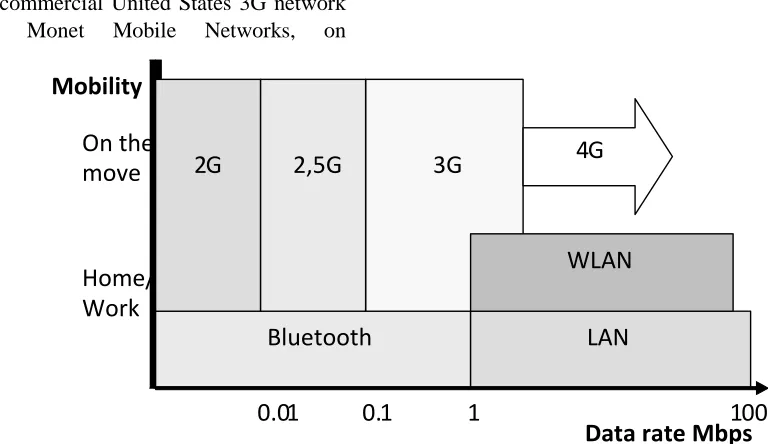
3G wireless technology is the convergence of various 2G wireless telecommunications systems into a single global system which includes both terrestrial and satellite components. 3G wireless technology has ability to unify existing cellular standards with CDMA, GSM, and TDMA. 3G has the following enhancements over 2.5G and previous networks: Higher data speed, Video-conferencing support, Enhanced audio and video streaming, Web and WAP browsing at higher speeds, IPTV (TV through the Internet) support transfer rate for 3G networks is between 128 and 144 kbps for
devices that are moving fast and 384 kbps for slow ones. For fixed wireless LANs, the speed goes beyond 2mbps. Figure 1 shows the various technologies related to 3G and their suitability for mobile users. Beyond 3G, it is predicted that mobile networks and the wireless communication landscape will be based on various technologies, offering seamless mobility with cellular networks. Fourth generation (4G) services will enable broadband wireless communication at home, at the office and on the move. In other words, new networks will make the services provided by the Web and the Internet as well as a variety of other services such as multimedia and entertainment available to mobile users.
The first European pre-commercial network was an UMTS network on the Isle of Man by Manx Telecom, the operator then owned by British Telecom, and the first commercial network (also UMTS based W-CDMA) in Europe was opened for business by Telenor in December 2001 with no commercial handsets and thus no paying customers.
The first network to go commercially live was by SK Telecom in South Korea on the CDMA-based 1xEV-DO technology in January 2002. By May 2002 the second South Korean 3G network was by KT on EV-DO and thus the South Koreans were the first to see competition among 3G operators.
The first commercial United States 3G network was by Monet Mobile Networks, on
CDMA2000 1x EV-DO technology, but this network provider later shut down operations. The second 3G network operator in the USA was Verizon Wireless in July 2002 also on CDMA2000 1x EV-DO. AT&T Mobility is also a true 3G UMTS network, having completed its upgrade of the 3G network to HSUPA.
The first pre-commercial demonstration network in the southern hemisphere was built in Adelaide, South Australia by m.Net Corporation in February 2002 using UMTS on 2,100 MHz. This was a demonstration network for the 2002 IT World Congress. The first commercial 3G network was launched by Hutchison Telecommunications branded as Three or "3" in June 2003.
Figure 1 Classification of Mobile Networks and Mobility
2.
EVOLUTION
OF
MOBILE
CELLULAR NETWORKS
The first mobile telephone systems (car phone) were introduced in the late 1940s in the United States and in 1950s in Europe. Those early single cell systems were constrained by
restricted mobility, limited service, low capacity, and poor speech quality. The equipment’s were heavy, expensive, bulky and susceptible to interference. Because of these limitations, less than one million subscribers were registered worldwide by 1980s. The figure below describes the evolution of the cellular networks.
Data rate Mbps
Home/
Work
Mobility
On the
move
Bluetooth
LAN
2
G
2,5G
3G
4
G
1
1
00
0.0
1
0.
1
2.1 First Generation (1G)
:
1-G refers to the first generation of wireless telephone technology (mobile communications). These are the analog telecommunications standards that were introduced in the 1980s and continued until being replaced by 2G digital
communications. These are
the analog telecommunications standards that were introduced in the 1980s and continued until being replaced by 2G digital The main difference between the two mobile telephone systems (1G and 2G), is that the radio signals used by 1G networks are analog, while 2G networks are digital.
Although both systems use digital signaling to connect the radio towers (which listen to the handsets) to the rest of the telephone system, the voice itself during a call is encoded to digital signals in 2G whereas 1G is only modulated to higher frequency, typically 150 MHz and up. The inherent advantages of digital technology over that of analog meant that 2G networks eventually replaced them almost everywhere.
2.2 Second Generation (2G):
The second generation 2G systems fielded in the late 1980s and finished in the late 1990s was planned mainly for voice transmission with digital signal and the speeds up to 64kbps. 2G wireless cellular mobile service was a step ahead of 1G services by providing the facility of short message service (SMS) unlike 1G that had rime focus on verbal communication The Bandwidth
of 2G is 30-200 KHz. During the second generation, the mobile telecommunications industry experienced exponential growth in terms of both subscribers and value-added services. An revolutionary technology GSM was introduced. GSM stands for Global System for Mobile communication or GSM use digital modulation to improve voice quality but he network offers limited data service. It used GPRS standard which delivered packet-switched data as packets.
2.3 Second Generation (2G) + Wireless
Networks:
The development of 2G cellular system was driven by the need to improve transmission quality, coverage and system capacity. Further advances in microwave devices and semiconductor technology brought digital transmission to mobile communications. Speech transmissions are still dominates the airways, but the demands for short message, fax, and data transmissions are growing rapidly. Supplementary services as encrypting of user data and fraud prevention have become standard features which are comparable to those in fixed networks. 2G cellular systems that includes GSM, D-AMPS, CDMA and PDC.
2.4 Third Generation (3G) Networks
:IMT-2000 standards, a system is required to provide peak data rates of at least 200 Kbit/s. 3G functions in the range of 2100 Hz and bandwidth 15-20 MHz The communication provides enhanced clarity and perfection like the real conversation. Recent 3G releases provide mobile broadband access of several M bit/s to smart phones and mobile modems in laptop computers. The first release of (Third Generation
Partnership Project) 3GPP Long Term Evolution (LTE) standard completely fulfil the (International Telecommunications Union) ITU 4G requirements called the IMT-Advanced. 4G or 3.9G technology is the first release LTE. Its evolution LTE Advanced is a 4G technology. The three major components of the 3G networks are explained below.
A Radio Access Network (RAN). This is a hierarchical arrangement of cell towers and base stations. The base stations are called as base transceiver station(BTS) or NobeBs in 3G. In some versions , there are also Radio Network Controllers(RNCs) that link to the BTSs to form a Radio Network Subsystem(RNS). A collection of RNSs using the wideband CDMA(WCDMA) air interface option form the UTMS Terrestrial Radio Access Network (UTRAN). All of these are referred as “ network devices” in figure 1. The important point is that all handovers between cell towers are centrally controlled in the 3G network hierarchy. A core network (usually IP) typing the
RAN to the 3G service Network. The network consist of all switches , routers and other network components required to transport mobile traffic.
A service network reached through the core network. Some the services reached(the servers in the figure1) are specific to the service provider , such as accounting information(current balance) , short Message service(SMS), paging , voice mail. Other services are reached through the GGSN, such as internet , other internet service providers(ISPs), corporate network virtual private network (VPNs). The mobile next broadband gateway can be configured as GGS.
2.5 Fourth Generation (4G
):mobile communications will have rates up to 20 Mbps higher than that of 3G. The Fourth Generation is available in many major metropolitan areas in the U.S., as companies continue to expand its service area. The 4G includes multiple technologies that are WiMAX and LTE. 4G LTE technology will have an
average speed of download approximately 5 to 12 Mbps, according to Verizon Wireless. A download made using 4G WiMAX technology speed average will be between 3 and 6 Mbps. This is a significant upgrade over 3G networks; allow increased performance when multitasking, playing games or streaming video.
3. COMPARISON BETWEEN 1G, 2G, 3G AND 4G:
4. FEATURES/SERVICES OF 3G
The ITU (International Telecommunication Union) has proposed 3G telecommunications standards to provide cost efficient high quality, wireless multimedia applications and enhanced wireless communications.
The features of 3g can be divided into two categories. One is data rates and the other is security.
The main feature of 3G technology is
that if it supports greater voice and
data capacity and high transmission
at low cost. 3G mobiles can operate
on 2G and 3G technologies.
The second main features is the
security: 3G offers greater security
features than 2G like Network
Access Security, network domain
Security, User Domain Security,
Application Security.
This technology provides localized
services for accessing traffic and
weather updates. Video calls and
video conference is another major
feature in 3G mobile.
Data transfer rates are high and can
support even live TV channels over
phone. Online media is another
exciting feature in 3G technology.
5. APPLICATIONS OF 3G
The 3G mobiles can be used as a modem for a computer which can access internet and can download games and songs at high speeds.
View live TV broadcasting in mobile. Get weather updates and new headlines in mobiles.
3G increases bit rate which helps the service providers to provide high speed internet facility and many applications to its customers.
3G devices can provide data transmission speed up to 2Mbits/s when used in stationary mode.
Provides multimedia services such as sharing of digital photos and movies. This technology provides real time
multiplayer gaming and location based services.
3G allows users to be online all the time. Teleconferencing at work is one of the
best applications.
6. DRAWBACKS
Upgrading the base station and cellular infrastructure to 3G incurs very high costs.
Service providers has to pay high amount for 3G licensing and agreements.
Problem with the availability of handsets in few regions and their costs. High power consumption.
7. CONCLUSIONS
Today, the majority of mobile services used via 3G networks are already available in current 2,5G networks (GPRS, EDGE) such as browsing the Web, sending and receiving multimedia messages (like pictures and video), and e-mailing. Therefore, 3G should not be viewed as a new technology surpassing the existing 2,5G networks, or a revolution in mobile communication. Instead, 3G should be considered to be evolution of existing mobile communications.
8. REFERENCES
1. Maier, G., Schneider, F., & Feldmann, A. (2010, January). A first look at mobile hand-held device traffic. In
Passive and Active Measurement (pp.
161-170). Springer Berlin Heidelberg.
2. Messerges, T. S., & Dabbish, E. A. (2003, October). Digital rights
management in a 3G mobile phone and beyond. In Proceedings of the 3rd ACM workshop on Digital Rights
Management (pp. 27-38). ACM.
3. Dornan, A. (2000). Essential Guide to Wireless Communications Applications: From Cellular Systems to WAP and
M-Commerce. Prentice Hall PTR.
4. Zipf, A. (2002). User-adaptive maps for location-based services (LBS) for
tourism. na.
5. Schmidt-Belz, B., Laamanen, H., Poslad, S., & Zipf, A. (2003). Location-based mobile tourist services: first user experiences. ENTER 2003: 10th
International Conference on Information Technology in Travel & Tourism.
6. López-Nicolás, C., Molina-Castillo, F. J., & Bouwman, H. (2008). An
assessment of advanced mobile services acceptance: Contributions from TAM and diffusion theory models.
Information & Management, 45(6),
359-364.
7. El Morr, C., & Kawash, J. (2007). Mobile virtual communities research: a synthesis of current trends and a look at future perspectives. International
Journal of Web Based Communities,