Analysis of the performance of Active Type
SFCL and FCL for Reducing the Fault
Current and Overvoltage in a Distribution
System
T. SRIPAL REDDY HOD, EEE
De part me nt of Electrical & Electronics Engineering,
Sarada Institute of Tech. & Science, Khammam, Telangana, India;
B. SHYAMALA DEVI M-tech Stude nt Scholar Departme nt of Electrical & Electronics
Engineering,
Sarada Institute of Tech. & Science, Khammam, Telangana, India
Abstract – The Active Superconducting Current Controller (ASCC) is a new type of Fault Current Limiters which can limit the fault current in different modes and also has the particular abilities of compensating active and reactive power for AC main circuit in the normal state. The use of the ASCC disturbs the operation of Over Current Relays (OCR) used in the distribution system. In consideration that applying superconducting fault current limiter (SFCL) may be a feasible solution, in this paper, the effects of a voltage compensation type active SFCL. The magnetic field in the air core can be controlled by PWM inverter output. Hence, the equivalent impedance can be maintained and overvoltage suppression is possible. The fault current and voltage suppression characteristics are simulated in mat lab. The simulation results show that the active SFCL can play an obvious role in restraining the fault current and overvoltage, and it can contribute to avoiding damage on the relevant distribution equipment and improve the systems safety and reliability.
Keywords: Resistive type SFCL, Active type SFCL, Distribution generation, over voltages, Fault conditions
I. INTRODUCTION
In recent years, with the great development of interconnected power grid, the power network structure becomes increasingly complicated, and the system short circuit capacity and short circuit current have reached a new level which could exceed the allowable currents of the circuit breakers. The increase of the fault current has imposed a severe burden on the related machinery in the grid, and the
stability of the power system is also damaged. The fault current limiters (FCL) are regarded as the suitable solution to solve excessive fault current problems. [1] Active superconducting fault current limiter (ASFCL) voltage compensation type is a novel topology of FCL. This type SFCL not only preserves the merits of bridge type SFCL such as the automatic switch to the current limiting mode and without the quench of the superconductor, but also has the particular abilities of controlling the steady fault current and compensating active and reactive power for AC main circuit in the nor mal state. Fig. 1 shows the circuit structure of the three phase active SFCL, which is consisting of three air-core superconducting transformers and a three-phase voltage source converter.
A single phase ground fault happens in a
decentralized syste m with isolated neutral, fault voltages will be induced on the other two health phases, and considering the multiple decentralized generating units the impact of the fault voltages on the system. Insulation stability and operation safety should be taken in to account seriously. The problem is taking in to consideration, applying superconducting fault current limiter (SFCL) may be an accurate solution.decreased to minimum value, these are depends on the length and operating temperature. If operating temperature exceeded, the SFCL comes in to operation the fault current bypass through resistor. Active superconducting fault current limiter (ASFCL) voltage compensation type is a novel topology of FCL. This type SFCL not only preserves the merits of bridge type SFCL such as the automatic switch to the current limiting mode and without the quench of the superconductor, but also has the particular abilities of controlling the steady fault current and compensating active and reactive power for AC main circuit in the normal state.
II. ANALYSIS OF ACTIVE TYPE AND RESISTIVE TYPE SFCL
A. Structure and Principle of the Active SFCL As shown in Fig. 1(a), it denotes the circuit structure of the single-phase voltage compensation type active SFCL, which is composed of an air-core superconducting transformer and a voltage-type PWM converter. Ls1, Ls2 are the self-inductance of two superconducting windings, and Ms is the mutual inductance. Z1 is the circuit impedance and Z2 is the load impedance. Ld and Cd are used for filtering high order harmonics caused by the converter. Since the voltage-type converter’s capability of controlling power exchange is implemented by regulating the voltage of AC side, the converter can be thought as a controlled voltage source Up. By neglecting the losses of the transformer, the active SFCL’s equivalent circuit is shown in Fig. 1(b).
Fig.1.Single-phase voltage compensation type active SFCL. (a) Circuit structure and (b) equivalent circuit.
In normal (no fault) state, the injected current (I2) in the secondary winding of the transformer will be controlled to keep a certain value, where the magnetic field in the air-core can be compensated to zero, so the active SFCL will have no influence on
the main circuit. When the fault is detected, the injected current will be timely adjusted in amplitude or phase angle, so as to control the superconducting transformer’s primary voltage which is in series with the main circuit, and further the fault current can be suppressed to some extent. Below, the suggested SFCL’s specific regulating mode is explained. In normal state, the two equations can be achieved.
(1)
(2)
Controlling I2 to make jωLs1 I˙1 −jωMs I˙2 = 0 and
the primary voltage U1 will be regulated to zero. Thereby, the equivalent limiting impedance ZSFCL is zero (ZSFCL = U1/I1), and I2 can be set as ˙ I2 =
˙Us_Ls1/Ls2/ (Z1 + Z2) k, where k is the coupling coefficient and it can be shown as k =
Ms/√Ls1Ls2.Under fault condition (Z2 is shorted), the main current will rise from I1 to I1f, and the primary voltage will increase to U1f.
(3)
(4) The current-limiting impedance ZSFCL can be
controlled in:
(5)
Fig.2. Application of the active SFCL in a distribution system with DG units.
According to the difference in the regulating objectives of I2, there are three operation modes: 1) Making I2 remain the original state, and the limiting impedance ZSFCL−1 = Z2 (jωLs1)/ (Z1 +
Z2 + jωLs1).
2) Controlling I2 to zero, and ZSFCL−2 = jωLs1. 3) Regulating the phase angle of I2 to make the angle
setting jωMs ˙ I2 = −c ˙Us, and ZSFCL−3 = cZ1/(1
− c) + jωLs1/(1 − c).
The air-core superconducting transformer has many merits, such as absence of iron losses and magnetic saturation, and it has more possibility of reduction in size, weight and harmonic than the conventional iron-core superconducting transformer. Compared to the iron-core, the air-core can be more suitable for functioning as a shunt reactor because of the large magnetizing current and it can also be applied in an inductive pulsed power supply to decrease energy loss for larger pulsed current and higher energy transfer efficiency.
There is no existence of transformer saturation in the air-core, and using it can ensure the linearity of
ZSFCL well.
B. Applying the SFCL into a Distribution Network with DG
As shown in Fig. 2, it indicates the application of the active SFCL in a distribution network with multiple DG units, and the buses B-E are the DG units’ probable installation locations. When a single-phase grounded fault occurs in the feeder line 1 (phase A, k1 point), the SFCL’s mode 1 can be automatically triggered, and the fault current’s rising rate can be timely controlled. Along with the mode switching, its amplitude can be limited further. In consideration of the SFCL’s effects on the induced overvoltage, the qualitative analysis is presented.
In order to calculate the over voltages induced in the other two phases (phase B and phase C), the symmetrical component method and complex sequence networks can be used, and the coefficient of grounding G under this condition can be expressed as
G = −1.5m/(2 + m) ± j √ 3/2, where m = X0/X1, and
X0 is the distribution network’s zero-sequence reactance, X1 is the positive-sequence reactance. Further, the amplitudes of the B-phase and C-phase over voltages can be described as:
(6) Where UAN is the phase-to-ground voltage’s root mean square (RMS) under nor mal condition. As shown in Fig. 3, it signifies the relationship between the reactance ratio m and the B-phase overvoltage. It should be pointed out that, for the distribution system with isolated neutral-point, the reactance ratio m is usually larger than four. Compared with the condition without SFCL, the introduction of the active SFCL will increase the power distribution network’s positive-sequence reactance under fault state. Since
X0/(X1 + ZSFCL) < X0/X1, installing the active SFCL can help to reduce the ratio m. And then, from the point of the view of applying this suggested device, it can lower the overvoltage’s amplitude and improve the system’s safety and reliability.
Further more, taking into account the changes in the locations of the DG units connected into the distribution system, the DG units’ injection capacities and the fault positions, the specific effects of the SFCL on the fault current and overvoltage may be different, and they are all imitated in the simulation analysis.
C. Structure of Resistive-SFCL
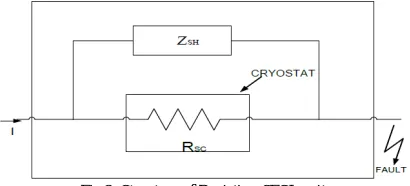
Resistive-type Superconducting Fault Current Limiters (SFCLs) made with High Temperature Superconductor (HTS) tapes provides the most operational and reliable protection against the faults due to their characteristics behaviour of high critical current density and quick Superconducting to Normal (S/N) state transition .The resistive type SFCLs is shown in series with the source and load (Fig.3). During nor mal operation the current flowing through the superconducting element RSC dissipates low energy. If the current rise above the critical current value the resistance RSC increases rapidly. The dissipated losses due to the rapid raise in resistance heats the superconductor above the critical temperature Tc and the superconductor RSC changes its state from superconducting to Normal state and fault current is reduced instantaneously. This phenomenon is called quench of superconductors. When the fault current has been reduced, the element RSC recovers its superconducting state. The parallel resistance or inductive shunt ZSH is needed to avoid hot spots during quench, to adjust the limiting current and to avoid over-voltages due to the fast current limitations. The resistive SFCLs are much smaller and lighter than the inductive ones. They are vulnerable to excessive heat during the quench state.
Fig .4.The Current Waveform With and Without SFCL during A Fault
.
III.FAULT CURRENT LIMITER
Fig. 5 shows the circuit topology of the proposed FCL which is composed of the two following parts:
1) Bridge part that includes a diode rectifier bridge, a small dc limiting reactor. (Note that its resistance is involved too.), a semiconductor switch (IGBT or GTO), and a freewheeling diode.
2) Shunt branch as a compensator that consists of a resistor and an inductor.
Fig.5. Proposed FCL topology
The total power losses of the proposed structure become a very small percentage of the feeder’s transmitted power.
IV. MATLAB/SIMULINK RESULTS
Case 1: Active type SFCL
Fig.6.Matlab/Simulink Model of Proposed Distribution System with Distributed Generation Units without any compensation scheme using Active SFCL methodology, using Matlab/Simulink
platform.
Fig.7.Voltage characteristics of the Bus-A under different locations of DG without SFCL.
Fig.9. Line current waveforms when the three-phase short-circuit occur at k3 point without SFCL.
Fig.10. Line current waveforms when the three-phase short-circuit occur at k3 point with SFCL.
Fig.11. Active SFCL’s current-limiting performances under different fault locations at k1 point.
Fig.12. Active SFCL’s current-limiting performances under different fault locations at k2 point.
Case 2: Active type FCL
Fig.13.Matlab/Simulink Model of Proposed Distribution System with Distributed Generation Units without any compensation scheme using Active FCL methodology, using Matlab/Simulink
platform.
Fig.14. Line current waveforms when the three-phase short-circuit occur at k3 point with FCL.
V.CONCLUSION
This paper is the quick review of Distributed Generation in India, its need, importance in near future. This paper provides how Traditional Generation is differing from Distributed Generation. In this paper, the application of the active SFCL and FCL into in a power distribution network with DG units is investigated. For the power frequency overvoltage caused by on the same problem using a DG based operation to enhance the power quality concerns at bus levels using a supportive source with active SFCL and FCL topologies. A single-phase grounded fault, compare to the active type SFCL and active type FCL. Active type FCL is reduces the overvoltage’s amplitude and avoids damaging the relevant distribution equipment. The active FCL can as well suppress the short-circuit current induced by a three-phase grounded fault effectively, and the power system’s safety and reliability can be improved.
[1] S. Conti, “Analysis of distribution network protection issues in presence of dispersed generation,” Elect. Power Syst. Res., vol. 79, no. 1, pp. 49–56, Jan. 2009.
[2] S.- Y. Kim and J.-O. Kim, “Reliability evaluation of distribution network with DG considering the reliability of protective devices affected by SFCL,” IEEE Trans. Appl. Supercond., vol. 21, no. 5, pp. 3561–3569, Oct. 2011.
[3] S. A. A. Shahriari, A. Yazdian, and M. R. Haghifam, “Fault current limiter allocation and sizing in distribution system in presence of distributed generation,” in Proc. IEEE Power Energy
Soc. Gen. Meet., Calgary, AB, Canada, Jul. 2009, pp. 1–6.
[4] S.-H. Lim, J.-S. Kim, M.-H. Kim, and J.-C. Kim, “Improvement of protection coordination of protective devices through application of a SFCL in a power distribution system with a dispersed generation,” IEEE Trans. Appl. Supercond., vol. 22, no. 3, p. 5601004, Jun. 2012.
[5] L. Chen, Y. Tang, J. Shi, and Z. Sun, “Simulations and experimental analyses of the active superconducting fault current limiter,” Phys. C, vol. 459, no. 1/2, pp. 27–32, Aug. 2007. [6] L. Chen, Y. Tang, J. Shi, Z. Li, L. Ren, and S. Cheng, “Control strategy
for three-phase four-wire PWM converter of integrated voltage compensation type active SFCL,” Phys. C, vol. 470, no. 3, pp. 231–235, Feb. 2010.
[7] L. Chen, Y. J. Tang, J. Shi, L. Ren, M. Song, S. J. Cheng, Y. Hu, and X. S. Chen, “Effects of a voltage compensation type active superconducting fault current limiter on distance relay protection,”
Phys. C, vol. 470, no. 20, pp. 1662–1665, Nov. 2010.
[8] J. Wang, L. Zhou, J. Shi, and Y. Tang, “Experimental investigation of an active superconducting current controller,”
IEEE Trans. Appl. Supercond., vol. 21, no. 3, pp. 1258–1262, Jun.