Enhancing Power System Stability Using Static
Synchronous Series Compensator (SSSC)
Priti W. Wamane1, Prof. Hitesh Murkute2
PG Student [PEPS], Dept. of Electrical Engineering, GNIET Nagpur, India1 Assistant Professor, Dept. of Electrical Engineering, GNIET Nagpur, India2
ABSTRACT:The continuous demand in electric power system leads to voltage instability. There may be insufficient reactive power causing voltage drop. The enhancement of voltage stability using static synchronous series compensator (SSSC) improves the system performance such as increase in transmittable power, transmission angle, power factor improvement and decrease line series reactance. Static synchronous series compensator (SSSC) is used to investigate the effect of this device and will be controlling active and reactive power as well as power oscillation damping. The steady state performance of SSSC will be presented using MATLAB software.
KEYWORDS:Active power, reactive power, power factor, Voltage stability, FACTS, Multi-bus system, Static synchronous series compensator (SSSC)
.
I.INTRODUCTION
In the deregulated power environment, the loads and generations change rapidly, causing certain corridors to be loaded to thermal limits. A small disturbance in the system, may lead to catastrophic failure resulting in complete blackout. In case, a line is overloaded or a contingency has occurred such as loss of line, or loss of large generator, the balance of load and generation in the system is distributed causing some of the lines to be overloaded. Therefore, a secure, stable and reliable operation of power system has become a serious challenge in the emerging electricity market scenario. The continuous growth in power demand and supply along with the limited expansion of transmission network changes the power flow pattern in the power system in such a way that some of the lines are overloaded. The flexible AC Transmission systems (FACTS) controllers find their enhanced application areas to resolve some of the challenges to ensure the proper power flow control, voltage control and stability enhancement.
The FACTS devices (Flexible AC Transmission Systems) could be a means to carry out this function without the drawbacks of the electromechanical devices such as slowness and wear. FACTS can improve the stability of network, such as the transient and the small signal stability, and can reduce the flow of heavily loaded lines and support voltages by controlling their parameters including series impedance, shunt impedance, current, voltage and phase angle. Controlling the power flows in the network leads to reduce the flow of heavily loaded lines, increased system loadability, less system loss and improved security of the system.
The static synchronous series compensator (SSSC) FACTS controller is used to prove its performance in terms of stability improvement. A Static Synchronous Series Compensator (SSSC) is a member of FACTS family which is connected in series with a power system. It consists of a solid state voltage source converter (VSC) which generates a controllable alternating current voltage at fundamental frequency? When the injected voltage is kept in quadrature with the line current, it can emulate as inductive or capacitive reactance so as to influence the power flow through the transmission line. While the primary purpose of a SSSC is to control power flow in steady state, it can also improve transient stability of a power system.
ISSN (Print) : 2320 – 3765 ISSN (Online): 2278 – 8875
I
nternational
J
ournal of
A
dvanced
R
esearch in
E
lectrical,
E
lectronics and
I
nstrumentation
E
ngineering
(A High Impact Factor, Monthly, Peer Reviewed Journal)
Website: www.ijareeie.com
Vol. 7, Issue 7, July 2018
II.SSSC CONFIGURATION
SSSC is basically a solid state VSC(Voltage Source Converter) attached in series to the transmission line and it generates the controllable AC voltages in quadrature to the line current. It provides virtual compensation of the line impedance by inserting the controllable voltage in the line which in turn controls the amount of real power transmitted by the network [2]. By controlling the magnitude and polarity of injected voltage (V) we can control the compensation level. It can be operated in both inductive as well as capacitive mode as per power system requirement. With DC energy source like battery, SSSC is capable for injecting real power in three systems. As a energy storage device we used DC link capacitor connected to DC side of the VSC. The VA rating of insertion transformer and converter of SSSC is depend on maximum line current (Imax) and maximum injected voltage (Vqmax ).
Figure 1. Basic configuration of SSSC
III.MODELLING OF THE PROPOSED FOUR BUS SYSTEM
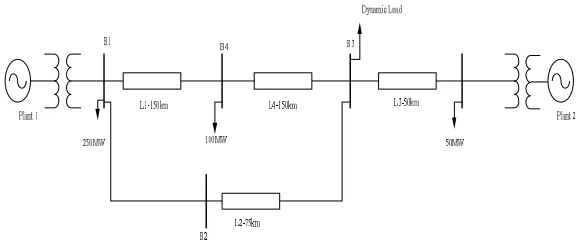
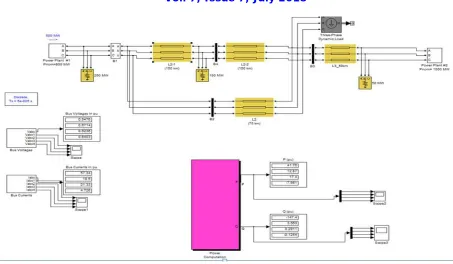
The dynamic performance of the SSSC is presented by real time voltage and current waveforms obtained after simulation. The simulation diagram for a two machine four bus system is given below. In this system SSSC is used for controlling the power flow through a 220KV transmission system. The system which has been made in ring mode consisting of four buses(B1-B4),connecting each other by transmission lines L1,L4, L2 and L3 having length 150KM,150KM, 75KM and 50KM respectively. The system has been supplied by two power plants with phase to phase voltage 11 KV. The simulation results obtained for bus 2 is given below. The SSSC has been connected to a bus that shows more variations in real and reactive power values.
Figure 2 . Two machine four bus system without SSSC
ISSN (Print) : 2320 – 3765 ISSN (Online): 2278 – 8875
I
nternational
J
ournal of
A
dvanced
R
esearch in
E
lectrical,
E
lectronics and
I
nstrumentation
E
ngineering
(A High Impact Factor, Monthly, Peer Reviewed Journal)
Website: www.ijareeie.com
Vol. 7, Issue 7, July 2018
Figure 4 : Current Waveform of Four buses without SSSC
Figure 5 : Active Power Waveform of Four buses without SSSC
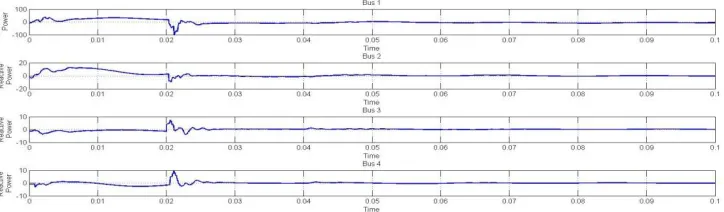
Figure 6 : Reactive Power Waveform of Four buses without SSSC
IV.TWO MACHINES FOUR BUS SYSTEM WITH SSSC
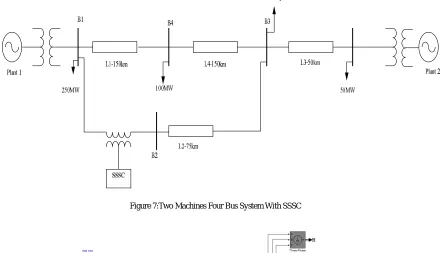
Figure 7:Two Machines Four Bus System With SSSC
Figure 8 : Two machine Four bus with SSSC Connected in Series with Bus 2 (B2)
ISSN (Print) : 2320 – 3765 ISSN (Online): 2278 – 8875
I
nternational
J
ournal of
A
dvanced
R
esearch in
E
lectrical,
E
lectronics and
I
nstrumentation
E
ngineering
(A High Impact Factor, Monthly, Peer Reviewed Journal)
Website: www.ijareeie.com
Vol. 7, Issue 7, July 2018
Figure 10 : Current Waveform of Four buses with SSSC Connected in Series with Bus 2 (B2)
Figure 11 : Active Power Waveform of Four buses with SSSC Connected in Series with Bus 2 (B2)
Figure 12 : Reactive power Waveform of Four buses with SSSC Connected in Series with Bus 2 (B2)
V. RESULTS
The performance of the SSSC is presented by real time voltage and current waveforms obtained after simulation. The simulation diagram for a two machine four bus system is given below. In this system SSSC is used for controlling the power flow through a 220 KV transmission system. The system which has been made in ring mode consisting of four buses(B1-B4),connecting each other by transmission lines L1, L4, L2 and L3 having length 150KM,150KM, 75KM and 50KM respectively. The system has been supplied by two power plants with phase to phase voltage 11 KV. The simulation results obtained for bus 2 is given below. The SSSC has been connected to a bus that shows more variations in real and reactive power values.
A. Simulation result of Two Machine System without SSSC
Bus V
(pu) I (pu) P (pu) Q (pu) S (pu) Power Factor
1 0.54 57.34 41.76 -14.7 44.27 0.9433
2 0.67 18.6 12.87 3.563 13.35 0.9640
3 0.62 21.33 17.4 0.2911 17.402 0.9999
4 0.64 4.73 7.951 -0.1254 7.95 1.0000
Table 1 : Simulation Result without SSSC
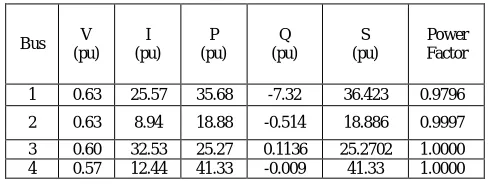
B. Simulation Result of Two Machine System with SSSC
Table 2 : Simulation Result with SSSC
VI. CONCLUSION
Static synchronous series compensator is capable of enhancing the power flow through the transmission system by injecting a fast changing voltage in series with the line. It is also observe that the SSSC injected voltage is in quadrature with line current. Based on obtained simulation result the performance of SSSC has been examined in multi- machine system. Here the performance of SSSC is presented by the real time voltage and current waveforms obtained after the simulation of a four bus system. The application of this can be extended to a multi machine multi-bus system to investigate the problems related to stability.
REFERENCES
[1] S. Arun Kumar, C.Easwarlal, M. Senthil Kumar, “Multi Machine Power System Stability Enhancement Using Static Synchronous Series Compensator (SSSC)”, International Conference on Computing, Electronics and Electrical Technologies [ICCEET], 2012.
[2] Ankitkumar B Patel, Pranav D Raval, Dhaval Patel” A SSSC Based Damping controller for Stability enhancement of power system” 3rd International Conference on Advances in Electrical, Electronics, Information, Communication and Bio-Informatics (AEEICB17)
[3] ArthitSode-Yome, NadarajahMithulananthan,”Static Voltage Stability Margin Enhancement Using STATCOM, TCSC and SSSC”2005 IEEE/PES Transmission and Distribution Conference & Exhibition: Asia and Pacific Dalian, China
[4] Kalyan K. Sen,”SSSC - Static Synchronous Series Compensator: Theory, Modeling, and Applications”,IEEE Transactions on Power Delivery, Vol. 13, No. 1, January 1998
[5] Narain, G. Hingorani, Laszlo Gyugyi, “Understanding FACTS Concepts and Technology of Flexible AC Transmission Systems”, IEEE Press, Standard Publishers Distributors, Delhi.
[6] P. Sumankumar, N.vijaysinha, C.B.Saravanan, “STATIC SYNCHRONOUS SERIES COMPENSATOR FOR SERIES COMPENSATION OF EHV TRANSMISSION LINE”, International Journal of Advanced Research in Electrical, Electronics and Instrumentation Engineering, Vol. 2, Issue 7, July 2013.
[7] K. R Padiyar, “FACTS Controllers in Power Transmission and Distribution”, New Age International Publishers (formerly Wiley Eastern Limited), New Delhi.
Bus V
(pu) I (pu) P (pu) Q (pu) S (pu) Power Factor
1 0.63 25.57 35.68 -7.32 36.423 0.9796
2 0.63 8.94 18.88 -0.514 18.886 0.9997
3 0.60 32.53 25.27 0.1136 25.2702 1.0000