PAPR Reduction in OFDM System Using
SLM and Companding Techniques with
Convolution Codes
Neha Porwal1, Satish Kumar2
PG Student, Dept. of ECE, Institute of Technology & Management, Gwalior, India1
Assistant Professor, Dept. of ECE, Institute of Technology & Management, Gwalior, India2
ABSTRACT: Orthogonal Frequency Division Multiplexing (OFDM) is a very attractive technique in wireless communications which provides robustness to channel fading and immunity to impulse interference. Despite of its advantages, one of the major drawback of OFDM system is very high Peak-to-Average Power Ratio (PAPR). Among the various PAPR reduction techniques, companding appears attractive for its simplicity and effectiveness and SLM . In this paper, we have used combination of companding technique and SLM technique with Convolutional codes to reduce PAPR within OFDM systems. It is shown in simulation results that the proposed scheme performs well reducing PAPR and improving without the need of any side information.
KEYWORDS: Orthogonal Frequency Division Multiplexing (OFDM),Peak-to-Average Power Ratio (PAPR), SLM (Selected Mapping), CC(Convolution Codes),Complementary Cumulative Distribution Function(CCDF).
I.INTRODUCTION
Orthogonal Frequency Division Multiplexing (OFDM) has become a popular technique for transmission of signals over wireless channels. OFDM has been adopted in several wireless standards such as digital audio broadcasting (DAB), digital video broadcasting (DVB-T), the IEEE 802.11a local area network (LAN) standard and the IEEE 802.16a metropolitan area network (MAN) standard. OFDM is also being pursued for dedicated short-range communications (DSRC) for road side to vehicle communications and as a potential candidate for fourth-generation (4G) mobile wireless systems. OFDM is a multicarrier modulation technique which splits high-rate data streams into a number of lower data rate streams that are transmitted simultaneously over a number of subcarriers. Because the symbol duration increases for the lower rate parallel subcarriers, the relative amount of dispersion in time caused by multipath delay spread is decreased. Inter symbol interference (ISI) is eliminated almost completely by introducing a guard time in every OFDM symbol [2]. However one of the major drawbacks of OFDM signal is its large envelope fluctuation, likely resulting in large peak-to average power ratio (PAPR), which distorts the signal. Some of the methods proposed in literature to reduce the PAPR of OFDM signals include several techniques such as amplitude clipping ,tone reservation (TR), active constellation extension(ACE) and coding , selective mapping, partial transmitting . In optimal companding coefficient is determined to enlarge small OFDM signals along with PAPR reduction. In non-linear companding scheme is described by a single valued function which allows to be transformed before amplification. In this paper, we propose a PAPR reduction technique using companding technique with SLM technique by BER coding . This paper is organize as follows : Concept of OFDM is introduced in Section I. Explains the PAPR of OFDM system in Section II . Matterials & method in Section III. Implementation method is explained in section IV. Simulation results and discussions are given in section V. Finally we will conclude in section VI.
II.OFDM SYSTEM MODEL AND PAPR PROBLEM
= 1
√
/ 0≤ ≤ −1
Where, k = 0,1,2,3..., N-1, are input symbols modulated by BPSK, QPSK or QAM and n is the discrete time index. The PAPR of an OFDM signal is defined as the ratio of the maximum to the average power of the signal, as follows
( ) = 10 {| | }
{| |} 0≤ ≤ −1
Where E{.}denotes the expected value operation and x=[x1,x2,x3,---xN-1 ]T
In the worst case all the sub-carriers may add together to form the signal due to which amplifier is no longer operates in its linear dynamic range and this causes serious problems due to nonlinearity of the power amplifiers.
When the OFDM signal with high PAPR passes through a non-linear device, (power amplifier working in the saturation region), the signal will suffer significant non-linear distortion . This non-linear distortion will result in in-band distortion and of-in-band radiation. The in-in-band distortion causes system performance degradation and the out-of-band radiation causes adjacent channel interference (ACI) that affects systems working in the neighbour bands. To lessen the signal distortion, it requires a linear power amplifier with large dynamic range. However, this linear power amplifier has poor efficiency and is so expensive. Hence, it is necessary to reduce the peak to average power ratio of the OFDM signal as it outweighs all the potential benefits of an OFDM system. Usually, Complementary Cumulative Distribution Function (CCDF) can be used to evaluate the performance of any PAPR reduction schemes.
. III. MATTERIALS & METHOD
3.1 COMPANDING
Companding is another popular PAPR reduction scheme. Companding is a composite word formed by combining compressing and expanding. In this scheme, at the transmitter a signal with high dynamic range is applied to a compander and at the receiver a decompanding function (the inverse of companding function) is used to recover the original signal. Initially, it was used in digital communication systems to increase the dynamic range of digital to analog converters (DACs). The μ-law and A-law are the two most popular compressing functions used worldwide. In
proposed a scheme a μ-law companding scheme to reduce the PAPR of OFDM signal. According to this scheme, the time domain OFDM signal ( x[n] ) is applied to a μ-law compressor to produce a companded OFDM signal given by
( ) =
( [ ]) 1 + ( )
(1 + )
where, A is the peak value of the OFDM signal before companding and μ is the parameter controlling nonlinearity of
the companding function. Sgn (.) and ln(.) are the standard signum and natural logarithmic function respectively
3.1.1 ALGORITHM FOR TRNASMITTER
The input data block X1, X2……Xn are convolution ally encoded with code rate =1/2 and constraint length = 7.
These symbols are compressed using μ -law companding before transmitting the data.
The coded data bits are mapped using 8 QAM modulation technique, and then take IFFT of the modulated data to form OFDM symbols.
Repeat step 1 to step 3 for number of times to produce different number of candidates for each data block.
Fig.1 TRANSMITTER
3.1.2 ALGORITHM FOR RECEIVER
Introduce additive white Gaussian noise in the transmitted signal.
Select the candidate with different values of PAPR and plot the CCDF curve for the different values of μ. After expanding the signal, FFT of the signal is computed.
Demodulate the data points using 8 QAM demodulation
The data bits are convolution ally decoded using Viterbi algorithm with hard decoding
Fig.2 RECEIVER
3.2 SELECTED MAPPING
SLM is another popular distortion-less PAPR reduction technique. Selective mapping scheme is a technique in which multiple phase rotations are applied to the constellation points, and the one that minimizes the time signal peak is used. Selective mapping absorb generating a large set of data vectors all representing the same information. The data vector with the lowest resulting PAPR is selected. Information about the selected and transmitted data vectors is coded and these codes are by an additional sub carriers. Fig 3 shows the blocks diagram of SLM.
Fig.3 Block diagram selected mapping
IV. IMPLEMENTATION
We have simulated using MATLAB R2014a. The simulation help is evaluating the performance of PAPR and CCDF . Our results show the effect of using modulation scheme 8 QAM techniques to reduce PAPR for OFDM
.
Select the Candidate with Minimum PAPR
8 QAM IFFT &μ law_
companding
Data Xi
8 QAM
8 QAM
IFFT &μ law_
companding
IFFT &μ law_
companding Convolution coding Convolution coding Convolution coding
AWGN channel Expander FFT
8QAM Decoder Convolutional decoder
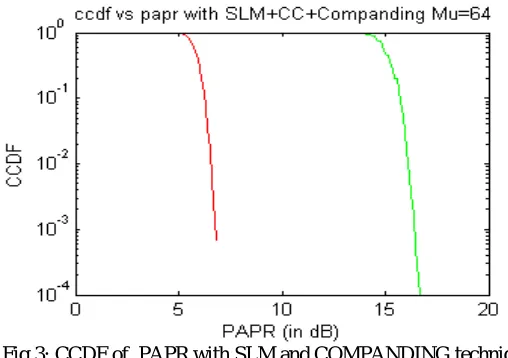
Fig 1: CCDF of PAPR with SLM and COMPANDING technique
Figure 1 show the values of original SLM is 16.4dB , the value of SLM and COMPANDING with Convolution is 6.5dB. The improvement performance in PAPR reduction in SLM and COMPANDING with Convolution techniques
Fig 2: CCDF of PAPR with SLM and COMPANDING technique
Figure 2 show the values of original SLM is 16.4dB , the value of SLM and COMPANDING with Convolution is 6.5dB. The improvement performance in PAPR reduction in and COMPANDING with Convolution techniques
Fig 3: CCDF of PAPR with SLM and COMPANDING technique
Fig 4: CCDF of PAPR with SLM and COMPANDING technique
Figure 4 show the values of original SLM is 16.5dB , the value of SLM and COMPANDING with Convolution is 6.5dB.The improvement performance in PAPR reduction in SLM and COMPANDING with Convolution techniques
Fig 5: CCDF of PAPR with SLM and COMPANDING technique
Figure 5 show the values of original SLM is 16.3dB , the value of SLM and COMPANDING with Convolutional is 6.5dB. The improvement performance in PAPR reduction in SLM and COMPANDING with Convolution techniques.
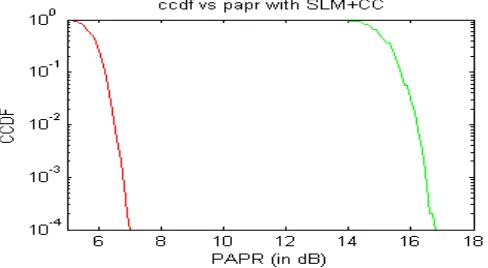
Figure 6 show the values of original SLM is 16.4dB .The SLM and Convolution is 6.5dB. The improvement performance in PAPR reduction in SLM and Convolution techniques.
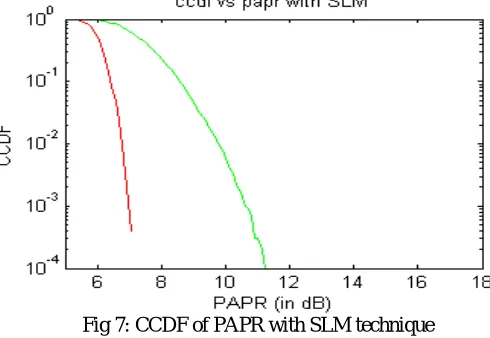
Fig 7: CCDF of PAPR with SLM technique
Figure 7 show the values of original SLM is 10.8dB The PAPR with SLM is 6.7dB. The improvement performance in PAPR reduction in SLM techniques
.
V. RESULT AND DISCUSSION
In this section we have evaluate the performance of 8 QAM modulation scheme using COMPANDING and SLM techniques for MATLAB program. Table 1 above shows the simulation parameters. The performance comparison of COMPANDING scheme and SLM scheme using convolution codes is also shown. The performance metric utilized in evaluating PAPR reduction scheme is CCDF Vs PAPR. We have comparison of the Table 1 parameter:- Modulation scheme, Value of ‘mu’ for companding , PAPR (CC+ SLM+ Companding).
Table 1: Simulation parameter
In this ccdf Vs papr with SLM and CC fig. 6 shown. The original SLM is green line indicate 16.4 dB value and PAPR with SLM and CC is red line indicate 6.5 dB value.
In this ccdf Vs papr with SLM fig. 7 shown. The original SLM is green line indicate 10.8 dB value and PAPR with SLM is red line indicate 6.7 dB value.
In simulation, we have taken values of ‘mu=256’.We can see that PAPR(CC+ SLM+ Companding) is 16.4dB and 8QAM modulation scheme used to technique in this provides better performance.
In simulation, we have taken values of ‘mu=128’.We can see that PAPR (CC+ SLM+ Companding) is 16.4dB and 8QAM modulation scheme used to technique in this provides better performance.
Modulation scheme Value of ‘mu’ for Companding
PAPR (CC+ SLM+ Companding)
In simulation, we have taken values of ‘mu=64’ .We can see that PAPR (CC+ SLM+ Companding) is 15.4dB and 8QAM modulation scheme used to technique in this provides better performance.
In simulation, we have taken values of ‘mu=32’ .We can see that PAPR (CC+ SLM+ Companding) is 16.5dB and 8QAM modulation scheme used to technique in this provides better performance.
In simulation, we have taken values of ‘mu=16’ .We can see that PAPR (CC+ SLM+ Companding) is 16.3dB and 8QAM modulation scheme used to technique in this provides better performance.
In this Table 1 simulated parameter 8QAM modulation scheme same all table. The PAPR is include convolution codes ,SLM, COMPANDING value for ‘mu’=256,128,64,32,16 different 16.4,16.4,15.4,16.5,16.3dB . It means the SLM techniques include COMPANDING technique are better performance in SLM. It is shown in simulation results that the proposed scheme performs well reducing PAPR and improve.
VI.CONCLUSION
OFDM systems have generic problem of high PAPR. Drawback of high PAPR is dynamic range of power amplifier and D/A convertor which increases its cost. Hence we apply reduction techniques to reduce PAPR. This paper analyzed companding technique and SLM with convolution coding.. The PAPR reduction performance have been evaluated by
computer simulation. Simulation results shows that the PAPR reduction performance is improved by using proposed scheme as compared with using companding technique only. In this scheme reduces the computational complexity significantly.
.
REFERENCES
[1] Pawan Sharma and Seema Verma, “Reducing PAPR of OFDM based wireless systems using Companding with Convolutional Codes,” International Journal of Distributed and Parallel Systems , vol.2, no.6, pp.99-102 ,November 2011.
[2] C.L.Wang, M.Y.Hsu, and Y.Wuynag, “A Low-Complexity Peak-to-Average Power Ratio Reduction Technique for OFDM systems,” Global Telecommunication Conference, 2003 Globecom’03 IEEE, pp.2375-2379.
[3] T.Jiang and Y.Wu, “An Overview: Peak-to-Average Power Ratio Reduction Techniques for OFDM Signals,” IEEE Transactions on Broadcasting, vol.54,no.2, , pp.257-268 June 2008.
[4] R.W . Bauml , R.F.H .Fischer, J.B. Huber Reducing the Peak to Average Power Ratio of multicarrier modulation by Selected Mapping,’’ IEE Electron, Letter vol.32, pp.1519-1528. october1996.
[5] J Cimini, Jr., "Analysis and simulation of a digital mobile channel using Orthogonal Frequcney Division Multiplexing,'.IBEEhns. Communation ., vol. COM-33, pp. 665-675,July 1985.
[6] S. H. Han and J. H. Lee, “An Overview of peak- to average power ratio reduction techniques for multicarrier transmission,” IEEE Wireless Communation ., vol. 12, pp.56-65, Apr. 2005.