ISSN (Print) : 2320 – 3765
ISSN (Online): 2278 – 8875
I
nternational
J
ournal of
A
dvanced
R
esearch in
E
lectrical,
E
lectronics and
I
nstrumentation
E
ngineering
(A High Impact Factor, Monthly, Peer Reviewed Journal)
Website: www.ijareeie.com
Vol. 8, Issue 3, March 2019
Smart Electronic Voting Machine Using
Raspberry Pi
K.Dinakaran#1, P.Aravindkumar#2, E.Bagavathi#3, M.Kathireshkumar#4, R.Madhankumar#5
Assistant professor, Department of Electronics and Communication Engineering, Jai Shriram Engineering College,
Tirupur, Tamil Nadu, India1
Department of Electronics and Communication Engineering, Jai Shriram Engineering College,
Tirupur, Tamil Nadu, India2 3 4 5
ABSTRACT: The basic idea of this project is to create an electronic voting machine that will help to eradicate
defrauding of the manual voting system and prior versions of electronic voting by using Raspberry Pi. Here propose a system that include multiple layers of verification to ensure the reliability of the device with include the finger print sensor verification. Each voter is entered into the system only after being recognized and checked with the given data base of enlist voters, once the corresponding finger print is matched with the information provided ,the voter will be allowed to proceed for choosing their preferred candidate from the panel of buttons, The final vote is then displayed onto a LCD for the satisfaction of voters .the proposed project displays transparency and also carries the feature of being autonomous during the course of operation.
KEYWORDS : Electronic voting machine, Raspberry pi, finger print sensor, LCD
I. INTRODUCTION
Election is the act of party casting votes to elect on individual for some type of position, election may involve a public or private vote depending on the position most position in the local, state, and federal governments are voting on in some type of election .in paper based on election. Voters cast their votes by simply depositing their ballots in sealed boxes distributed across the electoral circuits around a given country, when the election period ends, all these boxes are opened and votes are counted manually in presence of the certified officials.
The person at the booth should show his Finger. This Finger print reader reads the details from the tag. This information is passed to the controlling unit for the verification , The controller reads DATA from the
reader and compares this data with the already existing data. If the data matches with the already stored information, the person is allowed to poll his vote. If not, a message is displayed on LCD and therefore the person isn't allowed to poll his vote. The polling mechanism carries out manually using the switches. LCD is employed to display the related messages.
Voting is a method by which the electorates appoint their representatives. In current voting system the voter should show his voter ID card whenever an individual goes to the booth to poll one’s vote. This process could be a time consuming method as the person needs to check the voter ID card with the list he has, confirm it as an authorized card and then enable the person to poll his vote. Thus,to avoid this type of problems.
ISSN (Print) : 2320 – 3765
ISSN (Online): 2278 – 8875
I
nternational
J
ournal of
A
dvanced
R
esearch in
E
lectrical,
E
lectronics and
I
nstrumentation
E
ngineering
(A High Impact Factor, Monthly, Peer Reviewed Journal)
Website: www.ijareeie.com
Vol. 8, Issue 3, March 2019
Voter identification is needed during two phases of the electoral process, first for voter registration so as to determine the right to vote and subsequently,at voting time, to allow a citizen to exercise their right to vote by verifying if the person satisfies all the necessities required to vote
II.HARDWARE PROTOCOL
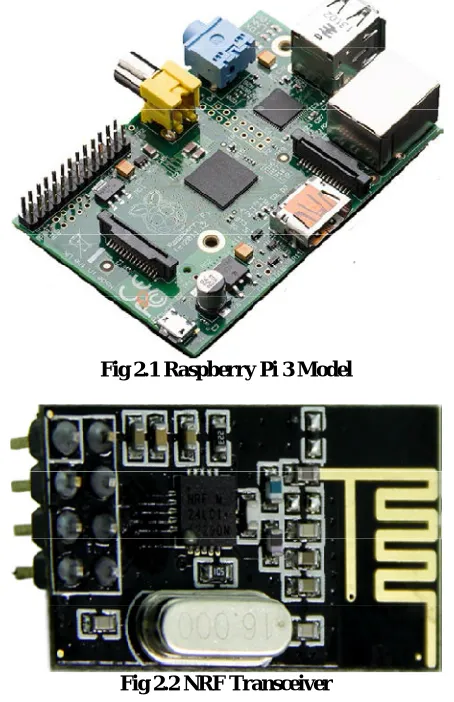
2.1. Raspberry pi 3 model
The raspberry pi is an minicomputer, it is an closed system hardware and it run multiple program at a time, then the candidate can update the details, there is no limitations of program language ,and then processor speed is 700 MHZ, memory size is 1 GB and above, there is no VGA support. The foundation provides Debian and Arch Linux ARM distributions and also Python as the main programming language, with the support for BBC BASIC, C and Perl.
Fig 2.1 Raspberry Pi 3 Model
Fig 2.2 NRF Transceiver
ISSN (Print) : 2320 – 3765
ISSN (Online): 2278 – 8875
I
nternational
J
ournal of
A
dvanced
R
esearch in
E
lectrical,
E
lectronics and
I
nstrumentation
E
ngineering
(A High Impact Factor, Monthly, Peer Reviewed Journal)
Website: www.ijareeie.com
Vol. 8, Issue 3, March 2019
instruction on TX_ADDR register, which will read the con-tents of the TX address register out of the 24L01 and into micro
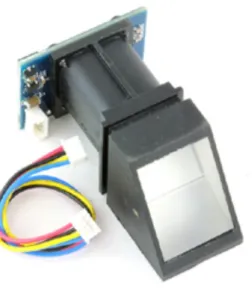
2.2. Fingerprint sensor R305
Fig 2.3 Fingerprint Sensor R305
A finger print sensor is an electronic device used to capture the digital image of the finger print pattern, the capture image is called as live scan,
This is a finger print sensor module with TTL UART interface for direct connection to microcontroller UART or through USB serial cable, the user store the finger print data in module and can configure it in 1:1or 1:N mode for identifying the person, the finger print module is directly interface with 3v3 or 5v microcontroller . a level of converter required for interfacing with pc serial port ,basic power 8-12 v AC/DC,
It is an good image processing capabilities can successfully capture image up to resolution 500 dpi, and then lower power consumption, low cast ,small in size , the image capture or scanning speed is 0.5 second, and then the verification speed is 0.3 second, it will store the 250 finger print image .
III. VOTING MACHINE
ISSN (Print) : 2320 – 3765
ISSN (Online): 2278 – 8875
I
nternational
J
ournal of
A
dvanced
R
esearch in
E
lectrical,
E
lectronics and
I
nstrumentation
E
ngineering
(A High Impact Factor, Monthly, Peer Reviewed Journal)
Website: www.ijareeie.com
Vol. 8, Issue 3, March 2019
3.1. STEPS INVOLVING IN VOTING PROCESS
Step1: Initialization of process.
Step2: It is assumed that the voters have already registered and their finger-prints and voter details are stored in remote
server
Step3: Check if the voter I.D is valid or not i.,e whether the candidate has registered or not by comparison of his finger
with already stored finger-prints from remote server.
Step4: If the voter has not registered or if the card ID is invalid, then display the message that the user is an
unauthorized person.
Step5: Else if the card is valid, then go to next step.
Step6: Check if the candidate has already voted or not.
Step7: If he has already casted his vote, then message is displayed that he has already voted and is prevented from
voting for the second time.
Step8: Else, if the candidate is voting for the first time, then he is allowed to vote.
Step9: output is displayed on LCD.
Step10: After vote casting the candidate’s photo, name, constituency and voter I.D is displayed on LCD.
Step11: The polling results are sent instantaneously to central server which is accessed by an official using I.P address
and password.
IV. WORKING PRINCIPAL
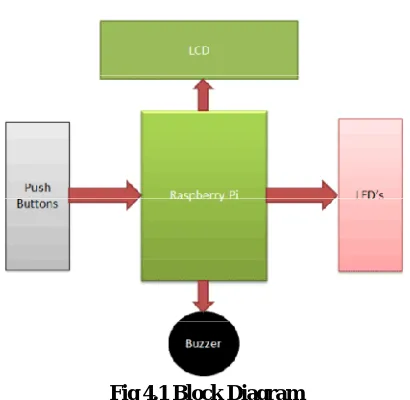
Fig 4.1 Block Diagram
ISSN (Print) : 2320 – 3765
ISSN (Online): 2278 – 8875
I
nternational
J
ournal of
A
dvanced
R
esearch in
E
lectrical,
E
lectronics and
I
nstrumentation
E
ngineering
(A High Impact Factor, Monthly, Peer Reviewed Journal)
Website: www.ijareeie.com
Vol. 8, Issue 3, March 2019
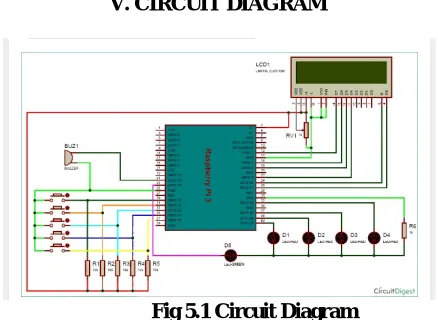
controlling the GPIO pins of Raspberry Pi. We can also use Raspberry Pi2 here. Here we have used Five Buttons, in which four have been used to Vote for four different candidates/parties and one button is used for showing the Result on LCD. These five buttons are directly
connected to GPIO pins 21 to 25 of RPI3, with respect to ground with 10K pull-up resistor for each one.
A 16x2 LCD is connected with Raspberry Pi. Control pin RS, RW and En are connected to GPIO pin 11, GND and 10. And data pin D4-D7 is connected to GPIO pins 6, 5, 4 and 1 of RPI. A buzzer is also used for beep when any of the buttons is pressed by voter. Here we have used a Green LED (D5) for indicating that system is ready and voter can submit their vote in the machine, by pressing the button. A 10k Pot is used
For controlling brightness of LCD.
V. CIRCUIT DIAGRAM
Fig 5.1 Circuit Diagram
VI. PIN DESCRIPTION OF RASPBERRY PI
VII. ADVANTAGES
The system will not allow the voter to vote two or more candidates.
The system will allow the user to vote for one time for a particular election.
ISSN (Print) : 2320 – 3765
ISSN (Online): 2278 – 8875
I
nternational
J
ournal of
A
dvanced
R
esearch in
E
lectrical,
E
lectronics and
I
nstrumentation
E
ngineering
(A High Impact Factor, Monthly, Peer Reviewed Journal)
Website: www.ijareeie.com
Vol. 8, Issue 3, March 2019
VIII. CONCLUSION
The project can be used for voting since it overcome all This the draw backs of ordinary voting machine also provide additional security. Its main advantage is that since fingerprints of every person is unique and hence this system completely reduces the chance of invalid votes. The system can be manufactured simply as well as cheap and casting vote becomes easier by the process of voting from any place inside Tamil Nadu.
REFERENCES
1. Umang Shah, Trupt Shah, Marteen Kansagara , Saagar Daxini , (March 2015),Biometric Secured Voting Machine to Avoid Bogus Voting Based on AADHAR CARD.
2. Patil Rahul H, TarteBabita B, Wadekar Sapana S, Zurunge Bhakti S,Prof. Phursule R, (September 2015), A Secure E-Voting System Using Face Recognition.
3. Pradeep Dimri, Pooja Chugh,( May 2015), Review of existing Indian Voting System and hybrid design using Biometric Security in Voting Authentication Process.
4. Shafi Muhammad Abdul hamid, Damian Oshomah Ugiomoh, Mohammed Danlami Abdul Malik, (May 2013),The Design and Development of Real-Time E-Voting System in Nigeria with Emphasis on Security and Result Veracity.
5. Sanjay Kumar1, Manpreet Singh , (July 2013 ), Desigan a secure electronic voting system using finger print technique.