ISSN 2286-4822 www.euacademic.org
Impact Factor: 3.4546 (UIF) DRJI Value: 5.9 (B+)
Practices of Teachers in Classroom
Management from the Perspective of
Students
PERVEEN INAYAT
BSN, The University of Lahore
MUHAMMAD HUSSAIN
MS in Medical Imaging Technology (MSMIT) UOL, LHR Bachelor of Science in Nursing (BSN) DUHS, KARACHI Assistant Professor Lahore School of Nursing, The University of Lahore
MUHAMMAD AFZAL
Master of Science in Nursing, AKU, Karachi MSC Haematology, BMU, Karachi MBA in Health Management, Preston University Associate Professor Lahore School of Nursing, The University of Lahore
SYED AMIR GILANI
PhD Public Health PhD Medical Diagnostic Ultrasound Dean, Faculty of Allied Health Science, The University of Lahore
Abstract:
result showed no statistically significant effect of gender, the level or the interaction between them at the level of significance (α = 0.05) on the areas of the questionnaire, and for the whole questionnaire. The study gave a number of recommendations.
Key words: practices, classroom management, teachers
1. INTRODUCTION
Classroom management represents an important skill and knowledge set for achieving student learning gains, but poses a considerable challenge for beginning teachers (Wolff, van den Bogert, Jarodzka, & Boshuizen, 2015).
Classroom management, the practices by which a teacher supervises student interactions, learning, and behavior, is a vital aspect of teaching. The quality of instructional time can be enhanced by effective classroom management techniques and classroom management interventions have even been found to improve students’ academic outcomes (Tekindal et al., 2017). Teachers who employ practices associated with positive behavior intervention and support (e.g., provide opportunities to respond, behavior specific praise, and pre-corrections) create superior learning environments (Kennedy, Hirsch, Rodgers, Bruce, & Lloyd, 2017).
Teachers have a powerful long lasting influences on their students. They directly affect how they learn, what they learn,how much they learn and the ways in which they interact with one another and the world around them. Teachers who are both experienced and effective know the content and student they teach,use efficient planning strategies, practice interactive decision making and embody effective classroom management skills (Stronge, 2018).
amongst the most entrenched indicators of accomplishment; when students are more occupied with scholastic guidance, they will in general have more noteworthy scholarly and social achievement (Harbour, Evanovich, Sweigart, & Hughes, 2015).
Powerful classroom the executives’ aptitudes are fundamental for educators. Sadly, numerous educators don't get satisfactory classroom the board preparing preceding starting their showing professions and feel caught off guard for the requests of overseeing understudy practices in their classrooms(Freeman, Simonsen, Briere, & MacSuga-Gage, 2014).
Teachers with a deeper professional knowledge have a superior understanding of the ways in which there students habitually approach and respond to the learning task,and how there cognitive styles and attitudes influence there learning performance (Stronge, 2018).
2. LITERATURE REVIEW
A study conducted in the university of Virginia in 2018 shows the association between student behaviors and teacher self-reported efficacy in using culturally responsive teaching and proactive behavior management practices (Larson, Pas, Bradshaw, Rosenberg, & Day-Vines, 2018).
Classroom management, the practices by which a teacher supervises student interactions, learning, and behavior, is a vital aspect of teaching. The quality of instructional time can be enhanced by effective classroom management techniques and classroom management interventions have even been found to improve students’ academic outcomes (Tekindal et al., 2017).
However in a study the results from multilevel regression analyses revealed that teacher educational interest contributed to student reports of teachers' instructional practices. These practices, in turn, were significant predictors of students' subject interest and mastery goals at both the student and the class level. Finally, teacher educational interest showed significant and substantial indirect relations to student motivation that were mediated by teachers’ instructional practices (Schiefele, 2017).
A study conducted in 2016 I which the results suggest that TSE(teachers self efficacy) shows positive links with students’ academic adjustment, patterns of teacher behavior and practices related to classroom quality, and factors underlying teachers’ psychological well-being, including personal accomplishment, job satisfaction, and commitment. Negative associations were found between TSE and burnout factors (Zee & Koomen, 2016).
In 2012, the Kendriya Vidyalaya Sanghatan made an attempt to digitalize their teaching by launching e-classroom pilot project, which aimed at converting 500 classrooms of Kendriya Vidyalaya Schools into smart classrooms by installing smart board i.e. interactive whiteboards. The findings of the study substantiate that constructs of the UTAUT model that determine the use behavior of technology are significantly correlated with the use of interactive whiteboard in the said context (Gosain, 2016).
A research conducted in 2015 in which analyses indicated a functional association between patterns of student behavior and teachers' classroom management. In classrooms where students consistently met expectations, teachers provided more opportunities to respond and less disapproval and reactive behavioral management (Pas, Cash, O'Brennan, Debnam, & Bradshaw, 2015).
forward as a key solution but seems chalanging. Actual DI implementation of teachers is linked to a complex set of variables: teachers' DI self-efficacy, teaching beliefs, teaching experience, professional development, teacher certification, and classroom size. The findings show that DI implementation seems high, but is still below a critical benchmark. The regression analysis results indicate 39% of the variation in DI implementation which can significantly linked to DI self-efficacy beliefs, higher constructivist beliefs and higher classroom size (Suprayogi, Valcke, & Godwin, 2017).
Teachers can embed proactive research-based strategies within their lesson plans to reduce behavior problems and improve achievement for all students, including students with disabilities(Nagro, Fraser, & Hooks, 2018).
3. PROBLEM STATEMENT
The issue of the examination is identified with the acts of school instructors in classroom the executives; they are fundamental in deciding the dimension of classroom cooperation, affect the instructive circumstance, and speak to the nerve that associates between the student and the educator, in the instructive and managerial viewpoints. Such practices spur thinking among understudies, help to pass judgment on the yields of instruction, and the job of the educator in the address, at that point came the examination to explore the adequacy of the showing staff in the classroom from the viewpoint of their understudies.
4. SIGNIFICANCE
proper management students will be able to concentrate reading material effectively which in turn will affect their GPA.
5. OBJECTIVE
The objective of the study is:
1. To see the practices of teachers in class room management from the perspective of students.
6. RESEARCH QUESTION
What are the practices of teachers in class room management from the perspective of students?
7. THEORETICAL FRAMEWORK
(Allen, 1996).
Effective teaching is linked directly with class room environment. Proper arrangement of class is key factor in enhancing students’ learning. This model helps teachers to build a classroom management plan. Starting with this foundation, each teacher should then begin to build a toolbox of effective strategies and teacher behaviors to create a comprehensive and effectual classroom management plan.
8. OPERATIONAL DEFINITIONS: Professional Knowledge:
Instructional Planning:
Instructional planning refers to the process of teacher engage in while planning and structuring learning activities to meet the needs of all students using the state standards the school curriculum data and engaging and appropriates strategies and resources.
9. MATERIAL AND METHOD Study Design
A cross-sectional study design was used. Study Setting
The setting for this research was Lahore school of nursing, The University of Lahore.
Duration of the Study:
This study completed in approximately 4 months (September 2018, to December 2018).
Study Population:
The study population for this research was all students studying in Lahore school of nursing, The University of Lahore. Sampling Technique:
The simple random sampling technique was be used to collect data from selected population.
Sample Size:
Sample size is determined by using this formula n= N/ 1+ (N) (E) 2
Desired sample size= n=? Target Population= N =176
Margin of error =E=0.05 at 95% confidence interval n= 176/1+176(0.05)2
n= 176/1+1 n=176/2 n=88
Sample Selection for Nurses: Inclusion criteria:
The subject included in the study was:
All nursing students in Lahore school of nursing, The University of Lahore
Both male and female
Those patients who were interested to participate in the study
Exclusion criteria:
The subjects who are excluded from the study was:
Students absent at the time of data collection
Those who are not willing to participate
10. ETHICAL CONCEDRATION
The rules and regulations set by the ethical committee of Lahore School of Nursing were followed while conducting the research and the rights of the research participants were respected.
Written informed consent attached was taken from all the participants.
All information and data collection was kept confidential.
Participants remained anonymous throughout the study.
The subjects were informed that there are no disadvantages or risk on the procedure of the study.
They were also informed that they will be free to withdraw at any time during the process of the study.
Data was kept in under key and lock while keeping keys in hand. In laptop it will be kept under password.
11. DATA COLLECTION PLAN
After taking informed consent, data was collected by the help of collection tool questionnaire adopted (Tawara, M. H., 2015). .
12. DATA ANALYSIS:
Data was analyzed by using SPSS version 22.0 statistical software for data analysis.
Demographic variables like age, gender, marital status, education etc. was analyzed by using descriptive statistics like frequency, percentage, mean and standard deviation. Percentages were calculated for categorical data while continuous data will be analyzed through mean and standard deviation.
13. RESULTS
Demographic Analysis Age:
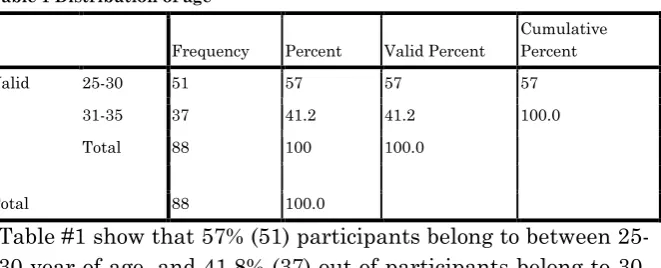
Table #1 show that 57% (51) participants belong to between 25-30 year of age, and 41.8% (37) out of participants belong to 25- 30-35 year of age.
Gender:
Table 2
Distribution of gender
Frequency Percent Valid Percent
Cumulative Percent
Valid Male 33 27.0 27.0 27.0
Female 55 62.0 62.0 100.0
Total 88 100.0 100.0
Table 1 Distribution of age
Frequency Percent Valid Percent
Cumulative Percent
Valid 25-30 51 57 57 57
31-35 37 41.2 41.2 100.0
Total 88 100 100.0
Table# 2 show that 27% (n=33) of the respondents were male and 62% (n=55) of the respondents were female.
Qualification:
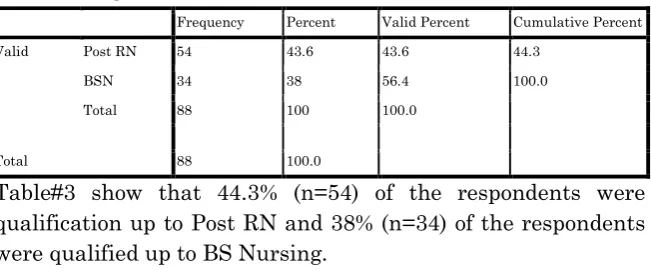
Table 3
Distribution of qualification
Frequency Percent Valid Percent Cumulative Percent
Valid Post RN 54 43.6 43.6 44.3
BSN 34 38 56.4 100.0
Total 88 100 100.0
Total 88 100.0
Table#3 show that 44.3% (n=54) of the respondents were qualification up to Post RN and 38% (n=34) of the respondents were qualified up to BS Nursing.
Section. II
What practices applied by the teachers of Lahore School of Nursing in their management of the classroom in the two areas (administrative, and educational) from the point of view of students?
Table: 1 Averages of the rating students
NO Area of Evaluation Average Percentage Grade
1 Administrative 3.85 0.76 High
2 Educational 3.53 0.71 Medium
3 The questionnaire as a whole
3.67 0.73 Medium
Results of the study for the second question:
Are there statistically significant differences in the practices applied in the university classroom management at the level of (0.05 = α) from the viewpoint of students attributed to the variables of gender, and the level of interaction between them? The two-way analysis of variance with statistical significance level of 0.05 using the statistical program SPSS, and the result showed no statistically significant effect for the gender and the level and the interaction between them at the level of (0.05 = α) for all areas of the questionnaire, and for the whole questionnaire, where the probability value was (P -Value> 0.05). Perhaps the reason for the lack of effect is that both genders are exposed to the same conditions, educational and administrative programs, and they have similar advantages, and the two levels (Diploma or Bachelor) are handled with the same administrative strategies or educational programs, even they may sit in the same classroom to learn some common educational programs.
DISCUSSION
Administrative area came at a high level for two reasons; first: teaching staff commitment to achieve security for students as the number of students is low, and the desire to achieve mutual respect between the two parties, and the second: The interest of teachers reflects their eagerness to build social intellectual system that helps to exchange the roles, considering that higher education is an important stage in the life of individuals, in particular that all the elements of the educational climate are available ; buildings, furniture and equipment, all of which are in favor of the educational process. This reflects the keenness of teachers to maintain a high level of classroom interaction management, it is the foundation to attract attention and increase the number of students.
acceptable but lower than the administrative area. The researcher believes that this may be due to the following reasons: Firstly, the presence of a high percentage of teachers without educational qualifications and this causes a decline in education according to the educational vision. Secondly, student’s interest to apply education outputs in the right manner has declined because of the decline of education system in the community as a whole.
Thirdly, perhaps the teaching methods applied are still the same: memorization and lecturing and do not focus on the mental construction, inquiry, and critical thinking. However, the total result came in the mid-level, and this may be attributed to the fact that the educational process in the college was not up to the ambitions of planners as is the case of education in the Arab world, because of the absence of educational programs and research on the part of teachers, for lack of financial support, not to mention overlooked feedback programs through which the educational plans are reviewed from time to time. It agreed with Abu Qedees study (2017) which stressed the inefficiency of teachers in the fields of education and management of university classroom.
CONCLUSION
The study came to investigate the level of teachers of Lahore School of Nursing in classroom management from the perspective of students, and after analyzing the responses to (32) items covered two areas: administrative, and educational. The total level of the questionnaire came in the mid-level affected by the educational area, which came in the mid –level, unlike the administrative area which occupied a high level. The study also confirmed the absence of the effect of gender or level and it does not constitute a disparity among the population of the study sample.
RECOMMENDATIONS
The study recommended the following:
1. Offer more training programs to develop the capacity of teachers in the field of educational sciences.
2. Brief the teaching staff on the results of the study, and compare them with the results of students in other university colleges.
3. Identify the items which came in the mid-level of the two areas, and analyze the common reasons.
REFERENCES
1. Ashman, A. F., & Conway, R. N. (2017). Using cognitive methods in the classroom: Routledge.
2. Borich, G. D. (2016). Observation skills for effective teaching: research-based practice. Routledge.
3. Brookfield, S. D. (2015). The skillful teacher: On technique, trust, and responsiveness in the classroom. John Wiley & Sons.
5. Freeman, J., Simonsen, B., Briere, D. E., & MacSuga-Gage, A. S. (2014). Pre-service teacher training in classroom management: A review of state accreditation policy and teacher preparation programs. Teacher Education and Special Education, 37(2), 106-120.
6. Gosain, K. (2016). Factors Influencing the use of Interactive Whiteboard. International Journal of Advanced Research, 3(3), 179-184.
7. Harbour, K. E., Evanovich, L. L., Sweigart, C. A., & Hughes, L. E. (2015). A brief review of effective teaching practices that maximize student engagement. Preventing School Failure: Alternative Education for Children and Youth, 59(1), 5-13.
8. Kennedy, M. J., Hirsch, S. E., Rodgers, W. J., Bruce, A., & Lloyd, J. W. (2017). Supporting high school teachers' implementation of evidence-based classroom management practices. Teaching and Teacher Education, 63, 47-57.
9. Larson, K. E., Pas, E. T., Bradshaw, C. P., Rosenberg, M. S., & Day-Vines, N. L. (2018). Examining how proactive management and culturally responsive teaching relate to student behavior: Implications for measurement and practice. School Psychology Review, 47(2), 153-166. 10. Metzler, M. (2017). Instructional models in physical
education. Routledge.
11. Schiefele, U. (2017). Classroom management and mastery-oriented instruction as mediators of the effects of teacher motivation on student motivation. Teaching and Teacher Education, 64, 115-126.
12. Stronge, J. H. (2018). Qualities of effective teachers: ASCD.
14. Tekindal, S., Roehrig, A. D., Jakiel, L. M., Arrastia, M. C., Rawls, E. S., & Izci, B. (2017). Differences in American and Turkish preservice teachers’ beliefs about the effectiveness of classroom management practices. International Journal of Pedagogies & Learning, 12(2), 101-116.
15. Tharp, R. (2018). Teaching transformed: Achieving excellence, fairness, inclusion, and harmony. Routledge. 16. Wolff, C. E., van den Bogert, N., Jarodzka, H., &
Boshuizen, H. P. (2015). Keeping an eye on learning: Differences between expert and novice teachers’ representations of classroom management events. Journal of Teacher Education, 66(1), 68-85.