c e-ISSN: 2348-6848, p- ISSN: 2348-795X Volume 2, Issue 12, December 2015
International Journal of Research (IJR)
Available at http://internationaljournalofresearch.org
Robust Image Segmentation for Removal of Distortion with
Reconstruction
Ashwini M; Navaneetha H P& Pooja C
Computer Science and Engineering (MTECH) MIT, MYSURU, INDIA
Abstract
A new algorithm is proposed for removing distortion from digital images. The challenge is to fill in the hole that is left behind in a visually reasonable way and reconstruction techniques for filling in small image gaps. We propose a best-first algorithm in which the confidence in the synthesized pixel values is propagated in a manner similar to the propagation of information in reconstruction. Reconstruction, the technique of modifying an image in an untraceable form, is as ancient as art itself. The goals and applications of reconstruction are numerous, from the restoration of damaged paintings and photographs to the removal/replacement of selected objects. In this paper, we introduce a novel algorithm for digital reconstruction of still images that attempts to replicate the basic techniques used by professional restorators . After the user selects the regions to be restored, the algorithm automatically fills-in these regions with information close them. The fill-in is done in such a way that isophote lines arriving at the regions’ boundaries are completed inside. In contrast with previous approaches, the technique here introduced does not require the user to specify where the novel information comes from. This is automatically done. Applications of this technique include the restoration of old photographs and damaged film; removal of superimposed text like dates, subtitles, or publicity; and the removal of entire objects from the image like microphones or wires in special effects.
Index Terms—Distortion; Image Reconstruction; Imagerestoration; isophotes; anisotropic diffusion
I. Introduction
In the current trends of the world, there are many advanced technologies to capture the image but there are many historical or old images which are distortion and those images are very important and there is a need to maintain and preserve them as the original image. Image is defined as an artifact that depicts or records visual insight. Images may be two dimensional such as photograph or three dimensional such as statue or hologram. They may be captured by optical devices such as camera, mirrors, lenses and etc. Sometimes these images may consist of distortions. The proposed system helps in removing the distortion which is present in the image and it reconstructs the image without any distortion.
The purpose of image segmentation is to partition an image into meaningful regions with respect to a particular application. The segmentation is based on measurements taken from the image and might be grey level, color, texture, depth or motion. Usually image segmentation is an initial and very important step in a series of processes aimed at overall image
understanding. Image segmentation includes identifying objects in a scene for object-based measurements such as size and shape and identifying objects in a moving scene for object-based video compression (MPEG4) and also helps in identifying objects which are at different distances from a sensor using depth measurements from a laser range finder enabling path planning for mobile robots.
Image processing has been developed extensively and now it routinely provides high-quality, robust reconstructions of noisy data collected by a wide variety of sensors and images. The field exists because it is impossible to build or find imaging instruments that produce arbitrarily sharp pictures, uncorrupted by measurement of distortion. It is, however, possible mathematically to reconstruct the underlying image from the non ideal data obtained from real-world instruments, so that the information present but hidden in the data is revealed with no distortion.
II. Related work
c e-ISSN: 2348-6848, p- ISSN: 2348-795X Volume 2, Issue 12, December 2015
International Journal of Research (IJR)
Available at http://internationaljournalofresearch.org
the user would need to go through the tremendous work of segmenting them and searching corresponding replacements throughout the picture. Although part of this search can be done automatically, this is extremely time consuming and requires the non-trivial selection of many critical parameters, Other texture synthesis algorithms, can be used as well to re-create a pre-selected texture to fill-in a (square) region to be reconstructed. In the group of disocclusion algorithms, a pioneering work is described. The authors presented a technique for removing occlusions with the goal of image segmentation. The second one is the basic idea is to connect T-junctions at the same gray-level with elastic minimizing curves. The technique was mainly developed for simple images, with only a few objects with constant gray-levels, and will not be applicable for the examples with natural images presented later in this paper. A very inspiring general variational formulation for disocclusion and a particular practical algorithm (not entirely based on PDE’s) implementing some of the ideas in this formulation. The algorithm performs reconstruction by joining with geodesic curves the points of the isophotes (lines of equal gray values) arriving at the boundary of the region to be reconstructed. As reported by the authors, the regions to be reconstructed are limited to having simple topology, e.g., holes are not allowed. The third one is the angle with which the level lines arrive at the boundary of the reconstructed region is not (well) preserved: the algorithm uses straight lines to join equal gray value pixels. These drawbacks, which will be exemplified later in this paper, are solved by our algorithm. On the other hand, we should note that this is the closest technique to ours and has motivated in part and inspired our work.
III. Our contribution
Algorithms devised for film restoration are not appropriate for our application since they normally work on relatively small regions and rely on the existence of information from several frames. On the other hand, algorithms based on texture synthesis can fill large regions, but require the user to specify what texture to put where. This is a significant limitation of these approaches, as may be seen in examples presented later in this paper, where the region to be reconstructed is surrounded by hundreds of different backgrounds, some of them being structure and not texture. The technique we propose does not require any user intervention, once the region to be reconstructed has been selected. The algorithm is able to simultaneously fill regions surrounded by different backgrounds, without the user specifying ―what to put where.‖ No assumptions on the topology of the region to be reconstructed, or on the simplicity of the image, are made. The algorithm is devised for reconstruction in structured regions (e.g., regions crossing through boundaries), though it is not devised to reproduce large textured areas. As we will discuss later, the combination of our proposed approach with texture synthesis techniques is the subject of current research.
IV. Digital Reconstruction Algorithm
A. Fundamentals of Algorithm
The core of our algorithm is an isophote-driven image sampling process. It is well-understood that exemplar-based approaches perform well for two-dimensional textures. But, we note in addition that exemplar-based texture synthesis is sufficient for propagating extended linear image structures, as well; i.e., a separate synthesis mechanism is not required for handling isophotes.
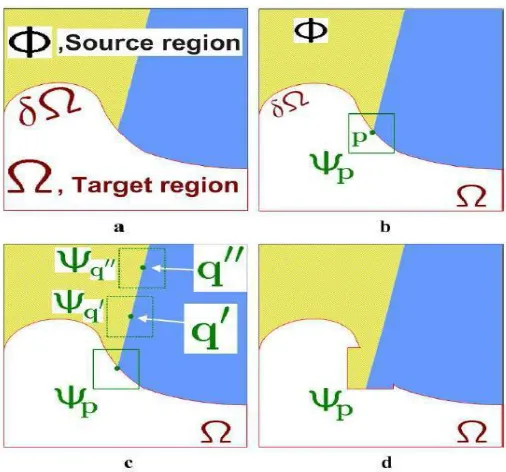
Figure 1. Structure propagation by exemplar-based texture synthesis. (a) Original image, with the target region -, its contour ±-, and the source region clearly marked. (b) We want to synthesize the area delimited by the patch ªp centred on the point p 2 ±-. (c) The most likely candidate matches for ªp lie along the boundary between the two textures in the source region, e.g., ªq0 and ªq00 . (d) The best matching patch in the candidates set has been copied into the position occupied by ªp, thus achieving partial filling of -. Notice that both texture and structure (the separating line) have been propagated inside the target region. The target region - has, now, shrank and its front ±- has assumed a different shape.
Figure 1 illustrates this point. For ease of comparison, we adopt notation similar to that used in the reconstruction literature. The region to be filled, i.e., the target region is indicated by and its contour is denoted ±-. The contour evolves inward as
c e-ISSN: 2348-6848, p- ISSN: 2348-795X Volume 2, Issue 12, December 2015
International Journal of Research (IJR)
Available at http://internationaljournalofresearch.org
inwards is a simple transfer of the pattern from the best-match source patch. (figure 1d). Notice that isophote orientation is automatically preserved. In the figure, despite the fact that the original edge is not orthogonal to the target contour ±-, the propagated structure has maintained the same orientation as in the source region. In this work we focus on a patch-based filling approach because, as noted in, this improves execution speed. Furthermore, we note that patch based filling improves the accuracy of the propagated structures.
B. Filling order is critical
The previous section has shown how careful exemplar-based filling may be capable of propagating both texture and structure information. This section demonstrates that the quality of the output image synthesis is highly influenced by the order in which the filling process proceeds. Furthermore, we list a number of desired properties of the ―ideal‖ filling algorithm. A comparison between the standard concentric layer filling (onion-peel) and the desired filling behavior is illustrated in figure 2. Figures 2b, c,d show the progressive filling of a concave target region via an anti-clockwise onion-peel strategy. As it can be observed, this ordering of the filled patches produces the horizontal boundary between the background image regions to be unexpectedly reconstructed as a curve. A better filling algorithm would be one that gives higher priority of synthesis to those regions of the target area which lie on the continuation of image structures, as shown in figures 2b’,c’,d’. Together with the property of correct propagation of linear structures, the latter algorithm would also be more robust towards variations in the shape of the target regions. A concentric-layer ordering, coupled with a patch-based filling may produce further artifacts.
avoiding ―over-shooting‖ artifacts that occur when image edges are allowed to grow indefinitely. The goal here is finding a good balance between the propagation of structured regions and that of textured regions (figure 2b’,c’,d’), without employing two adhoc strategies. As demonstrated in the next section, the algorithm we propose achieves such a balance by combining the structure ―push‖ with a confidence term that tends to reduce sharp in-shooting appendices in the contour of the target region. As it will be demonstrated, the filling algorithm proposed in this paper overcomes the issues that characterize the traditional concentric-layers filling approach and achieves the desired properties of: (i) correct propagation of linear structures, (ii) robustness to changes in shape of the target region, (iii) balanced simultaneous structure and texture propagation, all in a single, efficient algorithm. We now proceed with the details of our algorithm.
V. Comparisons with diffusion-based reconstruction.
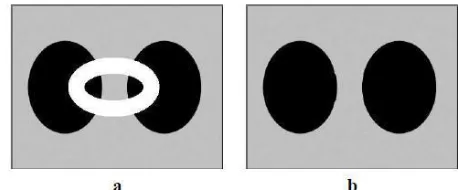
We now turn to some examples from the reconstruction literature. The first two examples show that our approach works at least as well as reconstruction. The first (figure 3) is a synthetic image of two ellipses. The occluding white torus is removed from the input image and the two dark background ellipses reconstructed via our algorithm (figure 3b). This example was chosen by authors of the original work on reconstruction to illustrate the structure propagation capabilities of their algorithm. Our results are visually identical to those obtained by reconstruction we now compare results of the restoration of a hand-drawn image.
Figure 2. The importance of the filling order when dealing with concave target regions. (a) A diagram showing an image and a selected target region (in white). The remainder of the image is the source. (b,c,d) Different stages in the concentric-layer filling of the target region. (d) The onion-peel approach produces artifacts in the synthesized horizontal structure. (b’,c’,d’) Filling the target region by an edge-driven filling order achieves the desired artifact-free reconstruction. (d’) The final edge-driven reconstruction, where the boundary between the two background image regions has been reconstructed correctly.
Therefore, filling order is crucial to non-parametric texture synthesis .To our knowledge, however, designing a fill order which explicitly encourages propagation of linear structure (together with texture) has never been explored, and thus far, the default favorite has been the ―onion peel‖ strategy. Another desired property of a good filling algorithm is that of
Figure 3. Comparison with traditional structure reconstruction. (a) Original image . The target region is the white ellipse in the centre. (b) Object removal and structure recovery via our algorithm.
c e-ISSN: 2348-6848, p- ISSN: 2348-795X Volume 2, Issue 12, December 2015
International Journal of Research (IJR)
Available at http://internationaljournalofresearch.org
Figure 4. Image restoration example. (a) Original image. The text occupies 9% of the total image area. (b) Result of text removal via our algorithm. (c) Detail of (a). (e) Result of filling the ―S‖ via traditional image-reconstruction. (d) Result of filling the ―S‖ via our algorithm. We also achieve structure propagation.
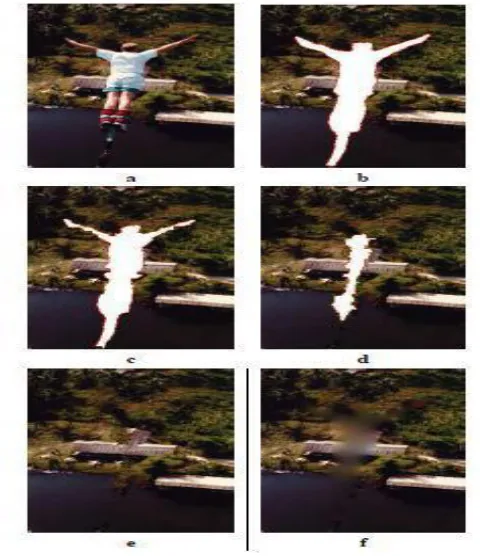
For comparison, figure 5f shows the result of filling the same target region (figure 5b) by image reconstruction5. Considerable blur is introduced into the target region because of reconstruction’s use of diffusion to propagate colour values. Moreover, high-frequency textural information is entirely absent.
Figure 5. Removing large objects from photographs. (a) Original image (b) The target region (in white with red boundary) covers 12% of the total image area. (c,d) Different stages of the filling process. Notice how the isophotes hitting the boundary of the target region are propagated inwards while thin appendices (e.g., the arms) in the target region tend to disappear quickly. (e) The final image where the bungee jumper has been completely removed and the occluded region reconstructed by our automatic algorithm (performed in 18 00, to be compared with 10 0 of Harrison’s resynthesizer). (f) The result of region filling by traditional image reconstruction. Notice the blur introduced by the diffusion process and the complete lack of texture in the synthesized area.
VI. Results
The CPU time required for reconstruction depends on the size of. In all the color examples here presented, the reconstruction process was completed in less than 5 minutes (for the three color planes), using non-optimized C++ code running on a PentiumII PC (128Mb RAM, 300MHz) under Linux. All the examples use images available from public databases over the Internet. Here is large (30 pixels in diameter) and contains a hole. The reconstructed reconstruction is shown on the right. Notice that contours are recovered, joining points from the inner and outer boundaries.
Also, these reconstructed contours follow smoothly the direction of the isophotes. A deteriorated B&W image (first row) and its reconstruction (second row). As in all the examples in this article, the user only supplied the ―mask‖ image (last row). This mask was drawn manually, using a paintbrush-like program. The variables were set to the values specified in the previous section, and the number of iterations T was set to 3000. When multiresolution is not used, the CPU time required by the reconstruction procedure was approximately 7 minutes.
With a 2-level multiresolution scheme, only 2 minutes were needed. Observe that details in the nose and right eye of the middle girl could not be completely restored. This is in part due to the fact that the mask covers most of the relevant information, and there is not much to be done without the use of high level prior information (e.g., the fact that it is an eye). These minor errors can be corrected by the manual procedures mentioned in the introduction, and still the overall reconstruction time would be reduced by orders of magnitude. This example was tested and showed to be robust to initial conditions inside the region to be reconstructed. Figure 6 shows a vandalized image and its restoration, followed by an example where overimposed text is removed from the image.
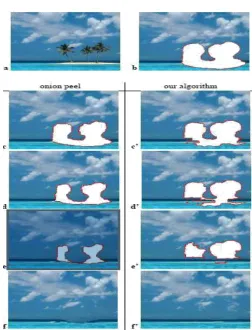
We show more examples on photographs of real scenes. Figure 5 demonstrates, again, the advantage of the proposed approach in preventing structural artefacts. While the onionpeel approach produces a deformed horizon (figure 6f), our algorithm reconstructs the boundary between sky and sea as a convincing straight line (figure 6f). During the filling process this task. Our method performs at least as well as previous techniques designed for the restoration of small
c e-ISSN: 2348-6848, p- ISSN: 2348-795X Volume 2, Issue 12, December 2015
International Journal of Research (IJR)
Available at http://internationaljournalofresearch.org
Figure 6. Concentric-layer filling vs. the proposed guided filling algorithm. (a) Original image. (b) The manually selected target region (20% of the total image area) has been marked in white with a red boundary. (c,d,e,f) Intermediate stages in the concentric-layer filling. The deformation of the horizon is caused by the fact that in the concentric-layer filling sky and sea grow inwards at uniform speed. Thus, the reconstructed sky-sea boundary tends to follow the skeleton of the selected target region. (c’,d’,e’,f’) Intermediate stages in the filling by the proposed algorithm, where the horizon is correctly reconstructed as a straight line.
Figure 7.. Removing large objects from photographs. (a) Original image. (b) The target region (10% of the total image area) has been blanked out. (c: : :e) Intermediate stages of the filling process. (f) The target region has been completely filled and the selected object removed. The source region has been automatically selected as a band around the target region. The edges of the stones have been nicely propagated inside the target region together with the water texture.
VII. Conclusions and future work
In this paper we have introduced a novel algorithm for image reconstruction that attempts to replicate the basic techniques used by professional restorators. The basic idea is to smoothly propagate information from the surrounding areas in the isophotes direction. The user needs only to provide the region to be reconstructed, the rest is automatically performed by the algorithm in a few minutes. The reconstructed images are sharp and without color artifacts. The examples shown suggest a wide range of applications like restoration of old photographs and damaged film, removal of superimposed text, and removal of objects. The results can either be adopted as a final restoration or be used to provide an initial point for manual restoration, thereby reducing the total restoration time by orders of magnitude. One of the main problems with our technique is the reproduction of large textured regions. The algorithm here proposed is currently being tested in conjunction with texture synthesis ideas to address this issue. We are mainly investigation the combination of this approach with the reaction-diffusion ideas of Kass and Witkin and of Turk. An ideal algorithm should be able to automatically switch between textured and geometric areas, and select the best suited technique for each region. We would also like to investigate how to inpaint from partial degradation. In the example of the old photo for example, ideally the mask should not be binary, since some underlying information exists in the degraded areas. The reconstruction algorithm here presented has been clearly motivated by and has borrowed from the intensive work on the use of Partial Differential Equations (PDE’s) in image processing and computer vision. When ―blindly‖ letting the grid go to zero, the reconstruction technique naively resembles a third order equation, for which too many boundary conditions are imposed (being all of them essential). Although theoretical results for high order equations are available, and some properties like preservation of the image moments can be immediately proved for our corresponding equation (this was done by A. Bertozzi), further formal study of our ―high order equation‖ is needed.
Nevertheless, this suggests the investigation of the use of lower, second order, PDE’s to address the reconstruction problem. We can split the reconstruction problem into two coupled variational formulations, one for the isophotes direction and one for the gray-values, consistent with the estimated directions. The corresponding gradient descent flows will give two coupled second order PDE’s for which formal results regarding existence and uniqueness of the solutions can be shown.
Acknowledgement
c e-ISSN: 2348-6848, p- ISSN: 2348-795X Volume 2, Issue 12, December 2015
International Journal of Research (IJR)
Available at http://internationaljournalofresearch.org
without which this project would not have been possible. We would also like to thank all our ISE staff members who have always been with us extending their precious suggestions, guidance and encouragement throughout the project. Lastly, we would like to thank our parents and friends for their support, encouragement and guidance throughout the project.
REFERENCES
[1] M. Ashikhmin. Synthesizing natural textures. In
Proc. ACM Symposium on Interactive 3D Graphics, pages 217–226, Research Triangle Park, NC, March 2001.
[2] C. Ballester, V. Caselles, J. Verdera, M. Bertalmio, and G. Sapiro. A variational model for filling-in gray level and color images. In
Proc. Int. Conf. Computer Vision, pages I: 10–16, Vancouver,Canada, June 2001.
[3]M. Bertalmio, A.L. Bertozzi, and G. Sapiro. Navier-stokes, fluid dynamics, and image and video inpainting. In Proc. Conf. Comp.Vision Pattern Rec., pages I:355– 362, Hawai, December 2001.
[4]M. Bertalmio, G. Sapiro, V. Caselles, and C. Ballester. Image inpainting. In Proc. ACM Conf. Comp. Graphics (SIGGRAPH), pages 417–424, New Orleans, LU, July 2000. http://mountains.ece.umn.edu/
»guille/inpainting.htm.
[5]M. Bertalmio, L. Vese, G. Sapiro, and S. Osher. Simultaneous structure and texture image inpainting. In
Proc. Conf. Comp. Vision Pattern Rec., Madison, WI, 2003. http://mountains.ece.umn.edu/
»guille/inpainting.htm.
[6]R. Bornard, E. Lecan, L. Laborelli, and J-H. Chenot. Missing data correction in still images and image sequences. In ACM Multimedia, France, December 2002.
[7]T. F. Chan and J. Shen. Non-texture inpainting by curvature-driven diffusions (CDD). J. Visual Comm. Image Rep., 4(12):436– 449, 2001.
[8]A. Criminisi, P. Perez, and K. Toyama. Object removal by exemplar-based inpainting. In Proc. Conf. Comp. Vision PatternRec., Madison, WI, Jun 2003.