Traffic-Aware Channel Allocation Scheme to
Improve the Throughput of IEEE 802.15.4
based Wireless Sensor Networks
Mini S. P.
1, S. Viswanatha Rao
2, Sakuntala S. Pillai
3PG Student [TCE], Dept. of ECE, Mar Baselios College of Engineering and Technology, Trivandrum, Kerala, India1
Vice Principal, Mar Baselios College of Engineering and Technology, Trivandrum, Kerala, India2
Dean (R&D), Dept. of ECE, Mar Baselios College of Engineering and Technology, Trivandrum, Kerala, India3
ABSTRACT: Multi-channel MAC protocol is a vital solution to enhance the capacity of wireless sensor networks (WSNs). Most of the existing multi-channel MAC protocols allocate channels based on the neighboring nodes without considering the traffic density of each node. By considering different traffic weights of different nodes we can improve the channel capacity of wireless sensor networks. This paper presents traffic aware channel assignment method based on 3-hop neighborhood which enhances the throughput of 802.15.4 MAC by reducing the number of packets dropped. Simulation results using NS2 demonstrates improvement in throughput and reduction in average end to end delay.
KEYWORDS: Wirelesspersonal area networks; IEEE 802.15.4; packet drop rate; throughput; multi-channel MAC.
I.INTRODUCTION
WSNs consist of large number of inexpensive and low power sensor nodes [1]. Numerous applications of WSN have been proposed, which includes habitat and environmental observation, calamity management, enemy detection etc. Distribution of sensor nodes in these applications is in random/fixed manner. Even though WSN is used for wide verity of applications there are some limitations for WSN. One of the major constraints is the low power capacity of sensor nodes. Each sensor node includes sensing, computing and communication units. Among these units communication unit consumes more power. During MAC design process minimizing the energy consumption of this unit is extremely important [2]. Communication characteristics and traffic pattern awareness contribute more in energy efficient MAC design.
Medium access control (MAC) layer is the part of data link layer in the open system interconnection (OSI) layer model and is responsible for proper communication through the channel. Majority of the existing MAC protocols are based on single channel communication. In single channel MAC communication any node within the range can interfere with the ongoing transmission. This may lead to collision and packet loss. In a multi-hop wireless sensor network a successful packet transmission occurs after several retransmissions due to packet collisions. This degrades the network performance.
This paper evaluates a traffic aware channel allocation method based on 3-hop neighbourhood which improves the network performance of IEEE 802.15.4 MAC. The IEEE 802.15.4 MAC [4] standard is especially designed for low data rate Wireless Personal Area Networks (WPANs). This standard supports simple, ultra low power and low cost applications. As a result, the IEEE 802.15.4 MAC has been widely used in WSNs employed in low data rate applications. IEEE 802.15.4 MAC supports 16 non-interfering channels within the Industrial, Scientific and Medical (ISM) band.
Simulations of this channel allocation method has been done using NS-2 simulator. The performance of WSNs with IEEE 802.15.4 MAC has been analysed based on the packet arrival rate. The variations in average end-to-end delay, number of lost packets and the network throughput, with respect to the packet arrival rate, have been studied and the results have been plotted. The results show that traffic aware channel allocation method improves the performance of the network, by increasing the throughput and reducing the packet drop rate and latency.
The rest of the paper is organized as follows: Section II gives a brief overview of the IEEE 802.15.4 MAC operation. The related works on performance analysis of WSNs employing IEEE 802.15.4 MAC have been discussed in Section III. Traffic aware channel allocation method is described in Section IV. The simulation scenario and simulation results have been explained in detail in Sections V and VI respectively. Section VII concludes the paper.
II.OVERVIEW OF IEEE 802.15.4
IEEE 802.15.4 standard provides physical and MAC layer specification for low rate wireless personal area networks. IEEE 802.15.4 standard was intended to enable simple, ultra low power and low data rate wireless connectivity among various devices.
A) Physical Layer Characteristics
Physical layer is the base layer of OSI model. It provides the data transmission service. Networks based on IEEE 802.15.4 operate on three RF bands: 868, 915 and 2450 MHz bands. Last band does not require licensing and it is known as Industrial, Scientific and Medical (ISM) band. According to the original standard (IEEE 2003b), 868 and 915 MHz frequency bands utilized Direct Sequence Spread Spectrum (DSSS) with data rates of 20 kbps and 40kbps respectively and data rate of ISM band is 250 kbps. Revised standard IEEE 2006 allows data rate up to 250 kbps for 868and 915 MHz bands.
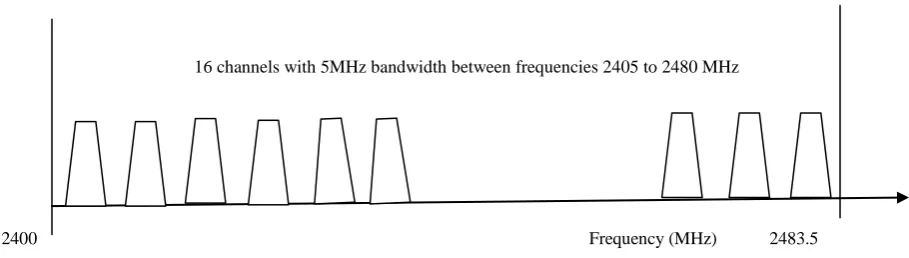
All three bands together provide 27 channels. 868 MHz band provides a single channel at 868.3 MHz frequency. 915 MHz band provides 10 channels with 2 MHz bandwidth between 906 to 924 MHz. ISM band supports 16 non-interfering channels having 5 MHz bandwidth between frequencies 2405 to 2485 MHz. Fig. 1 illustrates the channel structure in ISM band.
Physical layer can operate data packets with a maximum payload of 127 bytes. This standard has ability to adjust the transmitting power, ability to measure the strength/ quality of received signal and the ability to check for the activity in the medium.
16 channels with 5MHz bandwidth between frequencies 2405 to 2480 MHz
2400 Frequency (MHz) 2483.5
i) Network Model
In IEEE 802.15.4 network, the PAN coordinator is the controller device and it builds a network with other devices. Two types of devices are used in 802.15.4 networks. Full Function Device (FFD) can act as a PAN coordinator or an ordinary device and FFD can talk to any device in the network. Reduced Function Device (RFD) acts as an ordinary device. It can only talk to an FFD.
ii) Topologies
This standard supports two topologies: Star topology and peer-to-peer topology. In a star topology all communications must go through the PAN coordinator. In peer-to-peer topology devices can communicate with each other directly with or without a PAN coordinator.
B) MAC Layer Characteristics
The Medium Access Control (MAC) supports the transmission of MAC frames through the physical channel. MAC layer itself manages physical channel access and network beaconing. It also controls validation of frames, guarantees time slots and node associations. Two operating modes in this standard are beacon enabled mode and non-beacon enabled mode.
In beacon enabled mode the coordinator periodically emits a special frame known as beacon. Super frame/ beacon interval is the time gap between two beacon frames. It is divided into two: an active period and an inactive period. All communications are carried during the active period. Active period is subdivided into Contention Access Period (CAP) and Contention Free Period (CFP). Each sub section contains a number of slots having same size. PAN coordinator sends beacon frames at the beginning of slot0 and it is followed by CAP. During CAP channel access is done based on CSMA/CA mechanism. In CFP, devices can access the channel by using Guaranteed Time Slots (GTSs). Inactive period is used for power saving by turning off the transceiver or moving into low power mode. Two MAC layer attributes; beacon order (BO) and superframe order (SO) controls the duration of beacon interval and active part of superframe respectively with a condition that it must satisfy the limit 0≤ SO ≤ BO ≤ 15. This mode utilizes slotted CSMA/CA mechanism to access the medium.
Non-beacon enabled mode does not support the superframe. In which, values of BO and SO is set to 15. In this mode coordinator does not emit beacons unless a device particularly request to do so. Due to the absence of beacon frames, devices can transmit data at any time. In this mode each node can communicate with any other device directly, without the help of a coordinator. This mode uses Un-slotted CSMA/CA technique to access the channel.
i) Uplink Communication in Beacon Enabled Mode
Uplink communication is the data transfer from node to the coordinator. This follows CSMA/CA algorithm. First step in slotted CSMA/CA algorithm is to set initial values for the state variables. i.e, the contention window (CW) is set to 2, the number of backoff stages (NB) is set to zero and the backoff exponent (BE) is set to macMinBE(default value is 3). Then a backoff timer is initialized using a random backoff time within the interval [0,(2BE – 1)], distributed according to the uniform distribution. When the backoff timer reaches zero, algorithm performs the Clear Channel Assessment (CCA) operation. If the channel is free for data transmission after the first CCA operation, then CW is decremented by 1and a second CCA is carried out and the process is repeated until the value of CW becomes zero. The packet is transmitted only if the value of CW equals zero. Otherwise, if the channel is found to be busy, then the state variables are updated, and this continues till the maximum limit of NB is reached. In this case, the data frame transmission is dropped. After receiving the data packet, the coordinator sends an optional acknowledgement. If the acknowledgement packet is not received within the time limit sender node initiates retransmission.
ii) Downlink Communication in Beacon Enabled Mode
acknowledgement packet to the destination node. Destination node listens for a period of aMacFrameResponseTime, after receiving the acknowledgement. During this period the coordinator send the data packet. After the successful reception of data packet, destination node sends an optional acknowledgement.
III.RELATED WORKS
Many researchers evaluated the performance of IEEE 802.15.4 MAC protocol under various scenarios. V. Kumar et al.[5] studied the performance of beacon enabled IEEE 802.15.4 MAC by using a cross layer approach for clustered wireless sensor networks. For the performance evaluation, they used Low energy adaptive clustering hierarchy protocol (LEACH) as clustering protocol and Dynamic MANET on-demand (DYMO) as routing protocol. The authors show that the clustered wireless sensor networks give better performance over non-clustered wireless sensor networks in terms of average jitter and end to end delay. They also prove that this clustered method degrades the performance of network by reducing throughput and increasing the energy consumption.
In [6] authors propose the circularity principle to improve the performance of IEEE 802.15.4 MAC. This method minimizes the number of data packet collision by modifying the data transmission from each node corresponding to time. Evaluation is done using AODV protocol by varying the number of nodes. They show that this method improves the throughput by reducing the number of dropped packets.
Shih, Bih-Yaw et al.[7] suggest two channel selection methods to enhance the performance of IEEE 802.15.4 MAC. They used a hybrid channel selection method based on hashing technique. Proposed method improves the performance of a wireless sensor network with star topology. They showed the performance improvement by measuring throughput, delay, channel utilization and average delay.
Authors in [8], improve the performance of IEEE 802.15.4 MAC with the help of practical service differentiation mechanisms. They ensure backward compatibility with the standard by making minor changes from the original protocol. Differentiated service scheme mainly focused on improving the performance of time-sensitive messages. They also analysed the performance of data frames in terms of average delay and probability of success.
IV.TRAFFIC AWARE CHANNEL ALLOCATION
This section describes a traffic aware channel allocation method used in this paper. Most of all existing multi-channel MAC protocols allocate channels based on information about neighboring nodes. According to this list available channels are allocated to all nodes in the network. Channel allocation based on neighboring nodes does not consider traffic weight of each node. Considering the communication characteristics and traffic pattern will enhance the throughput of WSNs. Various types of communication traffics are data traffic, routing discovery traffic, link layer traffic and hello packets etc. This paper mainly focuses on data traffic.
The data traffic density of WSNs varies from network to network, i.e, traffic density is application dependent. WSN applications can be classified as event-driven or periodic traffic generation applications. For periodic traffic generation applications, constant bit rate (CBR) traffic can be used to model the network. Poisson process can be used for variable bit rate applications. This paper deals with CBR traffic. Even though a network follows CBR traffic, traffic requirement of individual nodes varies corresponding to the traffic pattern and number of traffic flows in the network.
In traffic aware channel method, each coordinator performs a passive scan for collecting information about neighboring nodes, which include the node IDs and their traffic weight. A node finds it’s 1-hop neighbor from the source address of received beacon frame. Each node forms its 1-hop neighbor’s list by using the source address of received beacon frames. 2-hop neighbor’s list can be formed with the help of 1-hop neighbor’s list and the 1-hop and 2-hop neighbor’s list together helps to build the 3-hop neighbor’s list.
nodes. From the number of packets received/passed by each node, we will get the knowledge of traffic requirement of each node.
After collecting all information, available channels are allocated to all nodes in the network. Nodes in the 3-hop neighbor list select the channel first according to the priority based on nodes traffic weight. Priority is in decreasing order of nodes traffic density, i.e. highest priority goes to the node with highest traffic weight. When a node selects its channel, it broadcasts this information in the network using beacon frame. Therefore, all the nodes can update the load of allocated channel. If two nodes have equal traffic weights, the node with smaller ID chooses its channel first. In 3-hop method, same channel is reused only in the 3-3-hop neighborhood. After allocating all the channels, node selects one of the least chosen channels.
For example, consider the system model as shown in Fig. 2. In this model, nodes 2, 6, 7, 8 and 11have higher traffic density compared to the other nodes. If we are assigning channels without considering this traffic imbalance we will not get the maximum throughput. This is because the nodes with higher traffic maybe assigned to a channel with heavy load. This will increase the packet loss due to the increase in number of collisions. Among these nodes, node 7 has highest traffic density. Channel assignment based on traffic density assign channels for different nodes in the decreasing order of traffic density. i.e., in this model node 7 chooses its channel first.
Fig. 2 Network model
Thus we can improve the network performance by considering the traffic density while allocating channels. Collision rate of the network is directly proportional to the traffic density of the network. Consideration of the traffic rate of each node in the channel allocation method will help reduce the number of dropped packets. Reduction in dropped packets enhances the network throughput and thereby improves the performance of the network.
V.SIMULATION SCENARIO
We analyze IEEE 802.15.4 MAC performance using traffic aware channel allocation method based on 3-hop neighbourhood. 3-hop neighborhood channel allocation method reuses the same frequency only in its 3-hop neighborhood. Number of collisions occurred in a network with channel allocation method based on 3-hop method is comparatively very less than that of 1-hop and 2-hop method [9]. A cluster-tree type beacon-enabled network topology is selected to make the system energy efficient.
The network model with 20 nodes is shown in Fig. 2. Each node in this network model represents a Full Function Device (FFD). The depth of the network is five. Node 0 in depth 0 acts as a PAN coordinator. All other nodes are coordinators. Each node in the network transmits data packets, to the PAN coordinator (uplink transmission). The PAN coordinator broadcasts downlink beacon frames to all nodes in the network to update the information about all nodes.
All the simulations have been carried out in the Network Simulator NS-2 [10]. The traffic in the network is assumed to be Constant Bit Rate (CBR). The protocol used in the transport layer is the Transmission Control Protocol (TCP), since it ensures high reliability in packet transmission. The data rate is assumed to be 250 kbps and the total simulation time is 60 seconds.
The initial energy of each node is assumed to be 50 J. The values of the power consumptions during transmit, receive, idle and sleep states of the nodes have been taken from the datasheets of commercial sensor nodes. Table 1 represents the simulation parameters.
In the simulation, we have considered four different traffic flows. The graphs in Section V show the variation in number of dropped packets, average end-to-end delay and throughput in the network, with respect to the packet arrival rate. The packet arrival rate has been varied from 100 kbps to 190 kbps. Each point in the graph has been obtained by averaging over a large number of iterations.
TABLE1. SIMULATION PARAMETERS
Parameter Value
Simulation area 120 m x 120 m
Simulation time 60 seconds
Packet size 50 bytes
Antenna Omni-directional
Transmission frequency 2.4 GHz
Traffic CBR
Routing protocol AODV
MAC protocol IEEE 802.15.4
Initial energy 50 J
Data rate 250 kbps
VI.RESULTS & DISCUSSIONS
In this section we evaluate the performance of channel allocation method based on 3-hop method and compare it with other methods. Parameters used for evaluation are number of dropped packets, average end to end delay and throughput.
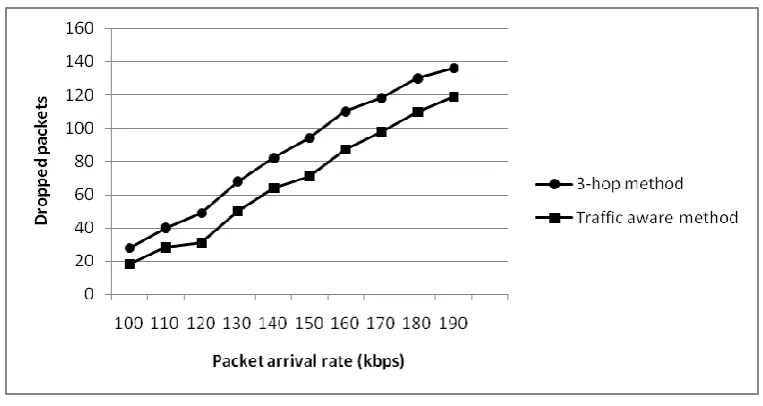
number of dropped packets becomes very less in traffic aware method, for the same packet arrival rate. This is because of the facts that the traffic-aware method consider traffic density in channel allocation in addition to frequency assigned for a particular node is reused only in its 3-hop neighborhood. So the number of collisions is very less in traffic-aware method compared to the other method.
Fig. 3 Number of dropped packets
The average end-to-end delay of the network is the average time taken for a data packet to reach the destination node from the source node which generates it. Fig. 4 shows that the average end-to-end delay increases with increasing packet arrival rate. Traffic density is low when the packet arrival rate is less, which means the number of packets generated will be small, which leads to less number of collisions. The number of retransmissions becomes very less in this situation. So the average end-to-end delay is also less. When the packet arrival rate increases, traffic density also increases, this in turn leads to a rapid increase in the number of collisions. This demands the retransmission of packets and thereby increasing the time required for successful delivery of packets, which increases the average end-to-end delay. Traffic-aware method provides lowest average end to end delay.
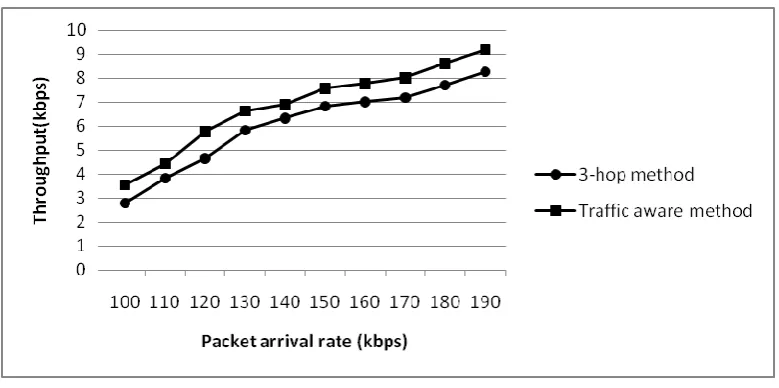
Fig. 5 shows enhancement in network throughput corresponding to packet arrival rate. Throughput increases with increase in packet arrival rate, since number of packets generated increases with increase in packet arrival rate. Therefore, the number of packets received increases with increase in packet arrival rate. Traffic aware method achieves highest throughput among the four methods. This is because traffic-aware method has least number of dropped packets.
Fig. 5 Throughput
VII.CONCLUSION
This paper presents traffic aware channel allocation technique based on 3-hop neighborhood method. We evaluate the performance of this method in terms of number of dropped packets, average end to end delay and throughput. This analysis showed that traffic aware channel allocation based on 3-hop method enhances the network throughput by decreasing the number of dropped packets.
REFERENCES
[1] A. A. A. Alkhatib and G. S. Baicher, “Wireless sensor network architecture," in International conference on computer networks and communication systems (CNCS 2012) IPCSIT, vol. 35, pp. 11-15, 2012.
[2] B. Narain, A. Sharma, S. Kumar, and V. Patle, “Energy efficient mac protocols for wireless sensor networks: A survey," International Journal of Computer Science & Engineering Survey (IJCSES) Vol, vol. 2, 2011.
[3] Y. Wu, M. Keally, G. Zhou, and W. Mao, “Traffic-aware channel assignment in wireless sensor networks," in Wireless Algorithms, Systems, and Applications, pp. 479-488, Springer, 2009.
[4] IEEE Std. 802.15.4-2006: Wireless Medium Access Control (MAC) and Physical Layer (PHY) Specifications for Low-Rate Wireless Personal Area Networks (WPANs), IEEE Std., September 2006.
[5] V. Kumar, A. Raghuvansi, and S. Tiwari, “Performance study of beacon-enabled ieee 802.15. 4 standard in wsns with clustering," in Power, Control and Embedded Systems (ICPCES), 2010 International Conference on, pp. 1-5, IEEE, 2010.
[6] R. Bhakthavathsalam, “Enhancement of throughput in 802.15. 4 mac layer using the principle of circularity," in Novel Algorithms and
Techniques In Telecommunications, Automation and Industrial Electronics, pp. 300{304, Springer, 2008
.
[7] B.-Y. Shih, C.-Y. Chen, C.-H. Shih, and J.-Y. Tseng, “The development of enhancing mechanisms for improving the performance of ieee 802.15. 4," International Journal of the Physical Sciences, vol. 5, no. 6, pp. 884-897, 2010.
[8]
A. Koubaa, M. Alves, B. Nefzi, and Y.-Q. Song, “Improving the ieee 802.15. 4 slotted csma/ca mac for time-critical events in wireless sensor networks," 2006.
[9]