Available online: https://edupediapublications.org/journals/index.php/IJR/ P a g e | 1457
Nano Material Sysnthesis
NARSE VIJAYA KUMAR
ADVANCE-MANUFACTURING SYSTEMS
PYDAH COLLEGE OF ENGINEERING
Mr.J.RAJASEKHAR
ASSOCIATE PROFESSOR
ADVANCE-MANUFACTURING SYSTEMS
PYDAH COLLEGE OF ENGINEERING
ABSTRACT:
A Copper nanoparticle based composite with grapheme oxide have prepared. The Cu/GO Nano composite was characterized by XRD and SEM technique. As grapheme based Nano composite have several important application like Photo catalyst, Sensor, Energy storage material, Fuel cell and Environmental issues as well as also in some Organic coupling reactions and in biological field so the present work could be considered as a potential for some novel application.
1.INTRODUCTION
1.1 BASIC STUDY OF CNT:
Carbon NANO tubes, discovered just over a decade ago, have enjoyed unprecedented attention from the scientific community due to the extraordinary properties that arise as a result of their unique structure. Carbon NANO tubes are an allotrope of carbon and may be envisioned as tubes formed by rolled up graphitic sheets. The NANO tubes form either as single walled NANO tubes (SWNTs), or multi walled NANO tubes (MWNTs), depending on the reaction conditions. They are extremely strong and thermally conductive. Their electrical
properties are interesting, as the nature of the electrical conductivity depends on the twist, of each tube; the electrical conductivity ranges from semiconducting to metallic, in nature. There are a number of reports in the literature of composites of carbon NANO tubes and polymeric matrices; the results indicate that even small amounts of NANO tubes (< 5 wt %) can have a significant influence on the electrical and mechanical properties of the composite. This technical memorandum gives a brief overview of carbon NANO tubes, their applications, and a summary of the recent literature of polymer – NANO tube composites.
Available online: https://edupediapublications.org/journals/index.php/IJR/ P a g e | 1458
1.2 A. Carbon NANO tube-Polymer
NANO composites
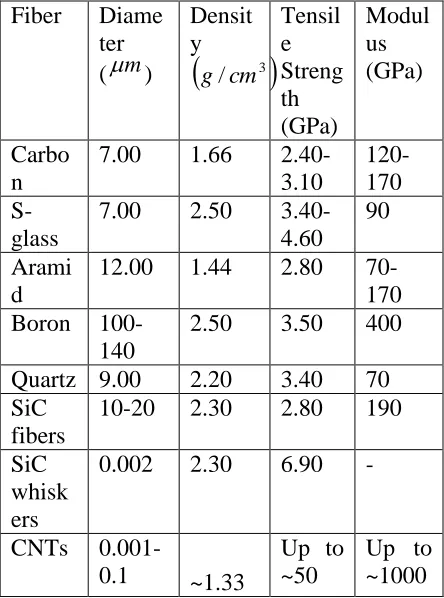
Since the discovery of carbon NANO tubes (CNTs) by Iijima , CNTs have become a subject of much research across a multitude of disciplines. A single-wall carbon NANO tube (SWCNT) can be viewed as a single sheet of graphite (i.e. graphene), which has been rolled into the shape of a tube . In addition to SWCNTs, there are also multi-wall carbon NANO tubes (MWCNTs) which can similarly be viewed as multiple graphene sheets stacked and rolled into the shape of tube (see Figure 1). CNTs have radii on the order of nanometers and lengths on the order of micrometers resulting in large aspect ratios beneficial to their use in composites , especially given the exceptional properties CNTs are believed to posses. For example, carbon NANO tubes (CNTs) are reported to have a Young’s modulus along the tube axis in the range of 300-1000 GPa, up to five times the stiffness of SiC fibers and with half the density (see Table I which provides a comparison of CNTs with other common fiber reinforcement materials), in addition to having a theoretically predicted elongation to break of 30. 40% . In addition, CNTs can be either metallic or semi-conducting depending
on the tubes chiral, or roll-up angle, which indicates the orientation of the hexagonal carbon rings relative to the tube axis . Metallic CNTs have been observed to conduct electrons ballistically, (with no scattering) having coherence lengths of several microns and with a current density measured as high as 109 A/cm2 (the highest of any known material). Similarly, CNT bundles have been observed to have a measured resistivity of 1E − 3 ohm-cm at 300 K , resulting in a conductivity higher
than any other known fiber. Finally, looking at thermal properties, CNTs have now been shown to have a thermal conductivity at least twice that of diamond
Table I. Properties of carbon NANO tubes in comparison with other common fiber reinforcement materials
Fiber Diame ter (m)
Densit y
3
/cm g Tensil e Streng th (GPa) Modul us (GPa) Carbo n
7.00 1.66 2.40-3.10
120-170
S-glass
7.00 2.50 3.40-4.60
90
Arami d
12.00 1.44 2.80 70-170 Boron
100-140
2.50 3.50 400
Quartz 9.00 2.20 3.40 70 SiC
fibers
10-20 2.30 2.80 190
SiC whisk ers
0.002 2.30 6.90 -
CNTs
0.001-0.1 ~1.33
Up to ~50
Up to ~1000
Available online: https://edupediapublications.org/journals/index.php/IJR/ P a g e | 1459 toughness of the composite and indicating a
need for multi scale analysis. Another example of particular interest, NANO tubes have been introduced into non-conducting polymers in attempts to make light-weight3 conducting polymer composites which can serve in structural applications while performing additional functions such as improving electromagnetic interference shielding efficiency and assisting in meeting electro-static discharge and grounding requirements for aircraft and spacecraft. Applications for CNTs in engineering systems are likely to focus in the near term on the enhancement of the mechanical, thermal and electrical properties of materials currently in use. As such, a wide variety of composites containing CNTs have been manufactured to take advantage of the reported high stiffness ( 1 TPa ), high strength ( 150 GPa ), as well as high thermal
and electrical conductivities ( Ω 2000
W/mK and 1000 − 200, 000 S/cm ,
respectively) of CNTs. Peigney et al. have fabricated composites specimens of CNTs embedded in ceramic powders while Milo et al. have embedded CNTs in poly(vinyl alcohol). Melt mixing has been used by Potschke et al. to introduce CNTs into a polyethylene matrix. Such efforts have identified several key challenges in the fabrication of CNT composites. Adequate dispersion of CNTs within the matrix has been a key issue given the tendency of CNTs to form bundles due to inter atomic forces.
2.LITERATURE REVIEW
Carbon nanotubes (CNTs) have been studied due to its unique properties and attracted in the field of research because of their application in different fields of nanotechnology [1, 2]. They have size in the
order of nanometer and large surface area that offers excellent gas absorption properties. The absorption of gas on the CNT surface at room temperature varies its electrical properties with fast response, which enables them to be a potential candidate for gas sensing applications [3-5]. Because of its small diameter, directly comparable to the size of an analyte molecule and the fact that every single atom of Carbon is in direct interaction with the environment, optimal interaction with neighborhood molecules occur, hence fabrication of highly sensitive electronic sensors is possible.
All the Carbon atoms in a Carbon nanotube are surface atoms makes them suitable for interaction with the analyte molecule. Gas sensors made from individual nanotubes have good sensitivity at room temperature [6], in comparison with the commercially available semiconductor sensors operating at a temperature above 200 oC. The adsorption of the analyte on the surface of the nanotubes happens with a partial transfer of charges, resulting in the variation of charge carrier concentration. The adsorbed analyte molecules vary the potential barriers present at the tube-electrode contacts, resulting in the alteration of electrical resistance and production of a sensor signal.
Available online: https://edupediapublications.org/journals/index.php/IJR/ P a g e | 1460 mechanism for the long-term drift in metal
oxide semiconductors. In order to avoid the long-term changes in their response could be done by operating the sensors at low temperatures without structural changes, without disturbing the gas reaction rate.
Carbon nanotubes have many potential applications such as catalyst support [7], electronic device [8], Li-ion batteries [9], nanoelectronic devices [10], and chemical sensors [11]. The ability of CNT for detecting polluting gases arises due to high surface area,provided by central hollow cores and outside side-walls, leading to the change in the electrical conductivity at room temperature on exposure to gas analyte.
In multiwall Carbon nanotube (MWCNT), the electrical resistance is mainly determined by the atom at the surface. This means that no diffusion is required, which in turn has impact on the response time of the gas sensor. These factors make MWCNT to be potential material for gas sensing applications. The electronic properties of CNT can be effectively tuned by modifying the surface of the CNT, which plays a vital role in the process of gas-sensing. The strong Carbon-Carbon bonding occurring on the hexagonal network of the side walls makes CNT relatively inert. By changing the local reactivity around structural defects present in CNT structures paves way to the interaction with ambient chemical species. Defects such as bends and ends of tube act as sites for attaching functional groups and sites of adsorption for gas molecules.
2.1 GAS SENSING MECHANISM IN MWCNT
CNT possess a tubular structure with large surface to volume ratio offering numerous sites for the gas molecules to adsorb. The adsorption of gas molecules onto the surface of CNT, results in donation or withdrawal of electrons to or from the CNT leading to variation in the CNT electrical properties. CNT have electrical properties which are highly sensitive to transfer of charge and doping. Nanosensors are limited by factors such as their instability to identify gas analytes of low adsorption energies, poor diffusion kinetics, and poor charge transfer with CNT.
Coating the surface of CNT with noble metal, metal oxide nanoparticles, or semiconducting quantum dots enhance the material with specific catalytic, magnetic, optical, or optoelectronic properties. Sensors made up of metal oxide (Tin Oxide, Vanadium Oxide, Indium Oxide) composites are good gas sensors. Conduction electrons arise from point defects like oxygen vacancies and interstitial metal atoms, which play a primary role in gas sensing process. The response of the metal oxide towards analyte gas molecules is based on chemisorption, in which charge transfer takes place between adsorbed gas species and metal oxide species. In air, negatively charged oxygen adsorbates like
Available online: https://edupediapublications.org/journals/index.php/IJR/ P a g e | 1461 electrical properties of the active layer with
respect to the adsorption rate of the gas analyte. When the sensor is exposed to a polluting gas, the gas molecule reacts with oxygen ions and releases the trapped electrons, leading to the reduction in the potential barrier and the sensor resistance decreases. Again when the sensor is set in air, the oxygen molecules are adsorbed on the surface of metal oxide grains to produce oxygen ions and recovery of resistance occurs.
PROBLEM STATEMENT
Because of CNT polymer interaction, polymer chains in CNTs’ vicinity (inter phase) have been observed to have more compact packing, higher orientation, and better mechanical properties than bulk polymer. Evidences of the existence of inter phase polymers in composite fibers, characterizations of their structures, and fiber properties are summarized and discussed. Implications of inter phase phenomena on a broader field of fiber and polymer processing to make much stronger materials are now in the early stages of exploration. Beside improvements in tensile properties, the presence of CNTs in polymeric fibers strongly affects other properties, such as thermal stability, thermal transition temperature, fiber thermal shrinkage, chemical resistance, electrical conductivity, and thermal conductivity. Even though work has been done in various types of NANO tubes, application a higher end of functionally graded material fabrication of high-performance fibers, and to find the most suitable processing techniques and conditions.
Continuous phase preparation of polymer matrix composites is a process of preparing
high accurate products in polymers. Preparation of carbon polymers including Sic particles for better applications also an advanced technique in present scenarios. Even though many researches advancing in polymer preparation of carbons advanced interpretation of NANO’s includes with local available polymers is became a major task because of its minute particle size. By considering all above tasks of preparation with low cost considerations there is a need of research for sophisticated output for future applications.
Scope of work
Prototyping or model making is one of the important steps to finalize a product design. It helps in conceptualization of a design. Before the start of full production a prototype is usually fabricated and tested. Manual prototyping by a skilled craftsman has been an age- old practice for many centuries. Modeling materials at the NANO scale using the well established continuum mechanics approach is a new and challenging task for computational mechanics. Many of the modeling assumptions and approaches in the macro- and micro-mechanics may still be valid at the NANO scale when they are properly applied, while many others may not. Special considerations also arise from the unique geometry (thin shell-like structure) as well as the size of carbon NANO tubes. Attentions should be paid to overall deformations or load transfer mechanisms, rather than to local stresses, such as those at the interface between the CNTs and matrix, where the physics may need to be addressed by micro dynamics.
Available online: https://edupediapublications.org/journals/index.php/IJR/ P a g e | 1462
The physical phenomena occurring at this level will dictate the aggregate properties of Carbon NANO tubes. Thermal and Mechanical properties
of CNT composites.
Micro structural analysis of fabricated NANO composites to check the internal bonding and flow of fabricated composites.
Analysis of fluid flow with different fluids analysis to find the streamline flows and the adjacent values with differ CNT polymer tubes.
Analysis of the interface thermal conductivity of optimised polymer for better approach.
To optimize CNT-polymer composites for desired thermal applications.
3. METHODOLAGY
Case 1- Fabrication of composites of CNT’s
and its micro structural optimization for material flaws during the PMC process time and the methods of rapid prototyping.
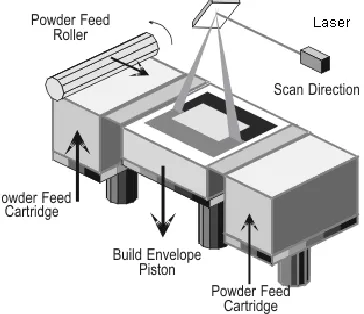
Prototyping or model making is one of the important steps to finalize a product design. It helps in conceptualization of a design. Before the start of full production a prototype is usually fabricated and tested. Manual prototyping by a skilled craftsman has been an age- old practice for many centuries. Second phase of prototyping started around mid-1970s, when a soft prototype modelled by 3D curves and surfaces could be stressed in virtual environment, simulated and tested with exact material and other properties. Third and the latest trend of prototyping, i.e., Rapid Prototyping (RP) by layer-by-layer material deposition, started during early 1980s with the enormous growth in
Computer Aided Design and Manufacturing (CAD/CAM) technologies when almost unambiguous solid models with knitted information of edges and surfaces could define a product and also manufacture it by CNC machining.
Case 2- Properties enhancement of PMC
CNT’s for further comparisons and applications
Carbon NANO tubes (CNTs) are promising reinforcing fillers for polymers due to their excellent mechanical, electrical and thermal properties. Recently the coupling of physical and mechanical properties particularly has achieved widespread interest in the area of carbon NANO tube composites.
Case3 : Fabrication of MMC with aluminium and fly ash composites for comparisons.
The application spectrum of low cost material reinforced metal matrix composites is growing rapidly in various engineering fields due to their superior mechanical properties. In the present study it is proposed to explore the possibilities of reinforcing aluminium alloy (AlSiC) with locally available inexpensive rice husk and fly ash for developing a new composite material. A rice husk and fly ash particles of 5, 10 and 15% each by weight are proposed to develop metal matrix composites using liquid metal processing route. The fabricated samples analysed to study internal bonding applications and properties by using SEM and OM. Thermal conductivity voltage constants also observed in microstructure analysis and flow of material also analysed.
Case-4-properties evaluation of CNT
Available online: https://edupediapublications.org/journals/index.php/IJR/ P a g e | 1463 The simplest and most commercially viable
technique is the vortex technique or stir casting technique. The stir casting setup consists of a furnace, an electric motor with a stirrer arrangement and temperature sensors. In this method, ceramic particulates are incorporated into liquid metal melt and the mixture is allowed to solidify. It is important to create a good wetting between the particulate reinforcement and the liquid metal. The vortex technique requires the introduction of pre-treated ceramic particles into the vortex of the molten matrix created by a rotating impeller. Generally, it is possible to incorporate up to 30% ceramic particles in the size range 5 to 10μm in a variety of molten aluminium alloys.
Case -5- Simulation modelling of CNT
tubes and analysis with different fluids.
1. Water 2. Diesel 3. Blood
Case-6- Comparative analysis with polymer
NANO tubes with MMC’s for replacement applications.
METHODOLOGY OF
RESEARCH PROCESS
Methodology case -1 describes the fabrication of carbon NANO polymer tubes fabrication by considering material depositing layer formation to check out the feasibility of production at easy methods without wasting material. By the preparation of tubes using the above method the properties enhancement like thermal conductivity, rate of heat transfer interface thermal conductivities are the findings in case-2 as an extension to the before case-1of fabrication for better optimization of properties. For better comparison of present
polymers another practical work done on aluminium metal matrix composites as further case-3 as the preparation of NANO fly ash mixed with aluminium alloys. The fabricated alloy properties are enhanced for structural stability and thermal properties for application comparison with polymer tubes as case-4. The two applications are comparing to get validation of polymer tubes usage in a practical way. As well as the practical optimization finish the conductivity flow rates of different fluids are taken for better results by considering practical thermal results interpreted in simulation by using ANSYS CFD work bench 15.0 as case-5. The interface thermal conductivity have done by checking FEM approach to conclude better results of simulation and the research work will give a scope for further extension of work discuss in case-6.
Available online: https://edupediapublications.org/journals/index.php/IJR/ P a g e | 1464
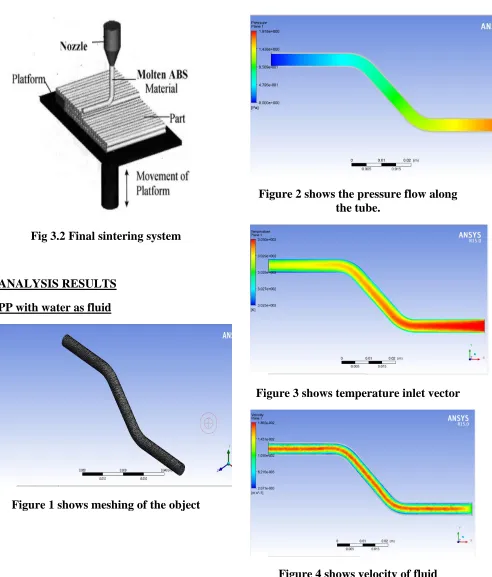
Fig 3.2 Final sintering system
ANALYSIS RESULTS
PP with water as fluid
Figure 1 shows meshing of the object
Figure 2 shows the pressure flow along the tube.
Figure 3 shows temperature inlet vector
Available online: https://edupediapublications.org/journals/index.php/IJR/ P a g e | 1465
Figure 5 shows velocity vector
Figure 6 shows temperature vector
Figure 7 shows pressure vector
Figure 8 shows velocity streamline
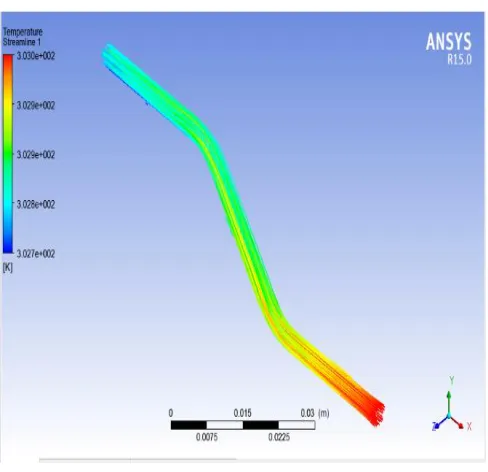
Figure 9 shows temperature stream line
CONCLUSIONS:
Available online: https://edupediapublications.org/journals/index.php/IJR/ P a g e | 1466 consideration of NANO layer thickness.
Structural stability observed in tests with different methods of approach before going to finalise the simulation model.
By taking volume weight ratios in to consideration it is easy to mix the volume ratios of alloy matrix and stir casting is one of the prominent processes of matrix fabrication because of its stirring capacity . The blade velocity will give good mixing and molecular bonding will give an excellent casting than normal casting process. From the study it is concluded that we can use fly ash for the production of composites and can turn industrial waste into industrial wealth. This can also solve the problem of storage and disposal of fly ash.
REFERENCES:
[1] A. Modi, N. Koratkar, E. Lass, B. Wei,(1994) Nature, “Research on health evaluation system of liquid-propellan rocket engine ground-testing bed based on fuzzy theory”,
ActaAstronautica ISSN:0424-0827 Page-171.
[2] Albrecht, P. and Lyding, (2003) “Russian Nuclear Rocket Engine Design for Mars Exploration”, J. Applied Physics Letters ISSN:2083-3142 Page- 5029
[3] A. Rothschild, F. Edelman, Y. Komem, F. Cosandey, (2000) “porous liquid propellant rocket Engine injectors”, Sensors and Actuators B Chemistry, ISSN:1083-2214 page- 282.
[4] A. Chowdhuri, V. Gupta, K. Sreenivas, R. Kumar, S. Mazumdar, P.K. Patanjali, (2004) “CFD Analysis of a Rocket Nozzle with Two Inlets Applied Physics Letters, ISSN 2277 – 8179 page-180.
[5] Al Palaniappan, D.W.H. Fam, A. I. Y. Tok, B. Lied Berg, S.M. Moochhala, (2011) Sensors and Acutators B, Proceedings of the National Academy of Sciences of the United States of America vol. 99, ISS