10.15662/ijareeie.2014.0312079
A Filtering Methodology to Remove Mixed
Noises from Colour Images using Fuzzy
Technique
Manikavasagam
1, R.Mohan Raj*
2Assistant Professor, Dept. of ECE, Jerusalem College of Engineering,Chennai, Tamil Nadu, India1 Assistant Professor, Dept. of ECE, Bharath University, Chennai, Tamil Nadu, India2
* Corresponding Author
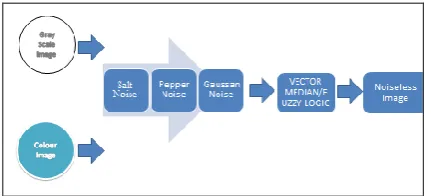
ABSTRACT: The project introduces a Fuzzy Based Weighted Vector Median Filter (FWMF) model to detect and eliminate the salt noise, pepper noise, Gaussian Mixed Impulsive noise. The mixed noises are applied to gray scale images and colour images. Through fuzzy logic methodology, the noises are detected and eliminated. Mixed impulsive and Gaussian noise reduction from digital color images is a challenging task because it is necessary to appropriately process both types of noise, that in turn need to be distinguished from the original image structures such as edges and details. Fuzzy theory is useful to build simple, efficient and effective solutions for this problem. In this paper, which proposes a fuzzy method to reduce Gaussian and impulsive noise from color images, uses one only filtering operation: a weighted Median. A fuzzy rule system is used to assign the weights so that both noise types are reduced and image structures are preserved. Experimental results should show the efficiency of the proposed fuzzy method, providing competitive results
KEYWORDS: Colour Image Filter, Fuzzy metrics, Fuzzy rules Weighted Vector Median Filter, gray scale, salt and pepper, gaussian
I. INTRODUCTION
Digital image is inclined to a variety of noise which affects the quality of image. Unwanted electrical fluctuations themselves came to be known as "noise. The main purpose of de-noising the image is to restore the detail of original image as much as possible. The criteria of the noise removal problem depends on the noise type by which the image is being corrupted. In the field of reducing the image noise several type of linear and non linear filtering techniques have been proposed. Salt and pepper noise is a form of noise typically seen on images. It represents itself as randomly occurring white and black pixels. Salt and pepper noise creeps into images in situations where quick transients, such as faulty switching, take place.
"Impulsive" noise is sometimes called salt-and-pepper noise or spike noise. An image containing salt-and-pepper noise will have dark pixels in bright regions and bright pixels in dark regions. This type of noise can be caused by analog-to-digital converter errors, bit errors in transmission, etc.,
Principal sources of Gaussian noise in digital images arise during acquisition eg., sensor noise caused by poor illumination and/or high temperature. The values that the noise can take on are Gaussian-distributed. However, in many physical environments, the noise exhibits impulsive characteristics, which cannot be adequately described by a Gaussian model.
10.15662/ijareeie.2014.0312079
There exists many techniques in the literature. Say., Peer Group Averaging (PGA). The Trilateral Filter(TF) is based on the well-known Bilateral Filter to smooth Gaussian noise but including an impulse detector to be also able to reject impulse noise. There are also other basic filtering techniques used to remove the noises from noisy images. These techniques need to be used repeatedly to ensure that different kinds of noises are removed from the image. This affects the quality of the image.
Adaptive Nearest Neighbor Filter (ANNF) uses a weighted averaging, where the weights are computed according to robust measures so that impulses that receive lower weights are reduced.
Fuzzy Vector MedianFilter (FVMF) - performs a weighted averaging where the weight of each pixel is computed according to its similarity to the robust vector median. Another well known solution is regularization approach, which is based on the minimization of appropriate energy functions by means of partial differential equations (PDEs) partition based filters – based on signal activity. One more technique in literature is Poisson-Gaussian noise removal.
II. CURRENT DENOISING TECHNIQUE
The current denoising technique used - averaging filter have following effect. Blur edges and details in an image. Averaging process results in in-effectiveness for impulse noise (Salt-and-pepper) removal. PSNR becomes very less at higher noise levels/densities.
The higher, the number of times different filters are used in the image, higher the quality of the image is affected. Several filters could dramatically decrease the computational efficiency of the whole process which implies that this solution could not be practical for real applications. Therefore the new methodology is proposed.
In the existing system we used Median filtering (Vector) algorithm to remove noise contents from the images. There are advantages of Median Filtering over Mean Filters. Median filters are Order Statistic Filters, which works on Ranking and Existing old values. With Median Filtering, blurring, and edge preservation would be better.
III. PROPOSED DENOISING TECHNIQUE
Here, a simple method is proposed to remove mixed impulsive Gaussian noise from colour images, which is based on fuzzy logic and weighted vector median filtering technique. The method to remove mixed impulse and Gaussian noise from color images which is based on fuzzy logic. According to our proposal, each image pixel is filtered only once using the same operation: a simple weighted median over the pixels in a filtering window. The nature of the method depends on how the weights involved are computed for colour image, for which we use a fuzzy-rule based system.
This fuzzy system takes as input two sources of information on the pixels in the filtering window: (i) the degree of noisiness (from the impulsive point of view) computed using a statistical method and (ii) the degrees of similarity
between the central pixel and the rest of the pixels in the window that is used for the filtering operation. From this information, the proposed method computes the weights that allow processing each pixel in an appropriate way, reducing the noise and preserving the image structures appropriately.
10.15662/ijareeie.2014.0312079
This method uses only one filtering operations whereas existing methods use many filtering operations to remove different kinds of noises. In addition to the removal of noises from the image, this method also preserves the image contents. This method uses the degree of noises in the image contents which other methods don‟t use.
The main purpose of the RGB color model is for the sensing, representation, and display of images in electronic systems, such as televisions and computers, though it has also been used in conventional photography. The denoising factors include the filtering process technology, type of filter, pixel processing and source of weights or information processing coefficients. Typical RGB input devices are color TV and video cameras, image scanners, and digital cameras. Typical RGB output devices are TV sets of various technologies (CRT, LCD, plasma, etc.), computer and mobile phone displays, video projectors, multicolor LED displays, and large screens such as JumboTron. Color printers, on the other hand, are not RGB devices, but subtractive color devices (typically CMYK color model). Fuzzy logic represents a good mathematical framework to deal with uncertainty of information and provides complicated systems in simple way. This article discusses concepts common to all the different color spaces that use the RGB color model, which are used in one implementation or another in color image-producing technology.
A. GRAY SCALE PROCESSING
In photography and computing, the gray scale or grayscale digital image is an image in which the value of each pixel is a single sample, that is, it carries only intensity information. Images of this sort, also known as black-and-white, are composed exclusively of shades of gray, varying from black at the weakest intensity to white at the strongest.
Major Types of noises in Digital Images are: Salt and pepper noise (Impulse Noise), Gaussian noise and Speckle noise. While performing gray scale processing, the colour image is converted to gray scale image using MATLAB software. Four different file formats are used to test the performance of Gray scale processing with performance measures.
B. SPATIAL FILTERING TECHNIQUE
Spatial filtering is the method of choice in situations when only additive random noise is present. Weighted Median (WM) filters have the robustness and edge preserving capability of the classical median filter and resemble linear FIR filters in certain properties.
The weighted median (WM) filter was first introduced as a generalization of the standard median filter, where a nonnegative integer weight is assigned to each position in the filter window. The structure of a WM filter is quite similar to that of a linear FIR filter.
The best-known order-statistics filter is the median filter, which, as its name implies, replaces the value of a pixel by the median of the gray levels in the neighborhood of that pixel:
10.15662/ijareeie.2014.0312079
FIG 2.0: WEIGHTED AVAERAGING MEDIAN FILTER SYSTEM
IV. COLOURIMAGEPROCESSING
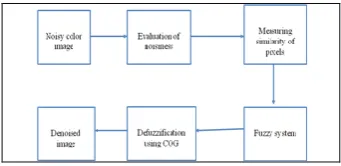
Weighted Median technique is used for filtering of noised colour image (for mixed noises) as they better preserve detail and edges which shows robustness in nature. The Weighted median filter, resembles linear filters due to the above qualities.
FIG 3.0 : WEIGHTED AVAERAGING MEDIAN FILTER SYSTEM
V. FUZZYLOGIC
The proposed fuzzy system handled two different sources. These are first, the noisiness, from the impulsive point of view, of each pixel in the image; second, the similarities observed between the pixel under processing and the rest of the pixels in the window.
Noisiness of image pixels:
We evaluate how noisy each image pixel is. So, we assign a certainty degree _(Fi) for the vague statement “Fi is noisy” to each Fi as follows. We order the pixels Fjin a window W′ centered at Fi which is also taken, for simplicity, of size n _ nin the way F(0);F(1);………. ;F(n2−1) according to a distance measure , so that _(Fi;F(0)) <=(Fi;F(1)) <=…………<=(Fi;F(n2−1)), where obviously F(0) = Fi. As the distance measure we use the metric L∞ given by
(2)
(3)
10.15662/ijareeie.2014.0312079
Fuzzy system and computation of weights:
To compute the weights involved in the filtering average operation we now use a fuzzy rule based system and fuzzy inference. The fuzzy system use the vague statements described in the previous subsections to decide whether each weight in (1) should be large, medium or small. Finally, defuzzification is used to obtain the particular value for each weight.
The objective of the rules in the fuzzy system can be summarized in two main ideas: (i) pixels that are noisy should be assigned to a small weight, and (ii) pixels that are noisefree can only be associated to a larger weight if either they are similar to the central pixel or if the central pixel is noisy. This latter idea, for the different cases to be found, is summarized in the following tree fuzzy rules:
1) IF (Fi is not noisy AND F0 is noisy AND the similarity between F0 and Fi is medium) THEN wi is a medium weight
2) IF (Fi is not noisy AND F0 is noisy AND the similarity between Fi and F0 is low) OR (Fi is not noisy AND F0 is not noisy AND the similarity between Fi and F0 is high) THEN wi is a large weight
3) IF (Fi is noisy) OR (Fi is not noisy AND F0 is noisy AND the similarity between Fi and F0 is high) OR (Fi is not noisy AND F0 is not noisy AND the similarity between Fi and F0 is medium) OR (Fi is not noisy AND F0 is not noisy AND the similarity between Fi and F0 is low) THEN wi is a small weight
VI. INPUTPICTURES
FIG 4.0: PNG,JPEG,BMP,TIFF IMAGES WITH VARYING NOISE DENSITIES , VARIANCES AS INPUT TO WEIGHTED VECTOR MEDIAN FILTERING TO PROCESS GRAY SCALE IMAGES ON MIXED
NOISES
The Noises are added to the process for gray scale processing and output performance measures monitored for a better weights in gray scale image. The Weighted and Non weighted filtering processes are compared for four file formats. The Excel graphs portraits the improvement in Weighted approach.
The BMP file format is capable of storing 2D digital images of arbitrary width, height, and resolution, both monochrome and color, in various color depths, and optionally with data compression, alpha channels, and color profiles.
10.15662/ijareeie.2014.0312079 VII. FILTERPERFORMANCE
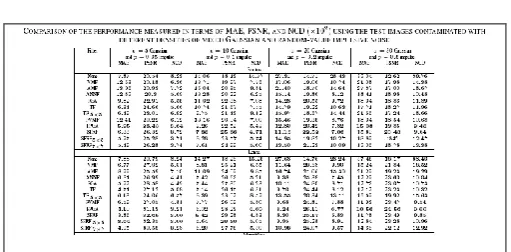
FIG 5.0: PERFORMANCE OF IMPULSIVE GAUSSIAN NOISE USING MEAN FILTER FOR COMPARISON PURPOSE.
Excel graphs are plotted for Individual Salt & Pepper Noise, Gaussian Noise and Impulsive Gaussian Noise types , filtered using Fuzzy Weighted Vector Median Filter and compared with Non Weighted Logic , not involving fuzzy for gray scale image. Above Results are using Mean Filter. Fuzzy is applied to colour image processing.
VIII. CONCLUSION
A simple and effective Median Filter method is proposed to reduce Gaussian and impulsive noise from Gray Scale Images. The method uses one only filtering operation, a weighted Median, which uses a set of weights Computed along with a Median Filtering system. The PSNR values are compared for Weighted and Non Weighted Median Filter Implementations, for Gray scale Images in four different Image formats. For Higher Image densities and variances, the Weighted Median Filter performs better.
a. Tiff Images show better resistance to combined noises and only gaussian, followed by PNG type b. For only salt & Pepper noise, the Filter shows higher performance in Tiff, followed by PNG.
REFERENCES
[1] Images Joan-Gerard Camarena, Valent´ın Gregori, Samuel Morillas and Almanzor Sapena „A simple fuzzy method to remove mixed Gaussian-
impulsive noise from colour”
[2] G. Hewer, C. Kenney, L. Peterson, A. Van Nevel, “Applied partial differential variational techniques”, in Proceedings of InternationalConference on Image Processing, vol. 3, 1997, pp. 372-375.
[3] Y. F. Ho, “Peer region determination based impulsive noise detection”, Proceedings of International Conference on Acoustics, Speech and Signal ICASSP‟03, vol. 3, 2003, pp. 713-716.
[4] C. Kenney, Y. Deng, BS Manjunath, G. Hewer, “Peer group image eenhancement”, IEEE Transactions on Image Processing, vol. 10 no. 2, pp. 326-334,Feb. 2001.
[5] Y. Deng, C. Kenney, MS Moore, BS Manjunath, “Peer grou filtering and perceptual color image quantization”, in Proceedings of IEEE international symposium on circuits and systems, vol. 4, 1999, pp. 21-4.
[6] Rafael Gonzalez Digital Image processing – 2 nd Edition [7] Web Articles
[8] Dr.K.P.Kaliyamurthie, D.Parameswari, Load Balancing in Structured Peer to Peer Systems, International Journal of Innovative Research in Computer and Communication Engineering, ISSN: 2249-2615,pp 22-26, Volume1 Issue 1 Number2-Aug 2011
[9] Dr.R.Udayakumar, Addressing the Contract Issue,Standardisation for QOS, International Journal of Innovative Research in Computer and Communication Engineering, ISSN (Online): 2320 – 9801,pp 536-541, Vol. 1, Issue 3, May 2013
[10] Dr.R.Udayakumar, Computational Modeling of the StrengthEvolution During Processing And Service Of9-12% Cr Steels, International Journal
of Innovative Research in Computer and Communication Engineering, ISSN(Online): 2320-9801,pp 3295-3302, Vol. 2, Issue 3, March 2014 [11] P.Gayathri, Assorted Periodic Patterns Intime Series Database Usingmining, International Journal of Innovative Research in Computer and Communication Engineering, ISSN(Online): 2320-9801, pp 5046- 5051, Vol. 2, Issue 7, July 2014.