ISSN 2286-4822 www.euacademic.org
Impact Factor: 3.4546 (UIF) DRJI Value: 5.9 (B+)
Cognitive side of the available scientific facts of the
technical equipment and the extent of benefit
AMEER MUSA ABAS
Assistant Professor College of Physical Education and Sport Sciences
University of AL-Qadisiyah, Iraq
BASEM SAMY SHHEED
Assistant Professor College of Physical Education and Sport Sciences University of Thi-Qar, Iraq
HAIDER TAWFEEQ SALIH
Assistant Lecturer College of Physical Education and Sport Sciences University of AL-Qadisiyah, Iraq
Abstract:
The modern programs have become heavily dependent on the physiological and psychological changes that occur in the systems of bodies of athletes and others due to various physical activities. As well as attention has increased on the food intake, which its quality and quantity proportional to the type of activities. It is so known that increasing in weight several kilograms effects on the player's physical efficiency and kinetic ability for distinction in the physical practice activity and performance skills, which requires that all vital systems are healthy and work efficiently.
vitamins and important nutrients for performing all activities in best possible manner.
There are some new technologies at affordable prices that everyone can possess it and have a positive effect on weight loss, but most individuals lacking the knowledge for use these devices efficiently. That gave the justifications of this study, where the researchers considered studying the cognitive side about the available scientific facts of the technical devices, and how to take advantage of it in using these devices properly. The goal of the study was to identify the extent of individuals (practitioners of sport and non-practitioners) benefit from the cognitive side of the available scientific facts of technical equipments. The study assumed that the cognitive side and the available aspect of knowledge and facts of technical devices have a positive impact in losing weight. In the theory framework, researchers have listed some vocabulary that used in this study. In the study methodology and field procedures, the researchers conducted homogeneity in the same group and they listed the equipments and tools used in the study, and they addressed the conducting of the trial exploratory test, pre and post-tests, as well as the procedures and data collection and the statistical analysis.
After data collecting from forms and analyze it statistically using (spss) software package, these data displayed in tables and then it analyzed and discussed scientifically in order to put the conclusions that have been reached through these results. Then the researchers put their recommendations for the possibility of benefiting from this study and the practical experience in the weight loss process without causing any harm to the practitioners of sport and non-practitioners using these portable and affordable technical devices.
Key words: cognitive side, scientific facts, sports, technical equipment
1. STUDY IDENTIFICATION:
1.1 Preface and the study importance:
etc) due to the contributions of researchers and scientists who have made unremitting efforts, and all kinds of scientific researches, tests, books, training laboratories, and so many theories and opinions of various fields has been emerged, and athletic field was not away from these developments.
Modern programs have become heavily dependent on the physiological and psychological changes that occur in the body's systems of athletes and others because of various physical activities. Therefore, attention has increased on food they intake, which is proportion in quantity and quality with the type of efforts that they exerted. Therefore, recently specialists interested in this field and identified the physical specifications that are consistent with the nature of each competition, which is increasing the effectiveness of the training process to reach the highest level possible.
Weight loss process is the reducing in player's weight intentionally to make him ready to participate in competitions physically without any increase in his weight (according to weight classes). Often this process done in the solo sports, where weight of the body plays a major and decisive role in achieving results such as wrestling, boxing, weight lifting body building ... etc. It is so known that increasing in weight several kilograms may effects on the player's physical efficiency and kinetic ability for distinction in the physical practice activity and performance skills, which requires that all vital systems are healthy and work efficiently.
1.2 Research justifications:
Researches and studies about weight, and how to reduce it without negative effects have increased recently, which led to design, construct of many technical devices that would help in weight loss of individuals, but at the same time. Those individuals are lacking the knowledge of how to use these devices properly, so the study justifications emerged where there are some new technologies at affordable prices that everyone can possess and have a positive effect on weight loss, but the cognitive side is very weak for most individuals and they lack of sufficient knowledge about these devices. Therefore, the researchers considered to study the cognitive side about the available scientific facts of the technical devices, and how to take advantage of it in using these devices properly. researches and studies about weight and how to reduce it without negative effects have been increased, which led to the design, construct of many technical devices that can reduce individuals' weight correctly, but a lot of these devices are expensive which makes the acquisition is difficult for many individuals (sport practitioners and non-practitioners), But there are some modern devices that have cheap prices suitable to all individuals and have a positive effect on weight loss, but the cognitive side remained little for using these devices properly , Therefore, the researchers considered to study the cognitive side about the available scientific facts of the technical devices, and how to take advantage of it in using these devices properly.
1.3 Research objectives:
1.4 Research hypotheses:
The researchers assumed that the cognitive side of the available scientific facts of the technical equipment has a positive impact on losing weight.
2 RESEARCH METHODOLOGY:
The researchers used the experimental method in an asymmetrical group's style for its suitability to the nature of the justifications of the study. The study sample included 12 members of the practitioners in Al-Rafidein Sport Club of (wrestling, taekwondo, weightlifting) players of weights between (80-100) kg, and 12 students from College of Education, College of Engineering, College of Literature at Al- Qadisiyah University for the academic year 2014- 2015 of weights between (80-100) kg, where these weights were chosen intentionally to serve the purpose of the study, as well as individuals willingness to involve in this study after taking their agreements and commitment to involve in it. The sample divided into two experimental groups, first one (practitioners of sport) and the second one (the non-practitioners of sport), then the researchers conducted homogeneity on each group in the variables (height, weight, and age).
Table (1) The homogeneity of the first experimental group members.
Variables Units Mean S.D C.V
Height Cm 170.700 4.785 2.803 %
Weight Kg 89.666 4.638 5.172 %
Age Year 20.300 0.948 4.669 %
Table (2) The homogeneity of the second experimental group members.
Variables Units Mean S.D C.V
Height Cm 171.3 6.711 3.917%
Weight Kg 88.917 4.870 5.477 %
As shown in the table (1 and 2), the coefficient of variation (C.V.) values were under (30%), this shows the homogeneity of the sample in each group, "The more near the coefficient of variation (1%) is a high homogeneous, and higher than (30%) means that the sample is heterogeneous.
"
2.1 Means, instruments and tools used in the study:
Arabic and foreign sources.
Observation and experimentation.
Data collection form for food types, its nutritional values and the amount of Calories.
Chinese-made medical scale for weight measuring and height.
Twenty-four electronic devices for measuring Calories, steps, and the number of kilometers.
Assistant Staff.
2.2 Exploratory experiment:
On (Wednesday and Thursday) 2015/1/29-30, the researchers conducted the exploratory experiment in Al-Rafidein Sport Club in external stadiums for Colleges of Education, Engineering and Literatures on the sample using the special equipments in order to:
1. Know the obstacles and difficulties that may occur during the experiment.
2. Determine the validity of the electronic devices.
WadihYassin andAbdulHassan Mohammedal-Obeidi :Statisticalcomputer
applicationsand uses ofcomputer ininPhysical Education studies,Mosul,
Dar Al-Kutubfor printing and publishing 1999, P. 161.
Supplement (2).
Assistantteamnames:
Dr. HaidarJabbar Abid, College of Litriture-Al- QadisiyahUniversity.
Dr. AbdullahHuwail,College of Engineering-Al- QadisiyahUniversity.
Assistant lecturer AhmadShamsuddin, wrestlingcoach–Al-RafidainClub
3. Determine the extent of the understanding of the sample how to use the devices.
2.3The data form *:
Researchers and assistant team held a scientific lecture to clarify the content of the experiment's data form and how to fill in by the sample, how the devices work, how to use it and where can be placed on to obtain an accurate data. The data form contains data of types of food intake by the study sample, which includes all types of (meat, grains, fruits, vegetables, etc.) as well as data obtained from the devices. Figure (1) illustrates some of these devices.
Figure (1): Some of electronic devices used in the experiment.
2.4 Pre-test:
The researchers conducted the pre-tests on (Saturday and Sunday) at 2015/2/1-2 for measuring (height, and weight) variables, and then they distributed the food data forms and the electronic devices to start the experiment.
The researchersin the presence ofassistant team explainedhow to useand
howdatadump of devices usedusingformdistributed ,and how tofill out
thisform ,as well asthey explained the importance of the and how torecord
2.5 Field study procedures:
After conducting the exploratory experiment through which the research sample identified the electronic devices and how to data dump:
Researchers checked that the schedule of the tournament does not conflict with the date of conducting the experiment. After that, they identified the sample of practitioners of sports (wrestling, taekwondo, and weightlifting). Then the sample has directed to workouts their sport training according to directions of their coaches, and practice of their life activities normally, with obligation to register the data every day and reset devices before starting the next day.
The sample has identified of students from colleges (Education, Engineering, and Literature) and after the completion of the first part exams, the sample members agreed to commit to follow-up the experiment and record data forms accurately every day and reset the devices before starting the next day, and so on.
Then the pre-test has conducted to collect the data of (height, weight) variables and the distribution of the forms, as well as devices for each sample members. The experiment period (one month only).
Researchers and assistant team follow-up research sample each week and check that the forms filled-up correctly.
2.6 The post- test:
2.7 Statistical methods used:
The researchers used the statistical package (spss) to get the most accurate results through laws of:
Arithmetic mean.
Standard Deviation (S.D). Coefficient of Variation (C.V.).
t- Test for correlated and independent samples.
3. RESULTS, ANALYSIS AND DISCUSSION:
Exhibition of the Results of Means and Standard deviations in tables for each two groups.
3.1 Exhibition of Means and Standard deviations for each groups for (consumed Calories and Calories in food).
3.1.1 Exhibiting Means and Standard deviations of the first group for (consumed Calories and Calories in food).
Table (3) Means and Standard deviations of the first group (consumed Calories and Calories in food).
Ser. Consumed Calories Calories in food
Mean S.D Mean S.D
1 2370.7 421.209 1708.93 119.103
2 2258.2 547.559 1668.33 095.853
3 2320.0 494.223 1709.63 107.663
4 2173.2 540.327 1787.73 096.836
5 2072.8 578.214 1767.53 130.651
6 2009.1 856.097 1818.77 196.570
7 2333.9 438.560 1694.77 123.088
8 2329.6 520.303 1700.40 223.548
9 0269.2 0393.03 1650.50 091.568
10 2216.0 429.67 1769.77 099.519
11 2025.321 411.03 1949.67 0121.450
3.1.2 Exhibition of Means and Standard Deviations of the second group for (consumed Calories and Calories in food).
Ser. Consumed Calories Calories in food
Mean S.D Mean S.D
1 1620.11 125.22 1502.13 109.16
2 1518.27 241.113 1364.05 99.802
3 1530.1 194.003 1205.81 104.064
4 1779.2 131.021 1404.09 98.106
5 1472.11 172.04 1169.47 100.18
6 1440.21 151.07 1315.21 106.972
7 1433.9 138.51 1147.07 111.480
8 1626.6 220.31 1401.44 123.209
9 1655.1 193.1 1253.02 97.107
10 1516.9 129.5 1301.35 110.216
11 1572.4 110.5 1257.55 102.34
12 1612.7 143.91 1378.11 123.33
3.2 Exhibition and analysis of weight results for pre and post-tests of each two groups.
3.2.1 Exhibition and analysis of weight results for pre and post-tests of the first group.
Table (5) The differences between pre and post-tests in weight for the first group.
variable Pre-test Post-test Calculated
(t) value
Significance
Mean S.D. Mean S.D.
10.967
significant
Weight 89.666 4.638 84.416 4.542
*Tabulated (t) value at level of significance (0.50), degree of freedom (11) =1.796.
between pre and post-tests of weight in favor of the post- tests, which achieves the goal and the first assumption.
3.2.2 Showing and analysis of weight results for pre and post-tests for the second group.
Table (6) The differences between pre and post-tests in weight for the second group.
variable Pre-test Post-test Calculated
(t) value
Significance
Mean S.D. Mean S.D.
10.967
significant
Weight 88.917 4.4.870 86.083 5.304
*Tabulated (t) value at level of significance (0.50), degree of freedom (11) =1.796.
The results shown in Table (6) for the pre and post-tests for weight of the second experimental group appear that the arithmetic Mean for pre-test is (88.917) and Standard deviation of (4.870), while the arithmetic Means for the post-test is (86.083) and Standard deviation is (3.965) . The Calculated (t) value is (5.304), and when we compare it with the Tabulated (t) value (1.796) at level of significance (0.05) and degree of freedom (11), we find that the Calculated (t) value is greater than Tabulated value, which shows the significant differences between pre and post-tests of weight in favor of the post- tests in this group, which achieves the goal of this study.
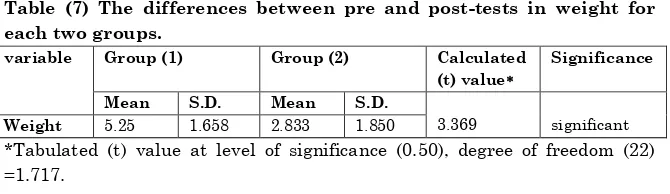
Table (7) The differences between pre and post-tests in weight for each two groups.
variable Group (1) Group (2) Calculated
(t) value
Significance
Mean S.D. Mean S.D.
3.369 significant
Weight 5.25 1.658 2.833 1.850
*Tabulated (t) value at level of significance (0.50), degree of freedom (22) =1.717.
arithmetic Means first group is (5.25) and Standard deviation is (1.658), while the arithmetic Mean for the second group is (2.833) and Standard deviation is (1.850). The calculated (t) value is (3.369), and when we compare it with the Tabulated (t) value (1.717) at level of significance (0.05) and degree of freedom (22), we find that the Calculated (t) value is greater than Tabulated value, which indicates a significant differences between first and second group for post- test for weight variable in favor of the first experimental group, which shows that the use of electronic devices has a positive impact on losing weight.
3.2.3 Showing and analyzing pre and post-tests results for weight for each two groups:
Table (8) Means, Standard deviations and Calculated (t) value for post-tests for weight for each two groups.
variable Group (1) Group (2) Calculated
(t) value
Significance
Mean S.D. Mean S.D.
0.958 random
Weight 84.416 4.542 86.083 3.965
*Tabulated (t) value at level of significance (0.50), degree of freedom (22) =1.717.
3.3 Discussion of the results of the pre and post tests for weight for two groups:
The results of the pre and post-tests for weight for each two groups shown in tables (5.6) show that there is a significant difference between pre and post-tests in favor of the post-tests. The researchers reason for this is due to the nature of the first experimental group (practitioners of sports) trainings which need an energy and food to consume Calories by warm-up and trainings, that leads to losing weights without physical or healthy harms. While in the second experimental group (non-practitioners of sports) there is a weight loose but not as much as the in the first group. The researchers reason for this is due to the the nature of their life style as students where they are consuming Calories in actions like walking, sport lessons especially the practical games, participation of games such as football inside and outside the university and their own works inside and outside home. All these reasons have a positive impact in losing weight:
"After the completion of the physical activities, the metabolic rate increases for several hours while the greater use of Calories more quickly "
"The training method used affect the fat ratio in the body ".
Results of differences in table (7) between pre and post-tests for the two groups show that there are significant differences in favor of the first experimental group (practitioners of sports).
Ahlam Taha Hassan al-Obeidi: the Impact of two programs of aerobics
using compound analysis in the development of some of the health fitness components and physical visualization in women (non-mathematic) aged (35-45 years), unpublished thesis, Baghdad University, 2006.
Abdul Alem Muhammad Abdul Alem: a Comparative study of the
Differences results in table (8) between the two groups show that there are random differences, and when we check their Means, we notice that there is an imperceptible change in the first experimental group. The researchers reason for this is due to the regular healthy diet and to the intensity and frequency of the physical exercises they practice, and to the recording and follow-up the type of food intake according Diet lists which depend upon fruits which have a big role in weight loss. Using electronic devices is one of factors that helps to control the amount of IN/OUT Calories. Practitioners of sports can use this method to lose weight without health and physical problems due to loss of fluids and vitamins that are affecting on the energy, which will affect their achievements in competitions. Non-practicing for Sports can also use this method through their knowledge of the causes of weight increasing, making them follow-up the amount of food they eat and the amount of Calories they loss, which helps them to get healthy and consistent bodies through continues use of this method as long as possible according to the nature of their daily lives.
"The metabolic level after physical activity depends on the nature of the exercise (intensity) and the length of the performance period (Size)"
"Reducing number of meals instead of the increasing will lead to a reduce the rate of metabolic processes and the temporary reduce in body weight"
"Experts confirm that it is easy to reduce the amount of Calories taken by eating certain foods in compared with the amount of consumed Calories by the exercises."
Chris M (2004) : Does Exercise affect resting metabolism ? www. American
College of sport medicine.
Ali Bashir Alfandi and Hilal Abdul Rahman: physiology and fitness, ed. 1,
Benghazi, seventh of April University, 1997, P. 170.
"The energy consumed as a result of training helps fat consumption (burn) in the body which helps for earn prominent muscles."
4- CONCLUSIONS:
Through the presentation of data analysis and discussion, the researchers reached the following conclusions:
1. Using of electronic devices has a significant impact in reducing weight healthily for practitioners of sports (wrestling, taekwondo and weightlifting).
2. Using of electronic devices has a significant impact in reducing the weight healthily of non-practicing of sports of college students (Education, Engineering, and Literature).
3. The continuous monitoring and recording of food data like quality and Calories and calculating the consumed Calories using the electronic devices plays a big role in weight loss.
5- RECOMMENDATIONS:
Through the results, the researchers recommend the following: 1. The need for use of electronic devices for all individuals
who want to reduce weight as they have a significant impact in reducing weight.
2. Conduct periodic tests, and pursuit Diet tables to know the amount of Calories involved and find out Calorie consumption through daily activities and programmed activities by devices.
Adel Turki Hassan Al-Delwi: the Principles of sports training and
3. Conducting similar research on the monotonous activities, especially in the non-sport institutions to determine the effect of these devices.
SOURCES:
1. Ahlam Taha Hassan al-Obeidi: the Impact of two programs of aerobics using compound analysis in the development of some of the health fitness components and physical visualization in women
(non-mathematic) aged (35-45 years), unpublished
thesis, Baghdad University , 2006.
2. Adel Turki Hassan Al-Delwi: the Principles of sports
training and strength training, ed.1, Iraq, Dar Al Diaa
for Printing & Design, 2011.
3. Abdul Alem Muhammad Abdul Alem: a Comparative study of the impact interval and continues training methods on the development of aerobic capacity and the percentage of fat for junior middle distance
under age (18 years), Encyclopedia of studies of Physical
Education and Sports in Arab world in the twentieth century , 1999 Research.
4. Abdul Rahman Musaiger: food, Dar Al-Fikr for printing and publishing, Amman, ed.1, 2000.
5. Ali Bashir Alfandi and Hilal Abdul Rahman: physiology and fitness, ed. 1, Benghazi, seventh of April University, 1997.
6. Falah Hassan Abdullah: Al-Diwaniya tomorrow newspaper, No. 175, Tuesday, 23 / August 2011, Page 7.
7. Louay Ghanem Sumaidaie: body agility, Dar Al-Fikr for printing and publishing, 2002.
Education studies, Mosul, Dar Al-Kutub for printing and publishing, 1999.
9. Chris M(2004) : Does Exercise affect resting metabolism www. American College of sport medicine.
SUPPLEMENT (1)
Calories of Food's type
Ser. Food Calories
1 Eggs 91
2 Orange 27
3 Apple 58
4 Pomegranate 20
5 Lemon 15
6 Banana 45
7 Eggplant 15
8 Onions 36
9 Potatoes 85
10 Garlic 60
11 Carrot 45
12 Cucumber 12
13 Spinach 36
14 Tomatoes 20
15 Beans 93
16 Cauliflower 25
17 Celery 9
18 Chicken 130
19 Fish 421
20 Milk 110
21 Yogurt 55
22 Cheese 162
23 Juice 37
24 Soft drinks 82
25 Lentil 16
26 Bread 224
27 Macaroni 115
28 Bean 15
29 Tea 13
30 Nuts 563