IMPROVING THE SHIELDING EFFECTIVENESS OF A RECTANGULAR METALLIC ENCLOSURE WITH
APERTURE BY USING EXTRA SHIELDING WALL
M. Bahadorzadeh and M. N. Moghaddasi
Department of Electrical Engineering Islamic Azad University
Science & Research Campus, Hesarak, Tehran, Iran
A. R. Attari
Electrical Engineering Department Ferdowsi University of Mashad Iran
Abstract—A new method for improving shielding effectiveness (SE) of a rectangular enclosure with multiple apertures has been proposed. In this method in order to compensate the effects of the apertures on reduction of (SE) parameter, instead of the one wall, two metallic walls containing apertures has been used. The numerical simulation uses a symmetric condensed node of TLM-TD (Transmission line Modeling Method-Time Domain) and subsequent Fourier Transform. The shielding effectiveness response to an electric field impulsive excitation is obtained. A study of the influence of the place of apertures in the walls and the distance between the two walls is presented.
1. INTRODUCTION
Nowadays, regarding to the importance of electromagnetic immunity and electromagnetic interferences issue of the electronic devices, a careful design of shielding enclosures has got so much attention.
techniques or by numerical simulations. Analytical formulations provide a faster means of estimating the SE. However, since these methods are based on simplifying assumptions, they cannot provide sufficient accuracy to meet the design specifications when the shielding structure is geometrically complex. A number of computational methods, such as the finite-difference time-domain (FDTD) method [l, 2], the method of moments (MOM) and integral equation [3–5], the finite element method (FEM) [6, 7] and hybridized numerical techniques in electromagnetic [8] have been proposed for the solution of shielding problems. The Shielding effectiveness metallic enclosure with a square aperture of dimension 60×60 mm has been analyzed by Transmission Line Method (TLM) in [9]. In this paper, in second part the shielding effectiveness of a metallic enclosure with extra wall and square aperture is analyzed by Transmission Line Method (TLM) and the effect of using extra wall will be investigated. The conclusion is presented in the last part of the paper.
2. SHIELDING EFFECTIVENESS ANALYSIS
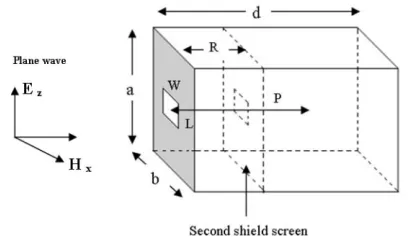
Figure 1 shows a typical metallic enclosure with extra shield screen and a rectangular aperture of dimension w×l illuminated by a plane wave. All sides are assumed perfectly conducting with an infinitesimal thickness. The observation point is located at a distancep away from the aperture inside the enclosure and on a line normal to the aperture and passing through the center of the enclosure.
To minimize the processing requirements, the symmetry of Fig. 1 can be used to advantage. Perfectly electric and magnetic conducting walls are placed atz=a/2 andx=b/2 symmetry planes, respectively. Thus, only a quarter of the structure needs to be solved and the necessary memory and processing time required will be reduced by a factor of four. The internal dimensions of enclosures are assumed to be 120 mm×300 mm×300 mm (a= 120 mm, b=d= 300 mm).
Figure 1. A typical enclosure with an extra shield screen. a = 120 mm,b= 300 mm, d= 300 mm, P = 150 mm, W =L= 60 mm.
is placed in front of the aperture. A simple absorbing boundary condition is applied in the free space region.
A non uniform mesh was used resulting in a TLM cell size of ∆x = ∆y = 5 mm, ∆z = 2.5 mm. The walls of the cavity were considered as infinitesimally thin metallic walls.The results for a single screen which is reported at [9] and proposed structure has been shown in Fig. 2. This results show that using second wall improves shielding effectiveness of the enclosure, but the resonant frequency of the enclosure increases because according to the Equation (2) for a closed rectangular metallic cavity the dimensions of enclosure have been reduced.
fr=
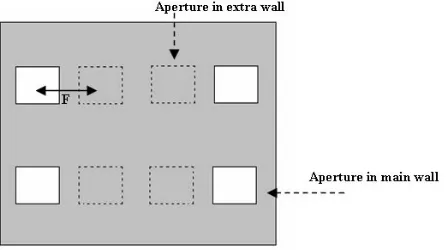
c 2 m a 2 + n b 2 + p d 2 (2) As it has been shown in [10] using multiple apertures will improve shielding effectiveness of enclosure. In this structure also using multiple apertures will increase SE parameter. To investigate this matter we used four (30 mm×30 mm) apertures instead of main aperture that each of them has equal surface to a quarter of the main aperture surface (60 mm×60 mm) Fig. 3. The distance between two walls in all simulations were kept constantR= 40 mm.
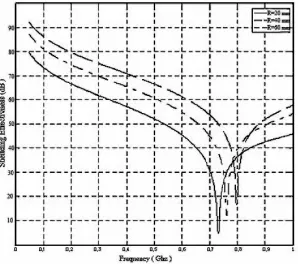
The effect of the displacement of apertures in second wall was also investigated and it has been shown that displacement would make shielding effectiveness better. Results for three different displacement is presented in Fig. 4.
Figure 2. Shielding effectiveness of single wall and double wall shielded enclosure for R= 40 mm.
Figure 3. Front panel of Enclosure and the place of apertures on two walls.
all the three different displacement (fr ≈770 MHz) as seen in Fig. 4.
To illustrate the influence of the distance between the two walls (R) on the SE parameter, different simulations were performed. In these simulations, the displacement of apertures in the second wall has been considered to be zero (F = 0) that means the apertures are located in front of each other. Results for this case has been shown in Fig. 5.
Figure 4. Shielding effectiveness of the enclosure for three different displacement.
Figure 5. Shielding effectiveness of the enclosure for the three different distances between walls.
3. CONCLUSION
It has been shown that by using two walls for shielding an enclosure will improve the shielding effectiveness of the enclosure however it would need some considerations regarding to the physical problems like airflow. Also, it has been noted that SE parameter can be improved by displacement of apertures and changing the distance between the two walls.
ACKNOWLEDGMENT
experimental evaluation of the electromagnetic radiation from apertures in shielded enclosures,” IEEE Trans. Electromagnetic Compatibility, Vol. EMC-34, No. 4, 423–432, November 1992. 4. Yla-Oijala, P., M. Taskinen, and J. Sarvas, “Surface integral
equation method for general composite metallic and dielectric structures with junctions,”Progress In Electromagnetics Research, PIER 52, 81–108, 2005.
5. Matsushima, A., Y. Nakamura, and S. Tomino, “Application of integral equation method to metal-plate lens structures,”Progress In Electromagnetics Research, PIER 54, 245–262, 2005.
6. Edrisi, M. and W. K. Chan, “EMC methodology for numerical electric field computation inside enclosure with aperture,” Electronics Letters, Vol. 35, 1233–1235, 1999.
7. Zhou, X. and G. W. Pan, “Application of Physical Spline Finite Element Method (PSFEM) to fullwave analysis of waveguides,” Progress In Electromagnetics Research, PIER 60, 19–41, 2006. 8. Chou, H.-T. and H.-T. Hsu, “Hybridization of simulation codes
based on numerical high and low frequency techniques for the efficient antenna design in the presence of electrically large and complex structures,”Progress In Electromagnetics Research, PIER 78, 173–187, 2008.
9. Attari, A. R. and K. Barkeshli, “Application of the transmission line matrix method to the calculation of the shielding effectiveness for metallic enclosures,” Palais des congr`es Acropolis, Nice, France, Novembre 12–14, 2002.
10. SiIveira, J. L., S. Benhassine, L. Pichon, and A. Raizer, “Analysis of the shielding effectiveness of a rectangular enclosure with apertures by TLM-TD,” Fourth International Conference on
Computation in Electromagnetic (CEM 2002), Bournemouth, UK,