R E S E A R C H
Open Access
Buffer-aided distributed space-time
coding schemes and algorithms for
cooperative DS-CDMA systems
Jiaqi Gu
1*and Rodrigo C. de Lamare
1,2Abstract
In this work, we propose buffer-aided distributed space-time coding (DSTC) schemes and relay selection algorithms for cooperative direct-sequence code-division multiple access (DS-CDMA) systems. We first devise a relay pair selection algorithm that can exploit all possible relay pairs and then select the optimum set of relays among both the source-relay phase and the relay-destination phase according to the signal-to-interference-plus-noise ratio (SINR) criterion. Multiple relays equipped with dynamic buffers are then introduced in the network, which allows the relays to store data received from the sources and wait until the most appropriate time for transmission. A greedy relay pair selection algorithm is then developed to reduce the high cost brought by the exhaustive search that is required when a large number of relays are involved in the transmission. The proposed techniques effectively improve the quality of the transmission with an acceptable delay as the buffer size is adjustable. An analysis of the computational complexity of the proposed algorithms and the delay and a study of the greedy algorithm are then carried out. Simulation results show that the proposed dynamic buffer-aided DSTC schemes and algorithms outperform prior art.
Keywords: DS-CDMA networks, Cooperative systems, Relay selection, Greedy algorithms, Space time coding, Dynamic buffer
1 Introduction
The ever-increasing demand for performance and reli-ability in wireless communications has encouraged the development of numerous innovative techniques. Among them, cooperative diversity is one of the key techniques that has been considered in recent years [1–4] as an effective tool to improving transmission performance and system reliability. Several cooperative schemes have been proposed [5–7], and among the most effective ones are amplify-and-forward (AF), decode-and-forward (DF) [7–9] and various distributed space-time coding (DSTC) technique [10–14]. For an AF protocol, relays cooperate and amplify the received signals with a given transmit power. With the DF protocol, relays decode the received signals and then forward the re-encoded message to the destination. DSTC schemes exploit spatial and temporal transmit diversity by using a set of distributed antennas.
*Correspondence: [email protected]
1Department of Electronics, University of York, YO10 5DD York, UK Full list of author information is available at the end of the article
With DSTC, multiple redundant copies of data are sent to the receiver to improve the quality and reliability of data transmission. Applying DSTC at the relays provides multiple processed signal copies to compensate for the fading and noise, helping to achieve the attainable diver-sity and coding gains so that the interference can be more effectively mitigated. As a result, better performance can be achieved when appropriate signal processing and relay selection strategies are applied.
1.1 Prior and related work
In cooperative relaying systems, different strategies that employ multiple relays have been recently introduced in [15–20]. The aim of relay selection is to find the opti-mum relay so that the signal can be transmitted and received with increased reliability. Recently, a new coop-erative scheme with relays equipped with buffers has been introduced and analyzed in [21–24]. The main purpose is to select the best link according to a given crite-rion. In [21], a brief introduction to buffer-aided relaying protocols for different networks is described and some
practical challenges are discussed. A further study of the throughput and diversity gain of the buffer-aided sys-tem has been subsequently introduced in [22]. In [23], a new selection technique that is able to achieve the full diversity gain by selecting the strongest available link in every time slot is detailed. In [24], a max-max relay selection (MMRS) scheme for half-duplex relays with buffers is proposed. In particular, relays with the opti-mum source-relay links and relay-destination links are chosen and controlled for transmission and reception, respectively.
1.2 Contributions
In this work, we propose buffer-aided DSTC schemes and relay pair algorithms for cooperative direct-sequence code-division multiple access (DS-CDMA) systems. Specifically, in the proposed cooperative DS-CDMA sys-tems, a relay pair selection algorithm (exhaustive/greedy) that selects the optimum set of relays automatically according to the signal-to-interference-plus-noise ratio (SINR) criterion is performed at the initial stage. In partic-ular, for the exhaustive search, all possible relay pairs are examined and compared, while for the proposed greedy relay pair selection, a reduced number of relay pairs are evaluated. Therefore, a link combination associated with the optimum relay group is then selected, which deter-mines if the corresponding buffers are ready for either transmission or reception. After that, the transmission for the cooperative DS-CDMA system begins. In particu-lar, the direct transmission for the first phase takes place between the source and the selected relay combination when the buffers are in the reception mode. On the other hand, when the corresponding buffers are switched to the transmission mode, the DSTC is performed for each user from the selected relay combination to the destination during the second phase. With dynamic buffers equipped at each of the relays, the proposed buffer-aided schemes take advantage of the high storage capacity where multiple blocks of data can be stored so that the most appropri-ate ones can be selected at a suitable time instant. The key advantage of introducing the dynamic buffers in the system is their ability to store multiple blocks of data according to a chosen criterion so that the most appro-priate ones can be selected at a suitable time instant with the highest efficiency. Furthermore, when referring to cooperative DS-CDMA systems, the problem of multiple access interference (MAI) that arises from nonorthogo-nal received waveforms in DS-CDMA systems needs to be faced. However, the use of buffers and the application of relay selections can effectively help in the interfer-ence mitigation by allowing transmissions performed over better conditioned channels.
The contributions of this paper are summarized as fol-lows:
• We propose a buffer-aided DSTC scheme that is able to store enough data packets in the corresponding buffer entries according to different criteria so that more appropriate symbols can be selected in a suitable time instant.
• We propose a relay selection algorithm that chooses a relay pair rather than a single relay as the DSTC transmission needs the cooperation of a pair of antennas. The proposed algorithm selects the target relay pair in order to forward the data, which effectively helps with the interference cancelation in the cooperative DS-CDMA systems as better transmission conditions are adopted through the proposed selections.
• A greedy relay pair selection technique is then introduced to reduce the high cost brought by the exhaustive search that is required when a large number of relays are involved in the transmission. • We propose a dynamic approach so that the buffer
size is adjustable according to different situations. • An analysis of the computational complexity, the
average delay, and the greedy algorithm are also presented.
The rest of this paper is organized as follows. In Section 2, the system model is described. In Section 3, the dynamic buffer-aided cooperative DSTC schemes are explained. In Section 4, the greedy relay pair selection strategy is proposed. In Section 5, the dynamic buffer design is given and explained. The computational com-plexity is studied, and the analysis of the delay and the greedy algorithm are then developed in Section 6. In Section 7, simulation results are presented and discussed. Finally, conclusions are drawn in Section 8.
Fig. 1Uplink of a cooperative DS-CDMA system
Consequently, the received signal for userkfrom relaysm andnto the destination over two consecutive time slots yields the 2N×1 received vectors described by
yrm,nd(2i−1)=h ture vector for userkfrom thelth relay to the destination withm,n ∈[ 1, 2,. . .,L]. The quantityakr
ldrepresents the kth user’s amplitude from the lth relay to the destina-tion,sk =[sk(1),sk(2),. . .sk(N)]T is theN×1 signature sequence for userk, andhrld,k are the complex channel fading coefficients for userkfrom thelth relay to the desti-nation. TheN×1 noise vectorsn(2i−1)andn(2i)contain samples of zero mean complex Gaussian noise with vari-ance σ2, bˆrld,k(2i − 1), and bˆrld,k(2i) are the decoded symbols at the output of relaylafter using a cooperative protocol at time instants(2i−1) and(2i), respectively. Equivalently, Eqs. (2) and (3) can be rewritten as
yrm,nd =H
the received signal from relays m andn over two time instants. The 2N×2 Alamouti matrix with the effective signatures for userkis given by
Hkr the processed vector when the DF protocol is employed at relaysmandnat the corresponding time instant, and nrm,nd =
n(2i−1)T,(n∗(2i))T T is the noise vector that contains samples of zero mean complex Gaussian noise with varianceσ2.
At the destination, various MUD schemes can be employed. For linear MUD, the detected symbols can be obtained as given by
Similarly, the maximum likelihood (ML) detection method can also be applied at the destination. The ML detector solves the following problem
˜
brm,nd,k =arg minyrm,nd−H k
rm,ndbrm,nd,k
and the symbols obtained by the ML algorithm when the Alamouti scheme is used are computed as given by
˜
brmd,k(2i−1)=
hkrmd
H
yrm,nd,k(2i−1)+
hkrnd
T
y∗rm,nd,k(2i)
=hkrmd H
hkrmd+
hkrnd T
hkrnd ∗ˆ
brmd,k(2i−1)
+hkrmd H
n(2i−1)+
hkrnd
T
n∗(2i)
,
˜
brnd,k(2i)=
hkrndHyrm,nd,k(2i−1)−
hkrmdTy∗rm,nd,k(2i)
=hkrndHhkrnd+hkrmdThkrmd∗
ˆ brnd,k(2i)
+hkrndHn(2i−1)−hkrmdTn∗(2i)
.
(8)
Consequently, after testing all possible symbols for ML detection, the most likely symbols are selected. This scheme groups the relays into different pairs, and a more reliable transmission can be achieved if proper relay pair selection is performed.
3 Proposed buffer-aided cooperative DSTC scheme
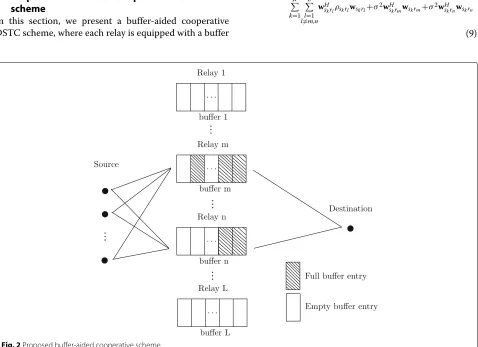
In this section, we present a buffer-aided cooperative DSTC scheme, where each relay is equipped with a buffer
so that the processed data can be stored and the buffer can wait until the channel pair associated with the best perfor-mance is selected (Fig. 2). Consequently, processed data are stored at the corresponding buffer entries and then re-encoded when the appropriate time interval comes. Specifically, the buffer with size J can store up to J packets of data and can either forward or wait for the best time instant to send data. This method effectively improves the quality of the transmission, where it guar-antees that the most suitable signal is selected from the buffer entries and sent to the destination with a higher reliability.
The algorithm begins with a SINR calculation for all possible channel combinations. In the case of the Alam-outi code, every two relays are combined into a group and all possible lists of corresponding channel pairs are considered. Thus, when referring to the SINR for a spe-cific relay pair, the signal transmitted or received by other relays are seen as interference. The corresponding SINR is then calculated and recorded as follows:
SINRsrm,n=
K
k=1
wHskrmρskrmwskrm+w
H
skrnρskrnwskrn
K
k=1 L
l=1 l=m,n
wH
skrlρskrlwskrl+σ2wHskrmwskrm+σ2wHskrnwskrn
,
(9)
SINRrm,nd= desired userkbetween the source and relayl, andρrk
ld = (hkr
ld) Hhk
rld is the correlation coefficient for user k from relaylto the destination.hskrl =askrlskhskrl is the channel vector from userkto relayl. In Eq. (9), SINRsrm,ndenotes the SINR for the combined paths from all users to relaym and relayn,wskrl is the detector used at the relays. When the RAKE receiver is adopted at the corresponding relay, wskrl is expressed as
wskrl =hskrl, (11)
and similarly, if the linear minimum mean square error (MMSE) receiver [28] is employed at the relays,wskrl is equal to represents the SINR for the combined paths from relaym and relaynto the destination. The receiver filterwkr
ld is employed by the detector used at the destination. When the RAKE receiver is adopted at the destination,wkr
ld is
Similarly, if the linear MMSE receiver is employed at the relays,wkr
The above equations correspond to a cooperative system under the assumption that signals from all users are trans-mitted to selected relaysmandn. Both RAKE and MMSE receivers are considered here for the purpose of complex-ity, and it should be mentioned that other detectors [29] can also be used. We then sort all these SINR values in a decreasing order and select the one with the highest SINR as given by
where SINRp,q denotes the highest SINR associated with
the relay p and relay q. After the highest SINR corre-sponding to the combined paths is selected, two different situations need to be considered as follows.
3.1 Source-relay link
If the highest SINR belongs to the source-relay link, then the signal sent to the target relayspandqover two time instants is given by
The received signal is then processed by the detectors as the DF protocol is adopted. Therefore, the decoded sym-bols that are stored and sent to the destination from the lth relay are obtained as
ˆ
whereQ(·)denotes the slicer. After that, the buffers are switched to the reception mode, and the decoded symbol is consequently stored in the corresponding buffer entries. Clearly, these operations are performed when the corre-sponding buffer entries are not full; otherwise, the second highest SINR is chosen as given by
SINRprep,q =SINRp,q (20)
where SINRu,v denotes the second highest SINR
asso-ciated with the updated relay pair u,v. {SINRsrm,n,
SINRrm,nd} \ SINR
pre
p,q denotes a complementary set
where we drop the SINRprep,q from the link SINR set
{SINRsrm,n, SINRrm,nd}. Consequently, the above process
repeats in the following time instants.
3.2 Relay-destination link
If the highest SINR is selected from the relay-destination link, in the following two consecutive time instants, the buffers are switched to transmission mode and the decoded symbol for userkis re-encoded with the Alam-outi matrix as in Eq. (1) so that DSTC is performed from the selected relayspandqto the destination as given by
The received signal is then processed by the detectors at the destination. Clearly, the above operation is conducted under the condition that the corresponding buffer entries are not empty; otherwise, the second highest SINR is cho-sen according to Eqs. (20) and (21) and the above process is repeated.
It is worth noting that for the purpose of simplicity, the above technique employed fixed-size buffers at the relays so that the transmission delay can be controlled with accurate estimation. The key advantage of the proposed scheme is its ability to select the most appropriate symbols before they are forwarded to the next phase. In practice, the performance highly depends on the buffer sizeJ, the number of usersK, and the accuracy of the detection at the relays. The proposed buffer-aided cooperative DSTC scheme is detailed in Table 1.
4 Greedy relay pair selection technique
In this section, a greedy relay pair selection algorithm is introduced. For this relay selection problem, the exhaus-tive search of all possible relay pairs is the optimum way to obtain the best performance. However, the major problem that prevents us from applying this method when a large number of relays involved in the transmission is its con-siderable computational complexity. WhenLrelays (L/2 relay pairs ifLis an even number) participate in the trans-mission, a cost ofL(L−1)link combinations is required as both source-relay links and relay-destination links need to be considered. Consequently, this fact motivates us to seek alternative approaches that can achieve a good balance between performance and complexity.
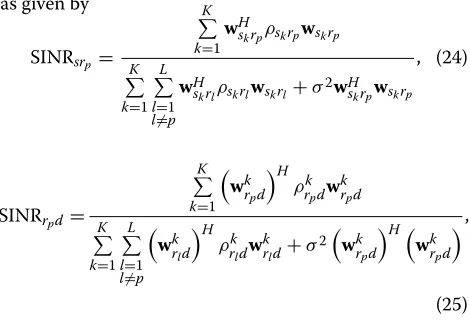
We propose a greedy relay pair selection algorithm that can approach the global optimum with a reduced compu-tational complexity. The algorithm starts with a single link selection where we examine the SINR for each of the links as given by
where SINRsrp and SINRrpd denote the SINR from the source to an arbitrary relay p and from relay p to the destination, respectively. We then select the link with the highest SINR, and its associated relayqis recorded as the base relay and given by
Table 1The proposed buffer-aided cooperative DSTC scheme
% List all possible relay pairs
% Select the combination with the highest SINR
SINRp,q=max{SINRsrm,n, SINRrm,nd}
%Source-relay link
ifSINRp,q∈[ SINRsrm,n] ,m,n∈[ 1,L]
ifthe buffers entries are not full
ysrl(2i−1)=
%Apply the detectors at relaynand relayqto obtain ˆ
brld,k(2i−1)andbˆrld,k(2i)and store them
in the corresponding buffer entries (l∈[p,q])
break
else%choose the second highest SINR
SINRprep,q=SINRp,q
SINRp,q∈max{SINRsrm,n, SINRrm,nd} \SINRprep,q
end
else%Relay-destination link
SINRp,q∈[ SINRrm,nd] ,m,n∈[ 1,L]
ifthe buffers entries are not empty
yrp,qd,k(2i−1)=hkrpdbˆrpd,k(2i−1)+hkrqdbˆrqd,k(2i)+n(2i−1), %Apply the detectors/ML at the destination for detection
break
else%choose the second highest SINR
SINRprep,q=SINRp,q
SINRp,q∈max{SINRsrm,n, SINRrm,nd} \SINRprep,q
end
end
%Re-calculated the SINR for different link combinations and
repeat the above process
Consequently, all possible relay pairs involved with base relayqare listed asp,q, wherep∈[ 1,L] ,p=q. The SINR for these(L−1)relay pairs are then calculated as in Eqs. (9) and (10). After that, the optimum relay pairn,qis chosen according to Eq. (15) and the algorithm begins if the cor-responding buffers are available for either transmission or reception.
4.1 Transmission mode
buffern =∅, n∈[ 1, 2,. . .,L] , (27)
and
bufferq =∅, q∈[ 1, 2,. . .,L] , (28)
wherebuffern andbufferq represents the buffernand the buffer q associated with the relay pair n,q. In this sit-uation, the DSTC scheme is performed afterwards as in Eqs. (22) and (23) through the selected relay pair. Con-versely, empty buffer entries indicate that the selected relay pair is not capable of forwarding the data to the des-tination. In this case, we drop this relay pair, select another relay pair among the remaining (L−2) candidate pairs with the highest SINR as given by
SINRm,q=arg max
The algorithm then repeats the new selected relay pair m,q. Otherwise, if all possible relay pairs p,q (p =
n,q,p ∈[ 1,L]) are not available, we then reset the base relay associated with the second highest SINR as described by
\SINRpreq denotes a
comple-mentary set where we drop the SINRpreq from the link
SINR setSINRsrp, SINRrpd
. After this selection process, a new relay pair is chosen and the transmission procedure repeats as above according to the buffer status.
4.2 Reception mode
When the buffers are switched to reception mode, simi-larly, a buffer space check is performed initially to ensure there is enough space for storing the processed data, namely,
buffern =U, n∈[ 1, 2,. . .,L] , (32)
and
bufferq =U, q∈[ 1, 2,. . .,L] , (33)
where U represents a full buffer set. In this case, if the buffers are not full, then, the sources send the data to the selected relay pairn,qover two time instants according to Eqs. (16) and (17). Otherwise, the algorithm reselects a new relay pair as in Eqs. (29), (30), and (31).
In summary, the relay pair selection algorithm solves a combinatorial problem using exhaustive searches by comparing the SINR of all links and combinations. Alter-natively, a low-complexity algorithm (for example, the proposed greedy algorithm) could be used to reduce the computational complexity of the pair selection task.
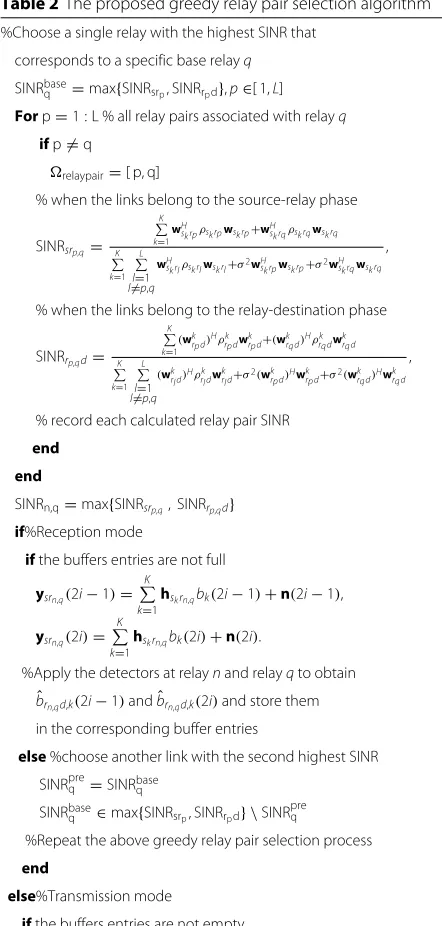
The greedy relay pair selection algorithm is show in Table 2.
Table 2The proposed greedy relay pair selection algorithm
%Choose a single relay with the highest SINR that
corresponds to a specific base relayq
SINRbase
q =max{SINRsrp, SINRrpd},p∈[ 1,L]
Forp=1 : L % all relay pairs associated with relayq
ifp=q
relaypair=[ p, q]
% when the links belong to the source-relay phase
SINRsrp,q=
% when the links belong to the relay-destination phase
SINRrp,qd=
% record each calculated relay pair SINR
end
end
SINRn,q=max{SINRsrp,q, SINRrp,qd}
if%Reception mode
ifthe buffers entries are not full
ysrn,q(2i−1)=
%Apply the detectors at relaynand relayqto obtain ˆ
brn,qd,k(2i−1)andbˆrn,qd,k(2i)and store them
in the corresponding buffer entries
else%choose another link with the second highest SINR
SINRpreq =SINRbaseq
SINRbase
q ∈max{SINRsrp, SINRrpd} \SINRpreq
%Repeat the above greedy relay pair selection process
end
else%Transmission mode
ifthe buffers entries are not empty
yrn,qd,k(2i−1)=hkrndbˆrnd,k(2i−1)+hkrqdbˆrqd,k(2i)+n(2i−1), %Apply the detectors/ML at the destination for detection
else%choose another link with the second highest SINR
SINRpreq =SINRbaseq
SINRbase
q ∈max{SINRsrp, SINRrpd} \SINRpreq
%Repeat the above greedy relay pair selection process
end
end
5 Proposed dynamic buffer scheme
The sizeJof the buffers also plays a key role in the perfor-mance of the system, which improves with the increase of the size as buffers with greater size allow more data pack-ets to be stored. In this case, extra degrees of freedom in the system or choices for data transmission are available. Hence, in this section, we release the limitation on the size of the buffer to further explore the additional advan-tage brought by dynamic buffer design where the buffer size can vary according to different criteria such as the input SNR and the channel condition. When considering the input SNR, larger buffer space is required when the transmission is operated in low SNR region so that the most proper data can be selected among a greater num-ber of candidates. On the other hand, in the high SNR region, a small buffer size is employed as most of the pro-cessed symbols are appropriate when compared with the situation in the low SNR region. In this work, we assume that the buffer sizeJis inversely proportional to the input SNR, namely, with the increase of the SNR, the buffer size decreases automatically. The algorithm for calculating the buffer sizeJis detailed in Table 3.
The buffer size can be determined by the current selected channel pair condition. In particular, we set a threshold γ that denotes the channel power, if the cur-rent selected channel power is under γ, the buffer size increases as more candidates need to be saved in order to select the best symbol, on the contrary, if the current selected channel pair power exceedsγ, we decrease the buffer size as there is a high possibility that the transmis-sion is not significantly affected. The approach based on the channel power for varying the buffer can be summa-rized in Table 4.
6 Analysis of the proposed algorithms
In this section, we analyze the computational complexity required by the proposed relay pair selection algorithm, the problem of the average delay brought by the proposed
Table 3The algorithm to calculate the buffer sizeJ
If SNRcur=SNRpre+d1
then Jcur=Jpre−d2,
where SNRcurand SNRprerepresent the input SNR after and before
increasing its value,
JcurandJpredenote the corresponding buffer size before and after
decreasing its value,
d1andd2are the step sizes for the SNR and the buffer size, respectively.
Table 4The algorithm for calculate buffer sizeJbased on the channel power
If minhskrl2≤γ or minhrld2≤γ, l∈[ 1,L]
Jcur=Jpre+d3
else
Jcur=Jpre−d3
end
whered3represents the step size when adjusting the buffer size.
schemes and algorithms, followed by the discussion of the proposed greedy algorithm.
6.1 Computational complexity
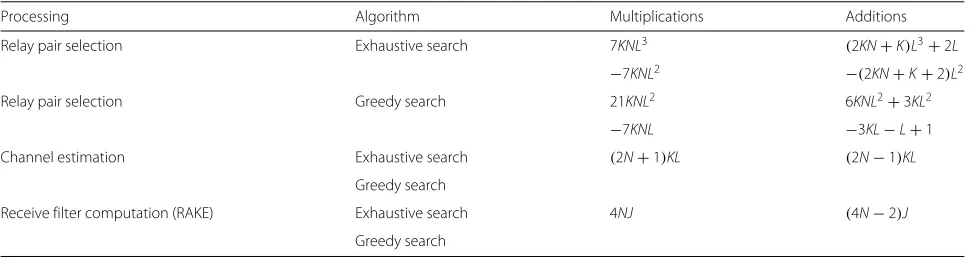
The proposed greedy relay pair selection method con-siders the combination effect of the channel condition so that the DSTC algorithm can be applied with a col-lection of relays. When compared with the exhaustive search that lists all possible subsets of relay pairs, less thanL(L−1)types of link combinations (associated with the corresponding L(L−1)/2 relay pairs) are examined as the proposed method explores the link combination when both single relay and relay pair are involved. For the greedy relay selection strategy, the proposed scheme explores a moderate to large number of relay pairs at each stage; however, the algorithm stops when the corre-sponding entries satisfy the current system requirement (transmission mode or reception mode); in this case, the maximum number of relay pair that we have to exam-ine is (L− 1) +(L−2) +. . .+ 1 = L(L−1)/2. On the other hand, when considering the exhaustive search, the total number of relay pairs that must be verified is CL2=L(L−1)/2. It should be mentioned that when calcu-lating the associated SINR, we have to double the number of calculation flops as we have to consider and compare both the SINR for source-relay links and relay-destination links. The detailed computational complexity is listed in Table 5. When comparing these two algorithms, the pro-posed greedy relay pair selection algorithm is an order of magnitude less costly. The complexity of channel esti-mation and receive filter computation are also listed in Table 5. It can been seen that, when a large number of relays participate in the transmission, with a careful con-trol of the buffer sizeJ, a good balance of complexity and performance is achieved.
6.2 Average delay analysis
Table 5Computational complexity
Processing Algorithm Multiplications Additions
Relay pair selection Exhaustive search 7KNL3 (2KN+K)L3+2L
−7KNL2 −(2KN+K+2)L2
Relay pair selection Greedy search 21KNL2 6KNL2+3KL2
−7KNL −3KL−L+1
Channel estimation Exhaustive search (2N+1)KL (2N−1)KL
Greedy search
Receive filter computation (RAKE) Exhaustive search 4NJ (4N−2)J
Greedy search
the performance-delay trade-off of the proposed buffer-aided DSTC schemes [30]. In this subsection, we analyze the average delay of the proposed schemes and algorithms. We assume that the source always has data to transmit and the delay is mostly caused by the buffers that equip the relays. LetT(i)andQ(i)denote the delay of packets ofM symbols transmitted by the source and the queue length at time instantifor DSTC schemes, respectively.
According to Little’s law [31], the average delay, which is also the average time that packets are stored in the corresponding buffer, is given by
T = Q Ra
time slots, (34)
whereQ = E[Q(i)] represents the average queue length at the relay buffer andRa(in packets/slot) is the average arrival rate into the queue.
In this analysis, we assume both the source and relay transmit at a constant instantaneous rate R (R = 1 packets/slot=Msymbols/slot) when they are selected for transmission and the transmission is operated with one packet ofMsymbols per time slot. We also for sim-plicity define the error probability for the source-relay link and relay-destination link asPsrandPrd(P= Psr =Prd), respectively. For a buffer with sizeJ(Jpackets are stored in the buffer), the average queue length is described by [30]
Q=
J
j=0
jPGj =JPGJ, (35)
wherePGj represents the buffer state probability that has been explained in [30];PGJ =Pfulldenotes the probability when the buffer is full. Similarly, we then definePG0 =
Pempty as the probability for the empty buffer. Therefore,
the average arrival rate into the buffer can be calculated as
Ra=(1−PGJ)P+PG0P. (36)
Similarly, the average departure rate from the buffer is given by
Rd=(1−PG0)P+PGJP. (37)
Consequently, the above equations can be further derived as
T = Q Ra =
PGJ (1−PGJ)P+PG0P
J packets/slot. (38)
Clearly, the above results demonstrate that the transmis-sion delay is linear with the buffer size.
Apart from that, the DSTC scheme will introduce fur-ther delay. For the DSTC scheme, the relay pair needs to wait an extra time slot for the second packet to arrive. Then, the relay pair can transmit the packets to the des-tination using DSTC scheme. In other words, the DSTC scheme takes two time slots to transmit two packets, and as a result, it brings extra delay obviously [32–34]. Mean-while, the relay pair selection processing also brings delay. For both exhaustive and greedy selections, they need to calculate the best relay pair from the candidates pool. This processing need extra computation time until the best relay pair is selected.
6.3 Greedy relay selection analysis
will not appear in the current stage. Hence, the relay pairs grouped at each step are presented as follows:
Stage 1 : 11,12,. . .,1L−1, Stage 2 : {21,22,. . .,2L−2},
.. .
Stage s : {s1,2s,. . .,sL−s}, ..
. Stage L−1 : {11},
wheresidenotes theith relay pair at thesth stage. Clearly, the maximum number of relay pairs that we have to con-sider for allL−1 stages is(L−1)+(L−2)+. . .+1 = L(L−1)/2, since this algorithm stops when selected relay pair with its associated buffers are available, the associ-ated complexity for the proposed greedy relay selection strategy is less thanL(L−1)/2.
Compared with the exhaustive search, which is consid-ered as the optimum relay selection method, the number of relay pairs examined for the processing is given by
Stage 1 :
11,12,. . .,1L(L−1)
2
.
The total number of relay combinations can then be cal-culated as CL2 = L(L − 1)/2, where each term Cmn =
m(m−1)...(m−n+1)
n! represents the number of combinations
that we choose, i.e.,nelements frommelements(m≥n). Because the number of relay pairs that we have to con-sider for the greedy algorithm is less than exhaustive search, the proposed greedy algorithm provides a much lower cost in terms of flops and running time when com-pared with the exhaustive search. In fact, the idea behind the proposed algorithm is to choose relay pairs in a greedy fashion. At each stage, we select the set of relays with the highest SINR. Then we consider the availability of the buffers, if the corresponding buffer entries do not satisfy the system mode, we reselect the relay pair in the follow-ing stages. After several stages, the algorithm is able to identify the optimum (or a near optimum) relay set that can satisfy the current transmission. To this end, we state the following proposition.
Proposition 1 The proposed greedy algorithm achieves an SINR that is upper bounded as follows:
SINRgreedy≤SINRexhaustive (39)
ProofWe investigate the upper bound by comparing the proposed algorithm and the exhaustive search at the first stage. At stage 1, sincesgreedyis a candidate subset of the exhaustive search, we have
1exhaustive=max
1exhautive(i),i∈1,CL2 , (40)
sgreedy∈
1exhautive(i),i∈1,CL2 , (41)
where1exhaustive(i)represents thei-th relay pair selected at the 1st stage of the exhaustive relay selection method.
Assuming both strategies select the same relay pair and the greedy algorithm is conducted at stages, we have
sgreedy= {p,q},
1exhaustive= {p,q},
this situation again leads to the equality that SINRsgreedy = SINR1
exhaustive. In contrast, if the exhaustive search chooses
another relay set that belongs to{1exhautive(i),i ∈[ 1,CL2]} that provides a higher SINR, clearly,sgreedy=1exhaustive, we can then obtain the inequality that SINRsgreedy ≤ SINR1
exhaustive.
7 Simulations
In this section, a simulation study of the proposed buffer-aided DSTC techniques for cooperative systems is carried out. The DS-CDMA network uses randomly generated spreading codes of length N = 16. The corresponding channel coefficients are modeled as uniformly random variables and are normalized to ensure the mean sig-nal value over all transmissions is unity for all asig-nalyzed techniques. We assume perfectly known channels at the receivers and we also present an example with channel estimation. Equal power allocation is employed. We con-sider packets with 1000 BPSK symbols and step sized = 2 when evaluating the dynamic schemes. We consider fixed buffer-aided exhaustive/greedy (FBAE/FBAG) relay pair selection strategies (RPS) and dynamic buffer-aided exhaustive/greedy (DBAE/DBAG) RPS.
a
b
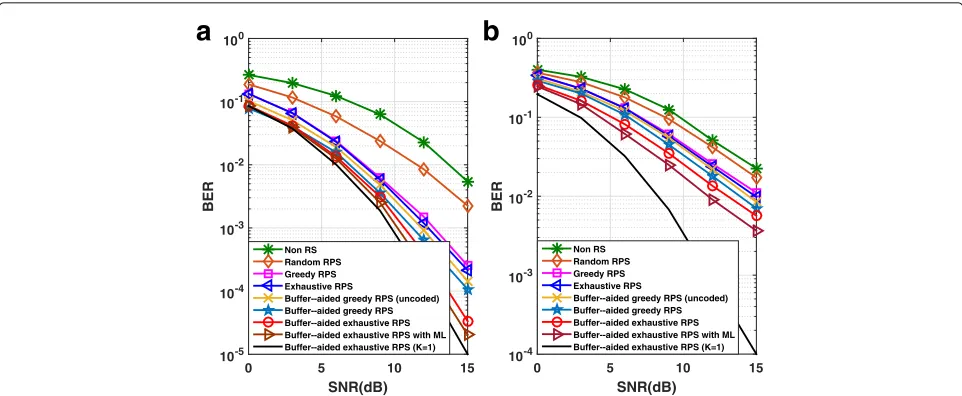
Fig. 3 aPerformance comparison for buffer-aided scheme and non buffer-aided scheme in cooperative DS-CDMA system with perfect decoding at the relay, RAKE at the destination.bPerformance comparison for buffer-aided scheme and non buffer-aided scheme in cooperative DS-CDMA system with MMSE at the relay, RAKE at the destination
possible relay pairs and selects the one with the high-est SINR. In contrast, the proposed buffer-aided scheme automatically selects the relay pair over both source-relay links and relay-destination links. Moreover, with the help of the buffers, the most appropriate data are sent and better overall system performance can be achieved. As for different decoding methods, we have also evaluated the BER performance when the ML detector is applied at the destination and the result shows that the ML detec-tor significantly outperforms the simple RAKE receiver. Additionally, we have also included a simulation curve when DSTC is not employed in the second phase trans-mission; the results show that the DSTC scenarios achieve higher diversity gain when compared with the uncoded system. Apart from that, the performance for a single-user buffer-aided exhaustive RPS DSTC is presented here for comparison purposes. Consequently, the results reveal that our proposed buffer-aided strategies (J =6) perform better than the one without buffers. In particular, Fig. 3a also illustrates that our proposed buffer-aided schemes can approach the single-user bound very closely.
Another example depicted in Fig. 3b compares the pro-posed buffer-aided DSTC transmission with different RPS and non-buffer-aided DSTC transmission with different RPS. In this scenario, we apply the linear MMSE receiver at each of the relay and the RAKE at the destination in an uplink cooperative scenario with three users, six relays, and buffer sizeJ = 6. Similarly, the system gain brought by the use of the ML detector at the destination and the performance bounds for a single-user buffer-aided exhaustive RPS DSTC are presented for comparison purposes. The results also indicate that the proposed
buffer-aided DSTC strategies (J = 6) have higher diver-sity gain when compared with the ones without employed DSTC schemes during the relay-destination phase. Fur-thermore, the BER performance curves of our greedy RPS algorithm approaches the exhaustive RPS, while keeping the complexity reasonably low for practical use.
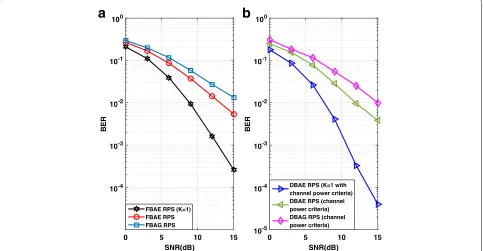
In the second example, we compare the proposed buffer-aided DSTC transmission with different RPS strategies and DSTC transmission with RPS and no buffers with channel estimation. The results are shown in Fig. 4. In this scenario, we apply the linear MMSE receiver at each of the relay and the RAKE at the destination in an uplink cooperative scenario with three users, six relays, and buffer sizeJ=6. Clearly, it can been seen that, due to the introduction of channel estimation, the performance for all algorithms are slightly degraded when compared with the assumption of perfect CSI. However, our pro-posed buffer-aided strategies (J = 6) still perform better than the one without buffers.
Fig. 4Performance comparison for buffer-aided scheme and non buffer-aided scheme in cooperative DS-CDMA system with MMSE at the relay, RAKE at the destination with channel estimation applied
a
b
according to a given criterion. In this case, there is a greater possibility to select the most appropriate data when the transmission is operated in poor condition as more candidates are stored in the buffer space. On the other hand, the transmission delay can be avoided when the outer condition improves as most of the candidates are appropriate. Simulation results verify these points and indicate that the DBAE/DBAG RPS outperform the FBAE/FBAG (J = 8) RPS and the advantage increases when adopting the single-user case. Furthermore, it can also be seen that the BER performance curves of the greedy relay pair selection algorithm [35] approaches the exhaustive search, while keeping the complexity reason-ably low for practical utilization.
The fourth example compares the FBAE/FBAG RPS scheme in Fig. 6a and the DBAE/DBAG RPS strategy in Fig. 6b in a DSTC cooperative system, where we apply the linear MMSE receiver at each of the relay and the RAKE receiver at the destination in an uplink coopera-tive scenario with three users, six relays, and fixed buffer size J = 8. Similarly, the performance for a single-user buffer-aided exhaustive RPS DSTC is presented for comparison purposes. In both figures, the buffer-aided exhaustive search RPS algorithm performs better than the greedy one. The average dynamic buffer size J is highly dependant on the threshold γ and the step size d, clearly, and with careful control on these parame-ters, better performance can be achieved. The simulation
results also indicate that our proposed dynamic design performs better than the fixed buffer size ones when we apply the same relay selection method, as depictedl in Fig. 6.
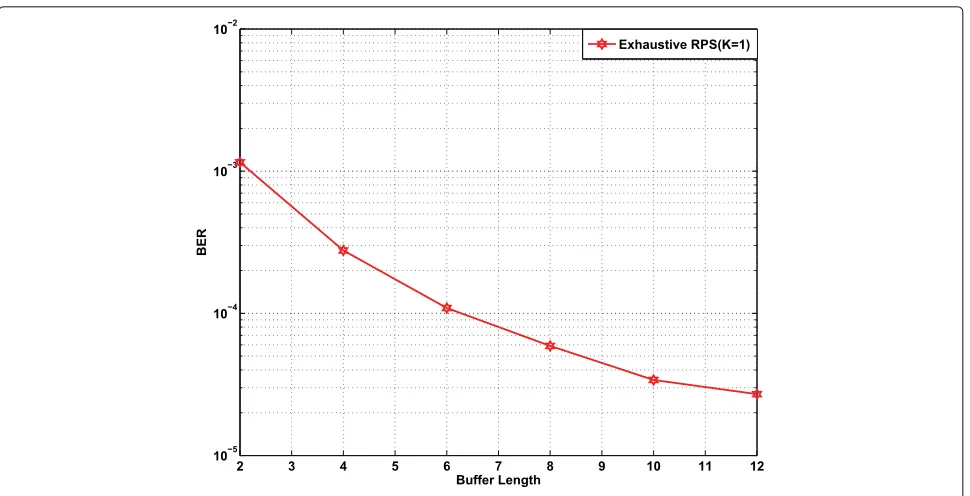
The algorithms are then assessed in terms of the BER versus buffer size Jin Fig. 7 with a fixed SNR= 15 dB. In this scenario, we assume perfect decoding at the relays as accurate detection at relays would highly influ-ence the following transmission and apply the RAKE at the destination. The results indicate that the overall BER degrades as the size of the buffer increases. It also shows that with larger buffer sizes, the system experi-ences diminishing returns in performance. In this case, a good balance between the transmission delay and the buffer size can be obtained when the buffer size is carefully considered.
In the last part, we demonstrate the influence of the dynamic buffer size on the average delay. We examine via simulations the proposed algorithms by measuring the average delay in packets versus the packet size in symbols in Fig. 8. This figure presents the average delay for differ-ent algorithms, when a certain number of symbols (that form packets) are transmitted. For the average delay, we measure the number of extra packets that are employed when compared with transmitted symbols. There exists a linear relation between the average delay and trans-mitted symbols, as outlined in the delay analysis. This is because for each certain number of transmitted packets,
a
b
Fig. 7BER versus size of the buffers for uplink cooperative system
the average delay is similar. As a result, when the trans-mitted symbols increase with a fixed numbers of packets, the average delay also increases with a similar numbers of packets. Therefore, with the increase of transmitted packet size, the average delay increases together. When we compare the proposed algorithms, the dynamic buffer size reduces the average delay. In particular, the proposed mul-tiuser buffer–aided greedy DSTC algorithm with dynamic buffer scheme has the lowest delay, followed by the greedy DSTC algorithm and the exhaustive DSTC algorithm with and without the dynamic buffer scheme.
Fig. 8Packet size comparison for uplink cooperative system
8 Conclusions
In this work, we have presented a dynamic buffer-aided DSTC scheme for cooperative DS-CDMA systems with different relay pair selection techniques. With the help of the dynamic buffers, this approach effectively improves the transmission performance and help to achieve a good balance between bit error rate (BER) and delay. We have developed algorithms for relay-pair selection based on an exhaustive search and on a greedy approach. A dynamic buffer design has also been devised to improve the perfor-mance of buffer-aided schemes. Simulation results show that the performance of the proposed scheme and algo-rithms can offer good gains as compared to previously reported techniques.
Acknowledgements
This work is funded by the ESII consortium under task 26 for low-cost wireless ad hoc and sensor networks.
Competing interests
The authors declare that they have no competing interests.
Author details
1Department of Electronics, University of York, YO10 5DD York, UK.2CETUC, PUC-Rio, Brazil.
Received: 24 May 2016 Accepted: 7 October 2016
References
1. JG Proakis,Digital Communications, 4th edn. (McGraw-Hill, Inc, New York, 2011)
3. S Wei, Diversity–multiplexing tradeoff of asynchronous cooperative diversity in wireless networks. IEEE Trans. Inf. Theory.53(11), 4150–4172 (2007)
4. SS Ikki, MH Ahmed, Performance analysis of cooperative diversity with incremental-best-relay technique over rayleigh fading channels. IEEE Trans. Commun.59(8), 2152–2161 (2011)
5. A Sendonaris, E Erkip, B Aazhang, User cooperation diversity—parts I and II. IEEE Trans. Commun.51(11), 1927–1948 (2003)
6. L Venturino, X Wang, M Lops, Multi-user detection for cooperative networks and performance analysis. IEEE Trans. Signal Process.54(9), 3315–3329 (2006)
7. JN Laneman, GW Wornell, Cooperative diversity in wireless networks: efficient protocols and outage behaviour. IEEE Trans. Inf. Theory.50(12), 3062–3080 (2004)
8. A Kalantari, E Soleimani-Nasab, M Ardebilipour, in2011 19th Iranian Conference on Electrical Engineering. Performance analysis of best selection DF relay networks over Nakagami-n fading channels, (Tehran, 2011), pp. 1–1
9. E Soleimani-Nasab, M Ardebilipour, A Kalantari, Performance analysis of selective df relay networks over nakagami-n and nakagami-q fading channels. Wirel. Commun. Mob. Comput.14(16), 1564–1581 (2014) 10. JN Laneman, GW Wornell, Distributed space-time coded protocols for
exploiting cooperative diversity in wireless networks. IEEE Trans. Inf. Theory.49(10), 2415–2425 (2003)
11. S Yiu, R Schober, L Lampe, Distributed space-time block coding. IEEE Trans. Wirel. Commun.54(7), 1195–1206 (2006)
12. RC de Lamare, R Sampaio-Neto, Blind adaptive MIMO receivers for space-time block-coded DS-CDMA systems in multipath channels using the constant modulus criterion. IEEE Trans. Commun.58(1), 21–27 (2010) 13. Y Jing, B Hassibi, Distributed space-time coding in wireless relay networks.
IEEE Trans. Wirel. Commun.5(12), 3524–3536 (2006)
14. T Peng, RC de Lamare, A Schmeink, in2012 International Symposium on Wireless Communication Systems (ISWCS). Adaptive distributed space-time coding for cooperative MIMO relaying systems, (Paris, 2012), pp. 611–615 15. Y Jing, H Jafarkhani, Single and multiple relay selection schemes and their achievable diversity orders. IEEE Trans. Wirel. Commun.8(3), 1084–1098 (2009)
16. P Clarke, RC de Lamare, Transmit diversity and relay selection algorithms for multi-relay cooperative MIMO systems. IEEE Trans. Veh. Technol.61(3), 1084–1098 (2012)
17. S Talwar, Y Jing, S Shahbazpanahi, Joint relay selection and power allocation for two-way relay networks. IEEE Signal Process. Lett.18(2), 91–94 (2011)
18. J Gu, RC de Lamare, in2014 22nd European Signal Processing Conference (EUSIPCO). Joint sic and multi-relay selection algorithms for cooperative DS-CDMA systems, (Lisbon, 2014), pp. 556–560
19. T Peng, RC de Lamare, A Schmeink, Adaptive distributed space-time coding based on adjustable code matrices for cooperative MIMO relaying systems. IEEE Trans. Commun.61(7), 2692–2703 (2013)
20. J Gu, RC de Lamare, J Wireless Com Network (2016).59(2016) 21. N Zlatanov, A Ikhlef, T Islam, R Schober, Buffer-aided cooperative
communications: opportunities and challenges. IEEE Commun. Mag. 52(4), 146–153 (2014)
22. N Zlatanov, R Schober, P Popovski, inGlobal Telecommunications Conference (GLOBECOM 2011). Throughput and diversity gain of buffer-aided relaying (IEEE, Houston, 2011), pp. 1–6
23. I Krikidis, T Charalambous, J Thompson, Buffer-aided relay selection for cooperative diversity systems without delay constraints. IEEE Trans. Wirel. Commun.11(5), 1592–1967 (2012)
24. A Ikhlef, DS Michalopoulos, R Schober, Max-max relay selection for relays with buffers. IEEE Trans. Wirel. Commun.11(5), 1124–1135 (2012) 25. SM Alamouti, A simple transmit diversity technique for wireless
communications. IEEE J. Sel. Areas Commun.16(8), 1451–1458 (1998) 26. CW Tan, AR Calderbank, Multiuser detection of alamouti signals. IEEE
Trans. Commun.57(7), 2080–2089 (2009)
27. H Liu,Signal Processing Applications in CDMA Communications, 1st edn. (Artech House, Inc, Norwood, 2000)
28. RC de Lamare, R Sampaio-Neto, Adaptive reduced-rank processing based on joint and iterative interpolation, decimation, and filtering. IEEE Trans. Signal Process.57(7), 2503–2514 (2009)
29. RC de Lamare, R Sampaio-Neto, Minimum mean-squared error iterative successive parallel arbitrated decision feedback detectors for ds-cdma systems. IEEE Trans. Commun.56(5), 778–789 (2008)
30. T Islam, RS A Iklef, V Bhargava, Diversity and delay analysis of buffer-aided bicm-ofdm relaying. IEEE Trans. Wirel. Commun.12(11), 5506–5519 (2013) 31. DP Bertsekas, RG Gallager,Data Networks, 2nd edn. (Prentice-Hall, Inc,
Englewood Cliffs, 1991)
32. M Bouanen, W Ajib, H Boujemaa, in2011 7th International Wireless Communications and Mobile Computing Conference. Throughput and delay analysis of truncated cooperative ARQ protocols using DSTC, (Istanbul, 2011), pp. 731–736
33. Y Gong, KB Letaief, Performance evaluation and analysis of space-time coding in unequalized multipath fading links. IEEE Trans. Commun. 48(11), 1778–1782 (2000)
34. Z Sheng, Z Ding, KK Leung, inGlobal Telecommunications Conference, 2009. GLOBECOM 2009. Transmission delay analysis with finite coding length in wireless cooperative networks, (Honolulu, 2009), pp. 1–6 35. J Gu, RC de Lamare, in2014 IEEE International Conference on Acoustics,
Speech and Signal Processing (ICASSP). Joint parallel interference cancellation and relay selection algorithms based on greedy techniques for cooperative DS-CDMA systems, (Florence, 2014), pp. 2754–2758
Submit your manuscript to a
journal and benefi t from:
7Convenient online submission
7Rigorous peer review
7Immediate publication on acceptance
7Open access: articles freely available online
7High visibility within the fi eld
7Retaining the copyright to your article