R E S E A R C H
Open Access
Outage performance of fixed-gain and
variable-gain AF full-duplex relaying in
non-identical Nakagami-
m
fading channels
Asil Koç
1, ˙Ibrahim Altunba¸s
1and Abbas Yongaço ˘glu
2*Abstract
We investigate outage performance of fixed-gain and variable-gain amplify-and-forward (AF) full-duplex (FD) relaying systems under residual loop-interference (LI) in non-identical Nakagami-mfading channels. New exact outage probability expressions are derived analytically in a single-integral form by using the cumulative distribution function approach. Moreover, tight lower-bound and asymptotic outage probability expressions are derived in closed-form for the evaluated systems. It is shown that the fixed-gain AF-FD relaying outperforms the variable-gain AF-FD relaying when LI power and/or signal-to-noise ratio increase. The analytical results are verified by Monte-Carlo simulations.
Keywords: Full-duplex relaying, Nakagami-m, Amplify and forward, Fixed-gain, Variable-gain, Outage analysis
1 Introduction
Full-Duplex (FD) communication allows receiving and transmitting the signal at the same time interval using the same frequency band, hence it improves the spectral efficiency and reduces end-to-end delay with respect to the conventional half-duplex communication [1]. Addi-tionally, the FD communication improves the network secrecy by means of the mixed signals during the simulta-neous transmission [1]. Therefore, it has recently gained great attention as a potential candidate for the next gen-eration wireless communication systems [2]. Although FD communication causes loop-interference (LI) (or self-interference) at the receiver antenna, the recent devel-opments on antenna technology and signal processing techniques make it feasible by applying LI cancellation techniques, e.g., antenna separation, analog cancellation and digital cancellation [3–5]. The practical implemen-tations in [4] shows that although the LI power can be decreased 74 dB on average, it cannot be completely removed, even with complex cancellation processes [4–6]. Moreover, the experimental studies as in [4] demonstrate that it is convenient to model the residual LI channel with
*Correspondence: [email protected]
2School of Electrical Engineering and Computer Science, University of Ottawa, Ottawa, Canada
Full list of author information is available at the end of the article
Rician or Nakagami-mfading due to the multipath signal propagation and line-of-sight (LOS) component between the transmitter and the receiver.
Cooperative communication with relaying has also attracted considerable attention in recent years since it provides coverage extension, capacity, outage, and error performance enhancement [7]. Amplify-and-forward (AF) and decode-and-forward (DF) are the most popu-lar signal forwarding methods used at the relays [7]. In the AF method, the amplifying process may be based on the partial or full channel state information of the source-relay channel, namely fixed-gain [8] and variable-gain [9] AF relaying, respectively. The conventional cooperative communication systems suffer from spectral efficiency loss due to half-duplex relaying. In order to improve the spectral efficiency, FD communication is utilized at the relays [10]. In the literature, several papers investigate per-formance of the AF-FD relaying. In [11], optimal power allocation (PA) problem and capacity of the variable-gain AF-FD relaying are investigated. In [12], outage proba-bility of the variable-gain AF-FD relaying system with direct link between source and destination is investigated in Rayleigh fading channels and shown that the direct link provides diversity gain. The outage probability of the variable-gain AF-FD relaying system with direct link is derived for Rayleigh fading channels in [13] under pro-cessing delay and residual LI. Note that the source-relay
link is assumed fading-free in [13]. In [14], optimal PA problem based on statistical and instantaneous channel state information for the variable-gain AF-FD relaying system with direct link is investigated for Rayleigh fad-ing under total source and relay power constraint. In that paper, minimum outage probability expressions are derived and comparisons with the DF-FD relaying are also presented. An optimal PA analysis based on minimizing the pairwise error probability is carried out for the fixed-gain AF-FD relaying in [15] and shown that unequal PA presents better error performance than those using equal power in the transmitters. In [16], error performance and diversity of uncoded and coded fixed-gain AF-FD relaying with direct link are investigated. AF-FD relaying is applied to the systems with multiple relays (e.g. in [17–19]) and shown that the performance can be enhanced significantly by using all the relays or the selected relay. The outage per-formance of variable-gain AF-FD relaying over
Nakagami-mchannel is recently analyzed in [20] and the exact outage probability expression is derived in terms of extended generalized bivariate Meijer-G function (EGBMGF). In [20], an approximate outage performance expression is also obtained in closed-form by ignoring additive noise in the source-relay channel. Besides, the asymptotic out-age probability, asymptotic ergodic capacity and ergodic capacity lower-bound expressions are presented. In [21], the outage performance of the fixed-gain AF-FD relay-ing is investigated and compared with the variable-gain AF-FD relaying over Rayleigh fading channels where the exact outage probability expression is obtained in a single-integral.
In this paper, we derive exact outage probability expressions for both fixed-gain and variable-gain dual-hop AF-FD relaying where all channels are modeled as Nakagami-m fading channel including the resid-ual LI channel. The outage probability expressions are obtained by using cumulative distribution function (CDF) of the end-to-end signal-to-interference-plus-noise ratio (SINR). Our results in the fixed-gain and variable-gain AF-FD relaying are both in a single-integral form. To the best of our knowledge, there is no outage perfor-mance investigation in the literature for the fixed-gain AF-FD relaying systems over non-identical
Nakagami-m fading channels. Also, our exact outage performance result for the variable-gain AF-FD relaying can be easily calculated numerically in comparison to the exact outage probability expression in terms of EGBMGF given in [20] which is based on double Mellin-Barnes type integrals. Furthermore, there is no restriction on the m parame-ter of the relay-destination link in our analyses. We also present tight lower-bound and asymptotic outage prob-ability expressions of the considered systems in closed-form. The theoretical results are validated by computer simulations.
The main contributions of our paper can be summa-rized as follows:
• All of the channels are modeled as Nakagami-m fading channels including the residual LI channel at the relay node which makes the analyses more accurate for practical purposes.
• The exact outage probability expressions of the fixed-gain AF-FD and variable-gain AF-FD systems are derived in single-integral forms which can be easily evaluated by using common mathematical package programs.
• For both of the considered systems, the exact outage performance analyses are supported with the lower-bound and asymptotic outage probability expressions obtained in closed-form.
• The advantages of the fixed-gain AF-FD relaying with respect to the variable-gain AF-FD relaying in terms of outage performance are presented. We
demonstrate that the system has lower error floor when the fixed-gain AF-FD relaying is deployed. • It is shown thatm parameter of the residual LI
channel has dominant effect for the performance limitation in the fixed-gain AF-FD systems. On the other hand, the dominantm parameter of the variable-gain AF-FD systems belongs to the source-relay link channel for the error floor.
The remainder of the paper is organized as follows. In Section 2, the system model for AF-FD relaying is introduced and the SINR expressions are derived for the fixed-gain and variable-gain relays. The exact out-age probability expressions of the proposed systems are given in Section 3. Then, the lower-bound and asymptotic outage probability analyses are given in Section 4. The the-oretical and simulation results for different scenarios are demonstrated in Section 5. Finally, Section 6 concludes the paper.
2 System model and end-to-end SINR
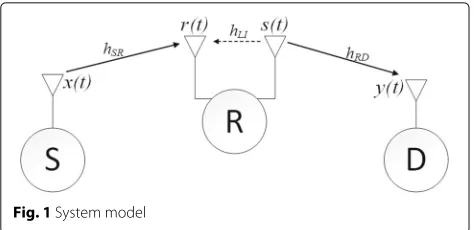
We consider a dual-hop network as in Fig. 1 where the source (S) and the destination (D) both have sin-gle antenna. Source and destination communicate with each other through an AF-FD relay (R) and there is no direct link between the source and destination. The relay is equipped with one receive and one transmit antenna. In the figure, hSR and hRD are complex chan-nel coefficients between S-R and R-D links, respectively andhLI is the complex residual LI term. Their envelopes (|hSR|,|hRD|,|hLI|) are assumed to be independent and non-identically Nakagami-mdistributed. When the unit-power signalx(t)is transmitted from the source, the signal received at the receive antenna of the relay is expressed as
r(t)=hSR
PSx(t)+hLI
Fig. 1System model
wheres(t)=βr(t−τ)is the signal transmitted by the relay at the same time.PSandPRare the transmission powers at the source and relay, respectively andnR(t)is the complex noise with zero mean and varianceσR2.βis the amplifica-tion factor andτ is the processing delay at the relay. By recursively using (1), the transmitted signals(t) can be rewritten as
s(t)=β ∞
j=1
βhLI
PR j−1
gt−jτ (2)
whereg(t) = hSR√PSx(t)+nR(t). Finally, the received signal at the destination can be given by y(t) = hRD√PRs(t) + nD(t) where nD(t) is the complex noise with zero mean and variance σD2. By analyzing (2), one can easily show that stability of the relay is guaranteed and oscillations are prevented, if theβ2 < 1/PR|hLI|2 condition is satisfied [3]. In that case, the instantaneous transmission power at the relay and the instantaneous end-to-end signal-to-interference-plus-noise ratio (SINR) at the destination are, respectively, given as [3]
PR|s(t)|2 =PR γSR+ 1 1 β2σ2
R −γLI
, (3)
γend= γRDγLI(γ γSRγRD SR+1)
1 β2σ2
R
−γLI +γRD+
1 β2σ2
R
(4)
where . represents the time average over one symbol duration, γSR = PS|hSR|2/σR2, γRD = PR|hRD|2/σD2 and γLI = PR|hLI|2/σR2. By definingγ¯SR = PSSR/σR2,γ¯RD =
PRRD/σD2, γ¯LI = PRLI/σR2 andA = E
|hA|2
with
A ∈ {SR,RD,LI}, probability density function (PDF) and CDF of these random variables can be given, respectively,
by pγA(x) =
μmAA xmA−1
(mA) e−xμA and FγA(x) =
γ (mA,xμA)
(mA) withμA = mA/γ¯A. Here,(.)andγ (., .)are the Gamma ([22] eq.(8.310.1)) and the lower incomplete Gamma ([22] eq.(8.350.1)) functions.
2.1 Fixed-gain relaying
By choosing the amplification factorβ=1/PSSR+PRLI+σR2, the instantaneous SINR is obtained as [21]
γend=
γSRγRD(C−γLI)
γSRγLIγRD+C(C+γRD−γLI), γLI<C
0, γLIC
(5)
withC= ¯γSR+ ¯γLI+1. Here,γLI<Cis obtained from the
conditionβ2<1/PR|hLI|2given before. Note that when the conditionβ2 <1/PR|hLI|2is not satisfied, i.e., when
γLIC, thenγend =0since the power of the interference
goes to infinity.
In order to make a fair comparison, average power con-sumption of the fixed-gain AF-FD relays should be taken into account. By using (3) andβ, the average transmission power at the relay is given by
EPR|s(t)|2 =PRE
γSR+1 C−γLI
. (6)
By using the independence property ofγSRandγLI, the
average power consumption can be obtained as
EPR|s(t)|2 =PRE[γSR+1] E[C−γLI]=
PRγ¯SR+1 C− ¯γLI =
PR. (7)
Although the instantaneous transmission power at the relay varies for the fixed-gain AF-FD relaying, the aver-age value is set toPRdue to the selectedβ. It is important to note that we assume the dynamic range of the power amplifier at the relay is unrestricted for the fixed-gain AF-FD systems similar to [8] and [21].
2.2 Variable-gain relaying
In order to assure the instantaneous
transmis-sion power as PR, the amplification factor is set to
β=1/
PS|hSR|2+PR|hLI|2+σ2
R. Please note that the
same amplification factor is commonly used in the FD literature such as in [12, 14, 18–20]. Although the ampli-fication factor changes with the instantaneous value of residual LI channel coefficient, which is an unknown for the relay,|hLI|2 can be obtained by using the energy detection techniques as mentioned in [14]. Then, the instantaneous SINR becomes
γend=
X1γRD
X1+γRD+1 (8)
where X1 = γSR/(γLI + 1). Note that the condition β2 < 1/PR|hLI|2 given before is always satisfied for the variable-gain relaying. By substitutingβ into (3), the instantaneous transmission power for the variable-gain AF-FD relaying can be easily given by [3]
PR|s(t)|2 =PR (9)
which also shows that the average transmission power of the relay for both the fixed-gain and variable-gain AF-FD relaying are the same and equal toPR.
3 Exact outage probability analysis
given in (5) and (8). The exact outage probability equals
Pout =Fγend(γth)whereFγend(.)is CDF ofγend andγthis a
threshold SINR.
3.1 Fixed-gain relaying
The CDF expression for the SINR given in (5) can be expressed as
Nakagami-m fading channels. In (10), the conditional CDFFγend(x|γLIC) = P(γend < x|γLIC) = 1since
In the above integral, the probability term can be written as
In the above equation, the first integral termI1can be simply solved as
The second integral termI2can be calculated as
I2 =
For integer values ofmSR, by using ([22] eq. (8.352.6)),I2 can be rewritten as
I2 =
By using the binomial equation for the term shown in the square brackets the above equation, we obtain
I2 = μ
whereKmRD−i(.)is the(mRD−i)
th order modified Bessel
function of second kind ([22] eq. (8.407.1)). Using (20) in (19) gives
To the best of authors’ knowledge, there is no closed-form solution for the above expression. By substituting (15), (16) and (21) into (11),Poutfor the fixed-gain AF-FD relaying can be evaluated by using numerical integration and it is rewritten as
Pout=1−γ (mLI,μLIC)
The above expression is in a single-integral form. There-fore, it can be easily and efficiently evaluated with com-mon mathematical software packages such as MATLAB, MATHEMATICA or MAPLE.
3.2 Variable-gain relaying
The CDF expression for the SINR given in (8) is given by
Fγend(x)=P(γend <x)=P
can be obtained. For integer values of mSR, by using ([22], eq. (8.352.6)), ([23] eq. (8)) and also the binomial expansion,
can be obtained. Now substituting (26) into (24),Poutfor the variable-gain AF-FD relaying is
Pout = 1−
The above expression is in single-integral form as well. Hence, it can be also easily and efficiently evaluated with common mathematical software pack-ages such as MATLAB, MATHEMATICA, or MAPLE. As mentioned in the Introduction, outage perfor-mance of the variable-gain AF-FD relaying systems in Nakagami-m fading channels is also independently evaluated in [20]. On the other hand, the exact out-age probability expression given in ([20] eq. (16)) is written in terms of EGBMGF which contains Mellin-Barnes type double-contour-integration ([24] Table I). Although, MATHEMATICA implementation of the EGB-MGF function has been provided in ([24] Table II), the built-in function is not available for EGBMGF to the best of our knowledge. Also, different from [20], our result is valid for both integer and non-integermRDvalues.
4 Lower-bound and asymptotic outage
probability analyses
4.1 Fixed-gain relaying
4.1.1 Lower-bound
In the previous section, the exact outage probability of the fixed-gain AF-FD relaying is derived in a single-integral form and given in (22). One can show that the integral term at (21) can be upper-bounded whenC−z(γth+1)
term inside the integration is replaced withC −zterm. This leads to a lower-bound of the outage probability which can be given by
Pout,low=1−γ (
By applying the variable transformation as t = CC−z
and using the binomial expansion, the above integralI4is expressed as
Then, the power series and the binomial expansions are used respectively as follows
I4=
whereI5can be easily solved as
I5=
By combining (28), (30), and (31), we obtain the lower-bound expression for the fixed-gain AF-FD systems in closed-form as
4.1.2 Asymptotic outage probability
When signal-to-noise ratio (SNR) goes to infinity, i.e., whenPS,PR → ∞for the finiteσR2 andσD2, the instanta-neous SINR in (5) becomes
lim
The asymptotic expression for the outage probability of the fixed-gain AF-FD systems can be obtained from (11). One can easily show that γ (mLI,μLIC) goes to
γ (mLI,mLI(η+1))forPS,PR → ∞where η = ¯γSR/γ¯LI.
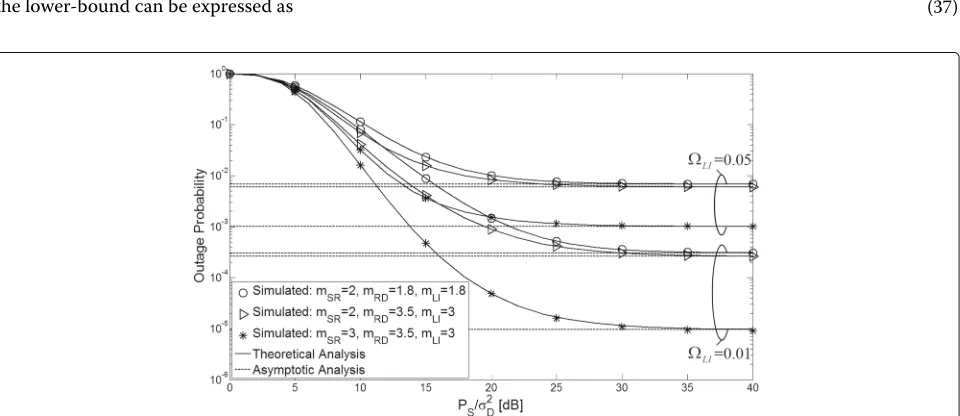
Fig. 2Outage probability of the fixed-gain AF-FD systems forLI= {0.05, 0.1},γth=3 and variousmvalues
By substituting (34) in (11), the asymptotic outage prob-ability is obtained in closed-form as
P∞out = 1 −
γmLI,mLI(η+1)'(γth+1)
(mLI) . (35)
As seen,Pout∞ for the fixed-gain case is a constant and
therefore leads to zero diversity order at high SNR and does not depend onmSR,mRDandRDparameters.
4.2 Variable-gain relaying
4.2.1 Lower-bound
In order to obtain a lower-bound for the variable-gain AF-FD relaying systems, we use the property of
γend<X1γRD/ (X1+γRD)<min(X1,γRD)where the
instan-taneous SINR for variable-gain relaying is given in (8). So, the lower-bound can be expressed as
Pout,low=P(min{X1,γRD} ≤γth)
=1−P(min{X1,γRD}> γth)
=1− ¯FX1(γth)F¯γRD(γth)
(36)
where FX¯ 1(.) was already found in (26). Therefore, we can easily derive the lower-bound expression in closed-form as
Pout,low=1− (
mRD,γthμRD) μmLILI (mRD) (mLI)eμSRγth
×
mSR−1
k=0
k
b=0
(b+mLI) (μSRγth)k b!(k−b)!(μLI+μSRγth)b+mLI
.
(37)
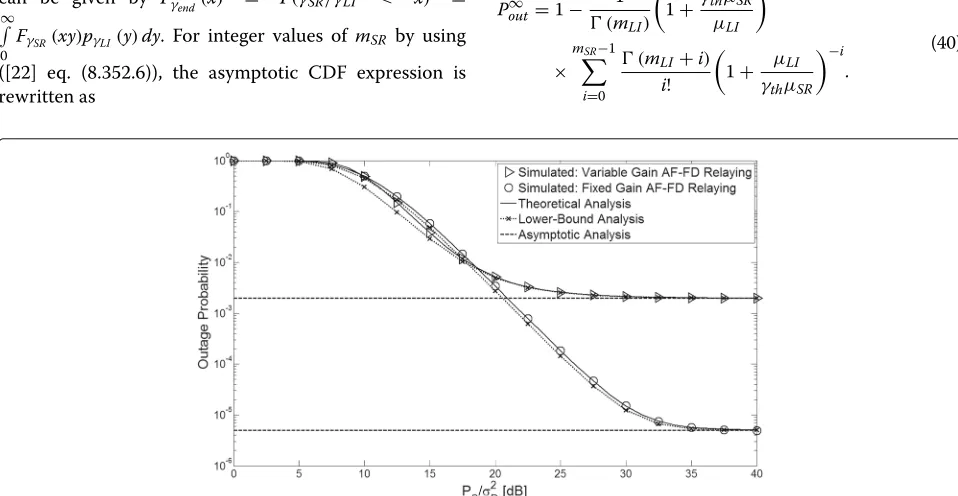
Fig. 4Outage probability of the fixed-gain and variable-gain AF-FD systems forLI=0.06,γth=2 and variousmvalues
4.2.2 Asymptotic outage probability
When PS,PR → ∞, the instantaneous SINR in (8)
becomes
lim PS→∞
PR→∞
γend = lim
PS→∞
PR→∞
X1γRD X1+γRD+1 =
γSR γLI
. (38)
In that case, the corresponding asymptotic CDF can be given by Fγend∞ (x) = P(γSR/γLI < x) =
∞
(
0
FγSR(xy)pγLI(y)dy. For integer values of mSR by using
([22] eq. (8.352.6)), the asymptotic CDF expression is rewritten as
Fγ∞ end=
∞
y=0 ⎡
⎣1−e−xyμSR
mSR−1
i=0
(xyμSR)i
i! ⎤
⎦μmLILIymLI−1e−yμLI
(mLI) dy
=1− μ
mLI
LI
(mLI) mSR−1
i=0 (xμSR)i
i! ∞
y=0
ymLI+i−1e−y(μLI+xμSR)dy.
(39)
The above integral can be easily solved by using ([22] eq. (3.351.3)). At the end, we obtain the asymptotic outage probability in closed-form as
P∞out=1−
1
(mLI)
1+γthμSR
μLI
−mLI
×
mSR−1
i=0
(mLI+i) i!
1+ μLI
γthμSR
−i
.
(40)
Fig. 6Outage probability of the fixed-gain and variable-gain AF-FD systems formSR=3,mRD=mLI=2.5 andγth=2
As seen,Pout∞ for the variable-gain case is also a
con-stant, hence leads to zero diversity order at high SNR. In addition, it does not depend onmRDandRDparameters.
Note that similar expression was also obtained indepen-dently in ([20] eq. (22)). Here, we provide (40) for the sake of consistency.
5 Numerical results
The theoretical (numerical) and Monte-Carlo simulations outage performance results of the fixed-gain and variable-gain AF-FD systems are shown in this section. During the outage performance analyses, we assume thatσ2
D=σR2for
all the scenarios andSR = RD = 1, PS = PR unless
otherwise stated. Moreover, the residual LI power, apart
from Fig. 6, is chosen in the range of 0.01 and 0.1 (−20and −10dB) as in [12, 14, 18–20].
Figure 2 plots the outage probability results of the fixed-gain AF-FD relaying versus PS/σD2 for two different LI powers, LI = {0.05, 0.1}, and various m values. The
threshold SINR was set toγth =3for these scenarios. As
seen from the curves, the outage probability decreases as
LIdecreases, i.e., efficiency of the loop-interference
can-cellation process increases. As seen, the exact analytical results obtained from (22) perfectly overlap with the sim-ulation results for allPS/σD2 values, verifying the accuracy
of our analyses. Moreover, the error floors monitored in simulations are consistent with the asymptotic expression for the fixed-gain AF-FD relaying given in (35). We see
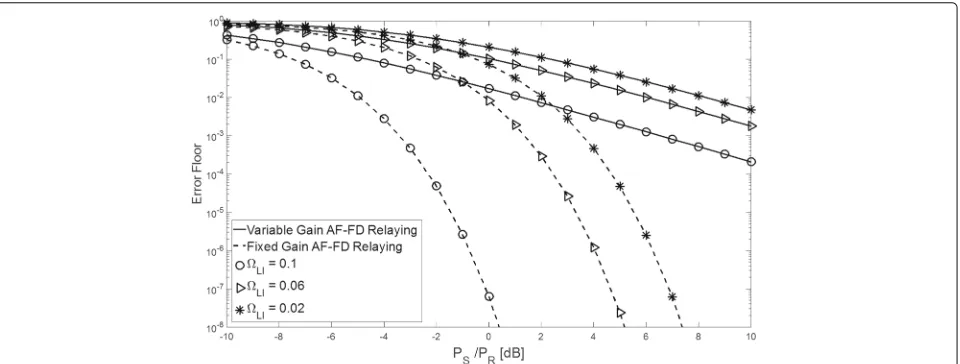
Fig. 7Error floor of the fixed-gain and variable-gain AF-FD systems forSR=1.2,RD=0.8,LI= {0.02, 0.06, 0.1},mSR=2,mRD=1.4,mLI=1.9
that the dominantmparameter on the asymptotic perfor-mance ismLIand other mparameters have no effect on the error floor for the fixed-gain AF-FD relaying.
The outage probability results of the variable-gain AF-FD relaying forLI = {0.01, 0.05},γth =1and variousm
values are demonstrated by Fig. 3. The simulation results are perfectly matched with both the analytical exact and the asymptotic outage results given by (27) and (40), respectively. Different from the fixed-gain AF-FD relay-ing, we see that the parametermSR has more dominant effect than the other m parameters on the asymptotic performance in the case of variable-gain AF-FD relaying.
Figure 4 compares the outage performance for the fixed-gain and variable-fixed-gain AF-FD systems for LI = 0.06, γth = 2 and variousm values. As seen, the fixed-gain
AF-FD relaying provides better outage performance than the variable-gain AF-FD relaying at moderate and high SINR regions since the LI effect decreases due to the fixed amplification factor. We also present the asymptotic out-age results and observe that the error floor occurs for both systems even at moderate values ofPS/σD2due to the resid-ual LI at the relay. The variable-gain AF-FD relaying has much higher error floor and reaches to the error floor at lowerPS/σD2values compared to the fixed-gain AF-FD relaying.
In Fig. 5, the consistency of the lower-bound analyses for both the fixed-gain and variable-gain AF-FD relaying are demonstrated where the system parameters are cho-sen as 2PS = 3PR, SR = 1, RD = 2, LI = 0.025, mSR =4,mRD =2.5,mLI =1andγth = 4. It is observed
that the exact outage probability of the fixed-gain AF-FD systems is tightly lower-bounded by the expression given in (32). For instance, there is only 0.38 dB difference between the lower-bound and the exact outage probabil-ity curves when the outage probabilprobabil-ity equals to 10−4. In addition, the lower-bound overlaps with the exact outage probability at the error floor. For the variable-gain AF-FD relaying, the lower-bound results obtained from (37) are close to the exact outage performance, e.g., the gap between the lower-bound and exact outage probability curves is approximately 1.4 dB at 2×10⁻². As in the fixed-gain AF-FD relaying, the lower-bound reaches to the exact performance at the error floor.
Figure 6 indicates the outage probability versusLIfor PS/σD2 values of 10 dB, 20 dB and 30 dB with mSR = 3,
mRD = mLI = 2.5andγth = 2. It is seen that the
fixed-gain AF-FD relaying achieves better outage performance as long asLIandPS/σD2increases. On the other hand, the
variable gain AF-FD relaying has lower outage probability for the small values ofLI, e.g., whenLIis smaller than
approximately−2,−16and−24 dB forPS/σD2 equals to 10 dB, 20 dB and 30 dB, respectively. Moreover, it is observed that the outage probability values for both the fixed-gain and variable-gain AF-FD systems are higher
than 5×10⁻¹, even for the high SNR values, e.g.,PS/σD2 =
30dB, whenLIis set toSR =RD = 1. This example
clearly presents the importance of the LI cancellation in the FD transmission.
In Fig. 7, by using the consistency of asymptotic out-age probability expressions given in (35) and (40) with the error floors for the fixed-gain and variable-gain AF-FD systems, respectively, the error floors are represented ver-susPS/PRforSR=1.2,RD=0.8,LI= {0.02, 0.06, 0.1}, mSR = 2, mRD = 1.4, mLI = 1.9 and γth = 5.
We observe that the error floors decrease as long as thePS/PR ratio increases for both systems. Actually, this is a predictable outcome because both the end-to-end SINR expressions given in (33) and (38) for PS,PR →
∞ are directly proportional to PS and inversely propor-tional to PR. Similar to the previous observations, it is also shown that the fixed-gain AF-FD relaying systems has considerably lower error floors. Also, the error floor for the fixed-gain AF-FD relays decreases more sharply in comparison with the variable-gain AF-FD relays, when
PS/PRincreases.
6 Conclusions
New exact outage probability expressions for the fixed-gain and variable-fixed-gain AF-FD relaying systems were pre-sented over non-identical Nakagami-mfading channels. The outage probabilities were obtained from CDF of the end-to-end SINR at the destination and verified through Monte-Carlo simulations. Our results show that the fixed-gain AF-FD relaying provides much better outage perfor-mance than the variable-gain AF-FD relaying when the power of the residual LI and SNR increase. We have also presented tight lower-bound and asymptotic outage per-formance results for both fixed-gain and variable-gain FD relaying. It was observed that the fixed-gain AF-FD relaying has much lower error floor with respect to the variable-gain AF-FD relaying. We have shown thatmLI
andmSR are dominantmparameters on the asymptotic outage performance of the fixed-gain and variable-gain AF-FD relaying, respectively.
Acknowledgements
The authors would like to thank the editor and anonymous reviewers for their constructive comments which helped to improve the technical quality of this paper.
Authors’ contributions
We, the authors of this paper, declare that all authors have materially participated in the research and the article preparation equally and have contributed equally to this paper. All authors read and approved the final manuscript.
Competing interests
The authors declare that they have no competing interests.
Publisher’s Note
Author details
1Electronics and Communication Engineering Department, Istanbul Technical
University, Istanbul, Turkey.2School of Electrical Engineering and Computer Science, University of Ottawa, Ottawa, Canada.
Received: 30 June 2016 Accepted: 18 May 2017
References
1. D Kim, H Lee, D Hong, A survey of in-band full-duplex transmission: from the perspective of PHY and MAC layers. IEEE Commun. Surv. Tuts.17(4), 2017–2046 (2015)
2. S Hong, J Brand, JI Choi, M Jain, J Mehlman, S Katti, P Levis, Applications of self-interference cancellation in 5G and beyond. IEEE Commun. Mag. 52(2), 114–121 (2014)
3. T Riihonen, S Werner, R Wichman, Optimized gain control for single-frequency relaying with loop interference. IEEE Trans. Wireless Commun.8(6), 2801–2806 (2009)
4. M Duarte, C Dick, A Sabharwal, Experiment-driven characterization of full-duplex wireless systems. IEEE Trans. Wireless Commun.11(12), 4296–4307 (2012)
5. E Everett, A Sahai, A Sabharwal, Passive self-interference suppression for full-duplex infrastructure nodes. IEEE Trans. Wireless Commun.13(2), 680–694 (2014)
6. A Sabharwal, P Schniter, D Guo, DW Bliss, S Rangarajan, R Wichman, In-band full-duplex wireless: challenges and opportunities. IEEE J. Sel. Areas Commun.32(9), 1637–1652 (2014)
7. JN Laneman, DNC Tse, GW Wornell, Cooperative diversity in wireless networks: efficient protocols and outage behavior. IEEE Trans. Inform. Theory.50(12), 3062–3080 (2004)
8. GK Karagiannidis, Performance bounds of multihop wireless
communications with blind relays over generalized fading channels. IEEE Trans. Wireless Commun.5(3), 498–503 (2006)
9. MO Hasna, MS Alouini, End-to-end performance of transmission systems with relays over Rayleigh-fading channels. IEEE Trans. Wireless Commun. 2(6), 1126–1131 (2003)
10. G Liu, FR Yu, H Ji, VCM Leung, X Li, In-band full-duplex relaying: a survey, research issues and challenges. IEEE Commun. Surveys Tuts.17(2), 500–524 (2015)
11. LJ Rodriguez, NH Tran, T Le-Ngoc, Optimal power allocation and capacity of full-duplex AF relaying under residual self-interference. IEEE Wireless Commun. Lett.3(2), 233–236 (2014)
12. DPM Osorio, EEB Olivo, H Alves, JCSS Filho, M Latva-aho, Exploiting the direct link in full-duplex amplify-and-forward relaying networks. IEEE Signal Process. Lett.22(10), 1766–1770 (2015)
13. Q Wang, Y Dong, X Xu, X Tao, Outage probability of full-duplex AF relaying with processing delay and residual self-interference. IEEE Commun. Lett.19(5), 783–786 (2015)
14. TP Do, TVT Le, Power allocation and performance comparison of full duplex dual hop relaying protocols. IEEE Commun. Lett.19(5), 791–794 (2015)
15. NH Tran, LJ Rodríguez, T Le-Ngoc, Optimal power control and error performance for full-duplex dual-hop AF relaying under residual self-interference. IEEE Commun. Lett.19(2), 291–294 (2015)
16. LJ Rodríguez, NH Tran, T Le-Ngoc, Performance of full-duplex AF relaying in the presence of residual self-interference. IEEE J. Sel. Areas Commun. 32(9), 1752–1764 (2014)
17. JS Han, JS Baek, S Jeon, JS Seo, Cooperative networks with amplify-and-forward multiple-full-duplex relays. IEEE Trans. Wireless Commun.13(4), 2137–2149 (2014)
18. I Krikidis, HA Suraweera, PJ Smith, C Yuen, Full-duplex relay selection for amplify-and-forward cooperative networks. IEEE Trans. Wireless Commun. 11(12), 4381–4393 (2012)
19. K Yang, H Cui, L Song, Y Li, Efficient full-duplex relaying with joint antenna-relay selection and self-interference suppression. IEEE Trans. Wireless Commun.14(7), 3991–4005 (2015)
20. Z Shi, S Ma, F Hou, KW Tam, inProc. IEEE GLOBECOM 2015. Analysis on full duplex amplify-and-forward relay networks under Nakagami fading channels (IEEE, San Diego, 2015), pp. 1–6
21. ˙I Altunbas, Koç, A Yongaçoglu, inProc. 2016 Wireless Days (WD). Outage probability of full-duplex fixed-gain AF relaying in Rayleigh fading channels (IEEE, Toulouse, 2016), pp. 1–6
22. IS Gradshteyn, IM Ryzhik,Table of Integrals, Series, and Products. (Academic Press, New York, 2007)
23. Y Xu, Y Wang, C Wang, K Xu, inProc. Int. Conf. Wireless Commun. and Signal Process. (WCSP). On the performance of full-duplex decode-and-forward relaying over Nakagami-m fading channels (IEEE, Hefei, 2014), pp. 1–6 24. IS Ansari, S Al-Ahmadi, F Yilmaz, MS Alouini, H Yanikomeroglu, A new