Volume 2009, Article ID 263695,11pages doi:10.1155/2009/263695
Research Article
Residue Number System Arithmetic Assisted Coded
Frequency-Hopped OFDMA
Dalin Zhu and Balasubramaniam Natarajan
Department of Electrical & Computer Engineering, Kansas State University, 2061 Rathbone Hall, Manhattan, KS 66506, USA Correspondence should be addressed to Dalin Zhu,[email protected]
Received 31 July 2008; Revised 17 December 2008; Accepted 23 February 2009
Recommended by Lingyang Song
We propose an RNS arithmetic-based FH pattern design approach that is well suited and easy to implement for practical OFDMA systems. The proposed FH scheme guarantees orthogonality among intracell users while randomizing the intercell interferences and providing frequency diversity gains. We present detailed construction procedures and performance analysis for both independent and cluster hopping scenarios. Using simulation results, we demonstrate the gains due to frequency diversity and intercell interference diversity on the system bit error rate (BER) performance. Furthermore, the BER performance gain is consistent across all cells unlike other FH pattern design schemes such as the Latin squares (LSs-)-based FH pattern design where wide performance variations are observed across cells.
Copyright © 2009 D. Zhu and B. Natarajan. This is an open access article distributed under the Creative Commons Attribution License, which permits unrestricted use, distribution, and reproduction in any medium, provided the original work is properly cited.
1. Introduction
Orthogonal frequency division multiplexing (OFDM) has been widely accepted as an enabling technology for next generation wireless communication systems. In OFDM, high-rate data streams can be broken down into a number of parallel lower-rate streams, thereby avoiding the need for complex equalization. OFDM also forms the foundation for a multiple access scheme termed as orthogonal frequency division multiple access (OFDMA). In OFDMA, each user is assigned a fraction of available subcarriers based upon his/her demand for bandwidth. The advantages of OFDMA include (1) the flexibility in subcarriers’ allocation; (2) the absence of multiuser interference due to subcarriers’ orthogonality; (3) the simplicity of the receiver design [1].
In order to enhance system throughput and spectral effi -ciency, frequency hopping (FH) is generally used in OFDMA cellular systems. It is desirable for FH patterns to satisfy the following conditions [2]: (i) minimize intracell interference; (ii) average intercell interference; (iii) avoid ambiguity while identifying users; (iv) exploit frequency diversity by forcing hops to span a large bandwidth. The first aspect is relatively easy to achieve by using orthogonal hopping patterns within a cell. To average intercell interferences, hopping patterns are
constructed in a way that two users in different cells interfere with each other only during a small fraction of all hops. The third condition requires base stations to have the capability of distinguishing different users efficiently according to their unique FH signatures. Finally, the last requirement not only ensures the security of the transmission, but also mitigates the effect of fading by exploiting frequency diversity.
FH-OFDMA. Here, although users across cells experience significant performance improvements, users within a cell may not occupy all of the available bandwidth to exploit full frequency diversity. Other aspects focusing on preventing hostile jamming and pilot-assisted channel estimation in FH-OFDMA are explored in [9,10], respectively.
In this paper, we propose a novel frequency hopping pattern design strategy based on RNS arithmetic for practical OFDMA cellular systems. We show that the resulting patterns are orthogonal within a cell and intersect only once across cells in a frequency hopping cycle. RNS arithmetic has found applications in many areas. However, its use in designing frequency hopping patterns is rarely considered [11, 12]. In [11], the design procedure can be visualized as a “top-down” approach where a given bandwidth is divided into multiple candidate subbands based on a predetermined moduli set. As a result, if the moduli set changes, the bandwidth of subcarriers varies. In this work, the division of bandwidth into candidate subcarriers is assumed to be given or determined in advance. Therefore, we can consider our proposed approach as a “bottom-up” method driven by grouping and indexing the subcarriers according to the RNS arithmetic. For practical OFDMA cellular systems, the proposed “bottom-up” approach is more feasible. For example, in downlink OFDMA cellular systems, a fixed number of subcarriers (e.g., 1024) with identical subcarrier bandwidth within each cell is usually assumed. Furthermore, for reducing intercell interference, [11] suggests the use of different moduli sets for adjacent cells. This approach results in adjacent cells employing different numbers of subcarriers with different bandwidths across cells. Once again, this is a stringent requirement that may not be feasible in practice. In this work, we invoke the use of the so-called two-stage and multistage selection algorithms to construct RNS-FH patterns such that (1) different users can use the spectral resources simultaneously within each cell and (2) the same number of subcarriers can be employed from cell to cell. Additionally, the proposed FH sequences force the intracell interferences to zero and average out the intercell interferences. The performance of the proposed FH pattern incorporating with both independent and cluster hopping schemes is characterized. Simulation results show that RNS-FH OFDMA has significantly better BER performance relative to traditional OFDMA scheme without FH. Another aspect that makes RNS-FH pattern design outperforms other existing FH techniques is that user hopping patterns span a larger bandwidth. Therefore, the channel fades associated with consecutive hops become independent. Moreover, with the use of FEC codes over multiple hops, the system can correct errors due to subcarriers that experience deep fades or subcarriers that are severely interfered by others.
The rest of the paper is organized as follows. InSection 2, system model along with signal transmission scheme, access strategies, and interference models is introduced. In Section 3, detailed RNS-FH pattern design procedures along with comparisons with the existing technique are presented. Simulation results with performance analysis are given in Section 4. Finally, we conclude this paper in
Section 5.
2. System Model
In this section, we first describe the signal transmission scheme for each individual user in an OFDMA system. Then, we introduce the access model and interference model under both independent and cluster hopping schemes.
2.1. Signal Transmission Scheme. The block diagram of FEC coded FH-OFDMA system is shown inFigure 1. Here, data bits of every user are first channel coded and then mapped to complex constellation points. We assume that there areM
users in the system, utilizing a total ofNOFDM subcarriers. Each user is assigned a specific set of subcarriers out of the total available subcarriers according to his/her data rates. Let
Nibe the number of subcarriers allocated to useri. Then, user
itransmits the information symbolsxi = (xi
1,x2i,. . .,xiNi) T
((·)Trepresents the transpose operation) on the assignedNi subcarriers. Therefore, the baseband transmitted signal of userican be expressed as
si(t)= Ni
k=1
xi
kej2π(k/T)t, 0≤t < T, (1)
wheresi(t) represents the time-domain signal, andTdenotes one OFDM symbol duration. Since this is an OFDMA system, it is important to remember that every user is assigned a different set of subcarriers for transmission, and this allocation is dynamic in the case of frequency hopping OFDMA. That is, in the IFFT module, the frequency assignment follows a predetermined FH pattern. Moreover, each user transmits zeros on subcarriers which are not assigned to him/her.
For convenience, we note Ci as the subcarrier that is assigned to useri. Hence,N×1 information symbols vector of userican be written as
xi(k)=
⎧ ⎨ ⎩
0, k /∈Ci,
xki, k∈Ci.
(2)
The discrete form of the transmitted signalsi(t) is then given as,
si=Fxi, (3)
whereFis the IFFT matrix defined as
F=√1
N
⎛ ⎜ ⎜ ⎜ ⎝
WN00 · · · W0( N−1)
N ..
. . .. ...
WN(N−1)0 · · · WN(N−1)(N−1)
⎞ ⎟ ⎟ ⎟
⎠, (4)
whereWNpq=ej2π pq/N.
Lethi=[hi(0),hi(1),. . .,hi(N−1)] denote the channel impulse response vector, then its Fourier transform is
Hi=FHhi, (5)
Modulator inputs
Binary
IFFT Coded
steams from other users
P/S Add CP
Hoppingpattern generator
FFT
Wireless channel
Remove CP P/S
Decoded steams for other users Binary
outputs FEC encoder
FEC
decoder Demodulator
. . .
. . .
Figure1: The block diagram of coded FH-OFDMA system.
access delay which can be modeled as a tapped delay line, that is,
hi(τ,t)=
L
l=1
hil(t)δ
τ,τl
, (6)
where L is the number of multipaths and τl is the time delay of thelth path. The tap coefficients are independent, zero mean, circularly symmetric complex Gaussian random processes at each instant t, that is,hi
l(t) ∼ CN(0,σl2) with the total power normalized to unity, that is,Ll=1σl2 =1. In this work, we use Jakes’ model to describe the time/frequency variation of each channel coefficient. Therefore, the spaced frequency (Δf) spaced time (Δt) correlation function of the channel frequency response can be expressed as [13]
rH(Δf,Δt)= L
l=1
σl2Jo
2π fDΔt
e−j2πΔf τk, (7)
where fDis the Doppler frequency.
At the receiver end, after FFT, the received signal corresponding to userion subcarrierkis
ri(k)=Hi(k)xi(k). (8) Then, the overall received signal which is a superposition of the signals transmitted from allMusers is
r(k)=
M
i=1
ri(k) +n(k)
=
M
i=1
Hi(k)xi(k) +n(k),
(9)
wheren(k) is the Fourier transform of the noise vector.
2.2. Access Model. In this part, clustered and independent FH-OFDMA are introduced, and closed form expressions of the expected number of collisions per symbol under both of these two hopping strategies are presented.
2.2.1. Clustered FH-OFDMA. In cluster hopping, each user selects a set of continuous subcarriers, termed cluster, to transmit the information symbols. Specifically, the hopping takes place among clusters of subcarriers based on prede-termined FH patterns. Therefore, collisions occur among clusters first, and then across all OFDM subcarriers within that cluster. The expected number of symbol losses per cluster collision corresponds to [4]
Ec=NcPint, (10)
whereNc is the number of subcarriers per cluster and Pint
represents the probability that at least one interfering user collides with the desired user. For cluster hopping, we have
N/Nc hopping clusters. Therefore, the collision probability between the desired user and the interfering user in one cluster is 1/(N/Nc). Hence, the probability that at least one of theM−1 users collides with the desired user can be expressed as
Pint=1−
1− 1
N/Nc
M−1
. (11)
For convenience, throughout the rest of this paper, we assume that each user employs the same number of subcar-riers (Nc) per cluster.
2.2.2. Independent FH-OFDMA. In independent hopping, subcarriers occupied by a user are selected independently from all available subcarriers. In other words,Ncsubcarriers in one cluster are not continuous anymore, and they are chosen in a pseudorandom fashion across the frequency spectrum. With independent hopping, the expected number of symbols lost per symbol collision is given by [4]
Ec= Nc
x=1
x pNc(x), (12)
Theorem 1. For independent FH-OFDMA scheme described
Proof. pNc(x) is the probability that x subcarriers of the desired user collide with the subcarriers of interfering user given that each user occupies a total of Nc subcarriers. It is evident that the number of possible combinations of x
subcarriers that experience collisions is (Nc
x). DefineqNc(a) as the probability that a symbols are collision-free given that each user occupiesNc subcarriers. Furthermore, define
pNc(b | c) as the conditional probability that b symbols collide given thatcsymbols are collision-free. Therefore, we can writepNc(x) as
Equation (15) denotes the probability that the desired user’s remaining Nc −xsubcarriers are collision-free while none of the otherM−1 users within the same cell occupies these subcarriers.pNc(x|Nc−x) is expressed as [4]
Equation (16) represents the conditional probability that each of thexsubcarriers of the desired user collides given that the otherNc−xsubcarriers are collision-free. By substituting (15) and (16) into (14), we obtain the result in (13).
2.3. Interference Model. In this paper, we model intercell interferences as additive complex Gaussian-distributed dis-tortions. This model is accurate when interferences from adjacent cells are perfectly randomized with respect to the cell of interest. Models specific to clustered and independent FH-OFDMA are presented in the following.
2.3.1. Clustered FH-OFDMA. In clustered FH-OFDMA, if interference occurs on any symbol on one subcarrier in the cluster, all other symbols in the same cluster will also experience interferences from adjacent cells. Hence, the interference for theith user can be modeled as [6]
ri=Hixi+ni+ei, (17) whereriis anN
c×1 vector, representing the received signal of user i; xi is the N
c ×1 transmitted signal vector; Hi
is an Nc ×Nc matrix that contains the frequency domain representations of channel impulse response;niis anN
c×1 vector whose components are complex Gaussian random variables with zero mean and variance σ2. Here, the N
c × 1 vector ei is the interference vector that captures the interference from all adjacent cells. The components of ei are i.i.d complex Gaussian random variables independent of
xi,Hiandni with mean zero, variances (σ2 where SIRs denotes the symbol signal-to-interference ratio and ρ ∈ {1, 0} characterizes the presence/absence of a collision between users in different cells. That is, if there is a collision, ρ equals to one; if there is no collision,ρ is set to zero. Furthermore, ρ can be modeled as Bernoulli’s random variable with probability of collision equals top(i.e.,
P(ρ=1)=pandP(ρ=0)=1−p), which can be expressed
whereMis the number of active users. If the system is fully loaded, thenM = N/Nc. If there is a collision, that is,ρ =
1, then all subcarriers in the cluster will be affected by the intercell interference.
2.3.2. Independent FH-OFDMA. In independent hopping, since subcarriers are selected independently of all other sub-carriers according to predetermined FH patterns, collisions occur independently. Hence, for thekth subcarrier of theith user,
ri(k)=Hi(k)xi(k) +ni(k) +ei(k). (20) Here, the interference powerσ2of the i.i.d complex Gaussian
random variableei(k) corresponds to
σ2= ρEs
SIRs, (21)
whereρ =1, 0 with probabilities pand 1−p, respectively. The collision probabilitypis given by
p=1−
For a fully loaded system with independent hopping,M is identical toN,Ncbecomes to one.
3. RNS-FH Pattern Design
RNS is defined by the choice ofvnumber of positive integers
mi (i = 1, 2,. . .,v), referred to as moduli [14]. If all the moduli are pairwise relative primes to each other, any integer
(rk,1,rk,2,. . .,rk,v), whereMr=
v
i=1miandrk,i=Nk
textmod{mi}fori=1, 2,. . .,v. Here,Nkis used to describe the kth user FH address. To recover Nk, or to distinguish users at the base station, Chinese remainder theorem (CRT) is generally used which is well known for its capability of solving a set of linear congruences, simultaneously. According to CRT, it can be shown that the numerical value ofNkcan be computed as [15]
Theorem 2. The residue sequences obtained using the RNS arithmetic as described above are orthogonal.
Proof. In order to prove that the residue sequences are orthogonal, we need to show that everyNkin the range of [0,Mr) has a unique residue set that is different from residue sets generated by other integers within the same range. We will prove this by contradiction as follows.
Assuming thatN1andN2are different integers which are
in the same range of [0,Mr) with the same residue set. That
the least common multiple (LCM) of mi. Furthermore, if
miare pairwise relative primes to each other, their LCM is
Mr =
v
i=1miand it must be thatN1−N2 is a multiple of
Mr. However, this statement does not hold since N1 < Mr andN2< Mr. Therefore, by contradiction,N1andN2should
not have the same residue set. In general, the residue set (rk,1,rk,2,. . .,rk,v) generated byNkis unique and can be used to represent the integerNkifNk< Mr.
Following the RNS arithmetic presented above, we pro-pose to design FH patterns that satisfy all the requirements described inSection 1while avoiding the limitations in [11]. Detailed procedures of constructing RNS-FH patterns are given in the following subsections. The first part describes the two-stage algorithm, while the second part introduces the multistage algorithm which can be considered as generaliza-tion of the two-stage algorithm. At the end of this secgeneraliza-tion, we compare our proposed RNS-FH pattern design strategy with the method presented in [11].
3.1. Two-Stage Algorithm. In this part, the detailed proce-dures of constructing RNS-FH patterns via the so-called two-stage algorithm is introduced. We present the algorithm for a cluster hopping OFDMA system. It is straightforward to extend the algorithm to the independent hopping scenario. The steps involved in the two-stage selection algorithm are given as follows.
Figure2: One example of RNS-assisted two-stage hopping strategy.
(1) Divide the total available subcarriers N into Mc clusters with each cluster containingNc number of contiguous subcarriers.
(2) If Mc can be written as a product of two pairwise relative primes, for example,Mc = a1 ·b1, we can
first groupMcclusters intoa1groups withb1clusters
in each group. Then, we index the groups from 0 to
a1−1.
(3) Index the clusters in each group from 0 tob1−1.
(4) At the 0th time slot, assign integerNkto userkas its FH address according to its access order to the system, where 0< Nk≤Mc.
(5) IfNkmod{a1,b1} = {a1,b1}, then userkselects the
b1th cluster out of thea1th group for transmission.
(6) At thetsth time slot, assign integerNk+tsto userkas its current FH address and repeat step 5.
(7) Repeat steps 4–6 until one mutually orthogonal FH pattern is obtained.
(8) IfMc can be expressed as products of other combi-nations of two pairwise relative primes, for example,
Mc = a2 ·b2 = · · · = aw·bw, then w different orthogonal FH patterns can be obtained by repeating steps 2–7,wtimes.
An example is given in Figure 2 to illustrate the two-stage RNS-assisted frequency hopping strategy. Here, 6 users access the system (M =6); the total number of subcarriers is 30 (N=30) and they are divided into 6 clusters (Mc =6) with each cluster containing 5 contiguous subcarriers (Nc = 5). At the 0th time slot, the FH address assigned to the 5th user is 5 according to his/her access order to the system. Therefore, 5 mod{2, 3} = {1, 2}. User 5 will choose the 2nd cluster of subcarriers out of the 1st group of clusters to transmit. At the 1st time slot, the FH address assigned to this user becomes 5 + 1 = 6. Obviously, 6 mod{2, 3} = {0, 0}, then he/she will select the 0th cluster of subcarriers out of the 0th group of clusters for transmission at this time. This process continues until one FH sequence of length Mc is constructed.
pattern design, but also strengthen the robustness of the entire FH scheme. We describe the multistage algorithm assuming an independent hopping scheme with each user employing the same number of subcarriers, that is,Ni =Nc for i = 1, 2,. . .,M. The steps involved in the multistage algorithm correspond to the following.
(1) IfNcan be written as a product ofmpairwise relative primes, for example, N = a1 ·b1 ·c1. . ., we can
first group N subcarriers into a1 groups with b1
subgroups in each group. Then, we index the first-stage groups from 0 toa1−1.
(2) Index the second-stage groups in each first-stage group from 0 tob1−1. Then group the subcarriers
in each second-stage group intoc1subgroups.
(3) Similar steps continue on until all of the subcarriers are grouped and indexed at themth-stage.
(4) At the 0th time slot, assign integer set {Nk,Nk +
M,. . .,Nk+MNc}to userkas its FH addresses, where
Nkis its access order to the system, 0< Nk≤N. (5) IfNkmod{a1,b1,c1,. . .} = {a1,b1,c1,. . .}, then user
k first selects the b1th second-stage group out of
the a1th first-stage group, then similar selecting
procedures continue on until the subcarrier at the
mth-stage has been extracted out for transmission. (6) The process in step 5 is repeated on the other
ele-ments in the integer set of userkuntilNcsubcarriers have been extracted out for userkto transmit. (7) At thetsth time slot, assign integer set{Nk+ts,Nk+
M+ts,. . .,Nk+MNc+ts}as the current FH addresses of userkand repeat steps 5-6.
(8) Repeat steps 4–7 until one mutually orthogonal FH pattern is obtained.
(9) If N can be expressed as products of other combi-nations ofmpairwise relative primes, for example,
N=a2·b2·c2· · · · = · · · =aw·bw·cw. . ., thenw different orthogonal FH patterns can be obtained by repeating steps 1–8,wtimes.
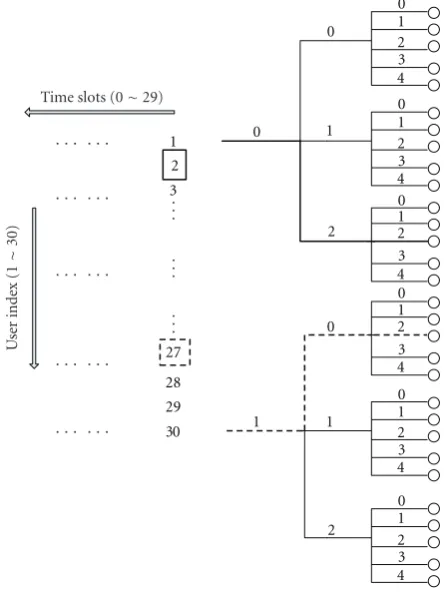
It is easy to visualize the multistage algorithm by using a tree diagram. An example is given in Figure 3. Here, 30 users access the system (M = 30); a total of 30 subcarriers are used, that is,N = a1 ·b1·c1 = 2·3·5 = 30. Two
specific examples are illustrated as follows: (1) consider user 2. The subcarriers used by this user at the 0th time slot can be calculated as follows: 2 mod{2, 3, 5} = {0, 2, 2}; that is, in the 0th first-stage group, the 2nd subcarrier out of the 2nd second-stage group is selected for transmission. This is indicated with a solid line inFigure 3; (2) consider user 27. 27 mod{2, 3, 5} = {1, 0, 2}; that is, in the 1st first-stage group, the 2nd subcarrier out of the 0th second-stage group is selected by the 27th user for transmission at the 0th time slot. This is indicated with a dashed line in the figure. This procedure continues until an FH sequence of length N is completed. We should note that in this example, the system is fully loaded (M = N = 30). For M < N, each user
Figure 3: One example of RNS-assisted multistage hopping strategy.
is assigned a set of FH addresses rather than one unique FH signature. For example, consider user 2 inFigure 3, the 2nd subcarrier occupied by user 2 at the 0th time slot is determined starting from his/her current FH address 2+30=
32 and following the steps as before. These steps are repeated untilNc subcarriers for user 2 are identified. Extrapolating the procedure across the time axis, an entire FH sequence of lengthNis designed.
With respect to the design procedures, the major dif-ference between independent hopping and cluster hopping is the following: in independent hopping, each FH address specifies a single subcarrier that can be used. Therefore, if users have very high bandwidth/rate or other QoS require-ments, multiple FH addresses can be given to accommodate. In cluster hopping scenario, a user may demand only one unique FH address as a single address completely specifies all Nc subcarriers required for transmission. Fully loaded independent hopping system is a special case of cluster hopping with one subcarrier in each cluster.
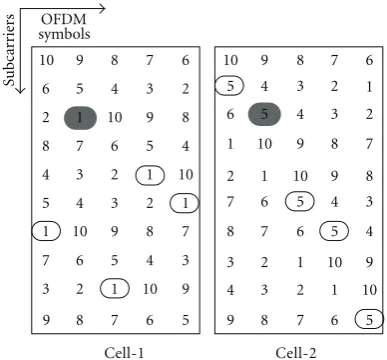
From Figures 2 and 3, it is evident that the proposed RNS-FH patterns guarantee the orthogonality among diff er-ent users within a cell. That is, users within the same cell will not interfere with each other when they simultaneously access the system. The next example, which is shown in
Cell-1 Cell-2
Figure 4: Two different FH patterns are given and their only collision point is highlighted.
{a1 =2,b1 =5}and{a2 =5,b2 =2}, respectively. From Figure 4, it is evident that every user in cell 1 experiences interference from different users from cell 2 during each of his/her hops. For example, in the first OFDM symbol duration, user 1 in cell 1 is interfered by user 8 from cell 2; in the next OFDM symbol slot, user 1 is interfered by user 5 from cell 2 and so on. In general, users from different cells collide only once during a frequency hopping cycle under the proposed scheme. Therefore, full interference diversity is exploited in the case of RNS-FH patterns.
The properties of the proposed RNS-FH patterns can be summarized as follows.
(1) At most, a size of N×N mutually orthogonal FH pattern can be obtained for the independent hopping scheme. The size becomes Mc×Mc for the cluster hopping.
(2) IfN (Mc) can be written as a product ofmpairwise relative primes, then at least, (m−1)m! different RNS-FH patterns can be obtained.
(3) With the use of the same moduli set, for indepen-dent hopping, RNS-FH patterns constructed afterN
frames (Mc for cluster hopping) are actually peri-odical extensions of the RNS-FH pattern designed during the firstN(Mc) frames.
(4) With knowledge of moduli and residue, the base station can regenerate the entire RNS-FH pattern using the CRT.
3.3. Comparison with [11]. In this section, we compare our proposed RNS-FH pattern design method with the technique presented in [11] (which also considers RNS as the design metric).
First of all, although both strategies (one proposed here and the other presented in [11]) use the RNS arithmetic as a basis, the mechanisms of determining the hopping sequence are different. In [11], the FH scheme can be visualized as a
“top-down” approach where a given bandwidth is divided into multiple candidate subcarriers in multistages according to the predetermined moduli set (see [11, Figure 2]). That is, the choice of the moduli set (top level decision) determines the number of subcarriers that can be used (bottom level decision) for hopping. This scheme is driven in conjunction with MFSK-modulated signals and a reference register C, which has the same length as the moduli set (v), providing reference to each user in order to enable synchronous transmission. However, in our work, we assume that the division of the frequency bandwidth has already been done in advance. That is, the number of subcarriers that can be used for hopping is given (bottom level decision). Based on this number, we employ a proper moduli set to group and index each of the candidate subcarriers (top level decision). Therefore, we can interpret our proposed initialization process as a “bottom-up” approach (see Figure 3). It is important to note that in practical OFDMA cellular systems, the division of the bandwidth within a cell is usually fixed and predetermined (e.g., 1024 subcarriers). Therefore, our “bottom-up” approach is more suitable for such practical systems. Furthermore, unlike the length-vreference register
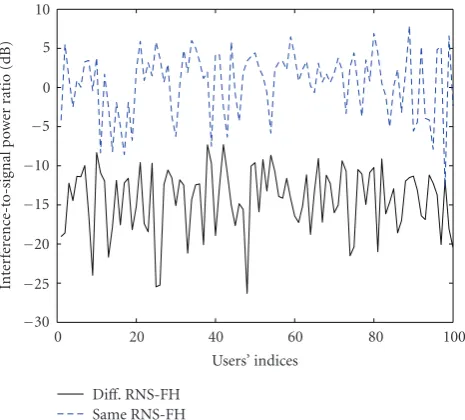
Cthat is used in [11], the FH scheme proposed in this paper invokes the use of only a length-one register to store the time index which in turn can be used to calculate current FH address of each user at the base station.
Secondly, for reducing intercell interference, [11] sug-gests the use of different moduli sets for adjacent cells. Since the choice of the moduli set determines the number of subcarriers used for hopping, a different moduli set in adjacent cells will result in different number of subcarriers in adjacent cells. If the total bandwidth is the same for all cells, this approach translates into subcarriers in adjacent cells having different bandwidths. This may be an unrealistic assumption for practical OFDMA systems. If the method in [11] is applied to a practical scenario using fixed number of subcarriers (each with the same bandwidth), high intercell interference will result (as shown inFigure 8). Our proposed “bottom-up” approach does not suffer from this drawback as it is built on the premise that the number of subcarriers and their bandwidths are fixed across cells.
In summary, the method proposed in this work is flexible and well suited for practical OFDMA cellular systems.
4. Simulation Results
Parameters of the simulated system are provided inTable 1. The cyclic prefix within one OFDM symbol duration is assumed long enough to eliminate ISI (intersymbol inter-ference). Two 6-ray channel pulse responses are considered following the UTRA vehicular test environment [16]. In
Figure 5, the correlation functions of these two channels are plotted versus the variation ofΔf, while Δt = 1 slot and
fDTs = 0.01. FromFigure 5, we can conclude that if small hopping intervals occur frequently in an FH pattern, Veh B can provide more frequency diversity than Veh A.
1 0.9 0.8 0.7 0.6 0.5 0.4
|
rH
(
Δ
f
,
Δ
t
)
|
0 20 40 60 80 100 120
Δf (subcarriers) Veh A
Veh B
Channel correlation in the frequency domainΔt=1 slot
Figure5: Channel correlation function.
Table1: System parameters.
Transmission BW 5 MHz
Carrier frequency 2 GHz
OFDM symbol duration 100μs
CP duration 10μs
Tone spacing 11 KHz
FFT size 128
Occupied subcarriers 110
Channel impulse response Veh A/Veh B
Channel coding 1/2 convolutional code
Modulation QPSK
Time slots 10
given in Figure 6. The high collision probability severely limits the number of active users that can be simultaneously supported by the FH system.
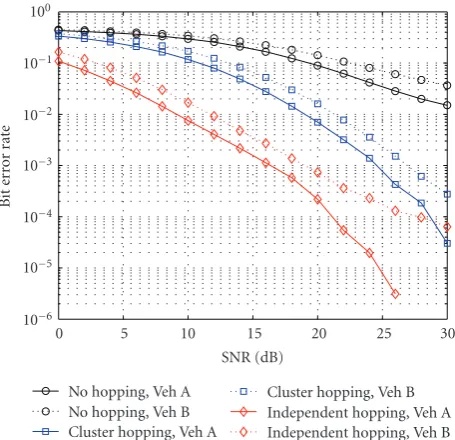
In Figure 7, bit error rate (BER) versus SNR of RNS-FH OFDMA under both cluster and independent hopping is plotted. The main objective of this example is to characterize the effects of frequency diversity exploited by RNS-FH patterns on system performance. Here, we assume that 10 users are in the system with 11 subcarriers assigned to each via the two-stage RNS hopping strategy. For cluster hopping, the moduli set used is{a1 =2,b1 =5}, while for
independent hopping, it is{a1 =2,b1=55}. It is observed
that both independent and clustered RNS-FH OFDMA dra-maticallyoutperforms the regular OFDMA scheme without hopping in both Veh A and Veh B environments. Another observation is that under both independent and cluster hopping, the system performs better in Veh A. That is, in the proposed RNS-FH patterns, large hopping intervals occur more frequently than small hopping distances. This characteristic is very important since it reveals that users occupy a wide bandwidth during a small fraction of all hops.
100
10−1
10−2
Expect
ed
n
u
mber
of
co
llisions
per
sy
m
bol
0 10 20 30 40 50
Number of users Cluster, analytical
Cluster, simulated
Independent, simulated Independent, analytical
Figure 6: Expected number of collisions per symbol versus the number of users.
100
10−1 10−2 10−3 10−4 10−5 10−6
Bi
t
er
ror
ra
te
0 5 10 15 20 25 30
SNR (dB) No hopping, Veh A
No hopping, Veh B Cluster hopping, Veh A
Cluster hopping, Veh B Independent hopping, Veh A Independent hopping, Veh B
Figure 7: BER versus SNR of RNS-FH OFDMA under cluster and independent hopping with different channel conditions.N =
110,M=Mc=10,Nc=11, fDTs=0.01.
Furthermore, since independent hopping scheme results in a much larger FH pattern than cluster hopping, more frequency diversity can be exploited in the independent hopping case. This is also clearly reflected by the simulation results shown inFigure 7. For example, at a BER level of 10−3, nearly 8 dB gain is offered by independent hopping relative to cluster hopping in Veh A environment.
10 5 0
−5
−10
−15
−20
−25
−30
In
te
rf
er
enc
e-t
o-sig
n
al
p
o
wer
rat
io
(dB)
0 20 40 60 80 100
Users’ indices Diff. RNS-FH
Same RNS-FH
Figure8: Intercell interference-to-signal power ratio for given users under different RNS-FH patterns and identical RNS-FH patterns assignments across cells.
the cell of interest while the y-axis characterizes the time-averaged intercell interference-to-signal power ratio for a given user. Two situations are considered: (1) different RNS-FH patterns are allocated to the cell of interest and the interfering cell (denoted by the solid line); (2) the same RNS-FH pattern as the cell of interest is assigned to the interfering cell (denoted by the dashed line). Here, we model the intercell interference as additive Gaussian-distributed distortion. Therefore, in scenario (1), users in the cell of interest will experience different interferences from the interfering cell across all hops, which in turn induces interference diversity.Figure 8clearly demonstrates that by employing the proposed method (i.e., allocating a different RNS-FH pattern to the interfering cell), the intercell interference floor can be significantly lowered relative to the scenario where all cells employ identical RNS-FH patterns.
Figures 9 and 10 show the effects of intercell interfer-ence diversity on system performance. BER versus signal-to-interference ratio (SIR) is plotted under cluster and independent hopping in Figures9and10, respectively. For cluster hopping, the FH pattern assigned to the interfering cell is constructed by using {a2 = 5,b2 = 2} while it is
{a2 = 55,b2 = 2}for the independent hopping scenario.
We simulate the case where the same RNS-FH pattern used in the cell of interest is assigned to adjacent interfering cells. Thus, users in the cell of interest will be affected by the same interferences from adjacent cells during all hops. Therefore, no interference diversity is exploited. Simulation results also reflect this feature. When the same RNS-FH pattern is assigned, frequency diversity as a result of hopping reduces the interference floor. Therefore, the no hopping case still exhibits the worst BER performance. When different patterns are allocated to interfering cells, the interference diversity along with frequency diversity further improves
100
10−1
10−2
10−3
Bi
t
er
ror
ra
te
0 5 10 15 20 25 30
SIR (dB) No hopping, Veh A
No hopping, Veh B Same RNS-FH, Veh A
Same RNS-FH, Veh B Diff. RNS-FH, Veh A Diff. RNS-FH, Veh B Effect of inter-cell interference on system performance
with cluster hopping
Figure 9: BER versus SIR of RNS-FH OFDMA under cluster hopping with different channel conditions.N =110,M=Mc = 10,Nc=11, SNR=25 dB, fDTs=0.01.
100
10−1
10−2
10−3
10−4
Bi
t
er
ror
ra
te
0 5 10 15 20 25 30
SIR (dB) No hopping, Veh A
No hopping, Veh B Same RNS-FH, Veh A
Same RNS-FH, Veh B Diff. RNS-FH, Veh A Diff. RNS-FH, Veh B Effect of inter-cell interference on system performance
with independent hopping
Figure10: BER versus SIR of RNS-FH OFDMA under independent hopping with different channel conditions.N =110,M=Mc = 10,Nc=11, SNR=25 dB, fDTs=0.01.
10−1
10−2
10−3
10−4
10−5
Bi
t
er
ror
ra
te
0.1 0.2 0.3 0.4 0.5 0.6 0.7 0.8 0.9 1 User loads
No hopping, Veh A No hopping, Veh B Same RNS-FH, Veh A
Same RNS-FH, Veh B Diff. RNS-FH, Veh A Diff. RNS-FH, Veh B Cluster-hopped RNS-FH OFDMA
Figure11: BER versus user loads of RNS-FH OFDMA under cluster hopping with different channel conditions,N =110,M=Mc = 10,Nc=11, SNR=25 dB, SIR=15 dB, fDTs=0.01.
10−1
10−2
10−3
10−4
10−5
Bi
t
er
ror
ra
te
0 0.2 0.4 0.6 0.8 1
User loads No hopping, Veh A
No hopping, Veh B Same RNS-FH, Veh A
Same RNS-FH, Veh B Diff. RNS-FH, Veh A Diff. RNS-FH, Veh B Independent-hopped RNS-FH OFDMA
Figure 12: BER versus user loads of RNS-FH OFDMA under independent hopping with different channel conditions, N =
110,M=Mc=10,Nc =11, SNR=25 dB, SIR=15 dB, fDTs= 0.01.
BER versus user loads is plotted in Figures11 and12
under cluster and independent hopping, respectively, in both Veh A and Veh B. Effects of frequency and interference diversities on system performance are explored at given SNR and SIR. It is evident that the system throughput can be significantly enhanced by assigning different RNS-FH patterns to different cells, while it is severely limited
100
10−1
10−2
10−3
10−4
10−5
Bi
t
er
ror
ra
te
0 5 10 15 20 25 30
SNR (dB) Cluster hopping,M=10,Nc=10
Cluster hopping,M=6,Nc=10
Cluster hopping,M=10,Nc=5
Cluster hopping,M=6,Nc=5
Figure13: Performance of cluster-hopped RNS-FH OFDMA with different cluster sizes and different number of active users, fDTs = 0.01.
if no hopping occurs. Furthermore, the performance gap between the identical hopping and the different hopping decreases with the increase in user loads. That is, the benefit of intercell interference diversity is greater for lower user loads.
Figure 13 illustrates that by increasing the cluster size (the number of subcarriers in one cluster), or the number of active users, the number of collisions increases. This in turn induces degradation in BER performance as can be seen from
Figure 13.
Finally, we compare our proposed RNS-FH pattern design strategy with state-of-the-art FH pattern designs. Specifically, our benchmark for comparison is the Latin squares (LSs-)-aided FH pattern design presented in [6]. In our proposed RNS-FH pattern, the spacing between hops in time and frequency is far enough that subcarriers employed in a single time slot are weakly correlated. This feature provides remarkable performance improvements that are consistent across all cells. However, in Latin squares (LSs-)-aided FH pattern design, performances in different cells may vary a lot. Relative comparisons are given inFigure 14, where two Latin squares-based FH patterns A4 and A38 [6] are
employed. In LSA38, smaller hops happen more frequently,
and for such smaller hops, Veh B exploits more frequency diversity than Veh A. The opposite is also true for LS A4.
Using simulation results, we first observe that in RNS-aided FH-OFDMA, different RNS-FH patterns provide nearly the same BER performance, while it varies a lot in LS-aided FH-OFDMA; the second observation is that our proposed RNS-FH patterns have similar BER performances to LSA4while
outperforming LSA38. Although there may exist LS-aided
100
10−1 10−2 10−3 10−4 10−5 10−6
Bi
t
er
ror
ra
te
0 5 10 15 20 25 30
SNR (dB) LS-FH,A4, Veh A
LS-FH,A4, Veh B
LS-FH,A38, Veh A
LS-FH,A38, Veh B
RNS-FH,m1, Veh A
RNS-FH,m1,Veh B
RNS-FH,m2, Veh A
RNS-FH,m2, Veh B
Figure14: Performance of independent-hopped RNS-FH OFDMA versus LS-FH OFDMA,N = 110,M = Mc = 10,Nc = 11, LS A4andA38are used, different moduli setsm1 = {2, 55}andm2 =
{2, 11, 5}are applied to construct RNS-FH patterns, fDTs=0.01.
scheme, the performance variations in LS-aided FH pattern design really limit their applications.
5. Conclusions
In this paper, we propose an RNS arithmetic-based FH pattern design that is well suited and easy to implement for practical OFDMA cellular systems. RNS-FH patterns not only guarantee zero collision within a cell, but also average the intercell interferences by assigning different FH patterns to adjacent cells. Additionally, by having a large spacing between the hopping frequencies, the RNS-FH patterns exploit frequency diversity effectively and provide significant improvement in BER performance. The BER performance gain is consistent across all cells unlike other FH pattern design schemes such as the LS-based method where wide performance variations are observed across cells. Simulation experiments demonstrate the superior performance of the RNS-FH scheme in terms of frequency diversity and intercell interference diversity under both independent and cluster hopping strategies.
References
[1] S. Gault, W. Hachem, and P. Ciblat, “Performance analysis of an OFDMA transmission system in a multicell environment,” IEEE Transactions on Communications, vol. 55, no. 4, pp. 740– 751, 2007.
[2] M. K. Simon, J. K. Omura, R. A. Scoltz, and B. K. Levitt, Spread Spectrum Communications, Computer Science Press, Rockville, Md, USA, 1985.
[3] T. Scholand, T. Faber, A. Seebens, et al., “Fast frequency hopping OFDM concept,”Electronics Letters, vol. 41, no. 13, pp. 748–749, 2005.
[4] T. Kurt and H. Delic¸, “On symbol collisions in FH-OFDMA,” inProceedings of the 59th IEEE Vehicular Technology Conference (VTC ’04), vol. 4, pp. 1859–1863, Milan, Italy, May 2004. [5] T. Kurt and H. Delic¸, “Space-frequency coding reduces the
collision rate in FH-OFDMA,”IEEE Transactions on Wireless Communications, vol. 4, no. 5, pp. 2045–2049, 2005.
[6] K. Stamatiou and J. G. Proakis, “A performance analysis of coded frequency-hopped OFDMA,” in Proceedings of IEEE Wireless Communications and Networking Conference (WCNC ’05), vol. 2, pp. 1132–1137, New Orleans, La, USA, March 2005.
[7] S. V. Maric and O. Moreno, “Using costas arrays to construct frequency hop patterns for OFDM wireless systems,” in Proceedings of the 40th IEEE Conference on Information Sciences and Systems (CISS ’06), pp. 505–507, Princeton, NJ, USA, March 2007.
[8] C. Wang, X. Zhang, and D. Yang, “Evaluation of welch-costas frequency hopping pattern for OFDM cellular system,” in Pro-ceedings of the 18th IEEE International Symposium on Personal, Indoor and Mobile Radio Communications (PIMRC ’07), pp. 1–5, Athens, Greece, September 2007.
[9] T. Li, Q. Ling, and J. Ren, “A spectrally efficient frequency hopping system,” in Proceedings of the 50th IEEE Global Telecommunications Conference (GLOBECOM ’07), pp. 2997– 3001, Washington, DC, USA, November 2007.
[10] B. M. Popovic and Y. Li, “Frequency-hopping pilot patterns for OFDM cellular systems,”IEICE Transactions on Fundamen-tals of Electronics, Communications and Computer Sciences, vol. E89-A, no. 9, pp. 2322–2328, 2006.
[11] L.-L. Yang and L. Hanzo, “Residue number system assisted fast frequency-hopped synchronous ultra-wideband spread-spectrum multiple-access: a design alternative to impulse radio,”IEEE Journal on Selected Areas in Communications, vol. 20, no. 9, pp. 1652–1663, 2002.
[12] J. Chen, T. Lv, and H. Zheng, “Joint cross-layer design for wireless QoS content delivery,” in Proceedings of IEEE International Conference on Communications (ICC ’04), vol. 7, pp. 4243–4247, Paris, France, June 2004.
[13] J. G. Proakis, Digital Communications, McGraw Hill, New York, NY, USA, 4th edition, 2001.
[14] K. W. Watson and C. W. Hastings, “Self-checked computation using residue arithmetic,”Poceeding of the IEEE, vol. 54, no. 12, pp. 1920–1931, 1966.
[15] L.-L. Yang and L. Hanzo, “Redundant residue number system based error correction codes,” inProceedings of the 54th IEEE Vehicular Technology Conference (VTC ’01), vol. 3, pp. 1472– 1476, Atlantic City, NJ, USA, October 2001.