Volume 2009, Article ID 670265,13pages doi:10.1155/2009/670265
Research Article
Joint Linear Filter Design in Multi-User Cooperative
Non-Regenerative MIMO Relay Systems
Gen Li,
1, 2Ying Wang,
1, 2Tong Wu,
1, 2and Jing Huang
1, 21Wireless Technology Innovation Institute, Beijing University of Posts and Telecommunications (BUPT), Beijing, 100876, China 2Key Laboratory of Universal Wireless Communications, Ministry of Education, Beijing 100876, China
Correspondence should be addressed to Gen Li,[email protected]
Received 30 November 2008; Revised 2 April 2009; Accepted 1 July 2009
Recommended by Yonina C. Eldar
This paper addresses the filter design issues for multi-user cooperative non-regenerative MIMO relay systems in both downlink and uplink scenario. Based on the formulated signal model, the filter matrix optimization is first performed for direct path and relay path respectively, aiming to minimize the mean squared error (MSE). To be more specific, for the relay path, we derive the local optimal filter scheme at the base station and the relay station jointly in the downlink scenario along with a more practical suboptimal scheme, and then a closed-form joint local optimal solution in the uplink scenario is exploited. Furthermore, the optimal filter for the direct path is also presented by using the exiting results of conventional MIMO link. After that, several schemes are proposed for cooperative scenario to combine the signals from both paths. Numerical results show that the proposed schemes can reduce the bit error rate (BER) significantly.
Copyright © 2009 Gen Li et al. This is an open access article distributed under the Creative Commons Attribution License, which permits unrestricted use, distribution, and reproduction in any medium, provided the original work is properly cited.
1. Introduction
Wireless relays are essential to provide reliable transmission, high-throughput, and broad coverage for next-generation wireless networks [1]. Deploying a relay between a source and a destination cannot only overcome shadowing due to obstacles but also reduce the required transmitted power from the source and hence interference to neighboring nodes. Relays can be regenerative [2] or nonregenerative [3]. The former employs decode-and-forward scheme and regenerates the original information from the source. The latter employs amplify-and-forward scheme, which only performs linear processing for the received signal and then transmits to the destinations. As a result of the above difference, a nonregenerative relay generally causes smaller delay than a regenerative relay.
MIMO techniques are well studied to promise significant improvements in terms of spectral efficiency and link relia-bility. In [4,5], the capacity of point-to-point MIMO channel is investigated and extensive work on multi-user MIMO has been done for a decade [6]. Therefore, combined with the above two technologies, a novel system called MIMO-relay emerges to accommodate users with high data rate
requests and extend the network coverage. Recently, there is a vigorous body of work on MIMO-relay systems [7–15]. For example, [7,8] derives upper bounds and lower bounds for the capacity of MIMO-relay channels. In [9], the optimal design of non-regenerative MIMO relays is investigated. Assuming relays and receivers with multiple antennas, the optimal relay matrix that maximizes the capacity between the source and destination is developed when a direct link is not considered or is negligible. The same problem is studied in [10], and [11] extends the work to partial channel state information (CSI) scenario.
system). While single-user MIMO-relay systems have been a primary focus of prior research, a few researchers begin to pay attention to multiuser scenario as well. In [16], the optimal design of nonregenerative relays for multiuser MIMO-relay systems based on sum rate is investigated. Assuming zero-forcing dirty paper coding at the base station (BS) and linear operations at the relay station (RS), it proposes upper and lower bounds on the achievable sum rate, neglecting the direct links from the BS to the users.
In this paper, we consider the problem of joint linear optimization for both downlink and uplink in multiuser cooperative nonregenerative MIMO-relay systems based on MSE criterion, which is different from the sum rate criterion in [16]. The MSE criterion is motivated by robustness to channel estimation errors and a lower implementation complexity. Then our main contributions are as follows.
(i) We derive the optimal joint design of the BS and RS filter matrices that achieves the minimum mean squared error (MMSE) for both downlink and uplink of the multiuser MIMO relay systems at the absence of direct path.
(ii) We propose several schemes for the design of the BS and RS filter matrices based on MSE criterion in the presence of direct path, which is called cooperative scenario in this paper.
(iii) We compare different schemes for direct-path-only scenario, relay-path-only scenario and cooperative scenario, and the numerical results are provided to show the effectiveness joint filter design and cooperative combine operation.
The rest of this paper is organized as follows. Sections2
and3formulate the system model and propose the joint filter design schemes for downlink and uplink of multiuser MIMO relay systems, respectively. Numerical results are given in
Section 4. Finally,Section 5concludes this paper.
Notations. Boldface capital letters and boldface small letters denote matrices and vectors, respectively. Superscripts∗,T, andHstand for the conjugate, transpose, and complex conju-gated transpose operation, respectively., while (·)−1and (·)† represent inversion and pseudoinversion of matrices. Also,
E(·) and tr(·) denote the expectation and trace operation, respectively, and, finally,Iis the identity matrix.
2. Downlink Systems
2.1. System Model and Problem Formulation. In this section, we focus on the downlink of the multiuser cooperative MIMO relay system as illustrated inFigure 1. Assuming half duplex relaying, the scenario under analysis consists of a base station (BS), a relay station (RS), andKmobile station (MS) transmitting through two orthogonal channels, for instance, two separate time slots as time division multiple access (TDMA). During the first slot, The BS deployed with N transmit antennas communicates with the fixed RS that has Mantennas and the MSs,each of which has single antenna.
A MIMO channel denoted byH1 ∈ CM×N is thus created
between the BS and the RS while a MIMO broadcast channel (MIMO BC) denoted byH0∈CK×N is also established. The
precoding strategy at the BS includes an encoding operation and a subsequent linear operation with a filter matrixF ∈ CN×K. The BS encodesK data streams that are targeted to the MSs and broadcasts it to the RS and the MSs. The RS processes the received signal with a filter matrixW∈CM×M, and then forwards the data streams to the MSs through a MIMO BC denoted byH2∈CK×Min the second slot. Finally,
in the cooperative scenario, each of the MSs combines the signals from the direct path (DP) and the relay path (RP) that are received in the first slot and the second slot, respectively. Note that all the matrices in this paper are assumed full rank for simplicity.
During the first slot, the signal model for the direct path of the proposed system in downlink is
y0=H0Fs+n0, (1)
wherey0 = [y01;y02;. . .;y0K] andn0 ∈ CK×1is a zero-mean
complex Gaussian noise vector received at the MSs with covariance matrixσ02I. Also,s∈CK×1denotes a zero-mean
complex Gaussian vector whose covariance matrix isI, which indicates that uncorrelated data streams are transmitted.
During the second slot, assumingyi2is the received signal
at MSiandy2 = [y21;y22;. . .;yK2], the signal model for the
relay path of the proposed downlink system is
y2=H2WH1Fs+H2Wn1+n2, (2)
wheren1 ∈ CM×1andn2 ∈ CK×1are zero-mean complex
Gaussian noise vector received at the RS and MSs with covariance matrices σ12I andσ22I, respectively. In addition,
we assume the signal and noise are uncorrelated as well. The assumptions with the afore-mentioned signal and noise can be summarized as
EssH=I; EnjnHj=σ2
jI; E
snHj=0. (3)
Then, the signaly0andy2are normalized as
s0=β−01y0, (4)
s2=β−21y2, (5)
where the scalarβ0 andβ2 can be interpreted asautomatic
gain controlthat are necessary to give reasonable expressions for the MSE in any real MIMO system.
Finally, we combine the signals from both the paths to get
s=α0s0+α2s2. (6)
Therefore, the optimization problem based on MSE can be formulated as
min F,w,β0,β2,α0,α2
Es−s22 (7)
s.t. trFFH=Et,
trWH1FFHH1HWH+σ12WWH
=Er,
..
Figure1: Multiuser cooperative MIMO relay system model in downlink.
where we assume that BS and RS use the whole available average transmit power, that is,EtandEr, respectively. Since
the transmitted signal from BS is Fs and the transmitted signal from the RS isWH1Fs+Wn1, by using the assumption
(3) simultaneously, the power constraints can be obtained. However, from the following explicit expression of the objective function, it can be seen that the problem (7) is too complex to be solved optimally:
Es−s22
Hence, we separate it to be several independent subproblems as the following sections produce.
2.2. Filter Optimization for Direct Path. Based on the signal model (1) and (4), we first propose the optimization problem for the direct path as
min
As the direct path is actually a conventional MIMO link, a closed form solution is found for the optimization in [17]
F=β0T−1HH0, (12)
Thus the optimal result for problem (10) is obtained.
2.3. Filter Optimization for Relay Path. For the relay path, the MSE is given by
ε=Es−s222
Then using (2) in (15), the optimization problem for the relay path is formulated as
Here, note that
2.3.1. Local Optimal Joint (OJ) MMSE Scheme. Aiming at the optimal solution of the problem (16), we can find necessary conditions for the transmit filterF, the relay filterW,and the weightβ2∈R+by constructing the Lagrange function
LF,W,β2,λ1,λ2
filter follows from (21):
W(ω)=β2W(ω) (23)
where the power constraint at the relay is used. Applying (23) into (21), we get
2/Er. Therefore, the filter matrix can be expressed as the
function of the transmit matrix for the optimization in (16):
W=β2G−11HH2FHHH1G−21, (27)
Similarly, the expression of the transmit filter matrix in terms of the relay filter matrix can be derived as
F=β2Q−1HH1WHHH2, (30)
From the above results, it is obviously seen thatFandWare functions of each other. Therefore, the solutions Frelay and
Wrelayfor the problem (16) can be obtained via the following
iterative procedures.
(1) Initialize the transmit filter matrix F, satisfying the transmit power constraint.
(2) Calculate the relay filter matrix Wwith the givenF
according to (27).
(3) Calculate the transmit filter matrixFwith the newW
according to (30).
(4) Go back to Step2until convergence to getFrelayand
Wrelay.
2.3.2. Suboptimal Joint (SOJ) MMSE Scheme. In this sub-section, we present a simplified closed form solution to the suboptimal structure ofFandW, in that the optimal scheme proposed above involves a complex iterative algorithm which is not quite practical in real systems.
First, we ignore the scalarβ2and the power constraint at
the relay for simplicity, and the problem can be changed into
min
Let the singular value decomposition (SVD) ofH1beH1 =
U1Σ1VH1. Here, for simplicity of the derivation, we assume
K=M=N. Thus,Σ(·)is a diagonal matrix of singular values
whileU(·) andV(·) are square and unitary matrices. Then,
our main theories are described as follows.
Theorem 1. The objective MSE of problem(33)can achieve its minimum when the BS filter and the relay filter are constructed as follows:
F=V1Σf, W=H†2ΣwUH1, (34)
whereΣfandΣware diagonal matrices.
Proof. The standard Lagrange multiplier technique, which is similar to that in the last section, is used to solve the optimization problem formulated in (33). By setting the derivative of the cost function to zero, we get
F=HH1WHHH2H2WH 1+λI
whereλis the Lagrange multiplier.
SupposingR = H2W, the afore-mentioned two
equa-tions can be arranged as
RH1F=FHHH1RHRH1F+λFHF, (36)
RH1F=RHH1FFHH1RRH+σ12RRH, (37)
which impliesRH1Fis Hermitian.
Thus, combining (36) and (37) gives
Premultiply the equation by ΘH(FH)† and postmultiply by
F†Θto get
in the afore-mentioned equation we get σ1
can be obtained, since no other matrices satisfy the property. Note thatPis a permutation matrix.
Similarly, we can also yield that
Vr=U1P. (45)
Substitute the SVD ofFandRin (38) to get
λVfΣ2fVHf =σ12UrΣ2wUHr . (46)
Using uniqueness of SVD, we have
Vf=UrP. (47)
Without loss of generality, set the permutation matrix as
P = I. Then, using (44), (45), and (47) in (15), the MSE
Since the trace of matrix depends only on its singular values,
Vf = Ur can be chosen to be any unitary matrix (e.g.,I)
without affecting the MSE. Therefore, we have
F=V1Σf, H2W=ΣwUH1, (49)
which leads to the desired result (34).
Theorem 2. The optimum MMSE power allocation policy can be expressed as
which produces the desired water filling result (50). Besides, from (46), (51) can be easily obtained.
Therefore, the filter matricesFrelay,Wrelay, and the scalar
β2 can be obtained via the following steps. First, calculate
Frelay andWaccording to Theorems1and2. Then, let the
relay filter matrixWrelay = ηW, where ηis chosen to meet
the relay power constraint. In addition, the scalarβ2 is set
to be equal toη. Thus, the solutions of Frelay,Wrelay, and
β2form a suboptimal scheme for the optimization problem
Table1: Computational complexity of the proposed schemes in downlink systems.
Schemes Complexity M=N =K=2
OJ-MMSE/RP T(4KM2+ 3M3+ 3NM2+ 4MNK+ 2MN2+KN2+N3) 7200
SOJ-MMSE/RP 3M3+ 3M2N+ 3K2M+K3 80
TAF-MMSE/RP 2NM2+ 2MN2+ 2MNK+KM2+KN2+N3 72
MMSE/DP KN2+N3+MN2 24
CS1-MMSE/RDP KN2+N3+MN2+ 3KM2+ 3M3+ 2MNK+NM2 96
CS2-MMSE/RDP 3M3+ 3M2N+ 3K2N+K3+N3 88
Table2: Computational complexity ofthe proposed schemes in uplink systems.
Schemes Complexity M=N =K=2
OJ-MMSE/RP 3KM2+ 3MN2+M3+N3 64
RAF-MMSE/RP MNK+MN+ 2KN2+N3 40
MMSE/DP 2KN2+ N3 24
CS1-MMSE/RDP 3MN2+ 9N3+ 3KM2+M3+NM2+MNK 144
CS2-MMSE/RDP 3KM2+ 3MN2+ 2KN2+M3+ 2N3 88
2.4. Filter Design Schemes for Cooperative Scenario. After the signal from the direct path and the relay path s0 ands2
are obtained, the optimization problem for combining them based on minimizing the MSE is formulated as
min α0,α2E
s−α0s0−α2s222
. (53)
By applying the standard Lagrange multiplier technique, the optimal weighing parameters are written as
α0=
tr[Re(R02)]tr[Re(Rs2)]−tr[R22]tr[Re(Rs0)]
tr2[Re(R
02)]−tr[R00]tr[R22]
,
α2=
tr[Re(R02)]tr[Re(Rs0)]−tr[R00]tr[Re(Rs2)]
tr2[Re(R
02)]−tr[R00]tr[R22]
, (54)
where we assumeRij=E(sisj) andRsj=E(ssj) (i,j=0, 2).
As is known, we are unable to find the optimal solution for problem (7). Then based on the optimal results for the subproblems (10), (16), and (53), we propose two schemes to approach the optimal results.
Cooperative Scheme 1 (CS1). In this scheme, we first present the transmit filter matrix from view of the direct path, that is, F1
cooper = Fdirect. Then, based on (27), the relay filter
W1
cooper is fixed. Besides, the scalar β0 and β2 at the MSs
can be easily obtained by using (13) and (28), respectively. Conditioned upon the results above, the covariance matrix
RijandRsj can be worked out to get the weightα0andα2.
Therefore, the above solutions{F1
cooper,W1cooper,β0,β2,α0,α2}
form Cooperative scheme 1 for the downlink of proposed multiuser cooperative MIMO-relay systems.
Cooperative Scheme 2 (CS2). Alternatively, this scheme takes the relay path into account primarily. Namely, the transmit filter matrix and the relay filter matrix follow the result deduced for the relay path, which is written as F2
cooper =
Frelay andW2cooper = Wrelay. Then the scalarβ0 andβ2 can
be calculated accordingly to normalize the received signal at the MSs. Similar with that inCooperative scheme 1, the weightα0andα2are obtained. Thus theCooperative scheme 2
{F2
cooper,W2cooper,β0,β2,α0,α2}is created.
In summary, all the schemes above are useful for different scenarios. As we know, there may be three kinds of users in relaying networks: direct users, pure relay users, and cooperative users. The direct users communicate with the BS directly and can use the filter design results inSection 2.2. For the pure relay users, they receive the data stream signal only from the relay path neglecting the direct link. These users can adopt the filter design results inSection 2.3. The cooperative users are those who combine the signal from the direct path in first time slot and the signal from the relay path in the second time slot. For these users, we propose two different filter design schemes inSection 2.4.
3. Uplink Systems
3.1. System Model and Problem Formulation. In uplink sys-tems, we also assume nonregenerative MIMO-relay system with direct link as depicted in Figure 2. As shown in downlink systems, there are also one BS equipped withN antennas, one RS with M antennas and K users each of which with single antenna in uplink systems. During the first slot, the users transmit data streams, respectively, to the BS and the RS through two independent MIMO access channels (MIMO AC) denoted byH0 ∈CN×K andH2 ∈CM×K. The
RS processes the received signal byW ∈ CM×M, and then transmits to the BS in the second slot. The channel between them is a traditional MIMO linkH1 ∈ CN×M. Multiplied
by the filter matrixF ∈CK×2N, the signal from two slots is
decoded to beKdata streams at the BS.
Similar with that in downlink systems, the signal model for the direct path of proposed systems in uplink is
..
MIMO link MIMO AC
1
Figure2: Multiuser cooperative MIMO relay system model in uplink.
where n0 ∈ CN×1 is a zero-mean complex Gaussian
noise vector received at the BS with covariance matrixσ02I.
Also, s ∈ CK×1 denotes a zero-mean complex Gaussian
vector whose covariance matrix is (Em/K)I, which indicates
uncorrelated data streams with equal power are transmitted. Note thatEmis the total transmit power for all the MSs. Here,
F0∈CK×N is the filter matrix at the BS for the direct path.
Then the signal model for the relay path of the proposed multiuser nonregenerative MIMO-relay system in uplink is given by
s2=F2H1WH2s+F2H1Wn2+F2n1, (56)
wheren1 ∈ CN×1 andn2 ∈ CM×1 are zero-mean complex
Gaussian noise vectors received at the BS and RS with covariance matrices σ2
1I and σ22I, respectively. Also, F2 ∈
CK×N is the filter matrix at the BS for the relay path. The afore-mentioned assumptions can be expressed as
EssH=ρmI; E
Finally, we combine the signals from both the paths to get
Therefore the optimization problem based on MSE can be formulated as
where we assume that the RS uses the whole available average transmit powerEr.
3.2. Filter Optimization for Direct Path. Based on the signal model (55), we first propose the optimization problem for the direct path as
min
F0
Es−s022
, (61)
whose optimal solution can be expressed as [18]
F0=ρmHH0
ρmH0HH0 +σ02I
−1
. (62)
3.3. Filter Optimization for Relay Path. For the relay path, the MSE is given by
ε=Es−s222
. (63)
Then using (56) in (63), the optimization problem for the relay path is formulated as
min
As discussed in downlink systems, the Lagrange function
with the Lagrange multiplier λ ∈ R and by setting its derivative, we have
Obviously, F2 andW are function of each other. Iterative
algorithms can be applied to get the optimal solution. However, it is too complex to be practical. Thus, a close-form solution will be derived in the following. Before the derivation, we introduce a useful lemma first [19] as follows.
Lemma 1. If A and B are both Hermitian, there exists a unitaryUsuch thatUAUHandUBUHare both diagonal if an only ifABis Hermitian.
Next, let the SVD ofH1andH2beH1=U1Σ1VH1,H2=
U2Σ2VH2. Here, we also assumeK =M = Nfor simplicity.
Then two main theorems involving the optimal scheme in uplink with their proofs are presented as follows.
Theorem 3. The objective MSE of problem(64)can achieve its minimum when the relay filter and the BS filter are constructed as follows:
W=V1ΣwUH2 F2=V2ΣfUH1, (69)
whereΣwandΣfare diagonal matrices.
Proof. the derivation begins with the equivalent form of (67) and (68) that are expressed as
Comparing the above equations, we get
σ2
a diagonal matrix. Without loss of generality, letΛ=I, that is
Since the left-hand side of the afore-mentioned equation is diagonal, the other term must be diagonal. Thus,VH1Uwand
VHwU2 must be a permutation matrix P, in that no other
matrices can satisfy the property. LetP=I, we have
Uw=V1 Vw=U2. (74) poses the MIMO relay channel into parallel channels.
Theorem 4. The optimum MMSE power allocation policy of the problem(64)can be expressed as
Σ2
Therefore, the afore-mentioned theorems form the closed form local optimal solution for uplink of proposed systems, that is, the filter matricesWandF2, can be easily
3.4. Filter Design Schemes for Cooperative Scenario. Based on the results derived earlier, we propose two schemes to approach the optimal results.
Cooperative Scheme 1. In this scheme, the relay filer matrix is given by the expression ofWas shown inSection 3.3. By
regarding matrix and noise vector of the conventional MIMO link, the receive filter matrixFcan be obtained via the Linear MMSE receiverin [18], that is,
Cooperative Scheme 2. In this scheme, the relay filer matrix is also given by the expression ofWas shown inSection 3.3. Besides, the BS detects the soft estimate of the data streams from the direct path and relay path using the filter matrix
F0 andF2, respectively. Finally, the receiver performs MRC
combination over the separate data stream and then decodes them.
4. Numerical Results
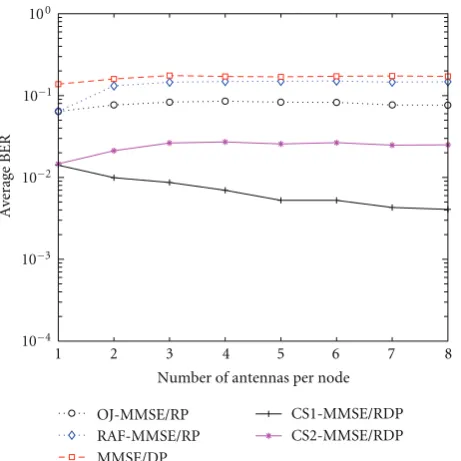
The bit error rates (BER) of the proposed schemes in the previous sections are evaluated by applying them to a K-user MIMO-relay system with N antennas at the BS andM antennas at the RS. We obtain the BER plots of OJ-MMSE/RP (Section 2.3.1), SOJ-MMSE/RP (Section 2.3.2), MMSB/DP (Section 2.2), CS1-MMSE/RDP (Section 2.4) and CS2-MMSE/RDP (Section 2.4) in downlink systems, together with OJ-MMSE/RP (Section 3.3), MMSB/DP (Section 3.2), CS1-MMSE/RDP (Section 3.4), and CS2-MMSE/RDP (Section 3.4) in uplink systems. Note that RP and DP denote direct path and relay path, respectively, while RDP represents the cooperative scenario with both the paths. In addition, we also evaluate the following two schemes as a reference for downlink and uplink systems, respectively.
(1)Transmit Amplify-and-Forward MMSE for relay path of downlink systems (TAF-MMSE/RP). This scheme only requires the relay to normalize the received signal to meet the power constraint and then forward the signal. In this case, the filter matrix at the relay is
W=η1I, (81)
whereη1 is given to meet the power constraint at the relay,
and hence the BS filter matrixFand the scalarβare obtained by substituting (81) into (30).
(2)Receive Amplify-and-Forward MMSE for relay path of uplink systems (RAF-MMSE/RP).In this scheme, the filter matrix at the relay is alsoW=η
1I, whereη1is given to meet
the power constraint at the relay and hence the uplink signal model becomes
y=Fη1H1H2 s+F
η
1Hln2+n1 , (82)
which is similar with that in conventional MIMO systems by regardingη1H1H2andη1H1n2+n1as equivalent channel
matrix and noise vector. Then the received MMSE filterFcan be obtained via the Linear MMSE receiverin [18].
In the simulation, we assume a flat fading channel in which each component of H1 and H2 is an i.i.d. complex
random variable with zero mean and unit variance. Consid-ering that the distance between BS and the MSs is usually larger than that between RS and BS, a relevant path losspis introduced to letH0 = pH0where each component ofH0
is another i.i.d. complex random variable with zero mean and unit variance. In addition, uncorrelated data streams and noise are assumed. To be more specific, 10000 QPSK symbols are simulated for each of the data streams per channel realization and all the results are mean of 2500 channel realizations.
4.1. BER versus SNR. Figures3and4show the comparisons of the BER versus SNR in downlink of multiuser MIMO-relay systems. SNR1 denotes the average signal-to-noise ratio of BS-RS link, that is, Et/σ12, while SNR2 denotes the
average signal-to-noise ratio of the RS-MS link, that is,Er/σ22.
Besides, we assumeσ2
0 =σ12=σ22andM=N=K=2 in the
simulation. The graphs show that the BER of the schemes except MMSB/DP and CS1-MMSE/RDP is saturated when SNR1 or SNR2 becomes large. This is because the relay path is dominant in these schemes, and thus if the SNR of either link is fixed, the BER will converge to a lower bound with the increase of SNR of the other link. On the other hand, we can see that the BER of CS1-MMSE/RDP scheme does not only outperform other schemes much but also is not saturated when increasing SNR1. This is due to the fact that it takes into account both the direct path and relay path and performs joint filter design over the paths. By comparing both the OJ-MMSE/RP and TAF-MMSE/RP scheme for relay path, it can be observed that the joint BS and RS filter design show BER gain than conventional precoding at the BS and AF at therelay, especially in high SNR region. However, when SNR1 is larger enough than SNR2, the MMSB/DP scheme for direct path is better than other schemes except CS1-MMSE/RDP scheme due to the performance loss of two hop transmission.
Figures5and6show the comparisons of the BER versus SNR in uplink of multi-user MIMO-relay systems. Here, SNR1 denotes the average signal-to-noise ratio of RS-BS link, that is,Er/σ12, while SNR2 denotes the average signal-to-noise
ratio of the MS-RS link, that is,Em/σ22. Similarly, the graphs
also show benefit from the proposed cooperative operation for both paths and joint filter design at BS and RS.
4.2. BER versus the Number of Antennas per Node. Figures
0 5 10 15 20 25 30 SNR1 (dB)
Average BER
OJ-MMSE/RP SOJ-MMSE/RP TAF-MMSE/RP
MMSE/DP CS1-MMSE/RDP CS2-MMSE/RDP
10−4
10−3
10−2
100
10−1
Figure 3: BER versus SNR of BS-RS link in downlink (p =
0.4, SNR2=15 dB).
0 5 10 15 20 25 30
SNR2 (dB)
OJ-MMSE/RP SOJ-MMSE/RP TAF-MMSE/RP
MMSE/DP CS1-MMSE/RDP CS2-MMSE/RDP
Average BER
10−3
10−2
100
10−1
Figure 4: BER versus SNR of RS-MS link in downlink (p =
0.4, SNR1=15 dB).
but it converges whenNbecomes large. However, the CS1-MMSE/RDP scheme in uplink systems performs differently, which shows that this scheme can eliminate the interference effectively.
4.3. BER versus the Relevant Path Loss of Direct Path. Figure 9
shows the BER of the schemes with various relevant path loss for downlink systems. Here, when the relevant path loss of direct path pis small enough, the CS2-MMSE/RDP scheme
0 5 10 15 20 25 30
SNR1 (dB)
OJ-MMSE/RP RAF-MMSE/RP MMSE/DP
CS1-MMSE/RDP CS2-MMSE/RDP
Average BER
10−4
10−3
10−2
100
10−1
Figure 5: BER versus SNR of RS-BS link in uplink (p =
0.4, SNR2=15 dB).
0 5 10 15 20 25 30
SNR2 (dB)
OJ-MMSE/RP RAF-MMSE/RP MMSE/DP
CS1-MMSE/RDP CS2-MMSE/RDP
Average BER
10−3
10
10−2 0
10−1
Figure 6: BER versus SNR of MS-RS link in uplink (p =
0.4, SNR1=15 dB).
1 2 3 4 5 6 7 8 Number of antennas per node
OJ-MMSE/RP SOJ-MMSE/RP TAF-MMSE/RP
MMSE/DP CS1-MMSE/RDP CS2-MMSE/RDP
Average BER
10−3
10−2
100
10−1
Figure 7: BER versus number of antennas in downlink (p =
0.4, SNR1=SNR2=15 dB).
1 2 3 4 5 6 7 8
Number of antennas per node
OJ-MMSE/RP RAF-MMSE/RP MMSE/DP
CS1-MMSE/RDP CS2-MMSE/RDP
Average BER
10−4
10−3
10−2
10−1
100
Figure 8: BER versus number of antennas in uplink (p =
0.4, SNR1=SNR2=15 dB).
than the former if the direct channel is good enough, which offers a measure for routing the users in cellular MIMO-relay networks.
Figure 10 shows the BER of the schemes with various relevant path loss for uplink systems. Apart from the CS2-MMSE/RDP scheme, other schemes perform similar with that in downlink systems. As the CS2-MMSE/RDP scheme for uplink systems also takes both the direct path and
0.1
Pathloss of direct path
0.2 0.3 0.4 0.5 0.6 0.7 0.8 0.9 1
Average BER
10−3
10−2
10−1
100
OJ-MMSE/RP SOJ-MMSE/RP
MMSE/DP CS1-MMSE/RDP
TAF-MMSE/RP CS2-MMSE/RDP
Figure9: BER versus pathloss of direct path in downlink (SNR1=
SNR2=15 dB).
0.1
Pathloss of direct path
OJ-MMSE/RP
MMSE/DP
CS1-MMSE/RDP
0.2 0.3 0.4 0.5 0.6 0.7 0.8 0.9 1
RAF-MMSE/RP CS2-MMSE/RDP
Average BER
10−3
10−2
10−1
100
10−4
Figure10: BER versus pathloss of direct path in uplink (SNR 1=
SNR2=15 dB).
the relay path into account, its BER decreases with the improvement of direct path.
1 2 3 4 5 6 7 8 9 10 Number of iterations
0 2 4 6 8 10 12 14
MSE
OJ-MMSE/RP (SNR1 = SNR2 = 5 dB)
Steady performance of OJ-MMSE/RP (SNR1 = SNR2 = 5 dB) OJ-MMSE/RP (SNR1 = SNR2 = 15 dB)
Steady performance of OJ-MMSE/RP (SNR1 = SNR2 = 15 dB) OJ-MMSE/RP (SNR1 = SNR2 = 25 dB)
Steady performance of OJ-MMSE/RP (SNR1 = SNR2 = 25 dB)
Figure11: MSE performance versus number of iterations.
and SVD parts into account. In addition, for the scheme involving iterative algorithm, we approximate the average iteration timeTto be 50. For downlink systems, it is observed that the reference scheme MMSB/DP and TAF-MMSE/RP is lower than others due to their simple operations. In addition, CS1-MMSE/RDP only requires a little more multiplications while providing much better performance than others as showed in the previous subsections. Similarly from 0, we can see that CS2-MMSE/RDP can achieve an excellent tradeoff of complexity and performance. However, CS1-MMSE/RDP scheme sacrifices not much complexity for much better performance than other schemes.
4.5. Convergence of Iterative Algorithm. Figure 11 gives the average MSE versus the iteration number for OJ-MMSE/RP scheme in Section 2.3.1 under three different system con-figurations, that is, SNR1 = SNR2 = {5, 15, 25}dB. In the figure the dash lines are the steady state performance of the corresponding configurations. As is seenFigure 11, it is obvious that the total MSE is monotonously decreasing and lower bounded to 0. These two facts guarantee the convergence of the scheme. In addition, simulation results have demonstrated that the system performance is very close to the steady-state solution after only a few numbers of iterations.
5. Conclusion
In this paper, the local optimal MSE-based joint (BS and RS) filters have been proposed for a multiuser coopera-tive nonregeneracoopera-tive MIMO-relay system. Both uplink and downlink are considered. It is clear that the cooperative system can be divided into two paths, that is, the direct path
and the relay path. As the optimal filter for the direct path can be obtained by using the exiting results of conventional MIMO link, we focus on the optimization for the relay path first. To be more specific, we propose the joint local optimal filter scheme, which involves an iterative algorithm in downlink scenario. Thus a simpler suboptimal scheme is derived for practical use. Then, in uplink scenario a closed-form optimal solution is exploited based on matrix analysis theory. The proposed optimal scheme firstly transform the MIMO relay channel into parallel sub-channels and then the optimal power allocation among the sub-channels has been found to follow a water-filling pattern. Furthermore, based on the results for direct path and relay path, two schemes are proposed for downlink systems and uplink systems with different combination methods, respectively. Numerical results and analysis show that joint filter design and cooperative operation can offer significant performance gain in terms of BER.
Acknowledgment
This work was supported in part by Ericsson Company, Beijing Science and Technology Committee under project no. 2007B053, National Natural Science Foundation of China (NSFC) under no. 60772112, National 973 Program under no. 2009CB320406, National 863 Program under no. 2009AA011802 and no. 2009AA01Z262.
References
[1] R. Pabst, B. Walke, and D. Schultz, “Relay-based deployment concepts for wireless and mobile broadband radio,” IEEE Communications Magazine, vol. 42, no. 9, pp. 80–89, 2004. [2] M. N. Khormuji and E. G. Larsson, “Receiver design for
wireless relay channels with regenerative relays,” inProceedings of the IEEE International Conference on Communications (ICC ’07), pp. 4034–4039, Glasgow, UK, May 2007.
[3] A. Bendjaballah, H. El Ghannudi, L. Clavier, N. Rolland, and P. A. Rolland, “Multihop wireless communications with non regenerative relays,” inProceedings of the 9th European Conference on Wireless Technology (ECWT ’06), pp. 189–192, Manchester, UK, September 2006.
[4] E. Telatar, “Capacity of multi-antenna Gaussian channels,” European Transactions on Telecommunications, vol. 10, no. 6, pp. 585–595, 1999.
[5] L. Zheng and D. N. C. Tse, “Diversity and multiplexing: a fundamental tradeoffin multiple-antenna channels,”IEEE Transactions on Information Theory, vol. 49, no. 5, pp. 1073– 1096, 2003.
[6] D. Gesbert, M. Kountouris, R. W. Heath, C.-B. Chae, and T. Salzer, “Shifting the MIMO paradigm,”IEEE Signal Processing Magazine, vol. 24, no. 5, pp. 36–46, 2007.
[7] B. Wang, J. Zhang, and A. Host-Madsen, “On the capacity of MIMO relay channels,”IEEE Transactions on Information Theory, vol. 51, no. 1, pp. 29–43, 2005.
[9] X. Tang and Y. Hua, “Optimal design of non-regenerative MIMO wireless relays,”IEEE Transactions on Wireless Commu-nications, vol. 6, no. 4, pp. 1398–1406, 2007.
[10] O. Munoz-Medina, J. Vidal, and A. Agustin, “Linear transceiver design in nonregenerative relays with channel state information,”IEEE Transactions on Signal Processing, vol. 55, no. 6, pp. 2593–2604, 2007.
[11] H. W. Je, B. Lee, S. Kim, and K. B. Lee, “Design of non-regenerative MIMO-relay system with partial channel state information,” in Proceedings of the IEEE International Conference on Communications (ICC ’08), pp. 4441–4445, Beijing, China, May 2008.
[12] J. Chen, X. Yu, and C.-C. J. Kuo, “V-BLAST receiver for MIMO relay networks with imperfect CSI,” inProceedings of the IEEE Global Telecommunications Conference (GLOBECOM ’07), pp. 571–575, Washington, DC, USA, November 2007.
[13] T. Abe, H. Shi, T. Asai, and H. Yoshino, “Relay techniques for MIMO wireless networks with multiple source and destina-tion pairs,”EURASIP Journal on Wireless Communications and Networking, vol. 2006, Article ID 64159, 9 pages, 2006. [14] S. W. Peters and R. W. Heath, “Nonregenerative MIMO
relaying with optimal transmit antenna selection,”IEEE Signal Processing Letters, vol. 15, pp. 421–424, 2008.
[15] Y. Fan and J. Thompson, “MIMO configurations for relay channels: theory and practice,”IEEE Transactions on Wireless Communications, vol. 6, no. 5, pp. 1774–1786, 2007.
[16] C.-B. Chae, T. Tang, R. W. Heath, and S. Cho, “MIMO relaying with linear processing for multiuser transmission in fixed relay networks,”IEEE Transactions on Signal Processing, vol. 56, no. 2, pp. 727–738, 2008.
[17] M. Joham, W. Utschick, and J. A. Nossek, “Linear transmit processing in MIMO communications systems,”IEEE Trans-action Signal Processing, vol. 53, no. 8, pp. 2700–2712, 2005. [18] D. Tse and P. Viswanath,Fundamentals of Wireless
Communi-cation, Cambridge University Press, Cambridge, UK, 2005. [19] R. A. Horn and C. R. Johnson,Matrix Analysis, Cambridge