R E S E A R C H
Open Access
Considering the fact that the memory in economic series changes with dynamic economic environment, this paper is devoted to the proposal of a variable-order fractional van der Pol model (VOFVDPM), where the order of the derivative is replaced by a time-dependent function. A numeric scheme for this model is designed by the Adams-Bashforth-Moulton method. The dynamic behaviors of the VOFVDPM with linear and periodic variable-order functions are investigated through numerical experiment. Some dynamic characteristics of the VOFVDPM that do not exist in a fractional order van der Pol model are discovered in the numerical simulation, such as existing limit point when the linear order functions have the same ranges and opposite slopes.
MSC: 26A33; 34A08
Keywords: van der Pol model; variable-order fractional derivative; dynamic behavior
1 Introduction
As a classical nonlinear dynamic model, the van der Pol model has attracted scholars’ attention from many fields since it was proposed by the Dutch electrical engineer and physicist Balthasar van der Pol. It is extensively applied in neurology, physics, sociology, and economics. Based on Kaldor’s model of business cycles, the van der Pol model of nonlinear business cycles is proposed by postulating symmetric shapes of the investment and savings functions []. Assuming that the investment outlay is periodic and continuous function of time, the forced van der Pol model of nonlinear economic cycles is presented in [], which is the generalization of Goodwin’s nonlinear accelerator-multiplier model. When the investment outlay is neglected, the forced van der Pol model of nonlinear eco-nomic cycles is the van der Pol model of nonlinear business cycles. In addition to Kaldor’s model and Goodwin’s nonlinear accelerator-multiplier model, the van der Pol model has been applied in other relevant economical problems; see [] for more details.
The dynamic of the van der Pol model of nonlinear economic cycles is extensively stud-ied by researchers. The bifurcation diagrams of the forced van der Pol model on varying the driver’s frequency and amplitude are analyzed in []. It points out the coexistence of asymmetric attractors ascribed to the system symmetry of the van der Pol oscillator, and it finds that periodic, quasiperiodic, and chaotic attractors coexist. In [], the dynamic
haviors are investigated by considering the change of control parameters, especially the pattern of bifurcation with damping parameter changing. The number of coexisting at-tractors in overlaps of mode-locking subzones is an important dynamic behavior, and it is analyzed in []. For the dynamics structure of the forced van der Pol model of nonlinear economic cycles it is found that the chaotic attractor is composed of chaotic saddles and unstable periodic orbits located in the gap regions of chaotic saddles for the model []. For existing chaos in the forced van der Pol model with certain parameters, the chaos control of chaotic unstable limit cycles is discussed in [].
Inspired by the development of fractional calculus, the fractional order derivatives are applied in the forced van der Pol model of nonlinear economic cycles, for which frac-tional order derivatives can depict a ‘memory principle’ in economic dynamic. Chaos in a fractional order modified van der Pol system is studied by [], where chaos exists in the fractional order system with the order both less than and higher than the number of the states of the integer order generalized van der Pol system. And chaos is also discovered in non-autonomous and autonomous generalized van der Pol systems excited by a sinusoidal time function with fractional orders []. In [], one presents a periodically excited van der Pol system with fractional damping, and one finds that the response of the system is very sensitive to changes in the order of fractional damping. Several other papers dealing with van der Pol oscillators could be found in the literature (see [–] and the references therein).
Compared to the usual forced van der Pol model of nonlinear economic cycles, the con-tribution of the fractional forced van der Pol model of nonlinear economic cycles is that it can describe memory in economic dynamics. However, the characteristic of this memory in economic time series will change with time, for which it is affected by the macroeco-nomic environment and government policy at different times. Therefore, this paper will propose a variable-order fractional forced van der Pol model of nonlinear economic cycles, which can describe the fact that memory in economic series is varying with time. The or-ders in the fractional forced van der Pol model of nonlinear economic cycles are replaced by positive bounded continuous functions. In order to obtain an effective and applica-ble numerical technique for solving the variaapplica-ble-order fractional van der Pol model, the Adams-Bashforth-Moulton method is adopted. Then we employ the technique to obtain the numerical results for the dynamics characteristics of the variable-order fractional van der Pol model with different parameters.
The remainder of this article is organized as follows: In Section , we review the math-ematical preliminaries as regards the variable-order fractional derivative. In Section , we propose a variable-order fractional forced van der Pol model of nonlinear economic cycles. In Section , we present the numerical technique for solving the variable-order fractional forced van der Pol model by the Adams-Bashforth-Moulton method. In Section , numer-ical experiments are performed to analyze the dynamic characteristics. The conclusions are drawn in Section .
2 Variable-order fractional derivative
are the Grünwald-Letnikov (GL) definition, the Riemann-Liouville (RL), and the Caputo definitions. According to these definitions, their corresponding variable-order fractional derivative can be defined as follows.
withh=t/Nbeing called the GL variable-order fractional derivative off(t).
Definition ([, ]) The Riemann-Liouville variable-order fractional derivative off(t) for a continuously differentiable functionf: [a, +∞)→Ris defined as
Definition ([, ]) The Caputo variable-order fractional derivative off(t) for a con-tinuously differentiable functionf : [, +∞)→Ris defined as
Remark For the above definitions of variable-order fractional derivative, whenα(t) = q> , (), (), () describe the fractional derivative. Ifα(t) =m– , (), (), () describe the classical (m– )th order derivative. Ifα(t) = ,DGLα(t,)RL,Cf(t) =f(t).
The main advantage of the Caputo derivative is that the initial conditions for the frac-tional differential equations are of the same form as that of the integer order differential equations []. Therefore, we study the VOFVDPM with the Caputo derivative in this pa-per.
3 Variable-order fractional van der Pol model of nonlinear business cycles
The forced van der Pol model of nonlinear business cycles can be described as follows:
dx
dt +μ
x– dx
dt +x=asin(ωt), ()
Based on (), we present the variable-order forced van der Pol model (VOFVDPM) of
Remark Ifa= , () is an unforced variable-order fractional van der Pol model of non-linear business cycles.
For the VOFVDPM,xis the macroeconomic variable of a certain economy, such as na-tional income, GDP, and so on.asin(ωt) is for the periodical investment outlays, which is a controllable variable and has impacts on the macroeconomic variablex. The variable-order fractional derivative of VOFVDPM reflects the varying memory in the macroeco-nomic seriesx. So the order functionsq(t),q(t) depict the evolution path of the
mem-ory in the macroeconomic seriesx. Therefore, VOFVDPM with a certain variable-order fractional derivative not only depicts the complex dynamics of national income, but also reflects the varying memory in the economical series of the national income. The appli-cation of a variable-order fractional derivative in the van der Pol model can be extended to other dynamic economic models.
4 Numerical scheme
where
In this section, we will analyze the dynamic behaviors of VOFVDPM by the above numer-ical scheme. The cases where the orders of the derivatives in VOFVDPM are varying with different linear and periodical functions of time are investigated. The experiments under a= are performed. Figures - are numerical results of VOFVDPM () for the cases where the variable-order functionsq,qare linear and periodic. We select the following
uniform grid:T= (t∈[, ]),h= .,N= ,,tn= .n,t= ,tN= .
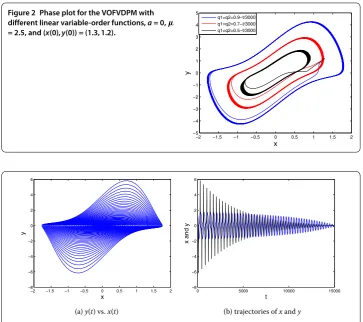
Figures (a), (b) exhibit the phase plots for linear variable-order functionsq(t) =q(t),
which are linear decreasing and increasing in the same range [., ] with the same speed, /,, respectively. It shows that the responses of the VOFVDPM with linear decreasing order function approach a limit cycle faster than with a linear increasing order function. The shapes of the limit cycles with linear decreasing and increasing variable-order func-tions are different in spite of the same range and speed. Figure shows the phase plots
(a)q(t) =q(t) = – t/, (b)q(t) =q(t) = . +t/,
Figure 2 Phase plot for the VOFVDPM with different linear variable-order functions,a= 0,μ
= 2.5, and (x(0),y(0)) = (1.3, 1.2).
(a)y(t) vs.x(t) (b) trajectories ofxandy
Figure 3 Phase plot and trajectories (blue line:x(t), black line:y(t)) for the VOFVDPM with
q1(t) = 1 – 4t/3,000,q2(t) = 0.6 + 4t/3,000,a= 0,μ= 2.5, and (x(0),y(0)) = (1.3, 1.2).
(a)y(t) vs.x(t) (b) trajectories ofxandy
Figure 4 Phase plot and trajectories (blue line:x(t), black line:y(t)) for the VOFVDPM with
q1(t) = 0.9 – 4t/3,000,q2(t) = 0.5 + 4t/3,000,a= 0,μ= 2.5, and (x(0),y(0)) = (1.3, 1.2).
for linear variable-order functions with different intercepts. From it, we can find that the scale of the limit cycles becomes smaller with smaller intercepts in the linear variable-order functions.
In order to investigate the dynamic characteristics of the VOFVDPM withq not
be-ing equal toq, Figures - exhibit the phase plots and trajectories for the case:q(t) =
(a)y(t) vs.x(t) (b) trajectories ofxandy
Figure 5 Phase plot and trajectories (blue line:x(t), black line:y(t)) for the VOFVDPM with
q1(t) = 1 – 4t/3,000,q2(t) = 0.6 + 4t/3,000,a= 0,μ= 2.5, and (x(0),y(0)) = (1.3, 1.2).
(a)q=q= . + .sin(t/) (b)q=q= . + .sin(t/)
(c)q=q= . + .sin(t/) (d)q=q= . + .sin(t/)
Figure 6 Phase plot for the VOFVDPM with different periodical functions,a= 0,μ= 2.5, and (x(0),y(0)) = (1.3, 1.2).
and the case:q(t) = . + t/,,q(t) = – t/,. For Figure ,q,qhave the same
range [., ], but decrease and increase with opposite slopes, respectively. It shows that the responses of the VOFVDPM have convergence to the limit point (, ). Figure for linearq,qwith the same ranges [., .] and opposite slopes, also has the same dynamic
behaviors and faster reaches the limit point (, ) than the case in Figure . However, the trajectories are divergent whenq,qincrease and decrease in the same range with
(a)y(t) vs.x(t) (b) trajectories ofxandy
Figure 7 Phase plot and trajectories (blue line:x(t), black line:y(t)) for the VOFVDPM with
q1(t) = 0.4 + 0.1 sin(t/50),q2(t) = 0.3 + 2t/3,000,a= 0,μ= 2.5, and (x(0),y(0)) = (1.3, 1.2).
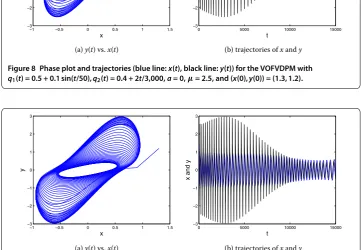
(a)y(t) vs.x(t) (b) trajectories ofxandy
Figure 8 Phase plot and trajectories (blue line:x(t), black line:y(t)) for the VOFVDPM with
q1(t) = 0.5 + 0.1 sin(t/50),q2(t) = 0.4 + 2t/3,000,a= 0,μ= 2.5, and (x(0),y(0)) = (1.3, 1.2).
(a)y(t) vs.x(t) (b) trajectories ofxandy
Figure 9 Phase plot and trajectories (blue line:x(t), black line:y(t)) for the VOFVDPM with
q1(t) = 0.6 + 0.1 sin(t/50),q2(t) = 0.5 + 2t/3,000,a= 0,μ= 2.5, and (x(0),y(0)) = (1.3, 1.2).
(a)y(t) vs.x(t) (b) trajectories ofxandy
Figure 10 Phase plot and trajectories (blue line:x(t), black line:y(t)) for the VOFVDPM with
q1(t) = 0.7 + 0.1 sin(t/50),q2(t) = 0.6 + 2t/3,000,a= 0,μ= 2.5, and (x(0),y(0)) = (1.3, 1.2).
(a)y(t) vs.x(t) (b) trajectories ofxandy
Figure 11 Phase plot and trajectories (blue line:x(t), black line:y(t)) for the VOFVDPM with
q1(t) = 0.6 + 2t/3,000,q2(t) = 0.7 + 0.1 sin(t/50),a= 0,μ= 2.5, and (x(0),y(0)) = (1.3, 1.2).
function with different periods, but it seems that significant differences are not discovered yet. Figures (a) and (c) exhibit different shapes of the limit cycle when the ranges of pe-riodical variable-order functions are different. From Figure , the periodic variable-order functions have little effect on the responses of the VOFVDPM.
Figures - present the phase plots and trajectories of the VOFVDPM withq,q
be-ing linear and periodic functions. The order functionsq,qare periodic and linear,
re-spectively, in the same range for Figures -, where the ranges are [., .], [., .], [., .], [., .]. We can find that the responses of the model approach the point (, ) in Figures - with smaller orders, and they are in convergence to a limit cycle in Fig-ures - with larger orders. However, Figure shows that the trajectories are divergent, where the order functionsq,q are linear and periodic, respectively, in the same range,
[., .].
The above numerical experiments investigate the dynamic behaviors of the VOFVDPM with different linear and periodical functions in the casea= . It shows that some novel dynamic characteristics of the model have been found in the numerical results, such as the existence of a limit point (, ) when linearq,qare in the same ranges and have opposite
characteristic of the FVDP model when the order of the derivative is a time-dependent function.
6 Conclusion
In this paper, we successfully extend the forced van der Pol model with nonlinear eco-nomic cycle to the VOFVDPM, which considers the memory in an ecoeco-nomic series vary-ing with time. The numeric scheme based on the Adams-Bashforth-Moulton method for the VOFVDPM has been designed. By the scheme, the dynamic behaviors of the model with linear or periodic variable-order function have been analyzed. The results of the anal-ysis suggest that the VOFVDPM presents some novel dynamic characteristics, which can-not be found in an integral and constant fractional van der Pol model.
Competing interests
The authors declare that there is no conflict of interests, nor are there financial or competing interests regarding the publication of this article.
Authors’ contributions
All authors contributed equally to the manuscript and typed, read, and approved the final manuscript
Acknowledgements
The project supported by National Natural Science Foundation of China (71501070) and Education Department foundation of Hunan Province (15B150).
Received: 6 April 2016 Accepted: 11 July 2016
References
1. Chang, WW, Smyth, DJ: The existence and persistence of cycles in a non-linear model: Kaldor’s model re-examined. Rev. Econ. Stud.38(1), 37-44 (1971)
2. Lorenz, HW: Goodwin’s nonlinear accelerator and chaotic motion. J. Econ.47, 413-418 (1987)
3. Chian, ACL: Nonlinear dynamics and chaos in macroeconomics. Int. J. Theor. Appl. Finance3, 601-624 (2000) 4. Parlitz, U, Lauterborn, W: Period-doubling cascades and devil’s staircases of the driven van der Pol oscillator. Phys. Rev.
A6, 1428-1434 (1987)
5. Mettin, R, Parlitz, U, Lauterborn, W: Bifurcation structure of the driven van der Pol oscillator. Int. J. Bifurc. Chaos3, 1529-1555 (1993)
6. Xu, JX, Jiang, J: The global bifurcation characteristics of the forced van der Pol oscillator. Chaos Solitons Fractals3(7), 3-19 (1996)
7. Chian, ACL, Rempel, EL, Rogers, C: Complex economic dynamics: chaotic saddle, crisis and intermittency. Chaos Solitons Fractals29, 1194-1218 (2006)
8. Mahmound, GM, Farghaly, AAM: Chaos control of chaotic limit cycles of real and complex van der Pol oscillators. Chaos Solitons Fractals21, 915-924 (2004)
9. Ge, ZM, Zhang, AR: Chaos in a modified van der Pol system and in its fractional order systems. Chaos Solitons Fractals
32, 1791-1822 (2006)
10. Ge, ZM, Hsu, MY: Chaos in a generalized van der Pol system and in its fractional order systems. Chaos Solitons Fractals
33, 592-604 (2007)
11. Chen, JH, Chen, WC: Chaotic dynamics of the fractionally damped van der Pol equation. Chaos Solitons Fractals35, 188-198 (2008)
12. Barbosa, RS, Machado, JAT, Vingare, BM, Calderon, AJ: Analysis of the van der Pol oscillator containing derivatives of fractional order. J. Vib. Control13, 1291-1301 (2007)
13. Ge, ZM, Hsu, MY: Chaos excited chaos synchronizations of integral and fractional order generalized van der Pol systems. Chaos Solitons Fractals36, 592-604 (2008)
14. Tavazoei, MS, Haeri, M, Attari, M, Siami, M, Bolouki, S: More details on analysis of fractional order van der Pol oscillator. J. Vib. Control15, 803-819 (2009)
15. Attari, M, Mohammad, MH, Tavazoei, S: Analysis of a fractional order van der Pol-like oscillator via describing function method. Nonlinear Dyn.61, 265-274 (2010)
16. Suchorsky, MK, Rand, RH: A pair of van der Pol oscillators coupled by fractional derivatives. Nonlinear Dyn.69, 313-324 (2012)
17. Xu, Y, Agrawal, OP: Models and numerical schemes for generalized van der Pol equations. Commun. Nonlinear Sci. Numer. Simul.18, 3575-3589 (2013)
18. Mishra, V, Das, S, Jafari, H, Ong, SH: Study of fractional order van der Pol equation. J. King Saud Univ., Sci.28, 55-60 (2016)
19. Ma, S, Xu, Y, Yue, W: Numerical solution of a variable-order fractional financial system. J. Appl. Math.2012, Article ID 417942 (2012). doi:10.1155/2012/417942(2012)
21. Xu, Y, He, Z: Synchronization of variable-order fractional financial system via active control and method. Cent. Eur. J. Phys. (2013). doi:10.2478/s11534-013-0237-x
22. Diethelm, K: The Analysis of Fractional Differential Equations. Springer, Berlin (2010)
![Figure 1 Phase plots for the VOFVDPM with q3,000 (the other common parameters are1(t) = q2(t) = 1 – 1t/3,000 and q1(t) = q2(t) = 0.9 + 1t/ a = 0, μ = 2.5) [blue line: (x(0),y(0)) = (0.2,0.3); red line:(x(0),y(0)) = (0,4)].](https://thumb-us.123doks.com/thumbv2/123dok_us/973225.1119621/5.595.118.479.542.689/figure-phase-plots-vofvdpm-common-parameters-line-line.webp)