The Ideal-Cipher Model, Revisited:
An Uninstantiable Blockcipher-Based Hash Function
J. Black∗
July 1, 2005
Abstract
The Ideal-Cipher Model of a blockcipher is a well-known and widely-used model dating back to Shannon [24] and has seen frequent use in proving the security of various cryptographic objects and protocols. But very little discussion has transpired regard-ing the meanregard-ing of proofs conducted in this model or regardregard-ing the model’s validity. In this paper, we briefly discuss the implications of proofs done in the ideal-cipher model, then show some limitations of the model analogous to recent work regarding the Random-Oracle Model [2]. In particular, we extend work by Canetti, Goldreich and Halevi [5], and a recent simplification by Maurer, Renner, and Holenstein [14], to exhibit a blockcipher-based hash function that is provably-secure in the ideal-cipher model but trivially insecure when instantiated by any blockcipher.
Keywords: Ideal-Cipher Model, Information-Theoretic Cryptography, Random-Oracle Model
∗
1
Introduction
The Standard Model. Before we can prove the security of a cryptographic system or object, we must specify what model we are using. The most common model used in mod-ern cryptography is the so-called “standard model.” Here we use no special mathematical objects such as infinite random strings or random oracles [2], and we abstract our com-munications system typically as a reliable but insecure channel. We have not been able to achieve most common cryptographic goals in the standard model without making additional complexity-theoretic hardness assumptions, because we still have no proof that any of our standard cryptographic building blocks have computational lower bounds. The common as-sumptions are typically that factoring the product of large primes is hard, or that discrete log is intractible in certain sufficiently large groups, or that AES is a good pseudo-random permutation (PRP) [15]. The standard model is usually well-accepted in our community despite the fact that proofs done in this model rest upon unproven assumptions and that already much relevant real-world context has been abstracted away (timing, power con-sumption, error messages, and other real-world effects are typically not included as part of the model in spite of the demonstrated fact they are often relevant to security).
The Random-Oracle Model. When proofs in the standard model are unappealing or are provably impossible (eg, see [18]), we often resort to proofs using an alternative model. By far the best-known is the “Random-Oracle Model.” The random-oracle model was used for some time before being formalized by Bellare and Rogaway [2], and continues to see widespread use today (there are more than a hundred instances; for a few examples see [2, 10, 17, 20, 23]). In the random-oracle model we have a public random function, accessible to all parties, which typically accepts any string from {0,1}∗ and outputs nbits. For each element in its domain, the corresponding n-bit output is uniform and independent from all other outputs. Proofs conducted in the random-oracle model often admit schemes which are provably-secure and more efficient than schemes which have been proven secure in the standard model, and for this reason the random-oracle model has been widely-adopted.
Of course random oracles do not exist in practice, and if the schemes proven secure in the random-oracle model are going to be put into use, we must choose some object to implement the random oracle. This step is called “instantiation.” Most often, random oracles are instantiated with cryptographic hash functions such as SHA-1 [19]. The following question then arises: now that we have instantiated our random oracle with a concrete function, what security guarantees do we have? Does our proof in the random-oracle model have any bearing on the security of the instantiated system?
is that it is provably-secure in the standard model and still practical (and, as with most proofs in the standard model, comes with an assumption: the Decisional Diffie-Hellman assumption [4]). Further doubt has been recently cast on the random-oracle model due to a string of results exhibiting schemes which are provably-secure in the random-oracle model but are completely insecure when instantiated by any hash function [1, 5, 6, 14]. Schemes of this type are called “uninstantiable.”
It has been noted [2] that proofs done in the random-oracle model do guarantee one thing: if the adversary treats the instantiated random oracle as a black box, promising not to think about its inner workings, promising not to exploit any unnatural behavior related to the fact that we have instantiated with some algorithm that has a compact description, then the proof remains valid in the standard model. Of course there is no guarantee that real adversaries would abide by such restrictions, and indeed they would be remiss if they did. Nonetheless, no scheme has thus far been proven secure in the random-oracle model and then broken once instantiated, unless this was the goal from the start.
The Ideal-Cipher Model. Blockciphers are a common building block for cryptographic protocols. In the standard model the associated assumption for blockciphers is that they are “pseudo-random permutations” (PRPs). By this we mean (informally) that an n-bit blockcipher under a secret randomly-chosen key is computationally indistinguishable from a randomly-chosenn-bit permutation. Proofs conducted using this assumption typically give reductions showing that if an adversary breaks some scheme, then there exists an associated adversary that can efficiently distinguish the underlying blockcipher from random.
There are countless examples where the PRP assumption in the standard model is sufficient, but there are also plenty of cases where we cannot get a proof to go through. In certain cases it can be shown that blockcipher-based schemes we believe to be secure cannot have a proof of security using only the PRP assumption in the standard model [25]. In this case we are faced with either abandoning attempts at a proof, or using an alternate model. The blockcipher analog for the random-oracle model is variously called the “Shannon Model,” the “Black-Box Model,” or the “Ideal-Cipher Model.” We will prefer the latter name in this paper.
Though not as widely-used as the random-oracle model, the ideal-cipher model dates back to Shannon [24] and has been used in a variety of settings (see, for example [3, 8, 9, 11, 12, 16, 26]). In the ideal-cipher model we think of a blockcipher E withk-bit key and n-bit blocksize as being chosen uniformly from the set of all possible blockciphers of this form. For each key, there are 2n! permutations, and since any permutation may be assigned to a given key, there are (2n!)2k
possible blockciphers. When we instantiate our black box, it becomes some particular blockcipher. AES with a 128-bit key is one choice from the nearly 22263 blockciphers we could have chosen (though in the spirit of Kolmogorov complexity and
The ideal-cipher model is analogous to the random-oracle model with three notable exceptions:
• The ideal cipher has a permutivity requirement that random oracles obviously do not.
• Adversaries interacting with an ideal-cipher oracle are typically given access to both the cipher and its inverse.
• The blocksizenof the ideal cipher is typically fixed a priori. This means that an ideal cipher is a finite object while the random oracle is an infinite one.
The ideal-cipher model has been used in a variety of settings, and like the random-oracle model, some researchers question the wisdom of its use. The argument is completely analogous: if a scheme is proved secure in the ideal-cipher model, what exactly are we guaranteed once the ideal cipher is instantiated by a real blockcipher? And if the answer is essentially “not much,” then what is the value of such proofs? A common argument against the ideal-cipher model is that most real-world blockciphers have distinguishing patterns which would exist with exceedingly small probability in a collection of random permutations. The key complementation property of DES is a typical example of this [15]. Although no such properties are currently known for AES, some blockcipher experts who are comfortable with the assumption that AES is a good PRP are reluctant to model AES as ideal because of practical concerns: the AES key schedule, for instance, is quite simple and it perhaps contains related-key properties we have not yet discovered.
As compensation to the adversary for his respecting the blockcipher as a black box, we often endow him with limitless computational resources. In this respect, many proofs done in the ideal-cipher model are information theoretic. This too is unrealistic, but here we are giving the adversary more power rather than enhancing the objects themselves. Nonetheless, it is saying something about the strength of our model that it allows us to achieve information-theoretic security.
The main result of this paper is to exhibit a blockcipher-based hash function that is secure in the ideal-cipher model against information-theoretic adversaries but which is triv-ially insecure once instantiated with any blockcipher. In order to state this result more clearly, we take a short detour to review blockcipher-based hash functions.
Blockcipher-Based Hash Functions. One area of recently-renewed interest involves constructing hash functions from blockciphers. This approach, dating back at least to Rabin [22], uses some blockcipher E with an n-bit key and an n-bit blocksize, and builds a compression function from it. Iterating this function then hopefully produces a collision-resistant hash function. Preneel, Govaerts, and Vandewalle [21] conducted a systematic study of a class of 64 blockcipher-based hash functions. They focused on compression functions of the form f(hi−1, mi) =Ea(b)⊕c where a, b, c ∈ {hi−1, mi, hi−1⊕mi, v} for
some fixed constant v. We can now hash any M ∈({0,1}n)+ by writing M = M
E n n
n mi
hi−1 > f(hi−1, mi)
Figure 1: The Matyas-Meyer-Oseas (MMO) compression function [13], calledH1 in [3]. E: {0,1}n × {0,1}n
→ {0,1}n
is a block cipher; the hatch mark denotes the location of the key. Iterating this compression function results in a provably-secure blockcipher-based hash function in the ideal-cipher model.
and then settingh0 to some constant (typically 0n) and settinghi=f(hi−1, m). We return h` as the digest. The PGV analysis consisted of testing a series of attacks on each of
these iterated hash functions. Black, Rogaway and Shrimpton [3] considered these same 64 constructions exhibiting either an attack or a proof of security (in the ideal-cipher model) for each. They determined that 20 of the 64 schemes were provably collision-resistant up to the birthday bound. For one example, see Figure 1.
Although a proof of security for a blockcipher-based hash function in thestandard model would be prefered, it has been shown that the PRP assumption is insufficient for building a collision-resistant hash function [25]. Indeed, one can easily imagine a blockcipher Ee : {0,1}n× {0,1}n → {0,1}n that is a good PRP, but which fails when used in the MMO construction of Figure 1. For example, let blockcipher E :{0,1}n× {0,1}n → {0,1}n be a good PRP and consider blockcipher Ee defined as follows:
e
E(K, X) =
K ifX =K
E(K, K) ifX =E−1(K, K) E(K, X) otherwise
So Ee is the same blockcipher as E with one change: we now have the invariant that
E(K, K) =K for all K ∈ {0,1}n. Clearly Ee is a good PRP since E was: for arandomly -chosen key K, Ee(K,·) is computationally indistinguishable from a random permutation. However, using Ee in MMO would be inadvisable: it is trivial to find collisions. Specifically, let H be MMO built on Ee withh0= 0n. ThenH(akEe(0, a)⊕a) = 0n for all a∈ {0,1}n.
(in particular uninstantiability results) might break down in the ideal-cipher setting given that ideal ciphers can be described with a finite string. We will show that the answer to the above question is “yes”: we exhibit a blockcipher-based hash function which is provably collision-resistant in the ideal-cipher model and for which it is trivial to find collisions once the ideal cipher has been instantiated.
We follow the approaches of [5, 14], adapting them to blockciphers and hash functions, and moving into the concrete (rather than asymptotic) setting. The main idea is to create a blockcipher-based hash functionHe that acts normally on most inputs, but acts insecurely when given a description of its oracle as an input. In the latter case, He tests the oracle description embedded in its input against the oracle it already has by submitting some number of test values. If the oracles agree on all values, He outputs a user-specified value which was also given in the input. The difficulty here is showing that He remains secure even when behaving this way, and the crucial point is that there a far more possible ideal ciphers with specified input-output pairs than there are encodings to represent them. All of this is formalized and rigorously proven in Section 3.
2
Definitions
Basic notions. Letκ, n≥1 be numbers. Ablockcipher is a mapE: {0,1}κ× {0,1}n→ {0,1}n where, for eachk∈ {0,1}κ, the functionEk(·) =E(k,·) is a permutation on{0,1}n.
Parameter n is called the blocksize of E, and n will be understood to be this quantity throughout the paper. If E is a blockcipher then E−1 is its inverse, where E−1
k (y) is the
string x such that Ek(x) = y. Let Bloc(κ, n) be the set of all block ciphers E: {0,1}κ ×
{0,1}n→ {0,1}n. Choosing a random element of Bloc(κ, n) means that for eachk∈ {0,1}κ one chooses a random permutation Ek(·).
A (blockcipher-based)hash function is a mapH: Bloc(κ, n)×D →Rwhereκ, n, c≥1,
D ⊆ {0,1}∗, and R={0,1}c. The functionH must be given by a program that, given M, computes HE(M) = H(E, M) using an E-oracle. Hash function f: Bloc(κ, n)×D → R
is a compression function if D ={0,1}a× {0,1}b for some a, b ≥1 where a+b ≥c. Fix
h0∈ {0,1}a. Theiterated hash of compression functionf: Bloc(κ, n)×({0,1}a×{0,1}b)→
{0,1}ais the hash functionH: Bloc(κ, n)×({0,1}b)∗
→ {0,1}adefined byHE(m
1· · ·m`) = h` wherehi=fE(hi−1, mi). SetHE(ε) =h0. We often omit the superscriptE tof andH.
We writex←$ S for the experiment of choosing a random element from the finite setS
and calling it x. An adversary is an algorithm with access to one or more oracles. We write these as superscripts. The notation |x| denotes the size of the string x, in bits, and the notation x[i . . . j] denotes the substring of string x starting at the i-th bit of x and terminating at the j-th bit, inclusive. All bits are numbered starting from 1, and ascending left-to-right. Finally, xky denotes the concatenation of stringsx and y.
Collision resistance. To quantify the collision resistance of a blockcipher-based hash function H we instantiate the blockcipher by a randomly chosen E ∈ Bloc(κ, n). An adversaryA is given oracles forE(·,·) and E−1(·,·) and wants to find acollision forHE—
that is, M, M0
where M 6=M0
butHE(M) =HE(M0
). We look at the number of queries that the adversary makes and compare this with the probability of finding a collision.
Definition 1 (Collision resistance of a hash function) LetHbe a blockcipher-based hash function, H: Bloc(κ, n)×D → R, and let A be an adversary. Then the advantage of A in finding collisions inH is the real number
AdvcollH (A) = PrhE←$ Bloc(κ, n); (M, M0)←$ AE,E−1: M 6=M0 &HE(M) =HE(M0)i
For q ≥1 we write AdvcollH (q) = maxA{AdvcollH (A)} where the maximum is taken over all
3
An Uninstantiable Blockcipher-Based Hash Function
In [3] we find 20 blockcipher-based hash function constructions that are provably secure in the ideal-cipher model. Specifically, it is shown that AdvcollH (q) = Θ(q2/2n) for 20
blockcipher-based hash functionsH. This bound is about the best we can hope for: a truly random function would have the same bound due to the birthday phenomenon.
The proofs in [3] are carried out in the ideal-cipher model and the adversaries are information theoretic. In this section we will show that any scheme H from this set can be transformed into a related scheme He such that He is uninstantiable. We first outline the method and then give the details.
Main Idea. Our goal is to produce an uninstantiable blockcipher-based hash function. We will do this by transforming some scheme which is provably secure in the ideal-cipher model. For concreteness, select any of the 20 secure schemes from [3] and call it H.
We will describe a related blockcipher-based hash function He which is uninstantiable. The idea has its roots in Kolmogorov complexity. We adapt the approach of Maurer, Renner, and Holenstein [14]; when He processes input M, it first decomposes M into three parts:
M = (π, c, v) where the details of this decomposition are left for later. The first parameter,
π is considered to be the encoding of a Universal Turing Machine (UTM), encoded in some well-defined manner. The second parameter c∈ {0,1}σ is a counter that is ignored by He, and the final parameterv∈ {0,1}nis the value that the adversary would like to have output by He.
NowHe uses its blockcipher oracle O to compute O(i,0n) for all 1 ≤i≤ |π|. (Why we choose this range will become apparent in the proof below.) It also computes π(i,0n) for the same set of i-values. If O(i,0n) =π(i,0n) for all 1 ≤i≤ |π|, He outputsv. If not, He
outputsH(M).
Now consider two cases: in the first case, the oracle to He was an ideal cipher I. This means that it is highly unlikely there is a sufficiently-short Turing-machine encoding, π, such that π(·,0n) would correctly match I on all |π| points, and therefore it is extremely unlikely that we would have I(i,0n) = π(i,0n) for all 1 ≤ i ≤ |π|. This means that in all likelihood He would output H(M), and we know this construction is provably collision resistant. And so in this case AdvcollHe (q) is Θ(q2/2n) by [3].
Now consider the case where the oracle to He is some blockcipher E; in other words we have instantiated oracle O with blockcipher E. There therefore exists some Turing machine π that implements E. Therefore an adversary may simply output two queries
M1 = (πk0σkv) and M2 = (πk1σ kv) for any fixed string v ∈ {0,1}n he desires. Since e
Note that things could not be worse forHe, in fact: not only can we find collisions, but we can find preimages for any output value, second preimages for any output value, and 2σ
inputs which collide on any chosen value.
A Detailed Description. We now proceed to formalize and prove correct the informal discussion just given. Throughout the remainder of this section,nwill denote the blocksize of our blockciphers.
Definition 2 Blockcipher E is said to be k-efficient if it can be implemented as a Turing machine never requiring more thank steps to produce its output.
For example, all modern blockciphers are 220-efficient. For the remainder of this
sec-tion, k is assumed to be some fixed value. We next exhibit an uninstantiable blockcipher-based hash function. Here, by “uninstantiable” we mean that a given hash functionH has
Advcoll
H (q) = O(q2/2n), and is therefore secure in the ideal-cipher model, but any
instan-tiation of its blockcipher oracle with a blockcipher E results in a trivially insecure hash function.
For the remainder of this section we will let H denote some blockcipher-based hash function which is known to be secure in the ideal-cipher model (such as MMO, in Figure 1). We now give the algorithm He which is an uninstantiable variant of H, then we prove its various properties.
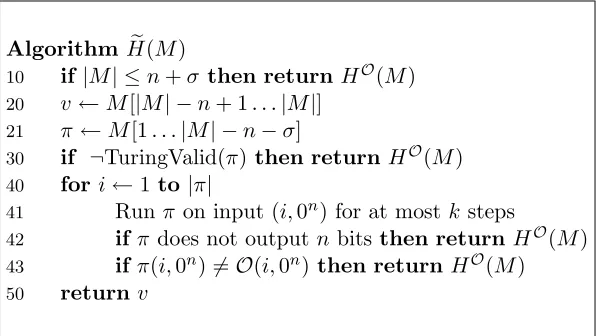
Algorithm He accepts messages M from the domain ({0,1}n)+ and outputs n bits. As
usual, the domain could be extended to M ∈ {0,1}∗ with an unambiguous padding rule. We fix two parameters to the algorithm: H, the provably-secure blockcipher-based hash function just mentioned, and a counter-size σ >0. We assume the domain of H has been extended to{0,1}∗so we can dispense with concerns about message sizes in our construction of He. We further fix some binary encoding scheme for Universal Turing Machines (UTMs) such that any UTM can be encoded into a binary string. Furthermore, we assume there is an efficient function TuringValid that returns truewhen given a string π that is a valid UTM encoding under our fixed convention. Finally, we letO denote the blockcipher-oracle which is used by He. The algorithm to computeHeO(M) is given in Figure 2.
We are now faced with arguing thatHe is uninstantiable. First notice thatHe is efficient: we assume that oracle calls are constant-time, so therefore HO
runs in time linear in the length of the input M. Since we run π for at most k steps, the whole algorithm runs in time O(k|π|) =O(|M|).
Algorithm He(M)
10 if|M| ≤n+σ then returnHO(M) 20 v←M[|M| −n+ 1. . .|M|]
21 π←M[1. . .|M| −n−σ]
30 if ¬TuringValid(π)then returnHO(M) 40 fori←1 to|π|
41 Runπ on input (i,0n) for at most k steps
42 ifπ does not output nbits then returnHO
(M)
43 ifπ(i,0n)6=O(i,0n) then returnHO(M)
50 returnv
Figure 2: An uninstantiable variant of the provably-secure blockcipher-based hash functionH. If the input encodes a valid UTM, we evaluate|π|values on this UTM and check against our oracleO. If they match, we simply output v, the lastnbits ofM. There are σ bits ofM which are ignored in order to help the attacker produce2σcolliding inputs with digestv. The UTMπis run for at mostksteps, where
k is a fixed parameter of the scheme.
Proof: There are two things we must prove: first, that He is secure in the ideal-cipher model. That is, Advcolle
HO(q) = O(q
2/2n). Second, that HeE is insecure for any efficient
blockcipher E.
We begin by showingHeO
is secure whenOis modeled by an ideal cipher. Fixqand suppose adversary Amakes q oracle queries to O. (Throughout the proof, we will assume q ≤2n/2
since q-values in excess of this render the bound vacuous.) At the end of this process, A
must output a pair of distinct messages M and M0
in the hope that HeO
(M) =HeO
(M0
). The probability that he succeeds is the advantage we wish to bound.
There are two types of collisions A may construct given the outputs from his q queries to O. The first collision is event C1: there exist two distinct messages M1, M2 such that
they collide under the original hash function (ie, H(M1) =H(M2)). We have selected H
such that Pr[C1] = O(q2/2n). The other type of collision A might construct given his q
oracle-query outputs results in event C2 which we describe next.
Extract π as in line 21, and observe thefor loop at lines 40 through 43. If at any time,π
does not outputnbits, or if the nbits it does output do not agree with O, we relegate the computation toH. Therefore we are concerned with the condition thatπcorrectly computes the|π|values required by the test on line 43. Ifπ(i,0n) =O(i,0n) for all 1≤i≤ |π|, we say
with length at most q bits. If C2 occurs, A will certainly have setv (computed at line 20)
to a colliding value, and so we therefore wish to bound Pr[C2].
Adversary A has made q queries to O and would like to now encode some qualifying pro-gram π into M, with |π| ≤ q. To this end, there are two possibilities: (1) A outputs a program π where C2 is guaranteed because he has queried O at all points from 1 to |π|
and there was a qualifying program, or (2)A outputs a programπ where there exists some point j with 1 ≤ j ≤ |π| that A did not query, yet C2 occurs by chance. In the second
case, He will askπ(j) and the probability over choices ofO thatπ(j,0n) =O(j,0n) is 1/2n. Therefore in this case Pr[C2]≤1/2n.
We therefore concern ourselves with the first case, where C2 occurs because Ahas queried
O(·,0n) at all points from 1 to|π|. The encoding scheme is of course fixed a priori. Therefore
Pr[C2] is computed over choices of O. Let Q` be the event that there exists a qualifying
program of size `. So C2 =Q1∨ · · · ∨Qq. For fixed `there are at most 2` possible
Turing-Valid encodings π with |π| =`. We evaluate, at line 43, O(i,0n) for 1 ≤i≤ |π|. Since we
are iterating on the key value for O, there is no permutivity, and therefore outputs will be uniform on {0,1}n. This means that, for a fixedi, the probability that π(i,0n) =O(i,0n) is 2−n
. The probability this will happen ` times is therefore 2−n`
, and given there are 2`
possible encodings, we see
Pr
O[Q`] ≤ 2
`/2n` = 1/2n.
So the chance of finding a qualifying program within q queries is
Pr
O[C2] = PrO[Q1∨ · · · ∨Qq] ≤ q X
`=1
1/2n = q 2n.
Finally, the chance that A can find any collision in q queries is bounded by Pr[C1∨C2] ≤
Pr[C1] + Pr[C2] =O(q2/2n) +q/2n=O(q2/2n), as required.
The second case is quite straightforward. We wish to show that HeE is insecure for any
efficient blockcipher E. Since E does have a concise Turing-Valid encoding π, we may simply write two messages
M =πk0σk0n and M0 =πk1σk0n.
Since the oracle to He is E, and since π agrees with E on every point, the if condition in line 43 will never hold and we will return v = 0n for each message. Thus we have
e
HE(M) =HeE(M0
Preimage, Second Preimage, and Multicollisions. Since the instantiated form ofHe
allows us full control over the output, we can clearly find 2σ preimages for any digest of our
choice, and we can similarly find 2σ−1 second preimages for any given value. Similarly, we can find multicollisions for any value, and 2σ collisions for each of the 2n possible outputs. In this sense, HeE is much worse than just failing to be collision resistant: it fails to have
any security properties at all.
On a technical note, the alert reader will notice that we at no time defined what “in-secure” means for a blockcipher-based hash function that has been instantiated. This is because all concrete hash functions are “insecure” if security requires the nonexistence of any efficient program that outputs a colliding pair of inputs! (Since collisions must exist for any non-injective mapf, there exists a program that simply outputs a colliding pair for any given f.) Nonetheless, there exists an intuitive notion of security for fixed functions like SHA-1, and clearly the instantiated version of hash function He is insecure in this sense.
Artificiality. Like all other uninstantiable schemes, He is quite artificial. It is uninstan-tiable only because it was designed to be, and upon inspection no one would use such a scheme. It remains to be seen whether there is a more natural construction (where “natu-ral” is necessarily subjective). Thus far, as in the random-oracle model analog, no scheme proven secure in the ideal-cipher model has been broken after instantiation, unless that was the goal from the start.
4
Conclusion and Open Questions
Although the scheme just presented is quite unnatural, it does arouse suspicion as to the wisdom of blindly using the ideal-cipher model in proofs of security. More evidence to support this suspicion could be provided by showing that Haes is insecure for a hash
scheme H from [3] that is provably-secure in the ideal-cipher model. Such an attack would necessarily exploit specific features of AES, but since AES is generally thought to be well-designed, it would add fuel to the fire.
References
[1] Bellare, M., Boldyreva, A., and Palacio, A. An uninstantiable random-oracle-model scheme for a hybrid-encryption problem. In Advances in Cryptology – EURO-CRYPT ’04 (2004), vol. 3027 ofLecture Notes in Computer Science, Springer-Verlag, pp. 171–188.
[2] Bellare, M., and Rogaway, P. Random oracles are practical: A paradigm for designing efficient protocols. InProceedings of the 1st ACM Conference on Computer and Communications Security (1993), pp. 62–73.
[3] Black, J., Rogaway, P., and Shrimpton, T. Black-box analysis of the block-cipher-based hash-function constructions from PGV. In Advances in Cryptology – CRYPTO ’02 (2002), vol. 2442 ofLecture Notes in Computer Science, Springer-Verlag.
[4] Boneh, D. The decision Diffie-Hellman problem. In Proceedings of the Third Algo-rithmic Number Theory Symposium (1998), vol. 1423 of Lecture Notes in Computer Science, Springer-Verlag, pp. 48–63.
[5] Canetti, R., Goldreich, O., and Halevi, S. The random oracle methodology, revisited. In Proceedings of the 30th ACM Symposium on the Theory of Computing (1998), ACM Press, pp. 209–218.
[6] Canetti, R., Goldreich, O., and Halevi, S. On the random-oracle methodology as applied to length-restricted signature schemes. In First Theory of Cryptography Conference (2004), vol. 2951 of Lecture Notes in Computer Science, Springer-Verlag, pp. 40–57.
[7] Cramer, R., and Shoup, V. A practical public key cryptosystem provably secure against adaptive chosen ciphertext attack. InAdvances in Cryptology – CRYPTO ’93 (1998), Lecture Notes in Computer Science, Springer-Verlag, pp. 13–25.
[8] Desai, A. The security of all-or-nothing encryption: Protecting against exhaustive key search. In Advances in Cryptology – CRYPTO ’00 (2000), vol. 1880 of Lecture Notes in Computer Science, Springer-Verlag.
[9] Even, S., and Mansour, Y. A construction of a cipher from a single pseudorandom permutation. InAdvances in Cryptology – ASIACRYPT ’91 (1992), vol. 739 ofLecture Notes in Computer Science, Springer-Verlag, pp. 210–224.
[11] Jaulmes, E., Joux, A., and Valette, F. On the security of randomized CBC-MAC beyond the birthday paradox limit: A new construction. In Fast Software Encryption (FSE 2002) (2002), vol. 2365 of Lecture Notes in Computer Science, Springer-Verlag, pp. 237–251.
[12] Kilian, J., and Rogaway, P. How to protect DES against exhaustive key search (An analysis of DESX). Journal of Cryptology 14, 1 (2001), 17–35.
[13] Matyas, S., Meyer, C., and Oseas, J. Generating strong one-way functions with cryptographic algorithms. IBM Technical Disclosure Bulletin 27, 10a (1985), 5658– 5659.
[14] Maurer, U. M., Renner, R., and Holenstein, C.Indifferentiability, impossibility results on reductions, and applications to the random oracle methodology. In First Theory of Cryptography Conference (2004), vol. 2951 of Lecture Notes in Computer Science, Springer-Verlag, pp. 21–39.
[15] Menezes, A., van Oorschot, P., and Vanstone, S. Handbook of Applied Cryp-tography. CRC Press, 1996.
[16] Merkle, R. One way hash functions and DES. In Advances in Cryptology – CRYPTO ’89 (1990), G. Brassard, Ed., vol. 435 ofLecture Notes in Computer Science, Springer-Verlag.
[17] Micali, S. CS-proofs. In Proceedings of IEEE Foundations of Computing (1994), pp. 436–453.
[18] Nielsen, J. B.Separating random oracle proofs from complexity theoretic proofs: The non-committing encryption case. In Advances in Cryptology – CRYPTO ’02 (2002), vol. 2442 of Lecture Notes in Computer Science, Springer-Verlag, pp. 111–126.
[19] NIST. Secure hash standard (FIPS 180-1). 1995.
[20] Pointcheval, D., and Stern, J. Security proofs for signature schemes. In Ad-vances in Cryptology – EUROCRYPT ’96 (1996), Lecture Notes in Computer Science, Springer-Verlag, pp. 387–398.
[21] Preneel, B., Govaerts, R., and Vandewalle, J. Hash functions based on block ciphers: A synthetic approach. In Advances in Cryptology – CRYPTO ’93 (1994), Lecture Notes in Computer Science, Springer-Verlag, pp. 368–378.
[23] Schnorr, C.-P. Efficient signature generation by smart cards. Journal of Cryptology 4, 3 (1991), 161–174.
[24] Shannon, C. Communication theory of secrecy systems. Bell Systems Technical Journal 28, 4 (1949), 656–715.
[25] Simon, D. Finding collsions on a one-way street: Can secure hash functions be based on general assumptions? In Advances in Cryptology – EUROCRYPT ’98 (1998), Lecture Notes in Computer Science, Springer-Verlag, pp. 334–345.
![Figure 1: The Matyas-Meyer-Oseas (MMO) compression function [13], calledcompression function results in a provably-secure blockcipher-based hash function in the ideal-cipher{ H1 in [3]](https://thumb-us.123doks.com/thumbv2/123dok_us/1846833.1239582/5.612.242.429.124.189/matyas-compression-function-calledcompression-function-provably-blockcipher-function.webp)