18th International Conference on Structural Mechanics in Reactor Technology (SMiRT 18) Beijing, China, August 7-12, 2005 SMiRT18-O04-5
4169 Copyright © 2005 by SMiRT18
THE PROBLEM OF MAINTENANCE OF STRENGTH, LIFETIME
AND SAFETY OF THE STRUCTURAL COMPONENTS
OPERATIONAL NPP FROM ITEMS OF A SYSTEM APPROACH
А
.F. German*
The professor, doctor of engineering science,
The executive director of Coordination centre on reliability, safety and lifetime of the
structural components of atomic stations (
К
CN BRAS)
The strength of the structural components NPP determines largely their lifetime, radiation and nuclear safety.
As shows world experience of operation NPP, in a series of cases during operation the local damages, gaps and destructions of elements of the structural components and pipelines emerge. These cases force maintaining organizations to execute on NPP large volumes of the inspections, repair and modernizing of the structural components.
These activities require large material inputs (order 50 % of the cost of operation NPP), however not always are effective and in a series of cases do not allow to reach required reliability and safety level of the structural components on a comparison with the normative requirements..
Really, according to the normative documents in Russia, USA, France and other countries in operation can not be arise a crack. It is provided with a lot of measures, including calculations on resistance to a fatigue on a criterion of origin of a crack. At calculation on resistance to a fatigue use margin coefficient from 10 up to 20 on number of a cycles. But actually cracks and other defects of metal during operation find out on the structural components all NPP of the world!
On figure 1 the generalized data about reliability of structural components NPP are submitted according to the requirements of the normative documents and actual results of operation. As it is visible, the actual reliability essentially differs from normative
One from the main reasons of such discordance is that the measures which are carried out on the NPP, developed during long time and under influence of the diverse factors, that has resulted in absence of a unified scientific methodology of the analysis of a problem of strength, lifetime and safety of the structural components NPP, to decrease of their reliability.
In the present report some results outcomes on creation of a unified methodology of maintenance of lifetime and reliability of the structural components NPP, and also outcomes it of application for maintenance of the integrity of SG tube.
The developed unified methodology is based on a system approach. The system approach allows most completely to consider a problem and to find ways of its fastest and optimum solution. Central concept of a system approach is the concept of a system.
The basic principles, position and methods of a system approach with reference to a problem of maintenance of strength, lifetime, reliability and safety of the structural components NPP are determined in the normative document [1].
_________
4170 Copyright © 2005 by SMiRT18 Some outcomes of application of a system approach for the solution of a problem of maintenance of SG tub integrity of the WWER-1000 and WWER-440 are adduced below.
The set of methodical and practical outcomes is called in the report as the system concept of maintenance of SG tube integrity. These outcomes are a particular case of practical realization of the system concept of maintenance of strength, lifetime reliability and safety, which is more generally submitted in the document [1].
The problem of maintenance of SG integrity has arisen on western NPP more than 20 years back, and in last 10 years was acquired by for in operation NPP of Russian production.
By consideration of a problem of maintenance of SG integrity with application of the system concept the following main problems were solved:
1. The reasons of origin of tube damage during operation are determined Time of operation.
2. The object function of f during operation tube integrity maintenance system is determined in view of opportunities of modern means and technologies.
3. The analysis existing on NPP of technologies and methods of maintenance of tube integrity, first of all stipulated by the SG operation instructions, is executed; the evaluation of effectiveness of these measures is conducted and by results of executed activities the structure of the tube integrity maintenance system is developed.
4. The adaptation of separate elements of a system of maintenance of the tube integrity up to a condition necessary for performance by system of the object function is carried out.
The system concept of maintenance of the tube integrity was realized on unit №2 Balacovo NPP and on units № 3, 4 Novovoronesh NPP and on series units of Ukraine NPP. In all cases the operation SG tubes of the units after application of the recommendations, developed within the framework of the system concept, passed successfully, without off-schedule and leaking from first in the second outline.
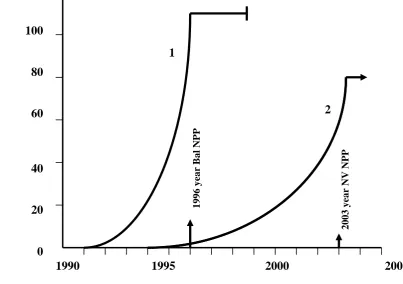
On Figure 2 the change of quantity of nondense tubes on unit №2 Balacovo NPP and unit №3 Novovoronesh NPP before application of the system concept and ambassador is shown. The course of curves on Figure 2 reflects that fact, that after realization of all measures stipulated by the system concept, quantity of nondense tubes on considered interval of time remains practically constant.
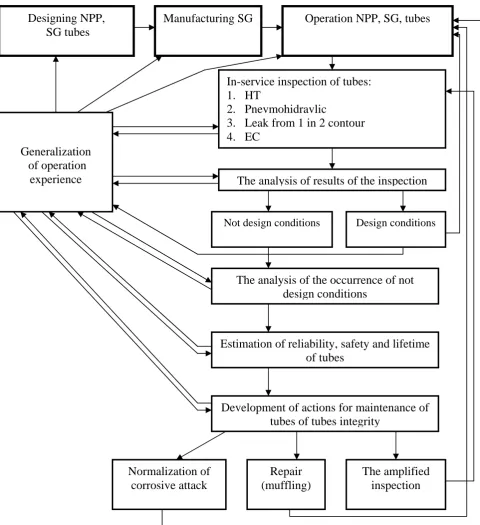
On Figure 3 the tube integrity of maintenance system during operation NPP is shown.
Features of operation of the indicated system on an example unit № 2 Balacovo NPP are shown below. The detailed description of condition tubes of this unit is given in work [2].
The major condition of successful performance of activities was the correct and unequivocal definition of the reasons of tubes damages in operation and renovation of process of tubes damage on unit №2 Bal NPP.
During executed by a method retrospective of network modeling of the analysis of the reasons of damage was shown, that leading and major factor of damage is the corrosion factor (in conditions units 2 Bal NPP it beginnings to act the ambassador ~ 5 years of operation payload without cleaning tubes), and such factors, as quality of metal increased vibrating and/or thermal stresses (and also number) of other hypothesizes, expressed by the experts, of damage) can not be considered at development of measures for maintenance of tubes integrity.
The analysis of effectiveness of the in-service inspection eddy current (EC) by a method has shown its insufficient probability of detection, (that is confirmed also by data PISC-3). EC probability of detection evaluated on the specially developed technique [3] with use of curve probability of detection of defects in tubes depending on depth of a defect.
The evaluation of EC probability of detection executed in 1996 and in 1998 on unit № 2 Bal NPP has allowed to define initial (till 1996) number damaged tubes, and also number defective tubes, stayed in SG after the control and damping revealed defective tubes because of an imperfection EC. These evaluations were executed on techniques [4, 5].
The outcomes of definition of EC POD, initial number defective tubes and numbers defective THAT after damping defective tubes with a criterion 70 % (1996) and 75 % (1998) are submitted on Figures 4 and 5, accordingly. It is necessary to mark, that during research of EC POD the essential influence to it chemical cleaning tubes and hydro tests was revealed. So the probability of detection of a defect in tubes, depth 100 % from a thickness of a wall (open defect), has made up to cleaning and HT - 0,39, and ambassador cleaning and HT - 0,78.
Significant number passed defective tubes, including containing open defects, because of an imperfection EC, has required development of additional ways of detection defective tubes.
4171 Copyright © 2005 by SMiRT18 For detection of the most dangerous defects bringing to a sudden break and/or to increase a leaks from tubes, it was offered according to [6] to carry out hydro tests by maximum allowed pressure of the first outline of absence pressure on the second outline of SG. All defects of the critical size in a mode such HT (if they are present) are broken of (sharply increase the sizes with formation of the large expiration of environment of the first outline). Thus for stayed tubes forms a reserve of safety on a criterion of a large leak (that is after such HT and damping of tubes with a leak there are no tubes, have defects with the sizes equal or large critical defects a mode HT and the more so in an operation mode).
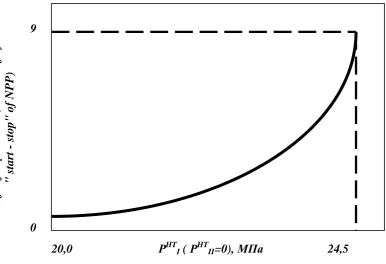
As have shown calculations with use of a normative technique М-02-91 [7], подрост of a defect from the sizes, critical in a mode HT, up to critical in a mode of normal operation + emergency with a gap steam pipeline will happen for 9 cycles "of start up - stop" reactor (with a factor of a reserve 10). Therefore, HT creates a reserve of safety, which validity is determined by size of HT pressure (figures 6, .7).
The analysis has shown (figure 4), that within the framework of a system approach it was possible to increase reliability of a pneumahydraulic method of the inspection tubes approximately from 50 % up to 100 % (for open defects with a leak, greater ~ 0,5 l/hours).
The circumscribed above analysis existing on NPP of technologies and methods of tubes integrity, their adaptation with allowance for object functions of a system of maintenance of tubes integrity has allowed providing reliable and safe operation NPP in Russia and on Ukraine with the previously damaged CG tubes.
By results of activities the normative document [8] is developed.
REFERENCES
1. Normative document SС-1-2005 «The system concept of maintenance of strength, lifetime, reliability and safety of the components and pipelines NPP ", КCN BRAS, М., 2004.
2. Getman А.F. Lifetime of the components and pipelines of operational NPP, М, Energoatomisdat, 2000.
3. The invention № 2003 105209/28 (005588) "A way of definition of reliability of the NDE of defects determining workmanship, reliability and safety of components" (Authors: Mahutov N.А., Тutnov A.A., Getman A.F., Lovchev V.N., Gutsev D.F., Dragunov J/G., Zubchenco A.S., Grigor’ev M.V., Prosvirin A.V., Kaliberda I.V.).
4. The invention № 2003 109692/28 (010527) "A way of definition of probability of detection of defects, initial and residual defectiveness of component with use of outcomes of the NDE" (Authors till item 3).
5. The invention 2004 105008 "A way of definition of residual defectiveness of component after two and more NDE" (Authors till item 3).
6. The invention № 2003 105210/28 (005589) "A way hydraulic tests of pressure vessels and pipelines ensuring full reliability and safety of their operation» (Authors till item 3).
7. М-02-91. A technique of definition allowed defects in metal of the components and pipelines during operation NPP.
8. Normative document RD ЭО-0552-2004 "The methodical recommendations for application of a system methodology of maintenance of SG tubes integrity on operational NPP with WWER-1000 and WWER-440 ",
4172 Copyright © 2005 by SMiRT18
1
10
-110
-210
-310
-410
-510
-60
Probability
Normative at realization of the actually
documents document [2]
-
destruction
-
the leak
-
the defect of metal
4173 Copyright © 2005 by SMiRT18
100
80
60
40
20
0
1990 1995 2000 2005
Number of tubes with through wall defec
ts
Calendar Time
1
2
Figure 2. Speed of increase of number of defective tubes
before application of system methodology and after it. Calendar time
of operation. Number of tubes with through wall defects.
19
9
6
year
B
a
l NPP
20
0
3
year
N
V
4174 Copyright © 2005 by SMiRT18
Designing NPP,
SG tubes
Manufacturing SG
Operation NPP, SG, tubes
In-service inspection of tubes:
1.
HT
2.
Pnevmohidravlic
3.
Leak from 1 in 2 contour
4.
EC
The analysis of results of the inspection
Not design conditions
Design conditions
The analysis of the occurrence of not
design conditions
Estimation of reliability, safety and lifetime
of tubes
Development of actions for maintenance of
tubes of tubes integrity
Normalization of
corrosive attack
Repair
(muffling)
The amplified
inspection
Generalization
of operation
experience
4175 Copyright © 2005 by SMiRT18
20 40 60 80 100
1,0
0,8
0,6
0,4
0,2
Probability of defec
tion
Dept of defects, %
4
1
3
2
Figure 4. Reliability in-service inspection on the unit
№
2
Balakovo NPP
1 - EC in 1996 (before application of system methodology);
2 - pneumatichydraulic quality monitoring (before application of system
methodology);
3 - EC in 1998 (after application of system methodology);
4 - a pneumatichydraulic quality monitoring (after application of system
methodology)
4176 Copyright © 2005 by SMiRT18
40 60 80 a/S, 100%
N
ИСХ;N
ОСТ160
120
80
40
0
Figure 5. Number of defective tubes on a SG:
1 - up to the control;
2 - after muffling by results of EC the control in 1996;
3 - after muffling by results of the control in 1998.
1
2
4177 Copyright © 2005 by SMiRT18