and Public Health
Article
Estimated Maternal Pesticide Exposure from
Drinking Water and Heart Defects in Offspring
Jihye Kim1, Michael D. Swartz2, Peter H. Langlois3, Paul A. Romitti4, Peter Weyer5, Laura E. Mitchell1, Thomas J. Luben6 ID, Anushuya Ramakrishnan7, Sadia Malik8, Philip J. Lupo9, Marcia L. Feldkamp10, Robert E. Meyer11, Jennifer J. Winston12,
Jennita Reefhuis13, Sarah J. Blossom14, Erin Bell15, A. J. Agopian1,* and the National Birth Defects Prevention Study
1 Department of Epidemiology, Human Genetics and Environmental Sciences,
University of Texas School of Public Health, Houston, TX 77030, USA; [email protected] (J.K.); [email protected] (L.E.M.)
2 Department of Biostatistics, University of Texas School of Public Health, Houston, TX 77030, USA; [email protected]
3 Birth Defects Epidemiology and Surveillance Branch, Texas Department of State Health Services, Austin, TX 78714, USA; [email protected]
4 Department of Epidemiology, College of Public Health, University of Iowa, Iowa City, IA 52242, USA; [email protected]
5 Center for Health Effects of Environmental Contamination, University of Iowa, Iowa City, IA 52242, USA; [email protected]
6 National Center for Environmental Assessment, United States Environmental Protection Agency, Research Triangle Park, NC 27711, USA; [email protected]
7 Community Epidemiology and Health Planning Unit, Cook County Department of Public Health, Oak Forest Health Center, Oak Forest, IL 60452, USA; [email protected]
8 Department of Pediatrics, University of Texas, Southwestern, Dallas, TX 75390, USA; [email protected]
9 Department of Pediatrics, Baylor College of Medicine, Houston, TX 77030, USA; [email protected] 10 Division of Medical Genetics, Department of Pediatrics, University of Utah School of Medicine,
Salt Lake City, UT 84108, USA; [email protected]
11 Division of Public Health, Birth Defects Monitoring Program, State Center for Health Statistics, Raleigh, NC 27699, USA; [email protected]
12 Department of Obstetrics and Gynecology, University of North Carolina, Chapel Hill, NC 27599, USA; [email protected]
13 National Center on Birth Defects and Developmental Disabilities, CDC, Atlanta, GA 30329, USA; [email protected]
14 Department of Pediatrics, University of Arkansas for Medical Sciences, Arkansas Children’s Hospital Research Institute, Little Rock, AR 72202, USA; [email protected]
15 Department of Environmental Health Sciences, University at Albany School of Public Health, Albany, NY 12144, USA; [email protected]
* Correspondence: [email protected]; Tel.: +1-713-500-9815
Received: 22 June 2017; Accepted: 3 August 2017; Published: 8 August 2017
Abstract: Our objective was to examine the relationship between estimated maternal exposure to pesticides in public drinking water and the risk of congenital heart defects (CHD). We used mixed-effects logistic regression to analyze data from 18,291 nonsyndromic cases with heart defects from the Texas Birth Defects Registry and 4414 randomly-selected controls delivered in Texas from 1999 through 2005. Water district-level pesticide exposure was estimated by linking each maternal residential address to the corresponding public water supply district’s measured atrazine levels. We repeated analyses among independent subjects from the National Birth Defects Prevention Study (NBDPS) (1620 nonsyndromic cases with heart defects and 1335 controls delivered from 1999 through 2005). No positive associations were observed between high versus low atrazine level and
eight CHD subtypes or all included heart defects combined. These findings should be interpreted with caution, in light of potential misclassification and relatively large proportions of subjects with missing atrazine data. Thus, more consistent and complete monitoring and reporting of drinking water contaminants will aid in better understanding the relationships between pesticide water contaminants and birth defects.
Keywords:pesticide; congenital heart defect; public drinking water; Texas; birth defects
1. Introduction
Congenital heart defects (CHDs) are among the most common congenital malformations, occurring in nearly 1% of live births [1]. CHDs account for approximately one-third of birth defects and are a leading cause of infant mortality due to birth defects [2,3]. The etiology of CHDs is poorly understood in the majority of nonsyndromic CHD cases (i.e., those that do not occur due to a recognized genetic syndrome). The prevalence of these defects varies by subtype of CHD [4], geography [5], and season of conception [6,7], which may suggest the involvement of environmental risk factors, such as pesticides, that also vary by geography and season.
In animal studies, some pesticides (e.g., organo-phosphorous pesticides, glyphosate) have been shown to have reproductive toxicity and teratogenic effects [8,9]. Observational studies in humans have reported associations between CHDs in offspring and parental occupational pesticide exposure [10], as well as residential proximity to agricultural areas where pesticides are applied [11–13]. Similar associations have been observed with other birth defects [14–17].
Water contamination may be an important source of human pesticide exposure, and higher versus lower maternal residential tap water consumption has been associated with CHDs in offspring [18]. The pesticide atrazine is of particular interest because it is one of the most widely applied agricultural pesticides in the U.S. [19], is present at substantial levels in ground water supplies (e.g.,≥0.003 mg/L, the U.S. Environmental Protection Agency (EPA) drinking water standard) [20,21], and is suspected to have adverse reproductive effects [21]. However, to our knowledge, no published study has evaluated atrazine or other pesticides in drinking water and CHD risk. In fact, we are aware of only three studies that have assessed associations between pesticides in water and any birth defect [22–24]. To address this gap, we examined the association between estimated maternal atrazine exposure via residential water district data from the EPA and risk for CHDs in offspring, using two independent data sources, the Texas Birth Defects Registry, and the National Birth Defects Prevention Study.
2. Materials and Methods
2.1. Texas Birth Defects Registry
from the Institutional Review Boards of the University of Texas Health Science Center at Houston and the Texas Department of State Health Services.
In this study, cases were defined as subjects with any structural CHD (BPA codes: 745.000–745.490, 745.510–745.900, 746.000–746.995, 747.100–747.320, 747.330–747.490) delivered from 1 January 1999 through 31 December 2008. We excluded births that only had a patent ductus arteriosus, patent foramen ovale, anomaly of umbilical artery, peripheral vascular system defect, pulmonary artery branch stenosis, or circulatory system anomaly. We further limited our analyses to those cases with documented diagnoses after delivery and no chromosome abnormality/syndrome. A total of 10,000 controls were randomly selected among all live born infants without known major malformations (i.e., not present in the Registry) delivered in Texas during the same study period. Subjects without a geocoded maternal address at delivery were excluded. Data on demographic and reproductive characteristics (i.e., potential confounders) were obtained from vital records. For the main analyses, cases and controls were restricted to subjects who were delivered from 1 January 1999 through 31 December 2005 (i.e., years with atrazine measurements, described below).
2.2. Water District Assignment
Our overall exposure assessment was based on linking each residential maternal address to the corresponding water supply district and estimating atrazine exposure based on measured levels for the district, as described below. The maternal address at delivery, as listed on vital records, was used as a proxy for address at conception. Only one address was reported for each mother. We obtained a map of geocoded boundaries for all public water systems in Texas from the Texas Water Development Board [27]. Each maternal address was converted to geocoded coordinates and these coordinates were overlaid with the water system map to identify the corresponding water district for each address.
2.3. Exposure Assessment
We obtained data on atrazine measurements from each water district’s routine monitoring during 1998–2005 from the Environmental Protection Agency (EPA) (https://www.epa.gov/ dwsixyearreview/six-year-review-2-contaminant-occurrence-data-1998-2005) [28]. The EPA requires quarterly monitoring except under certain conditions when it allows reduced monitoring. If a water system meets certain criteria, EPA grants waivers from the regular monitoring (40 CFR Part 141.24) [29]. If the measurements are consistently below the detectable assay limit, EPA guidelines allow for less frequent testing [30]. Measurements at or below the limit of detection for the assay were coded as 0µg/L for our main analysis, based on an approach proposed by Rinsky et al. [30]. Sensitivity analyses were also conducted, coding such measurements as the minimum detectable value for the assay instead. In our study, each subject was linked to atrazine measurements by matching residential addresses and public water districts. Because many districts did not have atrazine measurements at frequent and regular intervals (and in some instances measurements were not available during the period of the pregnancy, see Results), we used the mean of atrazine levels during the entire monitoring period (1999–2005) for each subject’s district. Based on the distributions in controls, mean atrazine values were categorized as “low” (<the 85th percentile) or “high” (≥the 85th percentile). For secondary analyses, the median atrazine levels were also categorized, using the same percentiles.
2.4. Statistical Analysis
We evaluated the association between high mean atrazine level and each of the eight CHD subtypes (e.g., conotruncal heart defects), as well as the combined group of any CHD (i.e., to assess the impact of missing atrazine measurements within population subgroups, see below and Results). To account for the correlation (i.e., clustering) between atrazine exposure and geographic location resulting from the use of a water district-level exposure assessment, mixed-effects (random-effects) models for logistic regression were used to investigate the association between maternal atrazine exposure and the risk of CHDs in offspring. Thus, we modeled subjects’ public water district as a random effect. We estimated crude and adjusted ORs and 95% CIs, using the lowest atrazine exposure category as the reference group. All models were adjusted for literature-based, a priori potential confounders that could be associated with atrazine and congenital heart defects: delivery year, maternal age at delivery (<20, 20–24, 25–29, 30–34, 35–39, and≥40 years), race/ethnicity (non-Hispanic White, non-Hispanic Black, Hispanic, and other), education (less than high school, high school, and greater than high school), birth place (U.S. or outside of the U.S.), smoking (yes or no), and previous live birth (yes or no). In a secondary model, we adjusted for the population size served by the subject’s water district (<5000, 5000–200,000, and >200,000) and urban/rural status (metropolitan, non-metropolitan but urban, and less urbanized) because of large differences in the proportion of subjects missing atrazine data between categories of these variables. For all of our analyses, we did not conduct comparisons for CHD subgroups in which fewer than 50 water districts were represented among cases, due to concerns regarding model validity and convergence in mixed models with group-level sparseness [31,32].
To limit the potential for selection bias related to the exclusion of subjects without atrazine exposure data, we repeated our analysis of any CHD among subjects who lived in districts that served >200,000 people, because these larger districts had few subjects missing atrazine exposure. (Analyses of specific CHDs were not performed under this secondary model due to small numbers in some groups.) This analysis was repeated using the median atrazine level instead of the mean. To assess the extent of selection bias related to missing atrazine, we repeated the main analysis of any CHD with a 3-level exposure variable (i.e., low/high/missing). Additionally, we performed two sensitivity analyses for the analysis of any CHD: (1) excluding subjects from region 11 (south Texas), where over-ascertainment of CHDs is suspected [5,33], and (2) expanding to include subjects delivered from 1999–2008 (i.e., to improve power and analyze more recent years). All analyses were performed using SAS version 9.3 (SAS Institute, Cary, NC, USA).
2.5. National Birth Defects Prevention Study
We used the National Birth Defects Prevention Study (NBDPS) as an independent sample to further evaluate the relationship between atrazine and CHDs. These analyses were approved by the institutional review boards (IRBs) of each NBDPS site, the Centers for Disease Control and Prevention, and the University of Texas Health Science Center at Houston.
The NBDPS is a large population-based case-control study of major birth defects in ten U.S. states. The details of subject selection and data collection methods have been reported previously [34]. Briefly, a detailed computer-assisted telephone interview, which included questions about maternal exposures before and during pregnancy, was conducted among mothers of infants with and without birth defects. For the present study, potential cases included babies with any CHD ascertained by the NBDPS [35], among live births, stillbirths, and elective terminations. All cases had confirmation by echocardiography, cardiac catheterization, surgery, or autopsy [36]. Cases with chromosome abnormalities or syndromes were not included in the NBDPS. Controls were live-born infants without any major birth defect, randomly selected from vital records or hospital discharge information, in the same areas and in the same study periods from which cases were selected.
from Arkansas (statewide), Iowa (statewide), North Carolina (northern Piedmont region counties, deliveries starting in 2003), and Utah (statewide, deliveries starting in 2003) of the NBDPS. Subjects from several other sites were excluded due to a high proportion of subjects residing in water districts, for which atrazine data were not available from the EPA. Subjects in the NBDPS from Texas were excluded to avoid overlap with subjects in the Texas analyses.
Atrazine exposure was assessed based on the linkage of maternal address at conception to the water supply district and the reported atrazine levels for each district from the EPA. If multiple addresses were reported during the month before conception through the third month of pregnancy, we used the first (i.e., earliest) address. The public water supply districts for mothers were identified by overlaying addresses with digitized service area maps for public water supplies obtained from local state agencies or municipal water utilities for each state [37]. If use of the digitized maps failed to identify a subject’s district, the district was assigned based on census place boundaries or, in rare instances, using interactive searching methods [37].
Using the same methods as in our Texas analyses, we repeated our main analyses using NBDPS data. Because the NBDPS had some CHD subtypes with small numbers and had relatively lower mean atrazine levels compared to Texas (90th percentile in controls: 0.41µg/L in Texas versus 0.08µg/L in NBDPS), atrazine values were categorized using different cut-offs for NBDPS to make the distribution more comparable to Texas categories: “low” (<the 95th percentile) and “high” (≥the 95th percentile). We adjusted for the same potential confounders as in the Texas analyses, except for rural/urban status, which was not available in the NBDPS. We also included an additional secondary regression model, adjusting for two variables that were not available for Texas subjects: household income (<$10,000, $10,000–50,000, and >$50,000) and supplemental folic acid intake (yes or no). For comparison to the secondary analyses among Texas subjects, we also repeated any CHD analyses among subjects in water districts serving a population size >25,000. (Analyses among districts serving >200,000 people or for specific CHD subtypes among districts serving >25,000 people could not be performed due to small numbers.) We also repeated analyses for any CHD among subjects in water districts serving >25,000 people using the median atrazine level (≤50th percentile versus >50th percentile).
3. Results
3.1. Texas Birth Defects Registry
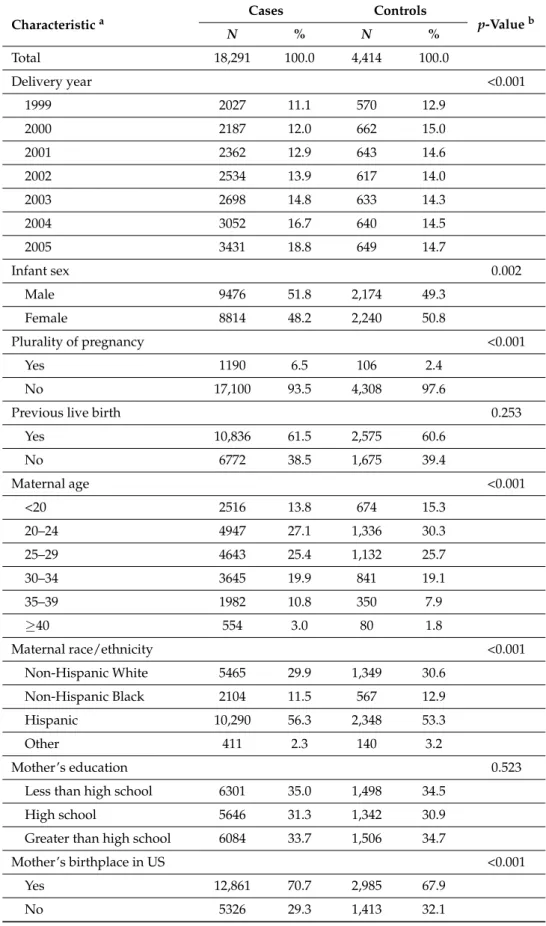
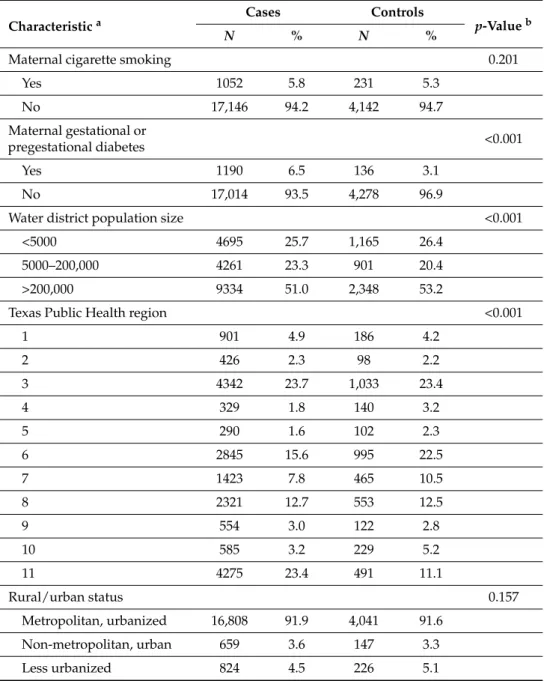
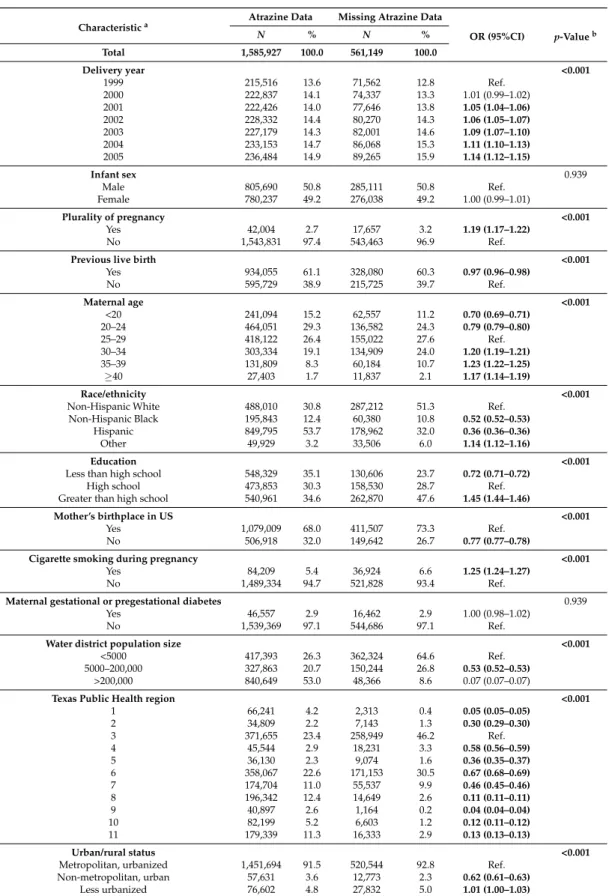
There were 43,512 infants with non-syndromic CHDs in Texas during 1999–2008. We randomly selected 10,000 controls among live-born infants statewide during this period. Out of 53,512 total subjects, 5889 (11.0% of cases and 11.1% of controls) did not fall within a public water system boundary (i.e., those with private wells) and were excluded. We also excluded 11,995 subjects (22.1% cases and 24.0% controls) who resided in water districts without any recorded atrazine levels during the monitoring period (1999–2005). Characteristics of these subjects were assessed (see below). Our main analyses were restricted to deliveries during 1999–2005 (i.e., years with atrazine measurements), resulting in 22,705 included subjects (18,291 cases and 4414 controls). (An additional 12,923 subjects delivered during 2006–2008 were included in a sensitivity analyses, described below.)
Table 1.Descriptive characteristics of cases and controls with available atrazine data, Texas, 1999–2005.
Characteristica
Cases Controls
p-Valueb
N % N %
Total 18,291 100.0 4,414 100.0
Delivery year <0.001
1999 2027 11.1 570 12.9
2000 2187 12.0 662 15.0
2001 2362 12.9 643 14.6
2002 2534 13.9 617 14.0
2003 2698 14.8 633 14.3
2004 3052 16.7 640 14.5
2005 3431 18.8 649 14.7
Infant sex 0.002
Male 9476 51.8 2,174 49.3
Female 8814 48.2 2,240 50.8
Plurality of pregnancy <0.001
Yes 1190 6.5 106 2.4
No 17,100 93.5 4,308 97.6
Previous live birth 0.253
Yes 10,836 61.5 2,575 60.6
No 6772 38.5 1,675 39.4
Maternal age <0.001
<20 2516 13.8 674 15.3
20–24 4947 27.1 1,336 30.3
25–29 4643 25.4 1,132 25.7
30–34 3645 19.9 841 19.1
35–39 1982 10.8 350 7.9
≥40 554 3.0 80 1.8
Maternal race/ethnicity <0.001
Non-Hispanic White 5465 29.9 1,349 30.6
Non-Hispanic Black 2104 11.5 567 12.9
Hispanic 10,290 56.3 2,348 53.3
Other 411 2.3 140 3.2
Mother’s education 0.523
Less than high school 6301 35.0 1,498 34.5
High school 5646 31.3 1,342 30.9
Greater than high school 6084 33.7 1,506 34.7
Mother’s birthplace in US <0.001
Yes 12,861 70.7 2,985 67.9
Table 1.Cont.
Characteristica
Cases Controls
p-Valueb
N % N %
Maternal cigarette smoking 0.201
Yes 1052 5.8 231 5.3
No 17,146 94.2 4,142 94.7
Maternal gestational or
pregestational diabetes <0.001
Yes 1190 6.5 136 3.1
No 17,014 93.5 4,278 96.9
Water district population size <0.001
<5000 4695 25.7 1,165 26.4
5000–200,000 4261 23.3 901 20.4
>200,000 9334 51.0 2,348 53.2
Texas Public Health region <0.001
1 901 4.9 186 4.2
2 426 2.3 98 2.2
3 4342 23.7 1,033 23.4
4 329 1.8 140 3.2
5 290 1.6 102 2.3
6 2845 15.6 995 22.5
7 1423 7.8 465 10.5
8 2321 12.7 553 12.5
9 554 3.0 122 2.8
10 585 3.2 229 5.2
11 4275 23.4 491 11.1
Rural/urban status 0.157
Metropolitan, urbanized 16,808 91.9 4,041 91.6
Non-metropolitan, urban 659 3.6 147 3.3
Less urbanized 824 4.5 226 5.1
aSome characteristic counts do not sum to the totals due to missing data;bestimated using chi-square test.
Table 2. Descriptive characteristics of potential controls with and without atrazine data in Texas, 1999–2005.
Characteristica Atrazine Data Missing Atrazine Data
OR (95%CI) p-Valueb
N % N %
Total 1,585,927 100.0 561,149 100.0
Delivery year <0.001
1999 215,516 13.6 71,562 12.8 Ref.
2000 222,837 14.1 74,337 13.3 1.01 (0.99–1.02)
2001 222,426 14.0 77,646 13.8 1.05 (1.04–1.06)
2002 228,332 14.4 80,270 14.3 1.06 (1.05–1.07)
2003 227,179 14.3 82,001 14.6 1.09 (1.07–1.10)
2004 233,153 14.7 86,068 15.3 1.11 (1.10–1.13)
2005 236,484 14.9 89,265 15.9 1.14 (1.12–1.15)
Infant sex 0.939
Male 805,690 50.8 285,111 50.8 Ref.
Female 780,237 49.2 276,038 49.2 1.00 (0.99–1.01)
Plurality of pregnancy <0.001
Yes 42,004 2.7 17,657 3.2 1.19 (1.17–1.22)
No 1,543,831 97.4 543,463 96.9 Ref.
Previous live birth <0.001
Yes 934,055 61.1 328,080 60.3 0.97 (0.96–0.98)
No 595,729 38.9 215,725 39.7 Ref.
Maternal age <0.001
<20 241,094 15.2 62,557 11.2 0.70 (0.69–0.71)
20–24 464,051 29.3 136,582 24.3 0.79 (0.79–0.80)
25–29 418,122 26.4 155,022 27.6 Ref.
30–34 303,334 19.1 134,909 24.0 1.20 (1.19–1.21)
35–39 131,809 8.3 60,184 10.7 1.23 (1.22–1.25)
≥40 27,403 1.7 11,837 2.1 1.17 (1.14–1.19)
Race/ethnicity <0.001
Non-Hispanic White 488,010 30.8 287,212 51.3 Ref.
Non-Hispanic Black 195,843 12.4 60,380 10.8 0.52 (0.52–0.53)
Hispanic 849,795 53.7 178,962 32.0 0.36 (0.36–0.36)
Other 49,929 3.2 33,506 6.0 1.14 (1.12–1.16)
Education <0.001
Less than high school 548,329 35.1 130,606 23.7 0.72 (0.71–0.72)
High school 473,853 30.3 158,530 28.7 Ref.
Greater than high school 540,961 34.6 262,870 47.6 1.45 (1.44–1.46)
Mother’s birthplace in US <0.001
Yes 1,079,009 68.0 411,507 73.3 Ref.
No 506,918 32.0 149,642 26.7 0.77 (0.77–0.78)
Cigarette smoking during pregnancy <0.001
Yes 84,209 5.4 36,924 6.6 1.25 (1.24–1.27)
No 1,489,334 94.7 521,828 93.4 Ref.
Maternal gestational or pregestational diabetes 0.939
Yes 46,557 2.9 16,462 2.9 1.00 (0.98–1.02)
No 1,539,369 97.1 544,686 97.1 Ref.
Water district population size <0.001
<5000 417,393 26.3 362,324 64.6 Ref.
5000–200,000 327,863 20.7 150,244 26.8 0.53 (0.52–0.53)
>200,000 840,649 53.0 48,366 8.6 0.07 (0.07–0.07)
Texas Public Health region <0.001
1 66,241 4.2 2,313 0.4 0.05 (0.05–0.05)
2 34,809 2.2 7,143 1.3 0.30 (0.29–0.30)
3 371,655 23.4 258,949 46.2 Ref.
4 45,544 2.9 18,231 3.3 0.58 (0.56–0.59)
5 36,130 2.3 9,074 1.6 0.36 (0.35–0.37)
6 358,067 22.6 171,153 30.5 0.67 (0.68–0.69)
7 174,704 11.0 55,537 9.9 0.46 (0.45–0.46)
8 196,342 12.4 14,649 2.6 0.11 (0.11–0.11)
9 40,897 2.6 1,164 0.2 0.04 (0.04–0.04)
10 82,199 5.2 6,603 1.2 0.12 (0.11–0.12)
11 179,339 11.3 16,333 2.9 0.13 (0.13–0.13)
Urban/rural status <0.001
Metropolitan, urbanized 1,451,694 91.5 520,544 92.8 Ref.
Non-metropolitan, urban 57,631 3.6 12,773 2.3 0.62 (0.61–0.63)
Less urbanized 76,602 4.8 27,832 5.0 1.01 (1.00–1.03)
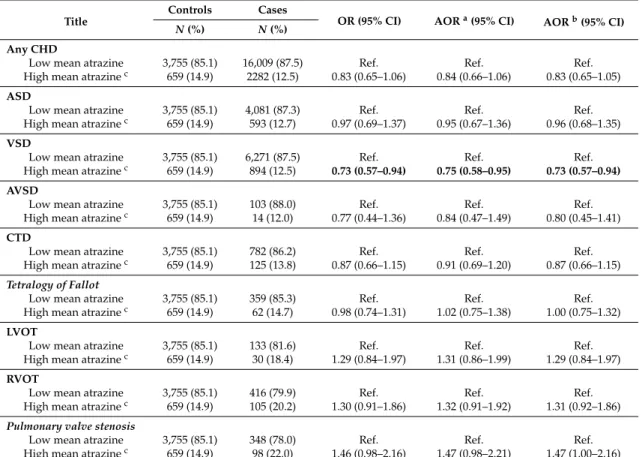
In our main association analyses, we assessed eight specific CHD subtypes as well as any CHD (Table3). In these analyses, there was a negative association between high versus low mean atrazine level and ventricular septal defects (AOR 0.8, 95% CI: 0.6, 1.0), after adjusting for delivery year, maternal age, race/ethnicity, education, birthplace, smoking, and history of previous live birth, and a similar result was observed after adjusting for water district population size and rural/urban status. The atrazine level was not significantly associated with any of the other seven CHD subtypes assessed or with any CHD in either adjusted model (range of adjusted odds ratios (AOR): 0.8–1.5). We repeated these analyses during an extended time period, for deliveries during 1999 through 2008, and these results were similar (data not shown). We repeated the main analysis for any CHD after excluding region 11 of Texas (where CHD cases may have been potentially over-ascertained) [33] and results were similar (data not shown).
Table 3. Association between estimated high mean atrazine in drinking water and heart defects in offspring in Texas, 1999–2005.
Title
Controls Cases
OR (95% CI) AORa(95% CI) AORb(95% CI)
N(%) N(%)
Any CHD
Low mean atrazine 3,755 (85.1) 16,009 (87.5) Ref. Ref. Ref.
High mean atrazinec 659 (14.9) 2282 (12.5) 0.83 (0.65–1.06) 0.84 (0.66–1.06) 0.83 (0.65–1.05)
ASD
Low mean atrazine 3,755 (85.1) 4,081 (87.3) Ref. Ref. Ref.
High mean atrazinec 659 (14.9) 593 (12.7) 0.97 (0.69–1.37) 0.95 (0.67–1.36) 0.96 (0.68–1.35)
VSD
Low mean atrazine 3,755 (85.1) 6,271 (87.5) Ref. Ref. Ref.
High mean atrazinec 659 (14.9) 894 (12.5) 0.73 (0.57–0.94) 0.75 (0.58–0.95) 0.73 (0.57–0.94)
AVSD
Low mean atrazine 3,755 (85.1) 103 (88.0) Ref. Ref. Ref.
High mean atrazinec 659 (14.9) 14 (12.0) 0.77 (0.44–1.36) 0.84 (0.47–1.49) 0.80 (0.45–1.41)
CTD
Low mean atrazine 3,755 (85.1) 782 (86.2) Ref. Ref. Ref.
High mean atrazinec 659 (14.9) 125 (13.8) 0.87 (0.66–1.15) 0.91 (0.69–1.20) 0.87 (0.66–1.15)
Tetralogy of Fallot
Low mean atrazine 3,755 (85.1) 359 (85.3) Ref. Ref. Ref.
High mean atrazinec 659 (14.9) 62 (14.7) 0.98 (0.74–1.31) 1.02 (0.75–1.38) 1.00 (0.75–1.32) LVOT
Low mean atrazine 3,755 (85.1) 133 (81.6) Ref. Ref. Ref.
High mean atrazinec 659 (14.9) 30 (18.4) 1.29 (0.84–1.97) 1.31 (0.86–1.99) 1.29 (0.84–1.97) RVOT
Low mean atrazine 3,755 (85.1) 416 (79.9) Ref. Ref. Ref.
High mean atrazinec 659 (14.9) 105 (20.2) 1.30 (0.91–1.86) 1.32 (0.91–1.92) 1.31 (0.92–1.86)
Pulmonary valve stenosis
Low mean atrazine 3,755 (85.1) 348 (78.0) Ref. Ref. Ref.
High mean atrazinec 659 (14.9) 98 (22.0) 1.46 (0.98–2.16) 1.47 (0.98–2.21) 1.47 (1.00–2.16)
CHD, congenital heart defect; OR, (crude) odds ratio (odds of cases between the exposed group to high mean atrazine and the unexposed group); AOR, adjusted odds ratio; ASD, atrial septal defect; VSD, ventricular septal defect, AVSD, atrioventricular septal defect; CTD, conotruncal heart defect; LVOT, left ventricular outflow tract; RVOT, right ventricular outflow tract;aadjusted for delivery year, maternal age, race/ethnicity, education, birthplace, smoking, and history of previous live birth;badjusted for population size of water district and rural/urban status;c
“high mean atrazine” defined as≥85th percentile (0.16µg/L) of mean values across all atrazine measurements in controls, 1999–2005; otherwise, “low mean atrazine”.
were similar to the main results (data not shown). We also repeated the main analyses for any CHDs using a three-level exposure variable (i.e., low, high, and missing), and the results for high versus low atrazine were similar to the main results (data not shown).
Table 4. Association between estimated atrazine exposure in drinking water and congenital heart defects in offspring in Texas, 1999–2005, among districts with population size >200,000.
Any CHD Controls Cases OR (95% CI) AORa(95% CI)
N(%) N(%)
High median atrazine
No (<95th percentileb) 1,904 (81.1) 7,766 (83.2) Ref. Ref. Yes (≥95th percentileb) 444 (18.9) 1,568 (16.8) 0.82 (0.34–1.99) 0.79 (0.32–1.91)
High mean atrazine
No (<95th percentileb) 1,904 (81.1) 7,766 (83.2) Ref. Ref. Yes (≥95th percentileb) 444 (18.9) 1,568 (16.8) 0.82 (0.34–1.99) 0.79 (0.32–1.91) CHD, congenital heart defect; OR, (crude) odds ratio; AOR, adjusted odds ratio;aadjusted for delivery year, maternal age, race/ethnicity, education, birthplace, smoking, and history of previous live birth;ball percentiles were based on data from full controls, 1999–2005 (0.37µg/L for 95th percentile median, 0.41µg/L for 95th percentile mean).
3.2. National Birth Defects Prevention Study
For comparison, we conducted similar analyses in the NBDPS for deliveries during 1999 through 2005. A total of 3591 subjects were available in the NBDPS and 636 subjects (8.7% of cases, 19.4% of controls) were excluded due to missing atrazine values, resulting in 2955 included subjects (1620 cases and 1335 controls). Demographic and reproductive characteristics were compared (Table S1), and differences were observed for state, delivery year, plurality, maternal age, maternal pregestational or gestational diabetes, and water district population size between cases and controls. In the NBDPS, 19.4% of control mothers were missing atrazine information, and differences in the distributions of state, delivery year, maternal age, household income, maternal pregestational or gestational diabetes, and water district population size were present between control subjects in districts with versus without atrazine measurements (Table S2). However, the distribution of missing atrazine data was not different between cases with any CHD and controls (p-value = 0.126)
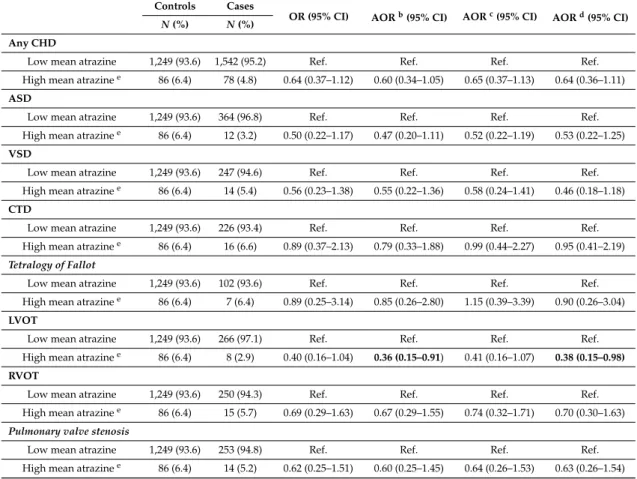
We repeated our main association analyses in the NBDPS (Table5). In these analyses, there was a negative association between high versus low mean atrazine level and left ventricular outflow tract defects (AOR 0.4, 95% CI: 0.2, 0.9) after adjusting for delivery year, maternal age, race/ethnicity, education, birthplace, smoking, and history of previous live birth. The magnitude of this result was similar after adjusting for water district population size, and after adjusting for potential confounding factors not present in the Texas data (i.e., household income and folic acid intake). The atrazine level was not significantly associated with any of the other six CHD subtypes assessed or with any CHD in either adjusted model (range of adjusted odds ratios (AOR): 0.5–1.2).
Table 5. Association between estimated high mean atrazine in drinking water and heart defects delivered in NBDPSa, 1999–2005.
Controls Cases
OR (95% CI) AORb(95% CI) AORc(95% CI) AORd(95% CI) N(%) N(%)
Any CHD
Low mean atrazine 1,249 (93.6) 1,542 (95.2) Ref. Ref. Ref. Ref.
High mean atrazinee 86 (6.4) 78 (4.8) 0.64 (0.37–1.12) 0.60 (0.34–1.05) 0.65 (0.37–1.13) 0.64 (0.36–1.11)
ASD
Low mean atrazine 1,249 (93.6) 364 (96.8) Ref. Ref. Ref. Ref.
High mean atrazinee 86 (6.4) 12 (3.2) 0.50 (0.22–1.17) 0.47 (0.20–1.11) 0.52 (0.22–1.19) 0.53 (0.22–1.25)
VSD
Low mean atrazine 1,249 (93.6) 247 (94.6) Ref. Ref. Ref. Ref.
High mean atrazinee 86 (6.4) 14 (5.4) 0.56 (0.23–1.38) 0.55 (0.22–1.36) 0.58 (0.24–1.41) 0.46 (0.18–1.18)
CTD
Low mean atrazine 1,249 (93.6) 226 (93.4) Ref. Ref. Ref. Ref.
High mean atrazinee 86 (6.4) 16 (6.6) 0.89 (0.37–2.13) 0.79 (0.33–1.88) 0.99 (0.44–2.27) 0.95 (0.41–2.19)
Tetralogy of Fallot
Low mean atrazine 1,249 (93.6) 102 (93.6) Ref. Ref. Ref. Ref.
High mean atrazinee 86 (6.4) 7 (6.4) 0.89 (0.25–3.14) 0.85 (0.26–2.80) 1.15 (0.39–3.39) 0.90 (0.26–3.04)
LVOT
Low mean atrazine 1,249 (93.6) 266 (97.1) Ref. Ref. Ref. Ref.
High mean atrazinee 86 (6.4) 8 (2.9) 0.40 (0.16–1.04) 0.36 (0.15–0.91) 0.41 (0.16–1.07) 0.38 (0.15–0.98)
RVOT
Low mean atrazine 1,249 (93.6) 250 (94.3) Ref. Ref. Ref. Ref.
High mean atrazinee 86 (6.4) 15 (5.7) 0.69 (0.29–1.63) 0.67 (0.29–1.55) 0.74 (0.32–1.71) 0.70 (0.30–1.63)
Pulmonary valve stenosis
Low mean atrazine 1,249 (93.6) 253 (94.8) Ref. Ref. Ref. Ref.
High mean atrazinee 86 (6.4) 14 (5.2) 0.62 (0.25–1.51) 0.60 (0.25–1.45) 0.64 (0.26–1.53) 0.63 (0.26–1.54)
NBDPS, National Birth Defects Prevention Study; CHD, congenital heart defect; OR, (crude) odds ratio (odds of cases between the exposed group to high mean atrazine and the unexposed group); AOR, adjusted odds ratio; ASD, atrial septal defect; VSD, ventricular septal defect, AVSD, atrioventricular septal defect; CTD, conotruncal heart defect; LVOT, left ventricular outflow tract; RVOT, right ventricular outflow tract;aNBDPS included data from Arkansas, Iowa, North Carolina, and Utah;badjusted for delivery year, maternal age, race/ethnicity, education, birthplace, smoking, and history of previous live birth;cadjusted for only population size of water district;dadjusted for only household income and folic acid intake;e“high mean atrazine” defined by as≥95th percentile (0.14µg/L) of mean values across all atrazine measurements in controls, 1999–2005; otherwise, “low mean atrazine”.
4. Discussion
We examined the association between maternal exposure to atrazine in public drinking water and CHDs in offspring using two large data sources. In our main analyses for Texas (1999–2005), estimated high atrazine exposure in public drinking water was not positively associated with any of the eight CHD subtypes assessed or any CHD (i.e., the group of any CHDs). In fact, ventricular septal defects were negatively associated with atrazine in Texas. In follow-up analyses in the NBDPS (1999–2005), no positive associations were observed between atrazine and any of the seven CHD subtypes assessed or any CHD, and a negative association was observed with left ventricular outflow tract defects. The observed magnitude of effect was <1 for most comparisons within the NBDPS. Our findings were similar across several sensitivity analyses, and do not support a positive association between atrazine and CHDs. However, our findings should be interpreted in light of limitations of the data.
that our analyses were impacted by selection bias, and that our results may not generalize to all women. However, when we accounted for subjects with missing data using a 3-level exposure variable (low/high/missing), the estimate for low versus high exposure did not change, which may suggest that there were not major effects due to missing exposure data.
We tried to further limit this potential selection bias by conducting sensitivity analyses among subjects in districts with more complete atrazine measurements (i.e., districts serving large populations), though these analyses could not be conducted for specific CHD subtypes due to small case numbers. We further tried to limit potential selection bias by using a secondary data source with more complete exposure data (i.e., the NBDPS), though substantially fewer cases were present among this data source. These limitations with the exposure data highlight the lack of complete collection and curation of public data on at least some pesticide water contaminants. It was unclear from these analyses if the atrazine data were missing because of districts not complying with mandatory reporting requirements, not properly reporting the data to the EPA, or another issue. Further, as several published studies have used water district monitoring data for similar analyses (e.g., other contaminants or outcomes), our findings emphasize the need for caution in interpreting results from such studies, which do not always address the impact of missing exposure data.
We observed negative associations between high versus low atrazine and two CHD subtypes: ventricular septal defects (VSDs) and left ventricular outflow tract (LVOT) defects. As we are not aware of any hypothesized protective effect of atrazine on birth defects (and these results were not entirely consistent between Texas and the NBDPS), we suspect that these observations may have arisen due to the limitations of the data (e.g., selection bias and/or measurement error). Alternatively, we cannot rule out the possibility that these trends might be explained by a relationship between atrazine and a very severe phenotype that resulted in an early fetal death or miscarriage (i.e., potential cases that were not ascertained). In fact, early fetal death/miscarriage has been associated with atrazine in animal [39] and human [40,41] studies.
Some previous studies have reported on the reproductive effects of atrazine. In animal studies, atrazine exposure has been associated with developmental effects, though relatively few of these studies have focused on malformations of the heart. Both zebrafish and rats have shown functional disturbances of the heart following atrazine exposure [42–44]. Another study observed that 23% of chicken embryos treated withN-nitrosoatrazine (which is formed when atrazine reacts with nitrite) had malformations, including CHDs [45].
Few studies have examined risks of CHDs in humans and pesticide exposure from water. Based on ecologic data, it was observed that Iowa communities served by a water reservoir contaminated with atrazine had higher rates of CHDs compared to other communities [46], but individual-level data were not available. Although a U.S. ecological study reported a correlation between surface water atrazine and birth defects overall [24], to our knowledge no prior analytic study has evaluated atrazine in water and individual-level risk of CHDs specifically.
However, other previous observational studies have reported links between atrazine in drinking water and non-CHD birth defects or reproductive outcomes. For example, a study from the NBDPS reported a weak association between atrazine (estimated based on catchment level stream and groundwater contaminant models) in drinking water and hypospadias [47]. In addition, a U.S. study observed an elevated prevalence of abdominal wall defects during months when seasonal patterns of atrazine and nitrate levels in surface water peaked [22], and in a semi-ecological study, the risk of gastroschisis was inversely associated with distance to the site of elevated atrazine exposure in surface water [23]. Some studies found that atrazine in drinking water was significantly associated with small for gestational age or preterm birth [30,48,49], whereas others did not find associations [50].
water have been independently associated with CHDs [51–53], and inconsistent results have been reported for nitrate in water and CHD risk [37,51,54].
In addition to water, occupational exposure is another important potential pesticide exposure source. Multiple studies have assessed occupational exposure to pesticides and CHDs, but the relationship is unclear. Briefly, Rocheleau et al. assessed maternal occupational exposure to pesticides and CHDs in the NBDPS [10] and found that maternal occupations with exposure to herbicides were associated with hypoplastic left heart syndrome, pulmonary valve stenosis, and tetralogy of Fallot. An additional case-control study conducted in Maryland found that mothers of cases with transposition of great arteries in offspring were more likely to use pesticides (at home, work, or other site) before or during pregnancy than mothers of controls [13]. However, a case-control study in China observed that maternal occupational exposure to pesticides during the periconceptional period was not associated with simple isolated CHDs [55], and another case-control study from California in U.S. also reported no association, but it had very few exposed cases (n= 7) [56].
Several studies have also assessed residential proximity to sites with agricultural pesticide application exposure and CHDs, although results have also been inconsistent. A population-based, case-control study observed that mothers residing near an area with agricultural pesticide application were more likely to have specific CHD subtypes in offspring than mothers who did not [11]. Another case-control study in North Carolina found that mothers exposed to high levels of agricultural pesticides near their residence had elevated risk of CHDs compared to mothers exposed to low levels of those pesticides [12]. Conversely, a registry-based, case-control study from Washington State revealed that neither higher proportions of agricultural land in the mother’s residence county nor agriculture-related maternal occupation were associated with the risk of ventricular septal defects [57]. Strengths of the present study include the use of population-based data, the large numbers of study subjects, the data on many potential covariates, the restriction to nonsydromic cases, the case classification review by clinicians (all NBDPS cases and a subset of Texas cases), and the repetition of similar analyses across independent data sources. However, there are limitations that need to be considered in the interpretation of our findings. Due to relatively sparse data on exposure levels over time for many districts (e.g., 26.1% of Texas control women’s districts were missing atrazine levels), we could not restrict the exposure time period to the critical period for heart development during early pregnancy. Instead, we used representative values of atrazine levels for each water district (e.g., mean) over the entire six-year monitoring period to define high or low atrazine groups, which may not have reflected atrazine levels during pregnancy (e.g., annual/seasonal changes were not reflected). Such a lack of seasonal specificity in atrazine levels might have led to measurement errors in this study, which may have biased effects towards the null. Also, the maternal residential address at conception was available in the NBDPS data, but not in the Texas data. As such, we used the address at delivery as a proxy in the Texas data. Results from previous studies assessing residential mobility during pregnancy in Texas and elsewhere suggest that this was unlikely to have made a major impact [58,59]. However, since we cannot ignore a possibility of measurement error due to the use of proxy addresses, formal measurement error modeling (e.g., Berkson model) would be of interest in future work.
Although we used two of the largest sources of birth defects data worldwide, small numbers among specific CHD subtypes did not allow for some of our sensitivity analyses to be conducted among these subgroups. Instead, we conducted these analyses among cases with any CHD, though these secondary analyses may have been limited by etiologic heterogeneity.
5. Conclusions
Our study examined the association between estimated maternal atrazine exposure in drinking water and the risk of CHD subtypes in offspring. No positive associations were observed between atrazine and CHDs, though our findings should be interpreted in light of the limitations of our study. More consistent monitoring, reporting, and curation of pesticide water contaminants in public water sources might aid in further characterizing potential associations. Considering the current limitations of water district data and with the absence of relevant biomarkers of exposure, our findings suggest that use of other data sources as proxies for water contaminant exposure (e.g., proximity to pesticide application sites) may be helpful. If environmental contaminant measurements from maternal/infant blood samples become available in future studies, this would also be beneficial.
Supplementary Materials: The following are available online atwww.mdpi.com/1660-4601/14/8/889/s1, Table S1: Descriptive characteristics of cases and controls with available atrazine data, NBDPS, 1999–2005, Table S2: Descriptive characteristics of all potential controls with and without atrazine data in NBDPS, 1999–2005. Acknowledgments:This work was supported by the National Institute of Environmental Health Sciences (grant R21 ES024895). This publication was supported in part through a cooperative agreement (U01DD000494) between the Centers for Disease Control and Prevention and the Texas Department of State Health Services (DSHS). Its contents are solely the responsibility of the authors and do not necessarily represent the official views, policies, or positions of the U.S. Centers for Disease Control and Prevention or the U.S. Environmental Protection Agency. Author Contributions: Jihye Kim conducted the analysis and drafted the manuscript. Michael D. Swartz, Peter H. Langlois, Paul A. Romitti, Peter Weyer, Laura E. Mitchell, Thomas J. Luben, Anushuya Ramakrishnan, Sadia Malik, Philip J. Lupo, Marcia L. Feldkamp, Robert E. Meyer, Jennifer J. Winston, Jennita Reefhuis, Sarah J. Blossom, and Erin Bell assisted with the study design, interpretation of results, and manuscript review. A. J. Agopian conceived the study, supervised the analysis and assisted in interpretation of results and manuscript writing and review. The National Birth Defects Prevention Study supported data collection, manuscript review, and approved the manuscript to be published.
Conflicts of Interest:The authors declare no conflict of interest.
Disclaimer:The views expressed in this manuscript are those of the authors and do not necessarily represent the views or policies of the U.S. Environmental Protection Agency. The findings and conclusions in this report are those of the authors and do not necessarily represent the official position of the Centers for Disease Control and Prevention.
References
1. Botto, L.D.; Correa, A.; Erickson, J.D. Racial and temporal variations in the prevalence of heart defects.
Pediatrics2001,107, E32. [CrossRef] [PubMed]
2. Centers for Disease Control and Prevention, Racial differences by gestational age in neonatal deaths attributable to congenital heart defects—United States, 2003–2006. MMWR Morb. Mortal. Wkly. Rep.
2010,59, 1208–1211.
3. Yang, Q.; Chen, H.; Correa, A.; Devine, O.; Mathews, T.J.; Honein, M.A. Racial differences in infant mortality attributable to birth defects in the United States, 1989–2002.Birth Defects Res. A Clin. Mol. Teratol.2006,76, 706–713. [CrossRef] [PubMed]
4. Van der Linde, D.; Konings, E.E.; Slager, M.A.; Witsenburg, M.; Helbing, W.A.; Takkenberg, J.J.; Roos-Hesselink, J.W. Birth prevalence of congenital heart disease worldwide: A systematic review and meta-analysis.J. Am. Coll. Cardiol.2011,58, 2241–2247. [CrossRef] [PubMed]
5. Langlois, P.H.; Scheuerle, A.; Horel, S.A.; Carozza, S.E. Urban versus rural residence and occurrence of septal heart defects in Texas.Birth Defects Res. A Clin. Mol. Teratol.2009,85, 764–772. [CrossRef] [PubMed] 6. Bound, J.P.; Harvey, P.W.; Francis, B.J. Seasonal prevalence of major congenital malformations in the Fylde of
7. Caton, A.R. Exploring the seasonality of birth defects in the New York State Congenital Malformations Registry.Birth Defects Res. A Clin. Mol. Teratol.2012,94, 424–437. [CrossRef] [PubMed]
8. Yu, Y.; Yang, Y.; Zhao, X.; Liu, X.; Xue, J.; Zhang, J.; Yang, A. Exposure to the mixture of organophosphorus pesticides is embryotoxic and teratogenic on gestational rats during the sensitive period.Environ. Toxicol.
2015,32, 132–146. [CrossRef] [PubMed]
9. Dallegrave, E.; Mantese, F.D.; Coelho, R.S.; Pereira, J.D.; Dalsenter, P.R.; Langeloh, A. The teratogenic potential of the herbicide glyphosate-Roundup in Wistar rats.Toxicol. Lett.2003,142, 45–52. [CrossRef] 10. Rocheleau, C.M.; Bertke, S.J.; Lawson, C.C.; Romitti, P.A.; Sanderson, W.T.; Malik, S.; Lupo, P.J.;
Desrosiers, T.A.; Bell, E.; Druschel, C.; et al. Maternal occupational pesticide exposure and risk of congenital heart defects in the National Birth Defects Prevention Study.Birth Defects Res. A Clin. Mol. Teratol.2015,103, 823–833. [CrossRef] [PubMed]
11. Carmichael, S.L.; Yang, W.; Roberts, E.; Kegley, S.E.; Padula, A.M.; English, P.B.; Lammer, E.J.; Shaw, G.M. Residential agricultural pesticide exposures and risk of selected congenital heart defects among offspring in the San Joaquin Valley of California.Environ. Res.2014,135, 133–138. [CrossRef] [PubMed]
12. Rappazzo, K.M.; Warren, J.L.; Meyer, R.E.; Herring, A.H.; Sanders, A.P.; Brownstein, N.C.; Luben, T.J. Maternal residential exposure to agricultural pesticides and birth defects in a 2003 to 2005 North Carolina birth cohort.Birth Defects Res. A Clin. Mol. Teratol.2016,106, 240–249. [CrossRef] [PubMed]
13. Loffredo, C.A.; Silbergeld, E.K.; Ferencz, C.; Zhang, J. Association of transposition of the great arteries in infants with maternal exposures to herbicides and rodenticides. Am. J. Epidemiol. 2001,153, 529–536. [CrossRef] [PubMed]
14. Rull, R.P.; Ritz, B.; Shaw, G.M. Neural tube defects and maternal residential proximity to agricultural pesticide applications.Am. J. Epidemiol.2006,163, 743–753. [CrossRef] [PubMed]
15. Meyer, K.J.; Reif, J.S.; Veeramachaneni, D.N.; Luben, T.J.; Mosley, B.S.; Nuckols, J.R. Agricultural pesticide use and hypospadias in eastern Arkansas.Environ. Health Perspect.2006,114, 1589–1595. [CrossRef] [PubMed] 16. Agopian, A.J.; Lupo, P.J.; Canfield, M.A.; Langlois, P.H. Case-control study of maternal residential atrazine exposure and male genital malformations.Am. J. Med. Genet. A2013,161A, 977–982. [CrossRef] [PubMed] 17. Agopian, A.J.; Cai, Y.; Langlois, P.H.; Canfield, M.A.; Lupo, P.J. Maternal Residential Atrazine Exposure and
Risk for Choanal Atresia and Stenosis in Offspring.J. Pediatr.2012. [CrossRef] [PubMed]
18. Shaw, G.M.; Swan, S.H.; Harris, J.A.; Malcoe, L.H. Maternal water consumption during pregnancy and congenital cardiac anomalies.Epidemiology1990,1, 206–211. [CrossRef] [PubMed]
19. Agency for Toxic Substances and Disease Registry.Toxicological Profile for Atrazine; U.S. Department of Health and Human Services: Washington, DC, USA, 2003; pp. 1–222.
20. Kolpin, D.W.; Kalkhoff, S.J.; Goolsby, D.A.; Sneck-Fahrer, D.A.; Thurman, E.M. Occurrence of Selected Herbicides and Herbicide Degradation Products in Iowa’s Ground Water, 1995. Ground Water1997,35, 679–688. [CrossRef]
21. Brender, J.D.; Weyer, P.J. Agricultural Compounds in Water and Birth Defects.Curr. Environ. Health Rep.
2016,3, 144–152. [CrossRef] [PubMed]
22. Mattix, K.D.; Winchester, P.D.; Scherer, L.R. Incidence of abdominal wall defects is related to surface water atrazine and nitrate levels.J. Pediatr. Surg.2007,42, 947–949. [CrossRef] [PubMed]
23. Waller, S.A.; Paul, K.; Peterson, S.E.; Hitti, J.E. Agricultural-related chemical exposures, season of conception, and risk of gastroschisis in Washington State.Am. J. Obstet. Gynecol.2010,202, e1–e6. [CrossRef] [PubMed] 24. Winchester, P.D.; Huskins, J.; Ying, J. Agrichemicals in surface water and birth defects in the United States.
Acta Paediatr.2009,98, 664–669. [CrossRef] [PubMed]
25. Miller, E. Evaluation of the Texas Birth Defects Registry: An active surveillance system.Birth Defects Res. A Clin. Mol. Teratol.2006,76, 787–792. [CrossRef] [PubMed]
26. Rasmussen, S.A.; Olney, R.S.; Holmes, L.B.; Lin, A.E.; Keppler-Noreuil, K.M.; Moore, C.A. Guidelines for case classification for the National Birth Defects Prevention Study.Birth Defects Res. A Clin. Mol. Teratol.
2003,67, 193–201. [CrossRef] [PubMed]
28. United States Environmental Protection Agency Six-Year Review of Drinking Water Standards. Available online:http://water.epa.gov/lawsregs/rulesregs/regulatingcontaminants/sixyearreview/index. cfm(accessed on 1 October 2012).
29. United States Enivornmental Protection Agency Consumer Factsheet on: ATRAZINE. Available online:
http://www.epa.gov/ogwdw000/pdfs/factsheets/soc/atrazine.pdf(accessed on 20 October 2015). 30. Rinsky, J.L.; Hopenhayn, C.; Golla, V.; Browning, S.; Bush, H.M. Atrazine exposure in public drinking water
and preterm birth.Public Health Rep.2012,127, 72–80. [CrossRef] [PubMed]
31. Mass, C.J. M.; Hox, J.J. Sufficient Sample Sizes for Multilevel Modeling.Methodology2005,1, 86–92. [CrossRef] 32. Bell, B.A.; Morgan, G.B.; Kromrey, J.D.; Ferron, J.M. The impact of small cluster size on multilevel models: A Monte Carlo examination of two-level models with binary and continuous predictors.JSM Proc. Sect. Surv. Res. Methods2010,1, 4057–4067.
33. Agopian, A.J.; Moulik, M.; Gupta-Malhotra, M.; Marengo, L.K.; Mitchell, L.E. Descriptive epidemiology of non-syndromic complete atrioventricular canal defects. Paediatr. Perinat. Epidemiol.2012,26, 515–524. [CrossRef] [PubMed]
34. Reefhuis, J.; Gilboa, S.M.; Anderka, M.; Browne, M.L.; Feldkamp, M.L.; Hobbs, C.A.; Jenkins, M.M.; Langlois, P.H.; Newsome, K.B.; Olshan, A.F.; et al. The National Birth Defects Prevention Study: A review of the methods.Birth Defects Res. A Clin. Mol. Teratol.2015,103, 656–669. [CrossRef] [PubMed]
35. Botto, L.D.; Lin, A.E.; Riehle-Colarusso, T.; Malik, S.; Correa, A. Seeking causes: Classifying and evaluating congenital heart defects in etiologic studies. Birth Defects Res. A Clin. Mol. Teratol. 2007, 79, 714–727. [CrossRef] [PubMed]
36. Ailes, E.C.; Gilboa, S.M.; Riehle-Colarusso, T.; Johnson, C.Y.; Hobbs, C.A.; Correa, A.; Honein, M.A. Prenatal diagnosis of nonsyndromic congenital heart defects.Prenat. Diagn.2014,34, 214–222. [CrossRef] [PubMed] 37. Brender, J.D.; Weyer, P.J.; Romitti, P.A.; Mohanty, B.P.; Shinde, M.U.; Vuong, A.M.; Sharkey, J.R.; Dwivedi, D.; Horel, S.A.; Kantamneni, J.; et al. Prenatal nitrate intake from drinking water and selected birth defects in offspring of participants in the national birth defects prevention study.Environ. Health Perspect.2013,121, 1083–1089. [CrossRef] [PubMed]
38. Croen, L.A.; Todoroff, K.; Shaw, G.M. Maternal exposure to nitrate from drinking water and diet and risk for neural tube defects.Am. J. Epidemiol.2001,153, 325–331. [CrossRef] [PubMed]
39. Greenlee, A.R.; Ellis, T.M.; Berg, R.L. Low-dose agrochemicals and lawn-care pesticides induce developmental toxicity in murine preimplantation embryos.Environ. Health Perspect.2004,112, 703–709. [CrossRef] [PubMed]
40. Arbuckle, T.E.; Lin, Z.; Mery, L.S. An exploratory analysis of the effect of pesticide exposure on the risk of spontaneous abortion in an Ontario farm population.Environ. Health Perspect.2001,109, 851–857. [CrossRef] [PubMed]
41. Petrelli, G.; Figa-Talamanca, I.; Lauria, L.; Mantovani, A. Spontaneous abortion in spouses of greenhouse workers exposed to pesticides.Environ. Health Prev. Med.2003,8, 77–81. [CrossRef] [PubMed]
42. Wiegand, C.; Krause, E.; Steinberg, C.; Pflugmacher, S. Toxicokinetics of atrazine in embryos of the zebrafish (Danio rerio).Ecotoxicol. Environ. Saf.2001,49, 199–205. [CrossRef] [PubMed]
43. Chan, Y.C.; Chang, S.C.; Hsuan, S.L.; Chien, M.S.; Lee, W.C.; Kang, J.J.; Wang, S.C.; Liao, J.W. Cardiovascular effects of herbicides and formulated adjuvants on isolated rat aorta and heart. Toxicol. In Vitro2007,21, 595–603. [CrossRef] [PubMed]
44. Rajkovic, V.; Kovac, R.; Koledin, I.; Matavulj, M. Atrazine-induced changes in the myocardial structure of peripubertal rats.Toxicol. Ind. Health2012,30, 250–258. [CrossRef] [PubMed]
45. Joshi, N.; Rhoades, M.G.; Bennett, G.D.; Wells, S.M.; Mirvish, S.S.; Breitbach, M.J.; Shea, P.J. Developmental abnormalities in chicken embryos exposed toN-nitrosoatrazine. J. Toxicol. Environ. Health A2013, 76, 1015–1022. [CrossRef] [PubMed]
46. Munger, R.; Hanson, J.; Isacson, P. Birth defects and pesticide-contaminated water supplies in Iowa.Am. J. Epidemiol.1992,136, 959.
48. Ochoa-Acuna, H.; Frankenberger, J.; Hahn, L.; Carbajo, C. Drinking-water herbicide exposure in Indiana and prevalence of small-for-gestational-age and preterm delivery.Environ. Health Perspect.2009,117, 1619–1624. [CrossRef] [PubMed]
49. Migeot, V.; Albouy-Llaty, M.; Carles, C.; Limousi, F.; Strezlec, S.; Dupuis, A.; Rabouan, S. Drinking-water exposure to a mixture of nitrate and low-dose atrazine metabolites and small-for-gestational age (SGA) babies: A historic cohort study.Environ. Res.2013,122, 58–64. [CrossRef] [PubMed]
50. Villanueva, C.M.; Durand, G.; Coutte, M.B.; Chevrier, C.; Cordier, S. Atrazine in municipal drinking water and risk of low birth weight, preterm delivery, and small-for-gestational-age status.Occup. Environ. Med.
2005,62, 400–405. [CrossRef] [PubMed]
51. Cedergren, M.I.; Selbing, A.J.; Lofman, O.; Kallen, B.A. Chlorination byproducts and nitrate in drinking water and risk for congenital cardiac defects.Environ. Res.2002,89, 124–130. [CrossRef] [PubMed] 52. Rudnai, T.; Sandor, J.; Kadar, M.; Borsanyi, M.; Beres, J.; Metneki, J.; Maraczi, G.; Rudnai, P. Arsenic in
drinking water and congenital heart anomalies in Hungary.Int. J. Hyg. Environ. Health2014,217, 813–818. [CrossRef] [PubMed]
53. Sanders, A.P.; Desrosiers, T.A.; Warren, J.L.; Herring, A.H.; Enright, D.; Olshan, A.F.; Meyer, R.E.; Fry, R.C. Association between arsenic, cadmium, manganese, and lead levels in private wells and birth defects prevalence in North Carolina: A semi-ecologic study.BMC Public Health2014,14, 955. [CrossRef] [PubMed] 54. Weyer, P.J.; Brender, J.D.; Romitti, P.A.; Kantamneni, J.R.; Crawford, D.; Sharkey, J.R.; Shinde, M.; Horel, S.A.;
Vuong, A.M.; Langlois, P.H. Assessing bottled water nitrate concentrations to evaluate total drinking water nitrate exposure and risk of birth defects.J. Water Health2014,12, 755–762. [CrossRef] [PubMed]
55. Wang, C.; Zhan, Y.; Wang, F.; Li, H.; Xie, L.; Liu, B.; Li, Y.; Mu, D.; Zheng, H.; Zhou, K.; et al. Parental occupational exposures to endocrine disruptors and the risk of simple isolated congenital heart defects.
Pediatr. Cardiol.2015,36, 1024–1037. [CrossRef] [PubMed]
56. Shaw, G.M.; Wasserman, C.R.; O’Malley, C.D.; Nelson, V.; Jackson, R.J. Maternal pesticide exposure from multiple sources and selected congenital anomalies.Epidemiology1999,10, 60–66. [CrossRef] [PubMed] 57. Batra, M.; Heike, C.L.; Phillips, R.C.; Weiss, N.S. Geographic and occupational risk factors for ventricular
septal defects: Washington State, 1987–2003. Arch. Pediatr. Adolesc. Med. 2007,161, 89–95. [CrossRef] [PubMed]
58. Lupo, P.J.; Symanski, E.; Chan, W.; Mitchell, L.E.; Waller, D.K.; Canfield, M.A.; Langlois, P.H. Differences in exposure assignment between conception and delivery: The impact of maternal mobility.Paediatr. Perinat. Epidemiol.2010,24, 200–208. [CrossRef] [PubMed]
59. Chen, L.; Bell, E.M.; Caton, A.R.; Druschel, C.M.; Lin, S. Residential mobility during pregnancy and the potential for ambient air pollution exposure misclassification.Environ. Res.2010,110, 162–168. [CrossRef] [PubMed]