Preliminary versions of this paper appear in 2007 IEEE Symposium on Security & Privacy Pro-ceedings, pp. 92–100, 2007 and in IET Information Security Journal, vol. 5, no. 4, pp. 207–219, 2011. This is the full version.
Provable-Security Analysis of
Authenticated Encryption in Kerberos
Alexandra Boldyreva Virendra Kumar
Georgia Institute of Technology, School of Computer Science 266 Ferst Drive, Atlanta, GA 30332-0765 USA
{sasha,virendra}@gatech.edu
Abstract
Kerberos is a widely deployed network authentication protocol currently being considered for standardization. Many works have analyzed its security, identifying flaws and often suggesting fixes, thus promoting the protocol’s evolution. Several recent results present successful, formal methods-based verifications of a significant portion of the current version, v.5, and some even imply security in the computational setting. For these results to hold, encryption in Kerberos should satisfy strong cryptographic security notions. However, prior to our work, none of the encryption schemes currently deployed as part of Kerberos, nor their proposed revisions, were known to provably satisfy such notions. We take a close look at Kerberos’ encryption, and we confirm that most of the options in the current version provably provide privacy and authenticity, though some require slight modifications which we suggest. Our results complement the formal methods-based analysis of Kerberos that justifies its current design.
Keywords: Kerberos, authenticated encryption, provable security.
1
Introduction
1.1 Motivation
the known vulnerabilities of the previous versions. The current version, Kerberos v.5, is already being revised and extended [24, 26, 25].
What is certainly desirable for the upcoming standard is to provide some guarantees that the protocol not only resists some specific known attacks, but that it withstands a very large class of possible attacks, under some well-studied assumptions. Modern techniques in cryptography (computational approach), and formal methods (symbolic approach) make it possible; however, formally analyzing such a complex protocol is not an easy task.
Several recent works contributed in this direction. Butler et al. [17, 18] have analyzed significant portions of the current version of Kerberos and its extensions in the symbolic approach (i.e. Dolev-Yao model [19]), and have formally verified that the design of Kerberos’ current version meets the desired goals for the most part. However, a known limitation of such analyses is a high level of abstraction. A significant advance has been made by a recent work by Backes et al. [1] in that it is the only work providing symbolic analysis that also guarantees security in the computational setting, the well-accepted strongest model of security. Their results use the computational soundness model due to Backes et al. [4, 3, 2]. However, for their results to hold, cryptographic primitives used in the protocol need to satisfy strong notions of security (in the computational setting). Namely, as the result of [23] implies, the encryption scheme utilized by the protocol needs to provide privacy against chosen-ciphertext attacks (be IND-CCA secure), as well as authenticity and integrity of ciphertexts (be INT-CTXT secure).
However, it is not known whether authenticated encryption1 in Kerberos is IND-CCA and INT-CTXT secure. Certain known vulnerabilities indicate that encryption in version 4 did not satisfy these notions [31]. While encryption in the current version, v.5, is designed to resist known attacks, it is not clear whether itprovably resists all attacks of the class, and if it does, under what assumptions. Provable security has become a de facto standard approach in modern cryptography research. Cryptographers design plenty of cryptographic schemes for a vast range of possible applications, and they usually provide rigorous proofs of security for their constructions. It is somewhat surprising then that the schemes that are actually used in deployed protocols remain unanalyzed from the provable security perspective. Our work aims to close this gap.
1.2 Contributions
We take a close look at the encryption schemes used in Kerberos v.5 (according to its specifications [26, 25]), in order to prove them secure, in the IND-CCA and INT-CTXT sense, assuming the underlying building blocks (e.g. a blockcipher) are secure. Our results complement the formal methods-based analysis of Kerberos as a key establishment and authentication protocol [17, 18]. General Profile. We first look at the encryption scheme description in the current version, v.5, specification (cf. [26], Section 6). We will refer to it as “General Profile”. Fix a blockcipher with input-output lengthn, and a key for it; a checksum, i.e. a hash function with arbitrary input length, and output length l. A messageM is first padded to make the length of the message plus l a multiple of n. Next, a random n-bit string conf is chosen. Then the checksum is applied to the stringconf ∥0l∥M. Let us call the checksum’s outputσ. Finally, the blockcipher in the CBC mode with fixed initial vectorIV = 0n is applied to the stringconf ∥σ∥M. Decryption is defined accordingly. Security of the scheme depends on how the checksum function is instantiated. The
1We will often refer to encryption schemes whose goal is to provide both privacy and authenticity asauthenticated
suggested instantiation is a hash function. We observe that the General Profile scheme conforms to a general Encode-then-Checksum-then-Encrypt construction, and the latter has a weakness. Namely, we show that even if one assumes the “more secure” component options, e.g. a secure blockcipher in a secure encryption mode and a secure hash function, the Encode-then-Checksum-then-Encrypt construction is not secure in general. That is, there exist attacks on the scheme composed of certain secure components, which shows that it does not provide integrity of ciphertexts. We note that these attacks do not apply to the General Profile itself, as it uses a particular encryption scheme recommended in [26]. Nevertheless, the attacks show a weakness in the overall design.
Modified General Profile. We propose simple, easy to implement modifications that are sufficient for provable security of the design of General Profile. Namely, we show that if the scheme uses a secure blockcipher (a pseudorandom function, or ”PRF”) in the CBC mode, as specified by General Profile, and if a message authentication code (MAC) that is a PRF is used as a checksum in place of the hash function, then Modified General Profile yields an encryption scheme that is IND-CCA and INT-CTXT secure. In particular, AES that is assumed to be a PRF and HMAC [8] that is proven to be a PRF [7], assuming the underlying compression hash function is a PRF, are good candidates for a blockcipher and MAC, respectively.
Simplified Profile. Next, we look at the recently proposed revisions to the encryption design in Kerberos, known as Simplified Profile (cf. Section 5 in [26] and [25]). This encryption scheme, for which implementations have not caught up yet, recommends to use AES or Triple-DES as a blockcipher, and HMAC [8] as a MAC, in the following manner. The message is first encoded such that the necessary padding is appended, and a random confounder (the name was suggested in most Kerberos specifications) is prepended. The blockcipher in CBC mode or a variant of CBC mode with ciphertext-stealing2, both with fixed all-zero-bit IV, and HMAC are applied to the encoded message independently to yield two parts of the resulting ciphertext. Decryption is defined accordingly. We prove that this method yields an encryption scheme that is IND-CCA and INT-CTXT secure, under the assumption that the blockcipher and the MAC are PRF. This confirms soundness of the design of the Simplified Profile. AES is conjectured to be a PRF, Triple DES was shown to be a PRF in the ideal cipher model [15], and as mentioned before, HMAC was proven to be a PRF [7], assuming the underlying compression hash function is a PRF. Therefore, they are the right choices of instantiations for the Simplified Profile. We comment that even though the Simplified Profile uses the CBC scheme with a fixed IV, this does not compromise security because pre-pending a random confounder to the message before encrypting makes the scheme equivalent to the CBC with random IV.
While our results are not as unexpected or “catchy” as some results discovering a flaw or imple-menting an attack on a practical protocol, they are far from being less important. Having provable security guarantees is an invaluable benefit for any cryptographic design, especially a widely de-ployed protocol. Our results together with the formal methods-based results in the symbolic setting constitute strong provable security support for the design of Kerberos.
1.3 Related work
Bellare and Namprempre [12] study various ways to securely compose secure (IND-CPA) encryption and secure (unforgeable against chosen-message attacks, or ”UF-CMA”) message authentication
2
code schemes. They show that only one out of the three most straightforward composition methods, Encrypt-then-MAC, is secure in general (i.e. always yields an IND-CCA and INT-CTXT encryption scheme). At the same time, certain secure components can yield a scheme, constructed via Encrypt-and-MAC or MAC-then-Encrypt paradigms, that is not IND-CCA or not INT-CTXT. If Kerberos’ design had utilized the Encrypt-then-MAC composition method with secure encryption and MAC schemes, we would have nothing to prove here. However, Kerberos uses some variations of Encrypt-and-MAC and MAC-then-Encrypt methods that rely on the properties of the encodings of the message, i.e. of preprocessing of the message before encryption and MAC are applied.
Bellare et al. [11] analyze security of encryption in another widely deployed protocol, Secure Shell, also known as SSH. They suggest several modifications to the SSH encryption to fix certain flaws, and they prove that the resulting scheme provably provides privacy against chosen-ciphertext attacks, and integrity of ciphertexts. They also provide general results about security of stateful en-cryption schemes composed according to the Encode-then-Encrypt-and-MAC paradigm, assuming certain security properties of the base encoding, encryption, and MAC schemes. The encryption scheme proposed for the revision of Kerberos v.5 (cf. Simplified Profile in [26]) conforms to the Encode-then-Encrypt-and-MAC method. However, the security results from [11] do not directly imply strong security notions of the Simplified Profile in Kerberos. First, the general results from [11] do not guarantee a strong notion of integrity of ciphertexts; they only consider a weaker notion of integrity of plaintexts. Second, the result of [11] require an IND-CPA secure base encryption scheme, but as we mentioned above, the base encryption in Kerberos is CBC with fixed IV, which is not IND-CPA secure.
Krawczyk [22] shows that the MAC-then-Encrypt composition method yields a secure authen-ticated encryption scheme, if the underlying MAC is UF-CMA, and if the encryption scheme uses a PRF blockcipher in CBC with random IV mode. We cannot use this result to prove security of the Modified General Profile, because the latter uses the CBC mode with zero IV, and moreover, it uses a particular encoding scheme so that the confounder (that basically plays the role of random IV for CBC) is also being MACed and encrypted. Proving this scheme requires special care.
Accordingly, we need to analyze the authenticated encryption schemes in Kerberos from scratch. 1.4 Outline
After defining some notation, we recall the relevant cryptographic primitives and their security defi-nitions. Next, we outline the designs of schemes in the General and Simplified Profile authenticated encryption schemes of Kerberos’ specification, as well as the modification to the General Profile that we propose. We follow with a detailed security analysis of the schemes, and we conclude with the summary.
2
Preliminaries
2.1 Notation
theith bit of M, and M[i...j] denotesM[i]∥ . . . ∥M[j]. If S is a set, then|S|denotes the size ofS;
X ←$ S denotes that X is selected uniformly at random from S. If A is a randomized algorithm, then the notationX←$ A denotes thatX is assigned the outcome of the experiment of runningA. IfA is deterministic, we drop the dollar sign above the arrow.
2.2 Cryptographic Primitives and their Security
Symmetric Encryption.
Definition 2.1. [Symmetric encryption scheme]Asymmetric encryption schemeSE = (K,E, D), with associated message space MsgSp, is defined by three algorithms:
• The randomized key generation algorithmK returns a secret key K.
• The (possibly) randomized or stateful encryption algorithmE takes as input the secret keyK and a plaintextM ∈MsgSp, and returns a ciphertext.
• The deterministicdecryption algorithmDtakes the secret key K and a ciphertextC to return the corresponding plaintext, or the special symbol⊥indicating that the ciphertext was invalid. The consistency condition requires thatDK(EK(M)) =M, for allK that can be output byK, and all M ∈MsgSp.
We now recall cryptographic security notions for encryption. The following definition [9] is for data privacy (confidentiality). It formalizes the requirement that even though an adversary may know some partial information about the data, no additional information is leaked.
Definition 2.2. [IND-CPA, IND-CCA] Let SE = (K,E,D) be an encryption scheme. For atk ∈ {cpa,cca}, adversary A, and a bit b, define the experiments ExpindSE-atk-b(A) as follows. In all the experiments, first the key K is generated by K. Let LR (left-or-right) be the “selector” that on input M0, M1, b returns Mb. The adversary A is given access to the left-right encryption
oracle EK(LR(·,·, b)) that it can query on any pair of messages of equal length in MsgSp. In
ExpindSE-cca-b(A), the adversary is also given the decryption oracle DK(·) that it can query on any ciphertext that was not returned by the other oracle. The adversary’s goal is to output a bit d as its guess of the challenge bit b; the experiment returnsd as well. Theind-atk-advantage of an adversaryA is defined as:
AdvindSE-atk(A) = Pr
[
ExpindSE-atk-1(A) = 1
]
−Pr
[
ExpindSE-atk-0(A) = 1
]
.
The scheme SE is said to be indistinguishable against chosen-plaintext attack orIND-CPA (resp.,
chosen-ciphertext attack or IND-CCA), if for every adversary A with reasonable resources, its ind-cpa (resp., ind-cca) advantage is small3.
3
The resources of an adversary we care about are its running time, the number of oracle queries it makes, and the total length of the queries. We use the standard convention that running time of an adversary is measured with respect to the entire experiment in which it runs. Here, and further in the paper, we call the resources of an algorithm (or adversary) “reasonable” if it runs for some reasonable amount of time (e.g. up to 10 years, or does 260 basic
It is easy to see that IND-CCA security is a stronger notion that implies IND-CPA security. The following definition [12, 13] is for authenticity and integrity of encryption. It formalizes the requirement that no adversary should be able to compute a new ciphertext which the receiver will deem valid.
Definition 2.3. [INT-CTXT] Let SE = (K,E, D) be an encryption scheme. The encryption scheme is said to provide authenticity, or ciphertext integrity (be INT-CTXT secure), if any ad-versaryA with reasonable resources can be successful in the following experiment only with small probability, called theint-ctxt-advantage of A,AdvintSE-ctxt(A). In the experiment, first the key K is generated by K. The adversary has access to two oracles: encryption oracleEK(·) and verifica-tion oracle VK(·). On input, a ciphertext C, VK(·) returns 1 if C was not returned by EK(·) and DK(C)̸=⊥. The adversary is successful in the experiment if VK(·) ever returns 1.
It has been shown [12] that if an encryption scheme is IND-CPA and INT-CTXT, then it is also IND-CCA.
Theorem 2.4. [[12], Theorem 3.2] Let SE = (K,E,D) be an encryption scheme. If it is IND-CPA and INT-CTXT secure, then it is also IND-CCA secure. Concretely, for any adversary A attacking the IND-CCA security of SE, that runs in timet, and makes qe queries to the left-right encryption oracle, andqdqueries to the decryption oracle, totalingµeandµdbits, respectively, there exist adversariesB and C attacking the scheme’s IND-CPA and INT-CTXT security, respectively, such that
AdvSEind-cca(A) ≤ AdvSEind-cpa(B) + 2·AdvintSE-ctxt(C).
Furthermore, B runs in time4 t, and makes qe queries to the left-right encryption oracle, totaling µe bits, while C runs in time t, and makes qe queries to the encryption oracle, and qd queries to the verification oracle, totaling µe and µd bits, respectively.
Pseudorandom Function Families. A family of functions is a map E:Keys×Dom → Ran, where we regard Keys as thekeyspace for the function family in that a key K ∈ Keys induces a particular function from this family, which we denote by EK(·).
Definition 2.5. [PRF] LetE:Keys×Dom→ Ran be a function family. LetR be the set of all functions from Dom toRan. E is called pseudorandom, or PRF secure, if any adversary A, with reasonable resources and access to an oracle that it can query on messages in MsgSp, has small
prf-advantage defined as
AdvprfE (A) = Pr
[
K ←$ Keys : AEK(·)= 1
]
−Pr
[
g←$ R : Ag(·)= 1
]
.
Message Authentication Codes (MACs).
Definition 2.6. [MAC]A message authentication code MAC = (K,T) with associatedmessage space MsgSp is defined by two algorithms:
• The randomized key generation algorithmK returns a secret key K.
4
• The deterministic5 tagging algorithmT takes as input the secret keyK, and a plaintext M ∈ MsgSp to return a tag forM.
For a message-tag pair (M, σ), we say σ is a valid tag for M, ifσ=σ′, whereσ′ ← TK(M).
The following security definition [10] requires that any adversary with reasonable resources can forge a valid tag for a new message only with small probability.
Definition 2.7. [UF-CMA]LetMAC= (K,T) be a MAC scheme. It is calledunforgeable against chosen-message attacks, or UF-CMA secure, if any adversary A with reasonable resources can be successful in the following experiment, only with small probability, called the uf-cma-advantage of A,AdvufMAC-cma(A). In the experiment, first the random keyK is generated byK. The adversary has access to two oracles: tagging oracleTK(·) and verification oracle6VK(·,·). On input, a message-tag pair (m, σ), VK(·,·) returns 1 ifm was not queried to TK(·) andTK(m) =σ, otherwise it returns 0. The adversary is successful in the experiment ifVK(·,·) ever returns 1.
Another (stronger) security definition requires that the output of the MAC is indistinguishable from a random string. The definition below is very similar to the PRF definition for the function family. The only difference is that now the key generation algorithm is used to generate a key.
Definition 2.8. [PRF for MACs]LetMAC = (K,T) be a MAC scheme. LetRbe the set of all functions with the same domain and range asT. MAC is called pseudorandom, or PRF secure, if any adversary A with reasonable resources and access to an oracle that it can query on messages in MsgSp, has a small prf-advantage defined as
AdvprfMAC(A) = Pr
[
K← K$ : ATK(·)= 1
]
−Pr
[
g←$ R : Ag(·)= 1
]
.
We recall the fact that any MAC that is PRF is also UF-CMA.
Theorem 2.9. [[14], Proposition 6.3] Let MAC = (K,T) be a MAC scheme. Then, for any adversaryF attacking UF-CMA security ofMAC, that runs in timet, and makesqtqueries to the tagging oracle, and qv queries to the verification oracle, totalingµt andµv bits, respectively, there exists an adversaryG attacking the PRF security ofMAC, such that
AdvufMAC-cma(F) ≤ AdvprfMAC(G) + qv |RanT| ,
where RanT denotes the range of T. Furthermore, G runs in time t, and makes (qt+qv) oracle queries, totaling (µt+µv) bits.
Hash Functions.
Definition 2.10. [Hash function]Ahash function HF = (K,H) consists of two algorithms. The
key generation algorithm K outputs a key K. The deterministic hash algorithm H on inputs K, and M ∈ {0,1}∗, outputs the hash valueH.
5
A MAC does not have to be deterministic, but most practical schemes are, and in this paper we consider only deterministic MACs.
6
Definition 2.11. [Collision-resistance]A hash functionHF = (K,H) is calledcollision-resistant
if any adversary with reasonable resources that is given a randomK output byK can output two messages M1, M2 ∈ {0,1}∗, such that HK(M1) = HK(M2), and M1 ̸= M2, only with a small
probability.
Encoding Scheme. An encoding scheme is an unkeyed invertible transformation that is used to extend the message with some associated data, such as padding, a counter, random nonce, etc.
Definition 2.12. [Encoding scheme] An encoding scheme EC = (Encode,Decode) with asso-ciated message space MsgSp is defined by two algorithms. The (possibly) randomized or stateful
encoding algorithmEncodetakes a messageM ∈MsgSp, and outputs a pair of messages (Me, Mt). The deterministic decoding algorithm takes Me and returns a pair (M, Mt), or (⊥,⊥) on error.
For any messageM ∈MsgSp, let (Me, Mt)←$ Encode(M), and (M′, Mt′)←Decode(Me). Then the consistency condition requires thatM =M′ andMt=Mt′. We note that in the constructions we will consider, Me is going to be used as input to the encryption algorithm, and Mt is going to be used as input to the MAC algorithm.
The following is from [13, 11].
Definition 2.13. [Coll-CPA] Let EC = (Encode,Decode) be an encoding scheme. It is called
collision-resistant against chosen-plaintext attacks, or Coll-CPA, if any adversaryAwith reasonable resources has only small success probability, called thecoll-cpa-advantage of A, orAdvcollEC-cpa(A), in the following experiment. The adversary has access to the encoding oracle Encode(·), and it is considered successful if it ever gets two replies (Me, Mt), (Me′, Mt′), such that Mt=Mt′.
3
Analysis of Encryption in Kerberos v.5
3.1 General Profile and the Underlying Composition Method
We first look at the encryption scheme specified in [26]. This document describes several options, but we note that all the choices conform to a general composition method that we outline below (the design is further generalized in [21]).
Construction 3.1. [Encode-then-Checksum-then-Encrypt]LetSE = (Ke,E,D),EC= (Encode,
Decode), andCS = (Kt,T) be an encryption scheme, an encoding scheme, and a checksum (i.e. hash function or MAC). The message space of the corresponding Encode-then-Checksum-then-Encrypt
schemeSE′ = (K′,E′,D′) is that ofEC, and the rest of the algorithms are defined as follows: • K′ runs K
e,Kt, and returns their outputs Ke∥Kt. • E′ on inputs K
e ∥Kt and M, first gets the encodings via (Me, Mt)
$
← Encode(M). It then computes σ← TKt(Mt), parses Me asMel∥Mer, and returnsC
$
← EKe(Mel∥σ∥Mer).
• D′ on inputs Ke∥Kt and C, computes Me ← Mel∥Mer, σ from (Mel∥σ∥Mer) ← DK
e(C),
decodes (M, Mt) ← Decode(Me), computes σ′ ← TKt(Mt), and returns M, if σ =σ′, and ⊥
otherwise.
plaintext
ciphertext zeros
tag
pad confounder
plaintext
confounder plaintext pad
ENCRYPT CHECKSUM
ENCODE
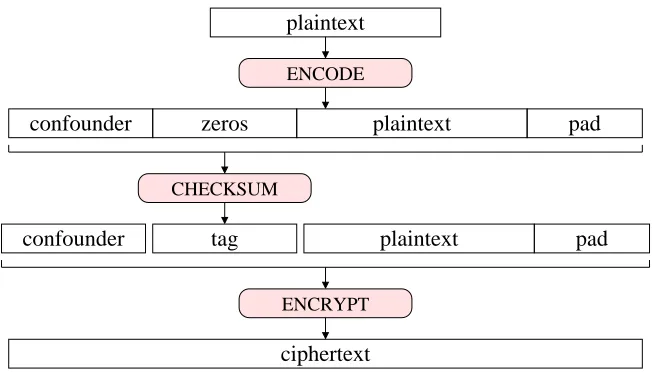
Figure 1: Encode-then-Checksum-then-Encrypt paradigm used in General Profile of Kerberos v.5.
The next construction specifies in more detail how Kerberos’ encryption operates, i.e. what specific algorithms instantiate the generic composition method of Construction 3.1.
Construction 3.2. [Authenticated encryption in Kerberos: General Profile] Let E: {0,1}k×{0,1}n→ {0,1}nbe a blockcipher. LetSE = (Ke,E,D) be the associated CBC encryption mode (cf. [9] for the formal description), with IV = 0n 7. Let HF = (K
h,H) be a hash function (to be used as checksum CS) with output of length l, which is keyless or whose key is public. Let EC = (Encode,Decode) be an encoding scheme, such that Encode with MsgSp = {0,1}∗, on input M, pads it to make the length of (l+|M|) a multiple of n bits (so that decoding is unambiguous), picks a random confounder of n bits conf ← {$ 0,1}n, computes Me ← conf ∥M, and Mt ←conf ∥0l∥M, and returns (Me, Mt). Mel is defined to be conf, and Mer is the rest of Me. Decode on inputMe parses it as conf∥M, computes Mt←conf∥0l∥M, and returns (M, Mt). Then Construction 3.1 describes the authenticated encryption called General Profile8.
Security Analysis of General Profile. Some supported instantiations include DES as the blockcipher, and MD4 and MD5 as the hash function. These are not good choices for known reasons. DES is an outdated standard, since its key and block sizes are too small considering modern computing power, and collisions have been found in MD4 and MD5 [28]. However, what our results show is that using the “more secure” building blocks, such as AES and a collision-resistant hash function, will not necessarily solve the problem. More precisely, we can neither prove, nor disprove the security of the General profile in this case. What we can show is that the Encode-then-Checksum-then-Encrypt composition method does not provide integrity in general
7The Kerberos specification also allows stateful update of theIV, i.e. theIV is assigned to be the last block of
the previous ciphertext. Our analyses apply to this case as well. But, since this option is not commonly used, we do not consider it in detail. We note however, that [26] does not specify how the state and IV are updated when the receiver gets an invalid ciphertext. The only reasonable resolution preventing malicious attacks disrupting the future communication may be to issue an error message and reset theIV to 0n.
8Our analysis does not take into account stateful approaches for key derivation used in few options of General
when it uses a hash function as a checksum, even if it uses a secure encryption option for the underlying encryption scheme. We note that the theorem below does not imply that the General Profile (Construction 3.2) is insecure, but it shows the limitation of its underlying general design (Construction 3.1), when used with the given encoding scheme.
Theorem 3.3. Let EC= (Encode,Decode) be the encoding scheme, defined in Construction 3.2. There exists an IND-CPA secure encryption scheme, and a collision-resistant hash function, so that the authenticated encryption obtained via Encode-then-Checksum-then-Encrypt (Construction 3.1), does not provide integrity (is not INT-CTXT secure). Concretely, there exists an adversaryI with reasonable resources, such thatAdvintSE-′ctxt(I) = 1.
The proof is in Section 4.1. In fact, the proof also shows that the general construction is insecure, even when a secure MAC is used as checksum (with the corresponding secret key being secret, of course), but in this case, the attack makes use of a rather artificial IND-CPA scheme. The attacks we provide are similar to those in [12, 22] that show insecurity of several general composition methods. We repeat that the attacks that we provide in the proof do not translate into an attack on any of the recommended options, they just show limitations in the general composition method. Modified General Profile. We now suggest simple and easy-to-implement modifications to the General profile construction, and show that they are sufficient to prove the security of the scheme. Namely, we suggest to use a secure MAC in place of the hash function, and show that the resulting authenticated encryption scheme is secure. Note that this does not contradict Theorem 3.3, because now we look at the particular encryption scheme that the General Profile uses (Construction 3.2), i.e. CBC with zero IV. We now define the construction, and state its security.
Construction 3.4. [Modified General profile]The construction is like Construction 3.2, except that a message authentication codeMAC = (Kt,T) is used as checksumCS.
Theorem 3.5. The authenticated encryption scheme described by the Modified General Profile (Construction 3.4) is INT-CTXT and IND-CCA secure, if the underlying blockcipher is a PRF, and the underlying checksum (MAC) is a PRF.
Concretely, let E:{0,1}k× {0,1}n → {0,1}n be a blockcipher, and SE = (Ke,E,D) be the CBC encryption mode with IV = 0n, that uses E. Let MAC = (Kt,T) be a message authentication code with output of length l. Let EC = (Encode,Decode) be an encoding scheme, and SE′ = (K′,E′,D′) be the authenticated encryption scheme associated to them by Modified General Profile (Construction 3.4). Then, for any adversaryI attacking the INT-CTXT security ofSE′, that runs in time t, and makes q′e queries to the encryption oracle, and qv queries to the verification oracle, totaling µ′e and µv bits, respectively, there exists an adversary F attacking the UF-CMA security of MAC, such that
AdvintSE-′ctxt(I) ≤ AdvufMAC-cma(F). (1)
Furthermore, F runs in time t, and makes qe′ queries to the tagging oracle,and qv queries to the verification oracle, totaling at mostµ′e+q′e·(2n+l−1) andµv+qv·(2n+l−1) bits, respectively. And for any adversaryA attacking the IND-CCA security ofSE′, that runs in time t, and makes qe queries to the left-right encryption oracle and qd queries to the decryption oracle, totaling µe and µdbits, respectively, there exist adversaries B and Gattacking PRF security ofE andMAC, respectively, such that
AdvindSE′-cca(A) ≤ AdvprfE (B) + 4·AdvprfMAC(G) + µ
2
e n2·2n +
2·qd
Furthermore, B runs in time t, and makes at most ⌊(µe+qe·(2n+l−1)/n)⌋ oracle queries, to-taling at mostµe+qe·(2n+l−1) bits;Gruns in timet, and makesqe+qdoracle queries, totaling at mostµe+µd+ (qe+qd)(2n+l−1) bits.
The proof is in Section 4.2. Note that the INT-CTXT security of the scheme requires only UF-CMA security of the checksum (MAC), while IND-CCA security relies on it being a PRF. As we mentioned before, any PRF MAC is also UF-CMA (Theorem 2.9), so PRF security is a sufficient assumption.
AES is believed to be a PRF, and HMAC was shown to be a PRF [7], assuming the underlying compression function is a PRF (cf. [7] for the definition of the latter). Therefore, these schemes constitute good instantiations for the above design.
3.2 Simplified Profile and the Underlying Composition Method
Kerberos designers proposed a new construction that they call “Simplified profile” (cf. Section 5 in [26], and [25]). Again, we start with a more general composition method that outlines the design.
Construction 3.6. [Encode-then-Encrypt&MAC]LetSE = (Ke,E,D),MAC = (Kt,T), and EC = (Encode,Decode) be an encryption scheme, a MAC scheme, and an encoding scheme. The message space of corresponding Encode-then-Encrypt&MAC scheme SE′ = (K′,E′,D′), is that of EC, and the algorithms are defined as follows:
• K′ runs K
e,Kt, and returns their outputs Ke∥Kt.
• E′ on inputs Ke ∥Kt and M, first gets the encodings via (Me, Mt) $
← Encode(M). It then computes C← EKe(Me),σ ← TKt(Mt), and returnsC∥σ.
• D′ on inputs K
e∥Kt and C∥σ, computes Me ← DKe(C), decodes (M, Mt) ← Decode(Me),
computes σ′← TKt(Mt), and returns M, ifσ=σ′, and⊥ otherwise.
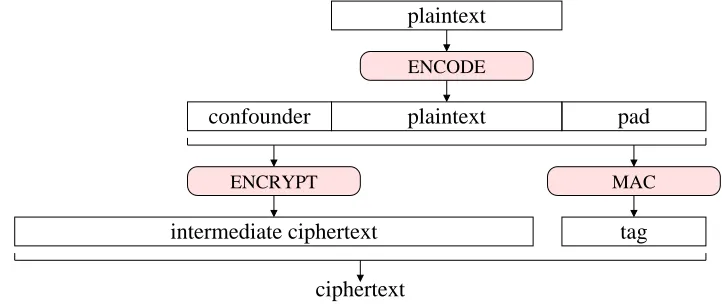
Above we assume that the outputs of the encoding scheme are compatible with the inputs toE,T. The next construction defines the Simplified profile, and Figure 2 depicts the design.
ciphertext
tag intermediate ciphertext
plaintext plaintext
pad confounder
ENCRYPT MAC
ENCODE
Construction 3.7. [Authenticated encryption in Kerberos: Simplified profile] Let E: {0,1}k×{0,1}n→ {0,1}nbe a blockcipher. LetSE = (K
e,E,D) be the associated CBC encryption mode with IV = 0n. Let MAC = (Kt,T) be a MAC scheme. Let EC = (Encode,Decode) be an encoding scheme, such that Encodewith MsgSp ={0,1}∗ on inputM pads M to make its length a multiple ofnbits (while permitting unambiguous decoding), picks a random confounder ofnbits conf ← {$ 0,1}n, computesMe←conf ∥M, and Mt←conf ∥M, and returns (Me, Mt). Decodeon input Me, parses it as conf∥M, computes Mt←Me, and returns (M, Mt). Then Construction 3.6 describes the Simplified Profile of authenticated encryption in Kerberos.
The following theorem states that the Simplified Profile provides strong security guarantees.
Theorem 3.8. The authenticated encryption schemeSE′, described by the Simplified Profile (Con-struction 3.7), is INT-CTXT and IND-CCA secure if the underlying blockcipher E is a PRF and the underlying MAC is a PRF.
Concretely, let E:{0,1}k× {0,1}n → {0,1}n be a blockcipher, and SE = (Ke,E,D) be the CBC encryption mode with IV = 0n that uses E. Let MAC = (Km,T) be a MAC scheme and EC = (Encode,Decode) be an encoding scheme. Let SE′ be the authenticated encryption scheme associated to them by Simplified Profile (Construction 3.7). Then, for any adversary I attacking INT-CTXT security ofSE′, that runs in timet, and makesqe′ queries to the encryption oracle, and qv queries to the verification oracle, totaling µ′e and µv bits, respectively, there exists an adversary F attacking UF-CMA security of MAC, such that
AdvintSE-′ctxt(I) ≤ AdvufMAC-cma(F). (3)
Furthermore, F runs in time t and makes q′e queries to the tagging oracle and qv queries to the verification oracle, totaling at mostµ′e+qe′ ·(2n−1) and µv+qv·(2n−1) bits, respectively. And for any adversary A attacking IND-CCA security of SE′, that runs in time t and makes qe queries to the left-right encryption oracle, andqdqueries to the decryption oracle, totaling µe and µd bits, respectively, there exist adversaries B and G attacking PRF security of E and MAC, respectively, such that
AdvindSE′-cca(A) ≤ AdvEprf(B) + 4·AdvprfMAC(G) +qe(qe−1) 2n+1 +
µ2e n2·2n+
2·qd
|RanT| , (4) where RanT denotes the set of outputs ofT. Furthermore, B runs in time t and makes at most ⌊(µe+qe·(2n−1)/n)⌋oracle queries, totaling at most µe+qe·(2n−1) bits;Gruns in timetand makesqe+qd oracle queries, totaling at mostµe+µd+ (qe+qd)·(2n−1) bits.
4
Proofs
4.1 Proof of Theorem 3.3
We present two alternative proofs of insecurity of the Encode-then-Checksum-then-Encrypt paradigm used in General Profile authenticated encryption. The first proof uses a natural encryption scheme and a not-so-natural hash function as a checksum. The second proof uses a special encryption scheme, but the checksum can be instantiated with arbitrary secure MAC.
Proof 1. Before presenting the proof, we give a high level idea. We show that the general authen-ticated encryption paradigm underlying General Profile does not preserve integrity of ciphertexts when instantiated with stateful counter (CTR) mode of the encryption scheme and a collision-resistant hash function that happens to leak the first bit of its input. The CTR mode of encryption is somewhat similar to the one-time pad, where the underlying blockcipher is applied to a counter to generate a pseudorandom pad which is then XORed with the message. Now, the ingenuity of our attack lies in showing that given any ciphertext that was output by the above scheme, one can produce another valid ciphertext by simply flipping the bits at two different positions, namely the first bit of the first and second blocks of the ciphertext. We repeat that the attack does not apply to the General Profile scheme itself.
Let E: {0,1}k× {0,1}n→ {0,1}n be a blockcipher, and letSE = (Ke,E,D) be the associated stateful counter encryption scheme, known as CTR or XOR encryption mode (cf. [9]). Its key generation algorithm Ke simply returns a random k-bit string Ke. The encryption algorithm E is stateful and maintains a counter ctr that is initially 0. E takes the key Ke, the current counter ctr, and a message M (padded if necessary to a length multiple of n-bits), and outputs ctr∥C[1]∥C[2]∥...∥C[m], where m is the total number of blocks, and for 1 ≤ i ≤ m, C[i] ← Mi⊕EKe(⟨ctr+i⟩). Here ⟨i⟩denotes the n-bit representation of an integer i. Next,E updates the
counter toctr+m+ 1. The decryption algorithmDtakesKeand a ciphertextctr∥C[1]∥...∥C[m] and outputs M[1]∥...∥M[m], where for 1 ≤ i ≤ m, M[i] ← C[i]⊕EKe(⟨ctr+i⟩). The CTR
encryption mode is proven to be IND-CPA secure ifE is a PRF [9].
Let HF = (Kh,H) be a collision-resistant hash function whose hash algorithm outputs strings of length l. Consider a modified hash function HF′ = (Kh,H′) whose hash algorithm H′ on an input key Kh and a message M, outputs M[0] ∥ HKh
(
M[1...|M|−1]
)
. We show that HF′ is also collision-resistant.
For any adversary A that can find collisions in HF′, we construct an adversary B that can find collisions in HF. B gives its own challenge key Kh toA and gets back two messages M′, N′. B computes M ← M[1′...|M′|−1], N ← N[1′...|N′|−1], and outputs M, N. Note that HK′ h(M
′) = M[0]′ ∥HKh
(
M[1′...|M′|−1]
)
=M[0]′ ∥HKh(M), andH′Kh(N
′) =N′
[0]∥HKh
(
N[1′...|N′|−1]
)
=N[0]′ ∥HKh(N).
IfH′K
h(M
′) =H′ Kh(N
′), andM′̸=N′, then it is easy to see thatH
Kh(M) =HKh(N), andM ̸=N.
B is almost as efficient as A. Therefore, ifHF is collision resistant, then so isHF′.
We now present an adversary I that breaks the INT-CTXT security of the scheme described by Construction 3.1 when it uses CTR encryption mode and modified hash function HF′ as SE and CS, respectively. I selects an arbitraryn-bit-long messageM and queries it to the encryption oracle. Let ctr∥C be the oracle’s reply. I then queries the ciphertext ctr∥C′ to the verification oracle, whereC′ is computed fromC by flipping the first bit of the first and second blocks.
We claim that the int-ctxt advantage ofIis 1. This is justified as follows. Considerconf∥σ∥M = DKe(ctr∥C). Here, σ=H′Kh(Mt), andMt=conf∥0
l+1∥M. Soσ =conf
[0]∥HKh
(
Mt[1...|Mt|−1]
)
ctr∥C can be parsed as ctr∥C[1]∥C[2]∥D, where C[1] and C[2] are the first and second blocks of C, andDis the remaining part of C. From the description of CTR encryption mode it is clear that
C[1] =conf ⊕EKe(⟨ctr+ 1⟩), and
C[2] =(σ∥M[0...n−l−2])⊕EKe(⟨ctr+ 2⟩), whereσ=conf[0]∥HKh
(
Mt[1...|Mt|−1]), andM[0...n−l−2] is the firstn−(l+ 1) bits of M.
So C[2] =(conf[0]∥HKh
(
Mt[1...|Mt|−1]
)
∥M[0...n−l−2]
)
⊕EKe(⟨ctr+ 2⟩).
Let us denote the ciphertext blocks produced by flipping the first bit of C[1] and C[2] by C′[1] and C′[2], respectively. So we have
C′[1] =(conf[0]∥conf[1...n−1]
)
⊕EKe(⟨ctr+ 1⟩) and
C′[2] =(conf[0]∥HKh
(
Mt[1...|Mt|−1])∥M[0...n−l−2])⊕EKe(⟨ctr+ 2⟩).
Let us denote the decryption ofctr∥C′by (Mel′ ∥σ′∥Mer′ ). So we haveMel′ = (conf[0]∥conf[1...n−1]),
σ′ = (conf[0]∥HKh(Mt[1...|Mt|−1])), and Mer′ =M.
Now notice that
Me′ = (Mel′ ∥Mer′ ) = (conf[0]∥conf[1...n−1])∥M, and
Mt′= (Mel′∥0l+1∥M′
er) = (conf[0]∥conf[1...n−1])∥0l+1∥M.
It is clearMt[1...|Mt|−1] =Mt′[1...|Mt′|−1]becauseMtandM
′
tdiffer only in first bit. So from above, we have
σ′ =conf[0]∥HKh(Mt[1...|Mt|−1]) =conf[0]∥HKh(Mt′[1...|Mt′|−1]) =H′Kh(M
′ t).
Thus, (Mt′, σ′) is a valid message-tag pair. Hence ctr∥C′ is a valid ciphertext that was never returned by the encryption oracle, and therefore, the int-ctxt advantage of I is 1.
I makes one oracle query of lengthnbits, and performs two operations of bit-complementation.
Proof 2. Our second proof is relatively simpler than the first one. We show that the general authenticated encryption paradigm underlying General Profile does not preserve integrity of ci-phertexts when instantiated with any arbitrary encoding scheme, an unforgeable MAC, and a special type of IND-CPA secure encryption scheme whose encryption algorithm prepends zero to the ciphertext and the decryption algorithm simply ignores the first bit of the ciphertext. In the Encode-then-Checksum-then-Encrypt paradigm encryption is the last step. So, with the above mentioned special type of encryption, one can easily produce a new valid ciphertext C′, given any ciphertext C output by the above scheme by flipping the first bit of C. We repeat that the attack does not apply to the General Profile scheme itself.
LetSE = (Ke,E,D) be any IND-CPA secure encryption scheme. Consider a modified encryption schemeSE′′ = (Ke,E′′,D′′), where E′′ on input key Ke and a messageM outputs 0∥EKe(M), and
D′′ on input key K
e and a ciphertext C outputs DKe
(
C[1...|C|−1]
)
. It is easy to see that if SE is IND-CPA secure, then so isSE′′ (cf. [12], Proof of IND-CPA security ofSE2, at the end of Section
3). Let MAC = (Kt,T) be any UF-CMA secure MAC.
It is clear thatC′ ̸=C, andC′is a valid ciphertext, becauseD′′ignores the first bit of ciphertext; therefore,DK′′
e(C
′) =D′′
Ke(C) =M. Thus, the int-ctxt advantage ofI is 1. I makes only one oracle
query of length|M|, and performs one bit-complementation. 4.2 Proof of Theorem 3.5
INT-CTXT security. We will reduce the integrity of ciphertexts of the Modified General Profile to the unforgeability of the underlying MAC scheme. The attack in Proof 1 of Section 4.1 shows that a collision-resistant hash function is not sufficient for integrity of ciphertexts. Moreover, from the attack in Proof 2 of Section 4.1, we know that even an unforgeable MAC cannot provide integrity of ciphertexts if used with any general IND-CPA secure encryption scheme. At a high level, we need an unforgeable MAC and the encryption scheme is required to have the following property for integrity of ciphertexts: for any pair of ciphertextsc, c′, ifc̸=c′ thenm̸=m′, wherem, m′ are the corresponding plaintexts. It is easy to see that while CBC with zero IV mode of encryption (or, any other standard deterministic encryption mode) satisfies this property, it may not necessarily hold for any general IND-CPA secure encryption scheme.
We now justify Equation 1. Let I be an adversary attacking the INT-CTXT security of SE′. We construct a forger F breaking the UF-CMA security ofMAC. F first runsKe to obtain a key Ke forE. It runsI and replies to its queries as follows.
For every encryption oracle queryMthatImakes,F does the following: It computes (Me, Mt)
$
←
Encode(M), and then it queriesMtto its own tagging oracle. Let us call the oracle’s replyσ. Next, F parses Me as Mel∥Mer, and formsMel∥σ∥Mer. Then, it computes C ← EKe(Mel∥σ∥Mer) and
returns C toI.
For every verification oracle queryCthatImakes,F does the following: It computesMel∥σ∥Mer ← DKe(C) and Mt ← Decode(Me), where Me = Mel∥Mer. Next, F queries (Mt, σ) to its own
verification oracle, then returns 1 to I if the same was returned by its own oracle.
We now analyze F. We claim that F is successful whenever I is successful. First of all, it is straightforward to see thatF correctly simulates the encryption oracle forI. Now, ifI is successful, then one of its verification oracle queriesC′is such that it was not returned by the encryption oracle (i.e. it’s new), and its decryption does not return ⊥. This means that Me′ must be new, where Me′(= Mel′ ∥σ′∥Mer′ ) ← DKe(C′), because the base encryption scheme SE is deterministic (CBC
with zero IV). If (Mel′ ∥σ′∥Mer′ ) is new, then eitherMel′ ∥Mer′ orσ′ must be new, which is equivalent to saying that either Mel′ ∥0n∥Mer′ (= Mt′) or σ′ must be new. This gives rise to two cases. The first case is when Mt′ is new (σ′ may or may not be new in this case). It is clear that in this case (Mt′, σ′) is a valid new message-tag pair. HenceF’s verification oracle will return 1.
The second case is when onlyσ′ is new, andMt′ is old, i.e. Mt′ is one of the messages that was queried to the tagging oracle. But then in this case,σ′ is an invalid tag, as the tagging algorithm is deterministic, and the distinct valid tag was returned as the answer to the corresponding query to the tagging oracle. Hence decryption of C′ will return⊥.
Hence, the uf-cma advantage of F is the same as the int-ctxt advantage of I. The time com-plexity of F is basically that ofI. F makes the same number of oracle queries as that of I. The total length of all the queries made byF exceeds that ofI by only a fixed number of bits, which is the number of queries times (2n+l−1), due to the use of encoding (at mostn−1 bits for padding, nbits for confounder, and lbits for tag).
IND-CPA security and INT-CTXT security of the scheme.
IND-CPA security. We show that the composed encryption scheme SE′ is IND-CPA secure if the underlying blockcipher is a PRF and the underlying MAC is a PRF.
Lemma 4.1. For any adversary S attacking IND-CPA security of SE′, that runs in time t, and makesq queries to the left-right encryption oracle, totalingµbits, there exist adversariesB andG attacking PRF security of E and MAC, such that
AdvindSE′-cpa(S)≤AdvprfE (B) + 2·Adv
prf
MAC(G) + µ2 n2·2n .
Furthermore,B runs in timetand makes at most ⌊µ+q·(2n+l−1)/n)⌋ oracle queries, totaling at most µ+q·(2n+l−1) bits; G runs in time t and makes q oracle queries, totaling at most µ+q·(2n+l−1) bits.
Proof of Lemma 4.1. We will first show that if the underlying MAC is PRF, then the encryption in the Modified General Profile is similar in terms of security to CBC encryption with random IV (Claim 4.2). Next, from the well known result of [14] (Claim 4.3), we know that CBC encryption with random IV is IND-CPA secure if the underlying block-cipher is a PRF. So, Lemma 4.1 will follow immediately from Claim 4.2 and Claim 4.3.
Claim 4.2. For any adversary S attacking IND-CPA security of SE′, that runs in time t, and makes q queries to the left-right encryption oracle, totaling µ bits, there exists an adversary D attacking IND-CPA security of CBC encryption scheme with random IV CBC$ = (Ke,E$,D$), and an adversaryGattacking PRF security of MAC, such that
AdvSEind′-cpa(S)≤AdvCBCind-cpa$ (D) + 2·AdvprfMAC(G).
Furthermore, D runs in time t and makes q queries to the left-right encryption oracle, totaling at most (µ+q·(2n+l−1)) bits; G runs in timet and makes q oracle queries, totaling at most (µ+q·(2n+l−1)) bits.
We recall a fact from [14].
Claim 4.3. [[14], Theorem 4.19] Let E: {0,1}k× {0,1}n → {0,1}n be a blockcipher, and let CBC$ = (Ke,E$,D$) be the associated CBC encryption scheme with random IV (cf. [9]). Then for any adversaryDattacking IND-CPA security of CBC$, that runs in time tand makesq queries to the left-right encryption oracle, totalingµ n-bit blocks, there exists an adversaryB attacking PRF security of E, such that
AdvindCBC-cpa$ (D)≤AdvprfE (B) +µ
2
2n .
Furthermore,B runs in time9 tand makesµ oracle queries, totaling µnbits.
Proof of Claim 4.2. At a high level the proof follows from the observation that the encoding scheme of Modified General Profile prepends a random confounder to the plaintext. So encrypting this encoded message using CBC with zero IV is equivalent to encrypting any message using CBC with “pseudorandom” IV, because the underlying blockcipher is assumed to be a PRF.
Let S be an adversary attacking IND-CPA security of SE′. For x ∈ {0,1,2,3,4,5}, we define the following experiments associated with S.
9
Experiment ExpHx
Ke ← K$ e, Kt← K$ t
RunS replying to its oracle query (M, N) as follows: (Me, Mt)
$
←Encode(M); (Ne, Nt)
$
←Encode(N);r← {$ 0,1}n Parse Me and Ne asMel∥Mer and Nel∥Ner, where|Mel|=|Nel|=n Switch (x):
Casex= 0: σ← TKt(Mt); C← EKe(Mel∥σ∥Mer)
Casex= 1: C← EKe(Mel∥r∥Mer)
Casex= 2: IV∥C← E$ K$
e(Mel∥r∥Mer)
Casex= 3: IV∥C← E$ K$
e(Nel∥r∥Ner)
Casex= 4: C← EKe(Nel∥r∥Ner)
Casex= 5: σ← TKt(Nt);C← EKe(Nel∥σ∥Ner)
Return C toS.
WhenS halts and outputs a bit, return that bit.
For x ∈ {0,1,2,3,4,5}, let Px = Pr [ExpHx = 1 ] denote the probability that ExpHx returns 1. By the definition ofAdvindSE′-cpa(S), we have
AdvindSE′-cpa(S) =P5−P0 = (P5−P4) + (P4−P3) + (P3−P2) + (P2−P1) + (P1−P0). (5)
We first show that for S, ExpH1 is indistinguishable from ExpH2. In ExpH1, (Mel∥r∥Mer) is encrypted using the CBC mode with zero IV, and the whole ciphertext is returned to S, while in
ExpH2, (Mel∥r∥Mer) is encrypted using the CBC mode with random IV, and the whole ciphertext,
except the IV, is returned toS. Note that in the latter case, the ciphertext given toShas the form of ((Mel⊕IV)∥r∥Mer) encrypted using the CBC mode with zero IV. However, sinceMel andIV are uniformly random strings, to an adversary that doesn’t know these in advance,Meland (Mel⊕IV) are indistinguishable. Hence, adversary S cannot distinguish between ExpH1 and ExpH2. The same argument applies to show that experimentsExpH3 and ExpH4 are indistinguishable inS’s view. Hence, (P4−P3) = (P2−P1) = 0. Thus, we have
AdvindSE′-cpa(S) = (P5−P4) + (P3−P2) + (P1−P0). (6)
GivenS, there exist adversariesDandG, such that the following claims hold, and these adversaries use the resources specified in Claim 4.2.
Claim 4.4. P3−P2 ≤AdvindCBC-cpa$ (D) .
Claim 4.5. (P5−P4) + (P1−P0)≤2·AdvprfMAC(G) .
Equation 6 and the above claims imply Claim 4.2.
Proof of Claim 4.4. We construct an adversary D breaking the IND-CPA security of CBC$ using adversarySas follows. For every message-pair query (M, N) thatS makes,Dfirst computes (Me, Mt)
$
← Encode(M), (Ne, Nt)
$
We analyzeD. The view ofS inExpH2 is indistinguishable from that inExpCBCind-cpa$,D-0, and the view ofS inExpH3is indistinguishable from that inExpCBCind-cpa$,D-1. Thus,P3−P2 ≤AdvindCBC-cpa$ (D).
The time complexity ofDis basically that ofS. Dmakes the same number of oracle queries as S. The total length of all the queries made by Dexceeds that ofS by only a fixed number of bits, which is the number of queries times (2n+l−1), due to the use of encoding (at most (n−1) bits for padding,n bits for confounder, andl bits for tag).
Proof of Claim 4.5. We construct adversariesG1 and G2 breaking the PRF security of MAC
using adversaryS such that
(P5−P4) + (P1−P0)≤AdvprfMAC(G2) +AdvprfMAC(G1).
G1 runs Ke to obtain a key Ke. For every message-pair query (M, N) that S makes, G1 first
computes (Me, Mt)
$
← Encode(M). Then it queries Mt to its oracle. Let’s call the oracle’s reply σ. Next, it parses Me as Mel∥Mer, forms Mel∥σ∥Mer, and computes C ← EKe(Mel∥σ∥Mer). G1
forwardsC back toS. WhenS halts and returns a bit, G1 halts and outputs the complement bit.
We analyze G1. When G1 is in the first experiment of Definition 2.8, then σ = TKt(Mt), so
G1 simulates ExpH0 perfectly, and when G1 is in the second experiment of Definition 2.8, then
σ is a random n-bit string, so G1 simulates experiment ExpH1 perfectly. Hence, (P1−P0) ≤ AdvprfMAC(G1).
AdversaryG2 can be constructed in a similar way, where for every message-pair query (M, N),
it does similar things asG1, but for message N. Thus, we have (P5−P4)≤AdvprfMAC(G2).
The time complexities ofG1, G2are basically that ofS. G1, G2 make the same number of oracle
queries as that ofS. The total length of all the queries made byG1, G2 exceed that of S by only a
fixed number of bits, which is number of queries times (2n+l−1), due to the use of encoding (at most (n−1) bits for padding, nbits for confounder, andl bits for tag).
Putting Gto be one of the adversariesG1, G2 with the larger prf-advantage we get AdvprfMAC(G2) +AdvprfMAC(G1)≤2·AdvprfMAC(G).
Thus, Claim 4.5 follows.
IND-CCA security. Equation 1, Lemma 4.1, Theorem 2.4, and Theorem 2.9 imply Equation 2. 4.3 Proof of Theorem 3.8
INT-CTXT security. We will reduce the integrity of ciphertexts of Simplified Profile to the unforgeability of the underlying MAC scheme. First, we note that an attack similar to that in Proof 2 of Section 4.1 can be mounted on Simplified Profile, too. Hence, as pointed out in Section 4.2, for the integrity of ciphertexts it is necessary that the encryption scheme satisfies the following property: for any pair of ciphertextsc, c′, ifc̸=c′ thenm̸=m′, wherem, m′ are the corresponding plaintexts. In addition, we point out again that while CBC with zero IV mode of encryption (or, any other standard deterministic encryption mode) satisfies this property, it may not necessarily hold for any general IND-CPA secure encryption scheme.
For every encryption oracle queryMthatImakes,F does the following: It computes (Me, Mt)←$
Encode(M) and then queries Mt to its own tagging oracle. Let us call the oracle’s reply σ. Next, F computes C← EKe(Me) and returns C∥σ toI.
For every verification oracle queryC∥σ that I makes,F does the following: It computes Me ← DKe(C) andMt←Decode(Me). Next,F queries (Mt, σ) to its own verification oracle and returns
1 to I, if the same was returned by its own oracle.
We now analyze F. We claim that F is successful whenever I is successful. First of all, it is straightforward to see thatF correctly simulates the encryption oracle forI. Now, ifI is successful, then one of its verification oracle queries C′∥σ′ is such that it was not returned by the encryption oracle (i.e. it’s new), and its decryption does not return ⊥. This gives rise to two cases. The first case is whenC′ is new (σ′ may or may not be new in this case). In this case,Me′ ← DKe(C′) must
be new, becauseC′ is new, and SE is deterministic. Mt′ is new, because it is equal to Me′. Thus, (Mt′, σ′) is a valid new message-tag pair. HenceF’s verification oracle will return 1.
The second case is when only σ′ is new and C′ is old. However, we show that in this case σ′ is invalid, and therefore decryption of C′ will return⊥. For the same reasons as explained above, old C′ implies that Mt′ is old, i.e. Mt′ is one of the messages which was queried to the tagging oracle. But then σ′ is an invalid tag, as the corresponding valid and distinct tag was returned as the answer to the corresponding query.
Hence, the uf-cma advantage of F is the same as the int-ctxt advantage of I. The time com-plexity of F is basically that ofI. F makes the same number of oracle queries as that of I. The total length of all the queries made byF exceeds that ofI by only a fixed number of bits, which is the number of queries times (2n−1), due to the use of encoding (at most (n−1) bits for padding, and nbits for confounder).
Before we analyze the IND-CCA security of SE′, let us claim its IND-CPA security.
IND-CPA security. Theorem 7.1 from [11] states that an encryption scheme composed via the Encode-then-Encrypt&MAC paradigm is IND-CPA if the base encoding scheme is Coll-CPA, the base MAC scheme is PRF, and the base encryption scheme is IND-CPA. However, we cannot use it directly, because the base encryption scheme in Construction 3.7 is CBC with fixed IV, which is obviously not CPA. We present a modification of Theorem 7.1 from [11] to claim the IND-CPA security of the encryption scheme in Construction 3.7, but before that we present the following construction and its security analysis:
Construction 4.6. Let SE = (Ke,E,D) be the CBC encryption scheme with IV = 0n, and EC = (Encode,Decode) be the encoding scheme of Construction 3.7. Then,SE′′ = (Ke,E′′,D′′) is defined as follows.
• E′′on inputsK
eandM first gets the encodings via (Me, Mt)
$
←Encode(M). It then computes C← EKe(Me), parses Me asconf∥M, where|conf|=n, and returns conf∥C.
• D′′ on inputs K
e and conf∥C computes Me← DKe(C), decodes (M, Mt)←Decode(Me), and
returnsM.
Claim 4.7. The schemeSE′′defined in Construction 4.6 is as secure as the CBC encryption scheme with random IV, CBC$ = (Ke,E$,D$). More precisely, for any adversary A attacking IND-CPA security ofSE′′, that runs in timet, and makesqqueries to the left-right encryption oracle, totaling µbits, there exists an adversary Dattacking IND-CPA security of CBC$, such that
Furthermore, Druns in time t and makesq queries to the left-right encryption oracle, totaling at most (µ+q·(2n−1)) bits.
Proof of Claim 4.7. The proof follows from a similar observation (as in the proof of Claim 4.2) that the random confounder prepended to the message by the encoding scheme acts as a “pseudo-random” IV in the encryption, because the underlying blockcipher is assumed to be a PRF.
We construct an adversary D, breaking the IND-CPA security of CBC$, using adversaryA. For every message-pair query (M, N) thatAmakes, Dfirst computes (Me, Mt)
$
←Encode(M), parses Me asconf∥M, where |conf|= n, pads N to multiple block lengths, and computes Ne ← conf∥N. Then it queries (Me, Ne) to its own oracle and gets back IV∥C, where IV is the first ciphertext block. Dforwards (conf ⊕IV)∥C back to A. When Ahalts and returns a bit, Dhalts and outputs that bit.
We analyze D. We claim that if D is in ExpCBCind-cpa$ -b(D) for b ∈ {0,1}, then A’s view in the simulated experiment is the same as that in the actual experiment ExpindSE′′-cpa-b(A). Hence
AdvindSE′′-cpa(A)≤AdvindCBC-cpa$ (D).
The time complexity of Dis basically that ofA. Dmakes the same number of oracle queries as that of A. The total length of all the queries made byDexceeds that ofAby only a fixed number of bits, which is the number of queries times (2n−1), due to the use of encoding (at most (n−1) bits for padding, andnbits for confounder)
From Claim 4.7 and Claim 4.3, we conclude the following.
Claim 4.8. The scheme SE′′ defined in Construction 4.6 is IND-CPA secure if the underlying blockcipher E is a PRF. More precisely, for any adversary A attacking IND-CPA security of SE′′, that runs in time t and makes q queries to the left-right encryption oracle, totaling µ bits, there exists an adversaryB attacking PRF security of E, such that
AdvindSE′′-cpa(A)≤AdvprfE (B) + µ2 n2·2n .
Furthermore,B runs in timetand makes at most⌊(µ+q·(2n−1)/n)⌋oracle queries, totaling at mostµ+q·(2n−1) bits.
The following theorem (which is a modification of Theorem 7.1 from [11]) states that the encryption scheme of Construction 3.7 is IND-CPA, if the underlying encoding scheme is Coll-CPA, the underlying MAC scheme is PRF, and the encryption scheme of Construction 4.6 is IND-CPA.
Theorem 4.9. Let SE = (Ke,E,D),MAC = (Kt,T), and EC= (Encode,Decode) be an encryp-tion scheme, a MAC, and an encoding scheme, respectively, such that the outputs of the encoding scheme are compatible with the inputs to E,T. Let SE′ and SE′′ be the associated encryption schemes as per Construction 3.7 and Construction 4.6, respectively. For any adversaryS attacking IND-CPA security of SE′, that runs in time t and makes q queries to the left-right encryption oracle, totalingµ bits, there exist adversariesA attacking IND-CPA security of SE′′,G attacking PRF security ofMAC, and C attacking Coll-CPA security of EC, such that