Mutual Information Analysis
A Universal Differential Side-Channel Attack
Benedikt Gierlichs1, Lejla Batina1, and Pim Tuyls1,2
1
K.U. Leuven, ESAT/SCD-COSIC
Kasteelpark Arenberg 10, B-3001 Leuven-Heverlee, Belgium
{bgierlic,lbatina,ptuyls}@esat.kuleuven.be
2
Philips Research Eindhoven, The Netherlands
Abstract. In this paper, we develop an information theoretic differential side-channel attack. An embedded device containing a secret key is modeled as a black box with a leakage function whose output is captured by an adversary through the noisy measure-ment of a physical observablee.g.the power consumed by the device. We assume only that the measured values depend somehow on the leakage and thus on the word being processed by the device. Without any knowledge on the particular dependency, this fact is exploited to mount a side-channel attack. We build a distinguisher which uses the Mutual Information between the observed and the leaked values as a statistical test. The Mutual Information is maximal when the hypothetical key guessed by the attacker equals the key in the device. Our approach is confirmed by experimental results. We perform power analysis on an embedded device using our Mutual Information based distinguisher and show that the correct key is clearly distinguishable. Finally, our approach allows to com-pute a good estimate of the minimal number of traces required to perform a successful attack and gives an upper bound on the information leakage in a single observation.
Keywords:Differential Side Channel Analysis (DSCA), Information Theory, Mutual Information
1 Introduction
Currently, embedded devices form the major part of the CPU market [16]. It seems that the vision of Pervasive Computing or Ambient Intelligence is being realised since we are more and more surrounded by devices such as smart cards, mobile phones, PDAs and more recently RFIDs and sensor nodes. These devices typically operate in hostile environments under control of a potential attacker and hence the data contained in them might be relatively easy compromised. Due to the tight constraints on their resources such as memory, number of gates, poweretc., it is a very challenging task to protect the information they carry in an adequate way.
In the last decade many other side-channels have been described such as electro-magnetic emanation [17], timing [9], acoustic [19]etc. Both, theory and practice have been developed and as a consequence several more advanced attacks have been pro-posed such as template [3] and higher-order attacks [12]. In parallel, a broad range of countermeasures has been put forward [4, 7, 8, 11]. For all side-channels we use the terminology Differential Side Channel Analysis (DSCA) when we refer to Differential Attacks.
DPA attacks as introduced by Kocheret al.[10] use a partitioning function to sort all power curves into two subsets. The partitioning function is defined by a special selection bit (e.g. the lsb) within an intermediate value of a (cryptographic) computation which can be predicted on the basis of a key hypothesis and a plaintext. The difference between the averages of the power consumption curves of these two subsets shows a clear peak for the correct key guess. To this distance of means test based on a partitioning of observed values we refer as a side-channel distinguisher. Other often used distinguishers are based on the Hamming weight or Hamming distance of some intermediate value which depends on a number of key and plaintext bits. In this paper we focus on univariate analysis,i.e. all functions considered are assumed to have time as at most one independent variable, but the work can be extended to the multivariate case.
Recently, a new research area appeared which deals with theoretical models for physical attacks in general and side-channel attacks in particular: Physical Observable Cryptography [14]. This line of research attempts to introduce the notion of provable security into cryptosystems that leak some side-channel information. Such attacks re-quire new models and new definitions of an adversary. Micali and Reyzin have evaluated some basic theorems of traditional black box cryptography and they have shown that these results do not hold in this new setting. In their physical observable model, the assumptions they made were very strong and their adversary is the strongest possible. This is one of the reasons why their model is hard to work with in practice and diffi-cult to apply to cryptographic primitives such as block ciphers, for which even black box security cannot be proven. This open question was the motivation for the work of Standaertet al.[20]. In their attempt to quantify the leakage, they restricted the most general assumptions from [14]. This led to a further refinement of the model and to the classification of adversaries (attacks) and leakage functions.
Our work is not following the same line of research although we also aim to introduce a more theoretical approach to side-channel analysis. More precisely, we follow the information theoretic approach in order to develop a more general attack than those previously known. The question we pose is whether one can perform a successful attack without incorporating any knowledge on the functional relationship between a physical observable,e.g.power consumption, and a leakage function,e.g. Hamming weight. We are interested in using information theoretic notions and insights to formalize side-channel concepts in such a way that each specific side-side-channel distinguisher can be seen as an instance of a Mutual Information based distinguisher. While previously used distinguishers are bound to specific classes of leakage functions, our Mutual Information based distinguisher is not.
Although information theoretical notions such as key entropy, increased entropy due to noise,etc.have been frequently used in DSCA related literature [1, 15, 6], their potential has not been fully exploited.
This paper is organized as follows. Section 2 introduces the basic notions of infor-mation theory. In Sect. 3 we introduce an inforinfor-mation theoretic model for side-channel attacks and analysis. It leads to the construction of a distinguisher that allows to infer the secret key from observed values. Section 4 provides the theoretical justification of our approach and compares it to so far widely deployed methods. In Sect. 5 we provide empirical evidence for the correctness of our model and its practicability whereas in Sect. 6 we empirically compare it to DPA and Correlation Power Analysis (CPA) [2]. In Sect. 7 we exemplify the applications of Mutual Information beyond key recovery and we conclude our work in Sect. 8.
2 Information Theory
We introduce the basic notions of information theory. For more details we refer to [5].
2.1 Information Theory Preliminaries
LetX be a random variable on a (discrete) space X with probability distribution PX.
The uncertainty that one has about the value of such a random variable when an experiment is performed, is expressed by the Shannon entropy of X which is usually denoted byH(X) or H(PX). It is defined by the following equation
H(X) =−X
x∈X
PX[X=x] log2PX[X=x]. (1)
H(X) expresses the uncertainty in bits. The entropy of the pair of random variables (X,Y) (where Y is a random variable on a space Y) is denoted by H(X,Y) and it expresses the uncertainty one has about both. We note that the entropy of two random variables is sub-additivei.e.
H(X,Y)≤H(X) +H(Y), (2)
with equality if and only if X and Y are independent. Often one is interested in the uncertainty aboutX given that one has obtained the outcome of an experiment on a related random variableY belonging to a possibly different space Y. This is expressed by the conditional entropyH(X|Y) which is defined as follows,
H(X|Y) =− X
x∈X,y∈Y
PX,Y[X=x,Y=y] log2PX|Y[X=x|Y=y], (3)
wherePX,Y denotes the joint probability distribution of XandY andPX|Y stands for
the conditional probability distribution of X given Y. When Y can be considered as an observation of Xover a noisy channel, then one often characterizes the channel by its set of conditional distributions {PY|X=x}x∈X. The reduction in uncertainty on X
obtained on X by having observedY. Hence the formula for the Mutual Information I(X;Y) is given by,
I(X;Y) =H(X)−H(X|Y) =H(X) +H(Y)−H(X,Y) =I(Y;X). (4)
The Mutual Information satisfies 0≤I(X;Y)≤H(X). The lower bound is reached if and only ifX and Y are independent. The upper bound is achieved when Y uniquely determines X. Hence, the larger the Mutual Information, the more close the relation betweenXand Y is to a one-to-one relation.
3 Side Channel Model
In this section, we describe a general model and attack methodology to exploit side-channel leakage of cryptographic devices with a minimal set of assumptions (in par-ticular, we assume only that there is a functional relationship between the leaked and observed values). In Sect. 5 we illustrate the results of our model and method in a concrete situation.
3.1 Definitions and Notations
LetA1, . . . , Al be a set of subsets of a spaceX. The setA={A1, . . . , Al}is a partition
ofX if and only ifAi∩Aj =∅ for alli6=j, i, j= 1, . . . , land ∪iAi =X. The elements
Ai, i= 1, . . . , l of Aare called atoms.
We model a device (e.g. an IC) that carries out a cryptographic operation Ek
depending on a secret keyk, modeled as the random variableK, as a physical computer
PC,i.e.an abstract computerAC with a side channel leakage functionL: (AC,L) (cf. [14]). The leakage function L models the fact, that the adversary can observe (up to a certain extent) the internal state of PC. We assume that L depends on time and on the word w being processed by PC. We model the words w being processed as a random variable W on {0,1}n. Hence the leakage functionL contains information on
W. Therefore we model the output values of L as a discrete random variable L on a spaceL={0, . . . , l}. It is furthermore assumed that l≤2n.
The random variable L1 is observed by measuring a physical observable O. The physical observableOis modeled as another random variable, on a continuous spaceO whereO =R models the most general case. Summarizing we have a model consisting of a cascade of two channels (cf. Fig.1):
1. W→L: the leakage channel through which information on the wordw is revealed at some timet=τ.
2. L → O: the measurement (observation) channel of the leakage through which O provides information onL.
During an attack the attacker obtainsq >0 observationsoi, i= 1, . . . , q, of O.
First, we consider the points of interest in time t = τi when the word w being
processed is the result of a function fk : {0,1}m → {0,1}n, x7→ fk(x) applied on an
1
Fig. 1.Schematic illustration of the cascaded channels
inputX(plaintext)2. We assume that the cryptographic primitiveEK is known to the
attacker and thatfk(·) is an intermediate result ofEK(·). The secret keykis a random
variableKon a key space{0,1}mwhich is uniformly random distributed. We will focus
on a known plaintext attack 3 where plaintexts X are chosen uniformly random from
{0,1}m.
3.2 Side Channel Attack
We denote by M = {ox1, . . . , oxq} the multi-set4 of q measurements of the physical
observableOwhen the (known) inputs x1, . . . , xq were processed by the device. A side
channel attacker has to develop a distinguisher D, which takes as input the measure-mentsox1, . . . , oxq and the plaintextsx1, . . . , xq, and creates a non-negligible advantage
for retrieving the key in the following experiment:
Experiment ExpscL: K←R{0,1}m
x1, . . . , xq ←R{0,1}m, ox1, . . . , oxq ←O
k∗ ← D(ox1, . . . , oxq;x1, . . . , xq)
The advantage Adv(ox1, . . . , oxq;x1, . . . , xq) is defined as
Adv(ox1, . . . , oxq;x1, . . . , xq) = Prob[k
∗=k].
3.3 Construction of an Information Based Distinguisher
To each possible key k′ ∈ {0,1}m, we associate a partition H
k′ = {Hk ′
0 , . . . , Hk
′
l } on
{0,1}m which is defined by
Hik′ ={x∈ {0,1}m | L(fk′(x)) =i} for i= 0, . . . , l.
The partition Hk′ induces a subdivision5 Gk′ = {Gk ′
0 , . . . , Gk
′
l } of the measurement
spaceO. The subdivision Gk′ is defined by,
Gki′ ={ox ∈O|x∈Hk
′
i }.
2
For ease of notation we assume that the key space and the plaintext space are of equal size{0,1}m,
but generalizations are straightforward.
3
Note that application to a known ciphertext scenario is straightforward.
4
A multi-set is a set in which values can appear several times.
5
LetPL and PO denote the probability distributions of the random variables L and O
respectively. We note that for a given plaintextx,O depends on the actual keykused by the device while the value of L depends on the hypothetical key k′ guessed by the attacker.
Given the multi-set of measurements M = {ox1, . . . , oxq}, and a subdivision Gk′
on O, we define the following set of conditional distributionsnP˜k|k′ O|L
k′=i(O|L=i)
ol
i=0.
The distributions ˜Pk|kO|L′=i(O = o|L = i) describe the random variable O given that
L(fk′(x)) =ifor a hypothetical key k′.
They represent a noisy observation channel L → O which depends on the hypo-thetical key k′, the actual key k, and the physical properties of the device and the measurement setup. The distributions{P˜k|kO|L′=i}li=0 are determined empirically by
gen-erating the histograms (cf. Sect. 5.1) of the measurementsox1, . . . , oxq belonging to the
atoms of Gk′ .
We define the Mutual InformationIk′k(L;O) under the key guessk′while the actual key iskas follows,
Ik′k(L;O) =H(PO)−H(Pk|k ′
O|L), (5)
wherePk|kO|L′ denotes the empirical conditional distribution used in the computation of
Hk′(O|L).
We define our distinguisher D:Oq× {0,1}m → {0,1}m by the following equation: given a multi-setM={ox1, . . . , oxq} of observations and the corresponding plaintexts
x1, . . . , xq,
D(ox1, . . . , oxq;x1, . . . , xq)7→k
∗ iff I
k∗k(L;O) = max
k′ Ik′k(L;O). (6)
The distinguisher D can be extended to retrieve also the point(s) in time t = τi
when the targeted computation fk(·) happens. Then it takes as input the multi-set of
observed traces M= {ox1(t), . . . , oxq(t)} and the plaintexts x1, . . . , xq. The extended
distinguisher is defined by,
D(ox1(t), . . . , oxq(t);x1, . . . , xq)7→(k
∗, τ) iff
Ik∗k(L;O(τ)) = max
(k′,t)Ik
′k(L;O(t)) (7)
4 Theoretical Considerations
4.1 Theoretical Justification
As mentioned above, entropy is the uncertainty about the measurements and quantify-ing this value gives us useful information such as the number of measurements required for a successful attack. Another interesting quantity is Mutual Information that mea-sures the mutual (in)dependence between variables. An advantage is that it can also be applied to non-Gaussian distributions. Hence, at first we want to address side-channel leakage by measuring this value. Intuitively, considering this function of two random variables, the maximum should be obtained for the correct key guess.
one specific data word that is an intermediate result of the computation. Therefore, it is evaluated only once by the attacker while the device handles the data word at instant(s)t=τi. Thus, for allt6=τithe device processes different words and in this case
observables are independent of the leakage function. The issue of partial dependency will be addressed at the end of this section.
More precisely, we consider the Mutual Information between the output of a leakage functionL and an observableO,i.e. the reduction in the uncertainty onLdue to the knowledge ofO for a key candidate k′, soIk′k(L;O) as defined in (5).
If the leakage functionLis computed for the correct keykwhich corresponds to the observed valuesOthen the Mutual InformationIkk(L;O) will obtain the maximal value
and for other valuesk′ (incorrect key hypotheses) the value of the Mutual Information Ik′k(L;O) will be lower.
We consider nowIk′k(L;O) for incorrect key hypotheses in all time instantstwhere
t6=τi.
Ik′k(L;O) =
=H(L(f(xi, k′)) +H(O(xi, k))−H(L(f(xi, k′)),O(xi, k)) =
=H(L(f(xi, k′)) +H(O(xi, k))−(H(L(f(xi, k′)) +H(O(xi, k))) = 0.
The first equality follows by the definition of Mutual Information and the second one from (2). On the other hand, for the correct keyk′ =kthe mutual informationIkk(L;O)
results in a strictly positive value. This follows directly from the non-negativity of Mutual Information and the fact that equality (to zero) holds if and only if two random variables are independent. So, at right timet=τi, the correct key leads to the highest
Mutual Information while at wrong time instants, incorrect key candidates result in a Mutual Information of zero. The existence of a maximum for Mutual Information as a function in time defined on a key space K is therefore proven. The uniqueness of the arguments follows directly from the assumptions on (in)dependency of a physical observable and the leakage function.
Hence, Mutual Information is theoretically equal to zero for all incorrect key guesses. This holds for all t6=τi but in practice we also get “peaks” at other moments as it is
shown in Sect. 5. The reason for this is that some data processed during the execution of the algorithm may be related with the intermediate datawin timeτi. We also mention
here that in practice we do not get zero but some values close to it as we are working with the noisy observationO of L.
Some peaks also appear for wrong key guesses, which seems to contradict the theory. These so-called “ghost peaks” occur due to the properties of the leakage function. For example, the Hamming weight of the S-box output can still be partially correlated for two different key guesses. Similar observations with respect to CPA are mentioned in [2].
4.2 Comparison of Mutual Information, DPA and CPA
between the leaked and the observed values, which is slightly more computationally expensive than standard DPA, but often gives better results.
CPA can only detect linear correlations and is therefore limited to attack scenarios where a linear approximation is justified. DPA does not require any specific dependency between the target bit and the observable, but is limited to the distance of means test, which uses less information than available. As already mentioned, this fact allows to envision the Mutual Information distinguisher as a generalization of other methods. So, the results obtained by this distinguisher are platform independent and arbitrary relationships between the power consumption and the leaked value can be assumed. The result is always expressed in bits and we can also estimate the number of measurements required for key recovery.
We compare these distinguishers from the experimental point of view in more detail in Sect. 6.
5 Experimental Results for Mutual Information
In this section, we apply the theoretical framework from Sect. 3 and provide exper-imental results based on measurements from an ATMega163 micro controller (8-bit) performing AES-128 encryption in software.6 The measurements O(t) represent the voltage drop over a 50Ω resistor inserted in the smart card reader’s ground line. We sample the power consumption att= 1, . . . ,20 000 during the first round of the AES-128 encryption of randomly chosen plaintexts7 with a constant key. Our experiments focus on the first key byte denoted byKand the first plaintext byte denoted byX, but application to the other bytes as well as to a known cipher text scenario are straight-forward.
5.1 Mutual Information Applied to Side Channel Leakage
Our Mutual Information method does not require any assumptions on the dependency between the measured value and the leaked value, except for the one that is fundamental to DSCA:the leakage and thus the power consumption of a device (partially) depends on the datawit is processing. We empirically confirm this statement with the following experiment, for which we use a sample size ofq = 50 000 power curvesoi(t) (i= 1, ..., q).
As leakage functionL, we use the value of the S-Box’s outcome for the first byte during the first round. Hence, eachoi(t) is assigned to an atom ofGk
′
byli = S-box(xi⊕k), li∈
{0, ...,255}.
First, we compute the sum of squared pairwise differences (sosd), i.e.we compute the meansmj(t) of {oi(t) |li =j} (j= 0, . . . ,255) and sum up their squared pairwise
differences (note that we omit the time parametert):
mj =
1
|{oi|li =j}|
X
oi|li=j
oi sosd=
255
X
j,n=0
(mj−mn)2.
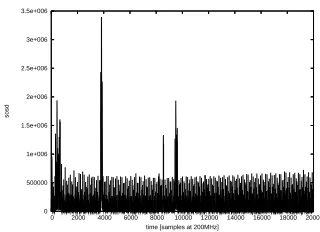
Figure 3 shows the resultingsosd trace. The obvious peaks appear during the Initial Roundkey Addition, the jointly implemented SubBytes and ShiftRows transformations, and the MixColumn operation.
6
We would like to point out that the AES encryption terminates in constant time.
7
0 0.2 0.4 0.6 0.8 1 1.2 1.4
0 2000 4000 6000 8000 10000 12000 14000 16000 18000 20000
Mutual Information I(Sbox(x \oplus k); P)
time [samples at 200MHz]
Fig. 2. Mutual Information of q = 50 000 curves
0 500000 1e+006 1.5e+006 2e+006 2.5e+006 3e+006 3.5e+006
0 2000 4000 6000 8000 10000 12000 14000 16000 18000 20000
sosd
time [samples at 200MHz]
Fig. 3.The sum of squared differences ofq= 50 000 curves
Next, we compute the Mutual InformationIkk(L;O) of the outputLof the leakage
function and the observed power consumptionO(t) according to (4, 5). The number of bins in the histogram can be chosen according to Scott’s rule [18], see the appendix.
We use 256 bins for the histogram of li (since li ∈ 0, . . . ,255) and for the
his-togram of oi(t) (since the resolution of our oscilloscope is 8 bit). This choice allows
the maximum precision but also requires a large amount of data. The resulting Mutual Information trace is depicted in Fig. 2. One observes that the peaks in the two plots are synchronous, hence the Mutual Information distinguisher is sensitive to differences in the power consumption. The applied leakage functionLpartitions the power curves into identical subsets, independently of the assumed key bytek′, since the Initial RoundKey Addition with a constant key byte and the SubBytes substitution are bijections. Hence, for any guess of the key byte the resulting partitions are merely permuted and the sta-tistical tests sosd and Mutual Information (incl. all intermediate entropy values) are independent of a key hypothesis. This means that this partitioning functionLdoes not allow key recovery. However, while the sosd metric only allows to reveal the point(s) of interest t= τi, the Mutual Information distinguisher additionally provides the
ad-versary with an estimate of the maximum Mutual Information Ikk(S-box(x⊕k);O)
inbits. This important figure gives an upper bound on the number of (secret) bits an adversary can learn from a single curve, on average. Only such a partition can lead to this estimate of the maximum Mutual Information, because it treats each possible byte of the 8-bit implementation separately. Applications of this number will be discussed in Sect. 7.
5.2 Empirical Evidence
This section aims at providing empirical evidence that the requirements from Sect. 3 are fulfilled and hence at confirming the theoretical considerations of Sect. 4.
In the next experiment, we apply the well-studied and widely agreed-on Hamming weight Model8 combined with the Mutual Information distinguisher to a set of q = 1 000 power curves O(t). We denote HW(w) as the number of bits set to “1” in the eight-bit word w, i.e. HW(w) =P8
i=1wi, HW(w) ∈ {0, . . . ,8}. Based on a key guess
k′∈ {0, . . . ,255}, each oi(t) is assigned to an atom of Gk
′
by li = HW(S-box(xi⊕k′)).
We compute the Mutual Information of the distributionsLandO(t) according to (4, 5). We set the number of bins for the histogram ofli to 9 and asoi(t) ideally is a
one-to-one function ofli (if the Hamming Weight Model was correct), we also use 9 bins for
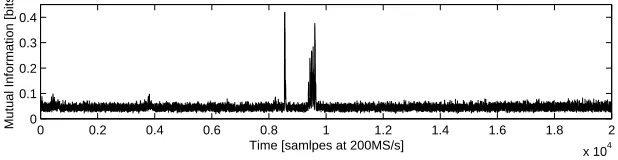
the histogram ofoi(t). Figure 4 depicts the resulting Mutual Information trace for the
correct key guessk′ =k. As can be seen when comparing to Fig. 2 and 3, the trace shows
0 0.2 0.4 0.6 0.8 1 1.2 1.4 1.6 1.8 2 x 10⁴ 0
0.1 0.2 0.3 0.4
Time [samlpes at 200MS/s]
Mutual Information [bits]
Fig. 4.Mutual Information over time for the correct key hypothesis
clear peaks at some9 of the points of interestt=τi. Hence, the first requirement from
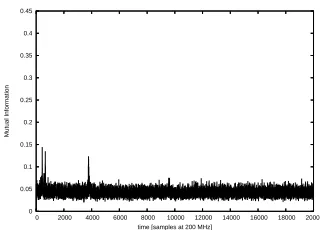
Sect. 3 is empirically confirmed. To verify whether the second requirement is fulfilled, we compute the same Mutual Information trace for all other key hypothesesk′ and test, if the highest derived Mutual Information value for any wrongk′ is lower than the one for k′ = k. More formally that is: argmaxtIkk(L,O(t))> argmaxt,k′6=k Ik′k(L,O(t)). Figure 5 shows the highest Mutual Information value (selected from the whole time frame) for every key hypothesis. The peak for the correct key hypothesis k′ = k is clearly distinguishable. Figure 6 shows the Mutual Information trace for the second best but wrong key hypothesis. The height of the visible “ghost peaks” is less than a third of the height of the peak for the correct hypothesis and they appear at different instants. Obviously, the second requirement from Sect. 3 is empirically confirmed. The maximum Mutual Information value achieved fork′ =k will be discussed in Sect. 7.
6 Comparison to DPA and CPA
In this section, we compare Mutual Information to other widely accepted and adopted statistical tests.
8
Note that our experimental platform implements a Harvard architecture and pre-charges its bus to “0”, so that the Hamming weight is equivalent to the bus’ toggle count.
9
0.05 0.1 0.15 0.2 0.25 0.3 0.35 0.4 0.45
0 50 100 150 200 250
Mutual Information
Key hypothesis k’ <-- correct key
Fig. 5.Maximum Mutual Information per key hypothesis 0 0.05 0.1 0.15 0.2 0.25 0.3 0.35 0.4 0.45
0 2000 4000 6000 8000 10000 12000 14000 16000 18000 20000
Mutual Information
time [samples at 200 MHz]
Fig. 6. Mutual Information over time for the second best key hypothesis
6.1 Comparison to Correlation Power Analysis
CPA as proposed in [2], estimates the Pearson Correlation Coefficient between a vector of observationsO(t) and a vector of predictions L
ρLO(t) =
qP
oi(t)li−
P
oi(t)
P
li
p
qP
oi(t)2−(Poi(t))2
q
qP
l2i −(P
li)2
. (8)
The summations are taken over theq measurements and the correlation coefficient has to be estimated for each time slice t = 1, . . . , T within the power curves O(t). We apply CPA to a set of power curves oi(t) (i = 1, . . . , q) and form the q predictions
according toli= HW(S-box(xi⊕k′)).10 To show the impact of the population size, we
useq = 1, . . . ,1000. Fig. 7 shows the maximum correlation coefficient,i.e.the maximum
from the overall time frame, for each key hypotheses k′ on the vertical axis over the population sizeqon the horizontal axis. The plot shows that the correct key hypothesis
0 100 200 300 400 500 600 700 800 900 1000 −1
−0.5 0 0.5 1
Population size N
Pearson Correlation
Fig. 7.Max. and min. correlation for each k′ over the number of samples used
k′=kis clearly distinguishable from aboutq = 30 upwards.
We now repeat the experiment but use the distinguisher Mutual Information instead of the correlation coefficient. More precisely, we use the same set ofq power curvesoi(t),
and the same partitioning functionli = HW(S-box(xi⊕k′)) in order to compute the
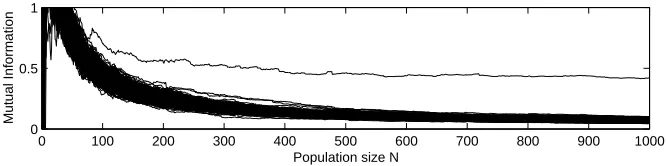
Mutual Information Ikk′(L;O) according to (4,5) for each time slice t. Again we use 9 bins for the histograms. Figure 8 shows the result of this experiment in the same manner as used for Fig. 7. The plot shows that the correct key hypothesis k′ = k is
10
0 100 200 300 400 500 600 700 800 900 1000 0
0.5 1
Population size N
Mutual Information
Fig. 8.Max. Mutual Information for eachk′over the number of samples used
clearly distinguishable from approximatelyq = 75 upwards.
Summarizing the results: CPA is able to recover the correct key from a smaller pop-ulation size than Mutual Information (q≈30 vs. q≈75). These results are explained if one considers the differences in the approaches, more precisely in the power models. CPA assumes the linear relationoi =a·li+b between the Hamming weightli and the
measured power consumption oi and is therefore limited to finding linear correlations
between O and L (cf. [2]). Mutual Information on the other hand makes no further assumption on the relation between the atomsHikof a partition and their typical power consumption inherent in the atomsgk
i of the subdivision, so that every possible power
model (in this case in nine variables) is plausible. A linear dependency seems to be a good first approximation of our platform’s power model and thus CPA needs less measurements. However, the true power model of our platform (based on the Hamming weight assumption) seems to be more complex since the correlation coefficient does not get close to its maximum value 1.
6.2 Comparison to Differential Power Analysis
(Single-bit) DPA as proposed in [10] computes the DPA bias signal
∆(t) =
P
ioi(t)li
P
ili
−
P
oi(t)(1−li)
P
i(1−li)
(9)
as the difference between the average of all measurements for which a so called target bit is 0 and the average of all measurements for which the target bit is 1. The summations are taken over the q samples and the bias signal has to be computed for each time slice within the power measurements O(t). We apply DPA to a set of power curves
oi(t) (i= 1, . . . , q) and use the least significant bit of S-box(xi ⊕k′) as the target bit
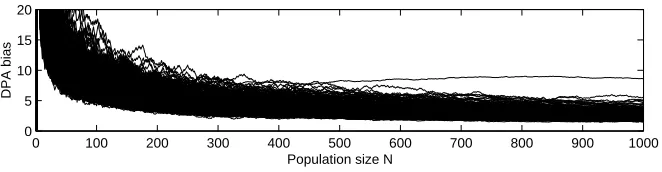
li. Again, we useq = 1, . . . ,1 000 to show the impact of the population size. Figure 9
0 100 200 300 400 500 600 700 800 900 1000 0
5 10 15 20
Population size N
DPA bias
Fig. 9.Maximum single bit DPA difference per key hypothesis
of the values in the set. This explains why Mutual Information recovers the key from fewer measurements.
We also tried multi-bit DPA as proposed in [13] and used 2 to 8 bits for the target bit function. However, in line with the conclusions of [2] and [13] we observed that, in our setup, multi-bit DPA leads to worse results than single-bit DPA due to the small population sizeq.
7 Application of the Results
This section discusses applications of Mutual Information analysis beyond key recovery.
7.1 How Many Curves Do We Need on Average?
By combining the leakage model with the notions of Fig. 1 we estimate the minimum number of measurements needed on average for non-ambiguous key recovery. We ex-emplify the approach using the Hamming weight Model.
In the Hamming weight Model, the input to channel 1 is W = S-box(x⊕k) and its outputL is the Hamming weight of the input. The Mutual Information of channel 1 can be computed analytically. We assume that the inputs to channel 1, hence the plaintexts, originate from a uniformly random distribution. Let wi = (0,1,2, . . . ,255)
andli ∈ {0, . . . ,8}(the Hamming weights ofW) for alli. Then the Mutual Information
of channel 1 is given byI(W;L) = 2.5442 bits.
The input to channel 2 is L and at its output we get O, a noisy observation ofL. From the experiment in Sect. 6 we estimate the Mutual Information of channel 2 as I(L;O) = 0.41 bits.
The uncertainty onLisH(L) = 2.5442 bits when the keys and plaintexts are chosen uniformly at random. The uncertainty onW and hence the keyKisH(K) =H(W) = log2(28) = 8 bits.
The task of an attacker is to track bits backwards through both channels in or-der to learn W and thus the key. She needs to learn 2.5442 bits from channel 2 in order to know one Hamming weight li. This implies that on average she will need to
observe E(oi) = 2.54420.41 = 6.21 measurements oi from the same Hamming weight li
to learn its value. Considering L as a random variable with probability distribution
PL = (2561 ,2568 , . . . ,2561 ) (where the probabilities are ordered according to increasing
Hamming weights) which reflects uniformly distributed plain texts, we can compute the numbervi of measurements needed for each Hamming weight li asvi = PEL(o(lii)) = P6.21L(li).
Finally, the weighted mean of the numbers of required measurements for each Ham-ming weight,E(M) =P
that are required on average to learn one Hamming weight11. For our setup this number is 55 measurements. The fact that this number slightly deviates from our experimental analysis, where we need ≈75 measurements, can be explained by the impossibility of observing 256 different plaintexts as a uniform distribution in less than 256 experiments. Hence, for a more precise estimation one needs to know the probability distribution of the plain texts. Further, our estimation does not cover the occurrence of redundant information,e.g.multiple observations of the same plaintext.
7.2 Application of the Maximum Mutual Information
The maximum amount of possible information leakage is a major concern for all man-ufacturers of secure embedded devices. Usually this figure is unknown and the security of a device is evaluated by exposing it to efficient attacks. If the attacks are successful, the device is equipped with additional countermeasures, and the procedure is repeated until the desired security level is reached.
The results of a Mutual Information analysis as presented in Sect. 5 provides a manufacturer with a very good estimate of the maximal possible information leakage. Based on his knowledge about the efficiency of the available countermeasures, where ef-ficiency denotes the increased uncertainty of an attacker, the manufacturer can directly choose an appropriate set of them and circumvent the costly and lengthy evaluation cycle.
8 Conclusion
We have introduced Information theoretical concepts to DSCA and constructed a side channel distinguisher based on Mutual Information, that efficiently and practically performs under relaxed assumptions and can be seen as a generalization of all previously applied statistical tests. In particular, we relax the assumption that a side channel adversary needs insight in the dependency of observations and leaked values. To carry out a successful Mutual Information based attack, the only requirement for an adversary is to know forwhich words processed the leakage differs. This means that the attacker does not need to know how the observation differs with the leakage.
We have also shown applications of Mutual Information in DSCA beyond key re-covery. In short it allows to asses the maximal possible information leakage, which is an important figure to manufacturers of secure embedded devices, and to estimate the minimal number of observations needed.
References
1. L. Batina and C. Jansen. Side-Channel Entropy for Modular Exponentiation Algorithms. In L. Tolhuizen, editor, Proceedings of the 24th Symposium on Information Theory in the Benelux, pages 37–44, Veldhoven, The Netherlands, May 2003. Werkgemeeschap voor Informatie-en-Communicatietheorie, Enschede, The Netherlands.
2. E. Brier, C. Clavier, and F. Olivier. Correlation power analysis with a leakage model. In M. Joye and J.-J. Quisquater, editors, Proceedings of 6th International Workshop on Cryptographic Hardware and Embedded Systems (CHES), number 3156 in Lecture Notes in Computer Science, pages 16–29. Springer-Verlag, 2004.
11
3. S. Chari, J.R. Rao, and P. Rohatgi. Template attacks. In B.S. Kaliski Jr., C¸ .K. Ko¸c, and C. Paar, editors,Proceedings of 4th International Workshop on Cryptographic Hardware and Embedded Sys-tems (CHES), number 2523 in Lecture Notes in Computer Science, pages 172–186. Springer-Verlag, 2002.
4. J.-S. Coron and L. Goubin. On Boolean and Arithmetic Masking against Differential Power Analy-sis. In C¸ .K. Ko¸c and C. Paar, editors,Proceedings of 2nd International Workshop on Cryptographic Hardware and Embedded Systems (CHES), number 1965 in Lecture Notes in Computer Science, pages 231–237. Springer-Verlag, 2000.
5. T.M. Cover and J.A. Thomas. Elements of Information Theory. John Wiley & Sons, 2006. 6. E. Dewitte, B. De Moor, and B. Preneel. Information theoretic measures applied to power and
electromagnetic traces from an FPGA performing an elliptic curve point multiplication. In B.S. Kaliski Jr., C¸ .K. Ko¸c, and C. Paar, editors,Proceedings of 25th Symposium on Information Theory in the Benelux, 2004.
7. J.D. Goli´c and C. Tymen. Multiplicative masking and power anaylsis of AES. In B.S. Kaliski Jr., C¸ .K. Ko¸c, and C. Paar, editors,Proceedings of 4th International Workshop on Cryptographic Hard-ware and Embedded Systems (CHES), number 2535 in Lecture Notes in Computer Science, pages 198–212. Springer-Verlag, 2002.
8. L. Goubin. A sound method for switching between boolean and arithmetic masking. In C¸ .K. Ko¸c, D. Naccache, and C. Paar, editors, Proceedings of 3rd International Workshop on Cryptographic Hardware and Embedded Systems (CHES), number 2162 in Lecture Notes in Computer Science, pages 3–15. Springer-Verlag, 2001.
9. P. Kocher. Timing attacks on implementations of Diffie-Hellman, RSA, DSS and other systems. In N. Koblitz, editor,Advances in Cryptology: Proceedings of CRYPTO’96, number 1109 in Lecture Notes in Computer Science, pages 104–113. Springer-Verlag, 1996.
10. P. Kocher, J. Jaffe, and B. Jun. Differential power analysis. In M. Wiener, editor,Advances in Cryptology: Proceedings of CRYPTO’99, number 1666 in Lecture Notes in Computer Science, pages 388–397. Springer-Verlag, 1999.
11. T.S. Messerges. Securing the AES finalists against power analysis attacks. In B. Schneier, editor,In Proceedings of 7th International Workshop on Fast Software Encryption Workshop (FSE), number 1978 in Lecture Notes in Computer Science. Springer-Verlag, 2000.
12. T.S. Messerges. Using second-order power analysis to attack DPA resistant software. In C¸ .K. Ko¸c and C. Paar, editors,Proceedings of the 2nd International Workshop on Cryptograpic Hardware and Embedded Systems (CHES), volume 1965 of Lecture Notes in Computer Science, pages 238–251. Springer-Verlag, 2000.
13. T.S. Messerges, E.A. Dabbish, and R.H. Sloan. Examining smart-card security under the threat of power analysis attacks. IEEE Trans. Comput., 51(5):541–552, 2002.
14. S. Micali and L. Reyzin. Physically observable cryptography. In M. Naor, editor,In Proceedings of 1st Theory of Cryptography Conference TCC, number 2951 in Lecture Notes in Computer Science, pages 278–296. Springer-Verlag, 2004.
15. S. Nikova, C. Rechberger, and V. Rijmen. Threshold implementations against side-channel attacks and glitches. In P. Ning, S. Qing, and N. Li, editors, Proceedings of Information and Commu-nications Security, 8th International Conference, ICICS 2006, number 4307 in Lecture Notes in Computer Science, pages 529–545. Springer-Verlag, 2006.
16. C. Paar. The Next Five Years of Embedded Security: Ad-hoc Networks and BMWs. In ECRYPT workshop - Cryptographic Advances in Secure Hardware - CRASH 2005, September 6-7 2005. Invited talk.
17. J.-J. Quisquater and D. Samyde. ElectroMagnetic Analysis (EMA): Measures and Couter-Measures for Smard Cards. In I. Attali and T. P. Jensen, editors,Smart Card Programming and Security (E-smart 2001), volume 2140 ofLecture Notes in Computer Science, pages 200–210. Springer-Verlag, 2001.
18. D. Scott. On optimal and data-based histograms. Biometrika, Vol. 66, No. 3., pp. 605–610, 1979. 19. A. Shamir and E. Tromer. Acoustic cryptanalysis. http://theory.csail.mit.edu/∼tromer/
acoustic/.
Appendix
Scott’s rule [18] defines the optimum bin widthb∗n as
b∗n= R∞ 6
−∞f′(x)2dx
!13
n−13
wherenis the number of measurements andfis the underlying probability distribution. For Gaussian distributionsb∗n= 3.49sn−13, wheresis the empirical standard deviation.
If one assumes Gaussian noise in the observations, he derives the number of bins as max(O)−min(O)
b∗