Translation-Based Projection for Multilingual Coreference Resolution
Altaf Rahman and Vincent Ng
Human Language Technology Research Institute University of Texas at Dallas
Richardson, TX 75083-0688
{altaf,vince}@hlt.utdallas.edu
Abstract
To build a coreference resolver for a new language, the typical approach is to first coreference-annotate documents from this tar-get language and then train a resolver on these annotated documents using supervised learn-ing techniques. However, the high cost asso-ciated with manually coreference-annotating documents needed by a supervised approach makes it difficult to deploy coreference tech-nologies across a large number of natural lan-guages. To alleviate this corpus annotation bottleneck, we examine a translation-based projection approach to multilingual corefer-ence resolution. Experimental results on two target languages demonstrate the promise of our approach.
1 Introduction
Noun phrase (NP) coreference resolution is the task of determining which NPs (or mentions) refer to each real-world entity in a document. Recent years have witnessed a surge of interest in multilin-gual coreference resolution. For instance, the ACE 2004/2005 evaluations and SemEval-2010 Shared Task 1 have both involved coreference resolution in multiple languages. As evidenced by the partici-pants in these evaluations, the most common ap-proach to building a resolver for a new language is supervised, which involves training a resolver on coreference-annotated documents from the tar-get language. Although supervised approaches work reasonably well, they present a challenge to deploy-ing coreference technologies across a large number of natural languages. Specifically, for each new lan-guage of interest, one has to hire native speakers of
the language to go through the labor-intensive, time-consuming process of hand-annotating a potentially large number of documents with coreference anno-tation before a supervised resolver can be trained.
One may argue that a potential solution to this corpus annotation bottleneck is to employ an unsu-pervised or heuristic approach to coreference resolu-tion, especially in light of the fact that they have re-cently started to rival their supervised counterparts. However, by adopting these approaches, we are sim-ply replacing the corpus annotation bottleneck by another, possibly equally serious, bottleneck, the knowledge acquisition bottleneck. Specifically, in these approaches, one has to employ knowledge of the target language to design coreference rules (e.g., Mitkov (1999), Poon and Domingos (2008), Raghu-nathan et al. (2010)) or sophisticated generative models (e.g., Haghighi and Klein (2007,2010), Ng (2008)) to combine the available knowledge sources. One could argue that designing coreference rules and generative models may not be as time-consuming as annotating a large coreference corpus. This may be true for a well-studied language like English, where we can easily compose a rule that disallows coreference between two mentions if they disagree in number and gender, for instance. How-ever, computing these features may not be as simple as we hope for a language like Chinese: the lack of morphology complicates the determination of num-ber information, and the fact that most Chinese first names are used by both genders makes gender deter-mination difficult. The difficulty in accurately com-puting features translates to difficulties in compos-ing coreference rules: for example, the aforemen-tioned rule involving gender and number agreement, as well as rules that implement traditional linguistic
constraints on coreference, may no longer be accu-rate and desirable to have if the features involved cannot be accurately computed. Consequently, we believe that research in multilingual coreference res-olution will continue to be dominated by supervised approaches.
Given the high cost of annotating data with coref-erence chains, it is crucial to explore methods for obtaining annotated data in a cost-effective manner. Motivated in part by this observation, we examine one such method that has recently shown promise for a variety of NLP tasks, translation-based projec-tion, which is composed of three steps. To coref-erence annotate a text in the target language, we (1) machine-translate it to a resource-rich language (henceforth the source language); (2) automatically produce the desired linguistic annotations (which in our case are coreference annotations) on the trans-lated text using the linguistic tool developed for the source language (which in our case is a coreference resolver) ; and (3) project the annotations from the source language to the target language.
Unlike supervised approaches, this projection ap-proach does not require any coreference-annotated data from the target language. Equally importantly, unlike its unsupervised counterparts, this approach does not require that we have any linguistic knowl-edge of the target language. In fact, we have no knowledge of the target languages we employ in our evaluation. One of our goals is to examine the fea-sibility of building a coreference resolver for a lan-guage for which we have no coreference-annotated data and no linguistic knowledge of the language.
Recall that we view projection as an approach for alleviating the corpus annotation bottleneck, not as a solution to the multilingual coreference resolu-tion problem. In fact, though rarely emphasized in previous work on applying projection, we note that projection alone cannot be used to solve multilin-gual NLP problems, including coreference resolu-tion. The reason is that every language has its own idiosyncrasies with respect to linguistic properties, and projection simply cannot produce annotations capturing those properties that are specific to the tar-get language. Our goal in this paper is to explore the extent to which projection, which does not require that we have any knowledge of the target language, can push the limits of multilingual coreference
res-olution. If our results indicate that projection is a promising approach, then the automatic coreference annotations it produces can be used to augment the manual annotations that capture the properties spe-cific to the target language, thus alleviating the cor-pus annotation bottleneck.
2 Related Work on Projection
The idea of projecting annotations from a resource-rich language to a resource-scarce language was originally proposed by Yarowsky and Ngai (2001) and subsequently developed by others (e.g., Resnik (2004), Hwa et al. (2005)). These projection al-gorithms assume as input a parallel corpus for the source language and the target language. Given the recent availability of machine translation (MT) ser-vices on the Web, researchers have focused more on translated-based projection rather than acquiring a parallel corpus themselves. MT-based projection has been applied to various NLP tasks, such as part-of-speech tagging (e.g., Das and Petrov (2011)), mention detection (e.g., Zitouni and Florian (2008)), and sentiment analysis (e.g., Mihalcea et al. (2007)).
3 Translation-Based Projection
Recall that our MT-based projection approach to coreference resolution is composed of three steps. Given a text in the target language, we (1) machine-translate the text to the source language; (2) au-tomatically produce coreference annotations on the translated text using a coreference resolver devel-oped for the source language; and (3) project the annotations from the source language to the target language. In this section, we employ our approach in three settings, which differ in terms of the ex-tent to which linguistic taggers (e.g., chunkers and named entity (NE) recognizers) for the target lan-guage are available. The goal is to examine whether these linguistic taggers can be profitably exploited to improve the performance of the projection approach. Below we assume that English and French are our source and target languages, respectively.
3.1 Setting 1: No French Taggers Available
In this setting, we assume that we do not have access to any French tagger that we can exploit to improve projection. Hence, all we can do is to employ the three steps involved in the projection approach as described at the beginning of this section to create coreference-annotated data for French. Specifically, we translate a French text to an English text using GoogleTranslate1, and create coreference chains for the translated English text using Reconcile2 (Stoy-anov et al., 2010). To project mentions from En-glish to French, we first align the EnEn-glish and French words in each pair of parallel sentences, and then project the English mentions onto the French text us-ing the alignment. However, since the alignment is noisy, the French words to which the words in the English mention are aligned may not form a con-tiguous text span. To fix this problem, we follow Yarowsky and Ngai (2001) and use the smallest text span that covers all the aligned French words to cre-ate the French mention.3 We process the English mentions in the text in a left-to-right manner, as processing the mentions sequentially enables us to ensure that an English mention is not mapped to a
1
Seehttp://translate.google.com.
2
Seehttp://www.cs.utah.edu/nlp/reconcile. We use the resolver pre-trained on the Wolverhampton corpus.
3
Other methods for projecting mentions can be found in Pos-tolache et al. (2006), for example.
French text span that has already been mapped to by a previously-processed English mention.4
To align English and French words, we trained a word alignment model using GIZA++5 (Och and Ney, 2000) on a parallel corpus comprising the English-French section of Europarl6 (Koehn, 2005) as well as all the French texts (and their translated English counterparts) for which we want to auto-matically create coreference chains. Following com-mon practice, we stemmed the parallel corpus us-ing the Porter stemmer (Porter, 1980) in order to reduce data sparseness. However, even with stem-ming, we found that many English words were not aligned to any French words by the resulting align-ment model. This would prevent many English men-tions from being projected to the French side, poten-tially harming the recall of the French coreference annotations. To improve alignment coverage, we re-trained the alignment model by supplying GIZA++ with an English-French bilingual dictionary that we assembled using three online dictionary databases: OmegaWiki, Wiktionary, and Universal Dictionary. Furthermore, if a wordwappears in both the English side and the French side in a pair of parallel sen-tences, we assume that it has the same orthographic form in both languages and hence we augment the bilingual dictionary with the entry (w,w).
Note that the use of a supervised resolver like Reconcile does not render our approach supervised, since we can replace it with any resolver, be it super-vised, heuristic, or unsupervised. In other words, we treat the resolver built for the source language as a black box that can produce coreference annotations.
3.2 Setting 2: Mention Extractor Available
Next, we consider a comparatively less resource-scarce setting where a French mention extractor is available for identifying mentions in a French text7, and describe how we can modify the projection ap-proach to exploit this French mention extractor.
Given a French text we want to
coreference-4
While we chose to process the mentions in a left-to-right manner, any order of processing the mentions would work.
5Seehttp://code.google.com/p/giza-pp/. 6
Seehttp://www.statmt.org/europarl/.
7
annotate, we first translate it to English using GoogleTranslate and align the French and English words using a French-to-English word alignment algorithm. Next, we identify the mentions in the French text using the given mention extractor, and project them onto the English text using the NP pro-jection algorithm described in Setting 1. Finally, we run Reconcile on the resulting English mentions to generate coreference chains for the translated text, and project these chains back to the French text.
As explained before, the performance of this method is sensitive to the accuracy of the NP projec-tion algorithm in recovering the English menprojec-tions, which in turn depends on the accuracy of the word alignment algorithm. To make this method more ro-bust to noisy word alignment, we make a modifica-tion to it. Rather than running Reconcile on the men-tions produced by the NP projection algorithm, we use Reconcile to identify the mentions directly from the translated text. After that, we create a mapping between the English mentions produced by the NP projection algorithm and those produced by Recon-cile using a small set of heuristics.
Specifically, letMP be the set of mentions
identi-fied by the NP projection algorithm andMRbe the
set of mentions identified by Reconcile. For each mentionmP inMP, we map it to a mention inMR
that shares the same right boundary. If this fails, we map it to a mention that covers its entire text span. If this fails again, we map it to a mention that has a par-tial overlap with it. If this still fails, we assume that mP is not found by Reconcile and simply addmPto MR. As before, we process the mentions inMP in
a left-to-right manner in order to ensure that no two mentions inMP are mapped to the same Reconcile
mention. Finally, we discard all mentions inMRthat
are not mapped by any mention inMP, and present MR to Reconcile for coreference resolution. Since
we now have a 1-to-1 mapping between the Recon-cile mentions and the French mentions, projecting the coreference results back to French is trivial.
It may not be immediately clear why the exploita-tion of the menexploita-tion extractor in this setting may yield better coreference annotations than those produced in Setting 1. To see the reason, recall that one source of errors inherent in a projection approach is word alignment errors. In Setting 1, when we tried to project English mentions to the French text, word
alignment errors would adversely affect the ability of the NP projection algorithm to correctly define the boundaries of the French mentions. Since coref-erence performance depends crucially on the abil-ity to correctly identify mentions (Stoyanov et al., 2009), the presence of word alignment errors im-plies that the resulting French coreference annota-tions could score poorly even if the English coref-erence annotations produced by Reconcile were of high quality. In the current setting, on the other hand, we reduce the sensitivity of coreference per-formance to word alignment errors via the use of the French mention extractor to produce more accurate French mention boundaries.
3.3 Setting 3: Additional Taggers Available
Finally, we consider a setting that is the least resource-scarce of the three. We assume that in ad-dition to a French mention extractor, we have access to other French linguistic taggers (e.g., syntactic and semantic parsers) that will allow us to generate the linguistic features needed to train a French resolver on the projected coreference annotations.
Specifically, assume that Test is a set of French texts we want to coreference-annotate, and Training is a set of French texts that is disjoint from Test but is drawn from the same domain as Test.8 To annotate the Test texts, we perform the following steps. First, we employ the French mention extractor in combi-nation with the method described in Setting 2 to au-tomatically coreference-annotate the Training texts. Next, motivated by Kobdani et al. (2011), we train a French coreference resolver on the automatically coreference-annotated training texts, using the fea-tures provided by the available linguistic taggers. Fi-nally, we apply the resolver to generate coreference chains for each Test text.
Two questions arise. First, is this method neces-sarily better than the one described in Setting 2? We hypothesize that the answer is affirmative: not only can this method exploit the knowledge about the tar-get language provided by the additional linguistic taggers, but the resulting coreference resolver may allow us to generalize from the (noisily labeled) data and make this method more robust to the noise
in-8
herent in the projected coreference annotations than the previously-described methods. Second, is this method necessarily better than projection via a par-allel corpus? Like the first question, this is also an empirical question. Nevertheless, one reason why this method is intuitively better is that it ensures that the training and test documents are drawn from the same domain. On the other hand, when project-ing annotations via a parallel corpus, we may en-counter a domain mismatch problem if the parallel corpus and the test documents come from different domains, and the coreference resolver may not work well if it is trained and tested on different domains.
4 Coreference Resolution System
To train the coreference resolver employed in Set-ting 3 in the previous section, we need to derive linguistic features from the documents in the target language. In our experiments, we employ the coref-erence data sets produced as part of the SemEval-2010 shared task on Coreference Resolution in Mul-tiple Languages. The shared task organizers have made publicly available six data sets that corre-spond to six European languages. Each data set comprises not only training and test documents that are coreference-annotated, but also a number of word-based linguistic features from which we derive mention-based linguistic features for training a solver. In this section, we will describe how this re-solver is trained and then applied to generate coref-erence chains for unseen documents.
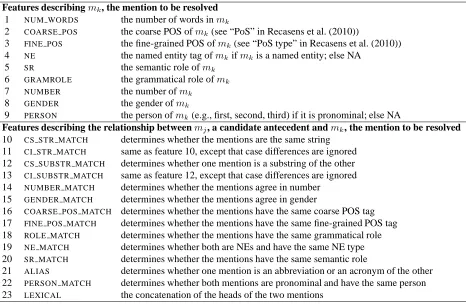
Training the coreference classifier. As our coref-erence model, we train a mention-pair model, which is a classifier that determines whether two mentions are co-referring or not (e.g., Soon et al. (2001), Ng and Cardie (2002)).9 Each instance i(mj, mk)
cor-responds tomj(a candidate antecedent) andmk(the
mention to be resolved), and is represented by a set of 23 features shown in Table 1. As we can see, each feature is either relational, capturing the relation be-tweenmj and mk, or non-relational, capturing the
linguistic property of mk. The possible values of
a relational feature (except LEXICAL) are C (com-patible), I (incom(com-patible), and NA (the comparison
9Note that any supervised coreference model can be used,
such as an entity-mention model (e.g., Luo et al. (2004), Yang et al. (2008)) or a ranking model (e.g., Denis and Baldridge (2008), Rahman and Ng (2009)).
cannot be made due to missing data). For a non-relational feature, we refer the reader to the data sets for the list of possible values.10
We follow Soon et al.’s (2001) method for creat-ing traincreat-ing instances. Specifically, we create (1) a positive instance for each anaphoric mentionmkand
its closest antecedentmj; and (2) a negative instance
formkpaired with each of the intervening mentions, mj+1, mj+2, . . . , mk−1. The classification
associ-ated with a training instance is either positive or neg-ative, depending on whether the two mentions are coreferent in the associated text. To train the classi-fier, we use SVMlight(Joachims, 1999).
Applying the classifier to a test text. After train-ing, the classifier is used to identify an antecedent for a mention in a test text. Specifically, each men-tion, mk, is compared to each preceding mention, mj, from right to left, andmj is selected as the
an-tecedent ofmkif the pair is classified as coreferent.
The process terminates as soon as an antecedent is found formkor the beginning of the text is reached.
5 Evaluation
We evaluate our MT-based projection approach for each of the three settings described in Section 3.
5.1 Experimental Setup
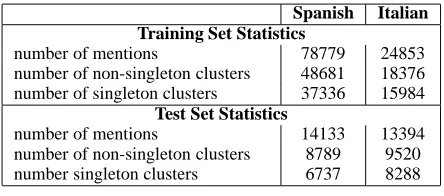
Data sets. We use the Spanish and Italian data sets from the SemEval-2010 shared task on Coreference Resolution in Multiple Languages.11 Each data set is composed of a training set and a test set. Statistics of these data sets are shown in Table 2.
Spanish Italian Training Set Statistics
number of mentions 78779 24853 number of non-singleton clusters 48681 18376 number of singleton clusters 37336 15984
Test Set Statistics
[image:5.612.316.538.522.620.2]number of mentions 14133 13394 number of non-singleton clusters 8789 9520 number singleton clusters 6737 8288
Table 2: Statistics of the data sets.
10
The data sets can be downloaded fromhttp://stel. ub.edu/semeval2010-coref/datasets.
11
Features describingmk, the mention to be resolved
1 NUM WORDS the number of words inmk
2 COARSE POS the coarse POS ofmk(see “PoS” in Recasens et al. (2010))
3 FINE POS the fine-grained POS ofmk(see “PoS type” in Recasens et al. (2010))
4 NE the named entity tag ofmkifmkis a named entity; else NA
5 SR the semantic role ofmk
6 GRAMROLE the grammatical role ofmk
7 NUMBER the number ofmk
8 GENDER the gender ofmk
9 PERSON the person ofmk(e.g., first, second, third) if it is pronominal; else NA
Features describing the relationship betweenmj, a candidate antecedent andmk, the mention to be resolved
10 CS STR MATCH determines whether the mentions are the same string 11 CI STR MATCH same as feature 10, except that case differences are ignored 12 CS SUBSTR MATCH determines whether one mention is a substring of the other 13 CI SUBSTR MATCH same as feature 12, except that case differences are ignored 14 NUMBER MATCH determines whether the mentions agree in number
15 GENDER MATCH determines whether the mentions agree in gender
16 COARSE POS MATCH determines whether the mentions have the same coarse POS tag 17 FINE POS MATCH determines whether the mentions have the same fine-grained POS tag 18 ROLE MATCH determines whether the mentions have the same grammatical role 19 NE MATCH determines whether both are NEs and have the same NE type 20 SR MATCH determines whether the mentions have the same semantic role
[image:6.612.76.542.57.363.2]21 ALIAS determines whether one mention is an abbreviation or an acronym of the other 22 PERSON MATCH determines whether both mentions are pronominal and have the same person 23 LEXICAL the concatenation of the heads of the two mentions
Table 1: Feature set for coreference resolution.
Scoring programs. To score the output of a coref-erence resolver, we employ four scoring programs, MUC (Vilain et al., 1995), B3(Bagga and Baldwin, 1998), φ3-CEAF (Luo, 2005), and BLANC
(Re-casens and Hovy, 2011), which were downloaded from the shared task website (see Footnote 10).
Gold-standard versus regular settings. The for-mat of each data set follows that of a typical CoNLL shared task data set. In other words, each row cor-responds to a word in a document; moreover, all but the last column contain the linguistic features com-puted for the words, and the last column stores the coreference information. Some of the features were computed via automatic means, but some were ex-tracted from human annotations. Given this distinc-tion, the shared task organizers defined two evalua-tion settings: in the regular setting, only the columns that were computed automatically can be used to de-rive coreference features for classifier training, and results should be reported on system mentions; on the other hand, in the gold-standard setting, only the columns that were extracted from human
annota-tions can be used to derive coreference features, and results should be reported on true mentions. We will present results corresponding to both settings. Note that these two settings should not be confused with the three settings described in Section 3.
Mention extraction. Recall that Settings 2 and 3 both assume the availability of a mention extrac-tor for extracting mentions in the target language. In our experiments, we extract mentions using two methods. First, we assume the availability of an oracle mention extractor that will enable us to ex-tract true mentions (i.e., gold-standard mentions) di-rectly from the test texts. Second, we employ simple heuristics to automatically extract system mentions.
Spanish, the best heuristic method operates as fol-lows. First, it extracts all the syntactic heads (i.e., the word tokens whose gold dependency labels are SUBJ, PRED, or GMOD). Second, for each syntac-tic head, it identifies the smallest text span contain-ing the head and all of its dependents, and creates a mention from this text span. For Italian, on the other hand, the best heuristic simply involves creating one mention for each gold NE. The reason why this sim-ple heuristic works well is that most of the Italian mentions are NEs, owing to the fact that abstract NPs and pronouns are also annotated as NEs in the Italian data set. When evaluated on the test set, the heuristic-based mention extractor achieves F-scores of 80.2 (78.4 recall, 82.1 precision) for Spanish and 92.3 (85.9 recall, 99.6 precision) for Italian.
5.2 Results and Discussion
5.2.1 Supervised Results
Our supervised systems. While our MT-based projection approach is unsupervised (i.e., it does not rely on any coreference annotations from the target language), it would be informative to see the mance of the supervised resolvers, since their perfor-mance can be viewed as a crude upper bound on the performance of our unsupervised systems. Specif-ically, we train a mention-pair model on the train-ing set ustrain-ing the 23 features shown in Table 1 and SVMlight as the underlying learning algorithm12, and apply the resulting model in combination with Soon et al.’s clustering algorithm (see Section 4) to generate coreference chains for the test texts.
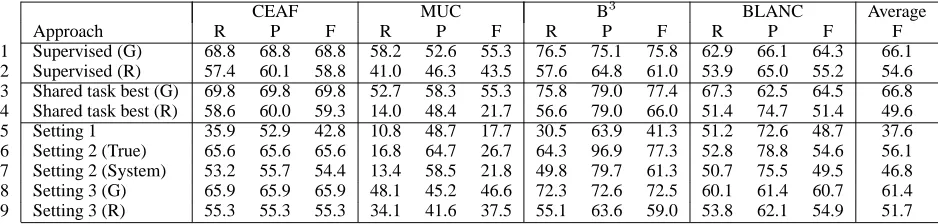
Results on the test sets, reported in terms of re-call (R), precision (P), and F-score (F) computed by the four coreference scorers, are shown in the first two rows of Table 3 (Spanish) and Table 4 (Italian). For convenience, we summarize a system’s perfor-mance using a single number, which is shown in the last column (Average) and is obtained by taking a simple average of the F-scores of the four scorers. More specifically, row 1, which is marked with a ’G’, and row 2, which is marked with a ’R’, show the results obtained under the gold-standard setting and the regular setting, respectively.
As we can see, under the gold-standard setting,
12
All SVM learning parameters in this and other experiments in this paper are set to their default values.
the supervised resolver achieves an average F-score of 66.1 (Spanish) and 65.9 (Italian). Not surpris-ingly, under the regular setting, its average F-score drops statistically significantly13 to 54.6 (Spanish) and 63.4 (Italian).14
Best systems in the shared task. To determine whether the upper bounds established by our su-pervised systems are reasonable, we show the re-sults of the best-performing resolvers participating in the shared task for both languages under the gold-standard and regular settings in rows 3 and 4 of Ta-bles 3 and 4. Since none of the participating systems achieved the best score over all four scorers, we re-port the performance of the system that has the high-est average F-score. According to the shared task website, TANL-1 (Attardi et al., 2010) achieved the best average F-score in the regular setting for Span-ish, whereas SUCRE (Kobdani and Sch¨utze, 2010) outperformed others in the remaining settings.
Comparing these best shared task results with our supervised results in rows 1 and 2, we see that our average F-score for Spanish/Gold is worse than its shared task counterpart by 0.7 points, but otherwise our system outperforms in other settings w.r.t. av-erage F-score, specifically by 5.0 points for Span-ish/Regular (due to a better MUC F-score), by 3.4– 4.7 points for Italian (due to better CEAF, B3, and BLANC scores). Overall, these results suggest that the scores achieved by our systems are at least as competitive as the best shared task scores.
5.2.2 Unsupervised Results
Next, we evaluate our projection algorithm. Setting 1. Results of our approach, when applied in Setting 1, are shown in row 5 of Tables 3 and 4. Given that it has to operate under the severe condi-tion where no linguistic taggers are available for the target language, it is perhaps not surprising to see that its performance is significantly worse than that of its supervised counterparts.
Setting 2. Recall that this setting is less resource-scarce than Setting 1 in that a mention extractor for
13
All significance test results in this paper are obtained using one-way ANOVA, withpset to 0.05.
14Separately, we determined whether the performance drop
CEAF MUC B3 BLANC Average
Approach R P F R P F R P F R P F F
1 Supervised (G) 68.8 68.8 68.8 58.2 52.6 55.3 76.5 75.1 75.8 62.9 66.1 64.3 66.1 2 Supervised (R) 57.4 60.1 58.8 41.0 46.3 43.5 57.6 64.8 61.0 53.9 65.0 55.2 54.6 3 Shared task best (G) 69.8 69.8 69.8 52.7 58.3 55.3 75.8 79.0 77.4 67.3 62.5 64.5 66.8 4 Shared task best (R) 58.6 60.0 59.3 14.0 48.4 21.7 56.6 79.0 66.0 51.4 74.7 51.4 49.6 5 Setting 1 35.9 52.9 42.8 10.8 48.7 17.7 30.5 63.9 41.3 51.2 72.6 48.7 37.6 6 Setting 2 (True) 65.6 65.6 65.6 16.8 64.7 26.7 64.3 96.9 77.3 52.8 78.8 54.6 56.1 7 Setting 2 (System) 53.2 55.7 54.4 13.4 58.5 21.8 49.8 79.7 61.3 50.7 75.5 49.5 46.8 8 Setting 3 (G) 65.9 65.9 65.9 48.1 45.2 46.6 72.3 72.6 72.5 60.1 61.4 60.7 61.4 9 Setting 3 (R) 55.3 55.3 55.3 34.1 41.6 37.5 55.1 63.6 59.0 53.8 62.1 54.9 51.7
Table 3: Results for Spanish
CEAF MUC B3 BLANC Average
Approach R P F R P F R P F R P F F
[image:8.612.78.547.58.170.2]1 Supervised (G) 74.5 74.5 74.5 31.8 67.4 43.2 74.4 93.6 82.9 58.4 79.6 62.9 65.9 2 Supervised (R) 73.7 74.3 74.0 31.9 68.0 43.4 60.8 92.5 73.3 58.4 79.6 62.9 63.4 3 Shared task best (G) 66.0 66.0 66.0 48.1 42.3 45.0 76.7 76.9 76.8 54.8 63.5 56.9 61.2 4 Shared task best (R) 57.1 66.2 61.3 50.1 50.7 50.4 63.6 79.2 70.6 55.2 68.3 57.7 60.0 5 Setting 1 17.0 26.0 20.6 8.1 28.5 12.6 14.1 30.5 19.3 50.1 62.9 32.9 21.4 6 Setting 2 (True) 73.3 73.3 73.3 14.2 60.6 23.0 72.9 96.8 83.2 51.9 77.9 53.2 58.2 7 Setting 2 (System) 60.4 70.1 64.9 17.2 68.2 27.5 59.3 97.1 73.6 52.0 82.9 53.4 54.9 8 Setting 3 (G) 64.3 64.3 64.3 28.3 63.3 39.1 65.3 87.4 74.8 55.1 74.7 57.5 58.9 9 Setting 3 (R) 61.1 62.9 61.9 29.5 63.2 40.2 60.3 84.1 70.2 55.3 72.9 58.3 57.7
Table 4: Results for Italian
the target language is available. Results of our al-gorithm, when operating under Setting 2 using true mentions and system mentions, are shown in rows 6 and 7 of Tables 3 and 4, respectively. In com-parison to the results for Setting 1, we see that the F-scores obtained under Setting 2 increase signifi-cantly, regardless of (1) the scoring programs and (2) whether true mentions or system mentions are used. These results provide evidence for our earlier hypothesis that our projection algorithm can prof-itably exploit the linguistic knowledge about the tar-get language that is available to it. In particular, the mention extractor helps make our approach less sen-sitive to word alignment and NP projection errors.
In comparison to our supervised results in rows 1 and 2, our algorithm still lags behind by about 8–10 points in average F-score. However, this should not be surprising, since our algorithm is unsupervised. Looking closer at the results, we can see that the performance lag by our approach can be attributed to its lower recall: in general, the lag in MUC recall appears to be more acute than that in B3and CEAF recall. Since MUC only scores non-singleton clus-ters wheres B3 and CEAF score both singleton and
non-singleton clusters, these results suggest that our approach is better at identifying singleton clusters than recovering coreference links.
Setting 3. Finally, we evaluate our approach in a setting where it has access to all the information available to our supervised resolvers, except for the gold-standard coreference annotations on the train-ing sets. Specifically, our approach uses projected coreference annotations to train a resolver on the training texts, whereas the supervised resolvers do so using gold-standard annotations.
Comparing Settings 2 and 3 with respect to true mentions (rows 6 and 8 of Tables 3 and 4), we see mixed results. According to MUC and BLANC, the resolvers in Setting 3 are significantly better than those in Setting 2 for both languages. According to B3, the resolvers in Setting 2 are significantly better
than those in Setting 3 for both languages. Accord-ing to CEAF, the Spanish resolvers in SettAccord-ing 3 are significantly better than their counterparts in Setting 2, but the opposite is true for the Italian resolvers.
gains in MUC recall. This suggests that the clas-sifiers being trained in Setting 3 have enabled the discovery of additional coreference links. In other words, there are benefits to be obtained just by learn-ing over noisy coreference annotations, a result that we believe is quite interesting. However, not all of these newly discovered coreference links are correct. The fact that some scoring programs (e.g., B3) are
more sensitive to spurious coreference links than the others (e.g., MUC) explains these mixed results.
Nevertheless, according to average F-score, the resolvers in Setting 3 perform significantly better than those in Setting 2 for both languages: F-score increases by 5.3 points for Spanish and 0.7 points for Italian. Similar trends can be observed when com-paring the two settings w.r.t. system mentions (rows 7 and 9 of Tables 3 and 4): F-score increases by 4.9 points for Spanish and 2.8 points for Italian.
While our Setting 3 results still underperform the supervised results in rows 1 and 2, we can see that they achieve 93–94% of the average F-scores of the supervised Spanish resolvers and 89–91% of the av-erage F-scores of the supervised Italian resolvers. Importantly, recall that our approach achieves this level of performance without relying on any gold-standard coreference annotations in Spanish and Italian, and we believe that these results demonstrate the promise of our MT-based projection approach.
Since these results suggest that our approach can-not be successfully applied without MT services, a parallel corpus for learning a word alignment model, and a mention extractor for the target language, a natural question is: to what extent do these require-ments limit the applicability of our approach? While it is the case that our approach cannot be applied to a truly resource-scarce language, it can be applied to the numerous Indian and East European languages for which the aforementioned requirements are sat-isfied but coreference-annotated data is not readily available.
6 Conclusions and Future Work
We explored the under-investigated yet challenging task of performing coreference resolution for a lan-guage for which we have no coreference-annotated data and no linguistic knowledge of the language. Our translation-based projection approach has the
flexibility to exploit any available knowledge about the target language. In experiments with Spanish and Italian, we obtained promising results: our ap-proach achieved around 90% of the performance of a supervised resolver when only a mention extrac-tor for the target language was available. We believe that this approach has the potential to allow coref-erence technologies to be deployed across a larger number of languages than is currently possible, and that this is just the beginning of a new line of work.
To gain additional insights into our approach, we plan to pursue several directions. First, we will isolate the impact of each factor that ad-versely affects its performance, including errors in projection, translation, and coreference resolu-tion in the resource-rich language. Second, we will perform an empirical comparison of two ap-proaches to projecting coreference annotations, our translation-based approach and Camargo de Souza and Orasan’s (2011) approach, where annotations are projected via a parallel corpus. Third, rather than translate from the target to the source language, we will examine whether it is better to translate all the coreference-annotated data available in the source language to the target language, and train a coref-erence model for the target language on the trans-lated data. Fourth, since the success of our pro-jection approach depends heavily on the accuracies of machine translation as well as coreference res-olution in the source language, we will determine whether their accuracies can be improved via an en-semble approach, where we employ multiple MT engines and multiple coreference resolvers. Finally, we plan to employ our approach to alleviate the corpus-annotation bottleneck, specifically by using the annotated data it produces to augment the man-ual coreference annotations that capture the specific properties of the target language.
Acknowledgments
References
Giuseppe Attardi, Maria Simi, and Stefano Dei Rossi. 2010. TANL-1: Coreference resolution by parse anal-ysis and similarity clustering. In Proceedings of the
5th International Workshop on Semantic Evaluation,
pages 108–111.
Amit Bagga and Breck Baldwin. 1998. Entity-based cross-document coreferencing using the vector space model. In Proceedings of the 36th Annual Meeting of
the Association for Computational Linguistics and the 17th International Conference on Computational Lin-guistics, pages 79–85.
Jennifer Camargo de Souza and Constantine Orasan. 2011. Can projected chains in parallel corpora help coreference resolution? In Anaphora Processing and
Applications, pages 59–69. Springer.
Dipanjan Das and Slav Petrov. 2011. Unsupervised part-of-speech tagging with bilingual graph-based projec-tions. In Proceedings of the 49th Annual Meeting of
the Association for Computational Linguistics: Hu-man Language Technologies, pages 600–609.
Pascal Denis and Jason Baldridge. 2008. Specialized models and ranking for coreference resolution. In
Pro-ceedings of the 2008 Conference on Empirical Meth-ods in Natural Language Processing, pages 660–669.
Aria Haghighi and Dan Klein. 2007. Unsupervised coreference resolution in a nonparametric bayesian model. In Proceedings of the 45th Annual Meeting of
the Association for Computational Linguistics, pages
848–855.
Aria Haghighi and Dan Klein. 2010. Coreference res-olution in a modular, entity-centered model. In
Pro-ceedings of Human Language Technologies: The 2010 Annual Conference of the North American Chapter of the Association for Computational Linguistics, pages
385–393.
Sanda Harabagiu and Steven Maiorano. 2000. Multi-lingual coreference resolution. In Proceedings of the
Sixth Applied Natural Language Processing Confer-ence, pages 142–149.
Rebecca Hwa, Philip Resnik, Amy Weinberg, Clara Cabezas, and Okan Kolak. 2005. Bootstrapping parsers via syntactic projection across parallel texts.
Natural Language Engineering, 11(3):311–325.
Thorsten Joachims. 1999. Making large-scale SVM learning practical. In Bernhard Sch ¨olkopf, Christo-pher Burges, and Alexander Smola, editors, Advances
in Kernel Methods – Support Vector Learning, pages
44–56. MIT Press, Cambridge, MA.
Hamidreza Kobdani and Hinrich Sch ¨utze. 2010. SU-CRE: A modular system for coreference resolution. In
Proceedings of the 5th International Workshop on Se-mantic Evaluation, pages 92–95.
Hamidreza Kobdani, Hinrich Sch ¨utze, Michael Schiehlen, and Hans Kamp. 2011. Bootstrap-ping coreference resolution using word associations. In Proceedings of the 49th Annual Meeting of the
Association for Computational Linguistics: Human Language Technologies, pages 783–792.
Philipp Koehn. 2005. Europarl: A parallel corpus for statistical machine translation. In Proceedings of MT
Summit X.
Xiaoqiang Luo, Abe Ittycheriah, Hongyan Jing, Nanda Kambhatla, and Salim Roukos. 2004. A mention-synchronous coreference resolution algorithm based on the Bell tree. In Proceedings of the 42nd Annual
Meeting of the Association for Computational Linguis-tics, pages 135–142.
Xiaoqiang Luo. 2005. On coreference resolution perfor-mance metrics. In Proceedings of Human Language
Technology Conference and Conference on Empirical Methods in Natural Language Processing, pages 25–
32.
Rada Mihalcea, Carmen Banea, and Janyce Wiebe. 2007. Learning multilingual subjective language via cross-lingual projections. In Proceedings of the 45th Annual
Meeting of the Association for Computational Linguis-tics, pages 976–983..
Ruslan Mitkov. 1999. Multilingual anaphora resolution.
Machine Translation, 14(3–4):281–299.
Vincent Ng and Claire Cardie. 2002. Improving machine learning approaches to coreference resolution. In
Pro-ceedings of the 40th Annual Meeting of the Association for Computational Linguistics, pages 104–111.
Vincent Ng. 2008. Unsupervised models for coreference resolution. In Proceedings of the 2008 Conference on
Empirical Methods in Natural Language Processing,
pages 640–649.
Franz Josef Och and Hermann Ney. 2000. Improved sta-tistical alignment models. In Proceedings of the 38th
Annual Meeting of the Association for Computational Linguistics.
Hoifung Poon and Pedro Domingos. 2008. Joint un-supervised coreference resolution with Markov Logic. In Proceedings of the 2008 Conference on Empirical
Methods in Natural Language Processing, pages 650–
659.
Martin F. Porter. 1980. An algorithm for suffix stripping.
Program, 14(3):130–137.
Oana Postolache, Dan Cristea, and Constantin Orasan. 2006. Transferring coreference chains through word alignment. In Proceedings of the Fifth International
Conference on Language Resources and Evaluation,
pages 889–892.
sieve for coreference resolution. In Proceedings of
the 2010 Conference on Empirical Methods in Natu-ral Language Processing, pages 492–501.
Altaf Rahman and Vincent Ng. 2009. Supervised mod-els for coreference resolution. In Proceedings of the
2009 Conference on Empirical Methods in Natural Language Processing, pages 968–977.
Marta Recasens and Eduard Hovy. 2011. BLANC: Im-plementing the Rand Index for coreference evaluation.
Natural Language Engineering, 17(4):485–510.
Marta Recasens, Llu´ıs M`arquez, Emili Sapena, M. Ant`onia Mart´ı, Mariona Taul´e, V´eronique Hoste, Massimo Poesio, and Yannick Versley. 2010. Semeval-2010 task 1: Coreference resolution in multi-ple languages. In Proceedings of the 5th International
Workshop on Semantic Evaluation, pages 1–8.
Philip Resnik. 2004. Exploiting hidden meanings: Us-ing bilUs-ingual text for monolUs-ingual annotation. In
Pro-ceedings of the 5th International Conference on Com-putational Linguistics and Intelligent Text Processing,
pages 283–299.
Wee Meng Soon, Hwee Tou Ng, and Daniel Chung Yong Lim. 2001. A machine learning approach to corefer-ence resolution of noun phrases. Computational
Lin-guistics, 27(4):521–544.
Veselin Stoyanov, Nathan Gilbert, Claire Cardie, and Ellen Riloff. 2009. Conundrums in noun phrase coref-erence resolution: Making sense of the state-of-the-art. In Proceedings of the Joint Conference of the 47th
Annual Meeting of the ACL and the 4th International Joint Conference on Natural Language Processing of the AFNLP, pages 656–664.
Veselin Stoyanov, Claire Cardie, Nathan Gilbert, Ellen Riloff, David Buttler, and David Hysom. 2010. Coref-erence resolution with reconcile. In Proceedings of the
ACL 2010 Conference Short Papers, pages 156–161.
Marc Vilain, John Burger, John Aberdeen, Dennis Con-nolly, and Lynette Hirschman. 1995. A model-theoretic coreference scoring scheme. In
Proceed-ings of the Sixth Message Understanding Conference,
pages 45–52.
Xiaofeng Yang, Jian Su, Jun Lang, Chew Lim Tan, and Sheng Li. 2008. An entity-mention model for coref-erence resolution with inductive logic programming. In Proceedings of the 46th Annual Meeting of the
As-sociation for Computational Linguistics: Human Lan-guage Technologies, pages 843–851.
David Yarowsky and Grace Ngai. 2001. Inducing mul-tilingual POS taggers and NP bracketers via robust projection across aligned corpora. In Proceedings of
the Second Meeting of the North American Chapter of the Association for Computational Linguistics, pages
200–207.
Imed Zitouni and Radu Florian. 2008. Mention detec-tion crossing the language barrier. In Proceedings of