Ames Laboratory Accepted Manuscripts
Ames Laboratory
6-6-2018
Universal doping evolution of the superconducting
gap anisotropy in single crystals of electron-doped
Ba(Fe1-xRhx)(2)As-2 from London penetration
depth measurements
Hyunsoo Kim
Iowa State University and Ames Laboratory
Makariy A. Tanatar
Iowa State University and Ames Laboratory, [email protected]
C. Martin
Iowa State University and Ames Laboratory
E. C. Blomberg
Iowa State University and Ames Laboratory
Ni Ni
Iowa State University and Ames Laboratory
See next page for additional authors
Follow this and additional works at:
https://lib.dr.iastate.edu/ameslab_manuscripts
Part of the
Condensed Matter Physics Commons
This Article is brought to you for free and open access by the Ames Laboratory at Iowa State University Digital Repository. It has been accepted for inclusion in Ames Laboratory Accepted Manuscripts by an authorized administrator of Iowa State University Digital Repository. For more information, please [email protected].
Recommended Citation
Kim, Hyunsoo; Tanatar, Makariy A.; Martin, C.; Blomberg, E. C.; Ni, Ni; Bud’ko, Sergey L.; Canfield, Paul C.; and Prozorov, Ruslan, "Universal doping evolution of the superconducting gap anisotropy in single crystals of electron-doped Ba(Fe1-xRhx)(2)As-2 from London penetration depth measurements" (2018).Ames Laboratory Accepted Manuscripts. 177.
Universal doping evolution of the superconducting gap anisotropy in
single crystals of electron-doped Ba(Fe1-xRhx)(2)As-2 from London
penetration depth measurements
Abstract
Doping evolution of the superconducting gap anisotropy was studied in single crystals of 4d-electron doped Ba(Fe1-xRhx)(2)As-2 using tunnel diode resonator measurements of the temperature variation of the London penetration depth Delta lambda(T). Single crystals with doping levels representative of an
underdoped regime x = 0.039 (T-c = 15.5 K), close to optimal doping x = 0.057 (T-c = 24.4 K) and overdoped x = 0.079 (T-c = 21.5 K) and x = 0.131 (T-c = 4.9 K) were studied. Superconducting energy gap anisotropy was characterized by the exponent, n, by fitting the data to the power-law, Delta lambda = AT(n). The exponent n varies non-monotonically with x, increasing to a maximum n = 2.5 for x = 0.079 and rapidly decreasing towards overdoped compositions to 1.6 for x = 0.131. This behavior is qualitatively similar to the doping evolution of the superconducting gap anisotropy in other iron pnictides, including hole-doped (Ba,K) Fe2As2 and 3d-electron-doped Ba(Fe,Co)(2)As-2 superconductors, finding a full gap near optimal doping and strong anisotropy toward the ends of the superconducting dome in the T-x phase diagram. The normalized superfluid density in an optimally Rh-doped sample is almost identical to the temperature-dependence in the optimally doped Ba(Fe,Co)(2)As-2 samples. Our study supports the universal
superconducting gap variation with doping and s(+/-) pairing at least in iron based superconductors of the BaFe2As2 family.
Keywords
superconductivity, London penetration depth, superfluid density, Fe-based superconductivity
Disciplines
Condensed Matter Physics | Physics
Authors
Hyunsoo Kim, Makariy A. Tanatar, C. Martin, E. C. Blomberg, Ni Ni, Sergey L. Bud’ko, Paul C. Canfield, and Ruslan Prozorov
1 © 2018 IOP Publishing Ltd Printed in the UK 1. Introduction
Iron-based superconductors derived from doped BaFe2As2 [1–3], provide rich platform for understanding superconducting pairing mechanism behind high superconducting transition
temperatures, Tc, in excess of 30 K. Because the pairing mech-anism is intimately related to the symmetry of the supercon-ducting order parameter and to the k dependence of the gap function ∆(k), studies of the superconducting gap structure, particularly gap anisotropy, are very important. Since most of the superconducting compounds require chemical substitution or doping, these studies must be conducted systematically over the doping phase diagrams of the materials.
Journal of Physics: Condensed Matter
Universal doping evolution of the
superconducting gap anisotropy in single
crystals of electron-doped Ba(Fe
1
−
x
Rh
x
)
2
As
2
from London penetration depth
measurements
Hyunsoo Kim1 , M A Tanatar , C Martin, E C Blomberg, Ni Ni, S L Bud’ko, P C Canfield and R Prozorov
Ames Laboratory US DOE and Department of Physics & Astronomy, Iowa State University, Ames, IA 50011
E-mail: [email protected]
Received 23 February 2018, revised 12 April 2018 Accepted for publication 18 April 2018
Published
Abstract
Doping evolution of the superconducting gap anisotropy was studied in single crystals of 4d-electron doped Ba(Fe1−xRhx)2As2 using tunnel diode resonator measurements of the temperature variation of London penetration depth ∆λ(T). Single crystals with doping level representative of underdoped regime x = 0.039 (Tc=15.5 K), close to optimal doping x = 0.057 (Tc=24.4 K) and overdoped x = 0.079 (Tc=21.5 K) and x = 0.131(Tc=4.9 K) were studied. Superconducting energy gap anisotropy was characterized by the exponent, n, by fitting the data to the power-law, ∆λ=ATn. The exponent n varies non-monotonically with x, increasing to a maximum n = 2.5 for x = 0.079 and rapidly decreasing towards overdoped compositions to 1.6 for x = 0.131. This behavior is qualitatively similar to the doping evolution of the superconducting gap anisotropy in other iron pnictides, including hole-doped (Ba,K)Fe2As2 and 3d-electron-doped Ba(Fe,Co)2As2 superconductors, finding full gap near optimal doping and strong anisotropy toward the ends of the superconducting dome in T-x phase diagram. The normalized superfluid density in an optimally Rh-doped sample is almost identical to the temperature-dependence in the optimally doped Ba(Fe,Co)2As2 samples. Our study supports the universal superconducting gap variation with doping with s± pairing at least iron based superconductors of BaFe2As2 family.
Keywords: superconductivity, london penetration depth, superfluid density, Fe-based superconductivity
(Some figures may appear in colour only in the online journal) AQ1
AQ2 AQ3
H Kim et al
Universal doping evolution of the superconducting gap anisotropy in single crystals of electron-doped Ba(Fe1−xRhx)2As2 from London penetration depth
measurements
Printed in the UK AABEF9
JCOMEL
© 2018 IOP Publishing Ltd 2018
00
J. Phys.: Condens. Matter
CM
0953-8984
10.1088/1361-648X/aabef9
Paper
00
Journal of Physics: Condensed Matter IOP
1 Current address: Center for Nanophysics and Advanced Materials,
Depart-ment of Physics, University of Maryland, College Park, MD 20742, United States of America
0953-8984/18/000000+5$33.00
H Kim et al
2 BaFe2As2 has attracted a great deal of attention for the pos-sibility to induce superconductivity using a variety of pertur-bations, such as chemical substitution on all three ionic sites, physical pressure, and artificial disorder. The highest Tc is achieved near the point at which the long range magnetic order is suppressed to zero. Unexpectedly, different ways to induce superconductivity give significant variation of the supercon-ducting gap anisotropy. In addition, chemical doping results in a well-defined ‘superconducting dome’ on the T(x) phase diagram. The superconducting gap anisotropy of electron-doped Ba(Fe1−xCox)2As2 was probed by London penetration depth measurements [4–6], in-plane [7] and inter-plane [8] heat transport and heat capacity [9–12] with a general consensus of the full-gap superconductivity at the optimal doping somewhat smeared by the pair-breaking effects of non-magnetic disorder due to ubiquitous s± pairing with substantial interband cou-pling resulting in two effective gaps with the magnitude ratio of roughly 1/2 [6, 13–15]. This gap structure evolves to strongly anisotropic and even nodal structure at the dome edges. On the other hand, London penetration depth [16] and thermal conductivity [16, 17] measurements reveal nodal supercon-ducting gap at the optimal doping in iso-electron substituted BaFe2(As1−xPx)2 with significant anomaly in the superfluid response near quantum critical point at the optimal doping [18]. Hole-doped Ba1−xKxFe2As2 reveals complicated doping evo-lution of the superconducting gap anisotropy with strong aniso-tropy in the underdoped compositions x < 0.25, in the range of bulk coexistence of superconductivity with magnetism [19–21], nodal superconductivity in heavily overdoped KFe2As2 [22–25] and general doping evolution and response to pair-breaking non-magnetic disorder described consistently over the entire phase diagram in a multi-band s± scenario [21, 26].
This diversity is promoted by the multi-band nature of the compounds and competition of inter-band and intra-band pairing interactions, Fermi surface nesting, and impurity scat-tering [15, 27]. In view of this complexity of the response we decided to probe superconducting gap anisotropy in other electron-doped materials. It is known that substitutions of Fe by Co and Rh give very similar doping phase diagrams [3,
28] and properties, as characterized, for example, by ther-modynamic and directional transport [29] studies. However, the superconducting gap was only studied in Co-doped compositions.
Here we report comparative study of the doping evolution of the superconducting gap structure in 4d-electron Rh-doped Ba(Fe1−xRhx)2As2 superconductors and compare with 3d-electron Co-doped samples. We find universal evolution of the superconducting gap in these compounds. London pen-etration depth at the optimal doping shows typical multi-gap behavior determined from the analysis of ∆λ(T) and super-fluid density ρs(T). The power-law function ∆λ=ATn was found to provide good description of the data for all doping levels studied, with significant variation of the exponent n, suggesting universal evolution of the superconducting gap from full-gap to strongly anisotropic-gap with deep minima in the under-doped and over-doped compositions.
2. Experimental
Single crystals of Rh-doped BaFe2As2 were grown out of FeAs self-flux [28]. Composition of the samples was mea-sured using wavelength dispersion version of electron-probe microanalysis, WDS, with the accuracy of about ±0.005. The samples used in the penetration depth study in 3He cryostat were pre-selected by measuring superconducting transitions in a simpler ‘dipper’ version of an apparatus utilizing a tunnel diode resonator (TDR) technique [30]. The sharpness of the transition was used as a selection criterion. Magneto-optical imaging of magnetic field screening in selected samples (see top right panel in figure 1) was used to characterize macro-scopic sample homogeneity [31, 32]. The data were taken at ∼5 K after zero-filed cooling and application of magnetic field.
Precision in-plane London penetration depth ∆λ(T) meas-urements using TDR technique were performed in high sta-bility a 3He-cryostat with the base temperature of ∼0.5 K. The sample was placed with its c-axis parallel to an excita-tion field, Hac∼20 mOe, much smaller than Hc1. The shift of the resonant frequency, ∆f(T) =−G4πχ(T), where χ(T) is differential magnetic susceptibility, G=f0Vs/2Vc(1−N) is a constant, N is the demagnetization factor, Vs is the sample volume and Vc is the coil volume. Constant G was deter-mined from the full frequency change by physically pulling the sample out of the coil. With the characteristic sample size, R, 4πχ= (λ/R) tanh(R/λ)−1, from which ∆λ can be obtained [33, 34].
3. Results
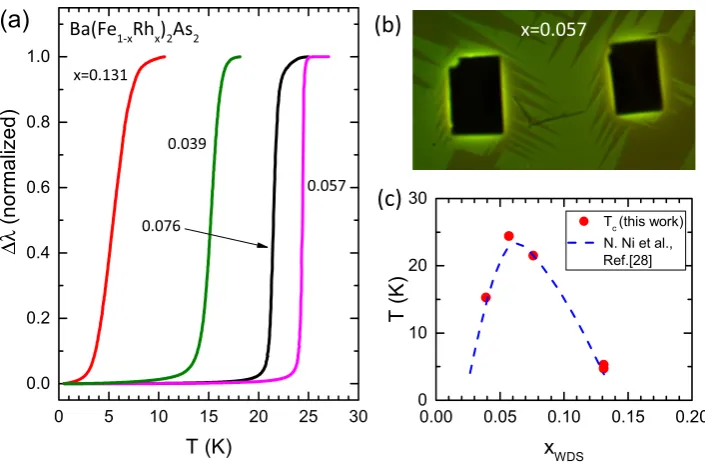
Top left panel of figure 1 shows temperature variation of the London penetration depth ∆λ(T) in samples of Ba(Fe1−xRhx)2As2 used in this study, left to right x = 0.131, 0.039, 0.076, 0.057. The data are normalized by ∆λ(Tc). Top right panel (b) in figure 1 shows magneto-optical imaging of two optimally doped samples (x = 0.057), revealing a homo-geneous field expulsion and lack of cracks and other macro-scopic inhomogeneities [32]. Bottom right panel (c) shows doping evolution of the superconducting Tc of the samples used in this study (red dots) in comparison with the data deter-mined from thermodynamic and transport measurements [28]. The superconducting transition in sample at optimal doping, x = 0.057, is very sharp, with most of penetration depth variation happening within 1 K interval. The trans-itions become broader in overdoped compostrans-itions x = 0.076 and x = 0.131 due to a finite slope of Tc(x) line leading to a bigger spread of Tc for similar variation of x in the sample. We found that the broadness of transition does not affect the low temperature λ(T) significantly as found in the similar study on the Co-doped system [4]. The doping dependence of
Tc in samples studied is in very good overall agreement with that determined from magnetization and transport measure-ments [28].
H Kim et al
3
3.1. London penetration depth and superfluid density in optimally doped Ba(Fe1−xRhx)2As2, x = 0.057
The main panel of figure 2 shows temperature variation of ∆λ(T) in optimally doped Ba(Fe1−xRhx)2As2, x = 0.057. The data are shown in a temperature range below 0.3Tc, the characteristic range in which the temperature dependence of the superconducting gap magnitude is negligible in single gap superconductors, and the dependence is determined by thermal excitation of quasi-particles over the superconducting gap. The blue open circles in the main panel of figure 1 rep-resent experimental data, the red line is best fit of the data using a power-law function, ∆λ=ATn with n=2.33
±0.02
and A=111±3 nm K−2.33. In clean limit, the temperature-dependent London penetration depth is expected to be expo-nential in full gap superconductors and is expected to be close to T-linear is superconductors with nodes in the gap. Addition of disorder pushes the dependence to T2 for both cases [6]. The power-law function is used to quantify the experimental data for the intermediate cases, when the amount of disorder is not known and actually the gap magnitude can vary either on the same Fermi surface sheet (gap anisotropy) or between different sheets of the Fermi surface (multi-band supercon-ductivity). It is empirically accepted that variation described by the power-law function with n > 3 corresponds to full-gap case, and n < 2 to a nodal case. As can be seen, the expo-nent in the sample at optimal doping is n = 2.33, in the range expected for full gap superconductors with significant effect of disorder. This is essentially the same as found in Co-doped samples [4].
Another way to analyze the penetration depth data for opti-mally Rh-doped sample is to calculate superfluid density using a
[image:5.595.124.477.63.296.2]relation, ρs(T) =λ2(0)/λ2(T). Since λ(T) =λ(0) + ∆λ(T) we need to know λ(0), which cannot be determined in our experiment. Using literature data λ(0) =200 nm determined
Figure 1. (a) Normalized temperature variation of the London penetration depth ∆λ(T)/∆λ(Tc) in samples of Ba(Fe1−xRhx)2As2, left to
right x = 0.131 (red), x = 0.039 (green), x = 0.076 (black) and x = 0.057 (magenta). (b) Magneto-optical images of selected optimally doped samples (x = 0.057) showing homogeneous expulsion of magnetic field after zero field cooling and application of magnetic field at 5 K, the base temperature of the setup. (c) Doping dependence of the superconducting Tc in samples studied. The TC was determined using
the maximum of the penetration depth derivative, d∆λ/dT, as a criterion. The composition of the samples was determined using WDS. For reference we show data from [28] (dashed line).
Figure 2. Main panel: temperature variation of ∆λ(T) in optimally doped Ba(Fe1−xRhx)2As2, x = 0.057 in the characteristic
temperature range below 0.3Tc. The open circles show experimental
data, the red line is the best fit to a power-law function, ∆λ=ATn
with n=2.33±0.02 and A=111±3 nm K−2.33. Inset shows
normalized superfluid density in Rh-doped sample x = 0.057 calculated using a relation, ρs(T) =λ2(0)/λ2(T), with λ(0) =200
nm from [35] (blue circles). Red line represents a calculated superfluid density in an optimally Co-doped Ba(Fe1−xCox)2As2 with
data after [36]. For reference we show expected variation of the superfluid density in single gap s-wave superconductor and nodal d -wave superconductor in clean limit.
[image:5.595.314.545.379.567.2]H Kim et al
4 in a similar superconductor [35], we calculated superfluid density as shown in inset in figure 2. For reference, we show a calculated superfluid density in an optimally Co-doped Ba(Fe1−xCox)2As2 which is taken from [36]. The two com-positions with 3d-transition metal substitution and 4d trans-ition metal substitution show nearly identical ρs(T), again supporting universal behavior of superconducting gap for dif-ferent types of electron doping. This temperature dependence of ρs(T) is different from either clean s-wave or clean nodal superconductor (inset in figure 2). It is rather representative of superconductors with significant gap magnitude variation over the Fermi surface with a significant effect of disorder.
[image:6.595.53.288.63.232.2]3.2. Doping evolution of the superconducting gap anisotropy
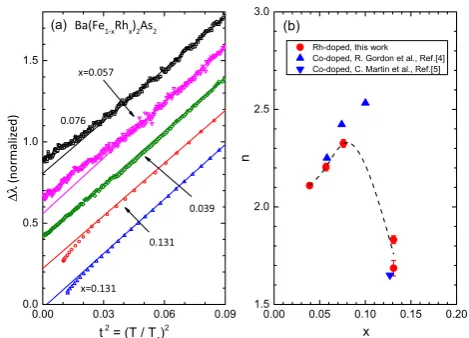
Figure 3 shows Variation of the low-temperature portion (T <0.3Tc) of London penetration depth with Rh substitution in Ba(Fe1−xRhx)2As2. To facilitate the comparison, the data are normalized by ∆λ(0.3Tc), offset vertically for clarity, and plotted versus square of the reduced temperature, (T/Tc)2. The solid straight lines represent quadratic behavior, as expected for temperature-dependent London penetration depth of the samples in dirty limit. It is clear that while samples close to optimal doping show upward deviation from a straight line on cooling, as expected for superconductors with full-gap, down-ward deviations are found in two samples with x = 0.131.
Right panel (b) of figure 3 shows doping evolution of the power-law exponent n with substitution level x of Fe with 4d
transition metal Rh (red circles) and with 3d transition metal Co (the data from [4, 5]). The data for Rh substitution were obtained by best fit of the data with power-law function for a temperature range T <0.3Tc. The exponent n takes maximum value close to optimal doping and decreases both towards the under-doped and over-doped compositions.
4. Discussion
The doping evolution of the superconducting gap aniso-tropy is one of the unique features in iron-based supercon-ductors [37]. Quite dramatic difference is found between nodal superconducting gap in samples with iso-electron P- and Ru-substitutions on one side [18, 38] and samples with electron- [37] and hole- [21] doping on the other. The dif-ference between electron- and hole-doped compositions is significantly less pronounced and can be partially assigned to a difference in the levels of disorder. Substitutions on Fe sites, contributing to the density of states at the Fermi level, in electron doped compositions leads to notably higher residual resistivity, than substitution in electronically inactive Ba site [3, 39, 40]. This difference in residual resistivity may be responsible for the significantly lower power-law exponents in optimally-doped Co (n = 2.3) [4] and Rh (n = 2.3) samples than in K-substituted BaFe2As2 (n > 3) [21].
Universal behavior of superconducting gap anisotropy in transition metal substituted electron-doped Ba(Fe1−xTx)2As2, (T = Co, Rh) is presumably the reason for BNC scaling between the magnitude of the specific heat jump at Tc and Tc value. This scaling is valid for all electron-doped Ba(Fe,T)2As2, (T = Co, Ni, Rh, Pd) and as our penetration depth study suggests holds for all measured properties.
5. Conclusion
In conclusion, systematic study of London penetration depth in electron doped Ba(Fe1−xRhx)2As2 compared with previ-ously reported Ba(Fe1−xCox)2As2 supports universal super-conducting gap structure and its evolution with doping in 122 iron based superconductors.
Acknowledgments
This work was supported by the US Department of Energy (DOE), Office of Science, Basic Energy Sciences, Materials Science and Engineering Division. The research was per-formed at Ames Laboratory, which is operated for the US DOE by Iowa State University under contract # DE-AC02-07CH11358.
ORCID iDs
Hyunsoo Kim https://orcid.org/0000-0002-9892-1080
M A Tanatar https://orcid.org/0000-0003-2129-9833
R Prozorov https://orcid.org/0000-0002-8088-6096
AQ4
AQ6
AQ7
Figure 3. (a) Variation of the ∆λ(T) normalized to its value at
T=0.3Tc with Rh concentration x in Ba(Fe1−xRhx)2As2. The data
are plotted as a function of (T/Tc)2, linearizing the dependence
for expected T2 dependence in the dirty limit (straight lines) and
offset vertically for clarity. The data for samples with x close to optimal doping, x = 0.057 (magenta symbols) and x = 0.075 (black symbols) show upward deviation from linear function, as expected for power-law dependence with n > 2. The data for under-doped composition x = 0.039 (green symbols) closely follow
T2 dependence, the data for two samples of overdoped x = 0.131
(orange circles and blue triangles) show downward deviation as expected for samples with exponent n < 2. Right panel shows doping evolution of the power-law fit exponent n. For reference we show doping evolution of the power-law exponent n in samples of Ba(Fe1−xCox)2As2 (blue triangles) as taken from [4, 5].
AQ5
H Kim et al
5 References
[1] Rotter M, Pangerl M, Tegel M and Johrendt D 2008 Angew. Chem. Int. Ed.47 7949
[2] Kasahara S et al 2010 Phys. Rev. B 81 184519
[3] Canfield P C and Bud’ko S L 2010 Ann. Rev. Condens. Matter Phys.1 27
[4] Gordon R T, Martin C, Kim H, Ni N, Tanatar M A, Schmalian J, Mazin I I, Bud’ko S L, Canfield P C and Prozorov R 2009 Phys. Rev. B 79 100506
[5] Martin C, Kim H, Gordon R T, Ni N, Thaler A, Kogan V G, Bud’ko S L, Canfield P C, Tanatar M A and Prozorov R 2010 Supercond. Sci. Technol.23 065022
[6] Prozorov R and Kogan V G 2011 Rep. Prog. Phys.74 124505 [7] Tanatar M A, Reid J P, Shakeripour H, Luo X G,
Doiron-Leyraud N, Ni N, Bud’ko S L, Canfield P C, Prozorov R and Taillefer L 2010 Phys. Rev. Lett.104 067002 [8] Reid J P, Tanatar M A, Luo X G, Shakeripour H,
Doiron-Leyraud N, Ni N, Bud’ko S L, Canfield P C, Prozorov R and Taillefer L 2010 Phys. Rev. B 82 064501
[9] Gofryk K, Sefat A S, Bauer E D, McGuire M A, Sales B C, Mandrus D, Thompson J D and Ronning F 2010 New J. Phys.12 023006
[10] Mu G, Tang J, Tanabe Y, Xu J, Heguri S and Tanigaki K 2011
Phys. Rev. B 84 054505
[11] Bud’ko S L, Ni N and Canfield P C 2009 Phys. Rev. B 79 220516
[12] Kim J S, Faeth B D and Stewart G R 2012 Phys. Rev. B 86 054509
[13] Mazin I I, Singh D J, Johannes M D and Du M H 2008 Phys. Rev. Lett.101 057003
[14] Mazin I I 2010 Nature464 183
[15] Hirschfeld P J, Korshunov M M and Mazin I I 2011 Rep. Prog. Phys.74 124508
[16] Hashimoto K et al 2010 Phys. Rev. B 81 220501 [17] Yamashita M et al 2011 Phys. Rev. B 84 060507 [18] Hashimoto K et al 2012 Science336 1554 [19] Kim H et al 2014 Phys. Rev. B 90 014517
[20] Reid J P et al 2012 Supercond. Sci. Technol.25 084013 [21] Cho K et al 2016 Sci. Adv. 2 (https://doi.org/10.1126/
sciadv.1600807)
[22] Fukazawa H et al 2009 J. Phys. Soc. Japan78 083712 [23] Dong J K, Zhou S Y, Guan T Y, Zhang H, Dai Y F, Qiu X,
Wang X F, He Y, Chen X H and Li S Y 2010 Phys. Rev. Lett.104 087005
[24] Reid J P et al 2012 Phys. Rev. Lett.109 087001 [25] Kim H, Tanatar M A, Liu Y, Sims Z C, Zhang C, Dai P,
Lograsso T A and Prozorov R 2014 Phys. Rev. B 89 174519
[26] Cho K, Kończykowski M, Murphy J, Kim H, Tanatar M A, Straszheim W E, Shen B, Wen H H and Prozorov R 2014
Phys. Rev. B 90 104514
[27] Chubukov A 2012 Ann. Rev. Condens. Matter Phys.3 57 [28] Ni N, Thaler A, Kracher A, Yan J Q, Bud’ko S L and
Canfield P C 2009 Phys. Rev. B 80 024511
[29] Tanatar M A, Ni N, Thaler A, Bud’ko S L, Canfield P C and Prozorov R 2011 Phys. Rev. B 84 014519
[30] Tanatar M A et al 2014 Phys. Rev. B 89 144514 [31] Prozorov R, Tanatar M A, Roy B, Ni N, Bud’ko S L,
Canfield P C, Hua J, Welp U and Kwok W K 2010 Phys. Rev. B 81 094509
[32] Tanatar M A, Ni N, Bud’ko S L, Canfield P C and Prozorov R 2010 Supercond. Sci. Technol.23 054002
[33] Prozorov R, Giannetta R W, Carrington A and Araujo-Moreira F M 2000 Phys. Rev. B 62 115
[34] Prozorov R and Giannetta R W 2006 Supercond. Sci. Technol.
19 R41
[35] Gordon R T et al 2010 Phys. Rev. B 82 054507 [36] Kim H et al 2010 Phys. Rev. B 82 060518
[37] Prozorov R, Cho K, Kim H and Tanatar M A 2013 J. Phys.: Conf. Ser.449 012020
[38] Qiu X et al 2012 Phys. Rev. X 2 011010
[39] Tanatar M A, Ni N, Thaler A, Bud’ko S L, Canfield P C and Prozorov R 2010 Phys. Rev. B 82 134528
[40] Liu Y, Tanatar M A, Straszheim W E, Jensen B, Dennis K W, McCallum R W, Kogan V G, Prozorov R and Lograsso T A 2014 Phys. Rev. B 89 134504
AQ8