Volume 2006, Article ID 74796, Pages1–11 DOI 10.1155/ASP/2006/74796
Performance Evaluation of Indoor Localization Techniques
Based on RF Power Measurements from Active or
Passive Devices
Damiano De Luca,1Franco Mazzenga,2Cristiano Monti,2and Marco Vari1
1RadioLabs, Consorzio Universit`a Industria-Laboratori di Radiocomunicazioni, Via A. Cavaglieri, 26, 00173 Roma, Italy
2Dipartimento di Ingegneria Elettronica, Facolt`a di Ingegneria, Universit`a degli Studi di Roma “Tor Vergata,” Via del Politecnico 1, 00133 Roma, Italy
Received 14 June 2005; Revised 10 May 2006; Accepted 18 May 2006
The performance of networks for indoor localization based on RF power measurements from active or passive devices is evaluated in terms of the accuracy, complexity, and costs. In the active device case, the terminal to be located measures the power transmitted by some devices inside its coverage area. To determine the terminal position in the area, power measurements are then compared with the data stored in an RF map of the area. A network architecture for localization based on passive devices is presented. Its operations are based on the measure of the power retransmitted from local devices interrogated by the terminal and on their identities. Performance of the two schemes is compared in terms of the probability of localization error as a function of the number (density) of active or passive devices. Analysis is carried out through simulation in a typical office-like environment whose propagation characteristics have been characterized experimentally. Considerations obtained in this work can be easily adapted to other scenarios. The procedure used for the analysis is general and can be easily extended to other situations.
Copyright © 2006 Hindawi Publishing Corporation. All rights reserved.
1. INTRODUCTION
The availability of indoor localization information is helpful to improve existing communication services as well as to cre-ate novel and more appealing ones. Several localization tech-niques have been presented and discussed in the open litera-ture [1–7]. Techniques in [3] focus on the extension of out-door satellite systems such as the GPS (and in the very near future Galileo) for indoor operations. They use indoor GPS signal repeaters and high-sensitivity receivers for the position calculation of fixed or nomadic devices. Results are very in-teresting but the real-time tracking of indoor mobile termi-nals in every location inside the building could be problem-atic.
Ultra-wideband-(UWB-) based communication net-works currently under study [8,9] also offer indoor localiza-tion at, practically, no addilocaliza-tional costs. In fact, due to the very large bandwidth allocated to UWB signals, position informa-tion based on the time difference of arrival can be very accu-rate also for indoor environments. Even though UWB tech-nology seems to be very promising, UWB-based localization systems and algorithms are still under study [9] and their performance could be compared with the results presented
in this paper that focus on other technologies and techniques for indoor localization.
In order to improve existing communication services with localization, it is necessary to integrate the communi-cation and the localization networks at some protocol level. In many cases, this integration is straightforward especially when the existing wireless communication infrastructure can be reused to include the localization feature with minor protocol modifications. An example is given in [4] where the received power of the signals transmitted by the access points (APs) of the wireless local area network (WLAN) is compared with those stored in the RF map of the area to achieve localization. The main techniques for indoor local-ization based on the measurement of the received power at the terminal provide the simplest and maybe the cheapest approach to include the localization feature inside an existing communication infrastructure. Implementation of position-ing methods based on time-delay measurements is generally more complex even though better position accuracy can be achieved provided that (indoor) multipath effects are ade-quately mitigated.
(1) the terminal measures the received power(s) of the sig-nals transmitted by some devices used for localization; (2) power samples are processed (somewhere) to estimate
the position of the terminal.
The data processing phase can be centralized or distributed. In the first case, power data are retransmitted by the terminal to a local server, while in the second case the terminal owns all the required side information necessary to calculate po-sition. The distributed approach may require the terminal to store and to (continuously) update the side information such as the location of the transmitting fixed points and so forth. This may lead to an unnecessary complexity of the entire system. In many cases, the centralized approach seems to be preferable, see [2]. Several data processing techniques mostly based on RF power measurements at the terminal have been proposed in the literature [2,6]. Typical implementations of this techniques adopt (common) communication technolo-gies such as IEEE 802.11 [10], Bluetooth [11], and so forth. In general, the accuracy of position estimation depends on the propagation characteristics of the specific environment, on the number of transmitting devices, and on the resolu-tion of the RF-radio map. In general, it can be observed that the accuracy of localization information greatly suffers for the presence of fading due to obstacles. As an example, in an office with moving persons, doors (closed or opened), the environment characteristics rapidly change and this can lead to a significant departure of the instantaneous powers mea-sured by the terminal from those stored in the radio map. An-other relevant factor influencing the position estimate is the power measurement accuracy guaranteed by the hardware inside the terminal to be located. In this paper, we present a statistical characterization of power measurement errors based on experimental data and we show that these inaccura-cies may turn out in (severe) localization errors. The perfor-mance of these techniques can be slightly improved with the use of motion prediction and estimation based on Viterbi-like algorithms or Kalman filters and so forth [6]. However in all cases, the precision of the estimated position is always related to the resolution of the radio map.
Until now, the attention was focused on localization tech-niques based on active devices transmitting beacon-like sig-nals. In this paper, we present a novel localization system based on passive devices of the RFiD type and we show that very good localization performance can be obtained with re-spect to the active case. The architecture of the proposed passive localization system is shown inFigure 1. The system comprises several passive devices scattered in the service area. The terminal to be located sends a signal in broadcast to in-terrogate the passive devices. The power transmitted by the interrogator is selected so that only the passive devices in the close proximity of the terminal respond to the interrogation. The identities of the answering passive devices and, possi-bly, the corresponding received powers are recorded by the terminal and are sent to a central server that processes the data in order to estimate the position of the terminal. The identities of the devices are used to restrict the area where terminal is located while the information on the measured power can be used to refine the position calculation. With
Passive device
Central server Service area
Terminal d1
d2
Figure1: Architecture of the considered passive localization system.
high probability, only devices in line of sight (LOS) will re-spond to the interrogation so that the free-space propagation model can be used to relate the received power level to the distancedi,i =0, 1,. . ., (seeFigure 1) between the terminal
and theith passive device.
The performance of the localization techniques based on passive devices mainly depends on their density that, due to the low cost of passive devices (simple labels), can be very high. Once passive devices have been placed in the area and their positions and identities have been registered to the lo-cal central server, no further maintenance of the system is required.1In a passive system, the selection of the multiple-access strategy required to avoid collision among the signals reaching the terminal is another important aspect for system design. Some techniques have been presented in [12] but it is out of the scope of the paper to discuss them and we as-sume that collision resolution is ensured. One simple and ef-fective method based on time backoffis briefly described in
Section 4.
To analyze the performances of the considered active and passive localization techniques, we introduce the probability of localization errorPpas a function of the number/density
of devices used for localization. In the active case, we define thePpas the probability that the measured position is
out-side a circle of radius 1.5d, wheredis the step of the regular grid of points representing the RF map of the area. The circle is centered in the actual terminal position. In the passive case, thePpis defined as the probability that the distance between
the estimated position and the actual position is greater than 1 m. Results onPpare obtained through simulation in a
real-istic office environment and accounting for power measure-ment errors due to the hardware characteristics of the ter-minal. The measurement errors are characterized in terms of an additive Gaussian noise (in dB) to be added to the av-erage power value. In order to analyze the performance in the active case, we use an extended multiwall propagation model that was developed on the basis of experimental mea-surements obtained during a campaign conducted within the University of Rome “Tor Vergata,” see [13].
1Except for the normal routine including the identification and
0 5 10 15 20 25 30 0
2 4 6 8 10 12 14 16 18 20
Figure2: Schematic representation of the considered scenario; the asterisks indicate the position of the active devices; area is 33.7×
20 m2.
It is shown that with an increase in the number of active devices, aPpdecreases, but due to power measurement noise
and quantization effects, it cannot be reduced below a limit-ing value. The dependence of thePpon the density of passive
devices in the area is studied. We show that the increase in the number of passive devices can be helpful to reduce thePp
even in the presence of power measurement errors. In fact, when the number of passive devices responding to the in-terrogation is relatively large (4 or more), relatively accurate localization can be achieved only using the identities of the responding devices. In fact, this information can be used by the server to determine the terminaluncertainty areadefined as the intersection of the coverage areas of the responding devices.
The paper is organized as follows: inSection 2we illus-trate the realistic office-like scenario considered in the paper. In Sections3and in4we analyze the limiting performance of the active and passive localization techniques, respectively. Finally inSection 5, conclusions are drawn.
2. SCENARIO DESCRIPTION
The topology of the considered office scenario is depicted in
Figure 2. The environment is characterized by small rooms aligned along two parallel corridors. Offices are accessed through fireproof doors. Small/medium-size walls are domi-nant in this kind of environment.
2.1. Multiwall channel model
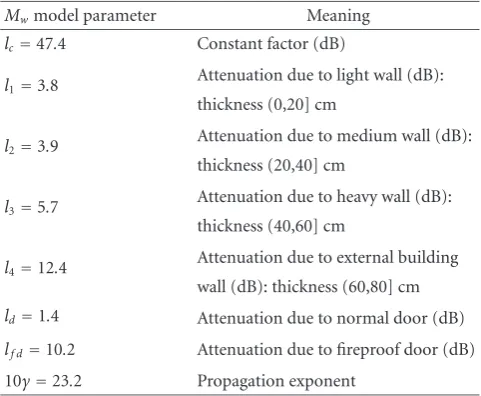
Due to the small number of transmitting devices in the area, in general it is not possible to apply simple propagation mod-els, such as free space, to relate the received power to distance. For this reason, we need to consider more complex propaga-tion models accounting for the geometry of the environment. In this paper we consider the multiwall path loss model presented in [13] which accounts for propagation at 2.4 GHz. It was obtained by the authors during an experimental
Table1: List and the meaning of the multiwall model parameters.
Mwmodel parameter Meaning
lc=47.4 Constant factor (dB)
l1=3.8 Attenuation due to light wall (dB):
thickness (0,20] cm
l2=3.9 Attenuation due to medium wall (dB):
thickness (20,40] cm
l3=5.7 Attenuation due to heavy wall (dB):
thickness (40,60] cm
l4=12.4 Attenuation due to external building
wall (dB): thickness (60,80] cm
ld=1.4 Attenuation due to normal door (dB)
lf d=10.2 Attenuation due to fireproof door (dB)
10γ=23.2 Propagation exponent
campaign within the office buildings of the University of Rome “Tor Vergata.” It is based on generalization of the clas-sical one slope loss model including an additional attenua-tion term due to losses introduced by the walls and floors encountered by the direct path between the transmitter and the receiver, that is,
L(d)=LOS(d) +Mw(dB), (1)
whereLOS(d) is
LOS(d)=10γlog10(d) +l0, (dB) (2)
andγis the path loss exponent,dis the direct transmitter-receiver distance inm, andl0is the minimum coupling loss. TheMwin (1) is the multiwall component that, for our
pur-poses, is expressed as
Mw=lc+ I
i=1 kwili+
Nd
n=1 χnld+
Nf d
n=1
λnlf d(dB), (3)
wherelcis a constant,kwiis the number of penetrated walls
of type i, li is the attenuation due to the wall of type i, i = 1, 2,. . .,I,Nd andNf d are the numbers of normal and
fireproof doors encountered by the direct path, andχn(λn)
are binary variables accounting for the status of thenth door (nth fireproof door).2The meaning of the parameters in (3) is summarized inTable 1. The constantlcin (3) includes the
constantl0in (2). The main advantages of using a multiwall model lies in its simplicity as compared to other techniques and in the possibility to calculate losses accounting for some physical characteristics of the propagation environment (e.g., the thickness of the walls traversed by the direct electromag-netic path). In addition, our model also includes the (non-negligible) loss introduced by fireproof doors in accordance
2Open:χ
to their status [13]. Limitations of the multiwall models as compared to more complex ray-tracing techniques have been analyzed in the current literature [14].
2.2. Characterization of measurement noise
The understanding of the power measurement errors due to the hardware in the terminal is important especially when the propagation map of the area (see the next section) is created on the basis of experimental data. To obtain power measurements, we used a portable device equipped with a standard IEEE 802.11 adapter. In order to characterize the power measurement accuracy of the adapter, we considered some commercial devices provided by different manufactur-ers. InFigure 3we plot the average power measured by fixed adapters receiving from an 802.11 AP under line-of-sight (LOS) propagation conditions. Data have been collected con-sidering different communication channels. From data in
Figure 3, it can be observed that adapters by different man-ufacturers provide different values of the average received power (up to 5 dB of variation) depending on the selected communication channel. This fact has to be accounted for in the creation of the RF map.
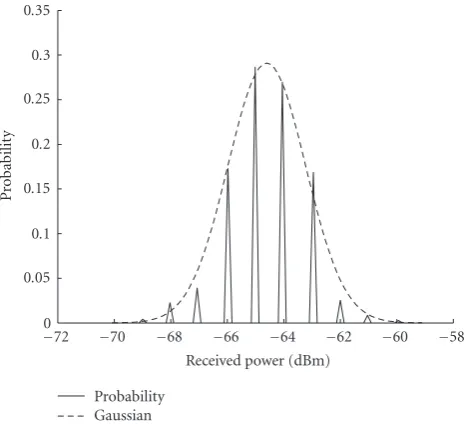
We also investigated the temporal coherence of the power measurements. We fixed the position of the AP and of the adapter in LOS conditions and we sampled the received sig-nal power each two seconds for a time interval of four hours, thus obtaining more than 7000 samples. It was observed that power measurements are quantized and they can sig-nificantly fluctuate around their mean. This fact is shown in
Figure 4where we plot the statistics of the received power of the AP beacon for a fixed terminal adapter operating in LOS propagation conditions. Power fluctuations are not negligi-ble and a Gaussian statistics (in dB) with standard deviation ofσ∼=2.5 dBm fits well to measurements. Power fluctuations can influence the performance of the localization algorithms based on the RF map which is commonly built using the av-erage power values.
3. LOCALIZATION BASED ON ACTIVE DEVICES
The positioning of the active devices in the area is a critical issue for the performance of the localization network. In an IEEE 802.11-based system, the access points (APs) can be po-sitioned to achieve the best coverage, thus reducing the over-lap among the coverage areas. Obviously, this could not be optimal for localization where it is necessary to increase the number of APs simultaneously seen by the terminal. In ad-dition, in order to save the costs of the communication net-work, coverage should be obtained using a suitable planning aiming at minimizing the number of the APs. In this case, the terminal to be located could receive one or two APs at maximum and, as shown in the following, this can impair the performance of the localization algorithm.
To assess the effectiveness of the active network for lo-calization, in the following we evaluate the limiting perfor-mance of a localization technique based on the RF map of the area. Performance is expressed in terms of the localiza-tion error probabilityPp. The considered technique operates
Ch 1 Ch 7 Ch 13
Operative channel 50
49 48 47 46 45 44 43 42 41 40
Re
ce
iv
ed
p
o
w
er
(d
B
m
)
Orinoco Enterasys Avaya
Figure3: Received average power on different WLAN channels; AP transmitter power of 17 dBm.
72 70 68 66 64 62 60 58
Received power (dBm) 0
0.05 0.1 0.15 0.2 0.25 0.3 0.35
P
robabilit
y
Probability Gaussian
Figure 4: Statistics of the average received power for a terminal adapter.
as follows:
(1) the terminal acquires the identity of the transmitting devices inside its coverage area, and for each one it measures the corresponding received RF power; (2) these data are transmitted to a central server to
deter-mine the position of the terminal.
3.1. Position estimation
received by each AP for each point (xi,yi) positioned over
a (regular) grid covering the entire service area. The RF map data are organized in an array. Each row refers to the powers received on the single grid point due to the ac-tive devices each one indexing one column of the array. The identities of the devices help to select the columns of the RF map to be used in the position calculation. Indi-cating with w = (w1,w2,. . .,wn) the vector of the
mea-sured power, it is compared with the stored power vectors
Wi =(Wi1,Wi2,. . .,Win),i=1,. . .,Npoints, whereNpointsis the number of grid points. TheWicontains the powers
mea-sured in theith grid point due to the transmission of then selected active devices.
The point in the RF map resulting at minimum distance fromwis selected as the position estimate of the terminal. From the work in [6], the Euclidean metric gives better re-sults with respect to the other methods. In this case we as-sume that the terminal is positioned in the jth point in the RF map grid, that is, (xj,yj), such that
j=arg min
i=1,...,Npoints
w−Wi2
, (4)
where · 2is the quadratic vector norm. From (4), it can be observed that when using the RF map, the minimum res-olution in the position estimation is related to the grid step (d). Expanding (4), the minimization problem is equivalent to searching for the index jcorresponding to the minimum component of the vector
O=E−2WHw, (5)
whereE = [E1 E2 · · · ENpoints]
T is a vector with
compo-nentsEi=WHi Wi;Wis ann×Npointsmatrix with columns equal to the RF map grid vectorsWi,i=1, 2,. . .,Npoints.
3.2. Simulation results
The calculation ofPp in a closed analytical form seems to
be a very difficult task since it depends on several parame-ters such as the number of active devices turned on in the area, their positions, the instantaneous propagation condi-tions (fast fading due to obstacles in the area), the accuracy of the power measurement in the terminal, the accuracy of the RF map, and on the topology of the area.
In order to evaluate the limiting performance of the lo-calization algorithms based on the RF map in terms ofPp, we
considered the following simulation scenario. A maximum numberNS = 21 of active devices have been positioned in
the area trying to avoid undesired clusterings. Their layout is shown with the asterisks inFigure 2. The transmission power of the single active device was set towT =20 dBm. In order
to evaluatePp under very general operating conditions, we
randomly locate the terminal in the area and for each po-sition we evaluate the vector w containing the RF powers wi received from the active device inside the coverage area
of the terminal. To account for realistic measurements, the received powers calculated with the multiwall model in (1) have been corrected by adding a zero-mean Gaussian error
0 5 10 15 20 25
Number of simultaneous active devices 0
10 20 30 40 50 60 70 80
PP
(%)
Mean performance Best performance Wrong performance
Figure5:Ppas a function of the number of active devices in the
area.
with standard deviation σ = 2.5 dB and their values have been quantized with a step of 1 dBm. The terminal receiver sensitivity was set toS= −∞dBm so that it is able to mea-sure the power coming from every active device in the area. The last assumptions is obviously unrealistic but it is helpful to provide a lower bound on the localization system perfor-mance. In order to evaluate the best achievable performance, no fast fading effects were considered. For each terminal loca-tion, the position estimate was evaluated in accordance to the algorithm described in the previous section. Several layouts of the active devices have been considered. During simula-tion, the number of active devices used for localization was varied from 2 up toNS. Indicating withNAthe number of
ac-tive devices (ADs) used for localization (NA =2, 3,. . .,NS),
for eachNAdifferent layouts of the active devices were
con-sidered. They were obtained by randomly switching on and offtheNSavailable devices. Calculations were repeated for
several positions of the terminal in the area and considering variableNA. For eachNA, calculation ofPpwas repeated
sev-eral times (5000) and considering different layouts. ThePp
was evaluated as the ratio of the number of times the esti-mated position was outside 1.5 d from the actual position of the terminal and the total number of trials.
InFigure 5we plot the averagePp as a function of the
available devices in the area. The RF map grid step was set to d = 2 m. InFigure 5the maximum, the mean, and the minimum values of the averagePphave been indicated. The
large variations in thePpare due to the geometric
arrange-ment of the active devices used for localization. In particular, since the ADs participating in the localization are randomly selected in each iteration, it was observed that the largest val-ues ofPp can be obtained when the ADs used for position
due to the symmetric configuration, the same power vec-tor may indicate different points in the area. Another case corresponding to large values forPp occurs when the ADs
are (randomly) concentrated within a relatively small area as compared to the service area. In this case for several points in the area, the differences among the power vectors are not so marked, and due to measurement errors, localization errors can occur. Better performance corresponding to the mini-mum values ofPpinFigure 5was obtained when no
particu-lar symmetries exist in the layout of the ADs and/or when the ADs are sufficiently sparsed in the area. WhenNA=NS=21,
the three curves intersect since the layout of the devices is unique.3
It is interesting to observe that even increasing the num-ber of active sensors in the area, thePpcannot decrease below
a threshold even in the best cases. This is due to noise and quantization error in the power measurements influencing the result of the comparison with the data in the RF map as in (4). Data in the RF map have been obtained from simula-tion neglecting any noise effect. This assumption is represen-tative of a realistic situation since the measured powers, used to create the RF map, are commonly obtained by averaging them over a long time and using accurate instrumentation. InFigure 6we plot the meanPpas a function of NA when
power measurements are affected by quantization error with and without noise. When only quantization noise is consid-ered, the performance lower bound is obtained.
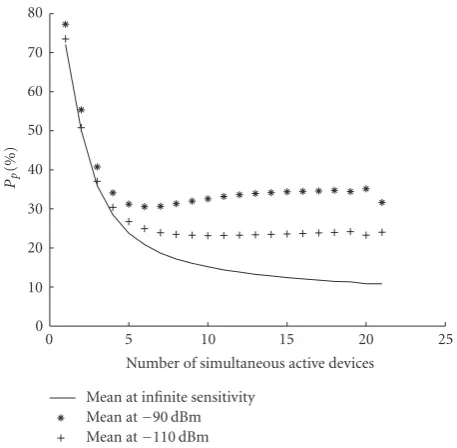
The dependence of Pp on the terminal receiver
sensi-tivity is shown inFigure 7where we plot the meanPp for
two different values of S, for example, S = −90 dBm and S= −110 dBm.
The improvement in the receiver sensitivity allows to increase the number of active devices seen by the termi-nals, thus providing better localization performance. How-ever when active devices are also used to provide communi-cation services (such as the APs in the IEEE 802.11a,b net-work), the visibility of more than one active device from the terminal to be located could lead to interference situations that impair the normal operation of random access schemes such as the carrier-sense multiple access with collision avoid-ance (CSMA/CA).
To analyze the performance of the localization algorithm including memory and tracking of the terminal position, we reimplemented the Viterbi-like technique in [7]. Results on Pp as a function of the number of active sensors in the area
are reported inFigure 8. To obtain the data inFigure 8, we assumed that terminals moved along some predefined routes in the office area. For each reference point in the route, we evaluated the position with the algorithm in (4) and we compared it with the exactposition of the terminal. From
3The goodness of one configuration of ADs with respect to another one for
localization could be appreciated looking, for example, at the minimum distance among power vectors calculated for the same set of ADs to be used for a terminal when it is located in a specific region of the service area. If the minimum distance among these power vectors is zero or com-parable to the power measurement error, localization in that region could be problematic and possibly the ADs should be repositioned.
0 2 4 6 8 10 12 14 16 18 20 22
Number of simultaneous active devices 0
10 20 30 40 50 60 70 80
Pp
(%)
Noise + quantization error Noise error
Figure6:Ppas a function of the number of active sensors in the
area; noise and quantization error (continuous line); quantization error alone (dashed line).
0 5 10 15 20 25
Number of simultaneous active devices 0
10 20 30 40 50 60 70 80
Pp
(%)
Mean at infinite sensitivity Mean at 90 dBm Mean at 110 dBm
Figure7:Ppas a function of the number of active sensors in the
area;S= −90 dBm andS= −110 dBm.
Figure 8, it can be observed that the improvement due to the addition of the terminal tracking features is modest at the expense of a greater complexity.
4. LOCALIZATION BASED ON PASSIVE DEVICES
to avoid interference, the answers coming from passive de-vices can be delayed by a random backofftime. In case of col-lision at the terminal receiver, interrogation can be repeated until every response is correctly received. Other, and more complicated, procedures to avoid or reduce collisions are il-lustrated in [12]. The terminal should also be able to measure the received powerwiof theith responding device that can
be related to the device-terminal distancediby the equation
wi=wT(λ/4π)
4G2
txG2rx d4
iIL
, (6)
whereλ=0.125 m is the wavelength associated to the oper-ating frequency (2.4 GHz),ILis the passive device insertion
loss,GtxandGrxare the transmitting and receiving antenna
gains, andwT (W) is the transmitted power of the
interro-gating signal.
The central server estimates the terminal position on the basis of the identities of the responding devices and the mea-suredwi(seeFigure 1). The identities of the responding
de-vices allow to restrict the area where the terminal is located. They can also be used to determine the uncertainty area ob-tained as the intersection of the coverage areas of the re-sponding devices. The position estimate within the uncer-tainty area can be refined using the values ofwiin (6).
In-verting (6) with respect todi, a position estimate (x,y) of
the terminal can be obtained solving the (overdetermined) nonlinear system of equations:
d2
i =
x−xi
2
+y−yi
2
, i=1, 2,. . .,Nr, (7)
where (xi,yi) are the coordinates of theNr responding
de-vices. The solution of the system in (7) was obtained us-ing standard algorithms implemented in thefsolveroutine of Matlab.
4.1. Simulation results
The passive devices used for localization have been posi-tioned as depicted inFigure 9where the coverage areas of a reduced set of devices have been depicted. The arrangement of RFID devices inFigure 9is only for illustrative purposes. The total number of RFID devices considered for simulation is higher than that inFigure 9. It is further assumed that de-vices cannot reradiate through walls. Similarly to the active case, in order to simulate different densities, the number of passive devices participating in the localization was varied during simulation. In particular, we randomly “turned off” some of the devices participating in the localization in accor-dance to a uniform distribution.4For each one of the selected RFID densities, we repeated the turning-offprocedure a large
4This approach is useful to analyze the localization performance of
net-works where RFID devices have been positioned in the area without any planning. Accurate planning would be useful to minimize the number of RFID devices required to cover the entire area, to avoid coverage holes, and so forth.
0 5 10 15 20 25
Number of simultaneous active devices 0
10 20 30 40 50 60 70 80
Pp
(%)
With Viterbi-like algorithm Normal
Figure8:Ppas a function of the number of active sensors in the
area; terminal, Viterbi-like tracking techniques have been included.
0 5 10 15 20 25 30
0 2 4 6 8 10 12 14 16 18 20
Figure9: Layout of a subset of the passive devices in the area and illustration of their coverage area.
number of times (about 500), and for each configuration we recalculated the position of the users moving in the area.5
For simulation purposes, the coverage radius of the pas-sive devices is restricted to 1.5 m. To this aim, we assumed that the power of the interrogation signal is wT=20 dBm
and the sensitivity of the terminal receiver was set to −90 dBm,Gtx=Grx=0 dB (omnidirectional antennas) and
insertion lossIL=20 dB. When the maximum value ofdiis
below 1.5 m, the free-space propagation model applies. The terminal to be located was randomly positioned in the area
5As a final remark, it should be observed that the considered statistical
0.14 0.5 0.86 1.22 1.58 1.94 2.3 2.66 RFID density (devices per m2)
0 10 20 30 40 50 60 70 80 90 100
Pp
(%)
0.5 m 1 m
Figure10:Ppas a function of the density of the passive devices.
in accordance to a uniform spatial distribution. Finally, the power measured by the terminal receiver for each responding device was affected by a zero-mean Gaussian random noise with standard deviationσ = 2.5 dBm. Quantization of the measured power was also considered in the simulation.
InFigure 10we plot the averagePp as a function of the
density of passive devices. Two different values for the toler-able estimation error, 0.5 m and 1 m, have been considered. The average ofPp is obtained with respect to the positions
of the terminal to be located. As expected, thePp decreases
with the density of devices. The largest values ofPpare
ob-tained when the number of responding passive devices is 0 or 1. In the first case (0 passive device responding), position cal-culation cannot be performed. In the second case (1 passive device responding), the terminal can be located on a circle at distancedifrom the passive device. In both cases, we assume
that position cannot be correctly estimated and a localization error always occurs. When the number of responding devices is 2, two points represent the solution of the nonlinear sys-tem of equations in (7). In this case, the terminal position is randomly selected with equal probability between the two available.
InFigure 11we plot the probability that the number of answering devices is equal to 0, 1 or 2 or 3 or above 3 as a function of the density of the passive devices. As expected, the percentages of having 0 or 1 answering device decreases with the density and so doesPp.
Introducing the position error as the distance between the estimated point and the actual position of the termi-nal in the area, in Figure 12 we plot the average position estimation error as a function of the density of the passive de-vices. Data corresponding to 0 and 1 responding devices have not been included inFigure 12. In general, it can be observed
0.14 0.5 0.86 1.22 1.58 1.94 2.3 2.66 RFID density (devices per m2)
0 10 20 30 40 50 60 70 80 90 100
R
esponding
de
vi
ce
s
(%)
Less than 2 responding devices 2 responding devices 3 responding devices 4 or more responding devices
Figure11: Number of passive devices responding to the terminal interrogation.
0.14 0.5 0.86 1.22 1.58 1.94 2.3 2.66 RFID density (devices per m2)
0.35 0.4 0.45 0.5
A
ver
age
p
osition
estimation
er
ror
(m)
Figure12: Position error as a function of the density of passive de-vices; power data available.
that when the number of responding devices is lower than 3, the position error increases. This fact is shown inFigure 11
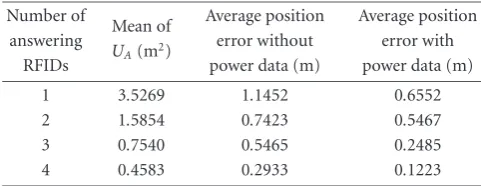
also be obtained using only the identities of the responding RFID devices. In this case, the server identifies the uncer-tainty areaUAassociated to the terminal, and in the simplest
case associates the user position with one point insideUA. In
Table 2we show the average extension ofUAas a function of
the number of RFID responding devices,Nresp. In the same table we also indicate the average of the error between the estimated position obtained from solving (7) and the true position. When power data are not available, position error is calculated with respect to the center ofUAthat was also
assumed as the estimate of the user position. As expected, in both cases, the average dimensions of the uncertainty ar-eas decrar-ease with the number of answering devices and ac-curate localization can be obtained when 3 or more RFID devices respond. The availability of uncertainty area allows to discard possible wrong solutions obtained from (7) due to noise in the measurement power and/or to possible geomet-rical RFID arrangements that can render the system in (7) ill-conditioned. In this case the server discards the solution obtained in (7) and defines the terminal position as the cen-ter of the uncertainty area,UA. However, when power data
can be safely used, the measurement error can be greatly re-duced (see the fourth column inTable 2).6Before conclud-ing this section, we briefly discuss the power energy required by the interrogator to ping the RFID devices. Due to the actual market unavailability of 2, 4 GHz RFID devices and of the corresponding interrogators, the power-energy con-sumption of the interrogator can be estimated assuming that the hardware used to build is based on the technology used for IEEE 802.11b products. As an illustrative example, we consider the power consumptions of the Cisco Aironet PCM-CIA cards indicated in [15]. In order to transmit an RF power of 100 mW, the overall power consumption is 2.25 W for a transmission speed of 1 Mb/s. During reception, the power consumed by the device is 1.35 W for receiver processing. Fi-nally Cisco also declares a consumption of 0.075 W in sleep mode. Using the previous data, it is possible to obtain the av-erage energy required to transmit one bit at 1 Mb/s, that is, Eb =2.25/106 =2.25μJ/bit. If the energy packet required to
activate the RFID has an equivalent duration of 40 bits, the energy to be transmitted isE = l·Eb = 90μJ. Indicating
withlthe number of bits retransmitted by the RFID tag, the energy required in the receiver for processing isl·1.35/106. Assuming for example that l = 40, we obtain an energy consumption of 54μJ that should be added to the required transmitted energy.7To calculate the total energy consump-tion required to process data obtained from tags, we need to consider the number of responding tags that can range from 1 up to 4. In this case, the energy for the interrogation can vary from 90 + 54 = 144μJ up to 90 + 4·54 = 306μJ.
6During simulations, we observed that because of power measurement
errors and quantization, when the number of responding devices was greater than 3, the Matlab fsolve subroutine sometimes provided unre-liable results. These results were discarded in calculating the last term in column 4 ofTable 2.
7We implicitly assumed that the processing of thel-bits returned from the
RFID should follow the same processing of a WLAN packet. This could be not true for the interrogator.
Table2: Average extension of the uncertainty area and average dis-tance error with and without power data.
Number of
Mean of Average position Average position answering
UA(m2) error without error with
RFIDs power data (m) power data (m)
1 3.5269 1.1452 0.6552
2 1.5854 0.7423 0.5467
3 0.7540 0.5465 0.2485
4 0.4583 0.2933 0.1223
Furthermore, from our simulations, the average number of responding tags in the area was 2.45 so that the average en-ergy consumption is 90 + 2.45·54 = 222.3μJ. Note that previous energy calculations assumed that RFID passive de-vices had a low sensitivity level, that is, they can respond even when the power at their input is very small (e.g.,−24 dBm in our case). This corresponds to a realistic future technologi-cal objective since semiconductor techniques are rapidly ad-vancing to reduce the RFID sensitivity towards tens ofμW, see [16]. If we assume−10 dBm [17] as a realistic value of the RFID sensitivity, applying the link budget formula in (6) for a interrogator-RFID maximum distance of 1.5 m, we obtain a required transmitter RF power of about 2.3 W (in line with the data in the current literature [18]) which corresponds to an overall power consumption of about 11.5 W.
Previous energy calculations can be used in the planning of the RFID network in order to set the polling frequency of interrogation in order to optimize the battery duration. Polling frequency should be adaptive, that is, when the server system senses that the user remains fixed in one position for a relatively long time, polling frequency should be drastically reduced.
A final observation should concern the operating fre-quency of the interrogator. We assumed that interrogator operates in the same frequency band of the WLAN (e.g., 2.4 GHz) which is used to convey data to the central server. In this case, the WLAN packets transmitted by the terminals or by the access point can activate the RFID devices. RFID responses can create background interference noise on the received WLAN packet. This could be easily avoided if the operation frequency of the RFID devices is different from that of WLAN. Many RFID devices exist on the market hav-ing operathav-ing frequency well below the 2.4 GHz. However, the adoption of RFID devices that can be activated on the WLAN band should not be discarded a priori especially if RFID could respond to interrogation on a frequency outside the WLAN band. In this case, interrogation would be at no additional energy costs since it is generated by normal packet transmission.
5. CONCLUSIONS
localization based on passive RFID devices has been pre-sented. Results have been obtained by simulation considering a realistic office environment and multiwall propagation in the active device case. From the results obtained in this paper, the probability of localization error in the active case is larger than that obtained in the passive case (see Figures5and10). In addition, even when active or passive devices are well posi-tioned in the area, the probability of localization error cannot decrease below an irreducible value. This is due to noise and power measurement errors which, in the active case, greatly influence the extraction of the position information starting from the data in the RF map. The proposed solution based on passive devices seems to be preferable with respect to the active one. This is due to the possibility of increasing the den-sity of passive devices to be used for localization at relatively low cost. The corresponding increase in the number of active devices would lead to very high costs in the active localiza-tion system in terms of maintenance (periodical change of the batteries) or installation (necessity to connect some or all the devices to a powerline). Finally, it has been observed that position estimation in the passive case can be obtained simply starting from a coarse estimation based only on the uncertainty area and can be possibly refined using the mea-sure of the powers received by the responding RFID devices. When the number of responding devices is relatively large, the accuracy of the coarse estimation is acceptable as it is also shown inTable 2.
ACKNOWLEDGMENTS
The authors would like to thank the anonymous reviewers for careful review and for valuable comments and sugges-tions that have been useful to improve the presentation of the paper. This work has been done within PULSERS Phase II - IST Contract N. 27142 of the FP6 of the European Com-munity.
REFERENCES
[1] J. Hightower and G. Borriello, “A survey and taxonomy of lo-cation systems for ubiquitous computing,” Technical Report UW-CSE 01-08-03, August 2001.
[2] P. Bahl, V. N. Padmanabhan, and A. Balachandran, “A soft-ware system for locating mobile users: design, evaluation, and lessons,” MSR Technical Report MSR-TR-2000-12, Microsoft Research and University of California, San Diego, Calif, USA, February 2000.
[3] F. Van Diggelen and C. Abraham, “Indoor GPS Technology,” CTIA, Dallas, Tex, USA, May 2001.
[4] P. Prasithsangareel, P. Krishnamurty, and P. K. Chrysantis, “On indoor position location with wireless LANS,” in Interna-tional Symposium on Personal, Indoors and Mobile Radio Com-munications (PIMRC ’02), Lisboa, Portugal, September 2002. [5] N. B. Priyantha, A. Chakraborty, and H. Baladrishnan, “The
cricket location-support system,” inProceedings of the 6th An-nual International Conference on Mobile Computing and Net-working (MOBICOM ’00), pp. 32–43, Boston, Mass, USA, Au-gust 2000.
[6] P. Bahl and V. N. Padmanabhan, “RADAR: An in-building RF-based user location and tracking system,” inProceedings of the
19th Annual Joint Conference of the IEEE Computer and Com-munications Societies (INFOCOM-2000), vol. 2, pp. 775–784, Tel Aviv, Israel, March 2000.
[7] P. Bahl, N. Venkata, N. Padmanabhan, and A. Balachandran, “Enhancements to the RADAR user location and tracking sys-tems,” Microsoft Research Technical Report MSR-TR-2000-12, February 2000.
[8] R. J. Fontana, “Recent Applications of Ultra Wideband Radar and Communications Systems,” http://www.multispectral. com.
[9] PULSERS, “Pervasive Ultra-wideband Low Spectral Energy Radio Systems,” EU-IST Programme (FP6), http://www.puls-ers.net.
[10] ISO/IEC 802-11: 1999(E),“Part 11: Wireless LAN Medium Ac-cess Control (MAC) and Physical Layer (PHY) Specifications” ANSI/IEEE Std 802.11, 1999 Edition.
[11] “Specification of the Bluetooth System,” version: 1.2 05 November 2003,http://www.bluetooth.org.
[12] K. Finkenzeller,RFID Handbook: Fundamentals and Applica-tions in Contactless Smart Cards and Identification, John Wiley & Sons, New York, NY, USA, 2nd edition, 2003.
[13] A. Borrelli, C. Monti, M. Vari, and F. Mazzenga, “Channel models for IEEE 802.11b indoor system design,” inIEEE In-ternational Conference on Communications, vol. 6, pp. 3701– 3705, Paris, France, June 2004.
[14] G. Wolfle, P. Wertz, and F. M. Landstorfer, “Performance, ac-curacy and generalization capability of indoor propagation models in different types of buildings,” inProceedings of 10th IEEE International Symposium on Personal, Indoor and Mobile Radio Communications (PIMRC ’99), Osaka, Japan, Septem-ber 1999.
[15] http://www.cisco.com.
[16] http://www.trolleyscan.com/paper/ecolect.html.
[17] Philips EPC 1.19 G2 RFID ASIC,http://www.semiconductors. philips.com.
[18] http://www.alientechnology.com.
Damiano De Luca received the “Laurea” degree in telecommunication engineering from the University of Rome “Tor Ver-gata,” Rome, Italy, in 2004. After his de-gree, in 2004, he joined RadioLabs, consor-tium between the University of “Tor Ver-gata” in Rome and Italian Industries oper-ating in the field of wireless communica-tions. His research interests include UWB, Bluetooth, and wireless lan technologies. He
is involved the radio propagation in indoor environment analy-sis, based on both empirical models (free-space modified, Motley-Keenan model, multiwall model) for the characterization of the ra-dio coverage power and deterministic models (ray tracing and ray launching) for the theoretical characterization of channel models.
Presently he is a Researcher in the Electronic Engineering Depart-ment of the University of Rome “Tor Vergata,” Italy. He is the au-thor of several scientific publications and the coauau-thor of a book on radar systems (in Italian). His main interests are in statistical signal processing, estimation theory, 3G and 4G networks. He is the Tech-nical Director of the RadioLabs Consortium (www.radiolabs.it).
Cristiano Montireceived the “Laurea” de-gree in electronic engineering from the Uni-versity of Rome “Tor Vergata” in 2000. He also received an M.S. degree in business ad-ministration in 2002. In the university, he was involved on IEEE 802.11 technology re-search. In particular his main activity was on 2, 4, and 5 GHz channel modellings and network management (load balancing, se-curity, and handoffissues among different
networks). Now he is working to receive the Ph.D. degree in Uni-versity of Rome “Tor Vergata.” He just takes care to research about indoor localization using sensor networks, RFID, UWB. Further-more, he is studying the problem about WiMax coverage and inter-ference.
Marco Vari received the Telecommunica-tions Engineering degree in telecommu-nications engineering at the University of Rome “Tor Vergata” in 2002. His thesis fo-cused on coexistence between WLAN (IEEE 802.11b) and Bluetooth devices. In 2003, he developed in the Tor Vergata Campus a WiFi network to provide free internet con-nectivity to students. His interests are in wireless network and in indoor localization