Volume 2010, Article ID 316820,12pages doi:10.1155/2010/316820
Research Article
Reversible Watermarking Algorithm with
Distortion Compensation
Vasiliy Sachnev,
1Hyoung Joong Kim,
2Sundaram Suresh,
3and Yun Qing Shi
4 1School of Information, Communications, and Electronic Engineering, The Catholic University of Korea,Bucheon 420-743, Republic of Korea
2CIST, Korea University, Seoul 136-701, Republic of Korea
3School of Computer Engineering, Nanyang Technological University, Singapore 639798 4Department of Electrical and Computer Engineering, NJIT, Newark, NJ 07102, USA
Correspondence should be addressed to Hyoung Joong Kim,[email protected]
Received 8 September 2010; Accepted 14 December 2010
Academic Editor: Ling Shao
Copyright © 2010 Vasiliy Sachnev et al. This is an open access article distributed under the Creative Commons Attribution License, which permits unrestricted use, distribution, and reproduction in any medium, provided the original work is properly cited.
A novel reversible watermarking algorithm with two-stage data hiding strategy is presented in this paper. The core idea is two-stage data hiding (i.e., hiding data twice in a pixel of a cell), where the distortion after the first stage of embedding can be rarely removed, mostly reduced, or hardly increased after the second stage. Note that even the increased distortion is smaller compared to that of other methods under the same conditions. For this purpose, we compute lower and upper bounds from ordered neighboring pixels. In the first stage, the difference value between a pixel and its corresponding lower bound is used to hide one bit. The distortion can be removed, reduced, or increased by hiding another bit of data by using a difference value between the upper bound and the modified pixel. For the purpose of controlling capacity and reducing distortion, we determine appropriate threshold values. Finally, we present an algorithm to handle overflow/underflow problems designed specifically for two-stage embedding. Experimental study is carried out using several images, and the results are compared with well-known methods in the literature. The results clearly highlight that the proposed algorithm can hide more data with less distortion.
1. Introduction
Data embedding techniques modify and, hence, distort the host signal (e.g., pixel values of image) in order to hide additional information. In many applications such as legal or medical images, loss of signal fidelity is undesirable. Hence, we need to develop reversible data hiding techniques, where the original host signal and the embedded message are able to be recovered exactly. In addition, these methods should have a high embedding capacity with less distortion. In general, high embedding capacity results in a high degree of distortion. Hence, these conflicting requirements stimulate interest among researchers in developing reversible water-marking algorithms with high capacity and low distortion. This paper addresses a novel approach by employing a two-stage embedding strategy to achieve the goal.
The first reversible data hiding approach was presented by Mintzer et al. [1]. They proposed a visible embedding
4], and histogram shifting [18,19], and by using appropriate domain for data hiding, such as integer DCT [6], integer DWT [7–10, 20], and prediction errors [14, 19, 21]. The above-mentioned methods can be improved further.
In difference expansion [15], the image is divided into pairs of neighboring pixels. The difference between two pixel values in a pair is used for data hiding. Two kinds of overlapping problems arise after data hiding into pairs: (a) overlapping due to difference expansion (i.e., modified pairs are mixed with unmodified pairs) and (b) overlapping due to overflow/underflow (i.e., some pairs cannot be modified). These overlapping problems are solved by marking all pairs in the location map. The location map must be compressed and added to the original payload.
The biggest problem in the original difference expansion method is the huge size of the location map. Even after compression, the location map occupies a significant portion of the payload. Thus, decreasing the size of the location map has been a challenging problem. Many improvements [12,13,22,23] over the Tian’s difference expansion aim to decrease the location map size. Kamstra and Heijmans [12] improved the difference expansion method by sorting pairs according to correlation factors computed using average values of the neighboring pairs. The location map covers only a portion of the sorted pairs, which contributes to the increase in payload. The compact location map achieves higher capacity but produces a similar level of distortion. Kim et al. [13] decreased the size of the location map further by removing nonambiguous parts. Their method [13] achieves better results when compared to Kamstra and Heijmans’ method [12]. All these expansions increase the payload but fail to minimize the distortion significantly.
Ni et al. [18] used a histogram shifting technique in the spatial domain. Thodi and Rodr´ıguez [19] explored the histogram shifting method by employing the prediction errors for efficiency. Sachnev et al. [21] improved the per-formance of the prediction error expansion by using sorting. Exploiting the histogram shifting approach to JPEG-LS prediction errors produces excellent results. The histogram shifting approach solves an overlapping problem by using the location map covered only prediction errors which can possibly cause overflow/underflow errors after data hiding. As a result, the histogram shifting method significantly decreases the location map size and sometimes can also eliminate the necessity of it.
Lee et al. [20] used an advanced watermarking technique based on integer-to-integer wavelet transform. Their method divides image into nonoverlapping blocks and applies a data hiding technique based on the definitions of expandability (which means a possibility of bit shifting operation) and changeability over high-frequency wavelet coefficients of each block. Bit-shifting approach is used for embedding data, and an LSB replacement approach for hiding the location map. Expanded and nonexpanded blocks are marked by different flags, 1 or 0, respectively, in the location map. It covers all blocks, and its size is (X/N)×(Y/M), where
N and M are the block size, and X and Y are the image size. In order to achieve reversibility, the proposed method requires location map, expansion matrixP, and original LSB
of coefficients from the blocks containing location map. The proposed technique outperforms existing methods as [2,7,
8,22] by exploiting high-frequency subbands and efficient data hiding technique. Even though the performance is better than [2,7,8,22], the requirement of location map, original LSB of coefficients from the blocks containing location map, and expansion matrix influence the capacity of the method.
This paper presents a new two-stage embedding strategy which hides more data with lower distortion compared to the existing reversible data hiding methods. In the proposed scheme, two bounds based on neighboring pixels are used to possibly hide data twice in a given pixel. First, the neighboring pixels are ordered, and the lower and upper bounds are calculated. The difference value between a pixel and its lower bound is used for hiding one bit according to the rules of histogram shifting. Next, the difference between the upper bound and the modified pixel is used for hiding another bit, such that the distortion in the first stage can be possibly reduced. Due to heterogeneity in the image’s features, the proposed strategy may remove at rare occasions, mostly reduce, or hardly increase distortion after the second stage of embedding. In this paper, we show the efficiency of the proposed method by calculating the portioned distortion impact of different scenarios (i.e., the case of removing, reducing, or increasing distortion), and by highlighting the theoretical efficiency compared with histogram shifting for the same conditions. Finally, we present the experimental results with comparison of the performance with well-known methods for four most popular test images. The results clearly illustrate its high capacity with low distortion. The organization of this paper is as follows. Section 2
explains the rationale of using two-stage embedding.
Section 3discusses important issues regarding the proposed method including two-stage embedding in detail, different scenarios in two-stage embedding, and a solution for overflow and underflow problems. Section 4 describes the encoder and decoder of the proposed method. Section 5
presents the experimental results. Section 6 concludes the paper.
2. Rationale of Using Two-Stage Embedding
Some reversible data hiding methods [13–15,22–24] use the concept of difference expansion transform. The difference expansion transform is based on a reversible integer Haar wavelet transform. Another approach commonly used in reversible data hiding is histogram shifting over prediction errors [19]. In all these schemes, the expansion affects the image quality. In this section, we first present the motivation of our work by highlighting the issues in expansion strategy. Later, we will present a strategy that can reduce distortion.
The well-known difference expansion method (DE) [15] uses the difference value between two neighboring pixels for hiding one bit of data. For a given pair of pixels (x,y),x,y∈ Z, 0≤x,y≤255, the difference expansion methods embed one bit of datab,b∈[0, 1] as follows:
wherehis the difference value between pair of pixels (x,y), andHis the modified difference value after hiding data. The modified pair of pixels is (X,Y), whereH=X−Y.
The total distortion in a pair (x,y) after data hiding is expressed as follows (seeFigure 1(a)):
DDE= |H−h| = |2·h+b−h| = |h+b|. (2)
The distortion of the prediction error expansion (PEE) can be calculated in the same fashion. Letm be a predicted pixel value of a pixelm, thend=m−mis the prediction error. The prediction error expansion hides one bit of data as follows (seeFigure 1(b)):
d=2·d+b. (3)
Hence, the distortion generated by prediction error expan-sion is
DPE=d−d= |2·d+b−d| = |d+b|. (4)
Note that the distortion of the difference errors expansion and prediction errors expansion are similar in nature.
Rationale for New Strategy. From the above analysis, we can see that the distortion of both methods directly depends on the difference value h or prediction error d. Hence, we need to find a suitable expansion technique, which has errors less then|h|or|d|. The main objective of reversible watermarking is to find a method which can embed more data with less distortion. Hence, we present a new strategy. In this strategy, each pixel is possibly expanded twice by embedding two bits of data. For every pixel, the lower and upper bounds are computed from eight neighboring pixels. Letaifori=1, 2,. . ., 8 be the surrounding pixels for a pixel
a0 as shown inFigure 2. The central pixela0 and its eight
neighboring pixels define a cell for embedding data. The neighboring pixels are sorted in ascending order to calculate the lower and upper bounds as follows:
L1= 4 n=1asn
4
,
L2= 8 n=5asn
4
,
(5)
where asn is a set of sorted neighboring pixels. The first
stage of the proposed data hiding technique is represented as follows:
e1=a0−L1, (6)
E1=2·e1+b1, (7)
A1=L1+E1. (8)
The distortion after the first stage of embedding is given as
D1= |A1−a0|. The second stage of the proposed data hiding
technique is represented as follows:
e2=L2−A1, (9)
E2=2·e2+b2, (10)
A2=L2−E2. (11)
The distortion after data hiding is
D2= |A2−a0|
= |L1−L2+ 3·e1+ 2·b1−b2|.
(12)
Note that the resulted distortionD2depends on the utilized
data embedding strategy. In our paper, we use the histogram shifting strategy for data hiding. Here, (7) and (10) depend on the differencese1 ande2, respectively. Such cases will be
explained later inSection 3.1.
In the proposed strategy, we can embed two bits with less distortion compared to a single embedding. Assume that the first hidden bitb1 is 1, second hidden bitb2is 1,a = 100,
L1 = 98,L2 = 104, ande1 = 2. First stage of embedding
givesE1 =2·e1+b1 =5, the central pixel valueA1 =103,
and the distance valuee2 =L2−A1 =104−103=1. Note
that the distortionD1 = 3 after first stage of embedding is
the same with distortion of DE and PEE (i.e.,e+b). Second stage of embedding givesE2=2·e2+b2=3, the central pixel
A2=L2−E2=104−3=101. The second stage of embedding
reduces distortion from 3 (distortion after the first stage) to 1. The resulted distortionD2after hiding two bits of data is
less than the distortion in DE and PEE for a single embedding (seeFigure 1(b)).
In the next section, we present the proposed data hiding algorithm with all possible scenarios and their distortion.
3. Two-Stage Embedding Algorithm Using
Histogram Shifting
In the proposed scheme, we can embed data twice with possibly reduced distortion. As explained in the previous section, first we calculate L1 and L2 using the sorted
neighboring pixels. For data hiding in each stage, we use the modification of the histogram shifting technique proposed by Thodi and Rodr´ıguez [19]. For the proposed data hiding technique, we suggest an algorithm to find the appropriate threshold values Tn and Tp (i.e., negative and positive)
similar to the original method. Now, we present the steps required to encode and decode the hidden data using a two-stage embedding technique.
Encoding. The algorithm embeds data (b1,b2) in two stages.
First, the first bitb1is hidden usingL1, and next the second
bitb2is hidden usingL2.
First stage:
E1= ⎧ ⎪ ⎪ ⎪ ⎪ ⎨ ⎪ ⎪ ⎪ ⎪ ⎩
2·e1+b1, ife1∈
Tn;Tp
,
e1+Tp+ 1, ife1> Tp,
e1+Tn, ife1< Tn,
(13)
wheree1=a0−L1.
Note that the expandable set isE=e∈[Tn;Tp] and the
shiftable set isS=e∈(−∞;Tn)∪(Tp;∞).
The pixel valuea0after embeddingb1is changed to
101 99 103 98 Before embedding After embedding 100 101 102 103 99 98 97 104 100 101 102 103 99 98 97 104 x x y y
L h L
X Y H (a) m m 98 98 98 98 98 98 100 103 Before
embedding embeddingAfter
100 101 102 103 99 98 97 104 100 101 102 103 99 98 97 104
m d m
M d (b) 103 100 98 98 102 106
99 97 105
103 98 98
102 106
99 97 105 103
103 98 98
102 106
99 97 105 101
Before embedding
After
stage 1 stage 2After
100 101 102 103 99 98 97 104 100 101 102 103 99 98 97 104 100 101 102 103 99 98 97 104 L2 L1 L2 L1 L2 L1
a e1 a a
A1 A1
A2
e2
E1
E2
(c)
Figure1: Different expansion strategies ((a) DE; (b) PEE; (c) Two-stage embedding).
a1 a2 a3
a8 a0 a4
a7 a6 a5 Cell
Figure2: A cell for the proposed scheme.
Second stage: Now, we hide the second bit of datab2inA1
usingL2. The embedding process is designed as one
E2= ⎧ ⎪ ⎪ ⎪ ⎪ ⎨ ⎪ ⎪ ⎪ ⎪ ⎩
2·e2+b2, ife2∈
Tn;Tp
,
e2+Tp+ 1, ife2> Tp,
e2+Tn, ife2< Tn,
(15)
wheree2=L2−A1.
The pixel valueA1 after embeddingb2 is represented as
follows:
A2=L2−E2. (16)
Tp and Tn are the positive and negative threshold
values. The threshold values can be approximately obtained using the histogram of the e1. Assume that the first and
second stages of embedding have the same payload, and the histogram’s shape ofe1ande2is similar. Thus, for the given
payloadP, the approximate threshold valuesTpandTnare
chosen such that|E| >0.5· |P|, whereE =e1 ∈ [Tn;Tp],
and|E|is the number of elements in the set E. In reality, due to difference between histogram’s shape of e1 and e2
(here, note that the exact value e2 can be computed only
after hiding data to e1), the approximate threshold values
may not be large enough to hide the payload P. Thus, if that happens, the magnitudes of the threshold values have to be increased, and the embedding process has to be repeated
30 35 40 45 50 55 60
0 0.2 0.4 0.6 0.8 1
PSNR
(dB)
Payload (bpp) Lena
0; 0
0;−1
1;−1 1;−2
2;−1 2;−2
2;−3
3;−2 3;−3
Figure3: Appropriate threshold values for Lena image.
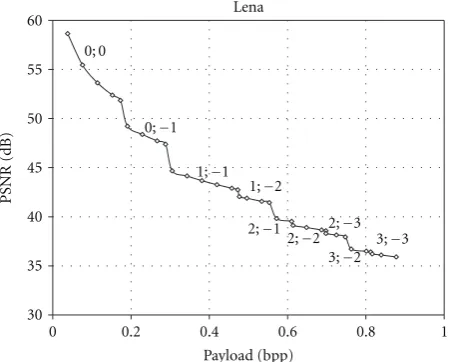
with new threshold values. Note that the proposed algorithm can exactly predict the threshold values for the first stage of embedding. Thus, the approximate threshold values have the minimal possible magnitudes to hide a necessary payload. We test the proposed algorithm and find that for most of payloads the approximate threshold values are suitable for data hiding. When the payload is large (≈1 bpp), the proposed algorithm requires one more iteration. In case of extreme payloads (≈1.5 bpp) close to the maximum possible size (seeFigure 7), the proposed algorithm requires multiple iterations. InFigure 3, we illustrate the appropriate threshold values for different payloads computed using the proposed method. If the payload approaches to the point to be increased (i.e., at 0.18 bpp, 0.29 bpp, or 0.47 bpp), the proposed method updates the threshold values (see
Figure 3).
the threshold values for histogram shifting are −2 and 2, while for the proposed method they are −1 and 1. Such low threshold values help in improving capacity and low distortion.
In the decoding process, the lower and upper bounds calculated using the neighboring pixels remain the same as in the encoder. Now, we present the steps required to decode the hidden data.
Decoding. Let (A2,a1,a2,. . .,a8) in a single cell be used for
decoding data. TheL1andL2are calculated using the sorted
neighboring pixels as described in (5).
First stage: the decoding process can be described as
e2= ⎧ ⎪ ⎪ ⎪ ⎪ ⎪ ⎨ ⎪ ⎪ ⎪ ⎪ ⎪ ⎩
E2
2
ifE2∈
2·Tn; 2·Tp+ 1
,
E2−Tp−1, ifE2>2·Tp+ 1,
E2−Tn, ifE2<2·Tn,
(17)
whereE2=L2−A2.
The second hidden bitb2is retrieved using
b2=E2 mod 2, E2∈
2·Tn; 2·Tp+ 1
. (18)
After retrieving the data from the pixel valueA2, the pixelA1
is computed as follows:
A1=L2−e2. (19)
Second stage: now, we retrieve the first datab1fromA1.
The decoding process is defined as follows:
e1= ⎧ ⎪ ⎪ ⎪ ⎪ ⎪ ⎨ ⎪ ⎪ ⎪ ⎪ ⎪ ⎩
E1
2
ifE1∈
2·Tn; 2·Tp+ 1
,
E1−Tp−1, ifE1>2·Tp+ 1,
E1−Tn, ifE1<2·Tn,
(20)
whereE1=A1−L1.
The first hidden bit (b1) is retrieved using
b1=E1 mod 2, E1∈
2·Tn; 2·Tp+ 1
. (21)
The original pixel valuea0after retrievingb1is recovered as
follows:
a0=L1+e1. (22)
The total distortion of the proposed two-stage embedding is
D2 = A2−a0, whereA2 is computed using (16). Here, the
modified pixelA2depends on the different scenarios in the
(13) and (15).
Thus, fore1 ∈ [0;Tp] (expandable, hiding bit b1) and
e2∈[Tn;Tp] (expandable, hiding bitb2), we have
D2=L1−L2+ 3·e1+ 2·b1−b2. (23)
Fore1 > Tp (shiftable, shifting by Tp) and e2 ∈ [Tn;Tp]
(expandable, hiding bitb1), we have
D2=L1−L2+e1+ 2·Tp+ 2−b1. (24)
Fore1> Tp(shiftable, shifting byTp) ande2< Tn(shiftable,
shifting byTn), ore1< Tn(shiftable, shifting byTn) ande2>
Tp(shiftable, shifting byTp), we have
D2=Tp−Tn+ 1. (25)
Fore1 ∈ [Tn;Tp] (expandable, hiding bitb1) ande2 > Tp
(shiftable, shifting byTp), we have
D2=e1+b1−Tp−1. (26)
Using the decoding process, we can retrieve the original pixel value a0 and the hidden data b1 and b2. The main
advantage of the proposed method is that the distortion due to data hiding in the first stage can be reduced in the second stage efficiently. Hence, we propose the two-stage embedding scheme to achieve high capacity with low distortion.
3.1. Different Scenarios in Two-Stage Embedding. The min-imization of distortion due to the first stage at the second stage depends one1. Based on the valuee1, there exist three
possible scenarios, namely: removable, half-removable, and nonremovable cases (seeFigure 4).
Removable. In this scenario, the distortion due to the first-stage embedding is removed completely in the second first-stage (i.e.,D2=0).
The equality for removing distortion is derived diff er-ently from (23), (24), (25), and (26).
Fore1 ∈ [0;Tp] (expandable, hiding bitb1) and e2 ∈
[0;Tp] (expandable, hiding bitb2), we have
e1=
L2−L1−2·b1+b2
3
. (27)
Fore1 ∈ [0;Tp] (expandable, hiding bitb1) ande2 > Tp
(shiftable, shifting byTp), we have
e1=Tp−b1+ 1. (28)
For e1 > Tp (shiftable, shifting by Tp) and e2 ∈ [0;Tp]
(expandable, hiding bitb1), we have
e1=L2−L1−2·Tp−2 +b1. (29)
Fore1 > Tpande2 > Tp(both shiftable, shifting byTp), the
distortion will be removed completely (i.e.,D2=0).
Note that for the e1 ∈ [Tn; 0) or e2 ∈ [Tn; 0), the
distortion cannot be removed in nature.
Half-Removable. In this scenario, the distortion due to the first-stage embedding can be removed partially in the second-stage. The distortion can be reduced or remain the same. In this case, the modified pixel value A1 should not
be greater than the upper bound L2. Thus, the difference
between the upper bound and modified pixel valueA1keeps
the sign (i.e., L2−A1 ≥ 0). In this case, the second stage
Before embedding 98 98 102 99 103 103 99 97 100 98 98 102 99 103 103 97 100 98 98 102 99 103 103 97 100 101 99 103 102 101 100 99 98 97 103 102 101 100 99 98 97 103 102 101 100 99 98 97 L2 L1 a L2 L1 L2 L1 a a e1
After stage 1 (hiding “1”)
e2
E1
After stage 2 (hiding “1”)
A1 A1
A2
E2
(a) Removable case
98 98 102 99 103 103 97 100 98 98 102 99 103 103 97 100 98 98 102 99 103 103 97 100 103 100 99 101 102 101 100 99 98 97 103 102 101 100 99 98 97 103 102 101 100 99 98 97 L2 L1
a e1
Before
embedding After stage 1(hiding “1”) L2
L1 a e2 E1 A1 L2 L1 a A1 A2 E2 After stage 2
(hiding “0”)
(b) Half-removable case
98 98 102 99 103 103 97 100 98 98 102 99 103 103 97 100 98 98 102 99 103 103 97 100 103 102 101 100 99 98 97 96 95 94 103 102 101 100 99 98 97 96 95 94 103 102 101 100 99 98 97 96 95 94 97 L2 L1 a e1 Before
embedding L2
L1 a e2 E1 A1 L2 L1 a A1 A2 E2 After stage 1
(hiding “0”)
96
After stage 2 (shifting)
94
(c) Nonremovable case
Figure4: Different scenarios of the two-stage embedding.
This inequality can be derived differently in respect of valuee1.
Fore1∈[0;Tp], we have
A1≤L2,
L1+ 2·e1+b1≤L2,
e1≤ L2−L1−b1
2 .
(30)
Fore1 ∈[0;Tp] ande2 ∈[0;Tp] ore2 > Tp, the distortion
D2is calculated using (23) or (26), respectively.
Fore1> Tp, we have
A1≤L2,
L1+e1+Tp+ 1≤L2,
e1≤L2−L1−Tp−1.
(31)
Similarly, for the differencee2∈[0;Tp], the distortionD2is
calculated using (24). Note that for the differencee2 > Tp,
the distortion D2 becomes 0 (i.e., the cell belongs to the
removable case).
Nonremovable. In this scenario, the distortion will increase after the second stage of embedding. This scenario occurs whene1<0 orA1> L2.
The inequality A1 > L2 can be rewritten similarly with
the half-removable case. Fore1∈[0;Tp], we have
e1> L2−L1−b1
2 . (32)
In this case, for e2 ∈ [Tn; 0) or e2 < Tn, distortionD2 is
calculated using (23) or (25), respectively. Fore1> Tp, we have
e1> L2−L1−Tp−1. (33)
Similarly, for the difference e2 ∈ [Tn; 0) or e2 < Tn, the
Note thatD2is always larger thanD1for bothe1<0 and
e2<0.
From the above three scenarios, we can see that the proposed two-stage embedding strategy either removes, reduces, or increases the distortion. Similarly, the distortion in the proposed strategy depends on the selected threshold values. Since the proposed method can embed data twice, the selected threshold values for a given capacity is less than the threshold values for histogram shifting. FromTable 1, we can see that the threshold values for the proposed method are 25– 50 percent lower. In some cases where the required payload is low, the threshold values are the same. Note that the distortion depends on the threshold values as well as the pop-ulation of pixels (cells) that cause distortion. In the proposed two-stage embedding method, the cells of the different cases (i.e., removable, half-removable, and nonremovable) cause different distortion impact. The nonremovable cells do not cause distortion at all. The distortion of the half-removable cells after the double embedding in our method is less than a single embedding in DE or PEE. The nonremovable cells cause higher distortion than that of DE and PEE under the same thresholds. Thus, in order to estimate the performance of the proposed method we have to analyze the distortion impact of the different cells unified to the specific classes as removable, half-removable, and nonremovable for the proposed two-stage embedding method, and expandable and shiftable for the histogram shifting method.
3.2. Efficiency of the Two-Stage Embedding. The efficiency can be estimated numerically by computing the portioned distortion of the different cells for the two-stage embedding and the histogram shifting. Such an analysis may help evaluate the distortion impact of the removable, half-removable, and nonremovable cells to the total distortion.
Since, the PSNR is the logarithmic measure of the MSE (see (34)), the distortion impact of different pixels (cells) can be calculated as an impact to the MSE,
PSNR=10·log10
2552
MSE
, (34)
where MSE is the mean squared error,
MSE= 1 m·n
n−1
i=0 m−1
j=0
I
i,j−Ki,j2= 1
m·nSE, (35)
wheren,mare the height and width of the image,I is the original image,Kis the modified image, and SE is the total squared error.
The total squared error (SE) can be calculated as follows:
SE=SE0+ SE1+ SE2, (36)
where
SE0=0 ifI
i,j∈removable cells,
SE1= I
i,j−Ki,j2
ifIi,j∈half-removable cells,
SE2= I
i,j−Ki,j2
ifIi,j∈nonremovable cells.
(37)
From (35) and (36), derive the PSNR as follows:
PSNR=10·log10
m·n·2552
SE1+ SE2
. (38)
Thus, the total distortion (PSNR) can be estimated using the squared errors of all the half-removable cells (SE1) and
nonremovable cells (SE2).
In our tests, we compare the squared errors (SE) and population of the half-removable and nonremovable cells (for the proposed method), and the expandable and shiftable cells (for the histogram shifting method). To illustrate the performance better, we study the squared error of the cells for Lena images versus the threshold values and payloads for Lena image. The results are reported inTable 1.
When the payload is 70 kbits, the proposed two-stage embedding method has 21,138 half-removable cells with squared error 21,102, and 77,151 nonremovable cells with squared error 266,157. The total squared error is 287,259, which causes PSNR 47.72 dB. For the same payload, the histogram shifting method has 70,000 expandable cells with squared error 71,144, and 166,113 shiftable cells with squared error 409,255. The total squared error is 487,399, which causes PSNR 45.25 dB. Thus, when the payload is 70 kbits, the total squared error of the proposed method is 200,140 lower, and the PSNR is 2.47 dB higher. For larger payloads such as 120 and 150 kbits, the PSNR value of the proposed method is 1.31 and 0.83 dB higher, respectively. Hence, the PSNR value for the proposed method is better than that of the histogram shifting method.
3.3. Overflow and Underflow Problems. An important issue in data hiding is to avoid overflow or underflow errors where the modified pixels exceed the 8-bit range [0; 255]. These problematic pixels should be skipped from the embedding process. Such pixels are called skipped cells that can exceed the boundary (i.e., A1 < 0, A1 > 255 or A2 < 0,
A2 > 255). Note that the skipped original cells and some
Table1: Populations of cells from different scenarios and sets versus different capacities for Lena image. Two-stage embedding
Payload kbits Tn;Tp Half-removable case Nonremovable case Total SE PSNR [dB]
Population SE Population SE
70 −1;0 21,138 21,102 77,151 266,157 287,259 47.72
120 −1;1 64,100 132,453 90,292 743,415 875,869 42.89
150 −1;2 69,290 277,756 111,507 1,500,101 1,777,857 39.82
Histogram shifting [19]
Capacity kbits Tn;Tp Expandable set Shiftable set Total SE PSNR [dB]
Population SE Population SE
70 −1;1 70,000 78,144 166,113 409,255 487,399 45.25
120 −2;2 120,000 277,651 141,098 906,021 1,183,672 41.58
150 −3;3 150,000 580,788 105,744 1,310,011 1,890,799 38.99
3. Recover header and data
- Define LSBhfromP= {data; LSBh}. - Define data.
- Recoverhusing LSBh. Begin
Encoder:
Given:
Image (I)
Data
1. Prepare data and image
- Define space for header (30 pixels) h= {I(1, 1),I(1, 2),I(1, 3),. . .,I(1, 30)} - Collect LSB of theh(LSBh)
2. Define thresholds (TnTp)
- Define cells (computeL1ande1) - GetTnandTp, such that |E|>0.5P, whereE=e1[Tn;Tp]
Decoder:
Given: Begin
Modified image (Im)
1. Read header
- Define thresholdsTn,Tp
and indexi
3. Data hiding
i=i+ 1
− |P|!=0
3.1 Definei-th cell
- Compute L1, L2, and el.
Update payload II:
P={P3,P4,. . .,Pn}
, P={P2,P3,. . .,Pn}
or skip
3.2 Overflow/underflow test
- Define E.x
E.a − E.b − E.c − E.d
+
+ + + +
+
Update payload I:P={LM;P}
4. Embed header
- Embed header (He) tohby LSB substitution
Define modified imageIm
End
End 2. Data extraction
i=i−1
− i >30
2.1 Definei-th cell
- ComputeL1,L2,ande1.
2.3 Decode data using second
2.3 Decode data using first and
2.2 Overflow/underflow test
- DefineAandA
Read LM1=P1− 0≤A ≤255 0≤A≤255
+
LM1=1− Read LM2=P2 + “D.a”
Update payload D
P= {P2,P3,. . .,Pn} P= {P3,P4,. . .,Pn}
“D.d ”
− LM2=0 + “D.c”
Define original imageI Assign cell’s indexi=31 (skip first 30 cells)
Assign cell’s indexi(from header) - Define payloadP= {data; LSBh}
- Define binary header:He=(Tn,Tp,i)2 3.3 Embedb1=P1using (13), (14)
3.3 Embedb1=P1,b2=P2using (13)–(16)
LM=“1” LM=“01” LM=“00”
stage only (20)–(22)
second stages (19)–(22)
“D.b”
the location map. Such a solution causes some additional problems. The decoder can not know the proper data hidden in the encoder side. Thus, the verification test (see below) in the encoder and decoder must use the same data. In our method this data is called “test bits.” Note that hiding “0” causes distortion less than hiding “1” to the same cell for a positive difference value. Thus, sometimes hiding “1” causes overflow/underflow, but hiding “0” does not. In this case, decoder does not know the proper data and may make wrong decision about the cell. Such a wrong decision is triggered by the wrong location map bits, that will cause the cascade misclassification for the rest of the location map and will also provide wrong recovered data. We solve this problem by adjusting the “test bits” as “1” for positiveeand “0” for negative.
Since the proposed method can hide two bits into a single cell, the problem of overflow/underflow can occur in any stage of embedding. Hence, we need one or two bits to identify the overlapping cells. There are four possible cases regarding the overflow/underflow problems for the encoder.
3.3.1. Overflow/Underflow Test for Encoder
Input. The cell for testing (i.e., (a0,a1,a2,. . .,a8)); data to
hideb1andb2; threshold valuesTnandTp.
Output. Case of the cell (i.e., E.a, E.b, E.c, or E.d); location map bit(s) when the case of cell does not belong to E.d.
Preprocessing. CalculateA1andA2using (14) and (16). For
0≤A2≤255, process the verification test as follows.
Calculate the test differencesd1andd2:
d1=A2−L1, d2=L2−A2. (39)
Hide the test bits to the test differencesd1andd2as follows:
Di= ⎧ ⎪ ⎪ ⎪ ⎪ ⎨ ⎪ ⎪ ⎪ ⎪ ⎩
2·di+bt ifdi∈
Tn;Tp
,
di+Tp+ 1 ifdi> Tp,
di+Tn ifdi< Tn,
(40)
wherei=1, 2;D1andD2are the modified test differences;bt
is the test bit. Ifd1ord2is negative,btis 0; otherwise,btis 1.
Calculate the test pixel valuesAandA:
A=D1+L1, A=L2−D2. (41)
Define the proper case for the tested cell:
(E.a) if a cell hasA1<0 orA1>255, then we mark the cell
as “1” in the location map. No bit can be embedded into this cell;
(E.b) if a cell has 0 ≤A1 ≤255 andA2 <0 orA2 >255,
then we mark the cell as “01.” In this case, only one bit can be hidden during the first stage of embedding; (E.c) if a cell has 0≤A1≤255, 0≤A2≤255, andA<0,
A>255 orA<0,A>255, then we mark the cell
as “00” in the location map. Here, we use a test bit to identify whether the cell is to be skipped or not. In this case, the mark identifies the cell can contain two bits of hidden data;
(E.d) if the cell does not belong to the skipped set after the two-stage data hiding process (0≤A≤255 and 0≤ A≤255), then no marker is used. No marker means two bits of successful data hiding.
Similar to the encoder, there are three possible situations regarding the overflow/underflow problems for the decoder.
3.3.2. Overflow/Underflow Test for Decoder
Input. Cell for testing (A0,a1,a2,. . .,a8); one or two bits
from the location map, if necessary; threshold valuesTnand
Tp.
Output. Case of the cell (i.e., D.a, D.b, D.c, or D.d).
Preprocessing. For a tested cell, process as follows: assume thatA2 =A0, whereA0is the modified central pixel of the
tested cell. Process the verification test using (39), (40), and (41). Get test pixel valuesAandA.
Define the proper case for the tested cell:
If a cell hasA<0,A>255 orA<0,A>255, then the cell was marked in the location map.
(D.a) If the first location map bit for current cell is “1,” no bit was embedded into this cell. Otherwise, read the second bit of the location map and check (D.b)-(D.c). The cell remains the same as original.
(D.b) If the first and second bits of the location map for the current cell are “01,” the current cell was modified during the first stage of embedding. In this case, the cell contains one bit of hidden data.
(D.c) If the first and second bits of the location map for the current cell are “00,” the current cell was modified during the first and second stages of embedding. In this case, the cell contains two bits of hidden data. (D.d) If a cell has 0 ≤ A ≤ 255 and 0 ≤ A ≤ 255,
then the cell was not marked in the location map and was modified during the first and second stages of embedding. In this case, the cell contains two bits of hidden data.
The location map is necessary for recovering data and should be hidden to image as part of payload. The exper-imental results show that the location map size is almost negligible when compared to full capacity. Fortunately, the location map is not necessary sometimes.
4. Algorithms for Encoder and Decoder
The encoder and decoder of the proposed method are presented inFigure 5.
30 35 40 45 50 55 60
0 0.1 0.2 0.3 0.4 0.5 0.6 0.7 0.8 0.9 1
PSNR
(dB)
Payload (bpp) Lena
(a)
Barbara
0 0.1 0.2 0.3 0.4 0.5 0.6 0.7 0.8 0.9 1
PSNR
(dB)
Payload (bpp) 20
25 30 35 40 45 50 55 60
(b) Mandrill
30
25
20 35 40 45 50 55
0 0.1 0.2 0.3 0.4 0.5 0.6 0.7 0.8 0.9 1
PSNR
(dB)
Payload (bpp)
(c)
Airplane
30
25 35 40 45 50 65
60
55
0 0.1 0.2 0.3 0.4 0.5 0.6 0.7 0.8 0.9 1
PSNR
(dB)
Payload (bpp)
(d) Peppers
Proposed
Lee et. al.
0 0.1 0.2 0.3 0.4 0.5 0.6 0.7 0.8 0.9 1
PSNR
(dB)
Payload (bpp) 25
30 35 40 45 50 55 60
Thodi & rodriguez (D3) Thodi & rodriguez (P3)
(e)
Boat
Proposed
Lee et. al. 25
30 35 40 45 50 55 60
0 0.1 0.2 0.3 0.4 0.5 0.6 0.7 0.8 0.9 1
PSNR
(dB)
Payload (bpp)
Thodi & rodriguez (D3) Thodi & rodriguez (P3)
(f)
20 25 30 35 40 45 50 55 60
0 0.2 0.4 0.6 0.8 1 1.2 1.4 1.6 1.8
PSNR
(dB)
Payload (bpp)
Airplane Lena Peppers
Barbara Boat Mandrill
Figure7: Embedding ability of the proposed method.
Step 1 embeds header information into a certain location, and copies the original values and embeds into another location in order to recover the original value. Header information includes a proper payload. Step 2 defines proper threshold values. Step 3 embeds data into image. Here, the block “Update payload I” inserts location map bit (bits) to the first position of the payload stream (i.e.,P = {LM;P}). The block “Update payload II” removes hidden bit (bits) from the payload stream. Note that according to the (13)– (16) the proposed method may hide zero, one, or two bits. In case of hiding zero bits, the block “Update payload II” skips updating the payload stream. Data hiding process stops when the last bit from the payload streamPis embedded into the image (i.e.,|P| =0). If the number of the available cells is not enough for hiding payloadP, increase thresholds values and repeat steps 3 and 4.
Decoder contains three main steps: “Read header,” “Data extraction,” and “Recover header and data.” Step 1 defines the initial parameters for decoding (threshold valuesTn,Tp
and indexi). Cell with indexiis the last modified cell in the encoder. Step 2 recovers the hidden payload and the original image. The block “Update payload D” removes the location map bit(bits) from the payload streamP. Step 3 recovers the original data where header information is embedded.
5. Experimental Results
The proposed two-stage reversible data hiding algorithm is tested over the six well-known uncompressed 512 ×512 grayscale images: Lena, Barbara, Mandrill, Peppers, Boat, and Airplane. Performances of the proposed algorithm are compared with well-known methods of Thodi and Rodr´ıguez [14, 19], and Lee et al. [20]. Figure 6 presents the PSNR values for various payloads in different grayscale images. From Figure 6, we can see that the PSNR value
of the proposed two-stage embedding is better than that of the existing methods. Particularly in high payloads, the proposed scheme shows better performance. The results clearly indicate the advantage of the two-stage embedding strategy.
For better understanding, the threshold values and squared errors used in our experiments and the respective number of cells in the half-removable and nonremovable sets for Lena image are reported inTable 1. The population of the cells and squared error in each set depends on the type of images and selected threshold values. FromTable 1, we can see that the population in the nonremovable set increases with increase in capacity, which makes its performance worse. Since some of the nonremovable cells can be used for data hiding in any one of the stages, the overall performance of the proposed two-stage embedding is better than that of the well-known methods in the literature.
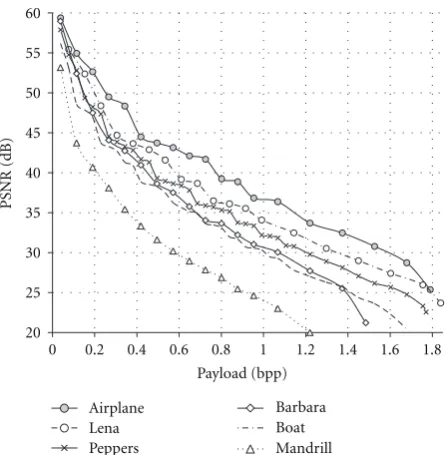
Figure 7shows the PSNR values for different payloads. FromFigure 7, we can see that the maximum payload for Lena, Airplane, Barbara, Peppers, Boat, and Mandrill images is 1.83, 1.79, 1.48, 1.77, 1.67, and 1.21 bpp, respectively. We also consider the capacity of the proposed method based on the given minimum allowable distortion. Hence, we select the minimum allowable distortion for each image based on the maximum capacity of the method P3 of Thodi and Rodr´ıguez [14]. In the case of the Airplane image, their maximum payload is 0.98 bpp and its corresponding PSNR value is 32.1 dB. If the 32 dB is the minimum allowable distortion, our method achieves 1.51 bpp, which is 50 percent more than the capacity of the histogram shifting method.
A similar observation can be made about the Barbara, Lena, Peppers, Boat, and Mandrill images. In the case of Mandrill, the maximum capacity is less than the other tested images due to its irregularity in the image, but our capacity is still higher than the existing methods. From the result, we can say that the proposed two-stage embedding algorithm can have lower distortion under the same capacity compared to the existing methods.
6. Conclusion
Acknowledgments
This work was supported by the Catholic University of Korea, IT R&D program (Development of anonymity-based u-knowledge security technology, 2007-S001-01), by the Ministry of Knowledge Economy, Korea, under the ITRC supervised by the National IT Industry Promotion Agency (NIPA-2010-C1090-1001-0004), by the Ministry of Culture, Sports and Tourism and Korea Culture Content Agency in the Culture Technology (CT) Research and Development Program, and by the Ministry of Education, Science and Technology under the supervision of National Research Foundation for 3DLife (FP7). Authors thank the reviewers for their valuable comments which improve the quality of this paper.
References
[1] F. Mintzer, J. Lotspiech, and N. Morimoto, “Safeguarding digital library contents and users: digital watermarking,” D-Lib Magazine, vol. 3, no. 12, pp. 33–45, 1997.
[2] J. Fridrich, M. Goljan, and R. Du, “Lossless data embedding for all image formats,” in Security and Watermarking of Multimedia Contents IV, vol. 4675 ofProceedings of SPIE, pp. 572–583, January 2002.
[3] M. van der Veen, F. Bruekers, A. Leest, and S. Cavin, “High capacity reversible watermarking for audio,” inSecurity, Steganography, and Watermarking of Multimedia Contents VI, vol. 5020 ofProceedings of SPIE, p. 111, January 2003. [4] A. Van Leest, M. van der Veen, and F. Bruekers, “Reversible
watermarking for images,” in Security, Steganography, and Watermaking of Multimedia Contents VI, vol. 5306 of Proceed-ings of SPIE, pp. 374–385, January 2004.
[5] M. U. Celik, G. Sharma, A. M. Tekalp, and E. Saber, “Reversible data hiding,” IEEE International Conference on Image Processing, vol. 2, pp. II/157–II/160, 2002.
[6] B. Yang, M. Schmucker, W. Funk, C. Busch, and S. Sun, “Integer DCT-based reversible watermarking for images using companding technique,” in Security, Steganography, and Watermaking of Multimedia Contents VI, vol. 5306 of
Proceedings of SPIE, pp. 405–415, January 2004.
[7] B. Yang, M. Schmucker, C. Busch, X. Niu, and S. Sun, “Approaching optimal value expansion for reversible water-marking,” inProceedings of the 7th Multimedia and Security Workshop, pp. 95–101, August 2005.
[8] G. Xuan, J. Chen, J. Zhu, Y. Q. Shi, Z. Ni, and W. Su, “Lossless data hiding based on integer wavelet transform,” in Proceedings of the IEEE Workshop on Multimedia Signal Processing, pp. 312–315, St. Thomas, Virgin Island, December 2002.
[9] G. Xuan, Y. Q. Shi, Z. C. Ni et al., “High capacity lossless data hiding based on integer wavelet transform,” inProceedings of the IEEE International Symposium on Circuits and Systems, vol. 2, pp. II29–II32, 2004.
[10] G. Xuan, C. Yang, Y. Zhen, Y. Q. Shi, and Z. Ni, “Reversible data hiding based on wavelet spread spectrum,” inProceedings of the IEEE 6th Workshop on Multimedia Signal Processing, pp. 211–214, Siena, Italy, 2004.
[11] D. Zou, Y. Q. Shi, Z. Ni, and W. Su, “A semi-fragile lossless digital watermarking scheme based on integer wavelet transform,”IEEE Transactions on Circuits and Systems for Video Technology, vol. 16, no. 10, pp. 1294–1300, 2006.
[12] L. Kamstra and H. J. A. M. Heijmans, “Reversible data embedding into images using wavelet techniques and sorting,”
IEEE Transactions on Image Processing, vol. 14, no. 12, pp. 2082–2090, 2005.
[13] H. J. Kim, V. Sachnev, Y. Q. Shi, J. Nam, and H. G. Choo, “A novel difference expansion transform for reversible data embedding,”IEEE Transactions on Information Forensics and Security, vol. 3, no. 3, pp. 456–465, 2008.
[14] D. M. Thodi and J. J. Rodr´ıguez, “Expansion embedding techniques for reversible watermarking,”IEEE Transactions on Image Processing, vol. 16, no. 3, pp. 721–730, 2007.
[15] J. Tian, “Reversible data embedding using a difference expan-sion,” IEEE Transactions on Circuits and Systems for Video Technology, vol. 13, no. 8, pp. 890–896, 2003.
[16] W. Hong, T. S. Chen, and C. W. Shiu, “Reversible data hiding based on histogram shifting of prediction errors,” in
Proceedings of the 2nd International Symposium on Intelligent Information Technology Application Workshop (IITA ’08), pp. 292–295, December 2008.
[17] H. C. Huang, I. H. Wang, and Y. Y. Lu, “High capacity reversible data hiding with adjacent-pixel-based difference expansion,” inProceedings of the 4th International Conference on Innovative Computing, Information and Control (ICICIC ’09), pp. 639–642, December 2009.
[18] Z. Ni, Y. Q. Shi, N. Ansari, W. Su, Q. Sun, and X. Lin, “Robust lossless image data hiding,” inProceedings of the IEEE International Conference on Multimedia and Expo (ICME ’04), vol. 3, pp. 2199–2202, Taipei, Taiwan, 2004.
[19] D. M. Thodi and J. J. Rodr´ıguez, “Reversible watermarking by prediction-error expansion,” inProceedings of the 6th IEEE Southwest Symposium on Image Analysis and Interpretation, vol. 6, pp. 21–25, Lake Tahoe, Calif, USA, March 2004. [20] S. Lee, C. D. Yoo, and T. Kalker, “Reversible image
water-marking based on integer-to-integer wavelet transform,”IEEE Transactions on Information Forensics and Security, vol. 2, no. 3, pp. 321–330, 2007.
[21] V. Sachnev, H. J. Kim, J. Nam, S. Suresh, and Y. Q. Shi, “Reversible watermarking algorithm using sorting and pre-diction,”IEEE Transactions on Circuits and Systems for Video Technology, vol. 19, no. 7, pp. 989–999, 2009.
[22] A. M. Alattar, “Reversible watermark using difference expan-sion of triplets,” inProceedings of the International Conference on Image Processing (ICIP ’03), pp. 501–504, September 2003. [23] A. M. Alattar, “Reversible watermark using difference expan-sion of quads,” in Proceedings of the IEEE International Conference on Acoustics, Speech, and Signal Processing, pp. III377–III380, May 2004.