Volume 2007, Article ID 12071,12pages doi:10.1155/2007/12071
Research Article
Modeling of Electrocardiogram Signals Using Predefined
Signature and Envelope Vector Sets
Hakan G ¨urkan,1Umit G ¨uz,¨ 1, 2and B. Sıddık Yarman3, 4
1Department of Electronics Engineering, Engineering Faculty, IS¸IK University, Kumbaba Mevkii, 34980 Sile, Istanbul, Turkey 2Speech Technology and Research (STAR) Laboratory, Information and Computing Sciences Division,
SRI International, 333 Ravenswood Avenue, Menlo Park, CA 94025, USA
3Department of Electrical-Electronics Engineering, College of Engineering, Istanbul University, 34230 Avcılar, Istanbul, Turkey 4Department of Physical Electronics, Graduate School of Science and Technology, Tokyo Institute of Technology,
Ookayama Campus, 2-12-1 Ookayama, Meguro-Ku 152-8552, Tokyo, Japan
Received 28 April 2006; Accepted 24 November 2006
Recommended by Maurice Cohen
A novel method is proposed to model ECG signals by means of “predefined signature and envelope vector sets (PSEVS).” On a frame basis, an ECG signal is reconstructed by multiplying three model parameters, namely, predefined signature vector (PSV)R,” “predefined envelope vector (PEV)K,” and frame-scaling coefficient (FSC). All the PSVs and PEVs are labeled and stored in their respective sets to describe the signal in the reconstruction process. In this case, an ECG signal frame is modeled by means of the members of these sets labeled with indicesRandKand the frame-scaling coefficient, in the least mean square sense. The proposed method is assessed through the use of percentage root-mean-square difference (PRD) and visual inspection measures. Assessment results reveal that the proposed method provides significant data compression ratio (CR) with low-level PRD values while pre-serving diagnostic information. This fact significantly reduces the bandwidth of communication in telediagnosis operations.
Copyright © 2007 Hakan G¨urkan et al. This is an open access article distributed under the Creative Commons Attribution License, which permits unrestricted use, distribution, and reproduction in any medium, provided the original work is properly cited.
1. INTRODUCTION
An electrocardiogram (ECG) signal which is a graphical dis-play of the electrical activity of the heart is an essential bio-logical signal for the monitoring and diagnosis of heart dis-eases. ECG signals which are recorded with digital equipment are most widely used in applications such as monitoring, cardiac diagnosis, event analysis, real-time transmission over telephone networks, patient databases, or long-term record-ing. The amount of ECG data grows depending upon sam-pling rate, samsam-pling precision, number of lead, and recording time. Obviously, continuous generation of huge amount of ECG data requires high storage capacity and also wide trans-mission band for the remote monitoring activities. While re-taining all clinically significant features including P-waves, QRS complexes, and T-waves, compression of the ECG sig-nals is essential in the biomedical engineering [1–3].
Various methods have been developed for modeling and compression of ECG signals during the last thirty years [2,3]. These methods can be classified into the following three categories: direct time-domain techniques [2–8] attempt to
reduce redundancy in the actual signal samples. Examples of this method include amplitude zone time epoch coding (AZTEC), the coordinate reduction time encoding system (CORTES), FAN and SAPA techniques, SAIES, mean-shape vector quantization method, gain-shape vector quantization method, and so forth. Transform-domain techniques [9–15] generate a coefficient sequence that reduces the amount of data needed to represent the original signal, and then inverse transformation is applied in order to reconstruct original sig-nal with acceptable error. In this technique, discrete cosine transform (DCT), Karhunen-Loeve transform (KLT), sin-gular value decomposition (SVD), wavelet transform (WT), and so forth have been employed for ECG compression and modeling. Parametric extraction methods [16] such as peak-peaking methods, linear prediction methods, neural network methods generate a set of parameters which is extracted from the original signal. These different modeling or compression methods yield different results, with regard to compression ratio and reconstruction error.
mean values that are coded by vector and scalar quantization, respectively. In [5], an ECG signal compression technique us-ing overlapped and linearly shifted codevectors is presented. Beat-based ECG compression method which exploits the re-dundancy among adjacent heartbeats and adjacent samples of the original ECG signals by using gain-shape vector quan-tization method is published in [6]. In [7], the ECG compres-sion method is described for signal-dependent frames us-ing matchus-ing pursuit algorithm. An algorithm based on ap-proximate multiscale pattern matching, encoding segments of an input signal using expanded and contracted versions of patterns stored in a dictionary is proposed to compress ECG signals in [8]. ECG compression methods are proposed based on discrete cosine transform and singular value de-composition in [9,12] and in [10], respectively. Several ECG compression techniques based on wavelet transform are pro-posed in [11,13–15]. An ECG compressor consists of beat codebook, short and long predictors, and an adaptive resid-ual quantizer is presented in [16].
In our previous work [17,18], speech signals were mod-eled by using predefined signature and envelope functions sets. In this work, the modeling method introduced in [18] is applied to represent ECG signals. Thus, in the reconstruction of ECG signal, while preserving diagnostic information; high compression ratios (CR) with acceptable percentage root-mean-square difference (PRD) levels are obtained.
In the following, first the proposed ECG modeling method is summarized. Then, formations of the predefined signature and envelope sets (PSEVS) are detailed (Section 2). In Section 3, an algorithm which generates the predefined signature and envelope sets and the reconstruction algorithm of the ECG signals are given.Section 4is devoted to the test results where the performance of the proposed method is compared with those of conventional methods.Section 5is spared for discussions and conclusion.
2. A MATHEMATICAL METHOD TO MODEL
ECG SIGNALS
2.1. Main statement
For any time frame “i,” the digitized ECG signal which is des-ignated by vectorXican be expressed as
Xi∼=CiαKϕR, (1)
where K ∈ {1, 2,. . .,NE}, R ∈ {1, 2,. . .,NS}; K, R,NE, and, NS are integers. Ci is a real constant, ϕTR = [ϕ1,ϕ2,ϕ3,. . .,ϕLF] is a row vector. The vectorCiϕR carries almost maximum energy ofXiin the LMS sense. In other words,CiϕR is the best approximation ofXiwith one term that minimizes the sum of square error point by point, over the frame under consideration. The (LF×LF) diagonal ma-trix αK = diagαi1 αi2 αi3 · · · αiLFacts as an envelope term on the quantityCiϕR, which may satisfy the equality of Xi =CiαKϕRor reduce the error defined on the difference [Xi−CiαKϕR] in the least mean-square (LMS) sense. Thus, it matches the envelope ofCiϕR to the original ECG frame vectorXi. The integerLFdesignates the total number of ele-ments in a frame “i.”
Therefore, we introduce the following definitions.
Definition 1. The vectorϕRis called the predefined signature vector (PSV) since it carries almost maximum energy of the ECG frame vectorXiwith a constantCi.
Definition 2. The diagonal matrixαKis called the predefined envelope matrix (PEM) since it matches the envelope ofCiϕR to the original ECG frame vectorXi.
Definition 3. The real constantCiis called the frame scaling coefficient (FSC).
2.2. Verification of the main statement
A discrete ECG signalx(n) can be written as
x(n)= N
i=1
xiδi(n−i). (2a)
In this equation,δi(n) represents the unit sample;xi desig-nates the amplitude of the sequencex(n) of lengthN.x(n) can also be given employing the vector/matrix notation,
XT=x(1) x(2) · · · x(N)=x1 x2 · · · x N
.
(2b)
In this representation,Xis called themain frame vectorand it is divided into frames with equal lengths for example, 8, 16, or 32 samples, and so forth. In this case, the frame matrix that is represented byMFis obtained by means of the frame vectors,
MF=
X1 X2 · · · XNF
, (3)
where
Xi=
x(i−1)LF+1 x(i−1)LF+2 · · · xiLF T
, i=1, 2,. . .,NF. (4)
In this equation,NF =N/LFdesignates the total number of frames inX. It can be shown that each frame vectorXican be spanned to a vector space formed by the orthonormal vectors {Vki;k=1, 2, 3,. . .,LF}, such that
Xi= LF
k=1
ckVki, ck=XiTVki. (5)
Vkiare determined by minimizing the expected value of the error vectorε =Xi−
LF
k=1ckVki with respect toVki in the LMS sense. Eventually,Vkiare computed as the eigenvectors of the autocorrelation matrixRiof the frame sequenceXiand it is given by
Ri= ⎡ ⎢ ⎢ ⎢ ⎢ ⎢ ⎢ ⎣
ri(1) ri(2) ri(3) · · · ri LF
ri(2) ri(1) ri(2) · · · ri LF−1
ri(3) ri(2) ri(1) · · · ri LF−2
..
. ... ... . .. ...
ri LF
ri LF−1
ri LF−2
· · · ri(1) ⎤ ⎥ ⎥ ⎥ ⎥ ⎥ ⎥ ⎦ ,
0.4 0.2 0 0.2 0.4
A
m
plitude
0 5 10 15 20
Sample
0.4 0.2 0 0.2 0.4
A
m
plitude
0 5 10 15 20
Sample
0.4 0.2 0 0.2 0.4
A
m
plitude
0 5 10 15 20
Sample
0.4 0.2 0 0.2 0.4
A
m
plitude
0 5 10 15 20
Sample Figure1: Some selected eigenvectors which exhibit similar patterns forLF=16.
where
ri(d+ 1)= 1 LF
[i·LF−d]
j=[(i−1)·LF+1]
xjxj+d, d=0, 1, 2,. . .,LF−1.
(7)
It should be noted thatRiis a positive semidefinite, real sym-metrical, and toeplitz matrix. The above-mentioned LMS process results in the following eigenvalue problem:
RiVki=λkiVki, k=1, 2,. . .,LF. (8)
Obviously,λkiandVkiare the eigenvalues and the eigenvec-tors of the problem under consideration. It is well known that the eigenvalues of theRiare also real and nonnegative. More-over, the eigenvectorsVkiare all orthonormal.
In (5),Vkican be streamed in accordance with the de-scending order of eigenvalues such that (λ1i ≥λ2i ≥ · · · ≥ λLFi). In this case in (5), the first eigenvectorV1ithat has the highest energy associated with highest eigenvalueλ1i repre-sents the directions of greatest variations of the signal. There-fore,V1iis called the major signature vector. In this regard, it may be suitable to approximate (5) with only first term as
Xi∼=C1V1i. (9)
In this case, the frame lengthLF must be selected in such a way that almost maximum energy ofXiis captured in (9).
The approximation (∼=) given by (9) can be converted to an equality (=) by means of an “envelope diagonal matrix
Ai” for each frame. Thus,Xiis computed as
Xi=CiAiV1i. (10)
In (10), diagonal entreesairof the matrixAiare determined in terms of the entreesv1irof the major signature vectorV1i and the samples of the original ECG signalxirof the frame vectorXiby
air= xir Civ1ir
, r=1, 2,. . .,LF. (11)
In this research work, many ECG signals were examined and thousands of frames were analyzed. It has been observed that patterns obtained by plottingai(n) =(air versus frame in-dex −n = 1, 2,. . .,LF) andvi(n) =(v1ir versus frame in-dex−n = 1, 2,. . .,LF) exhibit repetitive similarities. Some of these patterns are shown in Figures1and2.
Therefore, these similar patterns can be eliminated by comparison. It was experienced that use of Pearson’s corre-lation coefficient which is defined by
ρWY
=
L
i=1 wi·yi
− L
i=1wi L
i=1yi
L
L
i=1w2i− Li=1wi 2
L· L
i=1yi2− Li=1yi 2
L (12)
0.5 1 1.5 2
A
m
plitude
0 5 10 15 20
Sample 4 2 0 2 4 6 A m plitude
0 5 10 15 20
Sample 4 2 0 2 4 A m plitude
0 5 10 15 20
Sample 6 4 2 0 2 4 A m plitude
0 5 10 15 20
Sample
0.8 1 1.2 1.4 1.6
A
m
plitude
0 5 10 15 20
Sample
0.5 1 1.5 2
A
m
plitude
0 5 10 15 20
Sample 2 1 0 1 2 A m plitude
0 5 10 15 20
Sample 1 0 1 2 3 A m plitude
0 5 10 15 20
Sample 2 0 2 4 A m plitude
0 5 10 15 20
Sample 40 20 0 20 40 A m plitude
0 5 10 15 20
Sample
0.5 1 1.5 2
A
m
plitude
0 5 10 15 20
Sample
0.8 0.9 1 1.1 1.2 1.3
A
m
plitude
0 5 10 15 20
Sample 2 0 2 4 A m plitude
0 5 10 15 20
Sample 1 0 1 2 3 A m plitude
0 5 10 15 20
Sample 20 10 0 10 20 30 A m plitude
0 5 10 15 20
Sample
0.5 1 1.5
A
m
plitude
0 5 10 15 20
Sample
0.5 1 1.5 2
A
m
plitude
0 5 10 15 20
Sample
0.5 0 0.5 1 1.5 2
A
m
plitude
0 5 10 15 20
Sample Figure2: Some selected envelope vectors which exhibit similar patterns forLF=16.
In this work, it is assumed that the two vectors are almost identical for 0.9≤ρWY ≤1. Hence, similar patterns of sig-nature and envelope vectors are eliminated accordingly.
In this work, once and for all, two types of sets were cre-ated by using reduced envelope and signature sequences.
0.15 0.2 0.25 0.3 0.35
A
m
plitude
0 10 20
Sample
0.4 0.2 0 0.2 0.4
A
m
plitude
0 10 20
Sample
0.4 0.2 0 0.2 0.4
A
m
plitude
0 10 20
Sample
0.22 0.24 0.26 0.28 0.3
A
m
plitude
0 10 20
Sample
0.1 0.2 0.3 0.4 0.5
A
m
plitude
0 10 20
Sample
0.2 0.25 0.3
A
m
plitude
0 10 20
Sample
0.4 0.2 0 0.2 0.4
A
m
plitude
0 10 20
Sample
0.1 0.2 0.3 0.4 0.5
A
m
plitude
0 10 20
Sample
0.4 0.2 0 0.2 0.4
A
m
plitude
0 10 20
Sample
Figure3: Some selected unique signature vectors in the predefined signature set forLF=16.
selected unique signature and envelope vectors are shown in Figures3and4. Hence, any ECG signal frameXican be rep-resented in terms of the multiplication of predefined enve-lopeαK and signatureϕR vectors pulled from PSS and PES with a constantCiin the least mean-square sense,
Xi∼=CiαKϕR. (13)
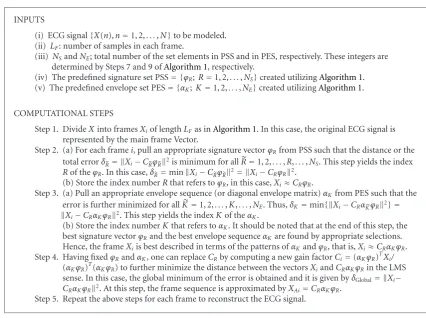
In the following, first an algorithm is presented to gener-ate predefined signature and envelope sets, which is essential for the reconstruction process of the measured ECG signals. Then, the reconstruction algorithm is introduced.
3. ALGORITHMS
The major philosophy of the proposed method to model ECG signals is based on the generation of the PSS and PES. Therefore, in this section first an algorithm is outlined to generate PSS and PES (Algorithm 1) then, reconstruction process of the ECG signals is detailed inAlgorithm 2.
In this work, different values ofLF(such asLF=8, 16, 20, 24, 32, 48, 64) were selected to investigate the effect of the frame length on the quality of the reconstructed ECG signal by means of the PRD level. Details of this effort are given in the subsequent section.
Once PSS and PES are generated, then any ECG sig-nal can be reconstructed frame by frame (Xi ∼=CiαKϕR) as implied by the main statement. It can be clearly seen that in this approach, the frame iis reconstructed with three ma-jor quantities namely, the gain factorCi, the indexRof the predefined signature vectorϕRpulled from PSS, and the in-dexK of the predefined envelope sequenceαK pulled from PES.αK andϕR are determined to minimize the LMS error which is described by means of the difference between the original frameXiand its modelXAi=CiEKSR.
Details of the reconstruction process are given in Algo-rithm 2.
In the following section, simulation results of the new ECG modeling method are presented.
4. SIMULATION RESULTS
0.5 1 1.5 2
A
m
plitude
0 5 10 15 20
Sample 4 2 0 2 4 6 A m plitude
0 5 10 15 20
Sample 4 2 0 2 4 A m plitude
0 5 10 15 20
Sample 6 4 2 0 2 4 A m plitude
0 5 10 15 20
Sample
0.8 1 1.2 1.4 1.6
A
m
plitude
0 5 10 15 20
Sample
0.5 1 1.5 2
A
m
plitude
0 5 10 15 20
Sample 2 1 0 1 2 A m plitude
0 5 10 15 20
Sample 1 0 1 2 3 A m plitude
0 5 10 15 20
Sample 2 0 2 4 A m plitude
0 5 10 15 20
Sample 40 20 0 20 40 A m plitude
0 5 10 15 20
Sample
0.5 1 1.5 2
A
m
plitude
0 5 10 15 20
Sample
0.8 0.9 1 1.1 1.2 1.3
A
m
plitude
0 5 10 15 20
Sample 2 0 2 4 A m plitude
0 5 10 15 20
Sample 1 0 1 2 3 A m plitude
0 5 10 15 20
Sample 20 10 0 10 20 30 A m plitude
0 5 10 15 20
Sample
0.5 1 1.5
A
m
plitude
0 5 10 15 20
Sample
0.5 1 1.5 2
A
m
plitude
0 5 10 15 20
Sample
0.5 0 0.5 1 1.5 2
A
m
plitude
0 5 10 15 20
Sample Figure4: Some selected unique envelope vector in the predefined envelope set forLF=16.
quality of the reconstructed signals was compared with those of classical methods. In the evaluation process of the pro-posed technique, compression ratios (CR) and percent root mean square differences (PRD) between the original and the reconstructed signals were computed [21,22]. In this regard,
PRD is defined by
PRD= N
n=1 xorg(n)−xrec(n) 2 N
n=1x2org(n)
INPUTS
(i) Main frame vector of the ECG signal{X(n),n=1, 2,. . .,N}. (ii) LF: total number of samples in each frame under consideration.
COMPUTATIONAL STEPS
Step 1. Compute the total number of framesNF=N/LF.
Step 2. DivideX(n) into framesXi. In this case, the original ECG signal is represented by the main frame vector.
Step 3. For each frameXi, compute the correlation matrixRi.
Step 4. For eachRi, compute the eigenvaluesλkiin descending order with the corresponding eigenvectors.
Step 5. (a) Store the eigenvector which is associated with the maximum eigenvalue; call it the “signature vector” with the frame indexi; and designate it asV1i.
(b) Compute the frame-scaling coefficientC1in the LMS sense to approximateXi∼=C1V1i. Step 6. Repeat Steps 5(a) and 5(b) for all the frames (i=1, 2,. . .,NF). At the end of this loop,
eigenvectors, which have maximum energy for each frame, will be collected.
Step 7. Compare all the collected eigenvectors obtained in Step 6 with an efficient algorithm. In this regard, Pearsons’ correlation formula may be employed. Then, eliminate the ones which exhibit similar patterns. Thus, generate the predefined signature set PSS= {ϕns(n);ns=1, 2,. . .,
NS}with reduced number of eigenvectorsV1i. Here,NSdesignates the total number of ones of kind signature patterns after the elimination.
Step 8. Compute the diagonal envelope matrix for eachC1iV1i.
Step 9. Eliminate the envelope sequences which exhibit similar patterns with an efficient algorithm as in Step 7, and construct the predefined envelope set PES= {αne(n);ne=1, 2,. . .,NE}; Here,NEdenotes the total number of ones of kind unique envelope patterns.
Algorithm1: Generation of the predefined signature and envelope sets.
wherexorg(n),xrec(n), andNdesignate original signal, recon-structed signal, and length of the original signal, respectively. The compression ratio (CR) is computed as follows:
CR=borg
brec or CR(%)=
borg−brec
borg ×100, (15)
where borg andbrec designate the total number of bits quired representing original and reconstructed signals, re-spectively.
The MIT-BIH database contains 48 ECG record-ings which are sampled at 360 Hz using a resolution of 12 bits/sample. On the other hand, the ECGMAN database includes 16 different digital ECG recordings with sampling rate of 500 Hz and 12 bits/sample resolution. In order to make fair comparison, MIT-BIH recordings were resampled at 500 Hz and all of the ECG recordings were normalized be-tween−1 and +1 values.
In the generation of PSS and PES, Pearsons’ correlation coefficientρwas varied over the interval 0.9 ≤ ρ ≤ 0.995 for the elimination process. In the course of computations, effect of various frame lengths LF was investigated. Obvi-ously, for each frame lengthLF, one has to determine the total number of predefined signature and envelope sets, namely, NS and NE which in turn yield the total number of bits bTotal=bCi+bR+bKrequired to represent the reconstructed ECG signals. In this presentation,bCi,bR, andbK designate
Table1: Variation of total number of bits with respect to frame length.
LF NS NE bTotal
8 15 512 6 + 4 + 9=19
16 16 1024 6 + 4 + 10=20
20 32 3836 6 + 5 + 12=23
24 125 7740 6 + 7 + 13=26
32 250 14 378 6 + 8 + 14=28
48 779 30 395 6 + 10 + 15=31
64 1736 58 486 6 + 11 + 16=33
INPUTS
(i) ECG signal{X(n),n=1, 2,. . .,N}to be modeled. (ii) LF: number of samples in each frame.
(iii) NSandNE; total number of the set elements in PSS and in PES, respectively. These integers are determined by Steps 7 and 9 ofAlgorithm 1, respectively.
(iv) The predefined signature set PSS= {ϕR;R=1, 2,. . .,NS}created utilizingAlgorithm 1. (v) The predefined envelope set PES= {αK;K=1, 2,. . .,NE}created utilizingAlgorithm 1.
COMPUTATIONAL STEPS
Step 1. DivideXinto framesXiof lengthLFas inAlgorithm 1. In this case, the original ECG signal is represented by the main frame Vector.
Step 2. (a) For each framei, pull an appropriate signature vectorϕRfrom PSS such that the distance or the total errorδR= Xi−CRϕR2is minimum for allR=1, 2,. . .,R,. . .,NS. This step yields the index
Rof theϕR. In this case,δR=minXi−CRϕR2= Xi−CRϕR2. (b) Store the index numberRthat refers toϕR, in this case,Xi≈CRϕR.
Step 3. (a) Pull an appropriate envelope sequence (or diagonal envelope matrix)αKfrom PES such that the error is further minimized for allK=1, 2,. . .,K,. . .,NE. Thus,δK=min{Xi−CRαKϕR2} =
Xi−CRαKϕR2. This step yields the indexKof theαK.
(b) Store the index numberKthat refers toαK. It should be noted that at the end of this step, the best signature vectorϕRand the best envelope sequenceαKare found by appropriate selections. Hence, the frameXiis best described in terms of the patterns ofαKandϕR, that is,Xi≈CRαKϕR. Step 4. Having fixedϕRandαK, one can replaceCRby computing a new gain factorCi=(αKϕR)TXi/
(αKϕR)T(αKϕR) to further minimize the distance between the vectorsXiandCRαKϕRin the LMS sense. In this case, the global minimum of the error is obtained and it is given byδGlobal= Xi−
CRαKϕR2. At this step, the frame sequence is approximated byXAi=CRαKϕR. Step 5. Repeat the above steps for each frame to reconstruct the ECG signal.
Algorithm2: Reconstruction of ECG signals by using PSEVS.
Table2: CR and average PRD associated with PSEVS for different frame lengths.
LF CR CR (%) Average PRD (%)
8 5.05 80.2 2.250
16 9.60 89.58 3.504
20 10.44 90.42 4.546
24 11.08 91.00 5.334
32 13.72 92.71 5.939
48 18.58 94.62 8.033
64 23.28 95.71 9.359
total number of bits required to represent one ECG frame is bTotal = 6 + 4 + 9 = 19 bits which in turn yield a com-pression ratio of CR = 8×12/19 = 5.05. On the other hand, ifLF = 64 is selected, thenAlgorithm 1reveals that NS = 1736 andNE = 58486 which corresponds to 33 bits per frame representation. In this case, compression ratio is CR=64×12/33=23.28.
Once PSS and PES were generated, then 16 ECG signals given by ECGMAN database were reconstructed for quality assessment of the proposed technique.Table 2illustrates the coding performance and the average PRD of the proposed method in terms of CR, CR(%), and PRD for different frame lengths.
As it can be seen from Tables 1 and 2, the proposed method exhibits relative compression ratios in the range of 80.2%–95.71% with average PRD varying between 2.250% and 9.359%.
It should be noted that in the existing literature, accept-able values of PRD are reported as less than 10% [21]. Thus,
Table 2 indicates that the proposed method results in high compression ratio with very good PRD levels. In Figure 5, various assessment means are given to evaluate the proposed method.
For the sake of visual inspection, for the frame length LF = 16 cases, various original ECG signals selected from ECGMAN database and the signals constructed via new method are depicted inFigure 6.
Figure 7shows the PRD variations of the reconstructed signals given inFigure 6. As it is seen fromFigure 7that av-erage PRD level is about 3.5% which corresponds to a high quality of reconstruction with high compression rate of 9.6. On the other hand, the average reconstruction time of the proposed method is approximately 1 second.
2 2.5 3 3.5 4 4.5 5 5.5 6 6.5 7 7.5 8 8.5 9 9.5 10
Av
er
ag
e
P
R
D
80 82 84 86 88 90 92 94 96
CR (%) (a)
80 82 84 86 88 90 92 94 96
CR
(%)
0 4 8 12 16 20 24 28 32 36 40 44 48 52 56 60 64 68 Frame length
(b)
2 2.5 3 3.5 4 4.5 5 5.5 6 6.5 7 7.5 8 8.5 9 9.5 10
Av
er
ag
e
P
R
D
0 4 8 12 16 20 24 28 32 36 40 44 48 52 56 60 64 68 Frame length
(c)
Figure5: (a) Performance assessment of the new technique: varia-tion of average PRD with respect to CR(%). (b) Performance as-sessment of the new technique: variation of CR(%) with respect to frame length. (c) Performance assessment of the new technique: variation of average PRD with respect to frame length.
Table3: Comparison of the proposed method with various ECG compression methods.
Method CR PRD (%)
TP [2] 2.0 5.3
AZTEC [2] 10.0 28.1
CORTES [2] 4.8 7.0
FAN/SAPA [2] 3.0 4.0
MSAPA/CSAPA [3] 5.0 3.5
SAIES [4] 5.9 16.3
Vector quantization of wavelet coefficients [3] 10.0 5.5
Classified vector quantization [3] 8.6 24.5
Peak peaking (spline) with entropy encoding [3] 10.0 14.0
ADPCM [9] 6.0 6.9
9.6 4.09
Mean-shape vector quantizer [3] 10.5 5.26
23.2 9.82
Predefined signature and envelope vector Sets (proposed method)
9.6 3.504
10.44 4.546 23.28 9.359
the percent root mean-squared errors were compared. Thus, the comparison results inTable 3are obtained.
These results indicate that the proposed method provides a higher compression ratio with lower PRD values over all the existing lossy compression methods.
5. CONCLUSIONS AND DISCUSSION
In this paper, a new method to represent ECG signals is pre-sented. The proposed technique is based on the generation of the predefined signature and envelope vector sets. In the pro-posed technique, each frame of any ECG signal is described by multiplying three major quantities, namely frame-scaling coefficientCi, the frame signature vector ϕR, and diagonal envelope matrixαK. Signature and envelope patterns are se-lected from the corresponding predefined signature and en-velope vector sets that are formed by using MIT-BIH ar-rhythmia database which contains much cardiac pathology. In the reconstruction process, each ECG frame is fully iden-tified with the frame-scaling coefficientCiand the indicesR andKof the predefined signature and the envelope patterns, respectively.
1 0.5 0 0.5
No
rm
al
iz
ed
amplitude
0 200 400 600 800 1000 1200 1400 1600 1800 2000 Original signal-ECGMAN1
1 0.5 0 0.5
No
rm
al
iz
ed
amplitude
0 200 400 600 800 1000 1200 1400 1600 1800 2000 Reconstructed signal-ECGMAN1
(a) PRD=3.2473, CR=9.6, reconstruction time: 1.061 seconds.
1 0.5 0 0.5 1
No
rm
al
iz
ed
amplitude
0 200 400 600 800 1000 1200 1400 1600 1800 2000 Original signal-ECGMAN2
1 0.5 0 0.5 1
No
rm
al
iz
ed
amplitude
0 200 400 600 800 1000 1200 1400 1600 1800 2000 Reconstructed signal-ECGMAN2
(b) PRD=4.1351, CR=9.6, reconstruction time: 1.072 seconds.
1 0.5 0 0.5 1
No
rm
al
iz
ed
amplitude
0 200 400 600 800 1000 1200 1400 1600 1800 2000 Original signal-ECGMAN8
1 0.5 0 0.5 1
No
rm
al
iz
ed
amplitude
0 200 400 600 800 1000 1200 1400 1600 1800 2000 Reconstructed signal-ECGMAN8
(c) PRD=3.2954, CR=9.6, reconstruction time: 1.072 seconds.
1 0.5 0 0.5 1
No
rm
al
iz
ed
amplitude
0 200 400 600 800 1000 1200 1400 1600 1800 2000 Original signal-ECGMAN15
1 0.5 0 0.5 1
No
rm
al
iz
ed
amplitude
0 200 400 600 800 1000 1200 1400 1600 1800 2000 Reconstructed signal-ECGMAN15
(d) PRD=3.7808, CR=9.6, reconstruction time: 0.952 seconds.
Figure6: Original and reconstructed ECG signals forLF=16.
0 0.5 1 1.5 2 2.5 3 3.5 4 4.5 5
PRD
ECG1 ECG2 ECG3 ECG4 ECG5 ECG6 ECG7 ECG8 ECG9 ECG10 ECG11 ECG12 ECG13 ECG14 ECG15 ECG16
ECG signals
Average PRD: 3.504
Figure7: PRD values associated with ECG signals in the ECGMAN database forLF=16.
obtained performance would be poor. Hereby, the ECGMAN database could not be used to construct the PSV and PEV sets.
It should be noted that if the ECG signals in the MIT-BIH arrhythmia database were used for the test signal, the perfor-mance of our method would be better than the reported re-sults in our paper. Because the ECG signal which is used to test is the same as the ECG signal which is used for construct-ing the PSV and PEV sets. In order to avoid this situation, two different databases were used to construct these sets and test the performance of our method.
It was briefly explained above; our training database is MIT-BIH database which includes 48 different ECG signals. The test set was selected from the different domains which are unlike the training data set. As a result, it can be con-cluded that our method is not a lead-specific method.
ACKNOWLEDGMENTS
The present work was supported by the Research Fund of Istanbul University, Project no. 400/03062005, and UDP-440/10032005.
REFERENCES
[1] D. L. Hudson and M. E. Cohen, “Intelligent analysis of biosig-nals,” in Proceedings of the 27th Annual International Con-ference of the Engineering in Medicine and Biology Society (EMBS ’05), pp. 323–326, Shanghai, China, September 2005. [2] S. M. S. Jalaleddine, C. G. Hutchens, R. D. Strattan, and W.
A. Coberly, “ECG data compression techniques - a unified ap-proach,”IEEE Transactions on Biomedical Engineering, vol. 37, no. 4, pp. 329–343, 1990.
[3] J. L. Cˆardenas-Barrera and J. V. Lorenzo-Ginori, “Mean-shape vector quantizer for ECG signal compression,”IEEE Transac-tions on Biomedical Engineering, vol. 46, no. 1, pp. 62–70, 1999. [4] S. M. S. Jalaleddine and C. G. Hutchens, “SAIES - a new ECG data compression algorithm,”Journal of Clinical Engineering, vol. 15, no. 1, pp. 45–51, 1990.
[5] S.-G. Miaou and J.-H. Larn, “Adaptive vector quantisation for electrocardiogram signal compression using overlapped and linearly shifted codevectors,”Medical and Biological Engineer-ing and ComputEngineer-ing, vol. 38, no. 5, pp. 547–552, 2000. [6] C.-C. Sun and S.-C. Tai, “Beat-based ECG compression
us-ing gain-shape vector quantization,” IEEE Transactions on Biomedical Engineering, vol. 52, no. 11, pp. 1882–1888, 2005. [7] K. Skretting, K. Engan, and J. H. Husøy, “ECG
compres-sion using signal dependent frames and matching pursuit,” inProceedings of IEEE International Conference on Acoustics, Speech and Signal Processing (ICASSP ’05), vol. 4, pp. 585–588, Philadelphia, Pa, USA, March 2005.
[8] E. B. de Lima Filho, E. A. B. da Silva, M. B. de Carvalho, W. S. da Silva J ´unior, and J. Koiller, “Electrocardiographic signal compression using multiscale recurrent patterns,”IEEE Trans-actions on Circuits and Systems I: Regular Papers, vol. 52, no. 12, pp. 2739–2753, 2005.
[9] H. Lee and K. M. Buckley, “ECG data compression using cut and align beats approach and 2-D transforms,”IEEE Transac-tions on Biomedical Engineering, vol. 46, no. 5, pp. 556–564, 1999.
[10] J.-J. Wei, C.-J. Chang, N.-K. Chou, and G.-J. Jan, “ECG data compression using truncated singular value decomposition,” IEEE Transactions on Information Technology in Biomedicine, vol. 5, no. 4, pp. 290–299, 2001.
[11] S.-G. Miaou, H.-L. Yen, and C.-L. Lin, “Wavelet-based ECG compression using dynamic vector quantization with tree codevectors in single codebook,” IEEE Transactions on Biomedical Engineering, vol. 49, no. 7, pp. 671–680, 2002. [12] H.-H. Chou, Y.-J. Chen, Y.-C. Shiau, and T.-S. Kuo, “An eff
ec-tive and efficient compression algorithm for ECG signals with irregular periods,”IEEE Transactions on Biomedical Engineer-ing, vol. 53, no. 6, pp. 1198–1205, 2006.
[13] S.-C. Tai, C.-C. Sun, and W.-C. Yan, “A 2-D ECG compression method based on wavelet transform and modified SPIHT,” IEEE Transactions on Biomedical Engineering, vol. 52, no. 6, pp. 999–1008, 2005.
[14] S.-G. Miaou and S.-N. Chao, “Wavelet-based lossy-to-lossless ECG compression in a unified vector quantization frame-work,”IEEE Transactions on Biomedical Engineering, vol. 52, no. 3, pp. 539–543, 2005.
[15] B. S. Kim, S. K. Yoo, and M. H. Lee, “Wavelet-based low-delay ECG compression algorithm for continuous ECG trans-mission,” IEEE Transactions on Information Technology in Biomedicine, vol. 10, no. 1, pp. 77–83, 2006.
[16] Y. Zigel, A. Cohen, and A. Katz, “ECG signal compression using analysis by synthesis coding,” IEEE Transactions on Biomedical Engineering, vol. 47, no. 10, pp. 1308–1316, 2000. [17] ¨U. G¨uz, H. G¨urkan, and B. S. Yarman, “A novel method to
represent the speech signals by using language and speaker in-dependent predefined functions sets,” inProceedings of IEEE International Symposium on Circuits and Systems (ISCAS ’04), vol. 3, pp. 457–460, Vancouver, BC, Canada, May 2004. [18] B. S. Yarman, ¨U. G¨uz, and H. G¨urkan, “On the
compara-tive results of “SYMPES: a new method of speech modeling”,” AEU - International Journal of Electronics and Communica-tions, vol. 60, no. 6, pp. 421–427, 2006.
[19] G. B. Moody,The MIT-BIH Arrhythmia Database CD-ROM, Harvard-MIT Division of Health Sciences and Technology, Cambridge, Mass, USA, 2nd edition, 1992.
[20] A Karas¸,Elektriksel ˙Is¸aretlerin Temel Tanım Fonksiyonlarıyla Karakterizasyonu, Ph.D. thesis, Department of Electrical and Electronic Engineering, Institute of Science, Istanbul Univer-sity, Istanbul, Turkey, 1997.
[21] Y. Zigel, A. Cohen, and A. Katz, “The weighted diagnostic dis-tortion (WDD) measure for ECG signal compression,”IEEE Transactions on Biomedical Engineering, vol. 47, no. 11, pp. 1422–1430, 2000.
[22] M. Blanco-Velasco, F. Cruz-Roldan, J. I. Godino-Llorente, J. Blanco-Velasco, C. Armiens-Aparicio, and F. L ´opez-Ferreras, “On the use of PRD and CR parameters for ECG compres-sion,”Medical Engineering and Physics, vol. 27, no. 9, pp. 798– 802, 2005.
Hakan G¨urkanreceived the B.S., M.S., and Ph.D. degrees in electronics and communi-cation engineering from the Istanbul Tech-nical University (ITU), Istanbul, Turkey, in 1994, 1998, and 2005, respectively. He was a Research Assistant in the Department of Electronics Engineering, Engineering Fac-ulty, Is¸ık University, Istanbul, Turkey. He has been an Instructor in the Department of Electronics Engineering, Engineering
Fac-ulty, Is¸ık University, Istanbul, Turkey, since 2005. His current in-terests are in digital signal processing, mainly with biomedical and speech signals modeling, representation, and compression.
¨
Umit G¨uz graduated from Istanbul Pertevniyal High School in 1988 and The Department of Computer Programming, Yıldız Technical University, Istanbul, Tur-key, in 1990. He received the B.S. degree with high honors from the Department of Electronics Engineering, College of Engineering, Istanbul University, Turkey, in 1994. He received M.S. and Ph.D. degrees in electronics engineering with high honors
Istanbul, Turkey since 1998. He was awarded a Postdoctoral Re-search Fellowship by the Scientific and Technological ReRe-search Council of Turkey in 2006. He was accepted as an International Fel-low by the Stanford Research Institute (SRI) International, Speech Technology and Research (STAR) Laboratory in 2006. He was awarded a J. William Fulbright Postdoctoral Research Fellowship in 2007. He was accepted as an International Fellow by the Inter-national Computer Science Institute (ICSI) Speech Group, Uni-versity of California, Berkeley, in 2007. His research interest cov-ers speech processing, modeling, coding, compression, automatic speech recognition, natural language processing, and biomedical signal processing.
B. Sıddık Yarman received the B.S. de-gree in electrical engineering from Istanbul Technical University, Turkey (1974); M.E.-E.E. degree from Electro-Math Stevens In-stitute of Technology Hoboken, NJ, 1977; Ph.D. degree in electrical engineering and mathematics from Cornell University, Itha-ca, NY, 1981; Technical staff, Microwave Technology Centre, RCA David Sarnoff Re-search Center, Princeton, NJ (1982–1984);