IJSTE - International Journal of Science Technology & Engineering | Volume 2 | Issue 10 | April 2016 ISSN (online): 2349-784X
In this paper we propose a method to send authentication information over wireless network for remote authentication. Remote authentication usually involves sending of encrypted information along with visual or audio cues. We perform semantic segmentation, chaotic encryption and data hiding to avoid hacking of sensitive information that is sent over a wireless network. Initially, the sender’s image is acquired by using the image acquisition device. The biometric image of the sender is encrypted using chaotic encryption. The encrypted data is hidden into the segmented image and transmitted over a network for authentication. At the server side the image is segmented and the hidden biometric image is extracted. Both the decrypted biometric image and the transmitted image are compared with the database.
Keywords: biometric image, chaotic encryption, data hidding, remote authentication, semantic segmentation
________________________________________________________________________________________________________
I. INTRODUCTION
Authentication is the used to confirm the truth of a data. This can also involve confirming the identity of a person. The two main categories in the authentication field are positive and negative authentication. In positive authentication, the passwords of all users that are stored, in a file. Thus the passwords space includes only user’s passwords and it is usually limited (according to the number of users). If attackers receive the passwords file, then can recover that passwords. On the contrary, in negative authentication the anti-password space is created, containing all strings that are not in the passwords file. If crackers receive the file, their work will be much harder. Negative authentication is used to reduce cyber-attack. By applying this technique, a different layer is added for authentication, preventing unauthorized users from attacking network access.
There are many techniques used for authentication. In this paper we use biometric image and a human face image for authentication. Biometrics is already being incorporated in remote authentication but only as password substitution in smart cards. In order to use their potential fully, biometrics can be incorporated in hybrid crypto-steganography scheme. Cryptographic algorithms can be used to scramble biometric image so that they cannot be understood, while steganography methods can be used to hide the encrypted biometric image so that they cannot be seen. This paper incorporates both to confront the problem of remote human authentication over wireless network. In particular wavelet-based steganography method is proposed for hiding encrypted biometric image into semantically segmented input image, by image acquisition device. The rest of this paper is organized as follows: Section II focuses on the proposed system. In Section III Detailed description of the chaotic encryption method is provided is presented. In Section IV focuses on the insertion of the encrypted biometric image into the input image while Section V gives a detailed description of the authentication mechanism. Section VI concludes the paper.
II. THE PROPOSED METHOD
The proposed method of remote authentication over wireless network aims to ensure (a)Robustness against noise compression and attacks (b)Good encryption method (c)ease of implementation .In this proposed method the input image acquired from image acquisition device is segmented and the biometric image is encrypted by applying cryptographic methods. The encrypted data are hidden into the segmented image and transmitted over a wireless network for remote authentication.
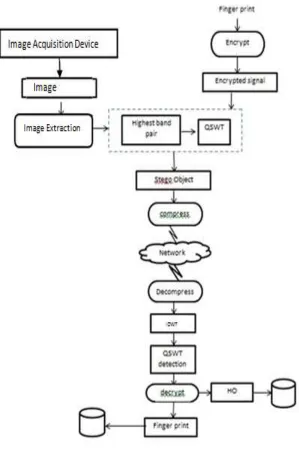
The overall architecture and dataflow of the proposed method is illustrated in figure (1). Initially, a chaotic pseudo random bit generator is used to generate random bits. These random bits are used to encrypt the biometric image. The input image acquired from the image acquisition device is segmented into two levels. The encrypted biometric image is hidden into the segmented image by incorporation steganography methods.[1]
Ordinal Feature Selection of Finger Print and
Image for Remote Authentication
D Jena Catherine Bel E S Akshaya Lakshmi
Asst. Professor UG Student
Department of Computer Science and Engineering Department of Computer Science and Engineering Velammal Engineering College, Chennai Velammal Engineering College, Chennai
Ba Vivitha O Akansha Lal
UG Student UG Student
Department of Computer Science and Engineering Department of Computer Science and Engineering Velammal Engineering College, Chennai Velammal Engineering College, Chennai
Fig. 1: Architecture of Proposed System
Image Acquisition:
The image acquisition device is used to capture the input image. a face detection algorithm is used to detect the region of the face in the acquired image. If a face is detected in the captured image, the face is cropped to be used as the cover image to hide the data into it. If the face is not detected, it prompts us to capture another image.
The Encryption Mechanism:
Chaotic random bit generator is used to generate random bits. The input biometric image is encrypted by using the generated random bits. This is a cryptographic method which produces a scrambled biometric image that cannot be understood.
Image Segmentation:
Ordinal Feature Selection of Finger Print and Image for Remote Authentication (IJSTE/ Volume 2 / Issue 10 / 151)
Data Hidding:
In the selected positions from the image the encrypted biometric image data are hidden into it by incorporating steganographic methods. By applying Inverse Discrete Wavelet Transform (IDWT),the segmented image with the encrypted data are combined and keeping the input image as the cover image, the stego-object is transmitted over the wireless network.
The Authentication Mechanism:
On receiving the stego-object at the server side, the hidden encrypted data are extracted from the cover image and decrypted. The decrypted biometric image and the cover image are compared with the database at the server side for authentication.
III. CHAOTIC ENCRYPTION
Chaotic encryption is the application of the mathematical chaos theory to the practice of the cryptography. This technique is used to privately and securely transmit information with the presence of an third-party or adversary. In this paper using this advanced technique of encryption, the input biometric image is encrypted.
Encryption Keys’ Genertation:
In most of the security schemes, the encryption process depends on generation of random keys of definite size. In this paper, the generated key has equal size to the size of each biometric image pixel value. Each key that is generated by chaotic pseudo random bit generated is based on a single chaotic system. [2]
The generalized formula for generating chaotic pseudo random bits is:
(1-X_n )μ+X_n=X_(n+1) (1) x1(n+1)=f(x1(n),μ1) (2) x2(n+1)=f(x2(n),μ2) (3) Two different keys are generated by giving two different values for x (n) &µ
Then the pseudo random bits sequence can be defined as: k(n) = {
1 f(x1(n), μ1) > f(x2(n), μ3) k(n − 1) f(x1(n), μ1) = f(x2(n), μ2) 0 f(x1(n), μ1) < f(x2(n, μ2))
(4)
Accordingly, the keys are generated by applying this condition and the generated keys are used for the encryption process.
Encrypytion Mechanism:
After generating the chaotic pseudo random keys, input image’s each pixel value is read by applying zigzag transformation and stored as vector values. These vector values of the biometric image are converted into binary values. With each vector value the generated random keys are XORed. This XORed values produce a new values. These values are again converted back to decimal values and placed as pixel values in a sequential order.
The output of this process produces an encrypted biometric image where its information is scrambled and cannot be understood. The mechanism of reading the input image by applying zigzag transformation[3] provides a high security. The input values are shuffled but in a orderly manner so that the encrypted image can be decrypted.
IV. DATA HIDDING
In the field of digital image processing, during last few decades have changed the estimation of a picture. Now a picture can speak thousands of words. We can now hide a large amount of data into a picture and make it indifferent from the original image. This can be achieved by applying steganography algorithm[4].
In this paper, we incorporate the same technique for hiding the data (encrypted biometric image) into to the input image that is captured by the image acquisition device. The encrypted biometric image is robustly hidden into the input image. In this process we aim at producing a stego-object that could protect its hidden message in case of noise, compression, attack.
Image Segmentation:
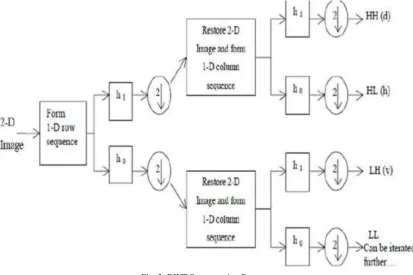
Fig. 2: DWT Segmentation Process
Subband LL1 can be further decomposed in similar way into four different subbands denoted as LL2, HL2, LH2, and HH2 respectively. The two level segmentation of a image by Appling Discrete Wavelet Transform is illustrated in figure (3).
Fig. 3: Two level of Segmentation using DWT
Coefficients’ Selection:
The goal of this paper is send sensitive information that are invisible to human eyes but also robust under different attacks. To achieve this goal we segment the input into two levels with seven subbands.
By comparing both the level’s subband pairs, the highest energy band pair is selected as the target area to hide the encrypted biometric image.
The generalized formula to sum both the level subband’s values,
(5) x2(i,j)={HL2,LH2,HH2},x1(p,q)={HL1,LH1,HH1}and M,N is the size of the subbands at level two
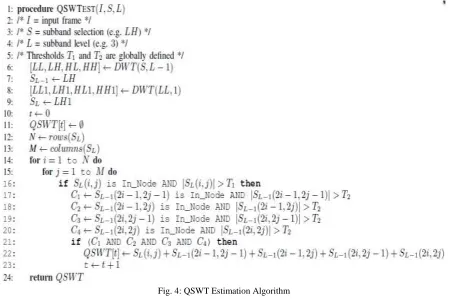
In the selected energy band pair, coefficients’ selection for inserting the encrypted biometric image is done by applying Qualified Significant Wavelet Trees (QSWT)[6]. Qualified Significant Wavelet Trees is applied on the segmented image to find the pixel position in which the encrypted biometric image is to be hidden. We construct a QSWT for one of these bands (LH1, LH2) (HL1, HL2) (HH1, HH2).
Ordinal Feature Selection of Finger Print and Image for Remote Authentication (IJSTE/ Volume 2 / Issue 10 / 151)
Fig. 4: QSWT Estimation Algorithm
The generalized formula to find the threshold values of the two level image,
(5)
(6)
After the encrypted biometric image is hidden into the segmented input image Inverse Discrete wavelet transform is applied to combine the segmented image and produce a stego -object.
This stego-object is transmitted over a wireless network for authentication at the server side.
V. AUTHENTICATION
The process of cryptography and steganography is used to securely transfer sensitive information over a wireless network for authentication. Once the stego-object is received at the server side. The hidden image is extracted from the cover image. The extracted two separate data are compared with the database for authentication.[8]
Extraction Process:
On receiving the stego-object over a wireless network, the received image is segmented into 2 levels by applying DWT algorithm, which is the same process segmentation for hiding the data into the image.[7]
The subbands obtained after segmentation is compared to find out the highest energy band pair among these subbands (LH1,LH2) (HL1,HL2) (HH1,HH2).the highest energy band pair obtained in this process will be the same band pair as obtained for hiding the encrypted biometric image.
After finding the highest energy band pair QSWT is applied in those subbands to find the pixel coefficients in which the encrypted image will be hidden.
From those pixel positions the inserted biometric image data is extracted and the encrypted biometric image is obtained. By applying the reverse process of encryption the input biometric image is obtained.
After subtracting the biometric image data from the stego-object.the segmented image is combined by applying Inverse Discrete Wavelet transform.
Input Image Authentication:
In this paper we propose Directional Binary Code (DBC)[9] based Face Recognition using DWT model. The DWT is applied to LL subband of size 50*50 which is converted into 100 cells with 5*5 dimensions of each cell. The Euclidian distance measure is used to compare the features of the test image and database images. This method renders better recognition rate compared to existing algorithm.
The 2D-DWT for an image is given in Equation 1
Where j is the power of binary scaling and k is a constant of the filter. The size of the image obtained after DWT is 50*50.The Haar wavelet is a sequence of rescaled square shaped functions whose basic function involves averaging and differencing the input image by many levels yielding coefficients. The Haar wavelet function is given by Equation 2 and its scaling function is given by the Equation 3.
DBC Feature Mapping:
DBC is applied on LL subband to encode the direction edge information. It captures the spatial relationship between the pair of neighborhood pixels along a given direction. Let Zi,j be a point in a cell ,four directional derivatives at Zi,j are given in Equation 4 to Equation 7.
The resized image of size 50*50 is partitioned into 100 cells of 5*5 matrixes. Table 1 shows a 3*3 neighbourhood centre on Ii,j taken out of 5*5 cell size, where each cell contributes one coefficient. For each cell, first order derivatives, denoted as Iα,β is calculated, where α= 0 ̊, 45̊, 90̊, 135̊ and d is the distance between the given point and its neighbouring point. Each coefficient values along four directions are averaged respectively to yield hundred features per face image. The derivatives obtained are converted into binary using the Equation 8.
Table – 1
A 3*3 neighborhood center on Ii,j
Out of 25 values of a 5*5 matrix, only centre 9 values are extracted to form a 9 bit binary code. Those 9 bits are read according
to the Equation 9. The DBCs computed along four directions i.e,
Ordinal Feature Selection of Finger Print and Image for Remote Authentication (IJSTE/ Volume 2 / Issue 10 / 151)
Face Feature Matching:
Euclidean Distance (ED) is used to verify whether the person is in database or not. If pi and qi are two points in a 2D plane, where i =1, 2, then the ED is given by the Equation 10.
The ED is calculated by comparing the feature vector of one test image with feature vectors of all images in the database. ED value and position of the image in the database for which ED is minimum and Person number is noted. ED value is compared with the threshold value. If the ED value is less than the threshold, we have to check whether the person from the database and the test image is same. If it is same, then the match count is incremented, else the mismatch count is incremented. If the ED value is greater than threshold then the false rejection rate count is incremented indicating the image in database is falsely rejected.
Now the test image is taken out of the database and above procedure is repeated to calculate the ED value. Then if ED value is greater than threshold, mismatch count is incremented. If ED value is less than threshold, false acceptance count is incremented, indicating the image is not present in database but still matching with a person from the database.
DBC Algorithm:
The algorithm for the proposed DBC-FR model Input: Face Database, Test Face image
Output: Recognition/ Rejection of a person. 1) Image is pre-processed.
2) DWT is applied and approximate band is considered.
3) LL band of 50*50 is partitioned into 100 cells of 5*5 matrixes each.
4) For each cell, the directional derivatives along 00, 450, 900 and 1350 are computed.
5) Derivatives are converted into binary and read in anticlockwise direction to form 9-bit binary code. 6) 9-bit code generated is then converted into its decimal equivalent.
7) The decimal values of all directional derivatives of each cell are averaged to obtain 8) single co-efficient per cell and 100 coefficients for whole image constitutes features.
9) Euclidean distance between feature vectors of images in database and feature vectors of test image is computed. 10) Image with minimum Euclidean distance is considered as matched image
Biometric Image Authentication:
The lines that flow in various patterns across fingerprints are called ridges and the spaces between ridges are valleys. It is these ridges that are compared between one fingerprint and another when matching.
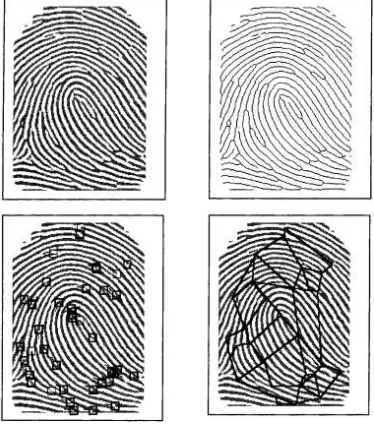
Initially, on the biometric image, image processing is performed. The ultimate objective of image processing is to achieve the best image by which to produce the correct match result. Firstly, the image enhancement step is designed to reduce this noise and to enhance the definition of ridges against valleys. Fingerprint have "redundancy" of parallel ridges. We can use this "redundancy of information" to design an adaptive, matched filter. This filter is applied to every pixel in the image. Based on the local orientation of the ridges around each pixel, the matched filter is applied to enhance ridges oriented in the same direction as those in the same locality, and decrease anything oriented differently. These incorrect "ridges" can be eliminated by use of the matched filter.
After the image is enhanced and noise reduced, we extract the ridges. Next, Thinning reduces the widths of the ridges down to a single pixel. Upon thinning the minutiae are detected. Endings are found at termination points of thin lines. Bifurcations are found at the junctions of three lines. Feature attributes are determined for each valid minutia found and a template is formed. The obtained template features are compared with the template stored in the database. If it matches the authentication is provided.
Fig. 4: Biometric Authentication
VI. CONCLUSION
Authentication using Biometric signals enter more into our everyday lives, since governments, and also other organizations, resort to their use in accomplishing crucial procedures (e.g. citizen authentication). Thus there is an need to further develop and integrate biometric authentication techniques into practical application. Towards this direction in this paper the biometrics authentication over networks has be proposed. Since steganography by itself does not ensure secrecy, it was combined with a chaotic encryption system. The proposed procedure, except of providing results that is imperceptible to the human visual system, it also outputs a stego-object that can resist different signal distortions, and steganalytic attacks. This provides a high security for sending sensitive information over a network. Lastly, the system is able to recover the hidden encrypted biometric signal under different losses. This provides an easy and efficient way to share information aver network and earlier retrieve it at the other end. This provides a high robustness for sending information. This proposed system can be further enhanced and made more secure by capturing the iris image of a person and performing the above mentioned encryption procedure to encrypt them and send over a network.
REFERENCES
[1] Klimis Ntalianis, and Nicolas Tsapatsoulis, ” Remote Authentication via Biometrics: A Robust Video-Object Steganographic Mechanism Over Wireless Networks”, ieee transactions on emerging topics in computing , JANUARY 2015
[2] Deep Desai1 , Appoorv Prasad2 , Jackson Crasto,” Chaos-Based System for Image Encryption”, Deep Desai et al, / (IJCSIT) International Journal of Computer Science and Information Technologies, Vol. 3 (4) , 2012,4809-4811,ISSN:0975-9646.
[3] Ketaki Bhaskar, Mitali Bakale, Priyanka Chaure, Priti Shirke, “Image Steganography for data hiding Using Huffman code, Zigzag and OPAP,”[1] in International Journal of Emerging Trends & Technology in Computer Science (IJETTCS), Volume 4, Issue 6, November - December 2015 , ISSN 2278-6856.
[4] YSwapnali Zagade, Smita Bhosale, “Secret Data Hiding in Images by using DWT Technique’s,” International Journal of Engineering and Advanced Technology (IJEAT) ISSN: 2249 – 8958, Volume-3, Issue-5, June 2014
[5] Ming-Shing Hsieh, Din-Chang Tseng, Member, IEEE, and Yong-Huai Huang, “Hiding Digital Watermarks Using Multiresolution Wavelet Transform,” Ieee Transactions On Industrial Electronics, VOL. 48, NO. 5, OCTOBER 2001
[6] Minati Mishra1 , Priyadarsini Mishra2 and Flt. Lt. Dr. M.C. Adhikary3,” Digital Image Data Hiding Techniques: A Comparative Study”, ANSVESA, 7(2), 105-115, 2012, ISSN-0974-715X
Ordinal Feature Selection of Finger Print and Image for Remote Authentication (IJSTE/ Volume 2 / Issue 10 / 151)
[8] Neha Gupta, V .K. Banga, “Image Segmentation for Text Extraction”, 2nd International Conference on Electrical, Electronics and Civil Engineering (ICEECE'2012) Singapore April 28-29, 2012
[9] Jagadeesh H S, Suresh Babu K, and Raja K B,” DBC based Face Recognition using DWT”, Signal & Image Processing : An International Journal (SIPIJ) Vol.3, No.2, April 2012
[10] Evline.J.Alappatt ,JsamyDavies ,Vince Paul, Mr.Sankaranarayanan P.N “Different Digital Watermarking Techniques for Secure Data Transmission,” Evline.J.Alappatt et al, / (IJCSIT) International Journal of Computer Science and Information Technologies, Vol. 6 (1) , 2015, 164-167,ISSN:0975-9646. [11] A. K. Jain, L. Hong, S. Pankanti, and R. Bolle, "An Identity-Authentication System Using FmgQvpr'mt^:' Proceedings of the IEEE, Vol. 85, No. 9, pp.
1365-1388,