Modern pulse compression radar involves digital signal processing of high bandwidth pulses modulated with different coding schemes. One of the limiting factors in the radar’s design to achieve desired target range and resolution is the need of high rate analog-to-digital (A/D) conversion fulfilling the Nyquist sampling criteria. The high sampling rates necessitate huge storage capacity, more power consumption, and extra processing
requirement. We introduce a new approach to sample wideband radar waveform modulated withCostas sequence
at a sub-Nyquist rate based upon the concept of compressive sensing (CS). Sub-Nyquist measurements of Costas sequence waveform are performed in an analog-to-information (A/I) converter based upon random demodulation replacing traditional A/D converter. The novel work presents an 8-order Costas coded waveform with sub-Nyquist sampling and its reconstruction. The reconstructed waveform is compared with the conventionally sampled signal and depicts high-quality signal recovery from sub-Nyquist sampled signal. Furthermore, performance of CS-based detections after reconstruction are evaluated in terms of receiver operating characteristic (ROC) curves and compared with conventional Nyquist-rate matched filtering scheme.
Keywords:Compressive sensing, Costas waveform, Analog-to-information conversion, ROC curves
1 Introduction
Modern pulse compression radars transmit wideband pulse (linear chirp, binary phase codes, Costas codes, etc.), and perform compression of returned pulse digit-ally after high-rate analog-to-digital (A/D) conversion stage. The conventional A/D converters follow Nyquist sampling theorem, which requires uniform sampling rate at least twice of the signal bandwidth for guaranteed re-construction of the band-limited signal [1]. Adequate A/ D conversion of wideband radar return signal requires both high sampling frequency and large dynamic range. In the radars employing digital pulse compression, one of the bottlenecks in achieving the desired range reso-lution is high-rate A/D conversion, which in many cases is either beyond technological limits or is too expensive.
Recently, a leap in signal sensing realm is made by the promising approach of compressive sensing (CS), which is mainly supported by the positive theoretical and ex-perimental results in [2–6]. It enables sampling at a rate comparable to signal’s information rate. In CS, an
incoherent linear projection is employed to acquire an accurate representation of compressible signal directly using few measurements, much lesser than the number prescribed by the Nyquist theorem. The signal is then recovered from undersampled measurements by solving an inverse problem either through a linear program or a greedy pursuit [7].
Many recent techniques employ CS to sample sparse signal of interest at sub-Nyquist rate using a low-rate sampler as in analog-to-information (A/I) converter. Two popular A/I approaches are periodic nonuniform sampling [8] and random demodulator scheme [9] with its hardware implementation in [10]. Another A/I model, modulation wideband converter (MWC) [11] can undersample analog multiband signal along with spectrum-blind recovery. CS applications to radar are mainly focused to hard target radar [12] or multiple-input-multiple-output (MIMO) radar [13] exploiting sparsity in the target range, Doppler, or angle space. Similarly, CS-based radar imaging using synthetic aper-ture radar (SAR) for terrain mapping [14] and ultra-wideband radar for through-the-wall target detection [15] are of major interests. Promising research, however, * Correspondence:[email protected]
1Air University, Islamabad, Pakistan
Full list of author information is available at the end of the article
in employing CS to reduce radar receiver complexity and its A/D converter sampling rate [16] exploiting radar waveform characteristics are limited.
One approach in pulse compression radar waveform design that achieves high target range and Doppler resolution is the Costas sequence, introduced by J. Costas [17]. The basic building block of Costas wave-form is a simple frequency-hopped signal of N con-tiguous sub-pulses each having distinct frequencies, which are selected through a special class of N×N permutation matrices known as Costas arrays [18]. A class of Costas sequences for which corresponding ambiguity function approaches an ideal or a thumbtack-like response is called Costas codes [19]. For high-resolution delay-Doppler imaging radars, transmitting waveform of N sub-pulses with proper frequency-shift sequence have Pulse Compression Ra-tio (PCR) of N2 [20].
In this paper, we propose a novel approach utilizing the concept of compressive sensing to digital radar sig-nal processing that employs Costas codes as the basis functions for pulse compression. We exploited the time-frequency sparsity of Costas sequence in transform do-main (Gabor dictionary) to represent the received signal with fewer measurements than traditionally required. The fewer sampled data implies significant reduction in memory and power consumption. The results acquired from undersampling of radar returned waveform in A/I converter via random demodulation, and then its recov-ery by solving the convex optimization problem shows promising Costas sequence reconstructions. We have evaluated the proposed approach by comparing the CS-based signal recovery against conventional discrete sam-ple reconstruction in terms of signal-to-noise ratio (SNR) and mean squared error (MSE). Finally, detection performance of CS-based Costas coded radar is analyzed through Monte Carlo simulations and is compared with conventional matched filtering (MF)-based radar
detector by means of receiver operating characteristic (ROC) curves.
The paper is further organized as follows. In Section 2, we explain the generation of Costas waveform followed by a discussion on discrete-time CS theory. In Section 3, we look into sparsity in Costas waveform and present mathematical framework of A/I model for low-rate sam-pling of the continuous-time waveform and its subse-quent reconstruction in transform basis. In Section 4, we lay ground work for ROC curves based performance analysis of CS-based detection scheme. Experimentation and results are discussed in Section 5. The paper is con-cluded in Section 6.
2 Background
2.1 Costas sequence waveform
The Costas sequence modulated waveform, transmit-ted by digital pulse compression radars, of pulse width T seconds, and can be regarded as a frequency hopping signal of N equal-length sub-pulses with kth sub-pulse being frequency modulated with frequency fk with respect to carrier frequency f0. In various time
slots, frequencies to be placed are determined via se-quence of ordered integers, S(k), k= 1,…,N. The se-quence S(k) for which the corresponding ambiguity function approaches an ideal or a “thumbtack” re-sponse is called Costas code.
The expression for the frequencyfkis:
Fig. 1Frequency assignment of eight sub-pulses.aStepped linear-frequency modulation (SLFM) waveform.b8-order Costas coded pulse
fk¼S kð ÞB
N k¼1;…; N
where B is the approximate signal bandwidth. The Costas waveform can be written as:
x tð Þ ¼X
N
k¼1
u kT
N −t
cos f0þfktþθk
ð1Þ
where
u tð Þ ¼ 1 0≤t≤T=N
0 elsewhere
and f0 and θk are the carrier frequency and initial
phase, respectively.
The Costas sequence can also be expressed in a con-venient way through a N×N matrix shown in Fig. 1, whereNrows are used to denote the sub-pulses and the Ncolumns are used to denote the stepped frequency. A “dot”indicates the frequency value assigned to the asso-ciated sub-pulse. A near thumbtack response as obtained
by Costas indicates the placement of one and only one frequency per time slot (row) and per frequency slot (column) [17]. Figure 1a shows the frequency assign-ment with a stepped linear-frequency modulation (SLFM) whereas in Fig. 1b, the frequency assignments are chosen in a random fashion, according to some pre-determined rule, in 8-order Costas array.
According to the traditional Shannon/Nyquist the-orem, the sampling of such waveform should be at least twice of its maximum bandwidth to avoid aliasing [1]. However, since the signal has distinct frequency compo-nents localized in time, we exploited sparse nature of Costas code by employing the concept of compressive sensing.
2.2 Theory of compressive sensing
Compressive sensing (CS) allows the acquisition of one-dimensional discrete-time signal of lengthN indexed as x(n), n= 1,…,N which is compressible in transform basisΨthat provides aK‐sparse representation ofxas:
x¼X
N
n¼1
bnψn¼
XK
i¼1
b nð Þi ψni ð2Þ
where x is a linear combination of K basis vectors chosen fromψn, niare the indices of those vectors, and
bn are the weighting coefficients. By stacking the basis
vectors as columns into the N×N sparsity basis matrix Ψ=ψ1…ψN, its matrix notation can be
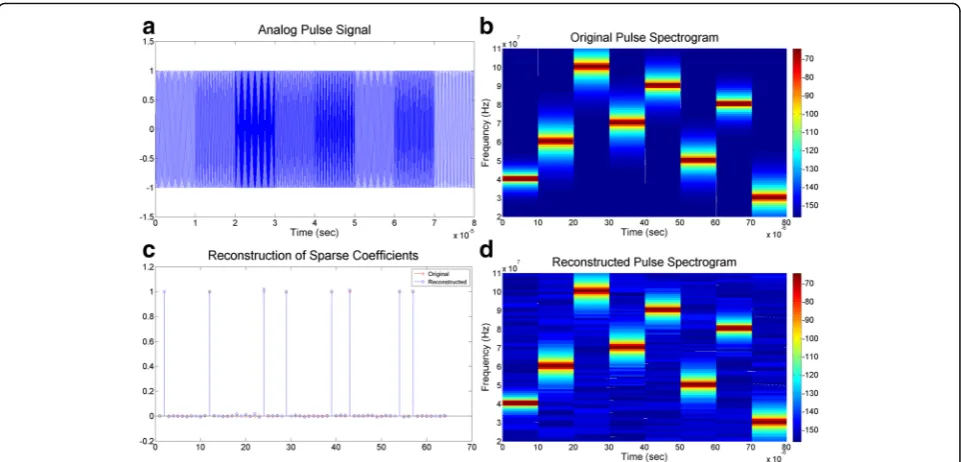
Fig. 38-order Costas coded pulse sampled at 4× sub-Nyquist rate:aOriginal wideband analog signal.bOriginal signal spectrogram.cOriginal and reconstructed sparse vectors.dReconstructed signal spectrogram
Table 1SNR (dB) and MSE for 8-sub-pulsed radar waveform
Sub-Nyquist rate
SNR (dB) MSE
Costas coded SLFM Costas coded SLFM
2× 39.4 38.6 5.74e−5 6.90e−5
4× 36.6 36.0 1.09e−4 1.25e−4
8× 33.3 32.9 2.34e−4 2.56e−4
x¼Ψb
wherebis an N× 1 column vector consisting of terms with the K largest magnitudes while setting all other terms to zero andK≪N.
In compressive sensing, a signal that is compressible in one basisΨ can be recovered withKlargestbn’s from
M¼O KlogN K
nonadaptive linear measurements on to a second basis Φ that is incoherent with the first basis [2, 21]. By incoherent, it is meant that the rows ofΦdo not provide a sparse representation of the columns ofΨ and vice versa. Thus, instead of measuring the N-point signal x directly, we take M<N linear projections that can be expressed in matrix notation as:
c¼ Φx¼ΦΨb¼Αb ð3Þ
wherecare themeasurementsinM× 1 column vector, ΦisM×N measurement matrix, andA=ΦΨwe define is aM×Nmatrix which when holds therestricted isom-etry property (RIP) recovers the signal x with high
Fig. 4SLFM waveform of eight sub-pulses sampled at 8× sub-Nyquist rate.aSpectrogram of original signal.bSpectrogram of A/I converted reconstructed signal
Fig. 5Receiver operating characteristic (ROC) curves (PdvsPfa) at
quality from undersampled measurements M [2, 4, 22]. The RIP and incoherency are valid for many transform pairs such as sinusoids and wavelets and delta spikes and Fourier sinusoids. The recovery of the set of trans-form coefficients b can be achieved through nonlinear optimization [23], by searching for the b with the smal-lestl1-norm that satisfies theMobserved measurements inc:
^
b¼ arg mink kb 1 such that c¼Ab ð4Þ
This optimization problem, also known as Basis Pur-suit [24], can be solved with conventional methods such as interior-point method. Alternatively, heuristic greedy algorithms such as least angle regression (LARS) [25] and orthogonal matching pursuit (OMP) [7] can also be applied at the expense of slightly more measurements.
3 Signal sensing and recovery 3.1 Compressible Costas waveform
The wideband Costas waveform in (1) possesses time-frequency sparsity in the sense that at each point in time, it is well approximated by few local sinusoids of constant frequency. The signals localized in the time-frequency domain have sparse representation under the Gabor transform, expressed as:
Vgðτ;fÞ ¼ x tð Þ;ψτ;fð Þt
D E
The coefficients of Vg are interpreted as the measure of the inner product of the signal with the Gabor atoms given by,
and uniform sampling [9, 10]. The signal is first modu-lated by a pseudo-random maximal-length sequence of +1’s, alternating at or faster than the Nyquist frequency of the received signal, called the chipping sequence, p(t). This demodulation spreads the frequency content of the signal to avoid aliasing in the second stage, which is a low-pass filter having an impulse response,h(t). The sig-nal is fisig-nally sampled at a lower rate ℳ compared to Nyquist rate using a traditional low rate A/D converter.
For our system of sub-Nyquist sampling of a continuous-time Costas sequence waveform, the discrete measurement vector c can be characterized as a linear transformation of the discrete coefficient vectorb. In ac-cordance with (3), this discrete transformation can be expressed as M×N reconstruction matrix Α that com-bines two matrices:Ψ, which translates the discrete coef-ficient vector b to an analog signal x, and Φ, which translates the analog signalx to the discrete set of mea-surementsc.
The output c[m], which is the result of convolution then demodulation and then sampling at rateℳ can be expressed as:
c m½ ¼
Z ∞
−∞xð Þpτ ð Þh tτ ð−τÞdτ ð5Þ
such thatt¼mℳ. As the Costas waveform expressed in (2) has discrete and sparse number of coefficientsΨ, therefore, (5) can be expanded and rearranged as:
c m½ ¼X
N
n¼1
bn
Z ∞
−∞ψnð Þpτ ð Þh mτ ð ℳ−τÞdτ ð6Þ
The reconstruction matrixΑcan be acquired from (6) by separating expression for each element αm,n∈ Α for
rowmand columnn:
αm;n¼
Z ∞
−∞ψnð Þpτ ð Þh mτ ð ℳ−τÞdτ
The reconstruction of the Costas waveform is then performed by exploiting the dictionary of Gabor atoms and recovering the set of transform coefficients b using nonlinear optimization algorithm involving leastl1-norm
Fig. 6Pdvs SNRoutperformance atPfa= 10−3with varying
solution as in (4) to recover the signal directly in the sparse domain.
4 CS-based detection
In this section, we discuss updated CS model which we use to compare performance of CS-based Costas coded radar detector with that of matched filtering (MF) in classical radars. Since classical radar detection theory has since long been well established, detection properties of CS-based techniques are not yet very well known [27]. As CS approach involves new set of parameters which do not appear in conventional radar systems such as target sparseness (K) and compression ratio (M/N), our aim is to assess the effects of these parameters on the detection performance of CS-based Costas coded radar. To update the CS model for evaluating detector performance, we incorporate reconstruction threshold (ηbp) in (4) so that recovery is performed as:
^
b¼ arg mink kb 1 such thatkc−Abk2≤ηbp ð7Þ
where threshold ηbp is proportional to noise standard
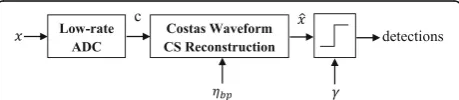
deviation. This nonlinear optimization problem, as already mentioned, is known as Basis Pursuit (BP). In order to achieve desired (Pd,Pfa) with an assigned SNR against selected number of measurementsMand thresh-old ηbp, we add a second detector after CS
reconstruc-tion as shown in Fig. 2. A separate detector after CS (tuningγin Fig. 2 reducesPfawhile maintaining highPd gives better performance than using single detector alone [28].
We present a case of one-dimensional radar which is to determine the presence or absence of target in a given range bin. Consider an unambiguous mapping of target ranges to phases over the whole transmitted bandwidth requiresN-order Costas coded waveform, of durationT, at Nyquist rate. In a compressive sensing (CS) frame-work, we exploit the sparsity in target presence at a given range bin and reduce the number of discrete fre-quency steps in a transmitted Costas coded waveform to M. The frequencies inM-order Costas coded waveform are selected uniformly at random (with none repeated) out ofNfrequencies withM≪N, such that first and last frequencies in bandwidth are selected and that at least two of the adjacent transmitted frequencies have separ-ation Δf to ensure unambiguous range ΔR preserved. Moreover, to achieve a fair comparison with conven-tional detection, it is assumed that same total power is transmitted irrespective of the order of Costas code, i.e., transmitted pulse durationTis to remain constant, hav-ing M/T bandwidth of each sub-pulse in Costas waveform.
The compressed received signal of M-order Costas code is corrupted by additive Gaussian noise of variance
σ2
Since the signal x of length N range bins is a sparse vector comprising of K complex target amplitudes ak
wherek= 1,…,Kare indices corresponding to range bins where targets are located and zero elsewhere. Thus, x = [a1, 0,a2, 0,…0,aK] is sparse directly in range domain
which leads to identity matrix INas basis matrix Ψ and
is therefore maximally incoherent with Φ. The output signal-to-noise ratio (SNRout), for each target, both for conventional and CS-based approach is given by:
SNRout¼j jak2=σ2
whereσ2is noise variance per sample. As output SNR is input to the detector and is independent ofM orN, it makes receiver operating characteristic (ROC)-based comparison more elegant, which is presented in next section.
5 Experimental results and discussion 5.1 Costas waveform reconstruction performance
We demonstrate the effectiveness of our approach by first compressive sensing a Costas coded radar wave-form, taking its undersampled measurements in A/I converter. The pulsed signal recovery is then performed by solving convex optimization problem using CVX 2.1 package in MATLAB [29].
original signal spectrogram shown in Fig. 3b.
To quantify the performance of Costas sequence sam-pled at sub-Nyquist rate, recovered signal is compared with conventionally sampled signal and, its signal-to-noise ratio (SNR) and mean squared error (MSE) is computed. The second and fourth column in Table 1 give the values of SNR and MSE, respectively, for 2×, 4×, 8×, and 16× sub-Nyquist rate sampling, which de-picts high-quality signal restoration even for minimum sampled data.
In our second example, we performed compressive sensing of a stepped linear-frequency modulated (SLFM) pulse in the same L-band. The frequency modulates linearly, among eight steps, between the frequency limits as mentioned in our first experiment. Again, 2×, 4×, 8×, and 16× sub-Nyquist rate sampling is performed in an A/I converter. The reconstruction is performed by exploiting the same Gabor dictionary of atom frequen-cies using nonlinear recovery algorithm. The spectro-gram of the original SLFM pulse and recovered time-frequency sequence from 8× sub-Nyquist rate samples is shown in Fig. 4.
The SNR and MSE performance as presented in col-umn 3 and colcol-umn 5, respectively, of Table 1 show high-quality reconstructed waveform at different undersam-pling rates using A/I converter. With decrease in the number of measurements acquired, the SNR of recon-structed signal slightly degrades as expected, but the re-construction performance is still appreciable even for higher undersampling rates.
5.2 ROC-based detection performance
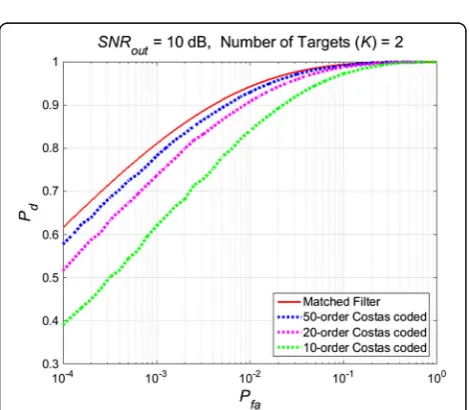
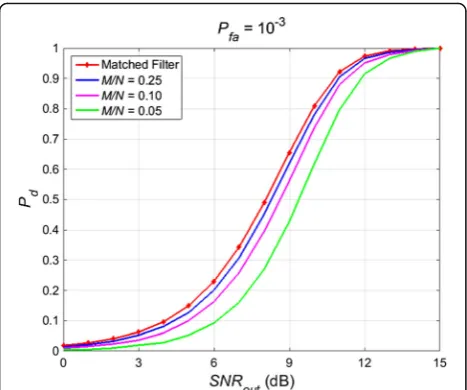
To better appreciate the performance of CS-based Costas coded radar, ROC curves for its detector are sim-ulated and are compared with theoretical detection per-formance of matched filtering (MF) in classical radars under varyingMfor a given SNR andPfa. Ten thousand Monte Carlo simulations are performed, and results are compared with an equal MF output SNR. The case is simulated for 2-point targets (K= 2) of constant ampli-tude, under ideal conditions that no sources of error other than noise are present. N= 200 is used with
curves with that of MF performance at a given SNRout of about 10 dB. Similarly, Fig. 6 depicts the performance of CS-based detection where Pd is plotted versus SNR for a fixedPfa= 10−3for all values ofM/Nratio.
The above results clearly show that CS-based Costas coded radar performs very close to conventional optimum MF system. Moreover, ROC curves show graceful degradation of target detection probability as the number of measurements is decreased in compari-son to what is required at Nyquist rate.
6 Conclusions
In this paper, we presented a novel application of com-pressive sensing in Costas coded pulse compression ra-dars. The wideband radar return is sampled below Nyquist rate in real time using an analog-to-information (A/I) converter. The recovery in time-frequency domain is achieved by employing nonlinear recovery algorithm. The reconstruction of Costas waveforms with different sub-Nyquist sampling rates are demonstrated which re-sults in significant reduction of A/D conversion band-width, memory capacity, and power consumption. The recovered signal holds high fidelity discrete frequency coding (Costas sequence) for pulse compression. The approach relaxes the bounds of using high-rate A/D converters for high bandwidth signal processing, in ra-dars and other applications, having low “information rate.” Moreover, a separate detector is used after CS re-constructions, and its performance is evaluated in terms of ROC curves through simulations. The analysis shows that even less order Costas coded waveforms in pulse compression radars depicts remarkable detection per-formance, quite comparable to that of conventional Nyquist-rate matched filtering.
Abbreviations
Authors’contributions
All authors read and approved the final manuscript.
Competing interests
The authors declare that they have no competing interests.
Author details
1Air University, Islamabad, Pakistan.2Norwegian University of Science and
Technology, Gjøvik, Norway.
Received: 9 June 2016 Accepted: 15 November 2016
References
1. CE Shannon, Communication in the presence of noise. Proc. IRE37(1), 10–21 (1949)
2. DL Donoho, Compressed sensing. IEEE Trans. Inf. Theory52(4), 1289–1306 (2006)
3. E Candès, J Romberg,Practical signal recovery from random projections. Proc. SPIE Conf. Wavelet XI, 2005, p. 5914
4. E Candès, J Romberg, T Tao, Robust uncertainty principles: exact signal reconstruction from highly incomplete frequency information. IEEE Trans. Inf. Theory52(2), 489–509 (2006)
5. E Candès, MB Wakin, An introduction to compressive sampling. IEEE Signal Process. Mag.25(2), 21–30 (2008)
6. R Gribonval, M Nielsen, Sparse representations in unions of bases. IEEE Trans. Inf. Theory49(12), 3320–3325 (2003)
7. JA Tropp, AC Gilbert,Signal recovery from partial information via orthogonal matching pursuit. IEEE Trans. Inf. Theory, 2005
8. JN Laska et al.,Random sampling for analog-to-information conversion of wideband signals. IEEE Dallas CAS Workshop, 2006, pp. 119–122 9. S Kirolos et al.,Analog-to-information conversion via random demodulation.
IEEE Dallas CAS Workshop, 2006, pp. 71–74
10. JN Jason et al.,Theory and implementation of an analog-to-information converter using random demodulation. IEEE Int. Symp. Circuits and Systems, 2007, pp. 1959–1962
11. M Mishali, YC Eldar, From theory to practice: sub-Nyquist sampling of sparse wideband analog signals. IEEE Journal of Selected Topics in Signal Process. 4(2), 375–391 (2010)
12. JH Ender, On compressive sensing applied to radar. Signal Process.90(5), 1402–1414 (2010)
13. Y Yu, AP Petropulu, HV Poor, CSSF MIMO RADAR: compressive-sensing and step-frequency based MIMO radar. IEEE Trans. Aerospace and Electronic Systems48(2), 1490–1504 (2012)
14. X Dong, Y Zhang, A novel compressive sensing algorithm for SAR imaging. IEEE Journal of Selected Topics in Applied Earth Observations and Remote Sensing7(2), 708–720 (2014)
15. B Zhang, W Wang, Through-wall detection of human being with compressed UWB radar data. EURASIP J. Wirel. Commun. Netw.1, 162 (2013)
16. R Baraniuk, P Steeghs,Compressive radar imaging. IEEE Radar Conference, 2007, pp. 128–133, doi:10.1109/RADAR.2007.374203
17. JP Costas, A study of a class of detection waveforms having nearly ideal range-Doppler ambiguity properties. Proc. IEEE72(8), 996–1009 (1984) 18. SW Golomb, T Herbert, Constructions and properties of Costas array. Proc.
IEEE72(9), 1143–1163 (1984)
19. BR Mahafza,Radar systems analysis and design using MATLAB. CRC Press, 2002, pp. 267–270, ISBN: 9781439884959
20. AW Rehaczek, Radar waveform selection—a simplified approach. IEEE Trans. Aerospace and Electronic SystemsAES-7(6), 1078–1086 (1971)
21. E Candès, J Romberg, Quantitative robust uncertainty principles and optimally sparse decompositions. Found. Comp. Math.6(2), 227–254 (2006) 22. R Baraniuk, M Davenport, R DeVore, M Wakin, A simple proof of the
restricted isometry property for random matrices. Constr. Approx.28(3), 253–263 (2008)
23. E Candès, J Romberg, T Tao, Stable signal recovery from incomplete and inaccurate measurements. Commun. Pure Appl. Math.59(8), 1207–1223 (2006)
24. S Chen, D Donoho, M Saunders, Atomic decomposition by basis pursuit. SIAM J. Sci. Comput.20(1), 33–61 (1999)
25. B Efron, T Hastie, I Johnstone, R Tibshirani, Least angle regression. Ann. Stat. 32, 407–499 (2004)
26. S Mallat,A wavelet tour of signal processing, 2nd edn. (Academic, San Diego, 1999)
27. L Anitori, M Otten, P Hoogeboom,Detection performance of Compressive Sensing applied to radar. IEEE Radar Conference, 2011, pp. 200–205, doi:10.1109/RADAR.2011.5960528
28. L Anitori, M Otten, W van Rossum, A Maleki, R Baraniuk,Compressive CFAR radar detection. IEEE Radar Conference, 2012, pp. 320–325, doi:10.1109/ RADAR.2012.6212158
29. CVX Research, Inc. CVX: Matlab software for disciplined convex programming, version 2.1, http://cvxr.com/cvx, Oct. 2014.
Submit your manuscript to a
journal and benefi t from:
7Convenient online submission 7Rigorous peer review
7Immediate publication on acceptance 7Open access: articles freely available online 7High visibility within the fi eld
7Retaining the copyright to your article