A Framework for Cross-lingual/Node-wise Alignment of Lexical-Semantic
Resources
Yoshihiko Hayashi
Faculty of Science and Engineering, Waseda University 2-4-12 Ohukubo, Shinjuku, Tokyo, 169-0072 Japan
Abstract
Given lexical-semantic resources in different languages, it is useful to establish cross-lingual correspondences, preferably with semantic relation labels, between the concept nodes in these resources. This paper presents a framework for enabling a cross-lingual/node-wise alignment of lexical-semantic resources, where cross-lingual correspondence candidates are first discovered and ranked, and then classified by a succeeding module. Indeed, we propose that a two-tier classifier configuration is feasible for the second module: the first classifier filters out possibly irrelevant correspondence candidates and the second classifier assigns a relatively fine-grained semantic relation label to each of the surviving candidates. The results of Japanese-to-English alignment experiments using EDR Electronic Dictionary and Princeton WordNet are described to exemplify the validity of the proposal.
Keywords: lexical-semantic resource, cross-lingual alignment, relation classification
1.
Introduction
Given the current situation where a variety of language re-sources have been actively developed and disseminated, in-tegrating these independently developed resources, prefer-ably in a standardized format, has become an important is-sue (Cimiano et al., 2013). In particular, aligning lexical-semantic resources (henceforth, LSR) across languages in the word-sense/lexical-concept level is highly demanded for realizing cross-language semantic applications. There are a few research projects in line with this re-search direction: BabelNet (Navigli and Ponzetto, 2012) maintains a wide-coverage multilingual semantic network, whose construction relies on mapping of Wikipedia (a mul-tilingual encyclopedia system, in a sense) entries to the cor-responding WordNet (Miller and Fellbaum, 2007) (an En-glish semantic lexicon) senses; Uby (Gurevych et al., 2012) combines a variety of lexical resources for English and Ger-man also in a word-sense level by applying a machine-learned classifier.
Like these well-known projects, our primary research goal is to establish a computational method to discover cross-lingual correspondences in a word-sense/lexical-concept level, given LSRs in different languages. However we further explore a methodology for classifying discovered cross-lingual correspondences with a broader range of se-mantic relation types, not limited to synonymy. To pursue this research direction, we apply a machine-learned classi-fier as in Uby (Gurevych et al., 2012), but with a variety of semantic relation types, including near-synonymy, hyper-nymy, verb-argument, and so on.
This paper presents a whole system architecture for en-abling node-wise alignment of LSRs in different lan-guages, where potential cross-lingual correspondences are first discovered and ranked by applying an existing method (Hayashi, 2013), and then classified by a succeed-ing module. We particularly propose that a two-tiered clas-sifiers configuration could be feasible for the second mod-ule: the first classifier filters out possibly irrelevant corre-spondences, and then the second classifier assigns a
rel-atively fine-grained semantic relation label to each of the surviving correspondences.
To exemplify the proposal, we conducted a series of Japanese-to-English alignment experiments that employ EDR Electronic Dictionary (EDR; for Japanese)1 (Yokoi, 1995) and Princeton WordNet (PWN; for English). EDR actually is a dictionary system, consisting of several types of computational dictionaries. and we mainly utilize EDR concept dictionary. Consult Appendix-A for more detailed description of EDR.
Here, we remind that we only utilize information given in Japanese for EDR, although this resource partly contains bilingual (Japanese and English) information. Similarly, we do not employ Japanese WordNet (Isahara et al., 2008), as our purpose is to explore a computational method to dis-cover relevant cross-lingual correspondences from arbitrary LSRs.
2.
Overall framework
2.1.
The task: node-wise alignment of LSRs
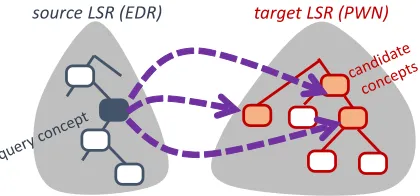
Ontology matching, defined as a process for determin-ing the alignment of a pair of given ontologies (Euzenat and Shvaiko, 2007), is one of the key technologies for enhancing the interoperability of existing knowledge re-sources, including LSRs. The importance of this tech-nology has increased particularly in the context of Linked Open Data. Although, the ontology matching usually main-tains structure-to-structure alignment, our work has prelim-inarily focused on the task of node-wise alignment, which could function as a fundamental building block for an entire structural alignment.Figure 1 illustrates the node-wise alignment task, where one concept in the source LSR is chosen as a query (hence-forth, a query concept), and the task is to discover a set of related concept nodes (including synonymous concepts) in the target LSR. Thus, as in ordinal information retrieval tasks, the problem is to achieve a higher precision while
1
ƐŽƵƌĐĞ>^Z;ZͿ ƚĂƌŐĞƚ>^Z;WtEͿ
Figure 1: Node-wise alignment of concepts in different lexical-semantic resources. Dotted arrows represent poten-tial semantic correspondences that should be classified and labeled.
keeping a level of recall. In addition, each correspondence (dotted arrows in Fig. 1) should be classified by the seman-tic type, and labeled accordingly. Among the possible types of semantic relation, synonymy would be of a particular im-portance especially in a cross-language setting, even though it could only dictate near-synonyms (Hirst, 2009).
2.2.
Proposed architecture
Figure 2 displays our proposed architecture for enabling node-wise alignment of LSRs in different languages. First cross-lingual correspondence candidates are discovered and ranked by applying an existing method (Hayashi, 2013), and then filtered and classified by a succeeding mod-ule (green box in Fig. 2).
In particular, this paper discusses feasible configuration of the latter module. Although the filtering and the classifica-tion could be simultaneously performed by a single classi-fier, we propose that a two-tiered classifiers configuration could be more adequate. That is, the first classifier filters out presumably irrelevant correspondences, and then the second classifier assigns a relatively fine-grained relation label to each of the survived correspondence candidates.
3.
Ranking candidate concepts
3.1.
Cross-lingual semantic relatedness
A method to discover conceptual mates in the LSRs for other languages was proposed in (Hayashi, 2013), and this method could be instantly incorporated into our proposed architecture. The method, given a query concept s, pro-duces a ranked list of candidate concepts (synsets) by com-putingscore(s, t)that measures the cross-lingual semantic relatedness betweensand a candidate conceptt. Here the set of candidate concepts is first generated by exploiting bilingual translation resources (Hayashi, 2012a).
score(s, t)≡(1−β)pscore(s, t) +βgscore(s, t) (1)
As defined in the formula,score(s, t)is computed as the weighted sum ofpscore(s, t)(synonym-based relatedness) and gscore(s, t) (gloss-based relatedness), where 0.0 ≤
β ≤1.0balances the blending of these elements.
The synonym-based relatedness pscore(s, t) dictates a cross-lingual semantic relatedness based on synonymous words (i.e., words that jointly specify a lexical con-cept). This score is computed by employing bilingual
re-sources along with a sense-tagged corpus in the target lan-guage (Hayashi, 2012a).
The gloss-based relatedness gscore(s, t), on the other hand, measures a cross-lingual semantic relatedness based on the textual similarity between the (extended) glosses (Banerjee and Pedersen, 2003). As the languages of comparing gloss texts are different, the extended gloss (in Japanese) for the query concept is first machine-translated2 into the target language (English), and then a monolingual textual similarity measure is applied.
The described configuration can be considered reasonable, as textual glosses, in general, provide richer linguistic con-texts and could be better machine-translated compared to the set of synonym words given to a concept node.
3.2.
Ranked list of candidate concepts
The results reported in (Hayashi, 2013) can be summarized as follows: (1) Synonymous concepts were ranked first for almost half (47.4%) of the test query concepts; (2) Some-what related concepts (including other than synonymous concepts) were discovered with a relatively good perfor-mance: mean average precision (MAP) was 0.695; (3) The optimum value ofβwas around 0.6, but rather robust in the range of [0.4, 0.8].
Table 1 shows a part of the ranked list for an EDR query concept (roughly means big power), exemplifying that a ranked list is a mixture of synonymous concepts (flag=syn), some related concepts (flag=rel), as well as irrelevant con-cepts (flag=irrel). This exactly motivates the presented work. That is, we would like to filter out irrelevant cor-respondences, and assign a label that signals the type of semantic relation to each of the relevant correspondences. Notice also that the parts-of-speech of candidate concepts are not uniform in the ranked list. This is brought about by the nature of EDR: an EDR concept does not explicitly load part-of-speech information, exhibiting a yet another notable difference between PWN and EDR.
4.
Classifying semantic relations
4.1.
Overall approach
We adopt a supervised learning approach. That is, we train a classifier, given hand-annotated training data. To do this, first we choose a set of query concepts from the source LSR (in this work, EDR), and then collect the ranked lists of candidate concepts in the target LSR (PWN): the method described in the previous section is applied for this purpose. Each cross-lingual correspondence candidate in the ranked lists is next hand-classified as one of the semantic relation types defined in an inventory (section 4.2). The annotated ranked lists are then fed into a machine learning (ML) algo-rithm, which employs a set of presumably effective features (section 4.3). The resulting classifier is finally evaluated by employing standard evaluation measures (section 4.4).
4.2.
Annotating cross-lingual correspondences
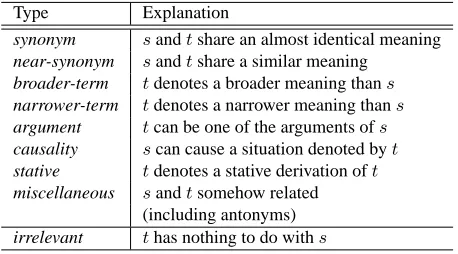
Table 2 summarizes our inventory of semantic relation types, which is referred in the creation of training data. Al-though we initially designed a more fine-grained inventory2
ƐŽƵƌĐĞ>^Z;ZͿ
ƋƵĞƌLJ ĐŽŶĐĞƉƚ
ZĂŶŬŝŶŐ ĐĂŶĚŝĚĂƚĞĐŽŶĐĞƉƚƐ
&ŝůƚĞƌŝŶŐ ŝƌƌĞůĞǀĂŶƚĐĂŶĚŝĚĂƚĞƐ
ůĂƐƐŝĨLJŝŶŐ ƚŚĞƐĞŵĂŶƚŝĐƌĞůĂƚŝŽŶƐ ƌĂŶŬĞĚůŝƐƚ
ŽĨĐĂŶĚŝĚĂƚĞĐŽŶĐĞƉƚƐ
ƌĂŶŬĞĚůŝƐƚǁŝƚŚ ƌĞůĂƚŝŽŶůĂďĞůƐ ƐĞŶƐĞͲƚĂŐŐĞĚ
ĐŽƌƉƵƐ ĞdžƚĞƌŶĂů
DdƐĞƌǀŝĐĞƐ
ƚĂƌŐĞƚ>^Z;WtEͿ
Figure 2: Proposed architecture.
r Synset ID Synonymous words Gloss flag
1 13945102-n power; office holding an office means being in power rel
2 11453016-n power the rate of doing work;measured in watts (= joules/second) irrel
3 05190804-n power; powerfulness possession of controlling influence rel
4 05616246-n ability; power possession of the qualities ... rel
required to do something or get something done
5 08177592-n superpower;great power; a state powerful enough to influence events throughout the world syn
major power; world power
6 01181559-v power supply the force or power for the functioning of irrel
7 05030680-n mightiness; might; power physical strength irrel
8 10461424-n power; force one possessing or exercising power or influence or authority rel
Table 1: A part of the ranked list of candidate PWN synsets for the query EDR concept with ID:0fb994 (represented by a Japanese word ” ”, also translated as ”world power; powerful country”).
Type Explanation
synonym sandtshare an almost identical meaning
near-synonym sandtshare a similar meaning
broader-term tdenotes a broader meaning thans narrower-term tdenotes a narrower meaning thans argument tcan be one of the arguments ofs causality scan cause a situation denoted byt stative tdenotes a stative derivation oft miscellaneous sandtsomehow related
(including antonyms)
irrelevant thas nothing to do withs
Table 2: Inventory of semantic relation types.
by referring to the semantic relation types developed by the EuroWordNet project (Vossen, 1998), we have ended up with the current one, where modest simplification was ap-plied3. Notice that broader-term includes hypernyms and holonyms, while narrower-term includes hyponyms and meronyms/partnyms. Also notice that irrelevant is intro-duced as a special semantic relation types.
4.3.
Features for machine learning
Features for representing a correspondence candidate can be divided into two feature groups: (1) features for a source/target concept node, and (2) features for a
source-3Our annotators were largely puzzled with the initial inventory.
In particular, the distinction between hyponymy with meronymy was not only hard for them but sometimes impossible to do, suggesting that the task of cross-lingual classification of seman-tic/conceptual relations for independently developed LSRs in-volves innate difficulties.
target node pair. We create a feature vector for each of the correspondence candidates by concatenating the sub-vectors for representing these feature groups.
Feature groups for a concept node are:
• Upper semantic classes: In order to signify the coarse semantic nature of a concept, we assign the set of up-per semantic classes as a feature of the concept. For this purpose, the lexicographer files, 45 in total, were adopted as the upper classes for PWN; 36 concepts, placed relatively higher in the concept hierarchy, were selected as the upper classes for EDR. We can easily assign this type of semantic feature even for an EDR concept by navigating the concept hierarchy. This type of semantic feature is finally represented by a 45 (for PWN) or a 36 (for EDR) dimensional binary vector.
• Part-of-speech: The part-of-speech of a concept is also employed as a feature and represented by a 5-dimensional binary vector. PWN explicitly provides this information, but EDR does not. To overcome this issue, we have assigned a possible set of parts-of-speech to each of the EDR upper semantic concepts, and we fake the POS information of an EDR query concept by referring to this assignment.
• Graph features: Two types of features computed from the graph structure of an LSR are introduced to dictate the relative importance of a concept node.
– Depth: hop count of the node from the root node of the LSR.
betweenness centrality and load centrality pro-vided by NetworkX4Python module.
Features for a source-target node pair are further divided into two types. It is natural to incorporate the scores given by the method described in section 2.1. They are: score(s, t) in the left hand side of the eauation (1), and pscore(s, t)andgscore(s, t)in the right hand side. In ad-dition to these scores, we tacked two types of gloss similar-ity as described below.
Word embedding vector-based gloss similarity: We have assigned a semantic vector for each of the gloss text, and computed the cosine similarity. Remind that the gloss text in the source language is translated into the target language: in this case Japanese into English. The se-mantic vector for a gloss text (both in English) is con-structed by summing up5 the word embedding vectors for each words in the gloss text. Each word vector is learned from a relatively large text corpus6by applying word2vec method (Mikolov et al., 2013).
Alignment-based gloss similarity: Another gloss simi-larity relies on the recently proposed monolingual sentence alignment algorithm (Sultan et al., 2104), which achieves a good level of accuracy due to the exploitation of depen-dency syntax. We incorporate the word embedding-based word similarity (with the threshold 0.65), instead of the pre-fixed synonym dictionary utilized in the original version, to admit word-level correspondences. Note that we utilize multiple MT engines to translate a source gloss text, yield-ing a set of translated gloss texts. Therefore the maximum similarity achieved from one of the translated gloss texts and the target gloss text is adopted as this alignment-based gloss similarity.
4.4.
ML algorithm and the evaluation measures
We train a classifier by adopting the Random Forest⃝R (Breiman, 2001) algorithm provided by scikit-learn7 Python module. The Random Forest algorithm was utilized, since it constantly gave us better results com-pared to the Support Vector Machines in the preliminary experiments. As our problem is a typical multi-class classification, we evaluate the learned classifier with the standard performance measures: accuracy, precision, recall, and F1.5.
Experiments
5.1.
Objectives
The objectives of the experiments are three-fold:
• To decide which classifier configuration is better: a one-tier classifier configuration where a single classi-fier also filters out irrelevant candidates, or the two-tiered classifiers configuration as shown in Fig. 2;
4https://networkx.github.io/
5We have tried a few variety of mathematical operations but
the simple addition gave the best results.
6enwik9 corpus is available for download at: http://
mattmahoney.net/dc/text.html
7http://scikit-learn.org/
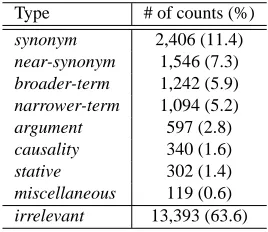
Type # of counts (%)
synonym 2,406 (11.4)
near-synonym 1,546 (7.3)
broader-term 1,242 (5.9)
narrower-term 1,094 (5.2)
argument 597 (2.8)
causality 340 (1.6)
stative 302 (1.4)
miscellaneous 119 (0.6)
irrelevant 13,393 (63.6)
Table 3: Distribution of semantic relation types.
• To compare among alternative systems of semantic re-lation types: A system that results in a better classifi-cation performance (with respect to some perspective) should be explored;
• To investigate into the importance of a proposed fea-ture group.
To accomplish these objectives, we collected the perfor-mance measures on the ranked lists data (section 5.2), while altering the system of semantic relation types (section 5.3). With respect to the last objective, we have conducted so-called ablation tests, which will be detailed afterwards (sec-tion 6.3).
5.2.
Data
5.2.1. Query concepts and the ranked lists
First we collected a set of ranked lists of at most 10 can-didate PWN synsets generated for an EDR query concept. To run the method described in (Hayashi, 2013), we se-lected 2,300 EDR query concepts by roughly observing the distribution of concepts in terms of a higher-level semantic classification.
Among the 2,300 query concepts, the method yielded ef-fective ranked list for 2,036 queries (efef-fective rate: 87.2%). Most of the ineffective queries were associated with some domestic concepts and/or named entities.
Calculated from the annotation results (described in the next subsection), the MAP measures for synonymous and related concepts are 0.483 and 0.783 respectively. These are slightly better figures than the ones reported in the orig-inal literature.
5.2.2. Distribution of semantic types
A team of annotators went through the ranked lists, and as-signed one of the semantic types chosen from the inventory shown in Table 2. Although each of the ranked lists was checked by only one annotator, the final results were ap-proved through discussions by the annotator team.
Mnemonic of the system Description
binary irrel:{irrelevant}, rel: (other relation types)
fine syn:{synonym},
near-syn:{near-synonym}, brd:{broader-term}, nrw:{narrower-term}, irrel:{irrelevant}, misc: (other relation types)
middle syn:{synonym}, rel:{near-synonym,
broader-terms, narrower-terms}, irrel:{irrelevant}, misc: (other relation types)
coarse syn:{synonym}, rel+: rel∪misc
Table 4: Alternatives of relation type system.
Mnemonic N A P R F1
binary 2 0.740 0.7566 0.8647 0.807
fine 6 0.655 0.678 0.972 0.799
middle 4 0.667 0.702 0.945 0.806
coarse 3 0.675 0.719 0.927 0.810
Table 5: Classification performances for irrelevant relation. (N represents the number of classes (types);Accuracy ap-plies to all target types.)
5.3.
Possible systems of semantic relation types
Although the final applicability of a system of semantic re-lation types depends on its final application, the distribu-tion (Table 3) suggests some modificadistribu-tion to the inventory (Table 2) should/could be made. To empirically investigate this issue, we compare four semantic relation type systems shown in Table 4. Notice that thebinarysystem is par-ticularly introduced to assess the two system-architectural alternatives discussed in section 5.1.6.
Results
The results presented in this section were collected from a series of experiments, in which the Random Forest learning algorithm was adopted.
We applied a standard 5-fold cross validation procedure: therefore the reported figures were computed by averaging over the results of the five trials. Also note that we con-firmed the variations in the results, brought about by the nature of the Random Forest, were very small.
6.1.
Filtering irrelevant correspondences
Table 5 summarizes the classification performances, par-ticularly focusing on the detection of irrelevant correspon-dences. The important remark here is that the shown results were obtained by the single classifier configuration, where irrelevant is included in the set of target classes.
Although the bestF1score was achieved with thecoarse type system, thebinarytype system could be considered most adequate, because it moderately balances the preci-sion (P) and the recall (R), and yields the best accuracy
Mnemonic N A P R F1
fine 5 0.438 0.426 0.674 0.522
middle 3 0.651 0.539 0.292 0.378
coarse 2 0.712 0.572 0.219 0.316
Table 6: Classification performances for synonym relation.
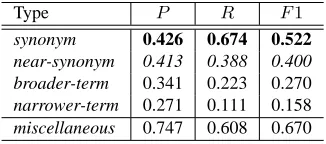
Type P R F1
synonym 0.426 0.674 0.522
near-synonym 0.413 0.388 0.400 broader-term 0.341 0.223 0.270
narrower-term 0.271 0.111 0.158
miscellaneous 0.747 0.608 0.670
Table 7: Classification performances of thefinesystem (without irrelevant correspondences).
(A) of 0.740, which insists that this configuration also gave a better performance for relevant types.
Therefore, we would conclude that irrelevant correspon-dences should be first filtered out, which means we should adopt the two-tiered classifiers configuration that was dis-played in Fig. 2.
6.2.
Comparison of semantic relation type
systems
Although the ”binary filter” works at a reasonable perfor-mance level (F1is around 0.8 with balancedP andR), it is still far from perfect. Nevertheless, here we assume that (a future version of) the filter perfectly performs, and com-pare the alternatives of the semantic relation type systems classified in Table 4, particularly in terms of the classifica-tion performances of synonymous correspondences. Table 6 compares the classification performances of syn-onym relation, where only the non-irrelevant data are fed into the machine learning process. Notice that thebinary system disappears here by definition, and the number of classes is decreased by one in all systems.
It is natural to observe the A increases as the number of target types (classes) decreases. Interestingly, however, the F1measure for synonym relation is rather better with the finesystem (F1 = 0.522) than that with other semantic type systems. This may due to: if we collapse dissimilar classes into a single class or a few classes, the total classifi-cation performance might degrade, suggesting that we have to adopt an appropriate semantic relation type system. Table 7 further breaks down the classification performances of thefinesystem for each classes, showing that the re-sults for synonym and near-synonym are somewhat promis-ing, but broader-term and narrower-term are hopelessly difficult to discriminate. This may partly reflect the dis-tribution of the semantic relation types in the data shown in Table 3. Nevertheless, these difficult classes may indirectly contribute to the classification of synonym relation, as well as that of near-synonym relation probably.
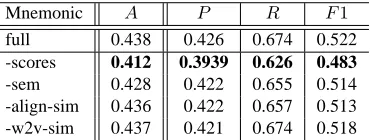
be-Mnemonic A P R F1
full 0.438 0.426 0.674 0.522 -scores 0.412 0.3939 0.626 0.483
-sem 0.428 0.422 0.655 0.514 -align-sim 0.436 0.422 0.657 0.513 -w2v-sim 0.437 0.421 0.674 0.518
Table 8: Ablation test results (without irrelevant correspon-dences).
tween different LSRs. However further experimentations with a larger data set would be necessary to make this more concrete.
6.3.
Importance of a feature group
We conducted a series of ablation tests in order to explicitly investigate the importance of each feature group. Table 8 displays the results with thefinesystem on the data with-out irrelevant candidates, where each mnemonic dictates one of the following ablation conditions. Larger degrade in the performance measure means that the associated fea-ture group was effective hence important.
• full: without any ablations (for comparison).
• -score: without scores in the candidate ranking (score, pscore, andgscore).
• -sem: without the upper semantic classes feature.
• -align-sim: without the alignment-based gloss similar-ity.
• -w2v-sim: without word embedding vector-based gloss similarity.
As expected, the score features play the most prominent role, being consistent with the results of the candidate rank-ing module, where MRR for the synonym relation was rel-atively high as around 0.5. Each of the remaining three feature groups also plays a role, but it should be noted that the word2vec-based gloss similarity was not very effective, probably suggesting that it captures more vague semantic relatednesses rather than semantic similarities.
For a comparison purpose, Table 9 shows corresponding performance figures obtained from the data including ir-relevant correspondences. Like the previously shown re-sults, the score feature group contributed most. Unlike the previous results however, the word2vec-based gloss sim-ilarity was confirmed to be effective in the classification, showing that semantic relatedness captured by this fea-ture could contribute to distinguishing irrelevant correspon-dences from relevant ones.
7.
Concluding remarks
This paper empirically showed that a two-tiered classifiers configuration is feasible for classifying cross-lingual cor-respondences between concept nodes in different lexical-semantic resources. The resulting performance measures revealed that the task itself is quite challenging, presum-ably due to innate differences in the semantic ranges of con-cepts in the languages. Often the information explicitly or
Mnemonic A P R F1
full 0.655 0.459 0.309 0.370 -scores 0.639 0.390 0.221 0.282
-sem 0.654 0.436 0.319 0.369 -align-sim 0.653 0.458 0.277 0.345 -w2v-sim 0.650 0.467 0.272 0.344
Table 9: Ablation test results (with irrelevant correspon-dences).
implicitly provided by each concept in a lexical-semantic resource are not suffice to distinguish between them from competing candidate concept in the other resources. This means that we may need to explore a better inventory of semantic relation type system as well.
Technically, we may have more rooms to improve. We would be able to incorporate more effective con-straints/preferences from the structure of each LSRs. Be-sides, recent progresses in distributed/distributional seman-tic representations (Weeds et al., 2014; Bollegala et al., 2015; Rothe and Sh¨utze, 2015) could help improve the set of features utilized in the machine learning process.
8.
Acknowledgments
This work was supported by JSPS KAKENHI Grant Num-ber #25280117.
9.
Bibliographical References
Satanjeev Banerjee and Ted Pedersen. 2003. Extended gloss overlaps as a measure of semantic relatedness. Proc. of the 18th International Joint Conference on Arti-ficial Intelligence (IJCAI’03), pp.805–810.
Danushka Bollegala, Takanori Maehara, and Ken-ichi Kawarabayashi. 2015 Embedding semantic relations into word representations. Proc. of the 24th Interna-tional Joint Conferences on Artificial Intelligence (IJCAI 2015), pp.1222–1228.
Leo Breiman. 2001. Random Forests. Machine Learning, 45 (1): 5–32.
Phillip Cimiano, John McCrae, Paul Buitelaar, and Elena Montiel-Ponsoda. 2013. On the role of senses in the ontology-lexicon. In: Alessandro Oltamari et al. (Eds.), New Trends of Research in Ontologies and Lexical Re-sources., pp.43–62. Springer.
J´erˆome Euzenat and Pavel Shvaiko. 2007. Ontology Matching, Springer.
Iryna Gurevych, Judith Eckle-Kohler, Silvana Hartmannm, Michael Matuschek, Christian M. Meyer, and Chris-tian Wirth. 2012. UBY - a large-scale unified lexical-semantic resource based on LMF. Proc. of the 13th Con-ference of the European Chapter of the Association for Computational Linguistics (EACL 2012), pp.580–590. Yoshihiko Hayashi. 2012a. Computing cross-lingual
syn-onym set similarity by using Princeton annotated gloss corpus. Proc. of 6th International Global WordNet Con-ference (GWA2012), pp.131–141.
Web services for accessing semantic lexicons. Language Resources and Evaluation, 46(2), pp.253–364.
Yoshihiko Hayashi. 2013. Blending two kinds of semantic relatedness for cross-language matching of lexical con-cepts. Proc. of 10th International Conference on Termi-nology and Artificial Intelligence (TIA2013), pp.35–42. Graeme Hirst. 2009. Ontology and the lexicon. In Steffen
Staab and Rudi Studer (Eds.) Handbook of Ontologies, pp.269–292. Springer.
Hitoshi Isahara, Francis Bond, Kiyotaka Uchimoto, Masao Utiyama and Kyoko Kanzaki. 2008. Development of Japanese WordNet. Proc. of the Sixth International Conference on Language Resources and Evaluation (LREC2008).
Rada Mihalcea and Dragomir Radev. 2011. Graph-based Natural Language Processing and Information Retrieval. Cambridge University Press.
Tomas Mikolov, Ilya Sutskever, Kai Chen, Greg Corrado, and Jeffrey Dean. 2013. Distributed representations of words and phrases and their compositionality. Advances in Neural Information Processing Systems 26, pp.3111– 3119.
George Miller, and Christiane Fellbaum. 2007. Wordnet. then and now. Language Resources and Evaluation 41, 209–214.
Roberto Navigli, and Simone Paolo Ponzettoo. 2012. Ba-belNet: The automatic construction, evaluation and ap-plication of a wide-coverage multilingual semantic net-work. Artificial Intelligence, 193, 217–250.
Sascha Rothe and Hinrich Sh¨utze. 2015. AutoExtend: Extending word embeddings to embeddings for synsets and lexemes. Proc. of the 53rd Annual Meeting of the Association for Computational Linguistics (ACL 2015), pp.1793–1803.
Md Arafat Sultan, Steven Bethard, and Tamara Sumner. 2014. Back to basics for monolingual alignment: Ex-ploiting word similarity and contextual evidence. Trans-actions of the Association for Computational Linguistics, Vol.2, p.219–230.
Piek Vossen (Eds.) 1998. EuroWordNet. Kluwer Aca-demic Publishers.
Julie Weeds, Daud Clarke, Jeremy Reffin, David Weir, and Bill Keller. 2014. Learning to distinguish hypernyms and co-hyponyms. Proc. of the 25th International Con-ference on Computational Linguistics (COLING 2014), pp.2249–2259.
Toshio Yokoi. 1995. The EDR electronic dictionary. Com-munications of the ACM 38(11), 42–44.
Appendix-A. Information structure of the
EDR Electronic Dictionary
The EDR electronic dictionary, unlike Princeton WordNet, is not a lexical database based on relational lexical seman-tics: Rather, it can be seen as a knowledge base enriched by linguistic information given in both Japanese and English. Another big difference lies in the consideration of parts of speech in the conceptual organization: as well known, PWN maintains POS-dependent lexical semantic networks, while EDR bears only a POS-independent network.