R E S E A R C H
Open Access
Optimal linear precoding for opportunistic
spectrum sharing under arbitrary input
distributions assumption
Rui Zhu
1,2,3, Yifei Zhao
2, Yunzhou Li
1,2*, Jing Wang
1,2and Hao Hong
1,2Abstract
Cognitive radio network with multiple-input multiple-output is an effective method to improve not only spectrum efficiency, but also energy efficiency. In this article, a linear precoding matrix optimization algorithm, named gradient-aided mutual information optimization (GAMIO), is designed to maximize the secondary users’ spectrum efficiency. Unlike the previous algorithms which were developed under a specific input assumption, the GAMIO algorithm can work without imposing any input assumption. Furthermore, a framework is also proposed to develop the energy-efficient algorithm which can work with arbitrary spectrum-efficient algorithm. In this way, an
energy-efficient algorithm, which can work under arbitrary input assumption, be developed based on the GAMIO algorithm (EEGAMIO). Numerical results indicate that either the GAMIO algorithm or the EEGAMIO algorithm shows the best performance at the present time.
1 Introduction
Fixed spectrum allocation is a traditional spectrum allo-cation methodology for wireless communiallo-cation systems. This method causes less spectrum efficiency due to the fact that most of the available spectrum is forbidden for the users except for the licensed user (primary user). Besides the spectrum efficiency, we also need an energy-efficient system in order to protect our environment and avoid the green house effect because, in recent years, the using and production of information and communi-cation technology (ICT) contribute an increasing share to the global green house gas emissions. ICT, especially mobile telecommunication network, shows exponentially increasing energy consumption and will no doubt become a major part of energy consumption in the future. For-tunately, with the development of cognitive radio (CR) [1] network and multiple-input multiple-output (MIMO), people find new opportunities to simultaneously improve
*Correspondence: [email protected]
1Department of Electronic Engineering, Tsinghua University, Beijing, China 2Research Institute of Information Technology, State Key Laboratory on Microwave and Digital Communications, Tsinghua National Laboratory for Information Science and Technology (TNList), Tsinghua University, Beijing, China
Full list of author information is available at the end of the article
spectrum efficiency and energy efficiency. Besides the tra-ditional radio resource allocation research of CR network which focused on time or frequency domains, MIMO CR network can allocate the resources of space domain and offers the secondary user more freedom degrees to trade off between maximizing the spectrum/energy efficiency and minimizing the interference at the primary user.
Among all of the new technologies for MIMO CR net-work, linear precoding [2-6] is the most popular research topic. There are several contributions in this field: Haykin [7] gives an overview of the green wireless communica-tion via cognitive dimension but it mainly focuses on the concept and pays less attention to the concrete applica-tion. Huang et al. [8] and Xing et al. [9] utilize game theory to maximize the sum of secondary users’ util-ity functions under the interference-power constraint. In [10,11], resource allocation of the secondary users is studied by applying the graph-theoretic models. Zhang and Liang [12] research the sub-space algorithm perfor-mance in CR network by singular-value decomposition (SVD) theory. However, all of the aforementioned works rely on the impractical Gaussian input assumption, which often leads to substantial performance degradation in real application. In order to overcome this shortage, a parameterized iterative algorithm [13], which can work
under equip-probable discrete input assumption, was proposed. Though the parameterized iterative algorithm cannot directly be used in CR network because of the interference constraint, an algorithm, named branch and bound-aided mutual information optimization (BAMIO), was proposed in [14,15] to optimize the precoding matrix in CR network. However, these algorithms can work only under the equip-probable finite alphabet inputs assump-tion. Thanks to the contribution of [16-18], a fundamental relation between the mutual information and the min-imum mean square error (MMSE) in Gaussian channel was unveiled. Furthermore, an algorithm named mercury water filling (M/WF) [19] was proposed to maximize the mutual information over parallel channel under arbitrary inputs assumption. But M/WF can work only when the channel matrix is diagonal and cannot be used in the CR network. This constraint limited its application. All of the above-mentioned drawbacks motivate the research of this article. Our goal is to address a linear precoding algorithm of spectrum/energy efficiency which can be used in CR network without imposing any input assumption.
The main contributions of this article are summarized as follows: First, this article formulates the spectrum and energy-efficient problem for CR network. Second, in the case of spectrum efficiency, a new algorithm based on the gradient-aided mutual information optimization (GAMIO) is proposed. Different from the previous works, the GAMIO algorithm does not limit any input assump-tion. It is more realistic than the previous algorithm which developed under the Gaussian or any other specific input assumption. Third, in the case of energy efficiency, this article proposes a framework to develop the energy-efficient algorithm which can work with any spectrum-efficient algorithm. In this way, it is easy to develop an energy-efficient algorithm (EEGAMIO) which can inherit the advantage of GAMIO algorithm and work under arbi-trary input assumption.
The remainder of this article is organized as follows: In Section 2, the MIMO CR network system model is proposed. Based on this model, we formulate the spectrum- and energy-efficient optimization problems. Two typical channel capacity expressions are also pro-posed to examine the algorithm performance in simu-lation. Linear precoding algorithm is given in Section 3 to solve the proposed optimization problem. The perfor-mance evaluation is shown in Section 4. Finally, conclu-sions are drawn in Section 5.
Notation:Bold face uppercase letters denote matrices, bold face lower case letters denote vectors. The super-script (.)† and (.)∗ stand for the conjugate transpose operator and the conjugate operator, respectively. The operatordiag(a)denotes a diagonal matrix with elements given bya. Trace(A) denotes the trace operation of matrix A. The operator E(.) denotes the statistical expectation
andEa(.)denotes the statistical expectation with respect toa. The operator.and|.|denote thel2norm and the matrices determinant, respectively.
2 System model and problem formulation
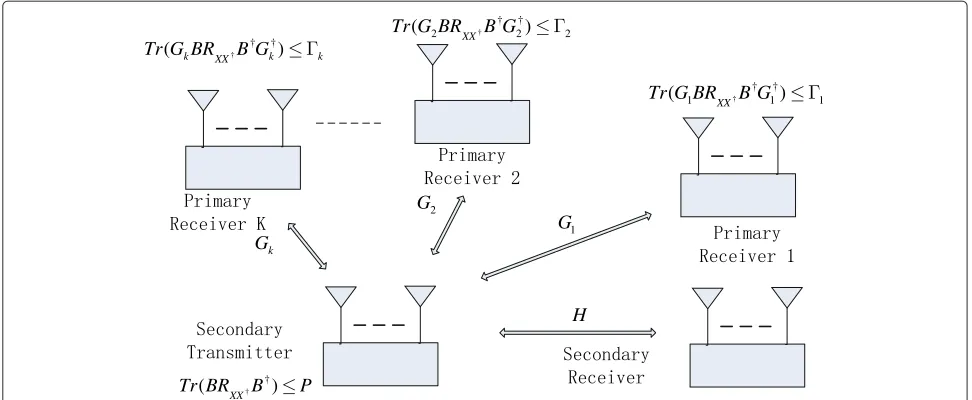
As shown in Figure 1, a MIMO CR network withK
pri-mary receivers and a single pair of secondary user is considered. All of the primary users and secondary users share the same spectrum for transmission. We consider the scenario where each user is equipped with multiple antennas. The channel state information (CSI) from the secondary transmitter to every receiver is perfectly known at the secondary transmitter. Under such assumptions, the secondary transmitter is able to adapt linear precoding matrix to optimize spectrum/energy efficiency.
In practice, the CSI between primary transmitter and secondary receiver can be obtained at the secondary transmitter by sensing the primary transmitter-emitted signal. On the other hand, the CSI between the secondary transmitter and secondary receiver can be obtained by periodical training when the time-division-duplexing model is employed. Of course, it is difficult to get the perfect CSI for the secondary transmitter. Hence, the achieved spectrum/energy efficiency is an upper bounder. Based on the model which we mentioned above, we
further assume that a Gaussian channel composed Nt
transmitted antennas and Nr received antennas is con-sidered. Then, the MIMO signal can be formulated as
y=HBx+z. (1)
In (1),yandxdenote the received and transmitted sig-nal vectors, respectively, and H ∈ CNr×Nt denotes the secondary users channel (in this article, we always assume that the channel matrix is full rank). z is the Gaussian additive noise vector. It is assumed thatz∼CN(0,σ2).B is the linear precoding matrix which we want to optimize. We denote the transmit covariance matrix of secondary users signal asRxx†,Rxx† = E
xx†, where the expecta-tionE[ .] can be referenced from the codebook. In order to simplify the representation, we normalize y and H with the noise vector z. So the equivalent signal can be represented as
y=HBx+z. (2)
The variablesy,H, andzarey=R−zz0.5 y,H=R−zz0.5 H, and z=R−zz0.5 z, respectively. Rzz is the covariance
matrix of z. It is clear that z ∼ CN(0, 1). And the covariance matrix ofzis an identity matrixI. The total transmitted power for secondary transmitter is denoted as
Pt. So the power constraint must be held as
1 G 2
G
k
G
H
†
† †
( k k) k XX
Tr G BR B G
†
† †
2 2 2
( )
XX
Tr G BR B G
†
† †
1 1 1
( )
XX
Tr G BR B G
†
†
( )
XX
Tr BR B P
Figure 1CR network where the secondary user shares the same transmit spectrum with primary.
Just like we mentioned above, we assume that there areKprimary receivers in the CR network and each pri-mary receiver is equipped with Nr antennas. For every primary receiver, there must be an interference power constraint over all received antennas. The interference power constraint can be represented as
Trace(GkBRxx†B†G
†
k)≤k, k=1,. . .,K. (4)
Gk represents the channel matrix between secondary
transmitter andkth primary receiver. From [7], it is clear that the obtained upper bound for the capacity loss of pri-mary user is a function of the interference powerk. So the capacity loss of any primary user due to the secondary transmission can arbitrarily be small by controlling the interference powerk.
Now, it is time to formulate the efficient problem. The first goal is to design the linear precoding matrix of sec-ondary user to maximize its spectrum efficiency under its own transmit power constraint together with a set of interference power constraints at primary users. The problem can be represented as (Pr1)
maximize: C=I(x,y)
subject to :
Trace(BRxx†B†)≤Pt Trace(GkBRxx†B†G
† k)≤k,
k=1,. . .,K.
(5)
We notice that many researchers usually develop their algorithm based on the Gaussian input assumption even though the input signal is not always a Gaussian signal, because it has a very simple and elegant expression (6) and can be solved effectively by convex optimization algorithm [20,21].
I(x,y)=log2I+HBRxx†B†H† (6)
Actually, the channel capacity has different expressions in different situations. For example, when we consider the equip-probable discrete signaling constellations, such as
M-ary PSK, PAM, and QAM, the channel capacity is more likely to be represented as [12,20,21]
I(X,Y)=Ntlog2M− 1
MNt MNt
m=1
×E ⎧ ⎨ ⎩log2
MNt
k=1
e−(HB(xm−xk)2−z2) ⎫ ⎬ ⎭.
(7)
where Mis the number of points in the signal constel-lation. Of course, there are many other channel capacity expressions in practical scenarios (e.g., TCM). Due to the limited space, we do not further enumerate them. It will obviously result in performance loss if we ignore the real input signal distribution. Thus, a spectrum-efficient optimization algorithm which can adapt to various input signals is needed. In Section 4, we will examine GAMIO algorithm under the Gaussian input assumption and 2-symbol equip-probable discrete input assumption. The simulation results show a consistent conclusion.
The second goal is to design the linear precoding matrix of secondary user to maximize its energy efficiency under not only its own transmit power constraint, but also a set of interference power constraints at primary users. The problem can be represented as (Pr2)
maximize: C/P=I(x,y)/Trace(BRxx†B†)
subject to :
Trace(BRxx†B†)≤Pt I(x,y)≥Ct Trace(GkBRxx†B†G
†
where Ct represents the minimal channel capacity for the quality of service. The energy-efficient problem has a close relationship with the spectrum-efficient problem. The algorithm for Pr1 can be modified to deal with Pr2 directly.
3 Efficient optimization algorithm under arbitrary input assumption
In this section, we present the linear precoding opti-mization algorithm. First, we give the gradient of mutual information with respect to precoding matrixB.
3.1 Gradient of mutual information with respect to the precoding matrixB
To start with, we give the gradient of mutual information with respect to the linear precoding matrixB, which was initially proposed in [17]. Since the channel is AWGN, the conditional output ofycan be represented as
py|x(y)= 1 πne
(−y−HBx2). (9)
wherenrepresents the dimension ofx. The mutual infor-mation is
Then the derivation of (10) is
∂I(x;y)
Therefore, (11) can be rewritten as
∂I(x;y)
Then (13) can be represented as
∂I(x;y)
Nikodym derivative), we can rewrite (16) as
∂I(x;y)
From the definition of conditional expectationEx|y=
Similarly, we also have
We also notice that
E
We denote (24) as T which represents the MMSE
matrix. From (23), (24), and the chain rule of derivation, we know that
∂I(x;y) ∂B =H
†
HBT. (25)
Of course, MMSE matrix have different expressions under different input assumptions. Under the Gaussian input assumption, we have [14]
T=E
If we assume that the signal follows the finite equip-probable discrete distribution, the MMSE matrix is repre-sented as
3.2 Optimization algorithm of Pr1
In this section, we propose an iterative algorithm to solve
Pr1. The linear precoding matrix B is updated by the
cutting-plane method. The idea is proposed in [22,23]. First, the algorithm localizes a set of candidate B in a closed set. Second, half of the closed set will be eliminated from the candidate set by choosing appropriate direction. The iteration will not stop until the candidate set is small enough. Usually, a common choice of the update direction
is the gradient of objective function which we want to optimized. So, from (25), We know it is
d1=
∂I(x;y) ∂B =H
†
HBT. (28)
Unfortunately, we cannot promise that the whole candi-date set satisfies the constraint condition. So, we have to examine them and choose the right direction in order to eliminate thebad candidateswhich does not satisfy the constraint. The feasible update direction is (29) which is the derivation of (3) and (4) [24]. If the constraint (3) or (4) cannot be satisfied, the GAMIO algorithm should take (29) instead of (28) for good candidates which satisfy the constraint condition.
d2=BRxx†
d3,k= G†kGkBRxx†, k=1,. . .,K
(29)
Beside the update direction, how to choose the initial candidate set is also an important element of GAMIO algorithm. A reasonable choice is the minimal size ellip-soid contained the optimal precoding matrixB∗. So, we should take the initial setAand centerB0as (30) based on
the transmitted power constraint (3).
A=diag([Pt,Pt,. . .,Pt]),
According to the property of gradient, the GAMIO algo-rithm will converge to the global optimal value if the Pr1 is a convex/concave problem. Of course, not all of input sig-nal distribution promise Pr1 is a convex/concave problem. The GAMIO algorithm performance will greatly depend on the initial value if the Pr1 is not a convex/concave problem. Usually, it will converge to a local optimal value. By the way, it should be noted that the Gaussian input assumption leads Pr1 to a concave problem. So, the GAMIO algorithm can achieve the global optimal value. It has the same performance as the interior-point algo-rithm which is considered as the best algoalgo-rithm under the Gaussian input assumption.
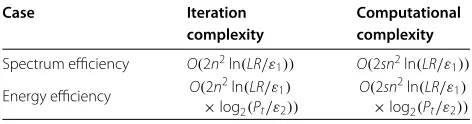
From [25], we know that the GAMIO, being a kind of cutting-plane algorithm, is a polynomial-time algorithm. The iteration complexity is decided by the threshold1 and initial setA. Without loss of generality, we assume that the channel capacity is Lipschitz. Then the itera-tion complexity isO(2n2ln(LRε
1)).Lrepresent the Lipschitz
condition constant.Ris decided by the initial setAand represents the volume of ellipsoid. The most complex part of GAMIO algorithm is to estimate the MMSE matrix based on the current precoding matrix. In order to reduce the time-consuming operations, we take the trick which employed in [15] and update the MMSE matrix
recur-sively. Lets be the number of operations in the MMSE
GAMIO algorithm isO(2sn2ln(LRε )). Of course,sis differ-ent under differdiffer-ent input assumption and can be adjusted according to the algorithm precision. The GAMIO algo-rithm is concluded as follows.
GAMIO algorithm under arbitrary input assumption 1. Initial the candidate set:
A=diag([Pt,Pt,. . .,Pt]),
3.3 Optimization algorithm of Pr2
Just as we mentioned before, Pr2 closely coupled with Pr1. In general, Pr2 is not a concave problem. So, we cannot solve it by traditional optimization method directly. Thus, we try to find a sub-optimal solution instead. We notice that the Pr2 decrease as its denominator value increases, while it will increase with the raise of its numerator value. So, we can minimize the denominator value and maximize the numerator value separately to optimize Pr2. It can be done by combining arbitrary spectrum efficient optimiza-tion algorithm with bi-secoptimiza-tion method. So, the Pr2 can be separated into two parts. The first part can be represented as (Pr3)
The only difference between Pr3 and Pr1 is the con-straint power Pi∗ which represents current power
con-straint duringith iteration. Obviously,Pt≥P∗i. If we have initial values ofPMinandPMaxare 0 andPt, respectively. The iteration will not stop untilPMinandPMaxare close enough. The computational complexity of this new itera-tive approach is tightly related with the spectrum-efficient algorithm for Pr3. Without any doubt, although arbitrary spectrum-efficient algorithm can work in this frame to optimize the energy efficiency, the energy-efficient algo-rithm which is developed based on the GAMIO algoalgo-rithm (EEGAMIO) is a better choice than any other algorithm to deal with various input signal. From [23], we know that the iteration complexity of bi-section method is
log2PMax−PMin
ε2 = log2Pt
ε2
(34)
where ε2 represents the threshold of bi-section method. Based on the conclusion of Section 3.2, we can get the iteration and computational complexity of EEGAMIO energy-efficient algorithm are O(2n2ln(LRε
ε2)respectively. Table 1 summarize the
complexity of the proposed algorithms and the framework of the energy-efficient algorithm is concluded as follows.
The framework of energy-efficient algorithm 1. Initial the searching set:
Pmin=0, Pmax=Pt, P∗0= Pmin+2Pmax;
2. Repeat:
(a) Solve the problem
max : I(x,y)
Table 1 The complexity of the proposed algorithms
0 2 4 6 8 10 12 14 16 18 20 0
0.5 1 1.5 2 2.5 3 3.5 4 4.5
SNR (dB)
C (Bit)
GAMIO Algorithm
InteriorPoint Algorithm
SVD+PowerAllocation
BAMIO Algorithm
Figure 2Channel capacity versus SNR under the Gaussian input assumption.
(b) IfI(x∗,y∗)≥Ct,
Pmax=P∗i, Pi∗+1= Pmin+2Pmax;
Else ifI(x∗,y∗) <Ct,
Pmin=Pi∗, P∗i+1= Pmin+2Pmax.
3. UntilPmax−Pmin≤ε2, end.
4 Simulation results
In this section, we demonstrate some simulation results. The simulation is separated into two parts. For simplic-ity, we assume that there is only one primary user in the CR network.
4.1 Spectrum efficiency
In first part, we test the spectrum efficiency of GAMIO algorithm. We take (6) and (7) as the channel capac-ity for the Gaussian input assumption and the finite equip-probable discrete input assumption, respectively. The channel matrix from secondary transmitter to
pri-mary receiver is G =
2 1 3 4
and the channel matrix
between secondary user is H =
2 1 1 1
. The average
signal-noise-radio (SNR) of CR MIMO system is given
by SNR = Pt
σ2. The total transmit powerPt is 2 W. The interference-power constraintis 1 W.
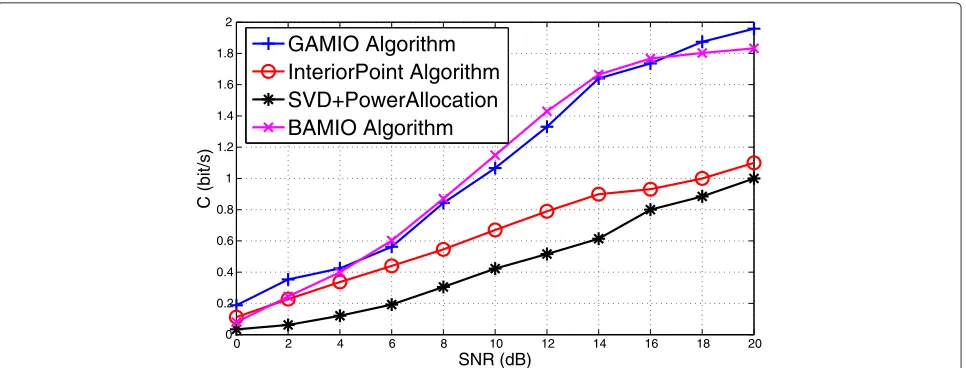
In Figures 2 and 3, we test the achievable channel capacity of secondary user under different situations. In Figure 2, we assume that the input signal follows the
0 2 4 6 8 10 12 14 16 18 20
0 0.2 0.4 0.6 0.8 1 1.2 1.4 1.6 1.8 2
SNR (dB)
C (bit/s)
GAMIO Algorithm
InteriorPoint Algorithm
SVD+PowerAllocation
BAMIO Algorithm
0 20 40 60 80 100 120 140 160 0
0.2 0.4 0.6 0.8 1 1.2 1.4 1.6 1.8 2
Iteration Times
C (bit/s)
SNR
20dB
15dB 25dB
10dB
5dB
Figure 4Channel capacity versus iteration times under the 2-symbol equip-probable discrete input assumption.
Gaussian distribution. So, the channel capacity can be expressed as (6). The line denoted with circle signs repre-sents the performance of interior-point algorithm. It has the best performance. The line with ’+’ represents the performance of GAMIO algorithm. It has the same per-formance as interior-point algorithm because the channel capacity (6) is a concave problem under the Gaussian input assumption. The line with ’∗’ represents the perfor-mance of space algorithm which is a well-known sub-optimal algorithm [12]. The line with ’×’ represents the performance of BAMIO algorithm and much lower than the others because the BAMIO algorithm is developed under equip-probable discrete input assumption.
In Figure 3, we assume that the input signal follows the 2-symbol equip-probable discrete distribution (e.g., BPSK). So the channel capacity can be expression as (7) with M = 2. Just as what Figure 2 shows, the first line with ’+’ represents the performance of GAMIO algorithm and the second line with ’×’ represents the performance of BAMIO algorithm. They almost have the same perfor-mance. Similarly, the third line denoted with circle signs represents the performance of interior-point algorithm and the fourth line with ’∗’ represents the performance of sub-space algorithm. Figure 3 shows that the perfor-mance of GAMIO and BAMIO algorithm is much better than interior-point algorithm and sub-space algorithm. It almost reaches the best capacity, 2 bit/s, when the SNR is 20 dB. On the other hand, the capacity of interior-point and sub-space algorithm lower than 1 bit/s because they intend to allocate too much energy to the best channel and degrade the channel capacity.
Figures 2 and 3 show that, unlike the traditional spectrum-efficient algorithm which developed under spe-cific input assumption, the GAMIO algorithm considers the specific input signal distribution and achieves the
best performance under various input assumption. This result is consistent with our analysis and previous research results [8,10].
Figure 4 gives the convergence performance results of GAMIO algorithm with different SNR. As shown in Figure 4, the algorithm converges to the optimal value before the iteration ends. On the other hand, we can also find that the convergence rate improves with SNR increasing.
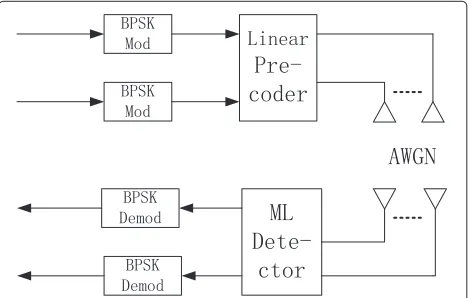
In order to unveil the meaning of different channel capacity expression, we present a BPSK MIMO system as Figure 5 shows. Figure 6 gives the BER of this sys-tem with different SNR, Figure 6 indicates that the BER of GAMIO and BAMIO algorithms is obviously lower than the interior-point algorithm and SVD algorithm. This result is consistent with Figure 3. And Figure 2 can-not reflect this property. Figures 2, 3, and 6 show that the input signal distribution affect the realperformance
0 2 4 6 8 10 12 14 16 18 20 10−2
10−1 100
SNR (dB)
BER (Bit)
GAMIO Algorithm
InterPoint Algorithm
SVD+PowerAllocation
BAMIO Algorithm
Figure 6BER versus SNR when we use the precoding matrix which proposed by SVD+PowerAllocation, interior-Point, and GAMIO algorithm, respectively.
greatly in practical scenarios. So, the GAMIO algorithm is more useful than any other spectrum-efficient algorithm, which can work only under specific input assumption, for various practical system design.
4.2 Energy efficiency
In the second part, we simulate the energy efficiency problem which is defined as Pr2. Just like the first part,
we also take into account two kinds of channel capac-ity expression. The first one is based on the Gaussian input assumption and the other one based on 2-symbol finite equip-probable discrete input assumption respec-tively. All of the assumptions are the same as the first part except adding a minimum channel capacity constraint,
Ct=1 bit/s.
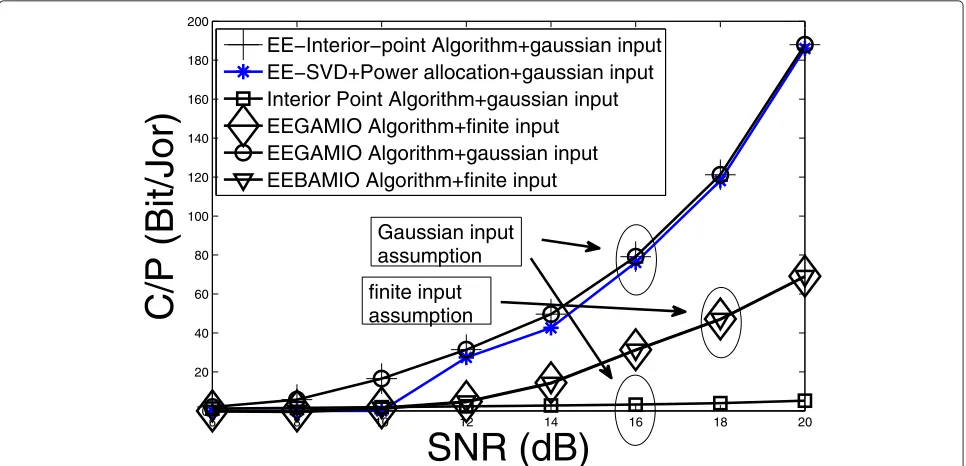
In Figure 7, we test the achievable energy efficiency under different situations. Under the Gaussian input
6 8 10 12 14 16 18 20
0 20 40 60 80 100 120 140 160 180 200
SNR (dB)
C/P (Bit/Jor)
EE−Interior−point Algorithm+gaussian input EE−SVD+Power allocation+gaussian input Interior Point Algorithm+gaussian input EEGAMIO Algorithm+finite input EEGAMIO Algorithm+gaussian input EEBAMIO Algorithm+finite input
Gaussian input assumption finite input assumption
12 13 14 15 16 17 18 19 20 0
20 40 60 80 100 120 140
SNR (dB)
Correct Bit/P (bit/Jor)
EE−Interior−point Algorithm+gaussian input, BER=0.29 EEGAMIO Algorithm+finite input, BER=0.16
EE−SVD+PowerAllocation+gaussian input, BER=0.29 EEGAMIO Algorithm+gaussian input, BER=0.27 EEBAMIO Algorithm+finite input, BER=0.16
Gaussian input assumption
2−symbol equip−probable input assumption
Figure 8Energy efficiency versus SNR in the MIMO system as Figure 5.
assumption, we develop energy-efficient algorithm based on the interior-point algorithm (EE-interior-point), sub-space algorithm (EE-SVD), and GAMIO algorithm (EEGAMIO), respectively. The results are noted with plus, star, and circle, respectively. As Figure 7 shown, the performances of EE-interior-point algorithm and EEGA-MIO algorithm have no significant difference under Gaussian input assumption. EE-SVD algorithm cannot satisfy the capacity constraint when the SNR is less than 12 dB. But it is almost the same as the other algorithms when SNR is beyond 12 dB. Similarly, we also develop energy-efficient algorithm based on the BAMIO algo-rithm and GAMIO algoalgo-rithm under the 2-symbol equip-probable discrete input assumption. The performance line is annotated by diamond and inverted-triangle, respec-tively. There are no performance results for EE-interior-point algorithm and EE-SVD algorithm because they cannot satisfy the capacity constraint under the 2-symbol equip-probable discrete input assumption. Figure 7 shows that, under either Gaussian or 2-symbol equip-probable discrete input assumption, the EEGAMIO algorithm can reach the best performance.
The last line denoted with square sign represents the energy efficiency of traditional interior-point algorithm under the Gaussian input assumption. It is much lower than all of the others. This result shows that the proposed framework of energy-efficiency is effective.
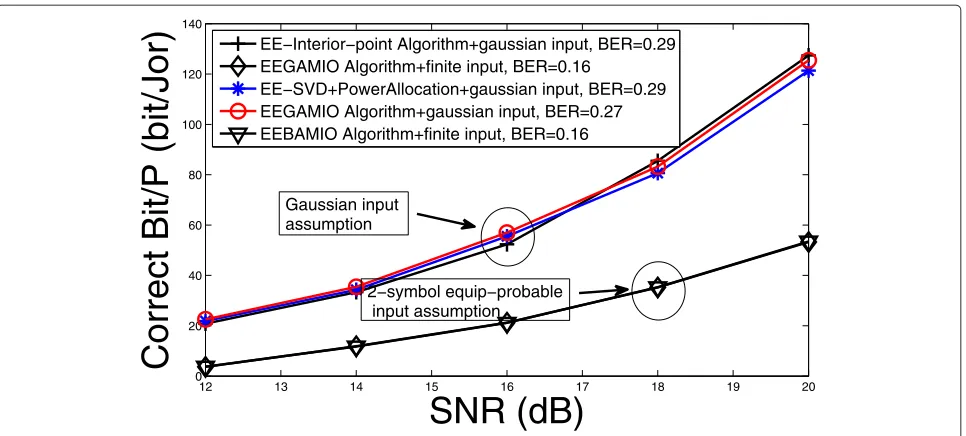
Figure 8 shows the energy efficiency of MIMO system which Figure 5 figured. The lines which denoted with plus, star, circle, diamond, and inverted-triangle sign are same as Figure 7. As Figure 8 shown, although the Gaussian input assumption can keep high energy efficiency, it brings more loss in the BER performance. So the Gaussian input
assumption is more difficult to satisfy the channel capac-ity constraint than the 2-symbol equip-probable discrete input assumption in the MIMO system as Figure 5. It also reveal that the input signal distribution affect the energy efficiency greatly.
5 Conclusion
In this article, linear precoding matrix optimization for the secondary user in a CR network is considered. We set both spectrum and energy efficiency as our goals. Unlike previous work, we do not limit the input signal following specific distribution. Instead, we propose a spectrum-efficient algorithm (GAMIO), which can work well under not only the Gaussian input assumption but also any other kind of input assumption. With this advantage, the GAMIO algorithm is more practical than existing algo-rithms, such as interior-point algorithm, SVD algorithm, or BAMIO algorithm. In the case of energy efficiency, we propose a framework to optimize the energy efficiency. With this framework, we can get different energy-efficient algorithms based on different spectrum-efficient algo-rithms. In order to deal with various signal, the EEGAMIO algorithm is a smart choice. The simulation results show that these algorithms can significantly increase the energy efficiency.
Competing interests
The authors declare that they have no competing interests.
Acknowledgements
2012ZX03004004-002), Independent Research Project (NO. 2010TH203-02), and Research project (Research of Dynamic Spectrum Allocation Technology in Cognitive Radio).
Author details
1Department of Electronic Engineering, Tsinghua University, Beijing, China. 2Research Institute of Information Technology, State Key Laboratory on Microwave and Digital Communications, Tsinghua National Laboratory for Information Science and Technology (TNList), Tsinghua University, Beijing, China.3The Telecommunication Engineering Institute, Air Force Engineering University, Shaanxi, China.
Received: 12 November 2012 Accepted: 21 February 2013 Published: 25 March 2013
References
1. J Mitola, GQ Maguire, Cognitive radios: making software radios more personal. Personal Commun.6(4), 13–18 (1999)
2. A Scaglione, P Staica, S Barbarossa, Optimal designs for space-time linear precoders and decoders. IEEE Trans. Signal Process.50(5), 1051–1064 (2002)
3. H Sampath, A Paulraj, Linear precoding for space-time coded systems with known fading correlations. IEEE Commun. Lett.6(6), 234–241 (2004) 4. S Zhou, GB Giannakis, Optimal transmitter eigen beamforming and
space-time block coding based on channel correlations. IEEE Trans. Commun.50(5), 1673–1690 (2003)
5. JP Kermoal, A stachastic MIMO radio channel model with expermental validation. IEEE J. Sel. Areas Commun.20(6), 1211—1226 (2002) 6. MHM Costa, Writing on dirty paper. IEEE Trans. Inf. Theory.29(3), 439–441
(1983)
7. S Haykin, Cognitive radio: brain-empowered wireless communications. J. Sel. Areas Commun.23(2), 201–220 (2005)
8. J Huang, R Berry, ML Honig, Auction-based spectrum sharing. ACM/Springer Mob. Netw. Appl. J. (MONET).11(3), 405–418 (2006) 9. Y Xing, CN Mathur, MA Haleem, R Chandramouli, KP Subbalakshmi, Dynamic spectrum access with QoS and interference temperature constraints. Trans. Mob. Comput.6(4), 423–433 (2007)
10. H Zheng, C Peng, inProceedings of the IEEE International Conference on Communication, vol. 5. Collaboration and fairness in opportunistic spectrum access (IEEE Press, USA, 2005), pp. 3132–3136
11. W Wang, X Liu, inProceedings of the IEEE Vehicular Technology Conference (VTC), vol. 1. List-coloring based channel allocation for open-spectrum wireless networks (IEEE Press, USA, 2005), pp. 690–694
12. R Zhang, YC Liang, Exploiting multi-antennas for opportunistic spectrum sharing in cognitive radio networks. IEEE J. Sel. Topic Signal Process.2, 88–102 (2008)
13. C Xiao, YR Zheng, Z Ding, Globally optimal linear precoders for finite alphabet signals over complex vector Gaussian channels. IEEE Trans. Signal Process.59(7), 3301–3314 (2011)
14. W Zeng, C Xiao, J Lu, Globally optimal precoder design with finite-alphabet input for cognitive radio networks. IEEE J. Sel. Topics Commun.30(10), 1861–1874 (2012)
15. W Zeng, C Xiao, M Wang, J Lu, Linear precoding for finite-alphabet inputs over MIMO fading channels with statistical CSI. IEEE Trans. Signal Process. 60(6), 3134–3148 (2012)
16. D Guo, SS Shitz, S Verdu, information, Mutual minimum mean-square error in Gaussian channels. IEEE Trans. Inf. Theory.51(4), 1261–1282 (2005) 17. DP Palomar, S Verdu, Gradient of mutual information in linear vector
Gaussian channels. IEEE Trans. Inf. Theory.52, 141–154 (2006) 18. SM Kay,Fundamentals of Statistical Signal Processing: Estimation Theory
(Prentice-Hall). (Englewood Cliffs, NJ, 1993)
19. A Lozano, AM Tulino, S Verdu, Optimum power allocation for parallel Gaussian channels with arbitrary input distributions. IEEE Trans. Inf. Theory.52(7), 3033–3051 (2006)
20. TE Duncan, On the calculation of mutual information. SIAM. J. Appl. Math. 19, 215–220 (1970)
21. G Jengren, M Skoglund, B Ottersen, Combining beamforming and orthogonal space-time block coding. IEEE Trans. Inf. Theory.48(3), 611–617 (2002)
22. TM Cover, JA Thomas,Elements of Information Theory. (Wiley, New York, 1991)
23. S Boyd, L Vandenberghe,Convex Optimization. (Cambridge University Press Cambridge, UK, 2004)
24. JR Magnus, H Neudecker,Matrix Differential Calculus With Applications in Statistics and Econometrics. (Wiley, New York, 1999)
25. S Boyd, EE392o Course Notes Stanford University (2004). http://www. stanford.edu/class/ee392o/elp.pdf
doi:10.1186/1687-6180-2013-59
Cite this article as:Zhuet al.:Optimal linear precoding for opportunistic
spectrum sharing under arbitrary input distributions assumption.EURASIP Journal on Advances in Signal Processing20132013:59.
Submit your manuscript to a
journal and benefi t from:
7Convenient online submission
7 Rigorous peer review
7Immediate publication on acceptance
7 Open access: articles freely available online
7High visibility within the fi eld
7 Retaining the copyright to your article