Development of Bipolar Plates Using
Expanded Graphite as a Raw Material
Supriya Jadhav1, Sneha Dhole2, Sheetal Suryavanshi3, Kavita S. Suranje4, V S Galphade5
U G Student, Department of Metallurgy and Material Science, College of Engineering, Pune, India 1
U G Student, Department of Metallurgy and Material Science, College of Engineering, Pune, India 2
U G Student, Department of Metallurgy and Material Science, College of Engineering, Pune, India 3
Assistant Professor, Department of Applied Science, College of Engineering Pune, India 4
Assistant Professor, Department of Metallurgy and Material Science, College of Engineering, Pune, India 5
ABSTRACT: The bipolar plate is a major component of the proton exchange membrane fuel cell (PEMFC). It is the costlier component of PEMFC stack. Expanded graphite-polymer composites were fabricated by compression moulding. Expanded graphite (EG), which is synthesized by heating of natural graphite at 750°C.The expanded graphite synthesized in this study has 20% of volume expansion. Expanded Graphite mixed manually with Resole Phenolic resin. Expanded graphite provides electrical conductivity and phenolic resin provides mechanical strength to the bipolar plate. Expanded-polymer composite has shown maximum electrical conductivity. On deviation from metallic materials expanded Graphite-Polymer composite bipolar plate are found promising for PEMFC providing the values targeted toward US-DOE.
KEYWORDS: Natural Graphite, EG, Resole resin, PEM
I. INTRODUCTION
Proton exchange membrane (PEM) fuel cells are considered a promising candidate for zero emission power source required for environmentally friendly transportation and stationary applications. It gives high current density and employs low operating temperature and pressure. However, practically, the connection of single fuel cell in series, called fuel cell stack, is usually done in order to increase the cell potential Hence, bipolar plate is used to separate the adjacent cell in the stack and conduct the electrons. In addition, bipolar plate also provides the fuel gas and the oxidizing gas, water and heat management within the cell. As a consequent, materials used in the fabrication of bipolar plate have to resist the fuel cell operating environment and the fabrication process should not be complicated [1]. Eighty percent of the fuel cell stack’s weight is the bipolar plate weight [2]. Thus, the development of bipolar plate for stack cell focuses on its properties, cost and weight of the entire fuel cell.
The conventional materials for producing bipolar plates are graphite (or graphite-polymer composites) or metal. Graphite plates were preferred over the metallic plates because of their high corrosion resistance and low density. On the other hand, the disadvantages of graphite are difficulties in machining (or in case of graphite-polymer mixtures in moulding) and its brittleness. Graphite-based polymer composite bipolar plates have potential to replace graphite plates, because they offer the advantage of greater ease of manufacturing than graphite plates.
organic compounds and polymers, therefore, some monomers, initiators and polymers are to be absorbed into the pores and galleries of expanded graphite by proper method to produce conductive composite.
Therefore, worldwide efforts are going on to develop lightweight and ductile bipolar plate from alternate materials that should satisfy the required series of properties of bipolar plate as per U.S. DOE technical targets [19]. EG is a kind of
modified natural graphite possessing high electrical conductivity and lower density (0.01–0.015 g/cm3) than that of
natural graphite (2.2 g/cm3). Thus it can be one of the alternate materials for the development of composite bipolar plates.
II. EXPERIMENTAL
A. Materials:
Filler material: Expanded Graphite Binder: Phenolic Resin (resole type)
B. Preparation of Expanded Graphite:
About 25gm of natural graphite kept in crucible and heated to temperature of 750oC and kept at this temperature for 5
minutes. Then, slowly cooled in furnace. This results in formation of expanded graphite. Volume expansion is about 20 time’s original volume.
C. Preparation of composite:
Hot compression molding process is used for making composite of expanded graphite and phenolic resin. Where, expanded graphite gives good electrical conductivity and good surface finish. Also, phenolic resin gives high mechanical strength to the bipolar plate. It is thermosetting type of polymer. Expanded graphite is mixed manually with phenolic resin in composition 70% of EG and 30% of resole resin. Then mixture is fed to preheated mold. The
heating temperature is 150oC and curing times is 15 minutes. The molding pressure is about 100 kg/cm2. It selected by
referring to literature review. The compression is done using Universal Testing Machine. Mold cavity diameter is 30mm. In first case we vary load and keep curing time constant (i.e. 15 min). Also, in second case vary curing time and keep load constant (i.e. 5kN).Because, above this load crack will occur in the compressed pellet. By taking care of this, composite plate i.e. bipolar plate is developed.
III.CHARACTERIZATION
A. Theoretical Density Measurement:
Theoretical densities of all composite sample were calculated by following formula.
Density =
Mass is measured by taking weight of the sample and volume is measured by multiplying cross sectional area to thickness of the sample. The diameter of sample is 30 mm.
B. Shore Hardness:
C. Electrical Conductivity:
Electrical conductivity is characterized by both the methods of in-plane and through-plane methods. The in-plane conductivity was measured using four-probe instrument (Coep, Pune). Through-plane conductivity was measured using KEITHLEY instrument (National Chemical Laboratory Pune). Actual resistance=Observed resistance-Contact
resistance (Contact resistance=2.05Ω) Conductivity=1/resistivity(R)
IV.RESULTS AND DISCUSSION
1. Experimental Results:
TABLE 1.COMPOSITION:
TABLE 2.EXPERIMENTAL DETAILS:
Sr No Force (kN) Pressure(MPa) Temperature (°C) Curing time(min) Remarks
1 7 10 150 15 Some cracks on
surface
2 5 7 150 15 Proper sample with
good surface finish
TABLE 3.RESULTS:
Sr No Pressure (MPa) Curing time
(min)
Hardness shores-d
In-plane Conductivity
Through-plane Conductivity
Density(g/cc)
1 10 15 49 150.2 6.2768 1.44
2 7 15 51 154.9 25.1624 1.88
Expanded Graphite Phenolic Resin (Resole)
Fig 1. Sample with 7 MPa pressure and 15 min of curing time has highest density i.e. 1.88g/cc. Because, sample with these parameters has good surface finish and less porosity.
Fig 2. Shore hardness Vs Hot compaction pressure
Fig 2. Sample with 7 MPa pressure and 15 min of curing time has highest shore hardness (i.e. 51). As pressure increases shore hardness decreases.
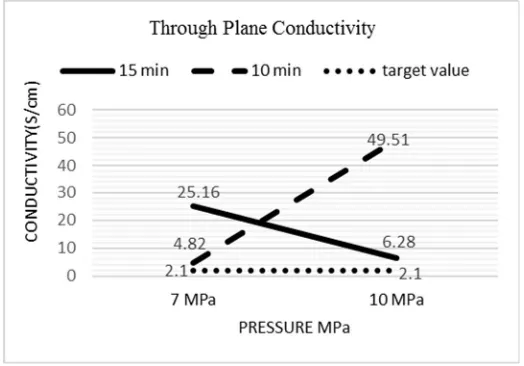
Fig 3. Variation of Through Plane Conductivity with change in compaction pressure and curing time.
Fig 3. Sample with 7 MPa pressure and 15 min of curing time has better through plane conductivity than with 10 min of curing time. As curing time decreases conductivity decreases, because resole resin get less time for curing (i.e. wettability decreases). A sample with 10 MPa pressure has better conductivity than sample with 7MPa pressure. Because, as pressure increases contact point and contact area increases so that conductivity increases.
V. CONCLUSION
1) Literature survey have shown that expanded graphite/resin composite is a good material for use in forming
fuel cell components due to its maximum conductivity, better corrosion resistance, low cost and ease of processing.
3)
We found good results with composite of 70:30expanded graphite and phenolic resin (resole) at 5 kN (i.e. 7MPa pressure) & 150oC temperature for 15 minutes curing time.
ACKNOWLEDGMENTS
The authors would like to sincerely thank Dr. Ashish Lele and Dr. Neelima Bulakh National Chemical the authors would like to sincerely thank Dr. Ashish Lele and Dr. Neelima Bulakh National Chemical Laboratories Pune for extending help in taking conductivity test and College of Engg. Pune for conducting and supporting our research program.
REFERENCES
[1] wikipedia/wiki/pem fuel cell
[2] R. L. Borup, N. E. Vanderborgh, Mat. Res. Soc. Symp.Proc. 393, 151 (1995). [3] J. Scholta, B. Rohland, V. Trapp, U. Focken, J. Power Sources, 84, 231 (1999). [4] D. N. Busick, M. S. Wilson, Electrochem. Soc. Proc., 98-27, 435 (1999). [5] M. Wu, L. L. Shaw, J. Power Sources, 136, 37 (2004).
[6] H. Wang, M. A. Sweikart, J. A. Turner, J. Power Sources.
[7] Ling Du, highly conductive epoxy/graphite polymer composite bipolar May, 2008 [8] J.H.leea,Y.K.Janga,C.E.Hongb,N.H.Kima,P.Li,H. Ki. Leec,