To Study the Steady State Thermal Analysis of
Steam Turbine Casing
Malagouda Patil
1, Aravind Muddebihal
2Assistant Professor, Dept. of Mechanical Engineering, Angadi Institute Technology & Manegement, Belagavi,
Karnataka, India1
Assistant Professor, Dept. of Mechanical Engineering, Angadi Institute Technology & Manegement, Belagavi,
Karnataka, India2
ABSTRACT: An important characteristic of a steam power plant is its ability to maintain reliability and safety of the plant against frequent start-ups and load changes give rise to temperature distribution in steam turbine casing, which results in non-uniform strain and stress distribution. The rapid increase of temperature and rotational speed during starts-ups, especially, makes conditions more severe and causes main components damage and reduction of life span for steam turbine. Thus accurate knowledge of thermal analysis and stresses distribution are required for the integrity and lifetime assessment for the turbine casing. In this work a steady-state thermal analysis of steam turbine casing was established by finite element method (ANSYS Mechanical). A steady-state thermal analysis calculated the effects of steady thermal loads on a system or component. Engineer/analysts often perform a steady-state analysis before performing a transient thermal analysis, which helps establish initial conditions. A steady-state analysis was last step of a transient thermal analysis. In steady-state thermal analysis we determined temperatures distribution of inner part is calculated by conduction, Heat transfer of a casing surface is affected by convection, thermal gradients, heat flow rates, various stress distributions and heat fluxes in an object that are caused by thermal loads that do not vary over time. A steady-state thermal analysis was linear with constant material properties or nonlinear with material properties that depend on temperature. The thermal properties of most material do vary with temperature, so the analysis usually is nonlinear. Including radiation effects also makes the analysis nonlinear.
KEYWORDS: Steady state, heat fluxes, HP Casing, Conduction, Convection and Heat Transfer.
I. INTRODUCTION
performance specifications. Steam turbine for utility service may have several pressure casing and elaborate design feature, all designed to maximize the efficiency of the power plant. For industrial applications, steam turbines are generally of simpler single casing design and less complicated for reliability and cost reasons. Combined Heat and Power (CHP) can be adapted to both utility and industrial steam turbine designs.
II. ASSEMBLYOFSTEAMTURBINE
Fig 1:10MW Steam Turbine Overall Assembly
A turbine assembly includes a many very important parts like casing, rotor shaft, blades & actuators with main body in fig 1. Detailed design assembly drawing of the steam turbine casing was carried out using CATIA V5 modeling software it is shown in fig 1. Actual specification of turbine which was taken for study is given table 1.
Table 1: Specification of Steam Turbine
III. STEAMTURBINECASINGMODEL
Generally turbine casings used are split horizontally and vertically. The casing houses the blades rotor, nozzles, and diaphragms. It also holds glands for steam sealing at each end for preventing leakage of steam from where the shaft passes through. The steam casing of turbine is generally arranged with centre line support i.e the support points are on the same horizontal plane as the centre line of the turbine. The steam end pedestal sits upon a flexible panting plate which provides rigidity in the vertical and lateral planes, but allows flexibility in the axial plane for casing thermal expansion. The combined thrust and journal bearing of the turbine rotor is housed in the steam end pedestal. The rotor, therefore, is moved axially towards the steam end with the axial movement of the casing. The casing is that portion of the turbine that either supports or supported by the bearing housings. The steam ring is attached to or is a part of the casing. All casing joints have metal to metal sealing surfaces no strings or gaskets are used. All turbines manufacturing companies use multiple piece casings consisting of two or more pieces that are split at the horizontal centreline to facilitate inspection or removal of the turbine rotor. The casings are either cast, fabricated, or a combination of both depending on operating conditions. The casing can be of iron, carbon steel, carbon molly steel, or chrome molly steel.
It is very difficult to exactly model the Steam Turbine casing, in which there are still researches are going on to find out transient thermo mechanical behaviour of casing during operating under higher temperature and pressure. There is always a need of some assumptions to model any complex geometry. These assumptions are made, keeping in mind the difficulties involved in the theoretical calculation and the importance of the parameters that are taken and those which are ignored. In modelling we always ignore the things that are of less importance and have little impact on the analysis. The assumptions are always made depending upon the details and accuracy required in modelling.
Capacity 10MW Turbine Speed 6750 RPM Inlet Temperature 4850C
The casing material is considered as homogeneous and isotropic.
Inertia and body force effects are negligible during the analysis.
The casing is stress free before the start up.
The analysis is based on pure thermal loading and vibration and
Thus only stress level due to the above said is done. The analysis does not determine the life of the casing.
The thermal conductivity of the material used for the analysis is uniform throughout
Fig 2: a) Steam Casing Top Half Portion b) Steam Casing Bottom Half Portion
IV. MESHED MODEL OF STEAM TURBINE CASING (HP)
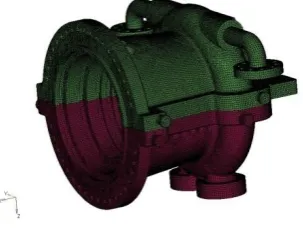
Fig 3: Steam Casing (HP) Meshed Model
The meshed assembly of a steam turbine casing is as shown in the Figure 3.Initially IGES file of a CATIA product has been imported to the HYPERMESH workbench then the meshing is carried out. In this case we did tetra type of element has been used and detail information on meshed assembly as shown in Table 2.
Table 2. Detail Information about Steam Casing Meshing
Object Name Steam Casing
Length Unit Millimeters
Bodies 13
Nodes 332917
V. HEAT TRANSFER ANALYSIS
Heat transfer of a casing surface is affected by convection and temperature distribution of inner part is calculated by conduction. The boundary conditions between surface and inner area for the thermal analysis were derived from calculated heat transfer coefficient according to time Heat transfer analysis was conducted from pre-warming to steady state condition using heat transfer coefficients and a steam temperature of each location acquired from operating data. For HP casing are made from castings and the life assessment portions are corner radius, pipe inner surfaces and welds. For turbine casing, especially, the major damage occurs at the nozzle fit and disk corner of casing.
A. THERMAL ANALYSIS
A thermal analysis calculates the temperature distribution and related thermal quantities in steam turbine casing. Typical thermal quantities are
The temperature distribution
The amount of heat lost or gained
Thermal fluxes
Thermal gradient
Thermal simulations play an important role in the design of many engineering applications, including internal combustion engines, turbines, heat exchangers, piping systems, and electronic components. In many cases, engineers follow a thermal analysis with a stress analysis to calculate thermal stresses (that is, stresses caused by thermal expansions or contractions).
The basis for thermal analysis in ANSYS is a heat balance equation obtained from the principle of conservation of energy. The finite element solution you perform via ANSYS calculates nodal temperatures, and then uses the nodal temperatures to obtain other thermal quantities.
B. TYPES OF THERMAL ANALYSIS
i. A steady state thermal analysis determines the temperature distribution and other thermal quantities under steady state loading conditions. A steady state loading condition is a situation where heat storage effects varying over a period of time can be ignored.
ii. A transient thermal analysis determines the temperature distribution and other thermal quantities under conditions that varying over a period of time.
I. Steady State Thermal Analysis
The ANSYS Multiphysics, ANSYS Mechanical, ANSYS FLOTRAN, and ANSYS Professional products support steady-state thermal analysis. A steady-state thermal analysis calculates the effects of steady thermal loads on a system or component. Engineer/analysts often perform a steady-state analysis before performing a transient thermal analysis, to help establish initial conditions. A steady-state analysis also can be the last step of a transient thermal analysis; performed after all transient effects have diminished. You can use steady-state thermal analysis to determine temperatures, thermal gradients, heat flow rates, and heat fluxes in an object that are caused by thermal loads that do not vary over time. Such loads include the following:
Convections
Radiation
Heat flow rates
Heat fluxes (heat flow per unit area)
Heat generation rates (heat flow per volume)
Constant temperature boundaries
VI. BOUNDARY CONDITIONS FOR STEADY STATE CONDITION
1. Temperature/Preusser Boundary Conditions
TEMPERATURE BOUNDARY CONDITIONS PRESSURE BOUNDARY CONDITIONS
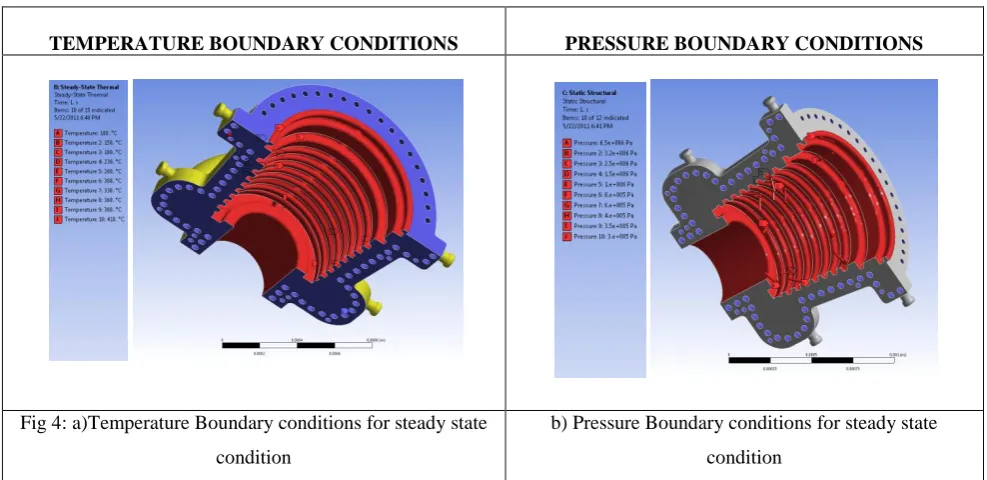
Fig 4: a)Temperature Boundary conditions for steady state
condition
b) Pressure Boundary conditions for steady state
condition
In case of steam turbine casing how the temperature and pressure are varies from inlet to outlet was shown in figure 4 (a) & (b). The inlet temperature of steam is 410 0C to 100 0C.The pressure varies from 65 to 3 bar (6.5×10⁶ to 3×10⁵ pa).Due to this temperature and pressure variation in a inner surface of turbine casing then the casing undergoes to deformation and thermal stress are induced in HP casing.
VII. ANALYSIS OF STEAM TURBINE CASING
A. Temperature Distribution In Casing In Steady State Condition
Fig 5(a): Temperature Distribution in steady state condition, (b): Temperature Distribution according to operation time.
B. Deformation In Steady State Condition
Total Deformation in Steady State Condition Directional Deformation (x-axis) in Steady State Condition
Fig 7: Total Deformation in steady state condition Fig 8:Deformation in x-axis in steady state condition
EQUIVALENT (VON-MISSES) STRESS AT STEADY
STATE CONDITION
MAXIMUM PRINCIPAL STRESS AT STEADY
STATE CONDITION
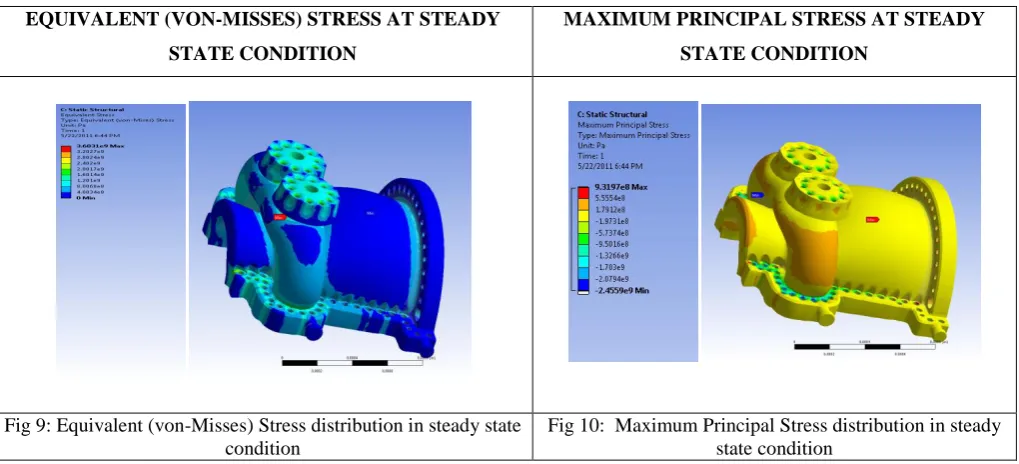
Fig 9: Equivalent (von-Misses) Stress distribution in steady state condition
SHEAR STRESS DISTRIBUTION AT STEADY STATE CONDITION
Fig 11: Shear Stress distribution in steady state condition
According to figure (7-11) shows the result of stress analysis on a steam turbine casing and the different results are obtained with maximum and minimum values of deformation and stresses using Finite Element Method (FEM) in ANSYS Workbench.
VIII. CONCLUSION
To maintain a high level of availability and reliability in a fossil power plant, substantial consideration of failure by repeated thermal loading should be carried out.
In this study, the steady state temperatures and stresses distributions within a turbine inner casing were achieved from actual operation data during cold start-up.
In steady state conditions we can calculate the maximum deformations within inner casing.
Equivalent (von-Misses) Stress distribution in steady state condition.
Total deformation and stress values are compared with analytical results calculated for 2D geometry.
If the thermal gradient is great enough, the stress at the bottom of the threads may be high enough to cause the carking. The result shows the casing develops higher stress levels in startup condition.
REFERENCES
[1]W. S. Choi, E. Fleury, G. W. Song and J.-S. Hyun, A life assessment for steam turbine rotor subjected to thermo-mechanical loading using inelastic analysis, Key Eng. Mat. 326−328, 601−604 (2006).
[2]Lucjan Witek, Daniel Musili Ngii, thermal fatigue problems of turbine casing Vol. 1(2009) 205-211
[3]Maneesh Batrani, BHEL Haridwar, Hypermesh an effective 3-D CAE Tool in Designing of complex steam turbine low pressure casing in 2006. [4]T.Stubbs, the role of NDE in the life management of steam turbine rotors, Swindon, England
[5]K. Fujiyama, Development of risk based maintenance planning program for Power Plant steam turbine, Final report on the Joint Project, pp. 69−82 (2007).
[6]Kiyoshi SAITO, Akira SAKUMA and Masataka FUKUDA, “Recent Life Assessment Technology for Existing Steam Turbines”, JSME International Journal Series B, Vol. 49, No. 2 (2006), pp.192-197.