Copyright 0 1996 by the Genetics Society of America
Interactions
of ZiguZeZessl
and
ZiguZeZess2
Function
During
Ligule
Induction in Maize
Lisa Harper
and
Michael Freeling
Department of Plant Biology, University of California, Berkeley, California 94720
Manuscript received April 25, 1996 Accepted for publication September 9, 1996
ABSTRACT
The maize ligule is an adaxial membranous structure on the leaf that develops at the boundary of the sheath and blade. The ligule and the associated auricle are dispensable structures, amenable to genetic manipulation. We present here a genetic analysis of ligulelessl ( l g l ) and liguleless2 (lg2), the two genes known to be uniquely necessary for ligule and auricle development. We show that both reference mutant alleles, lgl-R and lg2-R, are null alleles. The double mutant phenotype suggests that lgl and lg2 act in the same pathway. Indeed, the dosage of a functional allele at either gene affects the null phenotype of the other. While lgl function has previously been shown to be cell-autonomous, here we show that the lg2-R phenotype is cell-nonautonomous, suggesting lgl and lg2 play different roles in the ligule- auricle induction mechanism. We present a model in which early lg2 function specifies the precise position where ligule and auricle will develop. Later lg2 function interacts with lgl function (either directly or indirectly) to transmit and receive a make-ligule-make-auricle inductive signal.
T
HE leaf of maize ( E a mays L.) is typical of the grasses. It is separated into blade and sheath by the ligule-auricle region (Figure 1). The ligule is a mem- branous fringe of epidermal tissue that grows perpen- dicular out of the plane of the leaf. The auricle encom- passes all tissue layers and acts as a hinge that allows the leaf blade to bend out from the main axis.Our current understanding of maize leaf develop- ment involves three general phases (SYLVESTER et al.
1990; FREELING 1992; SMITH and HAKE 1992; POETHIC
and SZYMKOWIAK 1995; HARPER and FREELINC 1996).
First, a group of cells in the meristem is recruited to become the next phytomer, the repeating unit of leaf, node, internode and axillary bud. The subset of these cells that will become the leaf are termed the “leaf founder cells” [defined in POETHIC (1984)l. Second, the founder cells all divide about equally to establish the leaf primordium, which can be seen as a bulge on the meristem flank. Third, a basipetal polar differentia- tion begins accompanied by a lateral polar differentia- tion from the middle toward the margin.
The earliest identifiable morphological features on a maize leaf primordium are three regions of different adaxial epidermal cell shapes (SYLVESTER et al. 1990). These correspond to the three regions on the mature leaf: the blade, the ligular region, and the sheath. The middle region, where the ligule and auricle eventually differentiate, represents an important marker on the leaf that we call the blade-sheath boundary. At an early point in development, this boundary occupies a dispro- portionately large region of the primordium (SYLWS-
Corresponding author: Michael Freeling, 351 Koshland Hall, Depart- ment of Plant Biology, University of California, Berkeley, CA 94720.
Genetics 144: 1871-1882 (Decernher, 1996)
TER et al. 1990). Because it appears so early, and because no mutants in maize remove it, we argue that establish- ment of the blade-sheath boundary is a fundamental defining feature of a maize leaf, and perhaps of all grass leaves (FREELING 1992). The dispensable ligule and au- ricle are elaborated later than the establishment of the blade-sheath boundary; however, they may utilize as- pects of this boundary as cues for their development.
Ligule differentiation begins when a leaf primordium is in its fourth to sixth plastochron, and differentiation is occurring at the tip of the blade. First, anticlinal divi- sions (new wall inserted perpendicular to the plane of the leaf) appear on the adaxial surface of the leaf to form a band of small cells termed the preligular band ( SHARMAN 1941, 1942; HAKE et al. 1985; BECRAFT et al.
1990; SYLVESTER et al. 1990; BECRAFT and FREELINC
1872 L. Harper and M. Freeling
A
B
C
FIGURE 1.-A cartoon of an adult maize plant (A), a single leaf (B), and the ligular region under study (C). a, auricle; b, blade; s, sheath; lig, ligule.
Recessive mutations in either of the unlinked genes
lgl or lg2 remove the ligule and auricle. When intro- gressed into either the W23 or Mol7 background, lgl
and lg2 mutants can be distinguished in seedlings as well as in adult plants. lgl mutants have been extensively studied and do not develop auricle or normal ligule on any leaf (BECRAFT et al. 1990; SYLVESTER et al. 1990). Ligules are completely absent from about the first 10 leaves; however, on the upper five to 10 leaves a rudi- mentary ligule develops without accompanying auricle
(BECRAFT et al. 1990; SYLVESTER et al. 1990). Although the mutant phenotypes of lgl and lg2 are superficially similar, this report shows the unique phenotype speci- fied by the lg2-referece (lg2-R) allele.
To better understand the biological role of lg2, we have used mosaic analysis, a successful tool to under- stand gene function [examples in maize include: lgl-R
(BECRAFT et al. 1990; BECRAFT and FREELING 1991), K n l -
0 (HAKE and FREELING 1986; SINHA and HAKE 1990),
D8-R (WERD and FREELING 1989), Tpl-R and Tp2-R (DUDLEY and POETHIG 1993)l. Mosaic analysis requires the simultaneous somatic loss of gene function of a dominant allele of the gene of interest and of a known cell-autonomous marker. If the borders of the cell-au- tonomous marker sector perfectly coincide with the borders of the gene-of-interest’s mutant phenotype, the wild-type product is considered cell-autonomous. If the borders do not coincide, the gene is considered cell- nonautonomous. In maize, such analysis has shown that
lgl function in ligule development is cell-autonomous and is required in the cells that make the ligule and auricle (BECRAFT et al. 1990). In this paper, we show that lg2 function is cell-nonautonomous in all tissues.
In addition to the mosaic analysis and description of the lg2 mutant phenotype, we present a series of genetic
experiments aimed at understanding the biological
function of lg2 and lgl. We show that both the lgl- reference (lgl-R) and the lg2-R alleles are genetic nulls. We also analyze various combinations of lgl and lg2
alleles, and present our idea of how lgl and lg2 act to induce a ligule and auricle.
MATERTALS AND METHODS
Generation of stocks used for mosaic analysis: The lg2 gene is located at position 101 on chromosome X (BRINK 1933). The most useful cell-autonomous marker on that arm is yellow10 ( y l o ) , located 13 map units distal to lg2 (HARPER and FREELING 1993). In an anthocyaninless background, y10 mutants have white kernels that produce white seedlings due to lack of carotenoids and chlorophyll. These seedlings die just after their second leaf has emerged, -12 days from germi- nation. The ligule phenotype (liguleless or wild type) can be scored before death.
To insure breakage events that uncovered y10 coinciden- tally uncovered lg2-R, a large inversion on chromosome arm X (Inv3u) was used to switch the orientation of the dominant (wild-type) alleles L g P and Y1@. Plants heterozygous for Inu?awere recognized by their phenotype of 18% pollen abor- tion and by suppression of recombination of markers located in or near the inversion (RHOADES and DEMPSEY 1953; BURN-
HAM 1962). Plants with 18% pollen abortion (Inv3a/+) were crossed to plants lg2-R Y1 @/lg2-R yl0. Progeny were self-polli- nated, and ears were selected that contain 25% white kernels. The white kernels were grown out and scored for their lg2 phenotype. At this point, ears that segregated for the inver- sion were distinguished from ears that do not by the presence or absence of recombination as observed in the white prog- eny. Nonwhite (yellow) seeds from ears in which all white progeny had lg2-R phenotype (indicating no recombination) were used for generation of mosaics. These yellow kernels segregate for useful Znv?a(Lg2+ Yl@)/lg2-R y10 and useless Inv?a(Lg2+ YlO+)/Inv3a(Lg2+ Y I P ) in a ratio of 2 1 .
To control for any possible adverse effects of the inversion, lg2 y10/ Lg2+ Y l @ stocks were also used to generate mosaics. Stocks were regenerated by self-pollinating, and selecting ears in which the white kernels grew into phenotypically y10 lg2- R seedlings. Recombination of 13% was detected in these lines; thus, -4.8% of X-rayed yellow seeds could have pro- duced confounding y10 Lg2+ sectors. About 29% could have generated informative y10 lg2 sectors. A stock of Inv?u/lg2 y10 was generously given by Dr. SCOTT POETHIG, University of Pennsylvania. Additional lines were made using lg2-K y10 and Inv3a provided by the Maize Genetics Cooperation Stock Center, University of Illinois at Urbana.
Generation and growth of mosaics: Somatic sectors of ge- notypically lgZ-R/deletion in otherwise wild-type leaves were generated by X-ray-induced chromosomal breakage in four separate experiments (two in the summer, grown in the Uni- versity of California Bay Area Research and Extension Center, and two in the winter, grown in soil bed greenhouses in Al- bany, CA). Kernels were imbibed for 48 hr in the dark on a sand bench in a greenhouse or for 24 hr on wet paper towels in the light in a greenhouse before irradiation. Imbibed ker- nels were given 1000 rad of X-rays through a 0.35-mm CU filter, from a Philips Model RT250 X-ray machine running at 225 kV. We preferred the 2 4 h r imbibition because the kernels were easier to plant without damage after irradiation.
Ligule Induction in Maize
shape, and special features were recorded. To determine which mesophyll layers the sector occupied, hand cross-sec- tions were made of all sectors in the blade just above the auricle and of many sectors in the sheath just below the ligule. These were mounted in water and observed. In almost all cases, the tissue layers demonstrating loss were the same in the blade and sheath in a single-sectored leaf. Thus, only cross-sections made in the blade directly above the auricle are reported here. The sectors in cross-section were drawn on a standardized cartoon, with special attention to the rela- tion of the sector boundaries and veins. To determine which, if any, epidermal layers the sector occupied, small strips of epidermis or small sections of leaves were mounted in water between a slide and coverslip. Because guard cells are the only chlorophyll-containing cells in the epidermis (sectors in the epidermis alone are not visible to the naked eye), only epidermis near white mesophyll was scored and recorded. Cross sections, epidermal peels, and whole mounts were visu- alized by epi-fluorescence microscopy through a Zeiss micro- scope using a 395- to 440-nm band path excitation filter with a long pass 470-nm barrier filter. At this excitation wavelength, green Y I P (wild-type) tissue autofluoresces red, while white y10 tissue appears clear. Because a sector almost never simply occupies all layers of the mesophyll along the sector’s lateral dimension, the transverse dimension of the leaf was divided into five layers from adaxial to abaxial: the adaxial epidermis (single cell layer), upper mesophyll (several cell layers), mid- dle mesophyll (represented by the vasculature and the very middle mesophyll cell layer), lower mesophyll (several cell layers), and the abaxial epidermis (single cell layer) ( L A N G DALE et al. 1989). The epidermis originates from the L1 layer in the meristem. The upper, middle and lower mesophyll originate from the L2 layer of the meristem (FREELING and
LANE 1994, and references therein). For simplicity, sectors were grouped as “L1
+
L2,” or “L2 only.” White sectors present only in the L1 do exist, but are not visible by eye because only the guard cells of the epidermis have chloro- plasts.Several sectors were found on adult leaves in which the adaxial and abaxial epidermis were not the same genotype. These sectors had white mesophyll, so the white epidermis could be a cell layer invasion from L2 to L1, or the sector could have been present only in the upper or lower meristem flank, giving rise to only one white epidermis, followed by cell layer invasion from L1 to L2 to generate the white mesophyll. In addition, about half of the sectors at the margin of the blade had white mesophyll and green epidermis, suggesting that the leaf margin may not always be L1.
Dosage analysis of lg2: The TB-3Lg translocation was used to generate the genotype LgZ-R/deletion (BECKETT 1978). TB- 3Lg is the seventh TB translocation on chromosome 3 and is thus labeled “g.” This designation is not related to a liguleless gene, and thus, we have dropped the g for clarity. Figure 2
shows the crosses made to observe lg2-R hemizygotes (hypo- ploids) and lg2-R homozygotes as siblings. Several plants from a TB-3Lg stock were crossed as females to lg2-R/lg2-R males. Several progeny from each cross were crossed as males to lg2- R/lg2-R females. It was assumed that males heterozygous for the TB-3Lg would generate the characteristically short hypo- ploids. The resulting families of progeny were planted in the field, and families that segregated tall lg2 mutants (-50%, representing lg2-R homozygotes) and short lg2 mutants (non- Mendelian ratios, representing R hypoploids) were selected for further analysis. A few representative short lg2 mutant plant were checked for pollen abortion and were found to shed 50% aborted pollen indicating that they were hypo- ploids. Likewise, a few tall lg2 mutant plants were confirmed to shed normal pollen, indicating that they had a complete
1873
-
49
x
TB-3Llg2
4
lg2
3
50% lg2ng2
Non-Mendelian lg2/-
Non-Mendelian TB-3LAg2
FIGURE 2.-Crosses for dosage analysis of lg2. TB-3L +/lg2 was crossed as a male to lgZ-R/lgZ-R. The cross was set up this way to compare lg2-R/lg2-R siblings to lg2-R/-. Hypoploids of TB-3L are runt, so lgZ-R/lgZ-R homozygotes could be distin- guished from lg2-R/- hypoploids. The TB translocation used was TB-3Lg. We have dropped the g here to avoid confusion
(see MATERWS AND METHODS).
chromosome complement. Several families segregating these genotypes were grown out in each of three summers for com- parison. Liguleless plants were carefully evaluated several times each as seedlings, as adults, and during and postflow- ering. All phenotypically lg2 mutant seedlings were labeled indicating the leaf on which auricle first developed. Stocks of TB-3Lg were obtained from Dr. JOHN FOWLER.
Dosage analysis of lgl: TB-2Sb plants were crossed individu- ally as males to both lgl-R/lgl-R and to a dwarf5 ( d 5 ) tester that is also located on chromosome arm 2 s . If progeny of a TB-2Sb male are liguleless or dwarf respectively, the B-A chromosome was nondisjoining. Liguleless or dwarf progeny were observed, respectively, in non-Mendelian ratios. The TB2-Sb stock and d 5 tester were kindly provided by Dr. JACK BECKETT, University of Missouri, Columbia.
Double mutant analysis: The reference alleles, lgl-R and lg2-R, were used for this experiment. Because of the similarity in the phenotypes of lgl and lg2 mutants, care was taken to ensure homozygosity of mutant alleles of both genes. The epidermal marker glossy2 (g12; 20 cM from lgl) was used to mark the chromosome carrying 1gI-R. The crosses are pre- sented in Figure 3. Liguleless, glossy progeny of cross 2 could have been heterozygous for lg2-R or homozygous for wild type. These progeny were self-pollinated and test-crossed to lgZ-R/lgZ-R. Progeny were planted from the self-pollination cross of an individual confirmed to be lgl g12/lgl g12; lg2/+. This progeny was 100% lgl-R gl2/lgl-R g12 and segregated 1:2:1 for
+/+,
lg2-R/+, lg2-R/lgZ-R, as confirmed by test crosses to lgl-R/lgl-Rand to lgZ-R/lg2-R. The lgl-R, g12and lg2-R alleles were originally from the Maize Genetics Cooperation Stock Center, University of Illinois at Urbana. These alleles had been introgressed four or more times into inbreds Mol7 and W23.
Allelism tests: All liguleless mutants used in this paper were crossed to both lgl-R homozygotes and to lg2-R homozygotes to confirm allelism. Progeny were grown in seedling flats and scored at 2-3 weeks old.
RESULTS
Phenotype of Zg2--R: To date, all known mutations in the Zg2 gene are recessive and have a similar or identical phenotype. When introgressed six generations into the
W23 inbred, the first and sometimes the second leaf completely lacked the ligule and auricle (Figure 4).
1874 L. Harper and M. Freeling
Cross 1 l g l 812 ,
.-
+
x -.-
+
lg2Cross 2 l g l g12
+
l g l 812+
l g l g12
+
X+
+ ’ lg2I
.-
+
select liguleless, glossyFIGURE 3.-Crossing scheme to generate lgl-R lg2-R double mutants.
crossed to lg2-R and self pollinated (cross 3). If the individual contained lg2-R, progeny of that self was grown, observed and testcrossed (cross 4).
Cross 3
- .
+
-
lg2 X l g l 812 ; lg2 - 0 r - Progeny of the second cross were testif liguleless,
inspect self l g l 812 l g l 812
+
25%
.-
Cross 4 50%
+
lg2l g l 812
’
l g l 812+
l g l 812 ’
+
x
-.-
25 %
.-
0
of the third leaf. Often, these “auricle wedges” were displaced with respect to one another on the juvenile leaves (Figure 4F). Successive leaves gradually devel- oped more ligule and auricle, until they looked almost wild type. This age-dependent expression can be seen by comparing Figures 4, C, F and I, and 6C.
Adaxial views of the ligular region on adult Zg2-R mu- tant leaves revealed a region around the midrib where sheath has been displaced into the blade (not shown). Small patches of ligule could often be seen in the area near the midrib where no auricle develops. In general, the area on a lg2 mutant leaf in which ligule and auricle developed occupied a greater portion of the leaf length. While ligule and auricle appeared more normal at the leaf margins of upper leaves, the area around the mid- rib almost never developed ligule and auricle.
Mutants of Zg2 also display the “liguleless” phenotype of upright leaves. While wild type leaves bend 45 de- grees at the auricle causing the blade to lay out from the main axis of the plant, Zg2 mutant leaves do not bend at the blade sheath boundary. This manifests as an upright leaf attitude. Structural reasons for this bend are not precisely known. However, since even the upper leaves of lg2 mutants are upright and they develop par- tial auricle, the bend may require a continuous auricle. This phenotype of upright leaves is also displayed in all
lgl mutants.
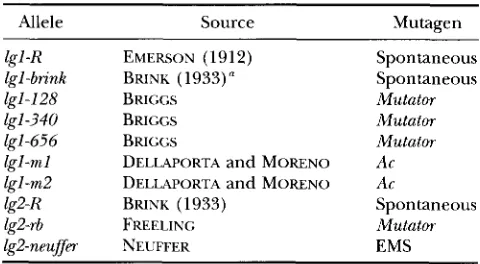
Saturation of the phenotype: To our knowledge seven lgl mutant alleles and three lg2 mutant alleles have arisen spontaneously or have been recovered from undirected mutagenesis experiments (Table 1). These mutants were discovered in the field by the distinctive upright stature due to the leaves not bending out at the auricle. We used two statistical methods of estimat-
ing the likelihood of missing a third gene that was capa- ble of producing a recessive liguleless phenotype, if there were such a gene. Using the equation that de- scribes the Poisson distribution
(e
= e-” X mi/z!), we estimated the chance that if there were three genes, we missed one ( i = 0; meaning zero alleles at a third gene). In this case, Po = e-” and m = 5 ( m = the average number of alleles per locus). Po = eC5 = 0.007, and thus there is a 0.7% likelihood that we missed a third gene. This method, however, gives a poor estimate because the average number of alleles per gene ( m = 5) cannot be precise. Thus, a second method was used to address the question: if there were exactly three genes in the genome capable of producing a recessive liguleless phe- notype, what is the probability that out of 10 mutants, one of the three genes gave no alleles? This can be described by 3(2/3)” = 0.052, indicating that there is a 5% chance that we missed an allele of a third gene. The results of both methods indicate that the existence of another gene capable of giving a recessive liguleless phenotype is unlikely.Several assumptions are made in these statistical cal- culations including that all loci are equally mutable, that transposable elements can transpose into any gene, and that all target genes are of the same length. While these assumptions are probably not true, these statistics gives us a very rough idea of the likelihood of the exis- tence of a third liguleless gene.
Ligule Induction in Maize 1875
---
-.---.
-1
pernumerary B chromosome (ROMAN 1947; BECKETT
1978). These E A translocations transmit normally through the female. However, the B centromere fre- quently nondisjoins at the second mitotic microspore division of male gametophyte development, causing one sperm to carry a duplication of the translocated arm, and one to carry a deficiency. This process results in loss (hypoploidy) or gain (hyperploidy) of the trans- located A arm in some progeny from crosses where the
E A translocation has been used as a male.
Due to the age-dependent expression of the Zg2-R
mutant phenotype, and the possibility of variation of this phenotype in different genetic backgrounds, it was considered necessary to compare lg2-R homozygotes
(lg2-R/lg2-R) to hemizygotes (lg2-R/d&tion) segregating in the same family. All phenotypically lg2-R mutant plants were compared at many stages throughout devel- opment. Plants hypoploid for chromosome arm X are short, so lg2-R homozygotes and hemizygotes could be distinguished by a liguleless-independent criteria dur- ing development. In addition, several of the short lg2- R plants were checked and confirmed to shed 50%
aborted pollen, indicating that they were hypoploids.
FIGURE 4.-Phenotype of wild type (A, D, and G),
lgI-R/lgI-R (B, E, and H) lg2-R/lg2-R ( C , F, and I ) . The lip~lar region of the first (A, B, and C), the fourth (D, E, and F) and the leaf subtending the primary ear (G, H, and I ) are shown. Note that by the fourth leaf, the IgI-R (E) and lg2-R (F) mutant can be distinguished by the displaced auricle that develops in the lg2-R mu- tant. In the leaf subtend- ing the primary ear, a ru- dimentary ligule can be seen in 1gI-R (H, arrow- head). and partial auricle and rudimentary ligule can be seen in lg2-R (F, ar- rowhead). a, auricle; b, blade; s, sheath; lig, ligule.
Several tall lg2-R siblings were confirmed to shed nor- mal pollen, indicating that they contained a full chro- mosome complement.
Both the 1g2-R hemizygotes (lg2-R hypoploids) and the Zg2-R homozygotes displayed variability in the leaf on which ligule and auricle first developed (some on the second, some on the third). Both classes of lg2-R mutants showed the agedependent expression of the phenotype discussed above. However, at each stage in development, no difference in the ligule and auricle was observed between leaves of lg2-R/lg2-R individuals and of lg2-R/&Zetion individuals. Thus, the 1g2-R allele meets the criteria for being a “genetic” null (MULLER
1932).
Dosage analysis was also performed on 1gI-R. ” h e n compared at many stages throughout development, the
ZgI-R hypoploids (lgI-r/d&tion) appeared no different than their lgI-R/lgI-R progenitors with respect to ligule and auricle. Particular care was taken to score the pres- ence of the rudimentary ligule in the upper leaves. This structure was observed in all Zgl-R hypoploids. There- fore, the lgl-R allele also meets the criteria for being a
1876 L. Harper and M. Freeling
TABLE 1
Mutant alleles of Zgl and Zg2 that have arisen spontaneously or have been recovered from undirected mutagenesis
Allele Source Mutagen
lgl -R lgl-brink lgl-I28 lgl-340 lgl-656 1gI -m 1 1gI-m2
lg2-rb lg2-neujfm lg2-K
EMERSON (1912) BRINK (1933)" BRICGS BRICGS BRICCS
DELLAPORTA and MORENO
DELLAPORTA and MORENO
BRINK (1933) FREELINC NEUFFER
Spontaneous Spontaneous Mutator Mutator Mutator Ac Ac
Spontaneous Mutator EMS
Mutant alleles are indicated with their source and mutagen, if known. The absence of a date in the source column denotes unpublished alleles from Dr. STEVE BRIGGS, Pioneer Hi Bred; Drs. STEVE DELLAPORTA and MARIA MORENO, Yale University; or Dr. GERRY NEUFFER, University of Missouri.
(I Lost.
Double mutants
and
other combinations of lgl-R andZg2-R alleles: Double mutants were constructed as de-
scribed in Figure 3. A plant of genotype lgl-R/lgl-R; lg2- R/+ was self-pollinated and 28 of the resulting progeny were carefully observed throughout development and test-crossed to determine their genotype. Scoring the
lg2-R test crosses showed Mendelian segregation of lg2- R: seven plants were lgl-R/lgl-R;
+/+,
15 plants werelgl-R/lgl-R; lg2-R/+, and six plants were lgl-R/lgl-R; lg2- R/lg2-R. Constructing the double mutants in this way allowed for the comparison of double mutants to single
lgl-R mutant siblings in the same genetic background. All leaves of the 28 plants lacked auricle. As seedlings, these plants looked identical to each other, lacking lig- ule and auricle on all of the first eight to 10 leaves. This phenotype is typical of the lgl-R mutant and suggests a simple additive phenotype in the lower leaves. However, the phenotypes of the adult leaves from the primary ear leaf to the flag leaf fell into three distinct classes. All of the lgl-R/lgl-R,
+/+
plants had a rudimentary ligule on all of the upper leaves. The blade-sheath boundary appeared distinct on these plants; the sheath was less green than the blade, and the adaxial sheath was shiny, while the blade appeared dull, as is typical of the lgl-R mutant. In contrast, the six double mutantlgl-R/lgl-R lg2-R/lg2-R plants had a novel phenotype of absolutely no ligule on any leaf and a blade-sheath boundary that was not distinct (Figure 5). That is, the amount of chlorophyll in the blade and sheath in the region of the boundary was very similar, and the shiny appearance of the adaxial sheath extended into the blade. The lgl-R/lgl-R; lg2-R/+ plants fell into two dis- tinct classes. Five plants had a typical lgl-R phenotype, while 10 plants had a novel phenotype of no ligule at all on any leaf, but still maintained a distinct blade- sheath boundary.
Although the lower leaves of the double mutants dis- played an additive phenotype, a synergistic interaction between the lgl-R and lg2-R mutant phenotypes was apparent from the lack of both a rudimentary ligule and a distinct blade-sheath boundary in the upper leaves. This suggests lgl and lg2are in a common biolog- ical circuit of action. The novel phenotype of some of the lgl-R/lgl-R; lg2-R/+ sibs of double mutants supports this conclusion.
Data supporting an interaction between lgl and lg2
were obtained from observing the progeny of test crosses of the double mutants to lgl-R/lgl-R and to lg2- R/lg2-R (see Figure 3, cross 4 ) . Progeny of these test crosses were grown to flowering and compared to their single homozygous mutant mothers (lgl-R/lgl-R; lg2-R/
+
compared to lgl-R/lgl-R;+/+,
and lgl-R/+; lg2-R/ lg2-R compared to+/+;
lg2-R/lg2-R). Surprisingly, the adult leaves between the leaf subtending the primary ear and the flag leaf of 10 lgl-R/lgl-R, lg2-R/+ individu- als observed displayed a more severe phenotype than10 lgl-R/lgl-R;
+/+,
individuals (no ligule on any leaf, but a distinct blade-sheath boundary was maintained) and the same leaves of 10 lgl-R/+; lg2-R/lg2-R individu- als displayed a more severe phenotype than 10+/+;
lg2-R/lg2-R individuals (less ligule and auricle devel- oped) (Figure 6). Both homozygote-heterozygote com- binations were still less severe than the double mutant. This sensitivity to each other's dose implies an interac- tion between lgl and lg2 function. Specifically, LG2 must be expressed in lgl-R/lgl-R plants, and LGl must be expressed in lg2-R/g2-R plants.
Thus, the synergistic double mutant phenotype sug- gests that the products of the lgl and lg2 genes act in the same pathway, and the reciprocal dosage sensitivity suggests that the products of lgl and lg2 genes may interact. Whether their interaction is direct or indirect has not been tested here.
Mosaic analysis of lg2 Mosaic analysis was performed to determine the autonomy of the lg2-R phenotype. X- rays were used to induce the loss of chromosome arm 3L (Lg2+ Y10') in a single cell early in development of the leaf or in the meristem. Simultaneous loss of Lg2+
and Yl0+ created a visible white clone of genotypically
lg2-R ylO/deletion cells on fully expanded green leaves. Three different genotypes were used for the experi- ment (see Figure
7,
and MATERIALS AND METHODS).Combining the four mosaic analysis experiments,
1630 X-rayed seeds of genotype Inv3a(Lg2+ YlOf)/lg2 y10 gave 42 sectored plants with a total of 72 sectored
leaves, 1798 X-rayed seeds of genotype Lg2+ YIO+/lg2
y10 gave 81 sectored plants with a total of 136 sectored leaves, and 2689 X-rayed seeds of genotype Lg2+ Yl0'/ Lg2+ y10 (controls) gave 84 sectored plants with a total of 142 sectored leaves. Thus, a total of 208 sectored experimental leaves, and 142 sectored control leaves were analyzed.
1877
. .
FIGURE 5.-Phenotype of the lgl-R lg2-R double mutants in the upper leaves. (A) Abaxial view of lgl-R/lgl-R plant next
lg2-R sibling (left). (C) Adaxial view of a lgI-R/ to (B). lgl-R/lgl-R, lg2-R/
Igl-R, lg2-R/lg2-R leaf showing no ligule or auri- cle.
we were not missing a critical class of sectors that might reveal lg2 autonomy. First, sectors were examined for tissue layer of chromosome loss, and scored as either
"L2" or
"L1
+
L2"
referring to the meristematic layer in which the loss occurred (see Table 2, and MATERIALSAND METHODS). Many sectors of both types were found.
Second, when drawings of all the experimental sectors
where superimposed, we confirmed that sectors were found across the entire lateral dimension of the leaf (midrib to margin). While sectors directly in the center of the midrib cannot be seen at the ligule, they can be inferred from the presence of a small white sector at the very tip of a leafjust to one side of the midvein. Such a sector is usually seen on a leaf that resides between two
FIGURE 6."The effect of gene dosage of lgl on the lg2-R mutant pheno- type and of lg2 on the lgl-
R mutant phenotype.
Leaves were taken from midway between the leaf subtending the primary ear and the flag leaf. Compare A (lgl-R/lgl-R;
Zg2-R/
+
) , and compare C+/+
) to B (lgl-R/lgl-R;(+/+; l@R/&-R) to D
1878 L. Harper and M. Freeling
A B extend to the auricle (called “L2 blade” in Table 2).
-
lg2 y10 lg2 y10 These were all L2 sectors and represented loss of theW
-
- ,
>I ylo Lg2
@
Lg2 yloj Inv3a
i
chromosome arm late in leaf development when theblade is differentiating basipetally (STEFFENSEN 1968;
X ray X ray POETHIC 1984). This wide spectrum of sector types is of
C the expected range and suggested that an informative
Lg2 y I 0
W
P
rl.p’/
Lg2 ylox
;ayFIGURE 7.-Chromosome 3 configuration of plants ex- posed to X-rays to induce breakage. (A) Use of an inversion insures any loss of ( Y l 0 Lg2) arm that uncovers y l 0 will also uncover lg2-R. (B) Conventional heterozygote. Most arm losses will include both genes; however, a break between Lg2
and Y10 is possible. ( C ) Control chromosomes carry the wild- type allele of lg2 on both homologues.
leaves that have sectors toward one of their margins. We observed several such sectors and inferred the pres- ence of a sector at the center of the midrib. Third, the sectors ranged in width from less than a millimeter to
2.5 cm in width, representing up to one-quarter of the width of the leaf at the ligule. Fourth, sectors were also found on all leaves from the fourth leaf to the flag leaf. Fifth, both single leaf sectors (originating in leaf, or small meristem sectors) and multiple leaf sectors (sec-
tor originating and maintained in meristem) were
found. Sixth, to examine the unlikely scenario of a focus of lg2 action in the blade, 26 experimental sectors were examined that existed in the blade only and did not
category was not missed.
No lg2-R/deletion sectors removed the ligule and/or auricle. The majority of both experimental (82%) and control (87%) sectored leaves showed no effect on the ligule or auricle (Figure 8 ) . This result indicates that lack of a wild-type Lg2+ allele in sectors has no effect on ligule or auricle differentiation, and therefore the lg2-R phenotype is cell-nonautonomous. Since we saw normal ligule and auricle development in sectors of both tissue layer categories “L2 only,” and “L1
+
L2,”the phenotype is cell-nonautonomous in both the lat- eral (from midrib to margin) and transverse (adaxial to abaxial) dimensions of the leaf.
Eighteen percent of experimental and 13% of con- trol sectored leaves showed some effect on ligule and/ or auricle development. These “effects” were of several types: a small notch or reduction in the ligule some- where within the sector but not coinciding with the borders of the white sector (60% of aberrant sectors), or an upward displacement of the upper auricle border on the distal (marginal) side of the sector (20%), or both (20%). Because these anomalies were seen in simi- lar percentages in both experimental and control sec- tors, they cannot be attributed specifically to loss of the
Lg2+ allele.
TABLE 2
Number of type and sectors found in mosaic analysis of lg2
Tissue layer Effect on ligule Sectored Sectored
Genotype of Lg2+ loss or auricle plants leaves
Lg2 y l O/Inv3a
lg2 y l
o/+
+
L2 L2 blade L1, L2 L2 L2 blade L1, L2 L2 L2 blade L1, L2 L2
L2 blade L1, L2
Wild type Wild type Wild type Aberrant Aberrant Aberrant Wild type Wild type Wild type Aberrant Aberrant Aberrant
22 0 5 6 0 9 33 25 9 6 1 7
36 0 14 9 0 13 72 25 24
7
1
7 Controls
y l
o/+
L2 ype Wild t 49 87L1, L2 type Wild 12 28
L2 Aberrant 10 13
L1, L2 Aberrant 5 6
L2 blade Wild type 8 8
L2 blade Aberrant 0 0
I.igrltr Indrlction i n kfaizc. I X i ! )
Fl(;l.l<l~. X.-;l 5 ( T l O I ~ O f ’ / $ - / ~ ~ / O - - on ;I I,,:.?’ }‘/O’//q2- H ~ 1 0 led. Soticc thc n o r m a l ligulc antl auricle within ~ l l c
scctor. (11) ;\tl;tsi;tl. ( B ) r1hasi;ll.
I)Is<:~ssIos
Saturation of liguleless mutant phenotype: M‘e have prohahly itlentifictl the only t w o gc’nes i n maize, capable of gkring a rccwsivc “ligulclcss” mutant phcnotypc. This phenotype is specifically the upright habit of the Ic;~vcs causcd b y t h e lack o r reduction of‘atu-iclc, not the
lack of ligule. Because of the intimate tlcvclopmcntal association Ixtwccn the ligule and auricle, we expect
any
genes involvctl i n the initiation o r induction of ligule and auricle t o have this phenotype. Saturation o f ’ the “ligulclcss” phenotype means t h a t other genes involved i n lig1llc and auricle initiation antl tlevelop- ment arc n o t identifial~le a s liguleless mutants. Theseo t h e r gcncs are either required elsewhere i n tlevelop-
mcnt (ilntl w o u l d condition a different, perhaps lethal, mutant phcnotypc) o r are duplicatcd. Since the maize gc-nome is a putative ancestral a1lotetr;lploicl (see
1 4 o o 1 ~ ; o/ e//. 199.3), i t is possible that thcrc arc tlupli-
catetl gcncs with nontliverged functions involwtl spe-
cific:dly i n ligule antl ;trlricle initiation and develop mcnt. IHowcvcr, there arc also o n l y t w o genes itlcntilicd i n rice (see the Rice Genetic Scwslcttcr, Vol. 9 ) t h a t have ligdelcss mutant phenotypes: (q and m): The gc-
nomcs o f ricc antl maize arc generally collinear, lmt the rice genome is not dr~plicatcd i n rchtion to other grasses ( M ~ ~ K I . PI crl. 199.‘; PATIXSOS rl ell. 19Cf.3). The
chromoson1;d locations o f the maize (ql gene ilnd the ricc (q gene arc syntcnow (PKAT(:IIIYI-I- a n d LAL~KII:.
1 9 9 1 ) . Furthermore, these mutants have similar phcntr t!,pcs. In atltlition, cr7rrof ricc has a similar mutant phe- notype t o (q2 of maize, althoug11 it is not yet known if these are syntcnorls (M. M o o s I ~ , this lab, unpr~hlishetl data). This suggests that any duplicated copies o f (ql antl o f (q2 have diverged enough t o provide functions different from those of @ I and (q2. (;onsitlering the c\dution;wy rclatctlncss o f maize antl rice, wc suggest that these t w o liguleless genes are the only ones in the grasses that can he idcntificd by the recessive liguleless mutant phenotypes. This may indicate that among the
many genes ncccssm-\. t o make ;I ligule ;mtl auricle, (ql
antl (q2 may he thc o n l y genes uniqucl!~ rcquirctl i n ligule antl auricle clcvclopment. 11 mutant t h a t lacked only the ligule antl maintaincrl t h c a1Iriclc is still possi- ble, although this phenotype has never l x w l seen in maize.
Other ~ C ’ I I ~ S th;it I>lily 21 role i n ligdc ;Inti auricle dcvclopmcnt w i l l have t o l x idcntificrl i n ways more inventive than random mutagenesis, such a s the cre- ation of suppressers o f ’ the ligulcless phenotype o r mo- lecular metllotls t o identify liglde-specific molccrdcs. We mav have ohscncd the cfl‘ccts of other genes in- volved i n ligule antl artricle tlcvelopmcnt i n o u r mosaic analysis. There \vere some effects seen on the ligule a n d / o r auricle i n a small percentage o f hot11 csperi- mental (18%) a n d control (13%)) leaf sectors that can- not be attrihrltctl to (q2 dos;~gc:. M’hilc these cffccts may simply I x tlcvclopmcntal :dm-rations, i t is also possible that they may hc the result ofhcmizygosit~~ a t ;I particu- lar gene(s) involvctl i n ligulc and auriclc tlcvelopmcnt. Because i t may hc reql1iretl elscwhcre i n rlcvclopment and h;1vc a Icthal mutant phenotype, this gcnc.(s) may show a ligulrlcss phenotype o n l y i n scctors on ;I leaf. If i t is linked t o 1 ~ 2 , the l o w frequency o f chromosome breakage cvcnts that led t o effkcts on the ligule antl auricle srlggcst that the gcnc(s) m;t!. be prOKilTlill t o
y 1 0 and lq2. Conversely, coincirlcntal breaks of other chromosome arms may he rcsponsihlc for these cfrccts.
lql and lg2 wild-type functions are involved in ligule and auricle development: (:omparison o f ’ (ql-I? o r /g2-
I? homozygotes to hemizygotes shows that thcsc alleles meet the criteria for genetic n u l l ;dlcles. These genetic results have since been corroborated with molccular analysis. In the case of (ql-I?. molecrdar analysis has revealed that this allele has a deletion o f (ql genomic sequences (L. H..\KITK, 14. MOKIX), R. KIUTXXK, S.
DEI.I.,WOKT,\ and 14. FKI.:I;I.IW;, r~npuhlishrtl results). Atltlitionally, an allele of (q2 that has a tlclrtion of’gcno- mic sequences has lxcn found (1. I~‘.\I.sI I ant1 F. FKI-E-
I,Is<;, unpul~lishetl rcslrlts), a n t l its phenotype is vel-\.
similar, if not itlcntical t o t h a t of the (q2-I? allcle. M‘c
conclude that thc molecular Icsions i n both thc (SI-I?
and (q2-Rmlltants result i n n u l l , loss of function alleles. O u r results show that M~.I.I.I;K’s 1932 guitlelincs
( M ~ . I . I . I < R 1932) for analysis o f allele types are still \xlicl antl v;duahlc.
The mutant phenotypes of ! $ I - R antl (q2-1< arc similar in that thcy both remove or reduce t h c ligule antl auri- cle o n the maize leafs. Since these mrlt;mts are rcccssivo null alleles, the function o f both wild-typc genes must l > e i n the tlcvclopmcnt o f t h c ligrllc antl auricle. (ql function n l m t be an absolute requirement for auricle dcvclopmcnt, fbr any liglllc on t h e lower Icavcs, and
for full length ligules on the upper leaves. (q2 function must he required for full elahor~tion o f ligrdr and auri- cle, b u t also for correct initiation a n d positioning o f
1880 L. Harper and M. Freeling
lgl and lg2 act in a common circuit of action: In lower leaves of the lgl-R lg2-R double mutant, a simple additive phenotype of no ligule or auricle is observed. This can be meaningless if two mutants have identical phenotypes (AWRY and WASSERMAN 1992), but we have shown that lgl-R and lg2-R homozygotes are readily distinguishable in their upper leaves (Figure 4). The synergistic phenotype apparent in the upper leaves of a lgl-R lg2-R double mutant suggests that LG1 and LG2
act in the same biological pathway. In addition, siblings of double mutants and progeny of test crosses revealed a general trend apparent in the upper leaves: the lgl
null mutant phenotype is sensitive to the dose of the
lg2 gene, and the lg2 null mutant phenotype is sensitive to the dose of the lg1 gene. This implies that LGl is expressed in the lg2 null mutant, and that LG2 is ex- pressed in the lgl null mutant. Both LG1 and LG2 must interact with other gene functions that produce the rudimentary ligule and auricle in the lgl and lg2 null mutants. To carry the implications even further, the dosage sensitivity may suggest that LGl and LG2 may act temporally close to each other in the development of the ligule and auricle. If a biochemical step involving a cascade or amplification of a signal would separate the actions of lg2 and lgl, we would not have observed this dosage effect. Additionally, the reciprocal dosage effects are expected if the LGl and LG2 proteins re- quire a fixed stoichiometry for function.
Is there a default mechanism that produces rudimen-
tary ligule on the upper leaves of lgl mutants? In con-
trast to the completely liguleless and auricleless leaves initiated early in development of lgl-R and lg2-R mu- tants, both mutants produce either some ligule, or lig- ule and auricle, on leaves developed later. In wild-type maize, there is little detectable morphological differ- ence between ligules and auricles of all leaves. However, in many grasses, adult leaves produce more elaborate ligules and auricles than juvenile leaves (CHAFFEY
1985). In an extreme example, CHAFFEX identified nine grass species that had membranous ligules on lower leaves, and veined ligules on the upper leaves ( CHAFFEY
1985). This observation suggests that mechanisms may exist in the grasses for augmenting ligule and auricle differentiation in an age-dependent manner. If this is the case, the phenotype of the lgl null mutant might have uncovered this otherwise masked program in maize. The rudimentary ligule in adult leaves of the Zgl
null mutant may be the product of this “adult ligule elaboration” program.
There is another possible explanation for the rudi- mentary ligule in the upper leaves of lgl null mutants. The lggene of rice and the ligene of barley are collinear with the lgl gene of maize (PRATCHETT and LAURIE 1994). However, preliminary observations show that the mutant phenotype in rice and barley is completely lig- uleless on all leaves, even the upper leaves (PRATCHETT and LAURIE 1994; M. MOONEY, unpublished observa-
tions). This presents the possibility that in maize, dupli- cated and diverged copies of lgl may be present and play a role in ligule development in the upper leaves. The same may be true for lg2. However, aurin rice and
lg2 in maize have nearly identical mutant phenotypes including the extensive auricle development in upper leaves. This datum does not support the duplicated and diverged gene explanation of the maize lg2 phenotype.
These two possibilities are not mutually exclusive; the duplicated and diverged copies of lgl and lg2 may be under the control of a general “adult ligule elabora- tion” program. In any case, the total lack of rudimen- tary ligule in the lgl-R lg2-R double mutant strongly suggests that an interaction of lgl and lg2wild-type func- tion is involved in rudimentary ligule and auricle forma- tion. If the rudimentary ligule in a lgl null mutant is
due to the action of a duplicated and diverged copy of
lgl (and/or lg2), this copy(s) must interact with both
LG1 and LG2.
lg2 function specifies the position of ligule-auricle induction: The mosaic analysis showed that mutant sec- tors of lg2-R y 1 0 on a wild-type leaf produce wild-type ligule and auricle. lg2 function is thus cell-nonautono- mous, which suggests that either LG2 itself moves or induces another molecule to move, over regions at least as large as the widest sector (a quarter of the width of the leaf). When a result of cell-nonautonomy is found in a mosaic analysis, one can ask whether there is a focus of gene action. If there were a focus of lg2 function, we would expect to find a subset of lg2-R y l 0 sectors in a particular region of the leaf would remove ligule and auricle not only within the sector, but also outside the sector. The region of the leaf in which such sectors were found would represent the focus of lg2 gene action. We found no such sectors in our lg2 mosaic analysis. Be- cause sectors were found across the whole lateral di- mension of the leaf, we conclude that there is no focus of lg2 function.
A cell-nonautonomous function with no focus of ac- tion may indicate the presence of a uniform field of 192
action across the whole lateral dimension of the leaf. The lg2 null mutant phenotype suggests the role of this developmental field may be to correctly position the initiation and progression of the preligule band.
The role of lgl and Zg2 in specification of the blade
sheath boundary: The blade-sheath boundary is thought to be established very early, by the time a leaf primordium is in its second to third plastochron (SLZVESTER et al. 1990; FREELING 1992). Our observations showed that lg2-R mu- tants produce ligule and auricle in small patches in a wider area compared to wild type, indicating that a nor- mal blade-sheath boundary is not established in the lg2-
Ligule Induction in Maize 1881
ligule, cells types that were always above the auricle in wild-type siblings. These data further indicate the inability of lg2 mutants to form a normal bladesheath boundary, suggesting that the wild-type lg2 function acts very early in leaf primordia development, and may interact with molecules that specify the blade-sheath boundary.
BECKAFT and coworkers (1990) state that the blade- sheath boundary in the lgl-R mutant is “less distinct” than that of wild type. The lg2-R null mutant blade- sheath boundary is more disturbed than that of the lgl-
R null mutant. However, the double mutant lacks al- most all visible markers of a mature blade-sheath boundary. This indicates that the 1gl and lg2 wild-type functions may interact in the formation of a normal blade-sheath boundary.
Roles of Zgl and Zg2 function in ligule and auricle induction and development: In a mosaic analysis of lgl- R mutant sectors on wild-type leaves, BECRAFT and co- workers (1990) established that lgl function is in most cases cell-autonomous, and is required in the epidermis for ligule development and in the mesophyll for auricle development. BECRAFT and coworkers did find that ab- sence of the lgl gene in small sectors within the auricle mesophyll did not affect internal auricle histology. This was the only case of cell-nonautonomy reported. BE- CKAFT and FREELING (1991) presented a model where a signal “organizes development of the ligular region.” They also found an unexpected phenomenon: the lig- ule and auricle “restarted” on the marginal side of all lgl sectors. This led them to propose the make-ligule- make-auricle signal cannot traverse lgl-R mutant sec- tors. Thus, LG1 is required not only to act on this signal but to propagate it as well. In addition, 40% of the time, reinitiated ligule and auricle were displaced downward, suggesting that the reinitiated ligule-auricle differenti- ated later in time than that closer to the midrib (BE- CRAFT and FREELING 1991). This led them to propose that the make-ligule-make-auricle signal emanates from near the midrib and moves outward toward the margin preceding the directional development of the preligu- lar band and actual ligule outgrowth. LG1 does not appear to be involved in initiation of the make-ligule- make-auricle signal (BECKAFT et al. 1990; BECRAFT and FREELING 1991). lgl function is thus in the reception end of the ligule/auricle induction pathway.
As discussed above, the products of lgl and lg2 act in a common circuit of action, and lg2function behaves in a cell-nonautonomous manner. One could ask whether
LG2 represents the make-ligule-make-auricle signal.
LG2 cannot be the only signal, because the ligule and auricle that develop in the lg2-R null mutant would not be expected if the make-ligule-make-auricle signal were absent Instead, it is likely that the field of lg2 function acts to restrict the make-ligule-and-auricle signal to a thin line across the lateral dimension of the primor- dium. Without the lg2 field, the signal is still sent but induces ligule and auricle in a broader, more disorga-
nized line. In wild-type plants, once the lg2 field is estab- lished and the make-ligule-make-auricle signal is sent, lgl function acts to interpret and propagate this signal. We therefore expect to find that lg2’s function acts be- fore lgl’s.
We do not yet know what factors are involved in ini- tiating the process of ligule and auricle development.
A clue is provided by several dominant leaf mutants that have ectopic ligule and auricle in novel places on the leaf. Among these are dominant mutants that ectop- ically express the homeobox genes knotted1 (knl)
,
rough sheath1 (rsl) and liguleless3 (Zg3) (VOLLBKECHT et al. 1991; SCHNEEBERGER et al. 1995; FOWLER et al. 1996,respectively), and several uncloned genes, rolled1 (rldl) ,
hai?y sheath frayed1 (hsfl), and lax midrib1 (lxml) (see FREELINC 1992). Unlike lgl and lg2 mutants, these mu- tants actually change the shape and/or position of the blade-sheath boundary. However, ligule and auricle in- duction simply follows these aberrant shapes. It is possi- ble that the dominant mutants change the shape of the ligule-auricle developmental field within the leaf primordia. Then, the lg2 and lgl genes perform their normal function within these new parameters. Mutant phenotypes of these dominant mutants, especially rsl and lg3 that strikingly effect the ligule auricle region specifically (BECKAFT and FREELINC 1994; FOWLER and FREELING 1996), lend support to the concept of a ligule- auricle developmental field within the leaf primordia.
We especially thank B m m KI.OECKE.NER-GRUISSEM, MARK Moo-
NEY, JUSTINE WAISH, and JOHN FOWI.ER for stimulating discussion and criticism during the course of this research. We thank BARBARA
ERS, LWXE JESAITIS, MIKE SCANLON and BARBARA LANE for critically reading this manuscript. We especially thank MARK MOONEY for draw- ing Figure l and for providing useful discussions relating maize to other grasses. We thank the Maize Coop, JACK Bv.(:w:rT, J I M BIRCHLER,
and SCOTT POETHIC; for providing strains and advice. We thank KAR. BROMAN for lessons in statistics. We thank the Clarinet Cafe for their stimulating lattes. We thank JOANNE WATKINS, BARBARA Ro‘Iz and
THOM KOUPAL for providing outstanding care of our plants. This work was supported by a grant from the U S . Department of Energy
(DOE grant DE-FG03-91ER20028).
KI.OECKENER-GRUISSEM, MARK MOONEY, JUSTINE WAI.SH. h N D A I . 1 . fi-
LITERATURE CITED
AWRY, L., and S. WASSERMAN, 1992 Ordering gene function: the interpretation of epistasis in regulatory hierarchies. Trends Genet. 8: 312-316.
B E C K E ~ , J. B., 1978 E A translocations in maize. I. Use in locating genes by chromosome arms. J. Heredity 69: 27-36.
BECRAFT, P. W., and M. FREELING, 1991 Sectors of ligulelpss-l tissue interrupt an inductive signal during maize leaf development. Plant Cell 3: 801-807.
BECRAFT, P. W., and M. FREELING, 1994 Genetic analysis of Rough
sheath1 developmental mutants of maize. Genetics 136: 295-31 1.
BECRAFT, P. W., D. K. BONGARD-PIERCE, A. W. SYLVESTER, R. S. PoF..
THIG and M. FREELING, 1990 The lipleless-I gene acts tissue specifically in maize leaf development. Dev. Biol. 141: 220-232.
BRINK, R. A., 1933 Heritable characters in maize XLW-1,iguleless
2. J. Hered. 24: 325-326.
BURNHAM, C. R., 196‘2 Discussions zn Cytogmrtics. Alpha Editions, Edina, MN.
1882 L. Harper and M. Freeling
ence of veined and membranous ligules on the same culm of british grasses. New Phytol. 101: 613-621.
DUDLEY, M., and R. S. POETHIG, 1993 The heterochronic teopodl and teopod2mutations of maize are expressed non-cell-autonomously. Genetics 133: 389-399.
EMERSON, R. A,, 1912 The inheritance of the ligule and auricles of corn leaves. Neb. Agr. Exp. Sta. Annu. Rep. 25: 81-88. FOWLER, J., and M. FREELING, 1996 Genetic analysis of mutations
that alter cell fates in maize leaves: dominant Liguleless muta- tions. Dev. Genet. 18 (3): 198-222.
FOWLER, J. E., G. J. MUEHLBAUER and M. FREELING, 1996 Mosaic analysis of the Lzguleless? mutant phenotype in maize by coordi- nate suppression of Mutator-insertion alleles. Genetics 143:489-
503.
FREELING, M., 1992 A conceptual framework for maize leaf develop ment. Dev. Biol. 153: 44-58.
FREELING, M., and B. LANE, 1994 The maize leaf, pp. 17-28 in The Maize Handbook, edited by M. FREEI.INC and V. WALBOT. Springer Verlag, New York.
HAKE, S., and M. FREELING, 1986 Analysis of genetic mosaics shows that the extra epidermal cell divisions in Knotted mutant maize plants are induced by adjacent mesophyll cells. Nature 320: 621- 623.
H A K E , S., R. M. BIRD, M. G. NEUFFER and M. FREELING, 1985 Develop ment of the maize ligule and mutants that affect it, pp. 61-71 in Plant Genetics, Proceedings of the Third Annual A R C 0 Plant Cell
Research Institute-UCLA Symposium on Plant Biology, edited by M. FREELING. Alan R. Liss, New York.
HARBERD, N. P., and M. FREELING, 1989 Genetics of dominant gib
berellin-insensitive dwarfism in maize. Genetics 121: 827-838. HARPER, L. C., and M. FREELING, 1993 The order of liguleless gene
function. Maize Genet. Coop. Newslet. 67: 17.
HARPER, L., and M. FREELING, 1996 Studies on early leaf develop- ment. Curr. Opin. Biotech. 7: 139-144.
LANCDALE, J. A,, B. LANE, M. FREELINC and T. NELSON, 1989 Cell lineage analysis of maize bundle sheath and mesophyll cells. Dev. Biol. 133: 128-139.
MOORE, G., T. FOOTE, T. HELENTJARIS, K. DEVOS, N. KURATA et al. 1995 Was there a single ancestral cereal chromosome? Trends Genet. 11: 81-82.
MULLER, H. J., 1932 Further studies on the nature and causes of gene mutations. Proc. 6th Int. Congr. Genet. 1: 213-255.
PATERSON, A. H., Y.-R. LIN, Z. LI, K. F. SCHERTZ, J. F. DOEBLEY et al., 1995 Convergent domestication of cereal crops by indepen- dent mutations at corresponding genetic loci. Science 269:
1714-1718.
POETHIG, R. S., 1984 Cellular parameters of leaf morphogenesis in maize and tobacco, pp. 235-259 in Contemporary Problems of Plant Anatomy, edited by R. A. WHITE and W. C. DICKSON. Academic Press, New York.
POETHIG, R. S., and E. J. SZYMKOWIAK, 1995 Clonal analysis of leaf development in maize. Maydica 40: 67-76.
PRATCHETT, N., and D. A. LAURIE, 1994 Genetic map location of the barley developmental mutant ligukless in relation to RFLP markers. Hereditas 1 2 0 35-39.
RHOADES, M. M., and E. DEMPSEY, 1953 Cytogenetic studies of defi- cient-duplicate chromosomes derived from inversion heterozy- gotes in maize. Am. J. Bot. 40: 405-424.
ROMAN, H., 1947 Mitotic nondisjunction in the case of interchanges involving the B-type chromosome in maize. Genetics 3 2 391- 409.
SCHNEEBERGER, R. G., P. W. BECRAET, S. HAKE and M. FREELING, 1995 Ectopic expression of the knox homeo box gene rough sheath1 alters cell fate in the maize leaf. Genes Dev. 9: 2292-2304. SHARMAN, B. C., 1941 Development of the ligule in &a mays L. Na-
ture 147: 641.
SHARMAN, B. C., 1942 Developmental anatomy o f t h e shoot of Zen mays I,. Ann. Bot. 6: 245-284.
SINHA, N., and S. HAKE, 1990 Mutant characters of Knotted maize leaves are determined in the innermost tissue layers. Dev. Biol.
SMITH, L. G., and S. HAKE, 1992 The initiation and determination of leaves. Plant Cell 4 1017-1027.
STEFFENSEN, D. M., 1968 A reconstruction of cell development in the shoot apex of maize. Am. J. Bot. 55: 354-369.
SYLVESTER, A. W., W. Z. CANDE and M. FREELING, 1990 Division and differentiation during normal and liguleless-1 maize leaf develop ment. Development 110: 985-1100.
SYNDER, K. and R. BERTRAND-GARCIA, 1993 A morphological analysis
of the liguleless2-2757 mutant, a new allele at the lg2 locus. Maize Genet. Coop. Newslet. 67: 28-29.
VOLLBRECHT, E., B. VEIT, N. SINHA and S. HAKE, 1991 The develop- mental gene Knotted-l is a member of a maize homeobox gene family. Nature 350: 241-243.
141: 203-210.