ABSTRACT
Smith, Alisa, R. The Structure and Relationship of Work-Related Interests & Needs.
(Under the direction of J. W. Cunningham.)
Measures of work-related interests (the Interest Inventory, Career Orientation
Profile-Work Activity Preferences, and US Employment Services Questionnaire) and
measures of needs (the Inventory of Work-Related Needs, Career Orientation
Profile-Benefits and Opportunities, and Minnesota Importance Questionnaire) were used to
clarify the nature of these domains. Mired with inconsistencies in terminology, this study
explored each domain separately by a) inspecting measurement characteristics, b)
examining the underlying structure of the recently developed Interest Inventory and the
newly developed I-WRN, c) identifying the cross instrument within domain factor
structures, and d) investigating convergent-divergent validity. Because there had been
very little previous research addressing the relationship between interests and needs, the
relationship between these two domains was explored through e) cross-domain structural
analysis of all six instruments, f) canonical correlation analyses and g) multiple
regression analyses. Data were collected from a sample of approximately 800
respondents drawn from the subject pool at North Carolina State University. The subject
pool consisted of undergraduates and included students from 95 different curricular
majors.
Internal consistency reliabilities from the various scales ranged from .28-.96 with
the 68 percent of them ranging between .80-.90. Test-retest reliabilities for the I-WRN,
of the 42 individual items of the Interest Inventory resulted in an eight-factor solution.
The eight interest factors were Technical Activities, Business Management, Animal &
Plant Life, Health Related, Arts & Humanities, Security & Enforcement, Architectural
Design, Human Development & Assistance, and Physical Performing. Factor analysis of
the 10 Interest Inventory scales resulted in a five-factor solution: Technical Activities,
Human & Animal Care, Business Management, Humanities, and Security, Enforcement
& Physical Performing. These two factor solutions explained 52 and 48 percent of the
variance respectively. An overall factor analysis of the three work-related interest
questionnaires resulted in an eight-factor solution that accounted for 73 percent of the
total variance. The eight factors were Technical & Hardware Related, Business Detail,
Leadership, Health Related, Liberal Arts, Protection, Enforcement & Physical
Performing, Caring for Plants & Animals, and Customer Sales & Service. The factor
structures from the above mentioned analyses were comparable to results from previous
research in this area. Convergent-discriminant correlational analyses of the Interest
Inventory with more established measures provided evidence for the construct validity of
the Interest Inventory.
Factor analysis of the Inventory of Work-Related Needs resulted in a five-factor
solution accounting for 72 percent of the total variance. The factors were titled
Responsibility & Recognition, Comfort, Self-Actualization, Enriched Working
Environment, and Helping. This structure closely resembles existent theory including
Maslow’s need hierarchy. Analysis of all three work-related need instruments together
produced an eight-factor solution that accounted for 67 percent of the variance. The
analyses of the I-WRN with more established measures provided evidence for the
construct validity of the I-WRN.
In the investigation of cross-domain relationships an overall factor analysis was
performed on all six interests and need questionnaires. This analysis produced a
14-factor solution accounting for 70 percent of the total variance. The 14-factors were titled
Responsibility & Recognition, Technical & Hardware Related, Business (low), Business
(high), Humanitarian, Comfort, Artistic, Self-Actualization, Interpersonal Relations,
Security & Physical Performing, Plants & Animals, Status, Autonomy, and Activity.
This solution produced pure factors, in that the variables were grouped according to their
domains, and only one mixed factor emerged that was marked by salient variables from
both domains. In a second set of cross-domain analyses, canonical correlations revealed
a number of statistically significant relationships. Across the three sets of equations there
were eight statistically significant canonical correlation coefficients. However,
correlations between the interest canonical variates and need variables were relatively
low, suggesting that although some relationships existed between the interests and needs,
these constructs fall into two distinct domains.
In a final set of cross domain analyses, multiple correlations again supported the
conclusion that although needs and interests relate in a consistent way and appear to be
components of the same motivational system they are distinct domains. In sum, the
results emphasize the distinct nature of interests and needs and call for an expansion in
the use of work-related needs in predicting outcomes such as vocational choice.
meaningful than unfamiliar interest activities and easier to rate especially for students
pursuing career exploration. Understanding the relationship between work-related
interests and needs is critical for organizations today. They are increasingly faced with
work role transitions due to attrition, mobility, de-layering activities and change in job
The Structure and Relationship of Work-Related Interests & Needs
by Alisa R. Smith
PhD Dissertation submitted to the Graduate Faculty of North Carolina State University in partial fulfillment of the
requirements of the Doctor of Philosophy Department of Psychology
Raleigh 2002
Approved by:
____________________________ ____________________________
Dr. Mark A. Wilson Dr. Donald W. Drewes
____________________________ ____________________________
Dr. Lynda Aiman-Smith Dr. J.W. Cunningham
ii
DEDICATION
I would like to dedicate this project to my husband Jule whom I love with all of my heart. He has been a blessing from God, a wealth of comfort and understanding, and a best friend. Getting married and completing a dissertation are two life changing endeavors. Doing them in tandem was often too great to even comprehend. Yet through it all, he has been a constant calm and source of strength. He says he is my biggest fan and after witnessing all of his efforts to make me laugh deeply, encourage me
BIOGRAPHY
Alisa Radziewicz Smith was born in El Paso, Texas along with her twin brother on January 23, 1969. She was raised in Garden City, New York. She attended the Catholic University of America in Washington D.C. where she majored in Political Science & Government, Economics, and English graduating magna cum laude.
Upon graduation she quickly realized that she wanted to identify and solve organizational problems and began working with Dr. Judith Komaki to understand what makes a leader effective. Soon thereafter, she enrolled in the PhD program at North Carolina State University and completed her Masters’ degree in 1998.
iv
ACKNOWLEDGEMENTS
I would like to take the opportunity to sincerely thank Dr. J. W. Cunningham who supported this research effort generously with material creation and data scanning and with his guidance in survey development, analysis planning, interpretation, and in reviewing and editing. He is a wealth of information and most of all he has always been an advisor with a heart that is genuinely interested in his students. In all my years working with him, he has never spoken an unkind word. His time as my advisor has ended but our relationship as collaborators is hopefully just beginning.
I also greatly appreciate Dr Mark Wilson, Dr. Don Drewes, and Dr. Lynda Aiman-Smith for their complete cooperation and assistance in moving through the dissertation process against tight deadlines. It has been an honor to work with them. I especially thank Dr. Aiman-Smith for taking on a student outside her department and for all of our interesting conversations. In addition, I would like to acknowledge Darnell Johnson who has always been a light in the Psychology department. Her dedication to serving students has made the dissertation process seamless. Her encouragement and friendly smiles have brightened many of my days. I look forward to having all of our paths cross.
vi
TABLE OF CONTENTS
List of Tables ………… x.
I. Introduction ………… 1
II. Review of the Literature ………… 2
Structure of Work-Related Interests ………… 2
Structure of Work-Related Needs ………… 11
Relationship between Work-Related Interests and the Relationship between Work-Related Needs
………… 19
Primary Research Questions ………… 34
III. Procedures ………… 36
Data Collection ………… 36
Sample Characteristics ………… 37
Instruments ………… 39
Career Orientation Profile (CareerOp) – Work Activity Preferences
………… 39
US Employment Services (USES) ………… 39
Interest Inventory ………… 40
Inventory of Work Related Needs (I-WRN) ………… 40 Career Orientation Profile (CareerOp) - Benefits
and Opportunities
………… 41
Minnesota Importance Questionnaire (MIQ) ………… 41
IV. Analyses and Results ………… 43
Item & Scale Analyses ………… 43
Reliability Analyses ………… 43
the Interest Inventory
Structure of Work-Related Interests: Joint Factor Analyses of three Work-Related Interest Inventories (Interest Inventory, CareerOp-Work Activity Preferences, and the US Employment Services Questionnaire)
………… 72
Construct Validity of Work Related Interests ………… 75 Structure of Work-Related Needs: Factor Analyses of
the Inventory of Work-Related Needs (I-WRN)
………… 80
Structure of Work-Related Needs: Joint Factor Analyses of three Work-Related Interest Inventories (Inventory of Work-Related Needs, CareerOp–Benefits and
Opportunities, and the Minnesota Importance Questionnaire)
………… 83
Construct Validity of Work-Related Needs ………… 86
Relationship between Work-Related Interests & Needs: Joint Factor Analyses of Six Instruments
………… 92
Relationship between Work-Related Interests and Needs: Canonical Correlations
………… 96
Relationship between Work-Related Interests and Needs: Regression Analysis
………… 98
V. Discussion ………… 105
Work-Related Interests ………… 105
Work-Related Needs ………… 108
Relationship between Work-Related Interests and Needs ………… 112 Importance of Studying Work-Related Interests and
Needs
………… 120
viii Appendix B: Us Employment Services (USES) ………… 129
Appendix C: Interest Inventory ………… 130
Appendix D: Inventory of Work-Related Needs (I-WRN)
………… 132
Appendix E: Career Op - Benefits-Opportunities ………… 133 Appendix F: Career Op – Work Activity Preferences ………… 135 Appendix G: Factor Analysis of the 42-item Interest
Inventory
………… 136
Appendix H: Factor Analysis of the 10 Interest Inventory Scales
………… 141
Appendix I: Factor Analysis of 3 Interest Questionnaires ………… 143 Appendix J: Monte Carlo Results: 10 Interest Inventory
scales matched to 11 CareerOp (Work Activity
Preferences) scales resulting in nine matched scales (A-E).
………… 148
Appendix K: Factor Analysis of the 22 I-WRN Scales ………… 153 Appendix L: Factor Analysis of 3 Work-Related Need
Questionnaires
………… 156
Appendix M: Monte Carlo Results: 22 I-WRN Scales collapsed into nine higher-order factors and matched to 10 CareerOp-Benefits & Opportunities Scales that were also collapsed into the nine higher-order factors
resulting in eight matched scales (A-E).
………… 163
Appendix N: Factor Analysis of 6 Questionnaires: 3 Work-Related Interest and 3 Need Questionnaires
………… 168
Appendix O: Canonical Correlations: 8 Interest Factors & 8 Need Factors
………… 188
Appendix P: Canonical Correlations: 11 CareerOp-Work Activity Preference Scales & 5 Need Factors
………… 194
CareerOp-Work Activity Preference Scales & 9 Need Factors (22 I-WRN scales sorted into 9 Higher Order Factors)
x
LIST OF TABLES
Table 1. Work-Related Interest Dimensions ……… 8
Table 2. Work-Related Need Dimensions ……… 17
Table 3. Expected Relationship between Work-Related Needs
……… 33 Table 4. Sample Distribution According to Age ……… 38 Table 5. Sample Distribution According to Grade Level ……… 38 Table 6. Correlations among the 10 CareerOp-Benefits &
Opportunities Scales
……… 44 Table 7. Correlations among the 10 Interest Inventory
Scales
……… 46 Table 8. Correlations among the 12 US Employment
Service Scales
……… 48 Table 9. Correlations Among the 11 CareerOp-Work
Activity Preference Scales
……… 50 Table 10. Correlations among eight MIQ Scales ……… 52 Table 11. Correlations among the 22 I-WRN Scales ……… 54 Table 12. Rate-ReRate Reliabilities: CareerOp-Benefits &
Opportunities Scales, Interest Inventory Scales, and I-WRN Scales
……… 59
Table 13. Internal Consistency Reliabilities for Three Interest and Three Need Scales Compared with Previous Research
……… 61
Table 14. Factor Analysis of the 42 Interest Inventory Items: Factor Titles, Congruence Coefficients, Salient Loadings, Percent of Variance and Cluster R2
……… 68
Table 15. Factor Analysis of the 10 Interest Inventory Scales: Factor Titles, Congruence Coefficients, Salient Loadings, Percent of Variance and Cluster R2
……… 71
Table 16. Joint Factor Analysis of three Work-Related Interest Inventory Scales: Factor Titles, Salient Loadings, Percent Variance Explained, and Cluster R2
……… 73
Table 17. Matched scales for Multitrait Multimethod Analyses of Work-Related Interests (A-E)
……… 77 Table 18. Factor Analysis of 22 I-WRN Scales: Factor
Titles, Congruence Coefficients, Salient Loadings, Percent of Variance Explained and Cluster R2
……… 82
Table 19. Joint Factor Analysis of three Work-Related Need Inventory Scales: Factor Titles, Salient Loadings, Percent of Variance Explained and Cluster R2
………. 84
Analyses of Work-Related Needs (A-E). Table 21. Joint Factor Analysis of Six Instruments: Factor
Titles, Salient Scales, Rotated Loading, Percent Variance and Cluster R2
……… 93
Table 22. Summary Table of Parameter Estimates for Eight Regression Analyses
………. 100 Table 23. Summary Table of Parameter Estimates for 11
Regression Equations
1
THE STRUCTURE AND RELATIONSHIP BETWEEN WORK-RELATED INTERESTS & NEEDS
INTRODUCTION
The present study is concerned with investigating the definition and measurement of human attributes. These include investigation of (1) the structure of work-related interests, (2) the structure of related needs, and (3) the relationship between work-related interests and work-work-related need values. The study also involves assessment of a recently developed instrument for collecting self-estimates of work-related needs, which will be employed in the above investigation. The instrument developed draws upon considerable research (Cunningham, 2000) on taxonomical classification that can be used for the purpose of career guidance.
This research stems from the lack of clarity around vocational interests, values/needs, and preferences. Dawis (1991) wrote of the lack of well-articulated theoretical foundations for vocational interests, values/needs, and preferences indicating the need for clarification of the conceptual framework of vocational psychology. Carter (1944) stated,
[We are] not concerned with verbal distinctions … [but] interested in the dynamics of behavior rather than in logical classification… [The] main concern is with what the standardized instrument measures, and what can be done with the results of such measures. (p. 9)
REVIEW OF PREVIOUS RESEARCH
The present study draws upon several topics of vocational literature and include (1) the structure of work-related needs (2) the structure of work-related interests and (3) the relationship between interests and needs. This chapter reviews the most
representative research efforts in each of these areas.
STRUCTURE OF WORK-RELATED INTERESTS
Interests are human attributes that are useful in predicting occupational membership. Many interest definitions exist. At a basic level they are tendencies to approach or avoid certain types of activities (Cunningham, 2000). They are also referred to as preferences or choices among alternatives. Interests are manifested in attraction toward or repulsion by objects, situations or events (Dawis, 1991). Interests are typically assessed through questionnaires that tap verbal manifestations of preferences or self-report questionnaires that ask for expressions of preferences. The majority of research on interests investigates how self-expressed interests are related to vocational choice. Vocational interests relate to vocational choice as evidenced by E. Strong’s finding that different professional groups can be differentiated on the basis of their responses to interest inventories (Dawis, 1991). A number of common personal dimensions have been found to characterize both people and occupations. This research rests on the existence of a stable structure among interest data.
3 investigated the structure of interests (Guilford, Christensen, Bond, & Sutton, 1954). They developed a 1000-item inventory measuring interests among other motivational concepts. Seven interest dimensions were identified and included Mechanical, Scientific, Social Welfare, Aesthetic Expression, Clerical, Business and Outdoor-Work Interests. Guilford and his associates concluded that interests constituted a ‘large number of basic, generalized dimensions that cut across many vocational lines, superimposed upon which are few social stereotypes of broad job families whose existence as unities rests upon knowledge of vocations’ (p. 29).
J.W. Cunningham and his associates have also explored the structure of interests using a series of instruments derived from job analytical research. The first of these studies involved factor analysis of activity preference scales from the Occupation Analysis Instrument based on factors derived from the Occupation Analysis Inventory (OAI; (Cunningham, Slonaker, and Riegel, 1975), a 617 item structured questionnaire containing both worker-oriented and job-oriented descriptors. The OAI has been used to support the basic notion that jobs can be looked at in terms of meaningful and reliable components (Cunningham, Boese, Neeb & Pass, 1983). Their efforts have not only supported the validity and reliability of using job analysis to describe components of jobs but also contributed to bridging the link between the world of work and human attributes.
Factor analysis of the OAI yielded seven factors and included Working with Hardware, Working with People and Ideas, Caring for Living Things, Sales and Organizational Activities, Scientific and Technical Activities, Artistic and Creative Activities, and Operation of Vehicles and Mechanized Equipment. Another study
Factor analysis of the WIQ resulted in the interpretation of seven factors that include Working with Hardware, Clerical and Business Detail, Caring for Living Things, Artistic and Creative Activities, Scientific Activities, Leadership and Enterprise, and Human Development and Assistance (Smith, 1983).
Another study involved factor analysis of the Career Orientation Profile (COP; Cunningham, Smith and Augustin, 1984). Nine factors were interpreted and include Working with Hardware, Clerical and Business Detail, Caring for Living Things, Artistic and Creative Activities, Scientific Activities, Leadership and Enterprise, Human
Development and Assistance, Protection, and Engineering and Technical Activities (1983). Convergent and discriminate correlation matrices provided evidence of a relationship between the CareerOp-Work Activity Preferences interest factors and the factors derived by Smith (1983). High correlations were also found between the
CareerOp interest scales and corresponding WIQ scales. These results provided support for the construct validity of the CareerOp interest scales and factors.
5 Augustin (1983) under the supervision of J.W. Cunningham examined the
structure of work-related interests by factor analyzing and comparing results from two inventories, the WIQ and the COP. The WIQ analysis produced a seven factor structure (Working with Hardware, Clerical and Business Detail, Caring for Living Things, Scientific Activities, Artistic and Creative Activities, Leadership & Enterprise and Human Development and Assistance). Upon analysis of the 35 work-activity area items of the COP, nine factors emerged (Working with Hardware, Leadership and Enterprise, Human Development and Assistance, Scientific Activities, Artistic and Creative
Activities, Protection, Caring for Living Things, Clerical and Business Detail, Engineering and Technical).
Cunningham, Slonaker, and Riegel (1987), factor and cluster analyzed 21 activity preference scales that were constructed from factor analytic work on the Occupation Analysis Inventory (OAI). Six replicable scale factors and clusters were identified and five of the six factors corresponded with Holland’s (1973) work-related personality types. This study represents a bridge between job analytic and interest research and is the first known effort to derive interest factors from job analytically induced scales. The six factors are Working with Hardware, Human Development & Assistance, Caring for Living Things, Sales, Office & Managerial Activities, and Scientific & Technical Activities.
choice explained relationships between vocational interests and vocational preferences. He identified six types of personality and corresponding environments (realistic,
investigative, artistic, social, enterprising and conventional). According to Holland, people search for anenvironment that matches their type or allows them to exercise their skills, abilities, and values (Brown & Brooks, 1990). Members of each typological group approach certain kinds of activities while tending to avoid others. Attributes of people employed in various occupations reflect their occupations’ characteristics and vocational interests and are positively related because they represent common personal dispositions (Cunningham, Slonaker & Riegel, 1987, pg. 271). Holland’s work encompasses the integration of interests, competencies, self-perceptions and values that direct career decisions. One main difference between Cunningham’s research and that of Holland is the identification of an additional factor: Caring for Living Things.
There is a wide range of evidence that suggests approximately four to ten
dimensions of interest account for most interest inventory scales (see Table 1). The same dimensions seem to be expressed in many ways and a relatively small number of
dimensions seem adequate to define vocational interest, preference and occupational choice (Holland, 1976). Outside of the research of Cunningham and his associates, very few studies have compared factor structures among various work-related interest
inventories.
Problem 1: Measuring the underlying structure of interests is core to
7 within the interest domain) analysis will determine whether the same factors emerge across different instruments. Of particular interest is the comparison of a new short-form questionnaire with two more established and tested instruments. This instrument can be readily used for career development purposes unlike most interest inventories which are lengthy and often less applicable for use in applied settings. These efforts can be used toward the development of a self-description system that allows respondents to rate their individual preferences for certain activities that can then be used in matching them to a suitable job (as long as the job has been suitably rated using a comparative job
Table 1
Work-Related Interest Dimensions
Thurstone
(1931) Droege & Hawk (1977) Christensen, Guilford,
Bond, & Sutton (1954)
Super & Crites
(1962) Holland (1973) Edwards & Whitney
(1972)
1 Realistic
Realistic-Investigative
2 Investigation
3 Science
Scientific-Technical Scientific Scientific 4
5 People Humanitarian Social welfare Social welfare 6
7 Enterprising
Social-Enterprising 8
9 Business Business
10
11 Social
12 Social-Business
Contact-Business
13 Language Artistic-Literary Literary Artistic Artistic
14 Aesthetic
Expression
Aesthetic 15 Nature-Outdoors Outdoor work
16 Protective
17 Conventional Conventional
18
19
Mechanical-Technical Mechanical 20 Routine-Industrial
21 Persuasive
22 Accommodating
23 Material
24 Clerical-Business Clerical Systematic- Record keeping 25
Factor analysis of 18 scales of
the SVIB
Factor analysis of 307 occupational
activities from DOT 3rd edition
1000 item inventory
9 Table 1 (continued)
Cunningham, Slonaker & Riegel (1975) Roe (1972) Smith (1983) Cunningham, Smith, Augustin (1984) 1 2
3 Scientific and Technical Activities
Science Scientific Activities Scientific Activities 4 Caring for Living
Things Caring for Living Things Caring for Living Things
5 Service Human Development &
Assistance
Human Development & Assistance 6 Leadership & Enterprise Leadership & Enterprise 7
8 Sales and Organizational Activities 9
10 General Culture
11 Working with People and Ideas
12 Business contact
13 Artistic and Creative Activities
Arts & Entertainment Artistic and Creative Activities
Artistic and Creative Activities 14
15 Outdoor
16 17
18 Technology Engineering and
Technical Activities 19 Operation of Vehicles
and Mechanized Equipment
20 Working with Hardware Working with Hardware Working with Hardware 21
22 23
24 Organization Clerical and Business
detail Clerical and Business detail
25 Protection
Factor analysis of 22 scales of the VAPP
Factor analysis of the WIQ
Table 1 (continued)
Spetz (1987)
Augustin (1983)
Augustin (1983)
1 2
3 Scientific Activities Scientific Activities Scientific Activities 4 Caring for Plants and Animals Caring for Living Things Caring for Living Things 5 Human Development & Assistance Human Development &
Assistance
Human Development & Assistance 6 Leadership & Enterprise Leadership & Enterprise Leadership & Enterprise 7
8 9 10 11 12
13 Artistic and Creative Activities Artistic and Creative Activities
Artistic and Creative Activities 14
15 16 17
18 Engineering and
Technical Activities 19
20 Working with Hardware Working with Hardware Working with Hardware 21
22 23
24 Clerical and Business detail Clerical and Business
detail Clerical and Business detail 25 Protection & Physical Feats Protection
Factor analysis of 23
WIQ & COP scales Factor analysis of COP (35 work activity area items - interests)
11
STRUCTURE OF WORK-RELATED NEEDS
Work-related needs have been an important variable in organizational psychology and like work-related interests are considered an important component of vocational attitudes and decision-making. Dating back to Maslow’s research, needs are seen as instrumental to job satisfaction. Unfortunately, the writings on work values suffer from a lack of consensus regarding more specific definition and conceptualization (Dose, 1997). Many research studies contain ‘need’ in the title of the study, but investigation reveals that the term is used loosely. Need is used interchangeably with values and interests which makes it difficult to firmly conclude what needs are and how they relate to other variables.
Although there is agreement that work needs are thought of as motivational variables stable over time, researchers have not made specific distinctions about what actually constitutes a work-related need. Work needs have been broadly been defined as approach or avoidance tendencies relative to more general classes or rewards, work conditions and outcomes (Cunningham, 1971, 2000). They reflect the reinforcement effects of experience with situations and events. Similarly, Super (1970) defined them as work-goals that are attributes or qualities that are intrinsically desirable and something that people seek in the activities in which they engage. They are goals that an individual looks to attain in order to satisfy a need. It seems that needs are satisfied by more than one kind of activity or occupation.
Allport (1961) related values to beliefs or standards while Maslow (1954) related them to needs. Pryor (1982) used the term ‘preferences’ to characterize values because he
viewed work values as being concerned with what individuals like or prefer in a job instead of what they think is good or ought to be done. These conceptualizations exemplify the differences in both terminology and description of how needs fit into the motivational space.
Recognizing the conceptual inconsistencies, Pryor (1982) integrated the concepts of values, preferences, and needs. Moving from the conceptual to the operational level of description, he empirically explored how these concepts might be integrated. Using the Work Aspect Preference Scale (WAPS), he investigated how the items clustered into levels to test the level of generality in which each operate. He concluded that all of these terms are related to liking or preferring between the person and work and that the terms differ in the level of generality. For example, if a person prefers altruistic work it is also probable that that person has a strong people orientation to work. He clustered 13 subscales of the WAPS into hierarchical groupings. For example, Life-style and Surroundings clustered together suggesting that individuals high on these preferences would have a concern for the environment in which they work and live. An overarching structure of two dimensions subsumed all levels and included a people
13 Lofquist and Dawis (1978) conceptually defined needs as preferences for
reinforcers. They operationalized needs using the Minnesota Importance Questionnaire (MIQ) and used it for taxonomic development of needs. The MIQ measures needs (scales) which include Ability Utilization, Achievement, Activity, Advancement, Authority, Company Policies and Practices, Compensation, Co-Workers, Creativity, Independence, Moral Values, Recognition, Responsibility, Security, Social Service, Social Status, Supervision-Human Relations, Supervision-Technical, Variety and Work Conditions /(Autonomy). Factor analytic research produced a six- factor structure (Dawis, 1991) that includes Achievement, Comfort, Status, Altruism, Safety and Autonomy. Further investigation established a tripartite relationship (environment, people and self) among needs. In other words, the scores fit best in a three-dimensional space where each space is anchored by one of the six values (1. Achievement-Comfort, 2. Altruism vs. Status, 3. Safety vs. Autonomy). Although Lofquist and Dawis refer to their taxonomy as needs there is considerable overlap between their factor structure and that of Super’s work values.
Lofquist and Dawis (1978) conducted a major study using the MIQ. Using four different subject groups and a total of 3033 employees they found that six factors emerged (Safety, Autonomy, Comfort, Altruism, Achievement and Aggrandizement). Analysis of 45 items as opposed to the fifteen scales they represent from the WVI resulted in six meaningful factors (Bolton, 1980). The factors are named Stimulating Work, Interpersonal Satisfaction, Economic Security, Responsible Autonomy,
that these factors are not specific enough for taxonomic purposes and little integration and examination across instruments occurs.
The lack of consistent conceptualization of needs suggests that the structure of needs is incomplete. Although there have been attempts to delineate the need and value realm, few cross instrument comparisons have been performed. Most research has involved a within instrument analysis. This provides little ability to link results and integrated findings in order to produce a comprehensive story about the domain of values and needs. Early on, Crites (1961) factored 11 variables as measured by scales on three different instruments and found that five factors emerged (Material Security vs. Job Freedom, Personal Status vs. Social Service, Social Approval, System and Structure). Not until the more recent work of Cunningham and his associates, have there been cross-instrument analyses. Specifically, Carter (1989), Augustin (1983), and Cunningham (2000) examined work-related need dimensions across a number of work-related need instruments.
Carter (1989) under the supervision of J.W. Cunningham performed factor and cluster analyses on a sample of 1,061 undergraduates who completed the Career Orientation Profile, the Minnesota Importance Questionnaire, the Work Aspect
15 (Pay/Future, Status & Recognition, Altruistic Concerns, Self-Actualization, Autonomy, Interpersonal Relations, Activity & Variety, Leadership Responsibility, and Structure.
Augustin (1983) under the direction of J.W. Cunningham concluded that although there appeared to be a relatively small number of value dimensions underlying a set of 20 more specific values or needs, the precise nature of those dimensions was not clear. Augustin (1983) conducted a within domain analysis by factor analyzing within each work-related need instrument in addition to a cross instrument study. Using the Career Orientation Profile (Benefits/Opportunities) and the Minnesota Importance
Questionnaire, he found meaningful and stable factor structures. Factor analysis of the Benefits and Opportunities scale yielded 10 factors (Self-Actualization, Good Pay and Future, Variety, Recognition/Status, Social Interaction, Comfort, Leadership, Feedback, Autonomy, and Participation).
McNab & Fitzsimmons (1987) also conducted a cross-instrument study. They compared scales from the Minnesota Importance Questionnaire (MIQ), Work Values Inventory (WVI), VS, and the Work Aspect Preference Scale (WAPS) and found little difference between needs, values, and preferences as measured by these instruments. Eight factors emerged (authority, co-workers, creativity, independence, security, altruism, work conditions, and prestige).
value instruments but also compared factor structures across questionnaires. Among the 31 factors and matching clusters that were produced, there were common constructs (Pay and Comfort, Status and Recognition, Altruistic Concerns, Autonomy, Growth,
Interpersonal Concerns, Activity and Variety, and Leadership and Responsibility). All of these research endeavors (see Table 2) have sought to clarify the inconsistency and overlap in the definitions of need, value, and preference.
Problem 2: Defining needs has been as inconclusive an enterprise as defining interests. Dawis (1991) concluded that the variety of conceptual definitions demonstrate that these concepts are still very much in the early stages of evolution. In addition, only occasional validity-related experiments have appeared in the applied psychology
literature (e.g. Heilman, 1979; Stulman & Dawis, 1976) and Dawis (1991, pg 862) considers them the exceptions not the rule.
The present study was designed to examine the dimensionality of work related needs for clarifying the underlying structure, to add to the conceptualization of needs, and extend the work conducted by Cunningham (2000). Of particular interest is the comparison of a newly developed questionnaire containing multiple-item scales with two more established instruments. Few studies have compared factor structures among various work-related need inventories. Instead, research has focused on within
17 Table 2
Work-Related Need Dimensions
Pryor (1983)
Dawis & Lofquist (1984)
Lofquist & Dawis (1978)
Cunningham & Augustin (1982)
1 Achievement Achievement
2 Self-development Ability Utilization Self actualization 3
4 Creativity Creativity
5 6
7 Security Safety Security
8 Independence Autonomy Independence Autonomy 9 Altruism Altruism Social service Altruism
10 Moral values
11 Co-workers (working
with friendly employees) Co-workers Interpersonal Relations 12
13 Recognition
14 Feedback
15 Managing Supervision
16 Supervision-Technical
17 Responsibility Leadership and
Responsibility
18 Authority
19 20
21 Money Compensation Pay and Future
22 Prestige Aggrandizement Social status Status
23 Surroundings Work Conditions
24 Company policies &
practices 25
26 Lifestyle (balance) 27 Detachment (freedom
from working in spare time)
28 Comfort Comfort
29
30 Variety Variety
31
32 Physical activity
33 Activity
34 Advancement
Work Activity
Table 2 (continued)
Super (1962)
McNab & Fitzimmons (1987)
Cunningham (2000) Bolton
(1980)
1 Achievement Growth
2 3
4 Creativity Creativity 5
6
7 Security Security
8 Independence Independence Autonomy Responsible Autonomy 9 Altruism Altruism Altruistic Concerns
10
11 Associates Co-workers Interpersonal Concerns Interpersonal Satisfaction 12 Supervisory Relations
13 14
15 Management Leadership &
Responsibility 16
17
18 Authority
19 20
21 Economic Returns Pay & Comfort Economic Security 22 Prestige Prestige Status & Recognition
23 Pleasant Surroundings Work Conditions 24
25 Esthetics Esthetic Concerns
26 Way of life 27
28 Comfortable Existence
29 Intellectual Stimulation Stimulating work
30 Variety Variety
31 32
33 Activity
34
Work Values Inventory Factor analysis of
MIQ, WVI and WAPS Factor analysis of the MIQ, INSUR – questionnaire, Work
Aspect Preference Scale, & the Job Benefits/Opportunities -
Career Orientation Profile
19
RELATIONSHIP AMONG WORK-RELATED INTERESTS & THE RELATIONSHIP AMONG WORK-RELATED NEEDS
Interests and needs have been traditionally treated as separate domains as outlined in the preceding literature sections. Comparisons of factor analytic results highlight differences in underlying structures. In addition, motivational models treat them as separate drivers of behavior. Locke and Henne’s (1986) model of motivation conceptually depict needs as the driver of values which drive intentions or interests which drive actions. These authors do not suggest that the model is a complete theory but rather an organizing device which identifies the main motivational concepts and their major interrelationships (Locke & Henne, 1986).
Work-related interests and needs also have been used to predict different outcomes, supporting the notion that they although related they are distinct domains. Interests are used for predicting job satisfaction, occupational membership, change, and tenure, and job performance. Relationships between work-related needs and
occupational membership is less evident (Dawis, 1991), although relationships to job satisfaction exist (Rounds, 1990). In fact, work needs accounted for variance in satisfaction in addition to interests. In addition, work-related needs have been found to account for additional variance accounted for in a person’s vocational interest-job preference fit (Soh, 2000) suggesting that although work-related interests and needs appear to be part of the same motivational system they individually appear able to
of interests suggesting that one is embedded in the other, drives being the more
fundamental and deeper part of a person’s personality. Empirical research has sought to clarify the relationship between interests and needs. Results have been slightly mixed. Contrary to historical applications of these variables, some studies have concluded that interests and needs are not separate domains.
Specifically, the following studies found that interests and needs were not distinct domains. MacNab and Fitzsimmons (1987) used a multitrait-multimethod analysis of scales from the Minnesota Importance Questionnaire (MIQ), Work Values Inventory (WVI), Values Scale (VS), and the Work Aspect Preference Scale (WAPS) and found little difference between needs, values, and preferences as measured by these
instruments. Eight factors emerged (authority, co-workers, creativity, independence, security, altruism, work conditions, and prestige). Through confirmatory factor analysis it was concluded that the four instruments were measuring similar constructs.
Similarly, research by Kinnane & Suziedelis (1962) found a high relationship between work values and inventoried interests and concluded that the individual’s
patterning of inventoried interests closely reflected his way of valuing work. A few years later, Thorndike, Weiss & Dawis (1968) published an article entitled “Canonical
21 Vocational Interest Blank (SVIB) were significant. They concluded that work-related interests and needs probably relate to the same motivational system and should not be considered distinct domains. Dagley, Super, and Lautenschlager (1990) analyzed four measures of interests and the VS and found evidence that interests and values are indistinguishable.
However, close examination reveals that the content of the items in the above mentioned studies are highly similar. It is not surprising that the scales correlate with each other across instruments and load on common factors. Concluding that interests and needs are the same is difficult because there are many discrepancies in the language surrounding interests, needs and values. Although interests and needs are cited as the variables of measurement the terms are operationally very similar. The items used in MacNab and Fitzsimmons’ (1987) interest and need instruments have high content correspondence. Katz (1969) also noted that the items listed in the SVIB interest items are similar to the MIQ need items. Both studies have heavy representation of
needs/values. This overlap distorts the conclusion that work-related interests and needs are similar. Dukes’ (1955) similarly commented that the terms interests and values are often used interchangeably although no difference in item content are perceptible.
One purpose of this study is to revisit how interests and needs relate by examining their underlying structures. Few cross-domain analyses have been performed that
the Work Values Inventory (WVI) (Ivey, 1963). Clerical, artistic and social service were the only factors that related across domains. According to these findings, the fields in which a person is interested appear to be relatively unrelated to what he values and holds important in his work. Additional cross instrument analyses include Guba and Getzels (1956), Stanley & Waldrop (1952) and Sarbin and Berdie (1940). They examined interests and values using the Strong Vocational Interest Blank and the Study of Values. Some significant relationships existed between interests and general values.
A number of years later,Breme & Cockriel (1975) tested whether work values and work interests were the same. They hypothesized that the Vocational Preference Inventory (VPI) and the Work Values Inventory (WVI) measured the same domain. However, they found that they were measuring two distinct domains. The VPI consists of Holland’s RIASEC categories while the WVI contains fifteen scales (creative, manage, achieve, surroundings, supervisory relationships, way of life, security,
associates, esthetics, prestige, independent, variety, economic ret., altruism, intellectual stimulation). The highest correlation was between Artistic interest and Aesthetic value (coefficient of .38). Aligning with Super (1973), they concluded that values were goals and interests reflected activities that lead to one goal or another.
23 designed a work values instrument. They determined that the common variance shared between work values and inventories interests shared was unimportant. Work values independently explained vocational choice. As such, the combination of work values and inventoried interests can be used to facilitate decision making in vocational guidance settings.
A number of years later, more research on the relationship between work values and occupational activity interests (Knapp & Knapp, 1979) ensued. Using the California Occupational Preference System (COP System) Inventory as a measure of interest they correlated the items with those contained in the Career Orientation Placement and
Evaluation Survey (COPES). They postulated that interests measured by the COPS were based on job activity preferences while work values measured by the COPES were based on value statements about the importance, purpose, or personal worth of the activity and did not refer to preferences for activities specific to particular jobs. The results showed a generally low order of relationship between measures of interest and values. Correlations ranged from .01 to .47 (between the Arts interest scale and the Aesthetic value scale) and accounted for approximately 22% of the common variance.
value (.38), Art interest and Esthetic value (.49), and Art interest and Creative value (.37). Content analysis of the scales contained in the CareerOp reveals that they are in fact discrete unlike those found in early studies.
Problem 3: Research findings continually show the centrality of interests and values as separate domains involved in vocational psychology. In light of the lack of cross domain studies and loose terminology usage, this study extends Augustin’s (1983) cross-domain and cross-instrument approach to determine how work-related interests and needs relate and provide further evidence to more recent findings that have shown
interests and needs to be distinct domains. The present study was designed to compare factor structures among work-related need as well as interest inventories and provide further support that the confusion between interest and need findings stem from incongruous operations of these variables. Little overlap is expected except in the following areas:
Artistic interest and Aesthetic type value scales similar to the findings of Ivey (1963) and Breme & Cockriel(1975).
Human Development & Assistance interest and Altruistic Concerns (chance to help others) similar to Augustin (1983)
Leadership & Enterprising interest and Leadership & Responsibility values similarto Augustin (1983)
Caring for Living Things and valuing Being outdoors similar to Augustin (1983)
25 exists among them to further the understanding of the relationship between work-related interests and needs. A priori hypotheses of how the dimensions relate were tested. These hypotheses are based on both conceptual and empirical research and are summarized in the ensuing paragraphs. This research hopes to add understanding to the job choice process by evaluating what influences preferences.
Specifically, it is expected that needs relate to interests in a certain manner as supported by motivation theory that describes work-related needs as manifested in interests that serve as standards that determine behavior (Locke & Henne, 1986). Further evidence of the existence of this relationship comes from the following definitions and theory that describe interests as driven by needs. In treating these concepts as separate, these descriptions provide additional support that interests and needs are distinct yet related domains.
into behaviors by preference (Allport, 1937). Allport (1937) found that individuals seek out situations that are congruent with their personality.
In this vein, it follows that if needs are stable and core to an individual as personality they should have a similar influence on work preferences. In other words, work activities are a public expression of work-related needs/values (Judge & Cable, 1997). One caveat is that there are somework-related needs that might be more socially desirable as research has certainly shown that there are some activities that are more desirable than others. For example, physical activity generally has had a lower mean value than other values such as self-development (Hesketh & Gardner, 1993).
From a theoretical perspective, Roe’s theory corroborates that needs and values drive interest preference (Roe, 1956, 1957). According to the theory a child’s early experiences with his or her parents will foster basic attitudes, interests and capacities which will be given expression in the general pattern of the adult’s life including his or her vocational preferences. The interaction between psychological predispositions and the environment lead to the development of a need hierarchy. Needs are then met through particular types of work environments. Roe (1956) classified occupations into eight occupational groups (service, business contact, organization, technology, outdoor, science, general culture and arts & entertainment) each spanning across six responsibility levels. Again, the idea that a need hierarchy is established in life, is stable, and
influences job choice decisions is proposed.
27 that they are related in some manner. There seems to be some agreement that work related needs and values function as the standards or criteria, by which persons evaluate things and that this evaluation is based on the relative importance of things to the person (Dawis, 1991). Cunningham, Slonaker & Reigel (1987) proposed that a profile of an individual (needs, interests, abilities) could be compared to occupational profiles across the same categories to study congruence and used for vocational exploration.
These theories and research suggest that work-related interests and needs should be related in that they are developed through the same developmental process. A
predictive relationship between interests and needs is expected. Unfortunately, interests have been traditionally used as a predictor (especially of later occupational membership) unlike work-related needs and values that have typically been used as a criterion variable. This is the case even though early assertions concluded that differences in the value schemes are precursors of the different satisfaction individuals will seek and derive from work (Ginzberg, Ginsburg, Axelrad, and Herma, 1951). According to Dawis (1991), no data have been compiled for work-related need and values as predictors of later
occupational membership.
development as an implementation of self-concept. They reasoned that while the
importance of relationships between needs and vocational choice seems well recognized, specific relationships between particular needs and particular vocational choices have not been clearly established. In their search to study the relationship between needs and inventories interests they found that specific predominant needs are related to inventoried interests. For example, they found that individuals with scores high on the need for endurance and achievement preferred biological and physical sciences as measured by the SVIB.
Breme & Cockriel (1975) made a similar conclusion in thinking that it would be possible to predict interest scores from value scores. They found that the only patterns that were readily observable were the correlations between the Artistic and Esthetic and the Enterprising and Economic Return scales (from the VPI and WVI). The discriminant function analysis indicated that 42 out of 57 people pre-grouped as socials looked like socials as indicated by their WVI scores. Deductively, occupational interests should reflect values, needs and motivation and as such values and needs are the mean toward which interests regress or are the framework of interests. It follows that interest patterns should reflect work values.
29 satisfy an individual and a number of possible occupations where they could be
successful. Super (1973) speculated that there was a hierarchy of needs, values, interests, traits, and attitudes. He believed that needs are the fundamental yet remote motivators of behavior that help us understand the make-up of people. Although useful, he believed they were less useful in predicting educational or occupational behavior. Super had come to call this the onion model of vocational motivation (Zytowski, 1994).
It should be noted that constraining factors could mask the existent relationship between interests and needs. Low relationships could relate to the difference between intrinsic versus expressed interests (or choice). There are other factors that influence expressed interests such as self-esteem (Korman 1967) or opportunities available. There might be some complicating factors such that preferences may not always result in choices that are behavioral manifestations in part because they are constrained by the environment.
More recently, Rounds (1990) found that work needs accounted for significantly more of the variance in satisfaction than did interests. In addition, interests were not as good a predictor for men as they were for women. Kanchier and Unruh (1989) found that job changers reported greater value on creativity, independence, and intellectual
stimulation than did nonchangers. Lokan (1986) established that work need patterns among Australian high school students were distinguishable for students expressing preferences for different life roles. Students preferring a worker role valued
achievement, creativity, and ability utilization whereas students preferring a leisure role valued physical activity, aesthetics, and social relationships.
In the current environment, individuals often have more than one career, making timely the study of how work needs and values might predict career decisions. In the past, individuals chose one career based on their predominant interests and pursued them across their work-life. Similarly, Zytowski (1994) not too long noted that in the 40 years since the concepts of work-related values and needs were introduced into vocational theory, little empirical research exists. As a step in that direction, this study investigates how work-related needs relate to interests.
Problem 4: Although past investigations have made important contributions, research is needed to explicate the system of relationships surrounding the job choice process. This study examined whether work-related needs (defined by responses to a structured questionnaire) can be used to predict interests (defined by responses to a structured questionnaire).
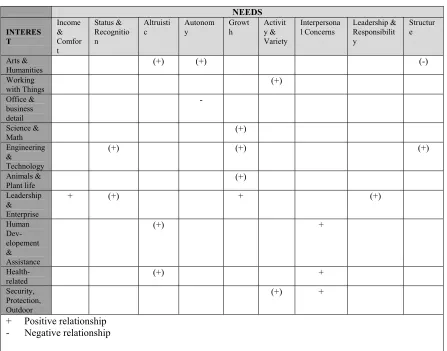
31 dislikes for certain interests. Although relationships might prove to exist, this does not imply that a specific need can be satisfied in only one interest or expressed in one occupation type. Rather this study tested whether predominant needs may be more readily implemented in certain interest areas. Table 3 depicts the hypothesized relationship between work-related needs and interests.
They hypothesized relationships were developed from the work of Roe (Roe & Klos, 1972) who developed a two-way classification table containing the relationship between occupations and nine molar needs (Service, Business Contact, Organization, Technology, Outdoor, Science, General Culture, and Arts & Entertainment). In addition, the following findings were used as a basis for prediction:
Relationship between artistic interests and creative & aesthetics needs (Breme & Cockriel, 1975; Ivey, 1963) and autonomy (Suziedelis & Steimel, 1963)
Relationship between enterprising interests with the need for economic return (Breme & Cockriel, 1975)
Relationship between clerical interests and need for planning (Ivey, 1963)
Relationship between social service interests and concern for others’ social welfare (Ivey, 1963) and the need for affiliation
Relationship between science interest (biological and physical) and need for theoretical stimulation (Ivey, 1963) and need for achievement
(Suziedelis & Steimel, 1963)
Relationship between technical interests and the need for order/structure
Relationship (negative) between interests related to business detail and autonomy needs (Suziedelis & Steimel, 1963)
33 Table 3
Expected Relationship between Work-Related Interests and Needs
NEEDS INTERES T Income & Comfor t Status & Recognitio n Altruisti c Autonom y Growt h Activit y & Variety Interpersona l Concerns Leadership & Responsibilit y Structur e Arts &
Humanities (+) (+) (-) Working
with Things (+)
Office & business detail
-
Science &
Math (+)
Engineering & Technology
(+) (+) (+)
Animals &
Plant life (+)
Leadership & Enterprise + (+) + (+) Human Dev-elopement & Assistance (+) +
Health-related (+) +
Security, Protection, Outdoor
(+) +
+ Positive relationship - Negative relationship
Note: Interest dimensions based on factor-analytic research (Spetz, 1987); Need dimensions based on Cunningham (2000) factor analytic research.
PRIMARY RESEARCH QUESTIONS
The present study is a multi-faceted research project that includes examining a recently developed work-related needs inventory through exploratory factor analysis, investigating the construct validity of vocational interest and value dimensions across six instruments and examining the relationship between work-related interests and needs. All activities are aimed at elaborating vocational taxonomic structure. Investigating work-related interest and needs not only within each instrument but also across instruments (and domains) contributes to our understanding of the structure of these constructs. The specific objectives of the study are to:
(1) Investigate the reliability and other psychometric characteristics of work-related interests (Interest Inventory, CareerOp- Work Activity Preferences, US
Employment Services)
(2) Examine the structure of the newly created Interest Inventory (within instrument analyses)
(3) Examine the structure across work-related interest questionnaires through a cross instrument analysis)
(4) Determine the stability of work-related interests
(5) Investigate the reliability and other psychometric characteristics of work-related needs
35 (7) Compare the structure of the newly developed work-related needs instrument
(I-WRN) with existing instruments (MIQ, CareerOp-Benefits & Opportunities) through cross instrument analysis
(8) Determine the stability of work-related needs
(9) Examine the joint factor structure of work related needs and interests to determine
whether a differentiated need and interest pattern emerges (cross domain and cross instrument analysis)
PROCEDURES
The study entails the collection of data on work-related variables. A recently developed work-related needs instrument was used in this study along with existing questionnaires. Specifically, three interest questionnaires (Career Orientation Profile-Work Activity Preferences, US Employment Services Questionnaire, and Interest Inventory) and three work-related needs questionnaires (Inventory of Work-Related Needs, Career Orientation Profile-Benefits and Opportunities, and MIQ) as outlined below were used.
Data Collection
37 To collect rate re-rate reliability data, forty students participated in a test retest group. They received the same three instruments on both administrations which included the I-WRN, Interest Inventory and the Career Orientation Profile. Questionnaires were administered in a different order across testing sessions.
Sample Characteristics
The main sample consisted of approximately 800 students enrolled in
undergraduate studies at North Carolina State University. Males comprised 60 percent of the sample while 40 percent were females. The majority of participants had an age that ranged between 19-24 years, comprising 96 percent of the sample. In addition, 60 percent of the sample had an age that ranged between 19-20 years. Table 4 presents the age distribution. The respondents represented 95 different curricular majors. The majority of subjects were Psychology, Electrical Engineering, Mechanical Engineering, Computer Engineering, Business Management, and Computer Science students. Nearly 50 percent of the participants were freshman. Table 5 presents the grade level
Table 4
Sample Distribution According to Age
Age n Percent
19 131 16.27
20 252 31.30
21 234 29.07
22 100 12.42
23 37 4.60 24 19 2.36 Other 32 3.97
Table 5
Sample Distribution According to Grade Level
Grade Level n Percent
Freshman 372 46.5
Sophomore 269 33.63
Junior 96 12 Senior 49 6.13
39
Instruments
Background Information Questionnaire – A background information questionnaire was administered at each session to collect demographic data. The questionnaire requested information on subjects’ grade level, age, gender, and curricular major.
Career Orientation Profile-Work Activity Preferences (CareerOp) – The CareerOp is a questionnaire developed in 1987 based on the work activity section of the Career Orientation Profile (COP) and the Work Interest Questionnaire. It is composed of 11 interest scales with 24 to 25 items per scale. A five point rating scales is used:
A – Dislike Very Much B – Dislike
C – Uncertain or Neutral D – Like
E – Like Very Much
Based on previous factor analytic research (States, 1993) 33 items were dropped from analysis. Those items deleted from analysis loaded on more than one factor. The instructions and a sample of work-related need items are contained in Appendix A.
US Employment Services (USES) – The USES Interest Inventory (U.S. Department of Labor, 1981) consists of 162 work activities that correspond to 12 interest scales
(Artistic, Scientific, Plants & Animals, Protective, Mechanical, Industrial, Business Detail, Selling, Accommodating, Humanitarian, Leading-Influencing, and Physical Performing. Scales are based on factor analytic work of items that correspond to groupings of occupations of the Dictionary of Occupational Titles. A three point rating scale is used:
The instructions and a sample of work-related need items are contained in Appendix B.
Interest Inventory – This questionnaire consists of 42 items that reflect 10 scales (Arts & Humanities, Working with Things, Office & Business Detail, Science & Math, Engineering & Related Technologies, Animals & Plant Life, Leadership & Enterprise, Human Development & Assistance, Security, Enforcement, or Physical Performing, and Health Related. Items not usually selected on a statistical basis. Usually overlap within a scale. Every item represents a different content area, hence, there is no redundancy in content area. Each item is rated on a five point scales:
A - Dislike Very Much B - Dislike
C - Uncertain or Neutral D - Like
E - Like Very Much
The instructions and a sample of work-related need items are contained in Appendix C.
Inventory of Work Related Needs (I-WRN) - The I-WRN is a recently developed questionnaire consisting of 196 items and 22 scales. Each scale contains 13-15 items. It is based upon previous research on the structure of work related needs and conceived to serve as a comprehensive instrument for use across work environments. The
questionnaire lists a wide variety of characteristics (such as conditions, benefits, advantages, and opportunities) that can be part of a work situation. Individuals are required to rate the importance of various characteristics using a five-point scale:
41 D - Important
E - Very Important
The instructions and a sample of work-related need items are contained in Appendix D.
Career Orientation Profile – Benefits and Opportunities (CareerOp) – consists of single-item descriptors that are divided among three sections (Job Benefits/Opportunities (needs or values), Work-Activity Areas (interests), and Mental and Physical Activities (abilities). The Benefits/Opportunities section contains 30-item scales describing rewards found in occupations. Each item is rated on a five-point scale:
A - Not Important B - Somewhat Important C - Moderately Important D - Important
E - Very Important
The instructions and a sample of work related need items are contained in Appendix E.
Minnesota Importance Questionnaire (MIQ) – The MIQ is a self-report instrument containing 21 statements of work reinforcers or conditions that make work satisfying. Originally designed as a paired form where a person responds by indicating the work reinforcer in each pair that is more important in an ideal job. A profile of work needs can then be compared for 1769 occupations as categorized in the Minnesota Occupational Classification System III (MOCS III).
The MIQ is also available in ranked form. Each item is rated on a five-point scale: A - Not Important
B - Somewhat Important C - Moderately Important D - Important
43
ANALYSES AND RESULTS
Item and Scale Analyses
Item analyses were performed to test the integrity of the instruments and to reduce the number of items per scale. To this aim, all items containing missing data were
replaced with the mean of the remaining items constituting the scale. Scale scores
consisting of the mean of the items in the scale were computed and used in all subsequent analyses. Specifically, item-total correlations, correlations between an individual item and the sum of the remaining items that constitute a scale were computed for the newly created I-WRN as well as for the Interest Inventory and the CareerOp--Work Activity Preferences. All items had item-total correlations above .40 and most were in the .70 range except for those removed from the scales. Six items were dropped from the I-WRN and include three items from the Activity scale, one item from the
Compartmentalization scale, one item from the Culture & Aesthetic Concerns scale, and one item from the Teamwork scale. Three items were dropped from the CareerOp-Work Activity Preferences and include one item from each of the following scales: Human Development and Assistance, Protection, Enforcement & Physical Feats and Scientific Activities.
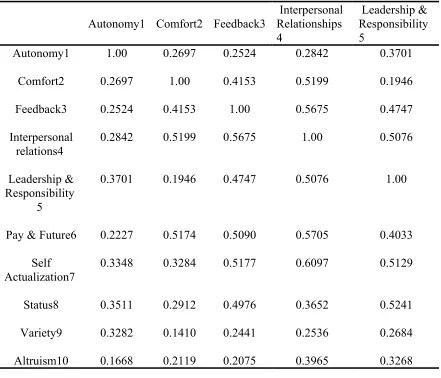
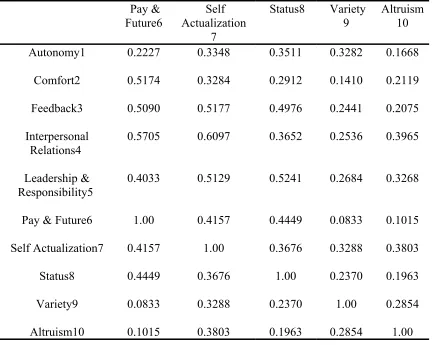
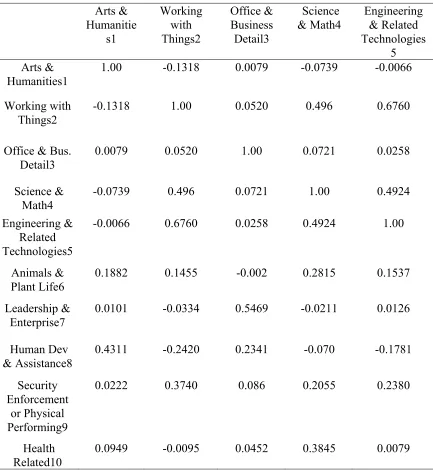
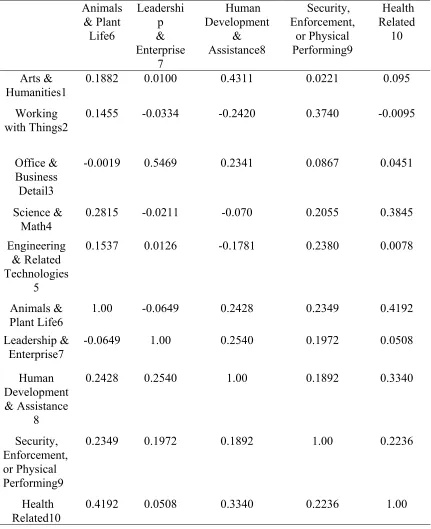
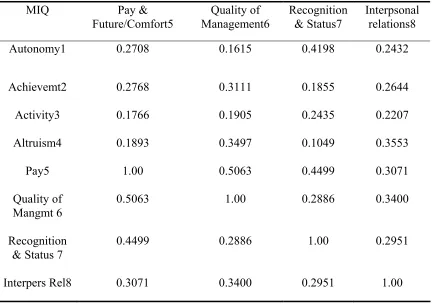
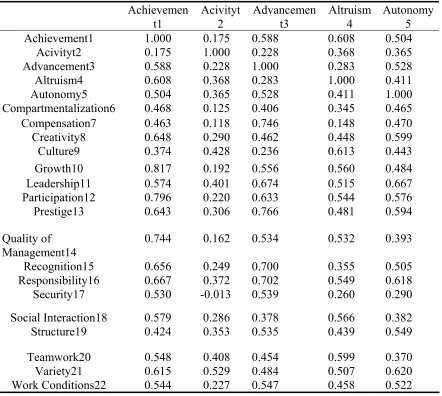
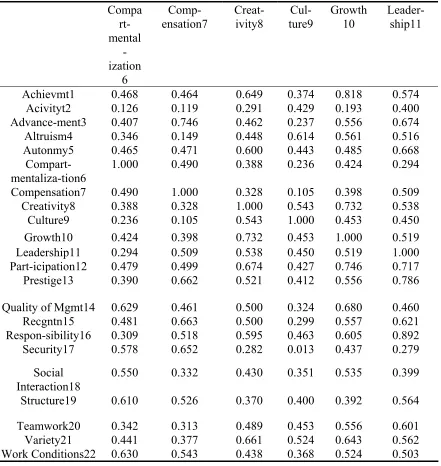
Scale intercorrelations were also computed for all instruments and the correlations for the revised instruments are contained in Tables 6-11. Particular attention was paid to items that correlate too highly with scales other than their own. The I-WRN had some high correlations which warrant their collapse into fewer factors.