Transactions of the 17th International Conference on Structural Mechanics in Reactor Technology (SMiRT 17) Prague, Czech Republic, August 17 –22, 2003
Paper # J06-5
Structural Dynamics in FBR
S B Bhoje
Indira Gandhi Centre for Atomic research, Kalpakkam-603 102, India
ABSTRACT
In view of thin walled large diameter shell structures with associated fluid effects, structural dynamics problems are very critical in a fast breeder reactor. Structural characteristics and consequent structural dynamics problems in typical pool type Fast Breeder Reactor are highlighted. A few important structural dynamics problems are pump induced as well as flow induced vibrations, seismic excitations, pressure transients in the intermediate heat exchangers and pipings due to a large sodium water reaction in the steam generator, and core disruptive accident loadings. The vibration problems which call for identification of excitation forces, formulation of special governing equations and detailed analysis with fluid structure interaction and sloshing effects, particularly for the components such as PSP, inner vessel, CP, CSRDM and TB are elaborated. Seismic design issues are presented in a comprehensive way. Other transient loadings which are specific to FBR, resulting from sodium-water reaction and core disruptive accident are highlighted. A few important results of theoretical as well as experimental works carried out for 500 MWe Prototype Fast Breeder Reactor (PFBR), in the domain of structural dynamics are presented.
KEYWORDS: Structural dynamics, FBR, FIV, fluid-elastic instability, pump induced vibrations, seismic analysis, core disruptive accident, large sodium water reaction effects, dynamic buckling
INTRODUCTION
FBR programme started in India with the construction of 40 MWt/13 MWe Fast Breeder Test Reactor (FBTR) which is operating at Kalpakkam since 1985. Towards establishing techno-economic viability on industrial scale, Department of Atomic Energy proposes to construct a 500 MWe Prototype Fast Breeder Reactor (PFBR) at Kalpakkam. PFBR is sodium cooled pool type reactor with two primary pumps and two secondary loops. The overall flow diagram is shown schematically in Fig.1. Nuclear heat generated in the 181 fuel subassemblies in the core is transported by primary coolant circuit to intermediate heat exchanger (IHX) in which the heat is transferred to secondary sodium circuit which has eight steam generators (SG). Steam produced in SG is supplied to a turbine through a steam–water system. .
In the reactor assembly (RA) shown in Fig.2, the main vessel (MV) of 12.9 m diameter, houses the primary circuit which comprises core, 2 sodium pumps (PSP) and 4 IHX.
MV contains the radioactive primary sodium and supports the core through grid plate (GP) and core support structure (CSS). There are two sets of absorber rods (AR), viz. Control and Safety Rods (CSR) (9 numbers) and Diverse Safety Rods (DSR) (3 numbers). Each rod is driven by its own drive mechanism, viz. CSRDM and DSRDM, which are housed inside the control plug (CP), which in turn is supported on small rotating plug (SRP) of the top shield (TS). Under normal operating conditions, sodium at 670 K is drawn from the cold pool by PSP and discharged through 4 pipes into the GP which supports the core subassemblies (CSA) as well as distributes flow through them. The high temperature sodium (820 K) leaving the core, impinges on CP which directs the flow into the hot pool. Both hot and cold pools have a free sodium surface blanketed by argon. The flow of sodium through IHX is driven by a level difference (1.5 m of sodium head) between the hot and cold pool free surfaces. The hot and cold pools are separated by inner vessel which is bolted to GP. In order to increase the structural reliability of MV, the most critical component in the RA, its temperature is maintained at ~ 700 K
(below creep regime) by passing a fraction of cold sodium from the CSS plenum, through the annular space between MV and thermal baffle (TB).
The major concern for the nuclear reactor safety, particularly under extreme loading conditions, is mainly due to dynamic loads and hence, the demonstration of structural integrity of components calls for thorough understanding and accurate quantification of dynamic loads, advanced analysis methodology, sophisticated computer codes and extensive validations. These aspects relevant to FBR are discussed in this paper. To start with, the structural dynamics problems are discussed in general. A few important results of analyses that have been carried out for Prototype Fast Breeder Reactor (PFBR) are highlighted.
STRUCTURAL DYNAMICS PROBLEMS IN FBR
Structural Characteristics
The operating pressure of sodium components in FBR, except SG is low (< 1 MPa) and thermal loadings are dominant both under normal as well as transient conditions. In view of these, thin walled shell structures, are chosen which help, apart from mitigating thermal stresses, to achieve economy. The diameter/thickness values for various RA components lie in the range 100-650. MV carries ~1150 t of primary sodium mass, apart from a concentrated load of ~ 950 t, transmitted through triple point. The inner vessel and TB are separated by relatively thin annulus of liquid sodium (annulus gap-diameter ratio: w/D ~ 1/100). Another special feature is the existence of free fluid surfaces which is the source of sloshing phenomena. The structural wall surfaces are subjected to random pressure fluctuations which can cause significant displacements of reactor internals by virtue of their high slenderness ratio. These features are responsible for their lower natural frequencies (1-15 Hz) and as a consequence, the vibration and seismic loadings play important role in the structural design of components.
Vibration Problems
CSA, thin shell structures in RA, thermocouple & sampling tubes in CP, IHX tubes, CSRDM, DSRDM, transfer arm (TA) and PSP are prone to vibrations. Even though the vibration level of PSP is controlled, the induced forces at the support locations can cause significant vibrations of the structures supported by them, possibly due to resonance. The vibrations originated either from PSP or from flow induced vibration mechanisms may cause unacceptable displacements of structures from the point of view of reactivity oscillations, mechanical interactions and high cycle fatigue due to fluctuating stresses. In some special cases, the fluctuations due to mechanisms such as fluid-elastic instability leads to a rapid damage of the structures.
Seismic Excitations
The earthquake (EQ) is an important load for both mechanical and civil structures. With the consideration of long reliable operation (design life of ~100 y is required for the safety related civil structures) and economy (adoption of common base raft and interconnected buildings concepts), detailed analysis is necessary for the nuclear island. For the mechanical systems, particularly the RA components, the seismic loadings are important in the structural design because of enhanced effects due to the structural characteristics (natural frequencies lie in the range of 5-10 Hz for which seismic amplifications are higher) and safety requirements, such as reactor scramability, reactivity oscillations, operability of PSP and structural integrity of components in the core support path. Further, the seismic loads are the largest of the primary loads and therefore, determine the wall thicknesses of the structures.
Large Sodium-Water Reaction Pressure Transients
The sodium has violent chemical reaction with water. The particular concern is the possibility of a large sodium water reaction (LSWR) in SG where both sodium and water coexists. Under a LSWR, high pressure and temperature are generated in the reaction zone, which in turn propagates pressure transients along the sodium pipeline. The main concern is the structural integrity of IHX, since its failure may introduce hydrogen and corrosive reaction products in the core affecting the reactor safety. Further, the structural integrity of adjoining SG and pipelines is also very important, since the piping failure causes sodium leak and subsequent sodium fire.
Core Disruptive Accident Loadings
Since FBR has many inherent and engineered safety features, a core disruptive accident (CDA), which involves melting of whole core, is of very low probability event (< 10-6/r-y). However, as a deterministic approach, it has to be
impact'. Due to this, apart from the possibly large stresses developed in MV, a small quantity of sodium is ejected through the gaps in TS component penetrations, to Reactor Containment Building (RCB). The consequent sodium fire results in an increase of temperature and pressure for which the RCB has been designed. CDA can impose transient loads on reactor vault which is considered for the vault design.
VIBRATION ANALYSIS
Vibration analysis of PFBR is presented in detail in a companion paper [2]. Only summary is given below.
PSP Induced Vibration
The PSP runs at a nominal speed of 590 rpm which can vary between 15 and 100 %. Fig.3 shows the simplified sketch of PSP. The pump assembly consists of pump shell and shaft which is located inside a standpipe penetrating into the cold pool. The impeller is mounted on the shaft and the suction bell is attached with the pump shell, at the bottom. The shaft and pump shell are connected at the top by an assembly of thrust and radial bearing. There is a hydrostatic bearing (HSB) between the shaft and suction bell, just above the impeller level, to align the shaft precisely along the central line under all operating speed of the pump within the radial clearance of 400 µ. If the displacement of the shaft w.r.t. pump shell at HSB level exceeds 400 µ, there can be metal to metal contact which in turn causes damage to HSB. Hence, it is essential to predict the vibration behaviour of PSP, which calls for detailed analysis taking into account all the complexities such as, modeling the stiffness and damping characteristics of HSB, gyroscopic effects, dynamic coupling of connected components, viz. MV, CSS, GP, primary pipe, fluid-structure interaction (FSI) and effects of fluids confined in the various narrow annular spaces. Towards this, a special purpose in-house
computer code was developed based on finite element formulation. Analysis indicates that the shaft natural frequency varies as a function of speed. At the minimum speed of 90 rpm, the frequency is ~2 Hz which is close to the fundamental frequency corresponding to cantilever beam (shaft). At nominal operating speed, under the assumption that there is no eccentricity, the frequency is 9 Hz. which is close to the normal operating frequency of the shaft. However, while running, the bearing develops higher stiffness and hence the frequency goes up. To take the advantage of stiffness variations with speed, the resonance is investigated by determining the dynamic response of the shaft at HSB under various operating speeds. The excitation source is the centrifugal force due to mechanical unbalance in the shaft caused by manufacturing misalignment. The misaligned shape is assumed
as vibration mode shape corresponding to 9 Hz. The locus of centroid of the shaft at HSB elevation (orbit plot), followed to attain the steady state condition is predicted as shown in Fig.4, which shows that the peak displacement of shaft at HSB location is 60 µ. The peak shaft displacements at various speeds are depicted in Fig.5 which clearly indicates that the resonance occurs at 700 rpm. Thus, there exists a margin of 1.2 on the nominal speed against resonance. The maximum amplitude at resonance, however, is limited to 160 µ which is less than the radial clearance of 400 µ. This implies that there is no metal to metal contact at HSB over the operating range including 20 %
over speed. Thus, the analysis ensures smooth operation of PSP over the entire operating speeds.
Vibration Response of RA components under Pump Induced Excitations
PSP induces dynamic forces at its supports: one at roof slab (RS) and another at spherical header nozzle. The force developed at RS is significant, since the peak value is ~ 2.5 t at RS support and < 0.5 t at nozzle support. The vibration responses of various RA components under the excitation at RS during its normal operation are predicted by CASTEM 3M. The finite element model includes MV, GP, CSS, inner vessel, CP, TB and TS (Fig.6). The core is modelled as an equivalent solid. GP, CSS and TS, which are of box type, are replaced by geometrically similar axisymmetric solids with modified elastic modulus and density, so as to have the same natural frequencies. PSP and IHX are not included in
Fig.3 Schematic of PSP located in RA
-70 0 70
-70 0 70
X-Displ - µ
Y -D is p l µ
Fig.4 Orbit plot at 590 rpm
0 20 40 60 80 100 120 140 160 180
0 100 200 300 400 500 600 700 800 900 1000 Speed - RPM
A m pl it ud e - µ
the finite element model, as they do not affect the results. Free vibration analysis has indicated that the natural frequency of control plug is ~ 9 Hz which matches with the PSP shaft frequency and hence, from the response analysis results for the applied excitation indicated in Fig.7, it is found that CP is experiencing maximum displacement with the maximum amplification of about 7 under its normal operating speed, due to resonance phenomenon (Fig.8). The amplitude of vibration of CP under pump induced excitation force at RS is estimated to be ~ 450 µ. The order of vibrations for other internals such as inner vessel and TB, are insignificant (<150µ).
Flow Induced Vibration
FIV mechanisms relevant to FBR components are vortex shedding and fluid-elastic instability. Vortex shedding often occurs at immediate downstream of structures subjected to cross flow and generates periodic fluid forces. If the shedding frequency coincides with a natural frequency of the structure, resonance occurs. The vortex shedding is the critical mechanism for an isolated tubes or shells. The critical components to be checked for this mechanism are AR device mechanisms (CSRDM/DSRDM), CP internals, TA and MV cooling tubes. Fluid-elastic instability results from coupling between fluid-induced dynamic forces and the motion of structures. Instability occurs when the flow velocity is sufficiently high so that the energy absorbed from the fluid forces exceeds the energy dissipated by damping. Fluid-elastic instability usually leads to excessive vibration amplitudes which may cause failures within a short time. The fluid-elastic instability is the critical mechanism for tube bundles subjected to cross flow and tube vibration problems in most of the heat exchangers are related to fluid-elastic instability. Analysis has been carried out for the above mentioned components. The input data required, apart from geometrical details, are natural frequencies and cross flow velocities. Natural frequencies are computed using
Fig.9 Schematic of CSRDM
-2 -1 0 1 2
0 2 4 6
T ime - s
Fo
r
c
e
Fig.7 PSP induced forces at RS
CP IV, TB
-7.5 -5 -2.5 0 2.5 5 7.5
0 1 2 3 4 5
Time - s
Fig.8 Responses of RA internals Fig.6 FE Model of RA
Fig.10. Frequency response of CSRDM
Radial constraint at CSR bottom tip No constraint at CSR bottom tip
Frequency- Hz
Displacem
CASTEM 3M computer code, including the fluid-structure interaction effects. The cross flow velocities computed by THYC3D, PHOENICS and STAR-CD codes indicate that the maximum cross flow velocity is less than 3 m/s. Except CSRDM (Fig.9), other components are found to meet the ASME Appendix-N criteria [3]. Considering the cross flow occurring in a narrow zone just above the core top, dynamic response is computed using the generated lift force function corresponding to excitation frequencies over the range of 1-10 Hz to cover the various operating conditions. The maximum response is found to be less than 1 mm (Fig.10), which is found to be acceptable with reference to reactivity oscillations, mechanical interactions and high cycle fatigue.
Fluid Elastic Instability of Weir Shell
In order to cool the MV, a fraction of cold sodium from CSS plenum is allowed to pass through the annulus between MV and weir shell, viz. feeding collector. The sodium after passing through the feeding collector, flows over the weir shell, falls down along the shell, reaches the restitution collector and finally mixes with the cold pool. Under some critical combinations of overflow rate and fall height, the weir shell undergoes fluid-elastic instability. Such vibrations were noticed during commissioning of French FBR called SPX [4]. In order to avoid such a problem in PFBR, analysis has been carried out to identify the instability regimes using the instability formulated by Aita [5] which indicates that the flow rate and the associated fall height lies in the stable region under normal operating
condition and in the unstable region under fuel handling condition (FHC) as shown in Fig. 11 for 1 % damping ratio. In order to determine dynamic response by detailed non-linear analysis, self induced fluid forces on the weir shell due to sloshing of liquid free levels are identified and analytical expressions are derived [6]. Using the modal superposition principles, the modal based non-linear dynamic equilibrium equations are written. Subsequently the equations are solved by direct integration technique using the natural frequencies and mode shapes computed numerically through CASTEM 3M code. The analysis indicates that the vibration is stable with a maximum amplitude of ~ 3.5 mm for a pessimistic damping value of 0.5 %, and the vibrations are negligible for the realistic damping value of 1 % (Fig.12). Thus, weir shell is found to be stable during FHC and thereby, under all the operating conditions.
SEISMIC EXCITATIONS
Kalpakkam lies in a low seismic zone and the peak ground acceleration values (PGA) are 0.066 g for OBE and 0.156 g for SSE in the horizontal directions. The corresponding values in the vertical directions are 0.044 g and 0.104 g respectively. Site dependent response spectra are also defined corresponding to these PGA values. 3 uncorrelated synthetic time history (TH) which are compatible to the target spectrum are developed, to apply 3 mutual perpendicular directions at the base raft. The seismic excitations at the RA support in the form of TH are determined by dynamic analysis of civil structures resting on base raft, which form input data for subsequent seismic analysis of RA. The seismic analysis is done to meet the following design requirements:
• The reactivity insertion because of core compaction due to horizontal displacements and relative vertical displacements between AR and FSA, should be < 0.5 $ under SSE.
• It should be possible to insert AR during SSE. For this, the relative horizontal motion between the core top and the CP bottom should be < 25 mm.
• The entire core should not be lifted upward from GP, which is ensured by limiting the peak vertical acceleration less than 0.9 g with 0.1 g margin.
• PSP should not seize. For this, a fluid film should be ensured in HSB, i.e. the relative radial displacement at HSB should be less than the radial clearance (400 µ).
Fig.11 Fluid elastic stability chart
FHC
Fig.12 Dynamic response of weir shell
• Sodium ejection to the RCB through the top shield seals, under sodium impact due to sloshing, is to be prevented. For this, the maximum sloshing height should be less than the cover gas space (nominal space is 0.8 m).
• There should not be any mechanical interaction between the adjacent shells.
• The stresses at the various critical components should be less than the allowable values (Level A for OBE and Level D for SSE) as per the RCC-MR [7] to ensure that there is no risk of buckling and consequent loss of structural integrity.
Seismic analysis of axisymmetric components is carried out including fluid structure interaction effects using the computer code CASTEM 3M. For this case, the finite element model shown in Fig.6 is used. Separate analysis is done for the CSA to consider the effects of interactions among CSA and for the PSP to consider the effects of non-linear stiffness characteristics of HSB using special purpose codes viz. CORESEIS and PUMPSEIS respectively. IHX is analysed separately including the effects of tubes using CASTEM 3M. Based on the analyses, it is demonstrated that all the above mentioned design criteria were met for PFBR. More details of analysis for the RA components, CSA and PSP are available in ref [8,9,10]. A few important results are highlighted below.
Natural Frequencies and Mode shapes of RA
A few typical vibration mode shapes for RA components including PSP are depicted in Fig.13. The important natural frequencies for RA are 1.2 Hz and 5.6 Hz which correspond to (i) rocking mode of the assembly of inner vessel, GP, CSS and CSA about the triple point of the MV where the CSS is attached and (ii) swaying mode of MV. The dominant sloshing frequencies are 0.45 Hz and 0.7 Hz. In the case of PSP, the mode having natural frequency of 1.3 Hz is basically rocking of CSS, GP and core about the triple point. The second with the natural frequency of 9 Hz is a coupled mode involving 3 deformations: (i) predominantly the bending of shaft as cantilever beam due to relatively low stiffness contribution by HSB, (ii) bending of shell as simply-supported beam at two supports, one at the top spherical support and another at spherical header and, (iii) swaying of MV.
Insertability of Absorber Rods and Reactivity Oscillations
Fig.14 shows the dynamic displacements of CSA in the central row at a few discrete time intervals under SSE. Fig.15 shows the relative horizontal displacements between the core top and the CP bottom (CSRDM gripper). The maximum horizontal displacement of the core top with reference to CSR gripper is 16 mm, which is less than allowable value of 25 mm and hence there is no problem of insertion of AR.
Fig.14 Dynamic displacements of CSA under SSE
Fig.15 Horizontal displacement of CSR w.r.t. core Fig.16 Vertical Displacement of CSR w.r.t. core
1.2 Hz 5.6 Hz 0.45 Hz 0.7 Hz 1.3 Hz 9 Hz
The main contribution for the reactivity oscillations is due to relative vertical displacements between core and CSR as shown in Fig.16. The peak relative vertical displacement between the core and CSR is 2.8 mm including 0.5 mm due to displacement of fuel pellets within clad and corresponding reactivity addition for 9 CSR is 43 pcm. The rms reactivity variation due to two horizontal displacements is obtained by algebraic sum of reactivity variations due to individual subassemblies, which is found to be ~28 pcm. The combined rms reactivity change is 51 pcm, which corresponds to ~ 0.15 $. This is less than acceptable value of 0.5 $. Hence, there is no fear of superprompt criticality.
Sloshing Heights
Maximum sloshing heights as seen in Fig.17 are ~40 mm and 150 mm respectively for the hot pool and feeding collector free levels, which are less than the cover gas height of 800 mm. Hence, there is no chance of sodium impacting on TS.
Vesse l displa ceme nts
Displ aceme nts of MV, inner vessel
and TB are found to be <10 mm under SSE. The horizontal displacements of TB and inner vessel at the top edges are shown in Fig.18. Hence there is no possibility of mechanical interactions between main & safety vessels, inner vessel & thermal baffles and inner and outer thermal baffles.
Dynamic Pressure Distribution on Thermal baffles Towards investigating the buckling risk of thermal baffles, the dynamic pressures on either surfaces of weir shell are extracted. From these, the net external pressure acting on it, is computed and presented in Fig.19. The weir shell is subjected to the maximum external pressure of ~ 200 kPa. This pressure distribution is used to investigate the dynamic buckling of weir shell.
Investigation of Buckling Risks
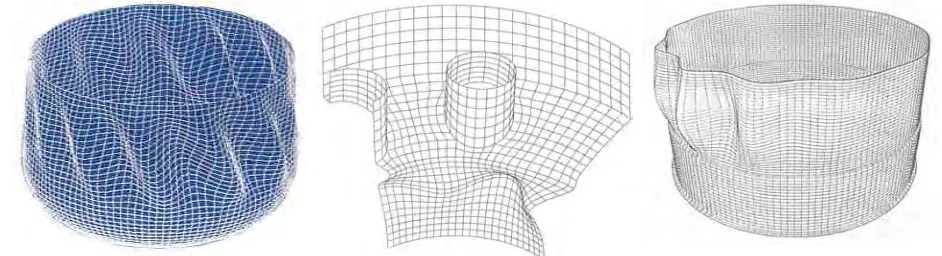
Using the computed dynamic pressures and stresses, critical buckling loads and associated mode shapes are predicted for the MV, inner vessel and TB, based on large displacement elasto-plastic analysis with CASTEM 3M. Fig.20 shows the shear buckling mode shape of MV under horizontal excitations, the buckled mode shape of inner vessel under vertical excitations and buckling of TB under the dynamic pressure acting on the wall during SSE. Finally, it is demonstrated that the factors of safety available on loads to cause buckling are more than the minimum values specified by RCC-MR and hence there is no risk of buckling of RA components under EQ. In the buckling analysis of TB, dynamic loading effects which can cause parametric instability is checked and noted that TB does not have such risk of instability.
Fig.19 Net pressure on outer TB Fig.17 Sloshing of hot pool and feeding collector surfaces
Inner baffle top
Investigation of PSP Seizure
The seismic analysis with response spectrum method indicates that the maximum stress intensity (P1 + Pb) value is
51 MPa in the pump shaft at the hallow portion and 53 MPa, at the motor support shell, which are much less than the allowable value of RCC-MR (~ 350 MPa). However, the seizure of pump during EQ is found to be a critical issue. This has been investigated in detail by using PUMPSEIS. The outcome of the analysis are the displacements of shaft w.r.t. bush attached with shell at HSB. The orbit plots are shown in Fig.21 for 290 rpm and 235 rpm respectively, which indicate that the shaft displacements are 350 µ at 295 rpm
and 450 µ at 235 rpm. By interpolation, it is seen that the shaft touches the bush on the shaft at 265 rpm, at which the eccentricity of shaft is equal to the radial clearance. This means that there is no fear of seizure under SSE while pump is running at speed > 265 rpm. At lower speeds, there can be impacts between shaft and bush at HSB. This is due to the low bearing stiffness of HSB at lower speeds because of lesser supply pressure. The impact forces are judged to be small and do not cause seizure. This needs to be demonstrated experimentally. However, under OBE, up to 20 % speed (~120 rpm), there is no fear of impact, since the maximum displacement is found to be < 400 µ . The maximum force on the pump spherical header at the nominal speed, under SSE, is less than 20t, which has been considered for the stress analysis of primary pipe.
Seismic Qualification Tests
Computer codes used for seismic analysis have been validated based on many benchmark problems. The CORESEIS code is validated under co-ordinated research programme formulated by IAEA [11]. Further validation has been done by generating data on 7 SA mockup tests conducted in-house. Fig.22 shows a typical validation for a 7 SA cluster mockup. Qualification test series on 1/10th scaled down RA models is in progress. Towards this, a 10 t capacity
shake table has been installed at IGCAR and a few preliminary tests on MV model without internals have been completed (Fig.23). Seismic qualification tests for other safety related components and equipment are also planned systematically.
Fig.21 Orbit plots under SSE 290 rpm 235 rpm Fig .20 Buckled mode shapes of MV, inner vessel and TB under EQ
Fig.23 Tests on MV model Fig.22 Seismic tests on 7 SA cluster mockup
LARGE SODIUM-WATER REACTION PRESSURE TRANSIENTS
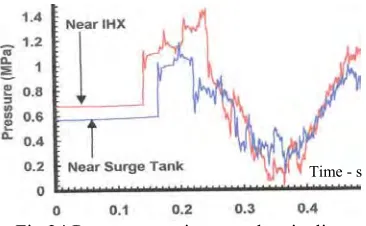
The design basis leak (DBL) has been estimated as instantaneous double ended guillotine rupture of 3 tubes at the top of SG, which leads to rupture of both rupture discs, at inlet and outlet of SG. The value of DBL is 13 kg/s. For the resulting SWR, the pressure transients at various locations have been predicted [12]. Fig.24 shows two typical pressure transients on the pipeline. The maximum pressure predicted at various secondary sodium circuit components are 5.4 MPa at SG, 0.7 MPa at surge tank, 1.8 MPa at IHX and 1.1 MPa at secondary sodium pump inlet, which are the design pressures for the respective components. In the analysis for assessing the stresses in the pipeline, FSI effects have been considered. The stress intensities are found to meet Level-C limits.
CORE DISRUPTIVE ACCIDENT (CDA)
For a work potential of 100 MJ under postulated CDA, fast transient FSI analysis is done by modeling the MV with sodium and internals. For this an in-house computer code, FUSTIN has been developed and validated by solving many international and in-house benchmark problems. CDA analysis of PFBR is presented in detail in a companion paper [13]. Only summary is given below.
Fig.25 shows the finite element model and the deformation of mesh configurations particularly, the growth of core bubble at 3 discrete time intervals. From the analysis, it is concluded that the structural integrity of primary containment is ensured and the net transient load transmitted to reactor vault is negligible. The sodium release to RCB is about 350 kg, which results in the pressure rise of 12 kPa in RCB.
Under a collaborative programme with Terminal Ballistic Research Laboratory (TBRL), Chandigarh, ~ 65 tests were conducted under three test series (TRIG-I, TRIG-II and TRIG-III) on scaled down models of MV with and without internals (Fig.26) using chemical explosives. The objectives of these test series are: (i) to generate data bank to validate FUSTIN code, (ii) to characterize the low density explosives (LDE) for the mockup tests, (iii) to ensure the structure integrity of IHX and DHX and (iv) to estimate the sodium leak by measuring water leak through TS penetrations. TRIG-III tests are on 1/13th scaled down mockups which have all the essential features of prototype geometry. Five
tests were conducted on TRIG-III mockups with 22 g LDE which simulates 110 MJ of energy release in the reactor scale which is the design requirement. It is noted from the tests that the MV, TS, DHX and IHX are integral with negligible deformations. It is also found that the maximum quantity of sodium leak extrapolated from the collected water leak is 233 kg. This value is ~ 67 % of theoretical prediction (350 kg), which shows the conservatism built in the numerical model. It is worth mentioning that the tests with increasing quantity of LDE (up to 220 g) indicate that the main vessel without any internal, is integral up to ~1200 MJ. This confirms that the structural integrity of MV is not of concern under CDA.
Fig.25 Core bubble growth
Fig.24 Pressure transients on the pipeline
Time - s
FURTHER WORKS
• Investigation of seizure of PSP by experiments
• Fretting wear of IHX tubes
• Seismic qualification tests
CONCLUSION
All the structural dynamics problems in the domain of vibration, seismic, LSWR and CDA have been quantified and analysed in detail for PFBR. There is no risk of vibrations of RA internals including PSP and CSRDM. Under SSE, reactivity insertion is less than the acceptable value of 0.5 $ and reactor scramability has been demonstrated. By quantifying the relative displacement between the shaft and journal at HSB and impact forces under seismic events, the PSP is found to be free from risk of seizure (for the speeds >265 rpm for SSE) and apart, the structural integrity of PSP has been demonstrated, both under OBE and SSE. MV, inner vessel and TB meet the buckling design rules of RCC-MR. Under CDA, the structural integrity of primary containment has been demonstrated. The sodium release to RCB is about 350 kg which results in pressure rise of 12. kPa in RCB. Based on this, 20 kPa is considered for the design pressure for RCB. There is no significant load transmitted to the reactor vault. Analysis for secondary sodium pipeline under seismic and LSWR loadings has been carried out. Seismic qualification tests are in progress.
REFERENCES
1. AERB (1990), Safety Criteria for Prototype Fast Breeder Reactor.
2. Chellapandi, P. et al., “Vibration Analysis of Reactor Assembly Internals for Prototype Fast Breeder Reactor”, Tran. 17th International Conference on Structural Mechanics in Reactor Technology, Prague, Vol. J, Czech
Republic, August 17-22, 2003.
3. ASME, Sec III, Appendix-N (1998), Dynamic Analysis Methods.
4. Cros, A, Del Beccaro, R. and Aita, S., “Thermal Protection of the Rapide 1500 Main Vessel by Means of a Spillway, Trans. 9th International Conference on Structural Mechanics in Reactor Technology, Vol. E, Laussane,
Switzerland, August 17-21, 1989.
5. Aita, S. and Gibert, R.J. “Fluid elastic Instability in a Flexible Wire: A Theoretical Model, IAEA Specialist Meeting on Flow Induced Vibrations in Fast Breeder Reactor, IWGFR-62, Paris – France, October 22-24, 1986. 6. Chellapandi, P. et al., “Fluid-elastic Instability of Thin Shells of an FBR”, 1st International Conference on
Vibration Engineering and Technology of Machinery (VETOMAC-I), Indian Institute of Science, Bangalore, October 25-27, 2000.
7. RCC-MR (1993), Design and Construction Rules for Mechanical Components for FBR Nuclear Islands, Section I, Subsection B, Class 1 Components, AFCEN.
8. S.B.Bhoje, “Seismic Analysis of Reactor Assembly of PFBR”, National Seminar on ‘Seismic Design of Nuclear Power Plants’, Structural Engineering Research Centre, Chennai, February 21-22, 2003.
9. Alok Gupta, et al, Seismic Behaviour of Prototype Fast Breeder Reactor Core, National Seminar on ‘Seismic Design of Nuclear Power Plants’, Structural Engineering Research Centre, Chennai, February 21-22, 2003.
10. P.Chellapandi, et al., Seismic Analysis of Primary Sodium Pump for Prototype Fast Breeder Reactor, National Seminar on ‘Seismic Design of Nuclear Power Plants’, Structural Engineering Research Centre, Chennai, February 21-22, 2003.
11. Morishita, M. et al., “Main Features and Results of IAEA Coordinated Research Program on Intercomparison of LMFR Seismic Analysis Codes”, Trans. 14th International Conference on Structural Mechanics in Reactor
Technology, Vol K, Lyon, France, August 17-22, 1997.
12. Selvaraj, P. et al., “Review of design basis accident for large leak sodium-water reaction for PFBR”, 4TH
international conference on Nuclear Engineering, Louisiana, March 1996.
13. Chellapandi, P. et al., “Analysis for Mechanical Consequences of A Core Disruptive Accident In Prototype Fast Breeder Reactor”, Tran. 17th International Conference on Structural Mechanics in Reactor Technology, Vol. J, Prague, Czech Republic, August 17-22, 2003.