Abstract
BILGIN, AHMET SOYDAN. Semantic Web Services Query and Manipulation Language for Quality Attributes of Web Services (Under the direction of Munindar P. Singh).
The Web is moving toward a collection of interoperating Web services. Achieving this interoperability requires dynamic discovery of Web services on the bases of their capability. The capability of a service can be best determined by its functional description attributes, which describe the service interface such as input and output of the service, and quality attributes, which provide additional information to evaluate the service.
SEMANTIC WEB SERVICES QUERY AND
MANIPULATION LANGUAGE FOR QUALITY
ATTRIBUTES OF WEB SERVICES
BY
AHMETSOYDANBILGIN
A THESIS SUBMITTED TO THE GRADUATE FACULTY OF
NORTH CAROLINA STATE UNIVERSITY
IN PARTIAL FULFILLMENT OF THE
REQUIREMENTS FOR THE DEGREE OF
MASTER OF SCIENCE
DEPARTMENT OF COMPUTER SCIENCE
RALEIGH
AUGUST2003
APPROVED BY:
PETER R. WURMAN PENG NING
MUNINDAR P. SINGH
Biography
Acknowledgement
I would like to thank my advisor Dr. Munindar P. Singh for his constant support, guidance, and patience. I would also like to thank my committe members Dr. Peter R. Wurman and Dr. Peng Ning. I would like to thank Mike for all the help and for those discussions on various topic. I‘m also grateful to Pinar for her patience while answering my questions. I thank Ashok, Ergun, Amit, and Yathi for their support and friendship. Finally I am thankful to my family for always being there whenever things get rough.
Table of Contents
List of Tables vi
List of Figures vii
1 Introduction 1
2 Background 6
2.1 Web Service Description Standards . . . 6
2.1.1 UDDI (Universal Description, Discovery, and Integration of Web Services) . . . 7
2.1.2 WSDL (Web Service Definition Language) . . . 8
2.1.3 E-Speak . . . 8
2.2 Semantic Web Standards and DAML-S . . . 10
2.2.1 RDF and RDF Schema . . . 11
2.2.2 DAML and OWL . . . 11
2.2.3 DAML-S or OWL-S . . . 12
2.3 Basics of DAML Query Language . . . 14
3 Service Categories and Attributes Ontology 18 4 Semantic Web Services Query and Manipulation Language 23 4.1 Basics of the Query Language . . . 23
4.2 Motivation for Proposed Language . . . 25
4.3 Modification and Enhancements . . . 27
4.3.1 Identification of Services . . . 27
4.3.2 Evaluating Class Instances . . . 29
4.3.3 Querying Properties . . . 32
4.3.4 Returning Name of Classes and Properties . . . 33
4.3.6 Inserting New Data . . . 36
4.3.7 Intersection, Union and Except . . . 37
5 Implementation 40 5.1 Implementation Environment . . . 41
5.2 Basic Architecture . . . 41
5.3 Querying Metadata . . . 43
5.4 Querying Data . . . 44
5.4.1 Database Schema and Mapping . . . 44
5.4.2 Conversion from DAML Query Language to SQL . . . 46
5.5 Limitations of the Implementation . . . 49
6 Discussion 52 6.1 Related Work . . . 52
6.1.1 RDF Query Language . . . 53
6.1.2 RDF Data Query Language . . . 54
6.1.3 RDF Query Specification . . . 55
6.1.4 Sesame . . . 55
6.1.5 DARPA DAML Query Language . . . 55
6.2 Main Contribution and Directions . . . 56
Bibliography 58 A Ontology files 62 A.1 A Sample Quality Attributes Ontology . . . 62
List of Tables
List of Figures
2.1 A car rental service provider . . . 8
2.2 Find thenameand themanagerof all subjects of typeDepartments . 15 2.3 Find themanagerof all subjects that hasname= “cosmetics” . . . 15
2.4 Find thenameof all subjects, which hasaddressproperty whose objects hasstreet= “Avent Ferry” . . . 16
2.5 Find the name of all departments where some items are sold . . . 16
2.6 Find the name of manager as well as the prices of items in the cosmetics department . . . 17
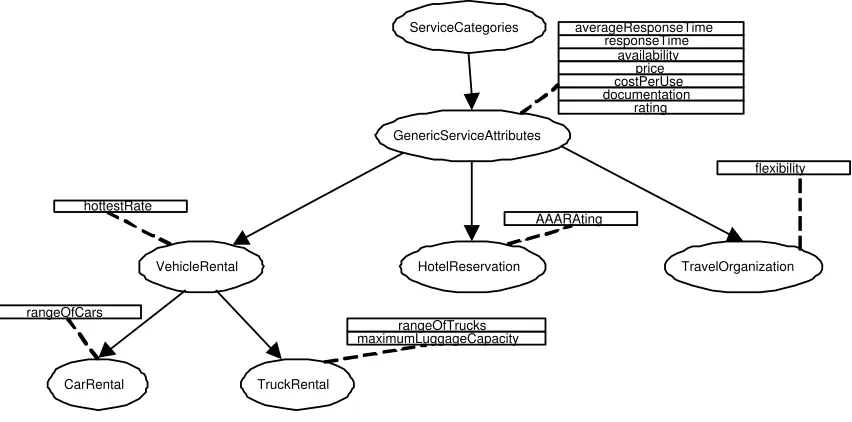
3.1 Representation of service categories and quality attributes ontology . . . 18
3.2 TheCarRentalservice category . . . 19
3.3 TherangeOfCarsattribute . . . 19
3.4 A vehicle rental service . . . 21
3.5 An abstract UML representation of the vehicle rental service . . . 22
4.1 ThevehicleRentalclass and an instance of thevehicleRentalclass 26 4.2 Find all the values of a given service for the given property . . . 28
4.3 Find the properties of a service with the given type . . . 29
4.4 Find the property of parties with given types . . . 30
4.5 Find the property of services with the given type and the value for the given property . . . 31
4.6 Find the properties of parties who submitted something to a given service . 31 4.7 Find the domain of a property . . . 32
4.8 Find the domain of properties whose range is the given class . . . 32
4.9 A sample class and a class instance . . . 33
4.10 Find the property of all services . . . 34
4.11 Find the name of the resources whoserangeis the given class . . . 34
4.12 Find the names of resources that are subclasses the given class . . . 36
4.13 Insert values for the new attribute of a given service . . . 38
4.15 Find the services which do not satisfy the restriction . . . 39
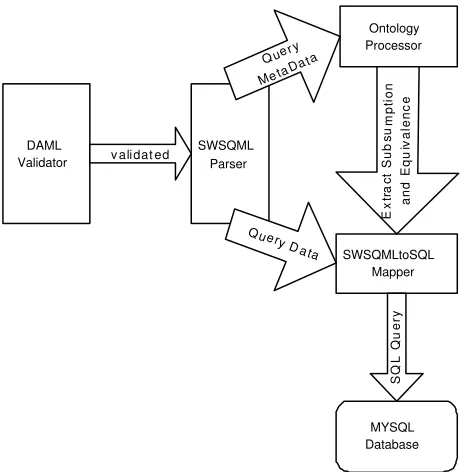
5.1 Basic architecture of DAML query service . . . 42
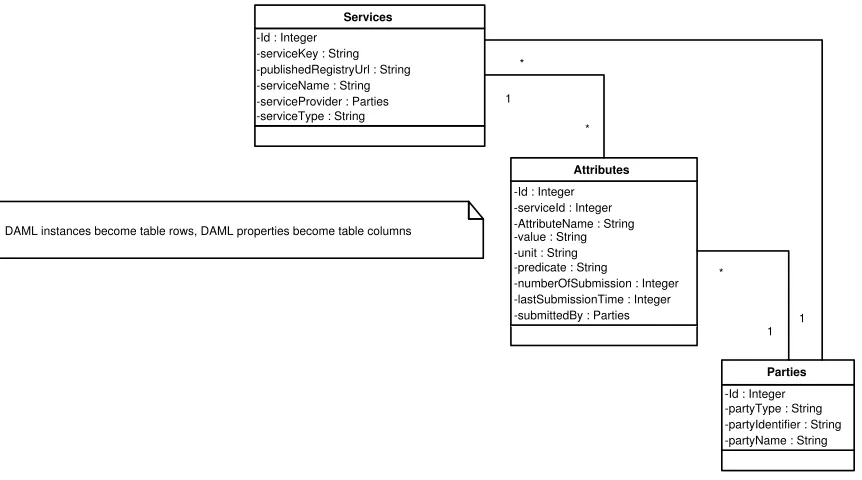
5.2 Representation of RDBMS table structure . . . 46
5.3 Representation of DAML classes . . . 47
5.4 Find theserviceKeyof car rental services which hascostPerUse= “cheap” . . . 48
5.5 Equivalent SQL translation for the query in Figure 5.4 . . . 49
5.6 The declaration of a service with two different types . . . 50
5.7 Queries with and without aliasing . . . 51
Chapter 1
Introduction
Web services are modular and self-describing applications, which can either be composed with other Web services to create businesses or simply deployed as reusable components to provide some functionality to their clients. An important characteristics of a Web service is that it is a black box as far as any client agent (human or artificial) is concerned. In this respect, service interface-based discovery including the matching of service inputs and outputs seem to be a good starting point in service discovery process [Paolucci et al., 2002a]. On the other hand, most of the time, discovering a service based on its outer skin may not give the desirable match; because of the service’s inner underlying decisions and workings that can affect the service’s quality. For example, a DocToPdf Converter Web service may take a.doc file as input and produce a.pdffile as output. However, this information will not be enough for a user who wants all the hyperlinks or the characters written inTahomaformat in his document to be converted properly.
also advertise some of these attributes. Some well-known sites such asbindingpoint.com [bindingpoint.com, 2001] andsalcentral.com[salcentral.com, 2001] already provide an in-terface to rank Web services.
Standards such as UDDI [UDDI, 2000] and ebXML [OASIS, 2001] address the prob-lem of Web service discovery. In a UDDI registry, Web services are published and discov-ered through four core data structures (businessEntity, businessService, bindingTemplate, and tModel) and their properties, which we review in Chapter 2.
Briefly, UDDI is an XML-based standard. XML-based standards represent syntactic properties of services. Human intervention is necessary to correctly interpret the intended meaning of syntactic properties. There is an important difference in the perspectives taken by syntactic and semantic representations. Syntactic representation is about the number of elements of certain types, their attributes and ordering, and the sorts of text that can appear in datatypes, while semantic representation is about things in the world that are expressed in shared ontologies—people who have names, car rental service who has rating attribute, and so on. Semantic representation provides a way for formal interpretation of intended meaning.
UDDI cannot represent quality attributes of Web services. Our first task in this thesis is to provide a way in which this information is represented as a supplementary Web service to current UDDI registries. We would like to represent Web services according to their cat-egory and quality attributes in unambiguous and computer interpretable form. To achieve this, we need to use Semantic Web standards.
discover the right service according to their criteria. Our system has an ontology of service categories and quality attributes pertaining to each service category. The main requirements of our ontology for Semantic Web service description are:
1. The advertiser (service provider) must have freedom to add new service categories and new quality attributes. Different advertisers may want to describe their services with different degrees of complexity and completeness.
2. We need support for the reasoning of subsumption and equivalence properties of both service categories and quality attributes. Each service category has its own specific attributes. In addition to this, the child service category (e.g.,CarRental) inherits its parent service category attributes (e.g.,VehicleRental,Rental, and other upper level service categories). In this scenario even attributes can have sub-super or equality relationships in the same service category. For example,average
response time is the child attribute of the response time attribute. Also
costandfeeare equivalent attributes.
3. Each service is represented with its quality attribute values provided by the service providers and service consumers.
Another relevant effort is DAML-S [DARPA, 2003], which represents the subset of the quality attributes as non-functional properties of a service. A recent study mentions these attributes as qualitative service attributes that provide information about the service provider, the intended service customers, geographic availability, and so on [Peer, 2003].
the main contribution of our work is the implementation of a flexible and simple ontology query language, which uses the existing ontology language primitives, and may be used to query our ontology and the Web service data based on this ontology.
DAML is one of the most powerful Semantic Web standards, which we review in Chap-ter 2. DAML provides representation for semi-structured knowledge objects with machine-processable data. It provides modeling primitives commonly found in frame-based lan-guages while its formal semantics is defined in description logic. It is also the starting point for the Ontology Web Language [van Harmelen et al., 2003], which has been just released as a draft in March 2003. Because of the existence of DAML-specific tools, we have used DAML instead of OWL for describing queries and ontologies. Our work can be easily migrated to OWL as its popularity increases in terms of tool support.
The main aspects of our work are:
1. Adopting DAML as a query description language.
2. The specification of a DAML query language that enables SQL-like features such as selection and insertion of DAML resources.
3. The specification of a DAML query language that can be used independent of the way data is stored. For example, the name of DAML instances is just the DAML language detail, so these names may or may not be stored.
4. Our specific purpose is to express a Semantic Web services Query and Manipulation Language that can be used to advertise and query quality attributes of Web services. This purpose provides a sample usage of the proposed DAML query language.
very general queries by incorporating DAML class expressions. His thinking of “What do I add to DAML to create a query” results in a general DAML query language that uses all the primitives of DAML itself. We first explain some of the insufficiencies of this lan-guage and then propose the necessary extensions and modifications to be able to query our ontology schema and the data stored in a relational database. We define a mapping between the relational database table structure and DAML classes, so those special agents use this mapping information to query the database as if the data were converted to DAML instances. We also insert new classes and properties to the existing ontology and database. We implement the basic properties of the proposed DAML query language by using ex-isting DAML-specific tools such as DAMLJessKB for parsing and reasoning and the Jena DAML API for creating DAML classes and properties.
Chapter 2
Background
This chapter gives brief information about the current Web service description standards and Semantic Web standards. We mention DAML-S and OWL-S as standards, which achieve the common purposes of both Web service description and Semantic Web stan-dards. We also give detailed information about the current DAML query language, which was proposed by deVos.
2.1 Web Service Description Standards
2.1.1 UDDI (Universal Description, Discovery, and Integration of
Web Services)
Universal Description, Discovery and Integration (UDDI) [UDDI, 2000] was jointly pro-posed as a standard by IBM, Microsoft, and Ariba. Having being propro-posed by leading vendors made more readily accepted as a standard. UDDI uses a service registry archi-tecture that presents a standard way for businesses to register their Web services and to discover other Web services. Conceptually, the information provided in UDDI registries consists of three components: white pages of company contact information;yellow pages that categorize businesses by standard taxonomies; andgreen pagesthat provide the tech-nical information about services by referencing the WSDL documents.
UDDI describes businesses and services by their physical attributes such as name and address. Services are also associated with a set of attributes called tModels. tModels can be associated with description standards such as WSDL to provide green page functionality, or with taxonomies such as NAICS (North American Industry Classification System) [Bureau, 1997] to provide yellow page functionality.
UDDI doesn’t represent service capabilities and doesn’t take into account quality of service attributes, so it is of no help to search for services on the basis of what they provide and what qualities they have. For example, UDDI doesn‘t support a query such asFind a car rental service that has good rating, is available 24 hours a day, and doesn’t charge an
extra fee for drivers under 25 years of age.
Figure 2.1 is a sample business entity which categorizes itself as a car rental service provider located in California by using NAICS and ISO 3166 Geographic Taxonomies [ISO, 2001].
(1)<?xml version="1.0" encoding="utf-8"?>
(2)<businessEntity businessKey="…" xmlns="urn:uddi-org:api_v2"> (3) <name>Company</name>
(4) <categoryBag> (5) <keyedReference
(6) tModelKey="uuid:c0b9fe13-179f-413d-8a5b-5004db8e5bb2" (7) keyName="NAICS: Car Rental"
(8) keyValue="51121" /> (9) <keyedReference
(10) tModelKey="uuid:4e49a8d6-d5a2-4fc2-93a0-0411d8d19e88" (11) keyName="California"
(12) keyValue="US-CA" /> (13) </categoryBag>
(14)</businessEntity>
Figure 2.1: A car rental service provider
If you query the services located in the US or if you look for a vehicle rental service, the UDDI registry will not find the service of Figure 2.1 although car is a subtype of vehicle and California is inside US [Januszewski, 2002].
2.1.2 WSDL (Web Service Definition Language)
WSDL [Christensen et al., 2001] is an XML format, closely associated with UDDI as the language for describing interfaces to business services registered within a UDDI database. WSDL is a kind of content language for advertisement of Web service functional descrip-tion attributes (i.e., inputs and outputs of the service operadescrip-tions). The green page funcdescrip-tion- function-ality of UDDI is achieved by providing link to WSDL of the Web service.
Like UDDI, WSDL does not support semantic description of services [Ankolekar et al., 2002].
2.1.3 E-Speak
utilization of E-services. Although E-Speak was not widely accepted commercially, it was the first platform that provided an attribute framework, which allowed for a robust description of services. For example, when talking about a car, it would not be enough to say that the car is an Audi. You would want to know the color, the engine power, the number of doors, whether it has a sunroof, and numerous other characteristics.
E-Speak provides the vocabulary architecture to create an attribute framework to de-scribe services. E-Speak and UDDI have similar goals in that they both facilitate the adver-tisement and discovery of services. E-Speak like WSDL supports the description of service and data types.
E-Speak Vocabulary An E-Speak vocabulary can be thought of as a real-world vocab-ulary. A vocabulary is a set of words that can be used to describe a service. This type of service description lends itself to forming structured queries to find those services within a certain category.
A complete E-Speak vocabulary specification consists of property names and the type of values they have associated with them. A vocabulary is required to find a service. The E-Speak vocabulary doesn’t make a distinction between functional description and quality attributes of a service. There is a default base vocabulary, which defines a set of generic attributes such as name, type, description, keywords, and version. If we choose to use anything other the above generic attributes, we will need to do some work to create a user-defined vocabulary. As an example, for the car rental domain, we can include attributes related to range of cars, legal restrictions for renting a car, and extra fees. This vocabulary will allow a client to form structured queries when trying to find an appropriate service.
search for the appropriate car rental service by specifying their search criteria including the same set of attributes. E-Speak provides several classes to support the creation, registration, and use of vocabularies.
Currently, no semantics is attached to any of the attributes defined in the E-Speak vo-cabularies. Service requests and advertisements are matched over the service description attributes, which do not distinguish between further subtypes. For example, a service can be advertised with attributes Response Time = 10and sells = Computer. A service con-sumer can query for a service that has Average Response Time 15 or for a service that
sells = Desktop. AlthoughDesktopis a subtype ofComputerandAverage Response Time
is a subproperty ofResponse Time, neither query will return a result.
2.2 Semantic Web Standards and DAML-S
A limitation shared by the XML-based standards is their lack of an explicit semantics: two identical XML descriptions may mean different things depending on when and who uses them. Service advertisers and service requestors can have different perspectives and different knowledge about the same service. Syntactically the advertised service may not match with the requested service, but semantically they can match with each other.
2.2.1 RDF and RDF Schema
Resource Description Framework [W3C, 1999], as its name implies, is a framework for describing and interchanging metadata. All things described by RDF expressions are called resources. Resources are identified by unique URIs. Thus a resource may be a Web page, a person, or any other object we wish to describe. A resource is associated with zero or more properties. RDF specifies that information be represented in the form of triples of the form
subject, predicate, object . A triple corresponds to Statement in
the RDF Syntax specification document. The object of a statement can be another re-source or a literal value. Hence, if we want to state that Soydan Bilgin is thecreator of the resourcehttp://vegas.csc.ncsu.edu/wsap/ServiceTypes.daml, we would have the triple:
http://vegas.csc.ncsu.edu/wsap/ServiceTypes.daml,creator,Soydan Bilgin .
RDF’s vocabulary description language, RDF Schema [W3C, 2002], is an extension of RDF. RDF Schema vocabulary consists of modeling primitives such asClass,
subClas-sOf, Property, subPropertyOf, domain, and range. These modeling primitives provide a
mechanism for describing groups of related resources and the relationships between these resources. Such a conceptualization of a domain is termed anontology.
2.2.2 DAML and OWL
It broadens the concept of a class by providing built-in support for enumerations and al-lowing local restrictions on properties. DAML also adds facilities for data typing based on the type definitions provided in XML Schema Definition Language.
OWL [van Harmelen et al., 2003] has three sub-languages: Lite,DL, and Full. OWL-DL is the one that supports existing description logic constraints to provide computational properties for reasoning systems. OWL-DL doesn’t add more descriptive power upon DAML. OWL is simply the W3C initiative version of DAML. OWL removes the syn-onyms in DAML (i.e.,DAML:rangeis same asRDF-Schema:range), adds some properties and classes to support versioning, and addsAllDifferent class and distinctMembers prop-erty to address the Unique Names Assumption. The intended usage of adding AllDifferent class and distintMembers property is that all individuals in a list formed by AllDifferent class are different from each other. These constructs facilitate the statement of uniqueness of individuals, which would otherwise be captured via statements of pairwise disjointness using theDAML:differentIndividualFromprimitive.
2.2.3 DAML-S or OWL-S
Web mark-up languages such as DAML and OWL enable the creation of ontologies for any domain and the instantiation of these ontologies for the description of web resources. DAML-S is a specific ontology expressed in DAML, which provides a vocabulary to de-scribe properties and capabilities of Web services in computer-interpretable form. The basic goal of DAML-S is to facilitate the automation of Web service tasks including auto-mated Web service discovery, execution, interoperation, composition, and execution moni-toring [Ankolekar et al., 2002]. OWL-S, in essence, is same as DAML-S, but expressed in OWL.
ServiceProfile, ServiceModel, and ServiceGrounding. The ServiceProfile outlines the ca-pabilities of the service. The ServiceModel models the service as a process and specifies how the service works. The ServiceGrounding specifies how the service can be accessed and its operations that can be invoked.
The profile provides the essential knowledge needed for an agent to discover a service that meets its requirements. It presents information regarding a given service provider, the functionality, and the functional attributes of a service. The inputs, outputs, preconditions, and the effects of the service represents the functionality of the service. Two examples of such functional attributes are quality rating and geographic radius. DAML-S makes a distinction between functional description attributes and functional attributes. Functional description attributes describe the interface. On the other hand functional attributes don’t deal with the process that the service implements. Functional attributes provide additional information about the service and the constraints on its use.
In this respect, our definition for quality attributes also covers the definition for func-tional attributes. the profile can represent limited number of quality attributes such as
Qual-ity Rating,Maximum Response Time,Average Response time, andGeographic Radius. In
addition to these attributes, the latest release of DAML-S specification (0.9 Beta Draft Re-lease) [DARPA, 2003] provides profile-based class hierarchies to describe the service and its functionality by positioning the service within some domain. Profile-based class hier-archies are constructed with inheritance of properties by subclasses. Constructing class hierarchies enable the categorization of services and thus support more powerful forms of query. This specification (with profile-based class hierarchies) meets the requirements for our ontology except for the diverse range of quality attributes, as explained in Chapter 1.
services. DAML-S provides limited number of quality attributes and simple profile-based class hierarchy. In our work, we develop an ontology to describe and categorize services by using quality attributes. Our ontology corresponds to the DAML-S profile with an emphasis on quality attributes.
Research is going on about the automated service capabilities matching and the au-tomated service composition by using DAML-S as the service description standard. A recent study shows how to map DAML-S service profiles into UDDI records to provide a way to record semantic information within UDDI records [Paolucci et al., 2002b]. [Li and Horrocks, 2003] implements a prototype matchmaker, which uses a DL reasoner to match service advertisements and requests based on a DAML-S based ontology. They also argue that service profiles contain too much information for effective matching.
2.3 Basics of DAML Query Language
deVos proposes the DAML Query Language [deVos, 2002], which allows us to query DAML instances. A query in this language is formulated with an expression of the
formselect property expression from class expression . The
query results are triples. The from clause, which is an expression describing a DAML class can be used for expressing complex DAML concepts. The overall goal of deVos was to build a simple query language that could be expressed in DAML and be implemented over various simple conventional (i.e., non-DAML) data sources. Even though it is simple, this query language would be sufficient for extracting statements from many data sources. Actually, the ease of use, power or lack of power of the proposed language would be that of DAML class expressions.
<Query>
<select rdf:resource="#manager"/> <select rdf:resource="#name"/> <from rdf:resource="#Departments"> </Query>
Figure 2.2: Find thenameand themanagerof all subjects of typeDepartments
the query in Figure 2.2 is the set of all statements with a subject of typeDepartments and a predicate ofnameormanager.
In general, the from clause in the query can accept any DAML class. deVos uses
DAML:Restrictionfor narrowing the search space. As a first step, consider a
restric-tion query in Figure 2.3:
<Query>
<select rdf:resource="#manager "/> <from>
<daml:Restriction>
<daml:onProperty rdf:resource="#name "/> <daml:hasValue>cosmetics </daml:hasValue> </daml:Restriction>
</from> </Query>
Figure 2.3: Find themanagerof all subjects that hasname= “cosmetics”
The result of the above query is the set of statements with predicate manager with subjects that have a property name equal to “cosmetics”. The object value of
DAML:hasValuecan be a literal or a reference to a resource. Multiple restrictions can
be expressed byDAML:subClassOfexpressions. The boolean combination of all these restrictions yields the projected subject. It is also possible to enumerate the instances to be queried by usingDAML:oneOfproperty. Different classes can be joined by the using
DAML:hasClassprimitive as in Figure 2.4 .
<Query>
<select rdf:resource="#name"/> <from>
<daml:Restriction>
<daml:onProperty rdf:resource="#address"/> <daml:hasClass>
<daml:onProperty rdf:resource="#street"/> <daml:hasValue>Avent Ferry</daml:hasValue> </daml:hasClass>
</daml:Restriction> </from>
</Query>
Figure 2.4: Find the nameof all subjects, which has addressproperty whose objects
hasstreet= “Avent Ferry”
Figure 2.5 shows an example:
<Query>
<select rdf:resource="#name"/> <from>
<SubQuery>
<select rdf:resource="#department"/> <from rdf:resource="#Items"/> </SubQuery>
</from> </Query>
Figure 2.5: Find the name of all departments where some items are sold
TheSubQueryis defined as aClassand aQuery. The triples returned by the inner
query form the input for the outer query.
A Request class contains a series of declare and evaluate terms. Each
declareterm introduces a class expression. It is expected that each declared class has a
name so that it can be referenced in another class declaration or query.
Each evaluateterm contains a query. The result of a Requestclass is the union
of the results of individual queries. Figure 2.6 is an elaboration of the fictitious department store as in [deVos, 2002] that returns the name of the department manager as well as the item prices in the cosmetics department .
<Request>
<!-- declarations for Departments, name, etc. omitted for brevity --> <declare> <daml:Class rdf:ID="CosmeticsDept"> <daml:subClassOf rdf:resource="#Departments"/> <daml:Restriction> <daml:onProperty rdf:resource="#name"/> <daml:hasValue>cosmetics</daml:hasValue> </daml:Restriction> </daml:Class> </declare> <evaluate> <Query> <select rdf:resource="#manager"/> <from rdf:resource="#CosmeticsDept"/> </Query> </evaluate> <evaluate> <Query> <select rdf:resource="#price"/> <from> <daml:Restriction> <daml:onProperty rdf:resource="#department"/> <daml:hasClass rdf:resource="#CosmeticsDep"/> </daml:Restriction> </from> </Query> </evaluate> </Request>
Chapter 3
Service Categories and Attributes Ontology
Our system incorporates a simple ontology for service categories and service quality at-tributes. In this ontology each service category corresponds to a DAML:Classand each quality attribute corresponds to aDAML:ObjectProperty. A hierarchical representa-tion of a sample ontology is shown in Figure 3.1:
GenericServiceAttributes
VehicleRental HotelReservation TravelOrganization
CarRental TruckRental
ServiceCategories
availability price costPerUse documentation
hottestRate
AAARAting rating responseTime averageResponseTime
flexibility
maximumLuggageCapacityrangeOfTrucks rangeOfCars
In this representation, ellipses represent classes and each row in the rectangles repre-sents an object property. TheServiceCategoriesis the abstract service category. The
GenericServiceAttributesis a subclass ofServiceCategories. The
hierar-chy of service categories is constructed viaDAML:subClassOfas shown in Figure 3.2.
<daml:Class rdf:ID="CarRental">
<daml:subClassOf rdf:resource="#VehicleRental/> </daml:Class>
Figure 3.2: TheCarRentalservice category
Each service has one serviceKey(a unique identifier of the service provider by a public registry like Microsoft business UDDI Registry), onepublishedRegistryUrl (the URL of the UDDI Registry), and oneserviceProvider(the provider of the ser-vice and is identified by thepartyIdentifier). In real life, a service can be published in more than one registry, but for the sake of simplicity we use just one service key of the service.
<daml:ObjectProperty rdf:ID="rangeOfCars"> <rdfs:label>rangeOfCars</rdfs:label> <daml:domain rdf:resource="#CarRental"/> <daml:range rdf:resource="#AttributeValues"/>
</daml:ObjectProperty>
Figure 3.3: TherangeOfCarsattribute
Each quality attribute belongs to at least one service category. For example,
rangeOfCarsis formed as in Figure 3.3.
properties associated with AttributeValues are value, unit, predicate,
numberOfSubmission, lastSubmissionTime, andsubmittedBy. According
to our ontology, values of attributes can be submitted by either service providers or service consumers. Each service provider or service consumer party has a name and an identifier property.
Sample Service Instance In the proposed approach, data pertaining to a Web service is stored in a relational database. This data can be converted to DAML instances if a map-ping between the structure of tables and DAML classes is defined. Chapter 5 defines and explains this mapping. After this mapping is applied, agents can query the data as if it were stored as DAML instances. Figure 3.4 describes a sample service as a DAML in-stance after the mapping is applied. In this representation, each service is an inin-stance of one of the service category classes in the ontology. Each service (service category class in-stance) has attribute values submitted by either the service provider or service consumers. For the sake of simplicity of implementation, we assume that a service provider or a ser-vice consumer can submit at most one value for each serser-vice attribute. This assumption proves to be important while inserting or modifying service data. Also resources of type
AttributeValuesclass that don’t have anysubmittedByproperty are assumed to
be submitted by the service provider
Figure 3.5 gives the abstract UML representation of the VehicleRental service. Each service has three main frames corresponding to three main tags in its service de-scription. The first-level frame corresponds to a service category class instance. There can be several second-level frames, each of which corresponds to a resource of type
AttributeValues. There can be several third-level frames, each of which
<ont:VehicleRental rdf:ID="vehicleRental1"> <ont:serviceProvider rdf:resource="#p3"/> <ont:serviceName>Ergun_VehicleRental</ont:serviceName> <ont:serviceKey>159734c6-bed1-417c-b74f-066dcf3f13b5</ont:serviceKey> <ont:publishedRegistryUrl>http://test.uddi.microsoft.com </ont:publishedRegistryUrl> <ont:availability rdf:resource="#v1"/> <ont:availability rdf:resource="#v2"/> <ont:price rdf:resource="#v3"/> <ont:hotRate rdf:resource="#v6"/> </ont:VehicleRental> <ont:AttributeValues rdf:ID="v1"> <ont:value>90</ont:value> <ont:unit>percentage</ont:unit> <ont:predicate rdf:resource="http://www.damlsmm.ri.cmu.edu/data/Math.daml#GREATER"/> <ont:numberOfSubmission>1</ont:numberOfSubmission> <ont:lastSubmissionTime>2003-05-01</ont:lastSubmissionTime> <ont:submittedBy rdf:resource="#p1"/> </ont:AttributeValues> <ont:AttributeValues rdf:ID="v2"> <ont:value>70</ont:value> <ont:unit>percentage</ont:unit> <ont:predicate rdf:resource="http://www.damlsmm.ri.cmu.edu/data/Math.daml#GREATER"/> <ont:numberOfSubmission>1</ont:numberOfSubmission> <ont:lastSubmissionTime>2003-05-02</ont:lastSubmissionTime> <ont:submittedBy rdf:resource="#p2"/> </ont:AttributeValues> <ont:AttributeValues rdf:ID="v3"> <ont:value>1</ont:value> <ont:unit>dollar</ont:unit>
DAML:Thingas attributes withObjecttype.
-serviceKey : String -publishedRegistryUrl : String -serviceName : String -serviceProvider : Party -availability : AttributeValues -availability : AttributeValues -price : AttributeValues -hotRate : AttributeValues
VehicleRental
-value : Object -unit : Object -predicate : Object
-numberOfSubmission : Integer -lastSubmissionTime : Date -submittedBy : Party
AttributeValues
-partyIdentifier : String -partyName : String
Party
submittedBy serviceProvider
ServiceProvider ServiceConsumer
Chapter 4
Semantic Web Services Query and Manipulation
Language
4.1 Basics of the Query Language
Our system incorporates a simple Semantic Web services Query and Manipulation Lan-guage (SWSQML), which the service providers and consumers use to query, insert, or modify both the quality attributes ontology and the service description data based on this ontology. The ontology is stored as triples in memory and the service description data is stored in a relational database. We use a relational database because of the SQL-like func-tionality that our language has. A major advantage of using a relational database is that it provides a scalable off-the-shelf solution. For the rest of the chapter, the metadata part of our system corresponds to our ontology and the data part corresponds to our database.
Our language should allow the following query and manipulation templates for our ontology:
1. Find the direct attributes (properties) of a specific service category.
3. Find the direct subclasses of a service category (class).
4. Find the transitive subclasses of a service category (class).
5. Find the property values (e.g., domain) of an attribute (property).
6. Insert a new service category (class).
7. Insert a new attribute (property).
Our language should allow the following query and manipulation templates for the service data stored in the relational database :
1. Find the attributes where a specific service has values.
2. Find the attributes and their values for a specific service.
3. Find the services which have a specific value for a specific attribute.
4. Find the services having a given attribute.
5. Find the type of a service.
6. Find the services which are of a specific service category.
7. Find the services which have values for the attributes whose range/domain is a spe-cific category.
8. Insert a new service.
Each service corresponds to an instance of a service category class in our ontology. The following example shows the way service instances can be created.
DAML:Class RDF:ID= "CarRental" represents the CarRental service
category. To create a new car rental service, the above class has to be instantiated, e.g., as
CarRental RDF:ID= "Soydan CarRental Service"
All the data related to service instances is stored in a relational database, which can be either a DAML repository or a non-DAML repository. Our implementation depends on a non-DAML repository as explained in Chapter 5.
4.2 Motivation for Proposed Language
The DAML Query Language proposed by deVos is useful in terms of querying DAML class instances. It can handle the following two query templates well:
1. Select properties from the instances of a class having a given property.
Find the attributes where a specific service has values.
Find the services having a given attribute.
2. Select properties from the instances of a class having a property with a specific value(s).
Find the attributes and their values for a specific service.
Find the services which have a specific value for a specific attribute.
system requirements, especially the query templates listed in Section 4.1. Specifically, the following extensions are needed:
1. Queries should be at the semantic level; not only at the structure level. At the struc-ture level, the (meta)data only consists of a set of triples. This is consistent with de-Vos’ motivation for using this query language for non-DAML data sources without reasoners. However, we require a query language that is sensitive to the semantics of the DAML and RDF Schema primitives. SWSQML needs to elaborate subsumption and equivalence relationships between classes and properties, e.g., SWSQML has to aware of the transitivity of the subclass relation.
2. We need to answer the following queries, which use our ontology:
Find the subclass ofVehicleRentalservice.
Find the properties whose range isAttributeValues.
deVos’ approach cannot evaluate the above queries, because it cannot query the DAML classes that have name. This situation is ideal for the data part of our system; because we don’t store the name of the classes in RDBMS tables. For the meta-data part, querying via the name of the class or property is crucial. For example, in Figure 4.1, we have a DAML:Classwith nameVehicleRantal and a DAML instance of typeVehicleRentalwith namevehicleRental1
<ont:VehicleRental rdf:ID="vehicleRental1">
*****
<daml:Class rdf:ID="VehicleRental"> <rdfs:label>VehicleRental</rdfs:label>
<rdfs:subClassOf rdf:resource="#GenericAttributes" </daml:Class>
We may not build a query by usingvehicleRental1if we store service instances in a non-DAML data source. This makes sense, but we should be able to build queries by usingVehicleRental. Named classes are not important in instances; because they are just DAML language detail and will be transparent to the user while joining different classes by usingDAML:hasClassprimitive as explained in Chapter 2.3. if we had stored the name of the classes in a relational database, it would have been infeasible to determine while inserting new instances whether the name for a DAML class instance has been used before.
3. A mechanism to insert (meta)data expressed by DAML. This is one of the reasons we decided to use and extend the DAML Query Language. Because of its dependency on DAML primitives, it is very straightforward to insert metadata.
The four main reasons listed above made us modify and extend the existing work. The next section explains our modifications and extensions by using the queries for our ontology file (ServiceTypes.daml) and two service instances (a vehicle and a car rental service). As an example, the mapping of the vehicle rental service from relations to DAML are given in Figure 3.4. As mentioned before, service instances are stored in a relational database, but mapping from both sources is easily done.
4.3 Modification and Enhancements
4.3.1 Identification of Services
(class instance) should be uniquely identified. Candidates for such an identifier for each service are serviceKey + publishedRegistryUrl, which can be obtained from a real public registry (i.e., UDDI). We add an identifier term to our query descrip-tion ontology. This term resembles the where term of SQL except that it can only be used for the unique identifier properties. The example in Figure 4.2 usesserviceKey+
publishedRegistryUrlas a unique identifier for the service. We can use the query
in Figure 4.2 to find all the details of theavailabilityproperty of the service whose
serviceKey is “159734c6-bed1-417c-b74f-066dcf3f13b5” and which is published in
the Microsoft UDDI Test Registry.
<Request> <identifier> <daml:Class> <daml:subClassOf> <daml:Restriction> <daml:onProperty rdf:resource="http://vegas.csc.ncsu.edu:8080/wsap/ServiceTypes.daml#serviceKey"/> <daml:hasValue>159734c6-bed1-417c-b74f-066dcf3f13b5</daml:hasValue> </daml:Restriction> </daml:subClassOf> <daml:subClassOf> <daml:Restriction> <daml:onProperty rdf:resource="http://vegas.csc.ncsu.edu:8080/wsap/ ServiceTypes.daml#publishedRegistryUrl"/> <daml:hasValue>http://test.uddi.microsoft.com</daml:hasValue> </daml:Restriction> </daml:subClassOf> </daml:Class> </identifier> <evaluate> <Query> <select rdf:resource="http://vegas.csc.ncsu.edu:8080/wsap/ServiceTypes.daml#availability"/> </Query> </evaluate> </Request>
4.3.2 Evaluating Class Instances
According to deVos’ proposal,
from RDF:resource = "class" is evaluated as
with a subject of type class. This kind of structure always evaluates instances of a class (data part), but if we want to evaluate the actual class itself (metadata part), DAML Query Language has no constructs, so we add the following terms:
RestrictedTo: This is subclass of DAML:Restriction and can have three properties: select, objectType, and subjectType. The
RestrictedTois used for the type declarations of instances.
objectType: This is a property with range of DAML:Class. It is used to restrict the search space to triples that have object type =class.
subjectType: This is a property with range of DAML:Class. It is used to restrict the search space to triples that have subject type =class.
To find theserviceKeyandavailabilityof vehicle rental services, our query should be:
<Query>
<select rdf:resource="http://vegas.csc.ncsu.edu:8080/wsap/ServiceTypes.daml#serviceKey"/> <select rdf:resource="http://vegas.csc.ncsu.edu:8080/wsap/ServiceTypes.daml#availability"/>
<from>
<RestrictedTo> <subjectType
rdf:resource="http://vegas.csc.ncsu.edu:8080/wsap/ServiceTypes.daml#VehicleRental" /> </RestrictedTo>
</from> </Query>
Figure 4.3: Find the properties of a service with the given type
<Query>
<select rdf:resource="http://vegas.csc.ncsu.edu:8080/wsap/ServiceTypes.daml#partyIdentifier"/> <from>
<RestrictedTo> <subjectType> <daml:Class>
<daml:oneOf rdf:parseType="daml:collection"> <daml:Class
rdf:about="http://vegas.csc.ncsu.edu:8080/wsap/ServiceTypes.daml#ServiceConsumer"/> <daml:Class
rdf:about="http://vegas.csc.ncsu.edu:8080/wsap/ServiceTypes.daml#ServiceProvider"/> </daml:oneOf>
</daml:Class> </subjectType> </RestrictedTo> </from>
</Query>
Figure 4.4: Find the property of parties with given types
RestrictedTo inherits all the properties of DAML:Restriction (i.e.,
DAML:onProperty). The query in Figure 4.5 finds theserviceKeyof all car rantal
services that haverangeOfCarsproperty with value equal to “Average” (Possible rating values are defined in QualityRating ontology).
If we do not need to query according to the type of the class, thenRestrictedTo should not be used. The query in Figure 4.6 returns the partyIdentifier and
<Query> <select rdf:resource="http://vegas.csc.ncsu.edu:8080/wsap/ServiceTypes.daml#serviceKey"/> <from> <RestrictedTo> <subjectType rdf:resource="http://vegas.csc.ncsu.edu:8080/wsap/ServiceTypes.daml#CarRental" /> <daml:onProperty rdf:resource="http://vegas.csc.ncsu.edu:8080/wsap/ServiceTypes.daml#rangeOfCars"/> <daml:hasClass> <daml:Restriction> <daml:onProperty rdf:resource="http://vegas.csc.ncsu.edu:8080/wsap/ServiceTypes.daml#value"/> <daml:hasValue rdf:resource="http://vegas.csc.ncsu.edu:8080/wsap/QualityRating.daml#Average"/> </daml:Restriction> </daml:hasClass> </RestrictedTo> </from> </Query>
Figure 4.5: Find the property of services with the given type and the value for the given property <Request> <identifier>…</identifier> <evaluate> <Query> <select rdf:resource="http://vegas.csc.ncsu.edu:8080/wsap/ServiceTypes.daml#partyIdentifier"/> <select rdf:resource="http://vegas.csc.ncsu.edu:8080/wsap/ServiceTypes.daml#partyName"/> <from> <daml:Restriction> <daml:onProperty rdf:resource="http://vegas.csc.ncsu.edu:8080/wsap/ ServiceTypes.daml#submittedBy"/> </daml:Restriction> </from> </Query> </evaluate> </Request>
4.3.3 Querying Properties
One of the drawbacks of deVos’ work is its inability to query metadata. To rectify this problem, we first added RestrictedToto get rid of the ambiguity between class and class instance projection in thefrompart. However, we still would not be able to answer two simple query templates listed below:
1. Find the range (domain) of a specified property.
2. Find resources whose range is a specified class.
Thefrom term in deVos’ DAML Query Language can only includeDAML:Class. We first changed the range of this term toDAML:Thing, so we are able to put properties in the
frompart of the query. For example, to find the domain of theavailabilityproperty, we have the following query:
<Query>
<select rdf:resource="http://www.w3.org/2000/01/rdf-schema#domain"/>
<from rdf:resource="http://vegas.csc.ncsu.edu:8080/wsap/ServiceTypes.daml#availability" / </Query>
Figure 4.7: Find the domain of a property
Notice thefrom term of the above query. As another example, we try to find the do-main of the properties whose ranges areAttributeValuesin ServiceTypes ontology.
<Query>
<select rdf:resource=" http://www.w3.org/2000/01/rdf-schema#domain "/> <from>
<daml:ObjectProperty> <daml:range
rdf:resource="http://vegas.csc.ncsu.edu:8080/wsap/ ServiceTypes.daml#AttributeValues" />
</daml:ObjectProperty> </from>
</Query>
In the the query in Figure 4.8, we useDAML:ObjectPropertyto narrow the search space of the subject resources to object properties.
4.3.4 Returning Name of Classes and Properties
The language proposed by deVos was a triple-based language. It returns all the statements, which include properties in theselectpart over the resources specified in theformpart of the query. Instead of returning the reply in triples form, we decided to return only values of properties specified in theselectpart of the query as key-value pairs. This approach, which resembles resource-centric query languages, reduces the useless information that would be returned if we query services (data portion of the system). As we discussed above, service data is formed by instantiating one of the service category classes in our ontology. In this formulation, we are interested only in properties and their values. We do not need the name of the subject or the object. This is reasonable, because the name of an object or a subject is only the implementation detail of DAML, and we don‘t store service data as a DAML-based data source. As shown in Figure 4.9, we are not interested in the name of the resourcevalue-1. We only want to know that some values exist for
availabilityproperty.
<ont:availability rdf:resource="#value1"/>
<ont:AttributeValues rdf:ID="value1"> <ont:value>90</ont:value>
<ont:unit>percentage</ont:unit>
<ont:predicate rdf:resource="http://www.damlsmm.ri.cmu.edu/data/Math.daml#GREATER"/> </ont:AttributeValues>
Figure 4.9: A sample class and a class instance
<select rdf:resource="http://vegas.csc.ncsu.edu:8080/wsap/ServiceTypes.daml#availability"/>
Figure 4.10: Find the property of all services
Normally the object value of theavailabilityproperty is the resource with name
value-1; but as we mentioned above we were not interested in the resource identifier
(name of the class). The above query returns the answer as if resources are joined automat-ically by using theRDF:IDas the shared key between these resources.
Querying the service data is just one side of the coin. On the other side of the coin, we need to query service metadata. While querying the service metadata, we need the obtain the name of classes and properties. For example, if we want to find properties whose range
isAttributeValuein our ontology, we have the following query:
<Query>
<select rdf:resource="http://vegas.csc.ncsu.edu:8080/wsap/dql.daml#subjectRDFID "/> <from>
<daml:ObjectProperty> <daml:range
rdf:resource="http://vegas.csc.ncsu.edu:8080/wsap/ ServiceTypes.daml#AttributeValues" />
</daml:ObjectProperty> </from>
</Query>
Figure 4.11: Find the name of the resources whoserangeis the given class
In the above querysubjectRdfIDis a property whose domain is the RDF-Schema property. The above query returns the name of all subject resources of triples, which satisfy the condition in the from part. Similar to subjectRdfID, we also define
objectRdfIDandpredicateRdfIDproperties as part of our DAML query
descrip-tion syntax. The objectRdfIDis used to return the name of all object resources. The
predicateRdfID is used to return the name of all predicate resources of triples that
4.3.5 Transitive Properties
One of the most important features of our system are subsumption and equivalence re-lationships between concepts (classes or properties). DAML has no primitives to query such relations. If we want to find the domain of a property by usingDAML:domainor
RDF-Schema:domainproperties in the select statement, we can only find classes
that are declared to be the domain of a specific property. We cannot find the transitive domain of a property by using the current primitives. For example, if the domain of the
availabilityproperty isGenericAttributes(as specified in our ontology) and
VehicleRentalis the subclass ofGenericAttributes, we cannot figure out that
VehicleRentalis also the domain of theavailabilityproperty by using the
cur-rent language primitives. For this reason we added some primitives that can be used to query transitivity of properties. Each of these primitives is defined as aDAML:Property. All of the properties below can either be used in theselector thefromparts of a query:
transitiveDomain: The domain is DAML:Property and their range is
DAML:Class.
transitiveRange: The domain is DAML:Property and their range is
DAML:Class.
transitiveSubPropertyOf: The domain is DAML:Property and the range
isDAML:Property.
transitiveSubClassOf: The domain is RDF-Schema:Resource and the range is DAML:Class. The domain of this property is declared as
RDF-Schema:Resource; because the select statement can only
ac-cept DAML:Property. On the other hand, like DAML:subClassOf,
transitiveSubClassOfcan also be used as a property whose domain
RDF-Schema:Resource.
As an example, the query in Figure 4.12 finds the name of classes, that are subclass of
VehicleRental:
<Query>
<select rdf:resource="http://vegas.csc.ncsu.edu:8080/wsap/dql.daml#subjectRdfID"/> <from>
<daml:Class>
<transitiveSubClassOf rdf:resource="http://vegas.csc.ncsu.edu:8080/wsap/ ServiceTypes.daml#VehicleRental"/>
</daml:Class> </from>
</Query>
Figure 4.12: Find the names of resources that are subclasses the given class
4.3.6 Inserting New Data
We also need to insert meta (data). We added the insert property whose domain is
Queryand range isDAML:Thing. Theinsertproperty resembles to the functionality
For example, the query in Figure 4.13 attempts to insert the priceproperty for the ser-vice whoseserviceKeyis “159734c6-bed1-417c-b74f-066dcf3f13b5” and is published in the Microsoft UDDI Test Registry. In this figure, new resources, which can either be the subjects or the objects of the insertion statement in theinsertpart of the query, are defined by thedeclareterm.
The query in Figure 4.13 inserts a new tuple. If we want to insert metadata, we have the same query formulation except theidentifierpart. The query in Figure 4.14 inserts
maximumBaggageCapacityin our ontology.
4.3.7 Intersection, Union and Except
In deVos’ language multiple restrictions were achieved by usingDAML:subClassOfin the from part of the query . The default set operator was intersection in these queries and it was implicitly defined. By using DAML set operator primitives like unionOf
and disjointWith, we are able to perform more algebraic set operations on result
sets. In Figure 4.15, we query all the services whose price is not expensive by using
DAML:disjointWith. We use thedisjointWithprimitive in SWSQML to query
<Request> <identifier> <daml:Class> <daml:subClassOf> <daml:Restriction> <daml:onProperty rdf:resource="http://vegas.csc.ncsu.edu:8080/wsap/ServiceTypes.daml#serviceKey"/> <daml:hasValue>159734c6-bed1-417c-b74f-066dcf3f13b5</daml:hasValue> </daml:Restriction> </daml:subClassOf> <daml:subClassOf> <daml:Restriction> <daml:onProperty rdf:resource="http://vegas.csc.ncsu.edu:8080/wsap/ ServiceTypes.daml#publishedRegistryUrl"/> <daml:hasValue>http://test.uddi.microsoft.com</daml:hasValue> </daml:Restriction> </daml:subClassOf> </daml:Class> </identifier> <declare> <ont:ServiceProvider rdf:ID="p1"> <ont:partyIdentifier>uuid:8993643</ont:partyIdentifier> <ont:partyName>Soydan Bilgin</ont:partyName> </ont:ServiceProvider> </declare> <declare> <ont:AttributeValues rdf:ID="v3"> <ont:value>2</ont:value> <ont:unit>dollar</ont:unit> <ont:predicate rdf:resource="http://www.damlsmm.ri.cmu.edu/data/Math.daml#EQUAL"/> <ont:submittedBy rdf:resource="#p1"> </ont:AttributeValues> </declare> <evaluate> <Query> <insert> <daml:Restriction>
<daml:onProperty rdf:resource="http://vegas.csc.ncsu.edu:8080/wsap/ ServiceTypes.daml#price"/> <daml:hasValue rdf:resource="#v3"/> </daml:Restriction> </insert> </Query> </evaluate> </Request>
<Request> <declare> <daml:ObjectProperty rdf:ID="maximumBaggageCapacity"> <rdfs:label>maximumBaggageCapacity</rdfs:label> <rdfs:domain rdf:resource="http://vegas.csc.ncsu.edu:8080/wsap/ServiceTypes.daml#CarRental"/> <rdfs:range rdf:resource="http://vegas.csc.ncsu.edu:8080/wsap/ServiceTypes.daml#AttributeValues"/> </daml:ObjectProperty> </declare> <evaluate> <Query> <insert rdf:resource="#maximumBaggageCapacity"/> </Query> </evaluate> </Request>
Figure 4.14: InsertmaximumBaggageCapacityproperty to the ontology
<Query> <select rdf:resource="http://vegas.csc.ncsu.edu:8080/wsap/ServiceTypes.daml#serviceKey"/> <from> <daml:Class> <daml:disjointWith> <daml:Restriction> <daml:onProperty rdf:resource="http://vegas.csc.ncsu.edu:8080/wsap/ServiceTypes.daml#price"/> <daml:hasClass> <daml:Restriction> <daml:onProperty rdf:resource="http://vegas.csc.ncsu.edu:8080/wsap/ ServiceTypes.daml#value"/> <daml:hasValue rdf:resource="http://vegas.csc.ncsu.edu:8080/wsap/ QualityRating.daml#Expensive"/> </daml:Restriction> </daml:hasClass> </daml:Restriction> </daml:disjointWith> </daml:Class> </from> </Query>
Chapter 5
Implementation
We have implemented basic properties of the existing DAML Query Language with pro-posed enhancements. We have denoted this enhanced language as Semantic Web services Query and Manipulation Language (SWSQML). We have implemented the SWSQML as a Web service. Just as UDDI is used to discover and publish Web services catalog infor-mation, the SWSQML can be used to query quality attributes of a Web service as well as schema of these quality attributes. Our Web service also provides limited publishing functionality.
mapping from DAML classes to database tables is trivial. The users of SWSQML service can use the mapping information, which is explained in Section 5.4, to query the database as if the data were converted to DAML instances.
5.1 Implementation Environment
We implemented the service in Java. We have developed and tested this application on Windows 2000 environment. We used an open source Java IDE environment called Eclipse from eclipse.org. We‘ve used MySql database to store our data. We’ve also used DAML specific tools such as DAML Validator [Rager, 2003], DAMLJessKB [Kopena and Regli, 2003], and the Jena DAML API [HPL, 2001]. The brief descriptions of these tools are given in Section 5.2.
5.2 Basic Architecture
DAML
Validator v alidat ed
SWSQML Parser
Ontology Processor
Query MetaData
SWSQMLtoSQL Mapper
Query D ata E
x tr a ct S u b sum p ti o n a n d E q u iv a le n c e MYSQL Database S Q L Q u e ry
Figure 5.1: Basic architecture of DAML query service
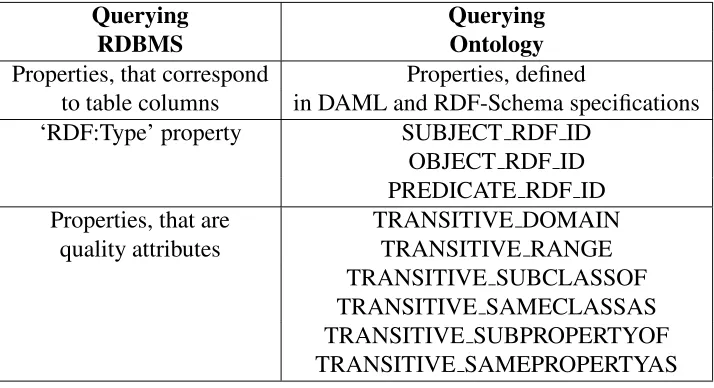
We decide which part of the system to query depending on the properties used in
select term of the query. The properties listed in the left side of Table 5.1 are used
in querying the relational database. The properties listed in the right side of Table 5.1 are used in querying the ontology. It can be easily observed that there are no common prop-erties used for querying both parts. In our system, we have just one ontology file, so we haven’t used a term to identify the ontology namespaces that will be queried. We don’t have a term likeusing namespaceas in RDQL [HPL, 2002], which is the query lan-guage used in the Jena Framework. In RDQL, it is necessary to figure out sources that need to be used while querying. Theusing namespaceterm can also be introduced to our DAML query description syntax to support querying more than one ontology file.
Querying Querying
RDBMS Ontology
Properties, that correspond Properties, defined
to table columns in DAML and RDF-Schema specifications
‘RDF:Type’ property SUBJECT RDF ID
OBJECT RDF ID PREDICATE RDF ID
Properties, that are TRANSITIVE DOMAIN
quality attributes TRANSITIVE RANGE
TRANSITIVE SUBCLASSOF TRANSITIVE SAMECLASSAS TRANSITIVE SUBPROPERTYOF TRANSITIVE SAMEPROPERTYAS
Table 5.1: Properties used while querying RDBMS and the ontology
representation of our ontology. These triples are then asserted into Jess [Friedman-Hill, 1997] knowledge base and the query is applied on this knowledge base. The usage of the Jess and the DAMLJessKB reduced our development time and facilitated reasoning about subsumption and equivalence relations between concepts. We also used the Jena DAML API to insert new classes and properties into our ontology.
If we have to query the data, which corresponds to a MySQL database, then we use SWSQMLtoSQL Mapper that converts DAML query into SQL query. SWSQML-toSQLMapper relies on the relational schema of underlying database to generate SQL statements. This module also uses the methods of the Ontology Processor to make in-ferences.
5.3 Querying Metadata
Querying metadata consists of processing the ontology triples in the memory by using DAMLJessKB. DAMLJessKB knowledge base contains the triples in
object format. DAMLJessKB also defines additional axioms to find transitive closure of
concepts. It is straightforward to separate DAML query into subject, predicate and object subparts to form the input for knowlege base. According to the name of the predicate, the Ontology Processor may need to scan knowlege base recursively. For example, the
TRANSITIVE SUBCLASSOFpredicate requires recursively scanning the knowledge base
for eachsubClassOfpredicate of given subjects or objects.
5.4 Querying Data
Querying data consists of two main tasks. These are translation from DAML query to SQL query, and reasoning to find subsumption and equivalence relations between concepts. The translation task is performed by the SWSQMLtoSQLMapper component and the rasoning task is performed by the Ontology Processor component. Therefore querying RDMS also requires processing the ontology file in memory as explained in Section 5.3
We’ve tried to make the translation from DAML query to SQL query as simple as possible. Making it simple lets us to adapt modified ontology structures to database schema easily. Translation from DAML query to SQL query requires the definition of a mapping between database schema and the ontology. By using this mapping information, the user of our service can query the database as if the data were converted to DAML instances.
5.4.1 Database Schema and Mapping
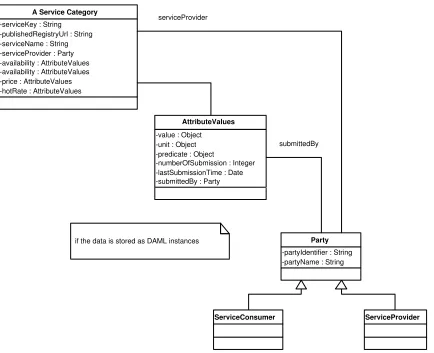
to a service, the parties table stores some basic information about the potential service providers and service consumers. In summary, the idea is to map the tables directly to DAML classes. Table rows become instances and each row can be viewed as a resource where columns are literals or links to other resources.
In Figure 3.4, in Chapter 3, we showed a DAML instance for a complete
VehicleRental service as if it were stored as a file. The mapping from this DAML
instance file to database table is trivial. It is almost one to one mapping from classes to tables, properties to columns, and instances to rows except three important differences, which can be easily observed from Figure 5.2 and Figure 5.3, respectively.
1. Addition of theattributeName column to the attributes table. We add this column to store names of quality attributes in a vertically designed attributes table instead of services table. We’ve designed the attributes table vertically because the number and the type of quality attributes assigned to a service can change for each service.
2. Addition of theserviceTypecolumn to the services table. As a result of this additon, the type of the service is stored as a column value, not as a table name.
-Id : Integer -serviceKey : String -publishedRegistryUrl : String -serviceName : String -serviceProvider : Parties -serviceType : String
Services
-Id : Integer -serviceId : Integer -AttributeName : String -value : String -unit : String -predicate : String
-numberOfSubmission : Integer -lastSubmissionTime : Integer -submittedBy : Parties
Attributes
-Id : Integer -partyType : String -partyIdentifier : String -partyName : String
Parties 1 * * 1 * 1 DAML instances become table rows, DAML properties become table columns
Figure 5.2: Representation of RDBMS table structure
5.4.2 Conversion from DAML Query Language to SQL
We have used MySQL database as our relational database; so we make the translation ac-cording to the MySQL SQL syntax. We‘ve defined a mapping function, which maps prop-erties to the columns and the tables of the database. For example, theavailabilityis mapped to the attributeName column of the attributes table, theserviceKeyis mapped to the serviceKey column of services table. We use joins, self-joins and table aliasing heavily. For example, two cases that we use the table aliasing are:
-serviceKey : String -publishedRegistryUrl : String -serviceName : String -serviceProvider : Party -availability : AttributeValues -availability : AttributeValues -price : AttributeValues -hotRate : AttributeValues
A Service Category
-value : Object -unit : Object -predicate : Object
-numberOfSubmission : Integer -lastSubmissionTime : Date -submittedBy : Party
AttributeValues
-partyIdentifier : String -partyName : String
Party
submittedBy serviceProvider
ServiceProvider ServiceConsumer
if the data is stored as DAML instances
Figure 5.3: Representation of DAML classes
2. If multiple properties reference to the same column more than once, e.g.,finding the availability property of services which has the price propertyrequires self-join and
table aliasing.