ISSN(Online): 2319-8753
ISSN (Print): 2347-6710
I
nternational
J
ournal of
I
nnovative
R
esearch in
S
cience,
E
ngineering and
T
echnology
(An ISO 3297: 2007 Certified Organization)
Vol. 4, Issue 1, January 2015
Object Tracking using Association Rule in
Clutter Environment
P.P.Halkarnikar
1, S.N.Talbar
2,P.N.Vasambekar
3Associate Professor, Department of Computer Engineering, DYP Institute of Engineering,Pune, Maharashtra, India1
Professor, Department of Electronics Engineering, SGGS College of Engineering, Nanded, Maharashtra India2
Professor, Department of Electronics, Shivaji University, Kolhapur, Maharashtra India3
ABSTRACT: In multiple objects tracking it become difficult to track the objects when they get cluttered due to proximity of the object. Such a cluttered environment leads to misleading target tracking in video analysis. This becomes important when video system is employed for security purpose or behavior analysis of the object. The object get merged and split due to occlusion or obstacles in viewing angle of the camera. In this paper we present the novel algorithm to handle issue of split and merge of the objects. To increase the robustness, association rules for object tracking are proposed. The algorithm tracks number of objects by keeping record of the split and merge of these objects with each other. Association rules are developed to track the multiple objects from frame to frame. Due to association rule application processing time increases when objects are merged or split, otherwise time required is same as normal object detection condition. In order to save the memory requirement for association of objects from frame to frame, linked list structure is implemented, which will expand and collapse as number of objects changes in given video frame. Object descriptors are stored as one node of the linked list along with object ID and flags indicating split and merge of objects. This list is updated as the video frames progresses for tracking of the objects. Such a system shows good result while tracking the multiple objects in cluttered environment due to shadow or occlusion or overlapping with in a frame.
KEYWORDS: multiple object tracking, split and merge, object separation, cluttered environment. I. INTRODUCTION
ISSN(Online): 2319-8753
ISSN (Print): 2347-6710
I
nternational
J
ournal of
I
nnovative
R
esearch in
S
cience,
E
ngineering and
T
echnology
(An ISO 3297: 2007 Certified Organization)
Vol. 4, Issue 1, January 2015
Overall organization of the paper is as follows. In this paper section II consider survey of related techniques. Section III deals with proposed algorithm. Section IV with result and last section with conclusion.
II. RELATED WORK
Object tracking methods are generally classified as model-based, appearance based, contour based and feature based. Hybrid methods are also employed which are combinations of some of the groups named above. Model based tracking method uses a priori knowledge of the shape of the object to track the object. But number of shapes stored in database is the limitation in this method. Appearance based methods track connected component to the 2D shapes of the object. The information provided by entire region is utilized to track the object. In contour based instead of tracking entire region only contour of the object is used. This is to save the computational requirement over the appearance based method. This method is unable to track the objects that are partially occluded. In feature based method feature of the object to be tracked are collected and these are compared in consecutive video frames. This is able to track even in partial occlusion of the object. However, selection of the required feature and grouping them for comparison is major hurdle of this scheme. Computational complexity also increases as number of feature used to track the object. To increase the reliability of the detection and tracking combination of above techniques are employed. These techniques are called as separate group as hybrid method. For detecting multiple objects in case of clutter, contextual information generated from scene can be used as feedback to detector.[6] Birth and exit of objects in case of occlusion of objects is compared with spatial information gather by adaptive Gaussian mixture model of background detection.This model is used by probability hypothesis density filter that spatially modulates its strength based on learned contextual information from previous frames. Multiple hypothesis tracker populates the association between the set of hypothetical states of objects. in another technique to identify the objects form frame to frame, blobsdetected by background model are labelled.[ 13] Blob direction and velocity are stored to predict next position of blobs. Euclidian distance detected in consecutive frames identifies the object in occlusion. Kalman filter is used by many application to track the objects.[7] To increase the reliability of object tracking shortest path in graph is used to identify the correct object [12]. Dynamic programming technique is used by authors to compare the object identity in case of occlusion.
III. PROPOSED ALGORITHM
This section deals with procedure of detecting multiple objects from the input video. This algorithm deals with situation in which objects get merged, overlapped or split. The steps involved in object tracking are object segmentation, validation and feature association.
A. Extraction of moving objects
The tracking of objects is done by association of object and their properties. The background subtraction module separates the background steady pixel and dynamic foreground pixels. There is no information about the object detected in the region. Therefore it is necessary to devise the algorithm which can distinguish number of objects present separately. Major hurdle in separating the multiple objects are shadow, occlusion and overlapping of moving objects. Gaussian mixture model with shadow removal [ ] shows good result but unable to handle the situation of occlusion and overlapping. Occlusion and overlapping generates the object merging. Sometime object pixel blob get separated by stationary object or moving objects which creates split situation. To handle situations of split and merge condition following algorithm is proposed.
B. Registration of objects.
After extracting foreground pixels which are detected by frame differencing of consecutive frames. Each object is detected as homogeneous region of connected pixels. The properties of each object is collected and compared with properties of the objectsstored in previous frames to track the objects.The properties or descriptor used for registering the objects are centroid, area, size, shape, vertices of the edges etc. either all or some of the descriptor are used to trace the object under different situations. The application of the object detecting system decides the
ISSN(Online): 2319-8753
ISSN (Print): 2347-6710
I
nternational
J
ournal of
I
nnovative
R
esearch in
S
cience,
E
ngineering and
T
echnology
(An ISO 3297: 2007 Certified Organization)
Vol. 4, Issue 1, January 2015
frame to identify exact object. In proposed system each object detected in scene is marked by object ID. Every object ID is associated with feature vector consisting of object descriptor. To save the descriptor of objects in memory linked list data structure is used. It helps in flexible data storage and faster comparison of the feature. As number of objects appearing and disappearing from the frame it is necessary to vary the storage space. Therefore linked list is preferable over fixed size data storage. Object tracking is two stage processes. In first step object descriptor are projected from current frame. The projected features are compared and object are identified in second stage and updated for next step. For each frame n, objects are defined by object partition П𝑜𝑛 , and object properties are defined by П𝜙𝑛 .
The information of current frame „n‟ of objects present Oi(n) is given by descriptor Фi(n). This operation can be defined as object descriptor projection. The object descriptor is defined as
Ф𝑖 = (Ф𝑖1 𝑛 , Ф𝑖2 𝑛 , Ф𝑖3 𝑛 , … … . , Ф𝑖𝑘 𝑛 ) ………. (1)
Where k are number of features describing the object i at given frame n. The number of feature selected will decide the complexity of object detection.
Let object ID isΦ𝑖1(n),the centroid of the object,(Ф𝑖2 𝑛 , Ф𝑖3 𝑛 ),the area of the object Ф𝑖4 𝑛 , and the mean
displacement of the object Ф𝑖5 𝑛 …. .… (2)
The number of feature selected and type of features selected depends upon the application to be developed. More features will increase the complexity of execution and requires more memory space for storage. The accuracy of object tracking will enhance with more feature registered for comparison. An updated object descriptor in next frame is defined as
Ф𝑖 𝑛 + 1 = (Ф𝑖1 𝑛 + 1 , Ф𝑖2 𝑛 + 1 , Ф𝑖3 𝑛 + 1 , … . ., Ф𝑖𝐾 𝑛 + 1 ) …… (3)
The updated values of features become initial values of next frame during processing, which reduces the memory space requirement for the feature vector.
C. Feature association.
The correspondence of the video objects in successive frames is achieved through association of object features. Tracking the object with feature association leads to the flexible technique that overcomes the problem of occlusion and merging of the objects due to proximity. Given the object feature of new frame and object feature of previous frame the proposed method performs two tasks
i) It defines the association between the object feature in current frame (n+1) and previous frame (n).
ii) It provides an effective initialization of the features comparison in successive frames.
The object segmentation and validation between consecutive frames is achieved by object ID defined. Feature association operates at low level and validate feature with specific descriptor. The two steps generate final correspondence between the objects present in consecutive frames.
i) Object segmentation validation: Object segmentation validation initialize the object attribute collection. Every separate object is given the object ID which helps in increases the accuracy of object detection in case of merge and split of the objects. For association of the objects features of current frame are compared with feature of previous frame. As generally frame to frame variations are not large unless drastic condition takes place. The feature vector of current frame becomes values for comparison for next frame.It is stored as linked list structure defined by object ID.Only two linked list are sufficient for tracking of objects from frame to frame to detect the changes.If numbers of linked list are increased then array of the entire previous linked list can be compared with correct frame number for more accurate detection of objects. In this context a new object identify as new nodein linked list. This node is not associated with any tracked object as new ID is allotted for it.Here linked list structure gives many advantages over other storage techniques as space requirement are defined dynamically and comparison can be done on any attribute as per rule of association.
ii) Object Tracking: The projection feature of all the objects in next frame are not taken for association but only (Xi,
Yi )n , 𝐴𝑖𝑛 and 𝑑𝑖𝑛are considered for comparison. Then tentative correspondence of the objects in frame n and next n+1
is established withcollected objects of next frame that isΠ𝑜𝑛+1.For convenience in our proposed work we have taken
ISSN(Online): 2319-8753
ISSN (Print): 2347-6710
I
nternational
J
ournal of
I
nnovative
R
esearch in
S
cience,
E
ngineering and
T
echnology
(An ISO 3297: 2007 Certified Organization)
Vol. 4, Issue 1, January 2015
As stated above number of features will change according to the application of system. The feature use for tracking may get modified due to viewing angle, illumination changes or motion change of the objects.Updated feature descriptor is defined as𝛷𝑖 (n+1)=[𝑋𝑖′, 𝑌𝑖′ , 𝐴′𝑖,𝑑𝑖′].
The correspondence is established as
[ 𝑋𝑖′, 𝑌𝑖′ 𝐴𝑖′, 𝑑𝑖′, 𝑛 + 1)]: [ 𝑋𝑖 ,𝑌𝑖 , 𝐴𝑖, 𝑑𝑖, 𝑛]
This procedure works well if objects are correctly segmented and remain same in each frame. But in reality the objects may appear merging due to occlusion. Some objects split due to occlusion by stationary objects.Sometimes due to noise in image object gets split into different blob which is temporary phenomena and may get original object in short time. An occlusion takes place when two or more objects overlap each other or by getting close to each other. All the possible situations can be detected by conditional validation of the object features.
iii) Association rules for object detection:For applying the rules for detection of different situationscreating clutter, blobs are considered as smallest unit. Blob is set of connected pixels in given frame. This can be treated as separate objects.Blob can be formed by following situations in video
1) Single separate object
2) Multiple object merge together due to proximally or occlusion.
3) Part of object split due to occlusion by stationary object.
Following rules are formed to detect object in above situations. Every object is identified by unique object ID.
Rule I
For identification of object minimum distance between objects in consecutive frames is considered as first condition. Values of centroid stored are used for calculation of distance in all the objects present in next frame.
𝑑𝑖 = (𝑋𝑖− 𝑋𝑖′)2+ (𝑌𝑖− 𝑌𝑖′)2)……(4)
Out of the distances calculated with each object the smallest is considered for object similarity. If 𝑑𝑖<𝑇ℎ1 Then 𝑂𝑖 𝑛 + 1 = 𝑂𝑖(𝑛) else new object initiated 𝑂𝑘+1(𝑛 + 1) .
If distance is within threshold then object is matched and tracked with same object ID. No other feature is tested as object ID remain same. Only updating of initialization values take place. Threshold depends upon the application and motion factor of the object.
Rule II
If (d(𝑂𝑖𝑛+1,𝑂𝑗𝑛+1) < Th1) AND ( 𝑂𝑖𝑛 +1,𝑂𝑗𝑛+ 1 є 𝑂𝑛)
Then condition of object split or merged may have occurred. We have to compare (Ai ,n) : ( Ai,n+1).
If (Ai(n) < Ai(n+1)) AND (Aj(n) <Aj(n+1)) then split flag is set for object ID i, j in frame n+1. If (Ai(n) > Ai(n+1)) AND (Aj(n) >Aj(n+1)) then merge flag is set for object ID i, j in frame n+1.
In both merge and spilt condition new object ID generated in frame n+1. This rule verifies the condition of partial or full occlusion. To test whether object disappeared from frame separate timer is attached. When time expires object is deleted from list and new object created is taken as true object from frame n+1. In this case rule I is applied fromnext frame. If merge or split flag is set comparisons are carried out according to rule III.
Rule III
If merge flag is set then 𝑂𝑖𝑛 ∉ 𝑂𝑛 +1, but it is not immediately removed from list of objects. Timer object is attached
to this object to test if it is disappeared or occlude by some other objects. If object reappears flags get reset. New object due to rule II will follow rule I and rule II as if independent object in list. When timer attached to object expires it is removed from list. If flags are set all rules are applied to that object. In case of clear flag condition only rule I is sufficient to track the object.
ISSN(Online): 2319-8753
ISSN (Print): 2347-6710
I
nternational
J
ournal of
I
nnovative
R
esearch in
S
cience,
E
ngineering and
T
echnology
(An ISO 3297: 2007 Certified Organization)
Vol. 4, Issue 1, January 2015
IV. STORAGE STRUCTURE
To improve the matching linked list type of object storage is used. Advantage of linked list is that it is linear data storage hence depending upon the number of objects present the length of linked list can be varied which save the memory space. It also keeps the algorithm expandable to match with number of objects present in frame. List accommodates dynamic existence of object due to merge and split. Objects inserted in list are consecutively connected if they are spatially together.
I) Node Structure:
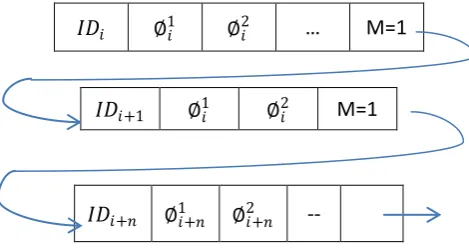
Fig. 1.Typical node of linked list used for storage per object. It contains object ID, features required for comparison, flags and pointer to next node.
II) Spilt
Fig. 2 Typical linked list status when object split take place. New node is created with split flag set and new object ID with highest ID but linked near split object.
III) Merge
Fig. 3Typical linked list status when object merging take place. New node is created with merge flag set and new object ID with highest ID but linked after merged objects.
Fig. 1 displays typical node structure used for experiment. Every node of the linked list has header and feature vector stored. Node have separate field for every attribute, flag and the pointer point to next node in the list. If new object is
𝐼𝐷
𝑖∅
𝑖1∅
𝑖2….
𝐼𝐷
𝑖∅
1𝑖∅
𝑖2…
S=1
𝐼𝐷
𝑖+𝑛∅
1𝑖+𝑛∅
𝑖+𝑛2--
𝐼𝐷
𝑖+1∅
𝑖1∅
𝑖2----
𝐼𝐷
𝑖∅
1𝑖∅
𝑖2…
M=1
𝐼𝐷
𝑖+1∅
𝑖1∅
𝑖2M=1
ISSN(Online): 2319-8753
ISSN (Print): 2347-6710
I
nternational
J
ournal of
I
nnovative
R
esearch in
S
cience,
E
ngineering and
T
echnology
(An ISO 3297: 2007 Certified Organization)
Vol. 4, Issue 1, January 2015
detected it is added to the end of the list. If object present in the list is spilt or merge additional node are generated with new object ID as shown in fig. 2 and fig. 3 . Merge flag is set and it is inserted next to the node having distance closed
to the existing object. Note that new object introduced has object ID next to last object present.
V. EXPERIMENTAL RESULT
Experiments are carried out in simulated and real videos. Results are verified with keeping the track of no of objects present in the frame. The association rule proposed above is applied with in area of interest instead of entire frame.
(A) (B)
Fig.4 (A) Sample frame 20 showing normal moving objects. (B) Sample frame 22 showing partial occlusion.
(A) (B) (C)
Fig.5 A) object blog detected using background subtraction algorithm. B) Merged Flag set as object blog is one C) split condition due to discontinuity in blog set split flag.
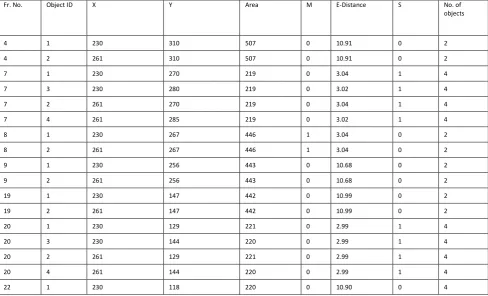
Fig.4. Shows the video frames of simulated video. In which objects are moving with constant speed as shown in Fig.4 (A). Fig. 4(B) shows merge condition in during the video run. The split and merge conditions are simulated and algorithm response is tested for number of object detected. Fig. 5 (A), (B), (C) shows the pixel conditions during merge and split. The objects detected due to pixel blobs are displayed in red boxes. The table 1 shows contains of linked list with object ID for some sample conditions. Table 1 shows result of applying proposed association rule for detection of split and merge on simulated video of two objects moving in same direction with constant speed. Though new object created by split are counted they are not finalized as split flag is set. Similarly during merging of objects count get reduced but not finalized as merge flag is set. The setting of flags can be used for detection of anomalies in surveillance.
VI. CONCLUSION
ISSN(Online): 2319-8753
ISSN (Print): 2347-6710
I
nternational
J
ournal of
I
nnovative
R
esearch in
S
cience,
E
ngineering and
T
echnology
(An ISO 3297: 2007 Certified Organization)
Vol. 4, Issue 1, January 2015
REFERENCES
[1] Xiaowei Zhou, Can Yang, Weichuan Yu, "Moving Object Detection by Detecting Contiguous Outliers in the Low-Rank Representation", IEEETransactions on Pattern Analysis & Machine Intelligence, vol.35, no. 3, pp. 597-610, March 2013,
[2] M. Piccardi, "Background Subtraction Techniques: A Review," Proc. IEEE Int'l Conf. Systems, Man, and Cybernetics, 2004.
[3] P. Ochs and T. Brox, "Object Segmentation in Video: A Hierarchical Variational Approach for Turning Point Trajectories Into Dense Regions", Proc. IEEE Int'l Conf. Computer Vision, 2011.
[4] Z. Zhou, A. Wagner, H. Mobahi, J. Wright, and Y. Ma, "Face Recognition with Contiguous Occlusion Using Markov Random Fields", Proc. IEEE Int'l Conf. Computer Vision, 2010.
[5] D. Parks and S. Fels, "Evaluation of Background Subtraction Algorithms with Post-Processing", Proc. IEEE Int'l Conf. Advanced Video andSignal Based Surveillance, pp. 192-199, 2008.
[6] Maggio, E.; Cavallaro, A., "Learning Scene Context for Multiple Object Tracking", Image Processing, IEEE Transactions on , vol.18, no.8, pp.1873,1884, Aug. 2009.
[7] Azari, M.; Seyfi, A.; Rezaie, A.H., "Real Time Multiple Object Tracking and Occlusion Reasoning Using Adaptive Kalman Filters", Machine Vision and Image Processing (MVIP), 2011 7th Iranian , vol., no., pp.1,5, 16-17 Nov. 2011.
[8] Halkarnikar, P.P.; Talbar, S.N.; Vasambekar, P.N., "Object separation in shadow clutter in video sequences," Radar, Communication and Computing (ICRCC), 2012 International Conference , vol., no., pp.299,302, 21-22 Dec. 2012
[9] Cai, Ling, He, Lei, Xu, Yiren, Zhao, Yuming and Yang, Xin. "Multi-object detection and tracking by stereo vision", Pattern Recognition 43, no. 12 (2010): 4028-4041.
[10] Jiyan Pan; Bo Hu; JianQiu Zhang, "Robust and Accurate Object Tracking Under Various Types of Occlusions", Circuits and Systems for Video Technology, IEEE Transactions, vol.18, no.2, pp.223,236, Feb. 2008
[11] Cavallaro, A.; Steiger, O.; Ebrahimi, T., "Tracking video objects in cluttered background," Circuits and Systems for Video Technology, IEEE Transactions, vol.15, no.4, pp.575,584, April 2005
[12] Kumar, P.; SurendraRanganath; Sengupta, K.; Huang Weimin, "Cooperative Multitarget Tracking With Efficient Split and Merge Handling", Circuits and Systems for Video Technology, IEEE Transactions on , vol.16, no.12, pp.1477,1490, Dec. 2006.
[13]J.S.Kim, D.H. Yeom, “Fast and Robust Algorithm of tracking multiple moving objects for intelligent video surveillances system”, IEEE Transactions on Consumer Electronics,vol.57, no.3, pp.1165- 1170, August 2011.
Table 1
Fr. No. Object ID X Y Area M E-Distance S No. of
objects
4 1 230 310 507 0 10.91 0 2
4 2 261 310 507 0 10.91 0 2
7 1 230 270 219 0 3.04 1 4
7 3 230 280 219 0 3.02 1 4
7 2 261 270 219 0 3.04 1 4
7 4 261 285 219 0 3.02 1 4
8 1 230 267 446 1 3.04 0 2
8 2 261 267 446 1 3.04 0 2
9 1 230 256 443 0 10.68 0 2
9 2 261 256 443 0 10.68 0 2
19 1 230 147 442 0 10.99 0 2
19 2 261 147 442 0 10.99 0 2
20 1 230 129 221 0 2.99 1 4
20 3 230 144 220 0 2.99 1 4
20 2 261 129 221 0 2.99 1 4
20 4 261 144 220 0 2.99 1 4
ISSN(Online): 2319-8753
ISSN (Print): 2347-6710
I
nternational
J
ournal of
I
nnovative
R
esearch in
S
cience,
E
ngineering and
T
echnology
(An ISO 3297: 2007 Certified Organization)
Vol. 4, Issue 1, January 2015
Fr. No. =Frame Number, Obj. =Object, M= Merge Flag, S= Split Flag. E-dist. = Euclidian Distance.
BIOGRAPHY
P. P. Halkarnikar received B.E. from Government College of Engineering, Pune in 1986and M.E. from Walchand College of Engineering, Sangli in 1993. Presently he is working as Associate Professor in Department of Computer Science And Engineering at D.Y. PatilInstitute of Engineering, Pune. He is visiting Professor atP.G. center, Department of Technology, Shivaji University, Kolhapur. He is consultant to many industries for development of microcontroller based products. His interest lies in microcontroller based instrumentation, computer vision, data mining and web technology. He is member of ISTE and IEI.
S. N. Talbar has received his B.E and M.E degrees from SGGS Institute of Technology, Nanded, India in 1985 and 1990 respectively. He obtained his PhD. from SRTM University, India in 2000. He is recipient of the Young Scientist Award by URSI, Italy in 2003. He had Collaborative research programme at Cardiff University Wales, UK. Currently he is working as Professor in Electronics & Telecommunication Department of SGGS Institute of Technology Nanded, India. He is a member of many prestigious committees in academic field of India. His research interests are Signal & Image processing, Pattern Recognition and Embedded System Design. He has published about 58papers in Journals and about 131 papers in Conferences. He is author of 7 books.
P.N. Vasambekar is working as Professor and Head, department of Electronics, Shivaji University, Kolhapur. His research specialization is in the field of Ferrites, Sensors, Microwaves, Antennas. He has published about 49 papers in Journals and about 60
papers in Conferences. He is author of 2 books
.
22 3 230 133 221 0 10.85 0 4
22 2 261 118 220 0 10.90 0 4
22 4 261 133 221 0 10.85 0 4
24 1 130 115 442 1 2.80 0 2
24 2 261 115. 442 1 2.80 0 2
26 1 230 104 507 0 10.96 0 2