A Novel Projective Integration Method (Pim) For the
Efficient Transient Stability Simulation of Power
Systems with High Dg Penetration
1.REGULAGADDA NARESH
DEPT OF EEE(EPS ) ,ANNAMACHARYA INSTITUTEOF TECHNOLOGY AND
SCIENCES, HYD, TS,INDIA
EMAIL:[email protected]
2.J.SHANKAR
ASSISTANT PROFESSOR, DEPT OF EEE ANNAMACHARYA INSTITUTE OF
TECHNOLOGY AND SCIENCES, HYD,TS, INDIA
E-MAIL :[email protected]
ABSTRACT
This essay deals a novel projective integration method (PIM) for the efficient transient stability simulation of power systems with high DG penetration. One procedure of the proposed PIM is decomposed into two stages, which adopt mixed explicit implicit integration methods to achieve both efficiency and numerical stability. Moreover, the stability of the PIM is not affected by its parameter, which is related to the step size. Based on this property, an adaptive parameter scheme is developed based on error estimation to fit the time constants of the system dynamics and further increase the simulation speed. The presented approach is several times faster than the conventional integration methods with a similar level of accuracy. The proposed method is demonstrated using test systems with DGs and virtual synchronous generators, and the performance is verified against MATLAB/Simulink
Key words: PIM, Distribution generation, Synchronous generators, Adaptive parameters
I. INTRODUCTION
The majority of distributed generation involving sources require inverters on the front end when connected to the grid. However, inverters do not have a rotating mass and thus have low inertia. Traditionally, the voltage and frequency stability of power grids are mainly supported by conventional rotating synchronous generators with large inertia coupled with a high short-circuit current ratio (SCR). Thus, the gradual subsituation of synchronous generators
and provide virtual inertia to power grids. Thus, the integration of DGs and VSGs can affect the dynamic behavior of the power system as a whole. Time-domain simulation is the most accurate and reliable approach to evaluate the dynamic behavior of power systems. However, the computational efficiency of such simulations is severely limited by the multi-time-scale property of power systems. The multiple time scales of conventional power systems mainly come from the different dynamics of synchronous generators and their regulators.
This project presents a projective integration method (PIM) for the fast transient stability simulation of power systems with high DG penetration. The main motivation is to take the ad-vantages of both explicit and implicit methods: efficiency and numerical stability. One procedure of the PIM consists of two stages. First, several steps of integration are performed using explicit methods with a small step size corresponding to the time constants of the fast components of the simulated system. Then, based on the previous results, a projective integration step with a larger step size is performed using an implicit pre-diction-correction method. The concept of the projective method was first proposed by Gear for stiff problems with gaps in their eigen value spectrum [29], and an extrapolation method, which had been proved equivalent to the explicit Euler method, was adopted in the projective stage. This scheme has been widely used for multi-time-scale simulations in the chemical, thermodynamic and molecular physical sectors. However, the numerical stability of Gear’s projective method can be easily influenced by the step size, and thus, it is difficult to improve the computational efficiency further. The PIM proposed here adopts the implicit prediction-correction method for the projective integration, and the former extrapolation method is used as one component of the predictor. Through this
modification, the numerical stability of the proposed PIM is no longer affected by its parameter related to the step size. In addition, other properties of the PIM and the contributions of the present paper are summarized as follows: 1) The small-step integration in the PIM is adopted to reflect the fast dynamics of the inverter-based DGs.
2) The projective stage in the PIM is performed to reflect the slow dynamics and overall trends of the fast dynamics of the simulated system. 3) The PIM has an accuracy of order 2.
4) This paper also proposes an adaptive parameter control scheme for the PIM based on error estimation. The error estimation is convenient to realize through the explicit integration steps of the PIM, and the step sizes of the projective integration can be controlled to fit the dynamics of the simulated system adaptively.
of the proposed PIM, which has not been discussed before in the literature.
6) The proposed PIM is demonstrated on two test systems with DGs and VSGs.
II. MODELLING OF VIRTUAL
SYNCHRONOUS GENERATOR
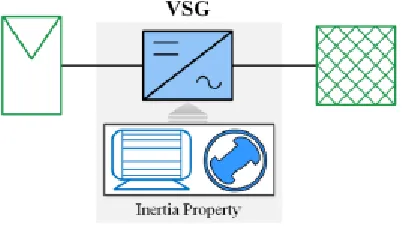
The basic concept of a VSG is shown in Fig. 1. In common practice, energy storage devices, such as batteries, are connected to the DC side of the VSG inverter.
A. Swing Equation for VSG Inertia Emulation
The main purpose of a VSG is to emulate the inertia and damping properties of electromechanical synchronous gener-ators. These two main aspects can be captured by the swing equation (1), which is widely used in the literature on power system stability and dynamics
where 𝐽 represents the moment of inertia, 𝐷 is the coefficient of fiction loss of the synchronous generator, 𝜔𝑔 and 𝜔0 denote the angular and synchronous speed of the generator, respectively, 𝑇𝑚 is the mechanical torque produced by the prime motor, and 𝑇𝑒 is the electrical torque.
B. Control Strategy of a VSG
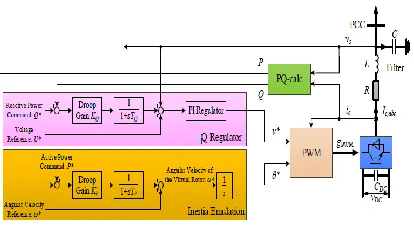
Fig. 2. Control scheme of the VSGs for transient stability analysis.
As shown in Fig. 2, the mechanical component of a synchronous generator is emulated by the VSG controller as a logical concept, which is
electrically fully effective from a grid perspective. The damping gain 𝐾𝐷 of the emulated synchronous generator is inversely linked to the droop gain 𝐾𝑃. Moreover, the time constant 𝑇𝑃 of the low-pass filter on the active power flow serves as an analogous function of the virtual inertia, which has a significant impact on the time scale of the system. Furthermore, the parameters selected for VSG implementations are not constrained by the physical design of any real synchronous generator. Thus, the diversity of the parameter selection of VSGs may aggravate the stiffness of the transient stability problem.
III. PROJECTIVE INTEGRATION METHOD
In the pro-posed PIM, one procedure consists of several explicit steps with a small step size, followed by a projective step with a large step size using an implicit prediction-correction approach. We call the small step integration the inner integrator, whereas the large projective step is referred to as the outer integrator. To fairly compare the computational efficiency of the PIM with the commercial simulator DIgSILENT Power Factory, the current-injection form of the algebraic equations is adopted during the inner and outer integration for the consistency of models. The algebraic equations are nonlinear since distribution generation is considered during the simulation. Accordingly, we use the Newton Raphson (NR) method to solve the nonlinear algebraic equations, which is the same as that of Power Factory.
corresponding to the fast time constants of the simulated system. Thus, the state variables 𝒙𝑛+𝑘 at 𝑡𝑛+𝑘can be computed. The explicit integration method must have at least second-order accuracy (the reason will be given later).
Stage II: Firstly in this stage, needs to be implicitly differenced at 𝑡𝑛+𝑘+𝑀as
where 𝒙𝑛+𝑘+𝑀denotes the system state variables at 𝑡𝑛+𝑘+𝑀, 𝒚𝑛+𝑘and 𝒚𝑛+𝑘+𝑀 refer to the algebraic variables at 𝑡𝑛+𝑘and 𝑡𝑛+𝑘+𝑀, respectively. Then,
𝒙𝑛+𝑘+𝑀and 𝒚𝑛+𝑘+𝑀are computed with a large step size of Δ𝑇 = 𝑀Δ𝑡 (𝑀 is a positive integer) in the following manner:
a) The differential equations of (3) are integrated from 𝑡𝑛+𝑘 to 𝑡𝑛+𝑘+𝑀 by the explicit Euler method to predict the initial estimates of 𝒙𝑛+𝑘+𝑀 as
and compute the algebraic function 𝒈(𝒙∗𝑛+𝑘+𝑀 ,
𝒚∗𝑛+𝑘+𝑀 ) = 0 to predict the initial estimates of
𝒚𝑛+𝑘+𝑀.
b) Correct 𝒙∗𝑛+𝑘+ and compute the initial estimates of 𝒙𝑛+𝑘+𝑀through
and then the initial estimates of 𝒚𝑛+𝑘+𝑀can be computed by solving 𝒈(𝒙(0)𝑛+𝑘+𝑀 , 𝒚
(0)
𝑛+𝑘+𝑀 ) = 0.
c) Further correct (0)𝑛+𝑘+𝑀 based on
and then compute 𝒈(𝒙(1)𝑛+𝑘+𝑀 , 𝒚 (1)
𝑛+𝑘+𝑀 (1) ) = 0 to correct 𝒚(0)𝑛+𝑘+𝑀 .
d) Terminate the iterations when the convergence condition is satisfied. If not, one can substitute 𝒙(1)𝑛+𝑘+𝑀 and 𝒚
(1)
𝑛+𝑘+𝑀 for 𝒙 (0)
𝑛+𝑘+𝑀 and 𝒚 (0)
𝑛+𝑘+𝑀 in (respectively, and then repeat c) and d) until the iterations converge.
In (8), 𝜉 denotes the error threshold.
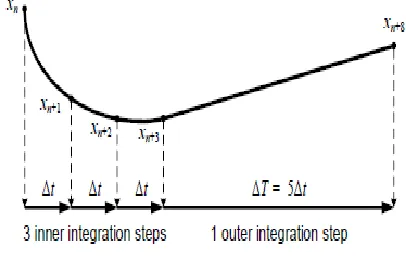
In the procedure above, the parameters 𝑘 and 𝑀 represent the number of inner integration steps and the multiple of the step size Δ𝑡 during the outer integration, respectively. Assum-ing that 𝑘 = 3 and 𝑀 = 5, the schematic diagram of one pro-cedure of the PIM is shown in Fig. 3.
Fig. 3. Schematic diagram of one procedure of the PIM.
IV. ADAPTIVE PARAMETER CONTROL FOR THE PIM
Stability domains of the conventional integration algorithms with A-stability, such as the trapezoidal method, are not affected by their step sizes. Thus, some variable step size meth-ods can be adopted for these algorithms to accelerate the calculation speed regardless of stability. Similarly, the stability domain of the PIM is irrelevant to its parameter 𝑀, and accordingly, we propose an error estimation method and an adaptive parameter control scheme for the PIM in this section
The error estimation for the PIM needs to be discussed sep-arately for different orders of its inner integration method:
1) Second-Order Integration Method:
We assume that the modified Euler (ME) method is selected as the inner integrator of the PIM. The third-order term in the Taylor expansion of the ME method from time 𝑛Δ𝑡 to (𝑛 + 𝑎)Δ𝑡 can be described as
Then, given parameter 𝑘, the third-order term in the Taylor expansion of the PIM proceeding one overall integration step with parameter 𝑀 is obtained as
and thus the LTE of the PIM can be approximated by neglecting the high-order residuals as
2) Integration Method of Order 𝑝 (𝑝 > 2): In this case
and further, the LTE can be estimated as in a similar way.
The differential term can be estimated by the Lagrange interpolation formula as
It is worth noting that the parameter 𝑘 of the PIM should be no less than 3 to ensure the solvability
B. Adaptive Parameter Control Strategy The main concept of the PIM with adaptive parameter control (PIM-AP) is as follows. First, after the inner integration of the 𝑙th step, the parameter 𝑀𝑙 of the upcoming outer integrator is obtained by a priori error estimation based on 𝑀𝑙−1, namely, the parameter of the last step of the PIM-AP. Then, we proceed with the first three stages of the outer integrator using 𝑀𝑙 and estimate the local error of the 𝑙th step through a posteriori error estimation. If the local error satisfies the error condition, 𝑀𝑙is accepted and the rest of the stages will be performed. Otherwise, 𝑀𝑙 is rejected and the outer integrator will be recalculated with an updated parameter. The pseudo code for the adaptive parameter control of the PIM is provided in Algorithm 1. In Line 7 of Algorithm 1, ⌊𝑥⌋ represents the “floor” function, taking the integer part of 𝑥 and ignoring the decimal part, and 𝜏 in Line 10 denotes the estimated error tolerance.
V. SIMULATION RESULTS
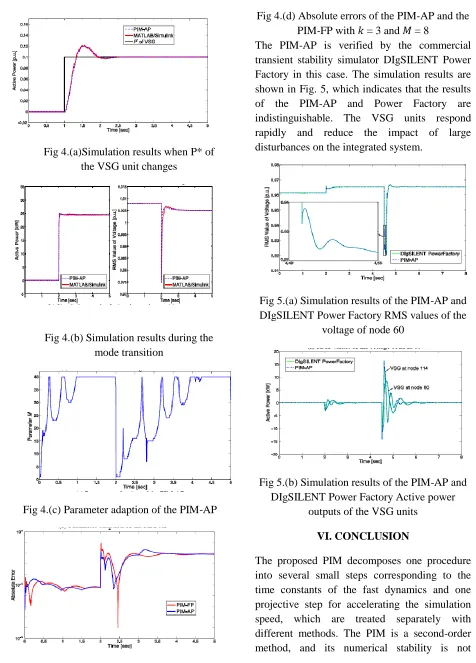
Fig 4.(a)Simulation results when P* of the VSG unit changes
Fig 4.(b) Simulation results during the mode transition
Fig 4.(c) Parameter adaption of the PIM-AP
Fig 4.(d) Absolute errors of the PIM-AP and the PIM-FP with 𝑘 = 3 and 𝑀 = 8
The PIM-AP is verified by the commercial transient stability simulator DIgSILENT Power Factory in this case. The simulation results are shown in Fig. 5, which indicates that the results of the PIM-AP and Power Factory are indistinguishable. The VSG units respond rapidly and reduce the impact of large disturbances on the integrated system.
Fig 5.(a) Simulation results of the PIM-AP and DIgSILENT Power Factory RMS values of the
voltage of node 60
Fig 5.(b) Simulation results of the PIM-AP and DIgSILENT Power Factory Active power
outputs of the VSG units
VI. CONCLUSION
affected by the selection of the step size. Based on this property, we have also presented an adaptive parameter control strategy for the PIM to further improve its computational performance. Various simulation experiments were performed on test systems with DGs and VSGs, and the accuracy of the PIM was verified against that of electromagnetic simulation using the MATLAB/Simulink tool.
REFERENCES
[1] J.G. Slootweg, and W.L. Kling, “Impacts of distributed generation on power system transient stability,” in Proc. IEEE Power Eng. Soc. Summer Meeting, 2002, pp. 862-867.
[2] A.M. Azmy, and I. Erlich, “Impact of distributed generation on the stability of electrical power system,” in Proc. IEEE Power Eng. Soc. Gen. Meeting, 2005, pp. 1056-1063. [3] L. Meegahapola, and D. Flynn, “Impact on transient and frequency stability for a power system at very high wind penetration,” in Proc. IEEE Power Energy Soc. Gen. Meeting, 2010, pp. 1-8.
[4] N. Soni, S. Doolla, and M.C. Chandorkar, “Improvement of transient response in microgrids using virtual inertia,” IEEE Trans. Power Del., vol. 28, no. 3, pp. 1830-1838, Jun. 2013.
[5] M.F.M. Arani, and E.F. El-Saadany, “Implementing virtual inertia in DFIG-based wind power generation,” IEEE Trans. Power Syst., vol. 28, no. 2, pp. 1373-1384, May 2013. [6] D.I.H.P. Beck, and D.I.R. Hesse, “Virtual synchronous machine,” in Proc. 9th Int. Conf. EPQU, 2007, pp. 1-6.
[7] J. Driesen, and K. Visscher, “Virtual synchronous generators,” in Proc. IEEE Power Energy Soc. Gen. Meeting-Conversion and Del. of Elect. Energy in the 21st Century, 2008, pp. 1-3.
[8] Q.C. Zhong, and G. Weiss, “Synchronverters: Inverters that mimic
syn-chronous generators,” IEEE Trans. Ind. Electron., vol. 58, no. 4, pp. 1259-1267, Apr. 2011.
[9] P. Kundur, Power System Stability and Control. New York, USA: McGraw-hill, 1994. [10] G. Wanner, E. Hairer, Solving Ordinary Differential Equations II. Berlin, Germany: Springer-Verlag Press, 1991.
[11] J.E. van Ness and F.B. Kern, “Use of the exponential of the system matrix to solve the transient stability problem,” IEEE Trans. Power App. Syst., vol. PAS-89, no. 1, pp. 83-88, Jan. 1970.
[12] M. Stubbe, A. Bihain, J. Deuse, et al., “STAG-a new unified software program for the study of the dynamic behaviour of electrical power sys-tems,” IEEE Trans. Power Syst., vol. 4, no. 1, pp. 129-138, Feb. 1989.
[13] A. Kurita, H. Okubo, K. Oki, et al., “Multiple time-scale power system dynamic simulation,” IEEE Trans. Power Syst., vol. 8, no. 1, pp. 216-223, Feb. 1993.
[14] J.Y. Astic, A. Bihain, and M. Jerosolimski, “The mixed Adams-BDF variable step size algorithm to simulate transient and long term phe-nomena in power systems,” IEEE Trans. Power Syst., vol. 9, no. 2, pp. 929-935, May 1994.